
Downstream Processing Market Size, Demand & Growth by 2034
Coverage: By Product ( Chromatography Columns and Resins, Filters, Membrane Adsorbers, Single-Use Products, Others ); Technique ( Purification Techniques, Solid-Liquid Separation, Clarification and Concentration ); Application ( Monoclonal Antibody Production, Vaccines Production, Insulin Production, Immunoglobulin Production, Erythropoietin Production, Others ); End User ( Biopharmaceutical Manufacturers, Contract Manufacturing Organizations )\n, and Geography (North America, Europe, Asia Pacific, and South and Central America)
- Status : Data Released
- Report Code : TIPBT00002217
- Category : Life Sciences
- No. of Pages : 150
- Available Report Formats :


- Last update date : July 03, 2026


2025 Market Size
US$ 46.91 Bn
Base year value
2034 Forecast
US$ 166.13 Bn
Projected by 2034
CAGR 2026-2034
15.09 %
Growth rate
Addressable Market
US$ 909.73 Bn
(2026-2034)
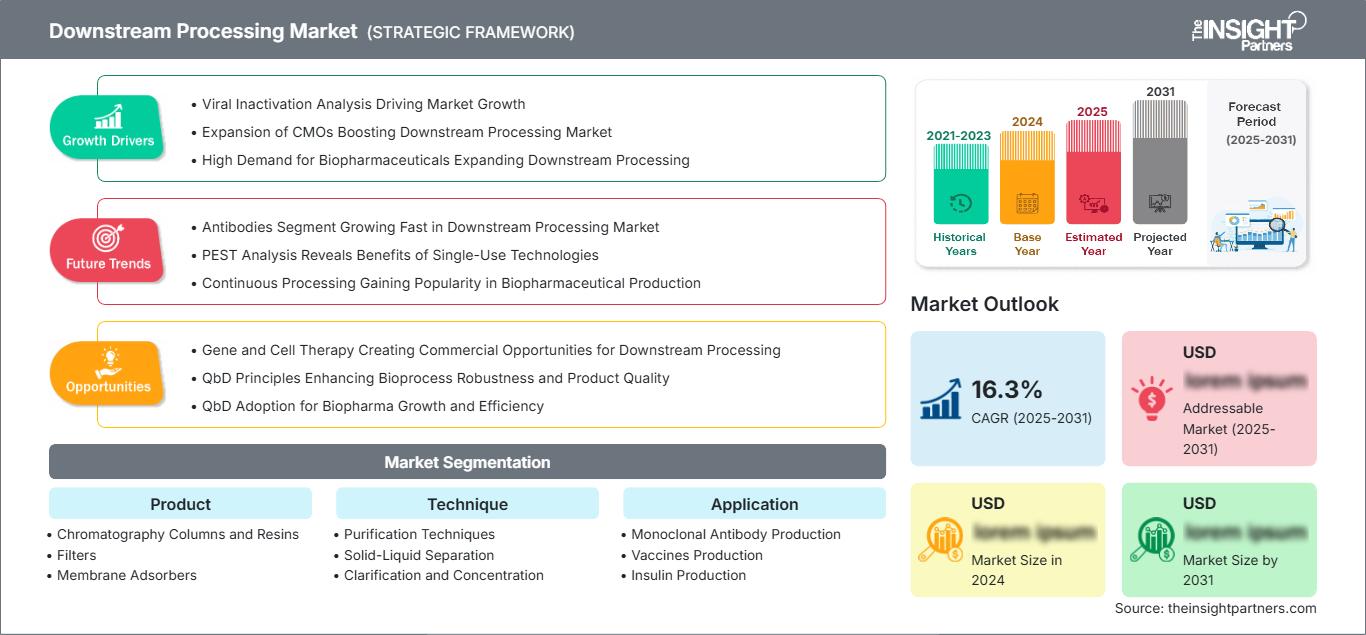
The Downstream Processing Market was valued at US$ 46.91 Billion in 2025 and is projected to reach US$ 166.13 Billion by 2034, expanding at a CAGR of 15.09% during 2026–2034. Market expansion is supported by rising biologics manufacturing, continuous innovation in purification technologies, and increasing investments in biopharmaceutical production capacity. The growing adoption of advanced downstream processing systems to improve product quality, reduce manufacturing costs, and accelerate commercialization continues to strengthen long-term market development.
North America is expected to maintain its leadership throughout the forecast period, advancing at an estimated 14.5–15.5% CAGR owing to its mature biopharmaceutical ecosystem and substantial investments in manufacturing innovation. Expanding monoclonal antibody production, strong contract development and manufacturing capabilities, and increasing implementation of automated purification platforms continue to reinforce regional competitiveness while encouraging technology adoption across commercial-scale biologics manufacturing.
Downstream Processing Market Assessment and Insights
- North America: Holds 39–43% share in 2025, growing at a CAGR of 14.5–15.5% during 2026–2034, driven by strong biologics manufacturing investments, expanding purification automation, and increasing commercial bioprocessing capacity.
- US: Accounts for 82–86% of the North American market in 2025, expanding at a 14.8–15.8% CAGR due to robust biologics production, rising investments in downstream processing technologies, and growing demand for manufacturing efficiency.
- Europe: Represents 25–29% share in 2025, growing at a 14.2–15.2% CAGR, led by Germany, the UK, and France through expanding biopharmaceutical innovation, manufacturing modernization, and increasing investments in advanced purification technologies.
- Asia Pacific: Holds 24–28% share in 2025, expanding at a 16.5–17.5% CAGR, led by China, Japan, and India with rapid biologics manufacturing expansion, supportive biotechnology investment policies, and growing biopharmaceutical production capacity.
- Largest Segment: Product holds the largest market share in 2025, growing at a 15.2–16.2% CAGR due to continuous demand for high-performance purification consumables that improve process efficiency and manufacturing scalability across biologics production.
- High Growth Segment: Application is projected to register the fastest growth at a CAGR of 16.0–17.0% during 2026–2034, driven by expanding monoclonal antibody development pipelines and increasing demand for advanced downstream purification technologies.
- Key companies analyzed in detail: Thermo Fisher Scientific Inc.; GE HealthCare Technologies Inc.; Merck KGaA; Danaher Corporation; 3M Company; Repligen Corporation; Lonza Group AG; Eppendorf SE; Corning Incorporated; Sartorius AG.
Source: The Insight Partners' analysis based on proprietary research, government publications, company annual reports, investor presentations, industry databases, and expert interviews.
Downstream processing has evolved alongside rapid advances in biologics manufacturing, with purification technologies becoming increasingly automated, scalable, and integrated into continuous production workflows. Manufacturers now emphasize higher product recovery, improved process consistency, and lower operating costs through advanced chromatography systems, membrane technologies, and single-use platforms. These developments have strengthened production flexibility while supporting regulatory compliance and commercial-scale manufacturing across diverse therapeutic applications worldwide.
Looking ahead, expanding biotechnology investments across emerging economies will reshape competitive dynamics while increasing regional manufacturing capabilities. Growing regulatory emphasis on product quality, supply resilience, and sustainable manufacturing practices is expected to encourage adoption of next-generation downstream solutions. Continued investment in digital process monitoring, modular manufacturing facilities, and advanced purification platforms will enable producers to meet rising demand for biologics, vaccines, and personalized therapeutic products over the coming decade.
Downstream Processing Market Report Scope
| Report Attribute | Details |
|---|---|
| Market size in 2025 | US$ 46.91 Billion |
| Market Size by 2034 | US$ 166.13 Billion |
| Global CAGR (2026 - 2034) | 15.09% |
| Historical Data | 2021-2024 |
| Forecast period | 2026-2034 |
Downstream Processing Market Analysis
The continuous rise in the need for biological products has continued to change the needs of downstream processing as companies seek better efficiencies in purification, contamination control, and manufacturing capabilities. The approval of more monoclonal antibodies, recombinant proteins, vaccines, and cellular therapy treatments has created the need for advanced methods of purification that are able to preserve product quality as well as optimize efficiencies in operations. With an increase in production volume, more companies continue to embrace automated chromatography, membrane filtration techniques, and disposable devices in their operations.
It is important for the industry to foster collaboration between equipment manufacturers, consumable manufacturers, biopharmaceutical companies, and contract manufacturing organizations. The supply chains have focused on standardized, efficient, and high-performing purification processes which meet the standards of regulation and are scalable in production. There have been continuous advancements in terms of resin efficiencies, filtration efficiencies, and process automation in the industry.
Competition in the downstream processing industry remains high as the existing technology vendors bolster their portfolio through innovations, collaborations, and manufacturing. The likes of Thermo Fisher Scientific Inc., Danaher Corporation, Merck KGaA, and Sartorius AG keep on investing in innovative purification technologies that make manufacturing more efficient and faster in delivering biologics into the market. The likes of product diversification and manufacturing capacities in various regions remain key focuses of many companies.
Investments are increasingly being made in digital manufacturing technologies, continuous downstream processing, and single-use purification systems. The likes of GE HealthCare Technologies Inc., Repligen Corporation, Lonza Group AG, Corning Incorporated, Eppendorf SE, and 3M Company keep on developing their product portfolio through R&D, manufacturing expansion, and collaborations. These competitive practices help the companies to differentiate themselves and at the same time deliver on the changing regulatory requirements and increasing global demand.
● REPORT CUSTOMIZATION
Tailor This Report To Align With Your Specific Business Requirements
This report can be customized to align precisely with your business objectives, scope, and target markets. Customization options include tailored segmentation, geography, competitive analysis, and strategic insights to support informed decision-making.
Customize This Report →WHAT YOU CAN ADJUST
- ● Segmentations
- ● Geography
- ● Competitive Analysis
- ● Language Preferences
Downstream Processing Market: Strategic Insights
Regional Insights
North America Downstream Processing Market
North America accounted for 39–43% of the global market during 2025 and is projected to register a 14.5–15.5% CAGR through 2034. The region benefits from mature biologics manufacturing infrastructure, continuous pharmaceutical innovation, and substantial investments in advanced purification technologies supporting commercial-scale production.
Growing adoption of automated downstream processing platforms and continuous manufacturing strengthens production efficiency while improving product consistency. Strong regulatory frameworks, expanding biotechnology funding, and established manufacturing capabilities continue supporting long-term investment across commercial biologics and vaccine production facilities.
U.S. Downstream Processing Market
The United States represented 82–86% of North American revenue in 2025 and is forecast to expand at a 14.8–15.8% CAGR during the forecast period. Extensive biologics manufacturing capacity and high research investments continue reinforcing market leadership.
Major industry participants maintain significant manufacturing, research, and technology development operations throughout the country. Increasing production of monoclonal antibodies, recombinant proteins, vaccines, and advanced therapeutics continues driving adoption of sophisticated chromatography, filtration, and single-use downstream processing technologies.
Europe Downstream Processing Market
Europe captured 25–29% of global market revenue in 2025 and is expected to record a 14.2–15.2% CAGR through 2034. Strong pharmaceutical manufacturing capabilities and established biotechnology research continue supporting regional expansion, with Germany maintaining the leading national position.
The United Kingdom benefits from a dynamic biotechnology ecosystem, expanding clinical research activities, and increasing investments in biologics manufacturing. Companies continue adopting advanced purification technologies to improve manufacturing productivity while strengthening domestic production capabilities for commercial therapeutics.
Germany remains Europe's largest downstream processing market owing to its advanced pharmaceutical manufacturing base, engineering expertise, and sustained investments in biotechnology infrastructure. Strong industrial collaboration and continued technology innovation support increasing implementation of automated purification systems across commercial manufacturing operations.
France, Italy, and Spain collectively contribute to regional expansion through increasing investments in biopharmaceutical manufacturing capacity, research collaborations, and modernization of production facilities. Continued adoption of advanced downstream technologies supports improved manufacturing efficiency while strengthening regional competitiveness in biologics production.
APAC Downstream Processing Market
Asia Pacific accounted for 24–28% of global revenue in 2025 and is anticipated to achieve the fastest regional growth at a 16.5–17.5% CAGR. China leads regional demand, supported by expanding biologics manufacturing capacity and sustained biotechnology investment.
China continues strengthening domestic biologics production through significant manufacturing expansion and supportive industrial policies. Japan emphasizes high-quality pharmaceutical manufacturing and process innovation, while South Korea advances commercial biologics production through expanding biotechnology investments.
India is rapidly increasing downstream processing adoption through expanding biosimilar manufacturing and contract development services. Australia supports regional innovation through advanced biomedical research, collaborative manufacturing initiatives, and investments in biotechnology commercialization that collectively strengthen APAC market growth.
Middle East & Africa Downstream Processing Market
The Middle East & Africa market is projected to register a 13.2–14.2% CAGR through 2034 as governments strengthen biotechnology capabilities and pharmaceutical manufacturing infrastructure. Saudi Arabia represents the leading national market due to increasing investments in healthcare industrialization.
The United Arab Emirates continues expanding pharmaceutical manufacturing capacity through supportive investment policies and modernization initiatives. South Africa maintains an important position through growing biotechnology research activities and vaccine manufacturing capabilities.
The Rest of the Middle East & Africa is witnessing gradual market expansion supported by healthcare infrastructure development, regional manufacturing initiatives, and increasing emphasis on improving pharmaceutical supply resilience. Public and private investments continue encouraging adoption of advanced downstream processing technologies across emerging production facilities.
Segmentation Analysis
Product
The Product segment is expected to remain the largest contributor to the Downstream Processing Market and is projected to register a 15.2–16.2% CAGR during 2026–2034. Demand is driven by the increasing commercialization of biologics, expansion of continuous bioprocessing, and widespread adoption of high-performance purification consumables that improve product recovery, process consistency, and manufacturing productivity across commercial production facilities.
- Chromatography Columns and Resins: Widely adopted for high-selectivity purification of monoclonal antibodies, recombinant proteins, and vaccines. Continuous improvements in resin binding capacity, lifecycle performance, and scalability enhance operational efficiency while supporting stringent product quality requirements.
- Filters: Increasing implementation of depth filters, virus filters, and sterile filtration systems improves contaminant removal, enhances product safety, and supports regulatory compliance throughout commercial biologics manufacturing operations.
- Membrane Adsorbers: Adoption continues rising because of higher processing speed, lower buffer consumption, and effective impurity removal. Their compatibility with continuous manufacturing workflows supports improved operational flexibility and manufacturing productivity.
- Single-Use Products: Disposable bioprocessing assemblies reduce cleaning validation requirements, minimize cross-contamination risks, and improve manufacturing flexibility, making them increasingly attractive for multiproduct biologics facilities and contract manufacturing environments.
Technique
The technique segment encompasses critical downstream purification approaches used to separate, concentrate, and refine biological products while ensuring commercial product quality and regulatory compliance.
- Purification Techniques: Advanced chromatography and affinity purification technologies improve product purity, maximize recovery rates, and enable efficient large-scale manufacturing of complex biologics with consistent batch performance.
- Solid-Liquid Separation: Centrifugation and filtration technologies effectively separate biomass from fermentation broths, supporting higher downstream efficiency while reducing process losses and improving manufacturing throughput.
- Clarification and Concentration: Modern clarification and concentration systems enhance process economics by reducing impurities, increasing product concentration, and preparing intermediates for subsequent purification stages with greater operational consistency.
Application
The application segment reflects expanding therapeutic manufacturing activities that require sophisticated downstream purification technologies to meet quality, safety, and regulatory standards across diverse biologics portfolios.
- Monoclonal Antibody Production: Represents the leading application owing to sustained therapeutic approvals, expanding oncology pipelines, and increasing commercial manufacturing volumes requiring highly efficient purification technologies and scalable downstream workflows.
- Vaccines Production: Rising investments in pandemic preparedness, routine immunization programs, and next-generation vaccine platforms continue driving demand for advanced purification and filtration solutions capable of supporting high-volume production.
- Insulin Production: Growing diabetes prevalence encourages manufacturers to improve purification efficiency, increase manufacturing capacity, and optimize downstream workflows for recombinant insulin production while maintaining stringent quality standards.
- Immunoglobulin Production: Expanding plasma-derived therapeutics and increasing treatment demand for immune disorders continue supporting adoption of advanced purification technologies that maximize recovery and product purity.
- Erythropoietin Production: Commercial manufacturing of recombinant erythropoietin increasingly relies on optimized downstream purification processes that improve yield consistency, reduce impurities, and support regulatory compliance across global pharmaceutical markets.
End User
End users increasingly prioritize integrated downstream processing solutions that improve operational efficiency, manufacturing scalability, and regulatory compliance while supporting expanding commercial biologics production worldwide.
- Biopharmaceutical Manufacturers: Continue representing the largest end-user group owing to increasing commercial biologics production, facility modernization, and investments in automated purification technologies that improve manufacturing efficiency and product consistency.
- Contract Manufacturing Organizations: Experience strong adoption as outsourcing strategies accelerate across pharmaceutical companies seeking flexible manufacturing capacity, specialized purification expertise, and faster commercialization of biologics and biosimilar products.
Opportunity Snapshot
| Segment Name | Revenue Contribution | Trend Tag | Adoption Stage |
| Monoclonal Antibody Production | High | Oncology Biologics | Mature |
| Vaccines Production | High | mRNA Scale-up | Scaling |
| Insulin Production | Medium | Biosimilar Expansion | Mature |
| Immunoglobulin Production | Medium | Plasma Fractionation | Scaling |
| Erythropoietin Production | Low | Recombinant Protein | Mature |
| Others | Low | Novel Therapeutics | Emerging |
Downstream Processing Market Growth Drivers and Impact Analysis
Expansion of Global Biologics Manufacturing Capacity
Quickly growing manufacturing capacity of biologicals is among the most compelling factors influencing the development of downstream processing technologies. Pharmaceutical enterprises keep ramping up production of monoclonal antibodies, recombinant proteins, vaccines, and biologics to meet the rising demands of the healthcare industry. The effective purification system should allow keeping product purity intact and comply with strict regulations. With the expansion of existing manufacturing facilities and creation of new plants, the investments into chromatographic equipment, membrane technologies, filtration devices, and automation solutions become increasingly rapid. The expansion of the manufacturing capacities drives the demand for equipment in both established pharmaceutical enterprises and newly formed biotech enterprises.
Growing Adoption of Single-Use and Continuous Processing Technologies
Companies are increasingly moving towards using single-use equipment and continuous downstream processing in order to enhance production efficiency, while at the same time minimizing operational complexities. The use of disposable technology eliminates the need for cleaning validation, reduces production changeover time, and minimizes contamination potential in multiproduct manufacturing plants. Continuous purification technologies enhance process control, increase throughput, and help in maximizing resource utilization during production processes. This new technology makes it possible for companies to react effectively to changes in market demands and produce complex biologics efficiently. With increasing regulatory acceptance of advanced manufacturing technologies, implementation will be increasingly widespread.
Increasing Outsourcing to Contract Manufacturing Organizations
Biopharmaceutical companies have been resorting to contract manufacturers for their commercialization needs without having to make major investments in manufacturing facilities. Contract manufacturers enable biopharmaceutical companies to take advantage of their expertise in downstream processes, state-of-the-art purification methods, and regulation experience that helps optimize the manufacturing process. Contract manufacturers keep on increasing the capacity of biologics production by investing in advanced automated purification equipment and flexible manufacturing facilities. This will help ensure a consistent demand for efficient downstream processes for different therapeutic classes. The increasing complexity of biologics manufacturing makes it even more important for technology providers to work together with contract manufacturers.
Downstream Processing Market Future Trends
Integration of Digital Process Analytics and Smart Manufacturing
The impact of digital transformation can be observed through the growing use of modern sensors, real-time monitoring tools, predictive analysis, and process optimization using artificial intelligence. The goal of manufacturers is to achieve enhanced visibility into the manufacturing process to increase consistency of batches, decrease product loss, and speed up decision-making during purification process steps. Digital solutions allow for early detection of any process deviations along with predictive maintenance and quality control. As the production of commercial biologics grows in complexity, intelligent manufacturing solutions will become more widespread.
Development of High-Capacity Next-Generation Purification Materials
The constant innovation in materials is continually reshaping downstream processing by producing better chromatography resins, membrane adsorbers, and filtration media with enhanced binding capabilities and selectivity. Such novel materials allow for faster processing, reduced buffer usage, and increased product recovery in the commercial manufacture of biologics. More and more companies are seeking purification systems that can handle large production capacities without degrading the quality of the products. Future research in innovative materials is likely to enhance the economics of manufacturing processes and the commercialization of complex biologics.
Downstream Processing Market Opportunities
Expansion Across Emerging Biopharmaceutical Manufacturing Hubs
Rapid growth in the biotechnology industry in emerging countries offers considerable business opportunities for equipment suppliers in downstream processing. Governments continue to promote local biologics manufacturing through infrastructure, research, and regulations. Increasing pharmaceutical production capacity creates additional needs for innovative purification techniques and automation systems. Equipment manufacturers that offer scalable technologies and services will not only be able to improve their business relations with customers but also enter the region's rapidly developing markets.
Strategic Innovation in Integrated End-to-End Purification Platforms
The trend of increased demand for integrated manufacturing solutions provides an opening for providers of downstream processing technology solutions that integrate aspects of chromatography, filtration, automation, digital monitoring, and process analytics. Integrated solutions help streamline processes, make system integration easier, and increase efficiency during commercial biologic manufacturing. Businesses that develop their innovations in interoperable technologies, modularity of manufacturing systems, and product development will be able to distinguish themselves through competitive differentiation in helping their clients achieve more scalable manufacturing capabilities.
Recent Developments
- April 2026: Merck completes acquisition of JSR Life Sciences’ Chromatography Business. The acquisition adds Amsphere™ Protein A resins and advanced Protein A chromatography capabilities to Merck’s downstream processing portfolio, enabling efficient, scalable purification of monoclonal antibodies. Combined with Merck’s established downstream portfolio, these capabilities help customers improve productivity and support reliable manufacturing from development through commercial scale.
- April 2025: Sartorius is expanding its CDMO network and entered into a CDMO collaboration with Mabion S.A., a biopharmaceutical company based in Poland, to offer customers comprehensive services that streamline timelines, reduce complexity, and deliver high-quality biologics to market faster and more efficiently.
- June 2024: Ecolab announced that its Purolite resin business, together with Repligen Corporation, a life sciences company focused on bioprocessing technology leadership, today announced the commercial launch of Purolite’s DurA Cycle, a protein A chromatography resin for large-scale purification processes. This new affinity resin is being introduced at the BIO International Convention (BIO 2024), being held June 3-6 in San Diego. This latest innovation marks a significant milestone in Purolite’s long-term strategic partnership with Repligen, further solidifying Ecolab’s dedication to driving advancements in the bioprocessing industry.
Frequently Asked Questions

- Comprehensive Market Sizing and Forecast Analysis
- Detailed Segmentation Analysis
- In-Depth Market Dynamics Assessment
- Regional and Country-Level Insights
- Competitive Landscape and Company Benchmarking
- Strategic Business Intelligence
Recent Reports
Testimonials

The Insight Partners' SCADA System Market report is comprehensive, with valuable insights on current trends and future forecasts. The team was highly professional, responsive, and supportive throughout. We are very satisfied and highly recommend their services.
RAN KEDEM Partner, Reali Technologies LTDs
I requested a report on a very specific software market and the team produced the report in a few days. The information was very relevant and well presented. I then requested some changes and additions to the report. The team was again very responsive and I got the final report in less than a week.
JEAN-HERVE JENN Chairman, Future Analytica
We worked with The Insight Partners for an important market study and forecast. They gave us clear insights into opportunities and risks, which helped shape our plans. Their research was easy to use and based on solid data. It helped us make smart, confident decisions. We highly recommend them.
PIYUSH NAGPAL Sr. Vice President, High Beam Global
The Insight Partners delivered insightful, well-structured market research with strong domain expertise. Their team was professional and responsive throughout. The user-friendly website made accessing industry reports seamless. We highly recommend them for reliable, high-quality research services
YUKIHIKO ADACHI CEO, Deep Blue, LLC.
This is the first time I have purchased a market report from The Insight Partners.While I was unsure at first, I visited their web site and felt more comfortable to take the risk and purchase a market report.I am completely satisfied with the quality of the report and customer service. I had several questions and comments with the initial report, but after a couple of dialogs over email with their analyst I believe I have a report that I can use as input to our strategic planning process.Thank you so much for taking the extra time and making this a positive experience.I will definitely recommend your service to others and you will be my first call when we need further market data.
JOHN SUZUKI President and Chief Executive Officer, Board Director, BK Technologies
I wish to appreciate your support and the professionalism you displayed in the course of attending to my request for information regarding to infectious disease IVD market in Nigeria. I appreciate your patience, your guidance, and the fact that you were willing to offer a discount, which eventually made it possible for us to close a deal. I look forward to engaging The Insight Partners in the future, all thanks to the impression you have created in me as a result of this first encounter.
DR CHIJIOKE ONYIA MANAGING DIRECTOR, PineCrest Healthcare Ltd.Reason to Buy
- Informed Decision-Making
- Understanding Market Dynamics
- Competitive Analysis
- Identifying Emerging Markets
- Customer Insights
- Market Forecasts
- Risk Mitigation
- Boosting Operational Efficiency
- Strategic Planning
- Investment Justification
- Tracking Industry Innovations
- Aligning with Regulatory Trends





 Get Free Sample for