
Dry Needling Market Size, Share & Trends by 2034
Coverage: By Therapy Type (Trigger Point Dry Needling, Manual Trigger Point Therapy, Intramuscular Dry Needling, Intramuscular Manual Therapy, Intramuscular Stimulation); Application (Low back pain, Knee pain, Neck pain, Migraines and headaches, Labor pains, Smoking cessation) , and Geography (North America, Europe, Asia Pacific, and South and Central America)
- Status : Data Released
- Report Code : TIPRE00018045
- Category : Life Sciences
- No. of Pages : 150
- Available Report Formats :


- Last update date : July 03, 2026


2025 Market Size
US$ 1,007.99 Mn
Base year value
2034 Forecast
US$ 2,343.54 Mn
Projected by 2034
CAGR 2026-2034
9.83 %
Growth rate
Addressable Market
US$ 14,926.40 Mn
(2026-2034)
The Dry Needling Market was valued at US$ 1,007.99 Million in 2025 and is expected to reach US$ 2,343.54 Million by 2034, registering a CAGR of 9.83% during 2026–2034. The market growth is influenced by rising adoption of minimally invasive pain management approaches, expanding clinical acceptance of musculoskeletal therapies, and increasing utilization of dry needling techniques across rehabilitation and physical therapy practices.
North America is expected to demonstrate sustained expansion in the Dry Needling Market, supported by increasing demand for non-pharmacological pain management solutions and broader integration of advanced physiotherapy practices. The region is projected to register a CAGR range of 10–12% during 2026–2034, driven by growing practitioner adoption, favorable reimbursement developments, and rising awareness regarding evidence-based rehabilitation techniques.
Dry Needling Market Assessment and Insights
- North America: Holds 35–39% share in 2025, growing at a CAGR of 10–12% during 2026–2034, driven by increasing clinical adoption of dry needling techniques, expanding rehabilitation services, and rising demand for musculoskeletal pain management.
- US: Accounts for 78–82% of the North American market in 2025, expanding at a 10–11% CAGR due to growing utilization of dry needling in physical therapy, increasing rehabilitation demand, and broader acceptance among healthcare professionals.
- Europe: Represents 27–31% share in 2025, growing at a 9–11% CAGR, led by the UK, Germany, and France through well-established physiotherapy networks, integration of dry needling into pain management protocols, and expanding rehabilitation services.
- Asia Pacific: Holds 20–24% share in 2025, expanding at a 10–13% CAGR, led by China, Japan, and India with healthcare infrastructure expansion, increasing awareness of therapeutic dry needling, and rising demand for non-pharmacological pain management solutions.
- Largest Segment: Trigger Point Dry Needling holds the largest market share in 2025, growing at a 10–12% CAGR due to its widespread use in the treatment of myofascial pain, musculoskeletal disorders, and sports-related injuries.
- High Growth Segment: Intramuscular Stimulation is projected to register the fastest growth at a CAGR of 11–13% during 2026–2034, driven by increasing adoption for advanced neuromuscular therapy applications and chronic pain management.
- Key companies analyzed in detail: Tanana Valley Clinic, LLC; Oregon Medical Group, P.C.; Tallahassee Primary Care Associates, P.A.; Hwato Medical Instruments Co., Ltd.; iDryNeedle Ltd.; Tai Chi Acupuncture & Wellness Centre Ltd.; MyoTech LLC; APS BioGroup; DBC Spring Medical Services Co., Ltd.; Serin Corporation Ltd.; Seirin Corporation; DongBang Medical Co., Ltd.; Asia-Med GmbH; Cloud & Dragon Medical Device Co., Ltd.
Source: The Insight Partners' analysis based on proprietary research, government publications, company annual reports, investor presentations, industry databases, and expert interviews.
The Dry Needling Market has evolved through increasing professional adoption of precision-based therapeutic techniques and improvements in needle manufacturing quality, training frameworks, and clinical protocols. Healthcare providers have gradually shifted toward targeted interventions for muscle dysfunction, encouraging demand for specialized equipment and standardized treatment methodologies. Developments in ergonomically designed needles and practitioner education programs have strengthened the ecosystem supporting rehabilitation-focused applications across multiple healthcare settings.
Future growth opportunities in the Dry Needling Market are expected to emerge from expanding healthcare infrastructure in developing economies, increased investment in physical therapy services, and regulatory progress supporting professional practice standards. Integration of digital training platforms, improved practitioner certification models, and broader research activities may enhance acceptance among healthcare professionals. Emerging markets across Asia Pacific and Middle East regions are expected to provide additional expansion pathways.
Dry Needling Market Report Scope
| Report Attribute | Details |
|---|---|
| Market size in 2025 | US$ 1,007.99 Million |
| Market Size by 2034 | US$ 2,343.54 Million |
| Global CAGR (2026 - 2034) | 9.83% |
| Historical Data | 2021-2024 |
| Forecast period | 2026-2034 |
Dry Needling Market Analysis
The demand for dry needling solutions is increasing due to growing prevalence of musculoskeletal disorders, sports-related injuries, and chronic pain conditions requiring alternative therapeutic approaches. The ecosystem includes needle manufacturers, healthcare professionals, rehabilitation clinics, training organizations, and specialized therapy centers. Supply dynamics are influenced by manufacturing capabilities, quality standards, practitioner availability, and increasing requirements for reliable clinical-grade instruments. Companies are focusing on improving product consistency, safety features, and usability to support expanding applications.
The competitive landscape of the Dry Needling Market consists of medical device manufacturers, therapy providers, and specialized healthcare organizations developing solutions for professional users. Companies such as Hwato Medical Instruments Co., Ltd., Seirin Corporation, DongBang Medical Co., Ltd., and Asia-Med GmbH participate through specialized needle offerings, while clinical providers including Tanana Valley Clinic, LLC and Oregon Medical Group, P.C. contribute through service-based adoption. Investment activity is focused on product innovation, practitioner education, and expansion into emerging healthcare markets.
Strategic positioning within the market is increasingly shaped by differentiation in product quality, professional training support, and regional accessibility. Manufacturers are strengthening distribution networks and partnerships with therapy institutions to improve market penetration. Organizations such as iDryNeedle Ltd., MyoTech LLC, APS BioGroup, and Cloud & Dragon Medical Device Co., Ltd. continue to support market development through specialized solutions. Competitive intensity is expected to increase as demand grows across rehabilitation, pain management, and wellness applications.
● REPORT CUSTOMIZATION
Tailor This Report To Align With Your Specific Business Requirements
This report can be customized to align precisely with your business objectives, scope, and target markets. Customization options include tailored segmentation, geography, competitive analysis, and strategic insights to support informed decision-making.
Customize This Report →WHAT YOU CAN ADJUST
- ● Segmentations
- ● Geography
- ● Competitive Analysis
- ● Language Preferences
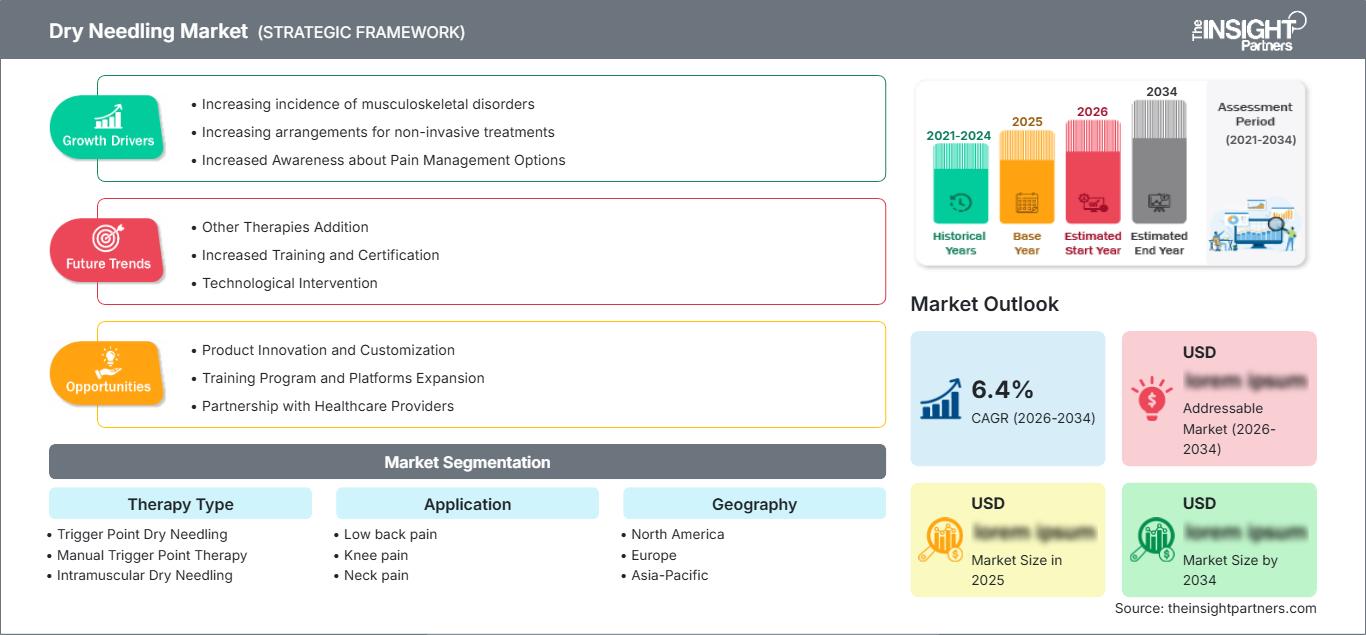
Dry Needling Market: Strategic Insights
Regional Insights
North America Dry Needling Market
North America represented 35–39% of the Dry Needling Market in 2025 and is projected to expand at a CAGR of 10–12% during 2026–2034. The region benefits from advanced rehabilitation infrastructure, increasing utilization of physical therapy services, and growing acceptance of minimally invasive pain management methods.
The US remains the primary contributor due to strong healthcare service availability, increasing practitioner adoption, and expanding applications across sports injuries, chronic pain, and musculoskeletal rehabilitation segments.
U.S. Dry Needling Market
The U.S. Dry Needling Market accounted for 78–82% of North America’s regional share in 2025 and is expected to grow at a CAGR of 10–11% through 2034. The market expansion is supported by increasing integration of dry needling into physical therapy practices and demand for non-drug pain management approaches.
Clinical organizations and therapy providers continue strengthening service availability, with companies including Tanana Valley Clinic, LLC, Oregon Medical Group, P.C., and Tallahassee Primary Care Associates, P.A. contributing to market presence. Application growth is visible across low back pain, neck pain, and sports rehabilitation.
Europe Dry Needling Market
Europe held 27–31% share of the Dry Needling Market in 2025 and is projected to register a CAGR of 9–11% during 2026–2034. The region benefits from established physiotherapy systems and increasing interest in evidence-supported rehabilitation techniques.
The UK market is expanding through increased professional adoption and broader awareness of therapeutic interventions for chronic pain conditions. Germany is supported by advanced healthcare infrastructure, rehabilitation services, and strong clinical networks. France, Italy, and Spain are witnessing gradual adoption through physiotherapy education and healthcare modernization.
Germany remains one of the leading countries in Europe due to structured rehabilitation practices and healthcare accessibility.
APAC Dry Needling Market
APAC accounted for 20–24% share in 2025 and is expected to achieve a CAGR of 10–13% during 2026–2034. Growth is supported by improving healthcare access, rising therapy awareness, and expanding rehabilitation facilities.
China represents a significant contributor due to domestic medical device capabilities and increasing healthcare investment. Japan supports adoption through advanced therapeutic practices, while South Korea and India are experiencing rising demand from expanding healthcare services. Australia demonstrates growth through professional therapy networks and rehabilitation adoption.
China is expected to remain a leading country due to industrial manufacturing capabilities and healthcare development initiatives.
Middle East & Africa Dry Needling Market
The Middle East & Africa Dry Needling Market is projected to grow at a CAGR of 8–10% during 2026–2034, supported by increasing healthcare infrastructure development and rising interest in specialized rehabilitation services. The region is gradually adopting advanced therapy approaches.
Saudi Arabia and the UAE are expanding through healthcare modernization programs and investment in medical services. South Africa contributes through established healthcare facilities and rehabilitation demand. Rest of MEA markets are supported by improving access to specialized care.
Saudi Arabia is expected to lead regional growth due to healthcare investment initiatives and expanding clinical capabilities.
Segmentation Analysis
Therapy Type
The Therapy Type segment of the Dry Needling Market is expected to expand at a CAGR range of 10–12% during 2026–2034, supported by increasing preference for targeted therapeutic approaches, broader clinical acceptance, and advancements in practitioner-led pain management techniques. Different therapy approaches address varying patient requirements, enabling healthcare providers to select techniques based on condition severity, treatment objectives, and rehabilitation protocols.
- Trigger Point Dry Needling: This sub-segment represents a widely adopted approach focused on releasing myofascial trigger points and improving muscle function. Adoption is supported by increasing applications in sports rehabilitation, chronic pain management, and physical therapy practices.
- Manual Trigger Point Therapy: This approach continues gaining attention due to its role in combining hands-on techniques with pain relief strategies. Growing demand for integrated rehabilitation methods supports adoption among healthcare professionals.
- Intramuscular Dry Needling: This technique is increasingly utilized for deeper muscle stimulation and targeted treatment of neuromuscular conditions. Rising clinical interest in precision-based interventions supports market expansion.
- Intramuscular Manual Therapy: This sub-segment benefits from growing application in specialized rehabilitation programs where combined manual and intramuscular techniques improve therapeutic outcomes and patient management strategies.
- Intramuscular Stimulation: Increasing utilization of advanced stimulation-based approaches supports this sub-segment, particularly in rehabilitation environments requiring focused neuromuscular activation and functional recovery solutions.
Application
The Application segment of the Dry Needling Market is witnessing increased adoption across multiple pain management and rehabilitation areas. Growing prevalence of musculoskeletal conditions, rising demand for non-invasive therapies, and expanding physical therapy services are contributing to broader application opportunities across healthcare settings.
- Low back pain: This application remains significant due to the high prevalence of lower back disorders and increasing use of dry needling techniques for muscle-related pain relief and mobility improvement.
- Knee pain: Adoption is supported by rising sports injuries, age-related joint conditions, and rehabilitation requirements where dry needling is used alongside broader therapeutic programs.
- Neck pain: Growing cases of posture-related disorders and workplace-related discomfort are increasing demand for targeted therapies addressing cervical muscle dysfunction.
- Migraines and headaches: Increasing exploration of muscular trigger point treatment approaches supports application growth for patients seeking complementary pain management options.
- Labor pains: This application is supported by growing interest in alternative therapeutic techniques and increasing awareness of supportive pain management approaches.
- Smoking cessation: Dry needling-based approaches are being explored as complementary interventions, creating niche opportunities within wellness and behavioral support applications.
Opportunity Snapshot
| Application | Revenue Contribution | Trend Tag | Adoption Stage |
| Low back pain | High | Chronic Pain Relief | Scaling |
| Knee pain | Medium | Sports Rehabilitation | Scaling |
| Neck pain | High | Posture Disorders | Scaling |
| Migraines and headaches | Medium | Trigger Therapy | Emerging |
| Labor pains | Low | Maternal Support | Emerging |
| Smoking cessation | Low | Wellness Therapy | Emerging |
Dry Needling Market Growth Drivers and Impact Analysis
Rising Prevalence of Musculoskeletal Disorders
Rising cases of musculoskeletal disorder patients are driving an increased demand for therapeutic solutions that can help in alleviating pain, limited mobility, and functional problems. Diseases like back pain, neck pain, and sport injury are prompting health professionals to include dry needling in their treatment plans. The effect of the trend on the market is that there will be more use of the solution in physiotherapy clinics, sport medicine clinics, and specialized pain management clinics. As patients develop preference for precise and less-invasive treatments, dry needling will remain relevant.
Growing Adoption of Non-Pharmacological Pain Management
The rising importance of non-medication-based techniques is driving healthcare decisions, leading to an increasing importance of dry needling within pain management treatment options. Patients and clinicians alike are looking for methods that work together with current medical treatments while overcoming issues surrounding drug addiction and chronic pain. This trend is helping create a larger acceptance among rehabilitation experts, thus facilitating adoption of dry needling in healthcare practices. The effect of this trend is demonstrated by rising demands for qualified specialists, special training courses, and treatment devices.
Expansion of Physical Therapy and Rehabilitation Services
The rise in physical therapy infrastructure has created more opportunities for the adoption of dry needling. More emphasis is being placed on the rehabilitation care model, leading to the integration of specialist treatment techniques into the overall rehabilitation process. Market implications include greater access, practitioner engagement, and higher demand for high-quality dry needling devices. Expansion in rehabilitation services, especially in regions where healthcare capabilities are being enhanced, is generating new opportunities for manufacturers and service providers.
Dry Needling Market Future Trends
Integration of Digital Training and Clinical Education Platforms
The future development of the Dry Needling Market will be affected by the use of online learning platforms that ensure better training and certification for professionals as well as greater consistency in procedures. This may lead to improved professional adoption through increased access to knowledge about procedures. These learning platforms may allow greater transfer of knowledge to developing countries where the availability of special training courses is currently lacking. The trend is likely to drive greater collaboration between manufacturers and health institutions in education-oriented programs.
Development of Advanced Precision-Based Therapy Solutions
Precision oriented therapy solutions are expected to be of great significance to the market, especially those that will enhance personalized and efficient therapies. There could be innovations regarding the designs of needles, ergonomic designs, and procedural techniques that will enhance the effectiveness of the products. Further usage of these products will require further evaluation of their benefits in clinics and by practitioners in the medical field. This will motivate companies to develop products that distinguish them in the market.
Dry Needling Market Opportunities
Expansion Across Emerging Healthcare Markets
The emerging economies offer market players in dry needling chances because of the growing health care facilities in the region, increased awareness about the availability of rehabilitative treatment options, and growing demand for the alternative methods. Nations in the Asia Pacific, Middle East, and other developing nations are spending on the development of their health care systems. This offers chances for the companies to grow their distribution networks. The companies could leverage these chances by forming regional partnerships, offering educational support to practitioners, and developing solutions tailored to regional needs.
Strategic Partnerships Between Manufacturers and Therapy Providers
Collaborations among device makers, rehab facilities, and professional training organizations form an interesting area of opportunity. Collaboration may assist in developing products, engaging practitioners, and promoting the use of standardized dry needling technique. Device makers could gain competitive advantage through collaboration with healthcare organizations that will help them meet clinical requirements and develop appropriate solutions. It is possible to leverage such collaborations for business growth, customer relationship management, and creation of ecosystems encompassing equipment, training, and treatment services.
Recent Developments
- September 2025: ATI Physical Therapy implemented NeedleCert's PrivilegePath, a fully automated internal credentialing system for dry needling. The initiative strengthens clinician competency verification and patient safety by ensuring only appropriately credentialed therapists provide standardized, high-quality dry needling services across ATI's nationwide clinics.
- January 2024, Myopain Seminars launched its live Intramuscular Electrical Stimulation (IMES) hands-on training program for clinicians already certified in IMES. The new course expands the company's dry needling education portfolio by integrating electrical stimulation techniques for treating neck, back, pelvic, upper- and lower-extremity pain, strengthening its advanced clinical training offerings.
- April 2024, Myopain Seminars collaborated with the American Occupational Therapy Association (AOTA) Inspire 2024 Annual Conference & Expo to promote dry needling education for occupational therapists. Through its participation, the company showcased its certification programs and expanded awareness of evidence-based dry needling techniques among rehabilitation professionals, supporting broader clinical adoption.
Frequently Asked Questions

- Comprehensive Market Sizing and Forecast Analysis
- Detailed Segmentation Analysis
- In-Depth Market Dynamics Assessment
- Regional and Country-Level Insights
- Competitive Landscape and Company Benchmarking
- Strategic Business Intelligence
Recent Reports
Testimonials

The Insight Partners' SCADA System Market report is comprehensive, with valuable insights on current trends and future forecasts. The team was highly professional, responsive, and supportive throughout. We are very satisfied and highly recommend their services.
RAN KEDEM Partner, Reali Technologies LTDs
I requested a report on a very specific software market and the team produced the report in a few days. The information was very relevant and well presented. I then requested some changes and additions to the report. The team was again very responsive and I got the final report in less than a week.
JEAN-HERVE JENN Chairman, Future Analytica
We worked with The Insight Partners for an important market study and forecast. They gave us clear insights into opportunities and risks, which helped shape our plans. Their research was easy to use and based on solid data. It helped us make smart, confident decisions. We highly recommend them.
PIYUSH NAGPAL Sr. Vice President, High Beam Global
The Insight Partners delivered insightful, well-structured market research with strong domain expertise. Their team was professional and responsive throughout. The user-friendly website made accessing industry reports seamless. We highly recommend them for reliable, high-quality research services
YUKIHIKO ADACHI CEO, Deep Blue, LLC.
This is the first time I have purchased a market report from The Insight Partners.While I was unsure at first, I visited their web site and felt more comfortable to take the risk and purchase a market report.I am completely satisfied with the quality of the report and customer service. I had several questions and comments with the initial report, but after a couple of dialogs over email with their analyst I believe I have a report that I can use as input to our strategic planning process.Thank you so much for taking the extra time and making this a positive experience.I will definitely recommend your service to others and you will be my first call when we need further market data.
JOHN SUZUKI President and Chief Executive Officer, Board Director, BK Technologies
I wish to appreciate your support and the professionalism you displayed in the course of attending to my request for information regarding to infectious disease IVD market in Nigeria. I appreciate your patience, your guidance, and the fact that you were willing to offer a discount, which eventually made it possible for us to close a deal. I look forward to engaging The Insight Partners in the future, all thanks to the impression you have created in me as a result of this first encounter.
DR CHIJIOKE ONYIA MANAGING DIRECTOR, PineCrest Healthcare Ltd.Reason to Buy
- Informed Decision-Making
- Understanding Market Dynamics
- Competitive Analysis
- Identifying Emerging Markets
- Customer Insights
- Market Forecasts
- Risk Mitigation
- Boosting Operational Efficiency
- Strategic Planning
- Investment Justification
- Tracking Industry Innovations
- Aligning with Regulatory Trends





 Get Free Sample for