Eco-Friendly Water Bottle Market Growth, Trends & Forecast by 2034
Eco-Friendly Water Bottle Market Size and Forecast (2021 - 2034), Global and Regional Share, Trend, and Growth Opportunity Analysis Report Coverage: By Material (Paper, Metal, Glass, Others), Distribution Channel (Supermarkets and Hypermarkets, Specialty Stores, Online Retail, Others)
Historic Data: 2021-2024 | Base Year: 2025 | Forecast Period: 2026-2034- Report Date : Apr 2026
- Report Code : TIPRE00027895
- Category : Consumer Goods
- Status : Upcoming
- Available Report Formats :


- No. of Pages : 150

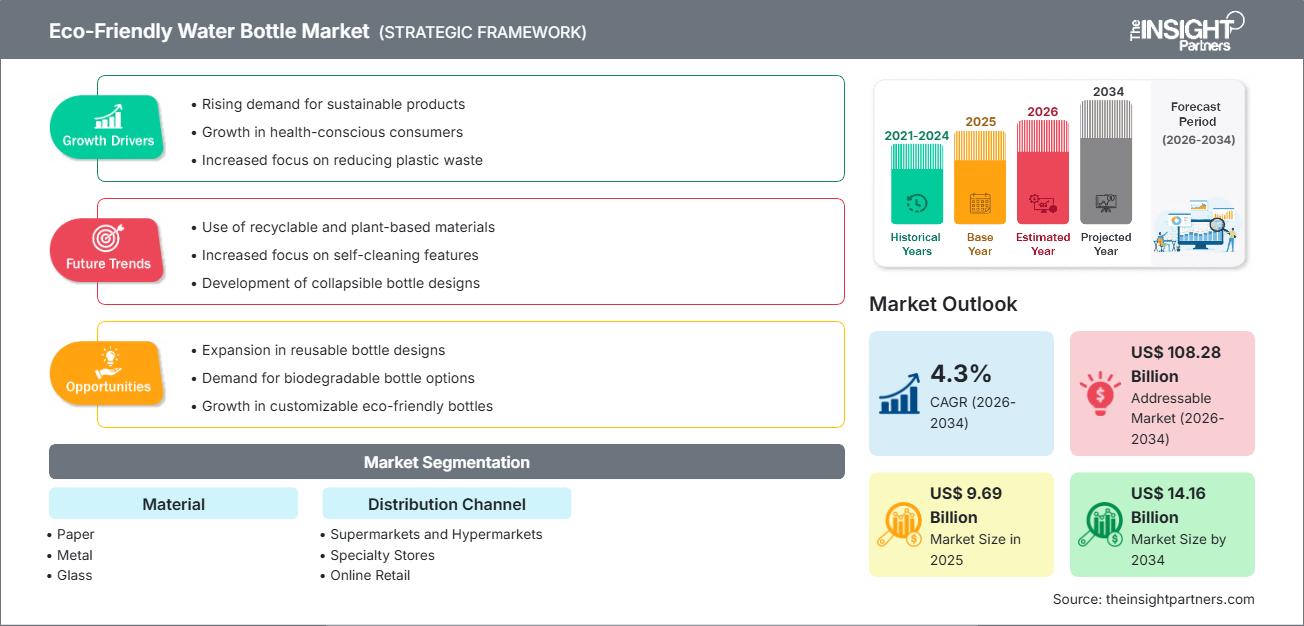
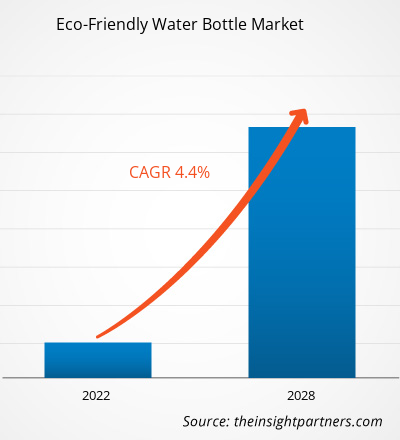
The global Eco-Friendly Water Bottle market size is projected to reach US$ 14.16 billion by 2034 from US$ 9.69 billion in 2025. The market is anticipated to register a CAGR of 4.3% during the forecast period 2026–2034. Key market dynamics include regulatory pressure on single‑use plastics, rising sustainability awareness, and ongoing product innovation in insulated, filtered, and smart bottles. Additionally, the market is expected to benefit from the surging global commitment to reducing single‑use plastics, the rapid expansion of organized retail and e‑commerce channels across emerging economies, and the increasing integration of sustainably designed, reusable bottles into premium lifestyle, outdoor, and wellness-oriented product segments.
Eco-Friendly Water Bottle Market Analysis
The Eco-Friendly Water Bottle market analysis indicates the market’s competitive edge is converging around material circularity, feature-rich differentiation, and brand purpose. Brands are competing on recycled content (e.g., certified post‑consumer stainless steel), traceable supply chains, and repairable, modular parts to extend product lifecycles—moves that reduce Scope 3 emissions while supporting premium positioning. At the product level, companies are prioritizing temperature performance, spill-proof ergonomics, and micro-filtration/UV-C purification for travel, office, fitness, and outdoor use cases. Strategically, vendors should, Own the sustainability narrative with evidence, Invest in channel mix and D2C personalization like online customization and limited color drops sustain engagement, while wholesale partnerships unlock scale. Followed by, bundle hardware with services, which filter subscriptions, app-based hydration prompts, and refill‑station tie‑ins create recurring revenue and loyalty moats. UV/filtration integrations and NFC-enabled impact tracking demonstrate clear use-case value beyond “reusability.”
Eco-Friendly Water Bottle Market Overview
Eco‑friendly water bottles span around metal, glass, paper-based composites, and other low‑impact materials. These have evolved from basic drinkware into lifestyle and performance gear. Mass adoption has been catalyzed by plastic-waste legislation, the mainstreaming of fitness/outdoor culture, and the normalization of refill behaviors at workplaces, campuses, gyms, and transit hubs. Product portfolios now commonly integrate double‑wall vacuum insulation, modular, replaceable lids, filter/straw systems, and app or NFC features that quantify waste avoided. Regionally, Europe benefits from stringent single-use directives and design-for-recyclability norms, North America from high brand innovation and omnichannel retail, and APAC from large, young consumer bases receptive to trend-led hydration accessories. For instance, the market in the US is positioned as everyday carry essentials across work, school, fitness, and travel. Retailers emphasize insulated, leak‑resistant designs and fashionable finishes. Brand storytelling centers on sustainability credentials, refill culture, and durability, with strong traction in e‑commerce and specialty outdoor chains.
Customize This Report To Suit Your Requirement
Get FREE CUSTOMIZATIONEco-Friendly Water Bottle Market: Strategic Insights
-
Get Top Key Market Trends of this report.This FREE sample will include data analysis, ranging from market trends to estimates and forecasts.
Eco-Friendly Water Bottle Market Drivers and Opportunities
Market Drivers:
- Escalating Regulation and Corporate Plastic Reduction: Expanding limits on single-use plastics and corporate zero‑waste commitments are shifting consumers and enterprises toward high‑quality reusables, reinforcing demand across retail and B2B merchandising.
- Performance and Wellness Convergence: Adoption in fitness and outdoor activities elevates demand for insulated, durable, and ergonomic formats, with filtration/UV options for safety and convenience on the go.
- Material Innovation and Circularity: Verified recycled stainless steel, recycled aluminum, and modular parts reduce lifecycle impacts while enabling premium price points and compliance with retailer sustainability benchmarks.
Market Opportunities
- Premiumization via Advanced Features: Vacuum insulation, ceramic linings, interchangeable lids, and integrated filtration/UV present upsell pathways; “smart” cues (NFC, hydration tracking) add service layers and community building.
- Impact‑Linked Branding & Partnerships: Models that finance plastic collection or community initiatives build differentiation and enterprise gifting appeal; co‑branding with outdoor, apparel, and automotive partners scales reach.
- Omnichannel Expansion in Growth Markets: APAC and select LATAM corridors offer volume growth via specialty retail and marketplace platforms; localized designs and climate‑appropriate insulation specs can accelerate adoption.
Eco-Friendly Water Bottle Market Report Segmentation Analysis
The Eco-Friendly Water Bottle Market share is analyzed across various segments to provide a clearer understanding of its structure, growth potential, and emerging trends. Below is the standard segmentation approach used in most industry reports:
By Material:
- Paper: Emerging fiber‑based or papier‑composite formats targeted at events and travel retail for short‑cycle reuse with recyclability messaging.
- Metal: Stainless steel and aluminum dominate premium and performance tiers, favored for durability, insulation, and recycled content credentials.
- Glass: Niche but growing for purity and taste neutrality; silicone sleeves and ergonomic caps improve portability.
- Others: Includes bio‑based polymers, silicone, and hybrid materials designed for lightweight convenience or specialty use cases.
By Distribution Channel:
- Supermarkets and Hypermarkets: High‑visibility placements, seasonal color runs, and bundle promotions drive mainstream adoption.
- Specialty Stores: Outdoor, sporting goods, and lifestyle boutiques curate premium insulated and technical SKUs.
- Online Retail: D2C customization, limited drops, and rapid colorway refreshes spur repeat purchases and community engagement.
- Others: Department stores, campus stores, corporates/B2B merchandising, and travel retail.
By Geography:
- North America
- Europe
- Asia Pacific
- South & Central America
- Middle East & Africa
Eco-Friendly Water Bottle Market Report Scope
| Report Attribute | Details |
|---|---|
| Market size in 2025 | US$ 9.69 Billion |
| Market Size by 2034 | US$ 14.16 Billion |
| Global CAGR (2026 - 2034) | 4.3% |
| Historical Data | 2021-2024 |
| Forecast period | 2026-2034 |
| Segments Covered |
By Material
|
| Regions and Countries Covered |
North America
|
| Market leaders and key company profiles |
|
Eco-Friendly Water Bottle Market Players Density: Understanding Its Impact on Business Dynamics
The Eco-Friendly Water Bottle Market is growing rapidly, driven by increasing end-user demand due to factors such as evolving consumer preferences, technological advancements, and greater awareness of the product's benefits. As demand rises, businesses are expanding their offerings, innovating to meet consumer needs, and capitalizing on emerging trends, which further fuels market growth.
Eco-Friendly Water Bottle Market Share Analysis by Geography
Asia-Pacific is expected to grow fastest in the coming years. Emerging markets in South & Central America, the Middle East, and Africa present untapped opportunities for premium, impact‑led brands, especially where refill infrastructure and anti‑litter campaigns are accelerating behavior change.
The eco‑friendly water bottle market is undergoing a decisive shift from commodity drinkware to purpose‑led, performance‑validated products. Growth is driven by the proliferation of refill culture, rising outdoor/fitness participation, and regulatory headwinds against disposable plastics. Below is a summary of market share context and trends by region:
North America
- Market Share: A mature, innovation‑intense market with strong D2C brands, robust specialty retail, and enterprise gifting channels.
- Key Drivers:
- Consumer demand for insulated, leak‑proof formats supporting hybrid work and travel.
- Retailer emphasis on sustainability claims and recycled content across assortments.
- Expanding outdoor and fitness ecosystems sustaining premium performance SKUs.
- Trends: Elevated color drops and collaborations; ceramic linings and next‑gen lids; early traction for smart/UV and filtration bottles.
Europe
- Market Share: Advanced sustainability policy environment, with brands aligning to circularity and recyclability criteria across channels.
- Key Drivers:
- Single‑use reduction mandates directing consumers to reusables.
- Preference for recycled aluminum/stainless solutions and locally produced SKUs.
- Strong outdoor and urban mobility adoption, supporting insulated and commuter‑friendly formats.
- Trends: Repairable components, modularity, and brand commitments to recycled inputs and climate certifications.
Asia-Pacific
- Market Share: The fastest‑growing region, anchored by large consumer bases and strong e‑commerce penetration.
- Key Drivers:
- Urbanization and lifestyle shifts toward portable hydration and heat‑management.
- Social/commerce platforms amplifying aesthetic and functional trends.
- Expansion of specialty chains and marketplaces driving premiumization.
- Trends: Lightweight insulated bottles, slim profiles for commute bags, and region‑specific colorways.
South and Central America
- Market Share: An emerging base with growth tied to outdoor lifestyle, eco‑tourism, and retailer sustainability initiatives.
- Key Drivers:
- Rising awareness of ocean plastic and coastal conservation programs.
- Modernization of specialty retail in Brazil and Mexico.
- Corporate promotional demand for branded, sustainable drinkware.
- Trends: Partnerships with conservation NGOs and growth in refill‑station pilots at events and campuses.
Middle East and Africa
- Market Share: Developing but opportunity‑rich, especially in climate‑challenged geographies where hydration accessories are daily necessities.
- Key Drivers:
- High demand for heat‑resilient, insulated formats due to arid climates.
- Growing interest in sustainable materials and refill culture among urban millennials.
- Investment in retail modernization and tourism‑oriented assortments.
- Trends: Durable, large‑capacity insulated bottles and corporate gifting aligned to green goals.
High Market Density and Competition
Competition is intensifying due to the presence of established leaders such as Chilly's, S'well, Ocean Bottle, Corkcicle, Hydro Flask, Bottles Società Benefit S.r.l. P.IVA, Frank Green, Qwetch, Klean Kanteen, and Kinto Co., Ltd, also contribute to a diverse and rapidly expanding market landscape.
This competitive environment pushes vendors to differentiate through:
- Premiumization and Proof: Temperature retention, leak‑proof engineering, and third‑party certifications (B Corp, Climate Neutral, recycled content) reinforce quality and ethics.
- Portfolio Innovation: UV‑enabled self‑cleaning, integrated filters, modular/repairable parts, and recycled‑content metallurgy elevate feature sets.
- Vertical Integration and Ethical Sourcing: Traceable recycled inputs (e.g., 90% PCR steel; 100% recycled aluminum) and impact programs (e.g., plastic‑collection funding) deliver transparent, values‑driven propositions.
- Advanced Manufacturing and Design: Vacuum insulation, ceramic coatings/linings, and ergonomic lids/straws designed for spill resistance and ease of cleaning.
Opportunities and Strategic Moves
- Partner with Outdoor, Fitness, and Lifestyle Channels: Collaborations and limited editions with outdoor retailers, fitness communities, and apparel brands can unlock new segments and strengthen seasonal sell‑through.
- Embed White‑Label & B2B Programs: Enterprise gifting and promotional markets reward verifiable impact claims and customization; aligning with corporate ESG agendas sustains volume.
- Invest in Circular Materials and Impact Accounting: Transitioning to certified recycled metals and publishing auditable impact (e.g., plastic‑collection equivalents) sharpen brand trust and pricing power.
Major Companies operating in the Eco-Friendly Water Bottle Market are:
- Chilly's
- S'well
- Ocean Bottle
- Corkcicle
- Hydro Flask
- Bottles Società Benefit S.r.l. P.IVA
- Frank Green
- Qwetch
- Klean Kanteen
- Kinto Co., Ltd.
Disclaimer: The companies listed above are not ranked in any particular order.
Eco-Friendly Water Bottle Market News and Recent Developments
- In February 2024, BRITA SE, acquired LARQ, Inc. The medium‑sized, family‑owned company based in Taunusstein, Germany, viewed this acquisition as a strategic milestone, particularly for advancing its consumer business in the North American market.
- In January 2024, YETI Holdings, Inc. announced that it had signed an agreement to acquire MYSTERY RANCH. As part of its expanding ecosystem of high‑performance outdoor gear, YETI emphasized that the acquisition is likely to complement its Eco‑Friendly Water Bottle portfolio by strengthening its position among consumers who prioritize durability and sustainability.
Eco-Friendly Water Bottle Market Report Coverage and Deliverables
The Eco-Friendly Water Bottle Market Size and Forecast (2021–2034) report provides a detailed analysis of the market covering below areas:
- Eco-Friendly Water Bottle Market size and forecast at global, regional, and country levels for all the key market segments covered under the scope
- Eco-Friendly Water Bottle Market trends, as well as market dynamics such as drivers, restraints, and key opportunities
- Detailed PEST and SWOT analysis
- Eco-Friendly Water Bottle Market analysis covering key market trends, global and regional framework, major players, regulations, and recent market developments
- Industry landscape and competition analysis covering market concentration, heat map analysis, prominent players, and recent developments in the Eco-Friendly Water Bottle Market.
- Detailed company profiles
Frequently Asked Questions

- Historical Analysis (2 Years), Base Year, Forecast (7 Years) with CAGR
- PEST and SWOT Analysis
- Market Size Value / Volume - Global, Regional, Country
- Industry and Competitive Landscape
- Excel Dataset
Recent Reports
Testimonials

The Insight Partners' SCADA System Market report is comprehensive, with valuable insights on current trends and future forecasts. The team was highly professional, responsive, and supportive throughout. We are very satisfied and highly recommend their services.
RAN KEDEM Partner, Reali Technologies LTDs
I requested a report on a very specific software market and the team produced the report in a few days. The information was very relevant and well presented. I then requested some changes and additions to the report. The team was again very responsive and I got the final report in less than a week.
JEAN-HERVE JENN Chairman, Future Analytica
We worked with The Insight Partners for an important market study and forecast. They gave us clear insights into opportunities and risks, which helped shape our plans. Their research was easy to use and based on solid data. It helped us make smart, confident decisions. We highly recommend them.
PIYUSH NAGPAL Sr. Vice President, High Beam Global
The Insight Partners delivered insightful, well-structured market research with strong domain expertise. Their team was professional and responsive throughout. The user-friendly website made accessing industry reports seamless. We highly recommend them for reliable, high-quality research services
YUKIHIKO ADACHI CEO, Deep Blue, LLC.
This is the first time I have purchased a market report from The Insight Partners.While I was unsure at first, I visited their web site and felt more comfortable to take the risk and purchase a market report.I am completely satisfied with the quality of the report and customer service. I had several questions and comments with the initial report, but after a couple of dialogs over email with their analyst I believe I have a report that I can use as input to our strategic planning process.Thank you so much for taking the extra time and making this a positive experience.I will definitely recommend your service to others and you will be my first call when we need further market data.
JOHN SUZUKI President and Chief Executive Officer, Board Director, BK Technologies
I wish to appreciate your support and the professionalism you displayed in the course of attending to my request for information regarding to infectious disease IVD market in Nigeria. I appreciate your patience, your guidance, and the fact that you were willing to offer a discount, which eventually made it possible for us to close a deal. I look forward to engaging The Insight Partners in the future, all thanks to the impression you have created in me as a result of this first encounter.
DR CHIJIOKE ONYIA MANAGING DIRECTOR, PineCrest Healthcare Ltd.Reason to Buy
- Informed Decision-Making
- Understanding Market Dynamics
- Competitive Analysis
- Identifying Emerging Markets
- Customer Insights
- Market Forecasts
- Risk Mitigation
- Boosting Operational Efficiency
- Strategic Planning
- Investment Justification
- Tracking Industry Innovations
- Aligning with Regulatory Trends




 Get Free Sample For