Fatigue Testing Machine Market Size & Overview
The Fatigue Testing Machine Market was valued at US$ 375.91 Million in 2025 and is projected to reach US$ 508.63 Million by 2034, expanding at a CAGR of 3.42% during 2026–2034. The market comprises equipment that applies repeated axial, bending, torsional, or multiaxial loads to materials and components to determine fatigue strength, endurance limits, crack propagation, and service-life behavior under controlled laboratory conditions.
North America is modeled to expand at ~3% CAGR through 2034, supported by aerospace qualification, automotive durability programs, and regulated medical-device verification. The Fatigue Testing Machine Market size is reinforced by replacement of legacy servohydraulic controllers, adoption of clean electrodynamic platforms in smaller laboratories, and sustained demand for traceable measurements under ASTM, ISO, and customer-specific test methods.
The drivers of Fatigue Testing Machine Market include the need to forecast failure due to a loading cycle that remains less than static strength threshold values. Auto components suppliers employ cyclic testing of suspension, powertrain, battery, fasteners, and structural components, while aerospace projects certify alloys, composites, assemblies, and engines. The medical device industry validates implants and delivery devices over millions of cycles. The demand originates from the standards, allowable design, warranties, and safety considerations, followed by laboratories, system integration companies, fixture developers, calibration companies, and software houses. Supply problems arise due to capacity. Low-capacity devices that use electrodynamic actuators will have exact motor and frame sizes. High-capacity equipment uses hydraulic devices and strong bases. Lead time may depend on fixtures, imported sensors, site preparations, and device certifications. Equipment providers who provide modular controls, extensive accessory packages, certified calibration, and local engineers will help minimize installation risks and extend the life of systems installed.
In terms of Fatigue Testing Machine Market competition, we see rivalry among diversified test and measurement companies and application-oriented specialists. Illinois Tool Works Inc., with the help of Instron, MTS Systems Corporation, Shimadzu Corporation, and ZwickRoell GmbH & Co. KG fight their competition in the areas of dynamic testing systems, software, and services. ADMET, Inc., Ducom Instruments, Qualitest International Inc., Ektron Tek Co., Ltd., Jinan Xinluchang Testing Machine Co., Ltd., and Blue Star Limited solve regional, specialized, distribution, or laboratory needs. Areas of investment are controller upgrade, all electric actuation, workflow automation, and application engineering. Strategic positioning includes adapting frequency, force, stroke, stiffness, and environment to testing needs instead of over-engineering frames. The suppliers who provide machines with fixtures, extensometers, chambers, method templates, training, and calibration earn recurring revenues and high switching costs. Working together with universities, certified labs, and component makers helps to develop testing methods for new materials quickly.
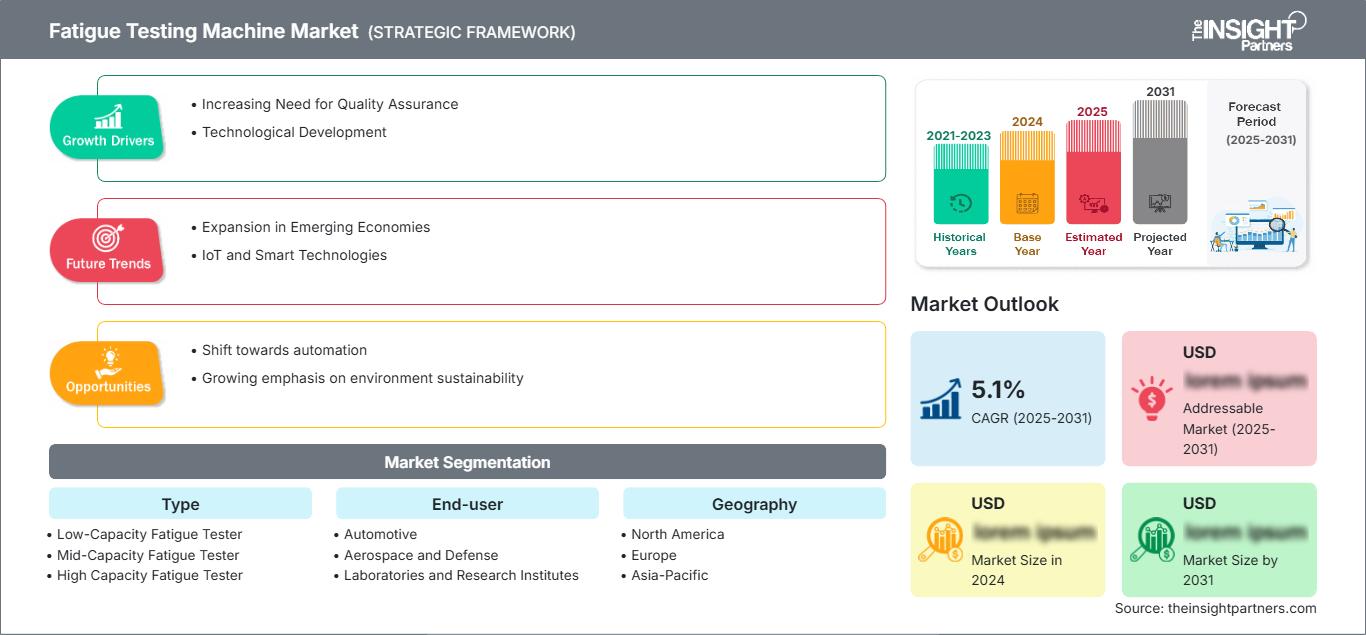
Fatigue Testing Machine Market Assessment and Insights
Regional Outlook
- North America: ~35% of the global market in 2025 | ~3% CAGR through 2034. Market position: The region leads through concentrated aerospace, automotive, medical-device, and accredited laboratory demand, alongside a large installed base requiring controller modernization, calibration, fixtures, and service.
- US: ~84% of North American market revenue in 2025 | ~3% CAGR through 2034. Market position: The US anchors regional spending through advanced manufacturing, defense programs, university research, standards-driven product validation, and the presence of major materials-testing suppliers and service networks.
- Europe: ~29% of the global market in 2025 | ~3% CAGR through 2034. Market position: Europe is a mature, engineering-intensive market led by Germany, with the UK, France, Italy, and Spain sustaining demand for automotive, aerospace, rail, energy, and research applications.
- Asia Pacific: ~27% of the global market in 2025 | ~5% CAGR through 2034. Market position: Asia Pacific is the fastest-growing region as China, Japan, South Korea, India, and Australia expand localized manufacturing, materials research, EV qualification, and advanced infrastructure testing.
Segment Outlook
- Type: ~100% share in 2025 | ~3% CAGR through 2034. Market position: Type captures the full capacity-based equipment taxonomy. Mid-capacity systems lead practical laboratory deployment because they balance force range, floor-space needs, application flexibility, and capital cost.
- End-user: ~100% share in 2025 | ~4% CAGR through 2034. Market position: End-user is the higher-growth planning lens as electric mobility, lightweight aerospace structures, implant durability, and outsourced validation broaden the customer mix.
Competitive Coverage
ADMET, Inc., Blue Star Limited, Ducom Instruments, Ektron Tek Co., Ltd., Illinois Tool Works Inc., Jinan Xinluchang Testing Machine Co., Ltd., MTS Systems Corporation, Qualitest International Inc., Shimadzu Corporation, ZwickRoell GmbH & Co. KG
Methodology
The Insight Partners follows Data Collection & Secondary Research, Primary Research, Data Analysis, and Data Triangulation & Final Review to validate market estimates and insights.
Source: The Insight Partners' analysis based on proprietary research, government publications, company annual reports, investor presentations, industry databases, and expert interviews.
Fatigue Testing Machine Market Trends
Automated Dynamic Testing and Closed-Loop Workflows
Fatigue Testing Machine Market trends increasingly point to automated specimen handling, method selection, alignment checks, test execution, and result transfer. Automation can reduce operator-dependent scatter and extend testing into unattended hours, which matters when programs require large specimen populations or lengthy cycle counts. The next step is tighter integration with laboratory information systems, simulation models, and digital material records. Adoption will begin in repeatable coupon and medical-device workflows before expanding to irregular components. Commercial advantage will depend on reliable exception handling and traceable metadata, not robotics alone, because a failed specimen or grip anomaly must be identified without corrupting the remaining sequence.
Energy-Efficient Drives and Very-High-Cycle Methods
Laboratories will increasingly select drive technology according to lifecycle energy, noise, maintenance, and target cycle count. Electrodynamic and servo-electric systems are gaining ground in low- and mid-force laboratories because they avoid hydraulic utilities, while resonance machines remain compelling for high-cycle metallic tests. Ultrasonic methods can accelerate very-high-cycle studies, allowing researchers to investigate inclusion-driven failures that are impractical at conventional frequencies. Hydraulics will remain important for high loads, long strokes, and multiaxial work, but power-on-demand units and improved control will reduce operating penalties. The market will therefore diversify by test physics rather than converge on a single platform.
Fatigue Testing Machine Market Growth Factors
Electrification and Lightweighting Expand Durability Workloads
Vehicle and aircraft developers are introducing battery enclosures, castings, bonded joints, advanced high-strength steels, aluminum alloys, thermoplastics, and composites into load-bearing designs. Each substitution changes stiffness, crack initiation, thermal behavior, and joining performance, creating new fatigue-test matrices at coupon, subcomponent, and component levels. Electric vehicles add vibration and durability requirements for motors, busbars, cooling systems, mounts, and battery structures. The commercial impact extends beyond new frames to fixtures, chambers, extensometers, control software, and method development. Suppliers that reproduce service waveforms and connect results with simulation workflows can shorten validation cycles and improve laboratory utilization.
Safety-Critical Qualification Sustains Standards-Based Testing
Fatigue failure can occur after repeated loading below a material’s static strength, making cyclic validation essential for products whose service life cannot be established through tensile testing alone. Aerospace parts, implants, pressure-related components, fasteners, and transport structures must demonstrate predictable endurance under defined loads and environments. Standards such as ISO 1099 and ASTM E466 provide foundations for force-controlled metallic fatigue testing, while application standards govern implants and specialized components. This driver supports traceable load measurement, alignment verification, environmental control, and accredited calibration. It also favors suppliers that can document complete test configurations rather than sell isolated frames.
Modernization of Installed Systems Improves Laboratory Economics
Many mechanically sound fatigue frames remain in service for decades, but obsolete controllers, software, sensors, and safety interfaces can limit productivity and data integrity. Retrofit programs allow laboratories to add digital waveform control, higher-resolution acquisition, modern reporting, remote diagnostics, and current operating systems without replacing the load frame or hydraulic plant. The result is a lower-capital route to improved repeatability and operator usability. Vendors gain recurring opportunities in controllers, transducers, calibration, service, and training. Modernization is particularly attractive in mature North American and European laboratories where installed capacity is high and downtime must be minimized.
Fatigue Testing Machine Market Opportunities
Localized Application Centers in High-Growth Manufacturing Hubs
Suppliers can establish regional demonstration, calibration, and method-development centers near expanding automotive, aerospace, medical, and industrial clusters in Asia Pacific. Fatigue Testing Machine Market Forecasts support investment in local engineers who can translate standards into fixtures, waveforms, environmental conditions, and acceptance procedures. The opportunity is not limited to equipment sales: shared application laboratories can generate service, training, retrofit, and outsourced-testing revenue while reducing customers’ adoption risk. Partnerships with universities and accredited laboratories can provide reference projects and skilled operators. Investment should prioritize service coverage and spare-parts availability before broad portfolio expansion.
Retrofit, Software, and Lifecycle Service Portfolios
Installed servohydraulic and mechanical systems provide a large addressable base for controllers, sensors, safety upgrades, software, and calibration. Vendors can create tiered modernization packages that separate essential compliance upgrades from productivity enhancements such as adaptive control, automated tuning, remote diagnostics, and data integration. Multi-year service agreements can stabilize revenue and improve customer uptime, while brand-neutral retrofit capability widens the target base. Success requires careful compatibility assessment because frame stiffness, actuator condition, hydraulic quality, and transducer performance constrain achievable results. A structured audit-to-upgrade pathway can turn one-off maintenance into a repeatable lifecycle business.
Segmentation Analysis
Type
Type is modeled to expand at ~3% CAGR during 2026–2034. The Fatigue Testing Machine Market scope covers low-capacity, mid-capacity, and high capacity testers selected according to force, frequency, stroke, specimen geometry, and environmental needs. Mid-capacity platforms offer the broadest balance of utility and cost, while low-force electric systems and high-force hydraulic installations address more specialized workloads.
- Low-Capacity Fatigue Tester: Low-capacity instruments suit biomaterials, small components, polymers, thin sections, electronics, and teaching laboratories. Compact footprints, low noise, plug-and-play electric drives, sensitive load measurement, and saline-bath compatibility strengthen their strategic role in medical and research applications.
- Mid-Capacity Fatigue Tester: Mid-capacity systems serve the largest cross-section of metals, composites, automotive parts, fasteners, joints, and structural coupons. Buyers favor configurable frames that support axial, bending, torsional, fracture, and environmental tests without the infrastructure burden of very large hydraulics.
- High Capacity Fatigue Tester: High capacity machines address heavy components, construction materials, large aerospace structures, rail parts, and energy equipment. Purchases are project-led and engineering-intensive because foundations, hydraulic supply, cooling, safety enclosures, custom grips, and acceptance testing materially affect total installed cost.
End-user
End-user is modeled to grow at ~4% CAGR during 2026–2034. Adoption is shaped by failure consequences, validation intensity, product-development cycles, and the economics of owning versus outsourcing equipment. Automotive and aerospace users require repeatable high-throughput testing, while laboratories, medical companies, and construction stakeholders emphasize method flexibility, traceability, and application-specific fixtures.
- Automotive: Automotive demand spans conventional and electric powertrains, chassis, suspension, fasteners, welds, composites, battery structures, elastomers, and interiors. Shorter development cycles favor automated sequences, reusable methods, high data throughput, and simulation-correlated component testing.
- Aerospace and Defense: Aerospace and defense programs test alloys, composites, joints, turbine materials, landing systems, and structural assemblies. Long qualification cycles, severe environments, low-volume critical parts, and multiaxial loading make precision, traceability, high-temperature capability, and lifecycle service strategically important.
- Laboratories and Research Institutes: Independent laboratories and research institutes need flexible systems that accommodate varied customers, specimens, and standards. Broad fixture libraries, quick changeovers, controller programmability, accredited calibration, and reliable technical support determine utilization and project turnaround.
- Medical: Medical applications include dental and orthopedic implants, spinal constructs, stents, catheters, and delivery devices. Low-force sensitivity, saline environments, multistation testing, clean electric actuation, and validated methods are central because testing can involve very high cycle counts and regulated documentation.
- Construction: Construction users evaluate reinforcing steel, concrete-related components, anchors, cables, fasteners, and structural materials. High loads, rugged grips, resonance efficiency, specimen preparation, and compatibility with civil-engineering standards shape purchasing, especially in infrastructure and certification laboratories.
Opportunity Snapshot
| End Users | Revenue Contribution | Trend Tag | Adoption Stage |
| Automotive | High | EV Durability | Mature |
| Aerospace and Defense | High | Lightweight Qualification | Mature |
| Laboratories and Research Institutes | Medium | Method Flexibility | Scaling |
| Medical | Medium | Multistation Testing | Scaling |
| Construction | Medium | Infrastructure Assurance | Mature |
| Others | Low | Specialty Validation | Emerging |
Regional Insights
North America Fatigue Testing Machine Market
North America accounted for an estimated ~35% of global revenue in 2025 and is modeled to expand at ~3% CAGR through 2034. Fatigue Testing Machine market share is driven by qualification testing of aerospace and defense components, automotive qualification tests, medical-device testing and an extensive network of independent and university laboratories. Procedures for purchasing based on ASTM standards, calibration and documentation ensure ongoing business after equipment installation.
The aging installed base of laboratories represents a substantial opportunity to upgrade to a newer control, software, transducer and safety system without changing the well-working machine frame and hydraulic infrastructure. The Canadian market includes aerospace, transportation, energy and academia sectors while the Mexican market features automotive component manufacturing. Increasingly, customers are making decisions based on energy efficiency, noise level, availability and service.
U.S. Fatigue Testing Machine Market
The US generated an estimated ~84% of North American revenue in 2025 and is projected to grow at ~3% CAGR through 2034. There is diversity in the application areas that generate demand for these products including aerospace primes, defense labs, automotive OEMs and Tier suppliers, medical device manufacturers, universities and commercial test facilities.
Companies like Illinois Tool Works Inc., MTS Systems Corporation, and ADMET, Inc. strengthen the domestic supplier base and services. The rest of the vendors will continue providing sales, calibration, and applications services for US markets. Increasingly, procurement will focus on controller compatibility, unattended operation safety, data export capability, and fixtures that limit variability in setup. Electric systems are becoming more accepted for low and moderate force systems, but servohydraulic systems are still required for higher force, long stroke, multi-axis control and harsh environments.
Europe Fatigue Testing Machine Market
Europe represented an estimated ~29% of global revenue in 2025 and is modeled to advance at ~3% CAGR through 2034. Europe is led by Germany due to its automotive engineering expertise, machine tool base, materials institutes, and experience in test equipment manufacturing. Its mature laboratories require software, automation, electrodynamic, resonance machines, and energy-saving hydraulic system upgrades.
Aerospace, motorsport, defense, and university testing requirements are met in the UK. France has integration of aviation, rail transport, nuclear power, and automotive industry, while Italy targets machinery, transport, and university testing requirements. Spain provides aerospace structures, renewable energy components, rail transport, and automotive testing. In all these sectors, there is interest for ISO and ASTM testing, CE certified safety, traceability of calibration, environmental testing, and good customer service nearby.
ZwickRoell GmbH & Co. KG enjoys a strong engineering and service position in the region, backed by Illinois Tool Works Inc., MTS Systems Corporation, Shimadzu Corporation, and European specialized distributors. Further growth in the market will be limited by high penetration of installed equipment, but still replacement business is taking place because of energy efficiency, automation, digitalization, and faster test rates from the labs. Composites, hydrogen system, additive metals, and battery structure research provide more incremental demand next to metal materials testing.
APAC Fatigue Testing Machine Market
Asia Pacific accounted for an estimated ~27% of global revenue in 2025 and is the fastest-growing region at ~5% CAGR through 2034. China is the leading country in Asia Pacific, supported by automotive scale, aerospace localization, infrastructure materials, and expanding domestic equipment supply. Japan and South Korea maintain advanced automotive, electronics, materials, and precision-manufacturing laboratories.
The Indian country gains from automotive engineering, localization of defense equipment, railway, construction material, and research expenditure, while Australia has mining, infrastructure development, aerospace, and university applications. Support for the production process and EV supply chain increases the demands, although the purchasing depends on capital budget, application support, and calibration availability. Regional suppliers can compete by localization of frames and service while importing controls and sensors worldwide.
Middle East & Africa Fatigue Testing Machine Market
The Middle East & Africa market is modeled to grow at ~4% CAGR through 2034. Saudi Arabia is the leading country in the Middle East & Africa where industrial localization, construction, energy, and university laboratories support demand. The UAE emphasizes aviation, advanced materials, infrastructure, and certification services, while South Africa contributes mining, transport, metals, and academic research.
Rest of MEA demand is concentrated in public laboratories, engineering universities, oil and gas service centers, and major infrastructure programs. Purchasers often prioritize versatile mid-capacity systems, remote diagnostics, training, and dependable calibration because specialist support is geographically dispersed. Growth depends on research funding, local technical capability, and the development of accredited test services that can aggregate demand across multiple industries.
Fatigue Testing Machine Market Report Scope
| Report Attribute | Details |
|---|---|
| Market size in 2025 | US$ 375.91 Million |
| Market Size by 2034 | US$ 508.63 Million |
| Global CAGR (2026 - 2034) | 3.42% |
| Historical Data | 2021-2024 |
| Forecast period | 2026-2034 |
| Segments Covered | Type, End-user, Geography |
| Region scope | North America, Europe, Asia-Pacific, South and Central America, Middle East and Africa |
Recent Developments
- July 2026: WANCE successfully installed two machines in Setsco Singapore. One is stranded wire relaxation testing machine, one is 500kN high frequency resonant dynamic fatigue testing machine. It is primarily used to test various technical parameters related to the fatigue fracture resistance of metallic materials, composites, and other materials. When equipped with corresponding fixtures and accessories, the system can perform tests such as S-N curve analysis, KIc, JIC, and CTOD measurements. It is particularly suitable for evaluating the fatigue characteristics and fatigue life of various components (e.g., plates, gears, crankshafts, threads, bolts, screws, studs, chains, connecting rods, compact tension specimens, valves, etc.) and structural parts (e.g., operating joints, connectors, helical kinematic pairs, etc.) under alternating loads.
- August 2025: Shimadzu, a world leader in analytical instrumentation and testing equipment, announces the European launch of the AUTOGRAPH AGS-X2 series, representing the latest evolution of the renowned AGS-X series for loads ranging 20kN to 300kN. With enhancements in speed, resolution, and usability, the AGS-X2 is thoughtfully engineered to meet the rigorous requirements of quality assurance and testing across various industries.
- February 2025: Alpha Technologies, a global leader in rheology testing instrumentation, announced it has acquired Metravib Material Testing, a specialist in dynamic mechanical analysis (DMA) and fatigue testing. The acquisition brings together two trusted names in material testing to expand global capabilities, improve customer support, and drive product innovation for research and industrial laboratories around the world. Alpha purchased Metravib Material Testing from the Acoem Group, a producer in AI-powered sensors and systems based in Limonest, France.
Frequently Asked Questions

Recent Reports






