
Firearm Lubricants Market Trends, Size & Growth by 2034
Coverage: By Type (Synthetic, Mineral Oil, Bio Based, Blended); Form (Oils, Aerosol Spray, Grease, Other Fluid); Application (Guns and Pistols, Tanks and Armored Vehicles); End-use (Military and Defense, Police and Private, Security Individuals) , and Geography (North America, Europe, Asia Pacific, and South and Central America)
- Status : Data Released
- Report Code : TIPRE00020336
- Category : Chemicals and Materials
- No. of Pages : 150
- Available Report Formats :


- Last update date : October 30, 2026


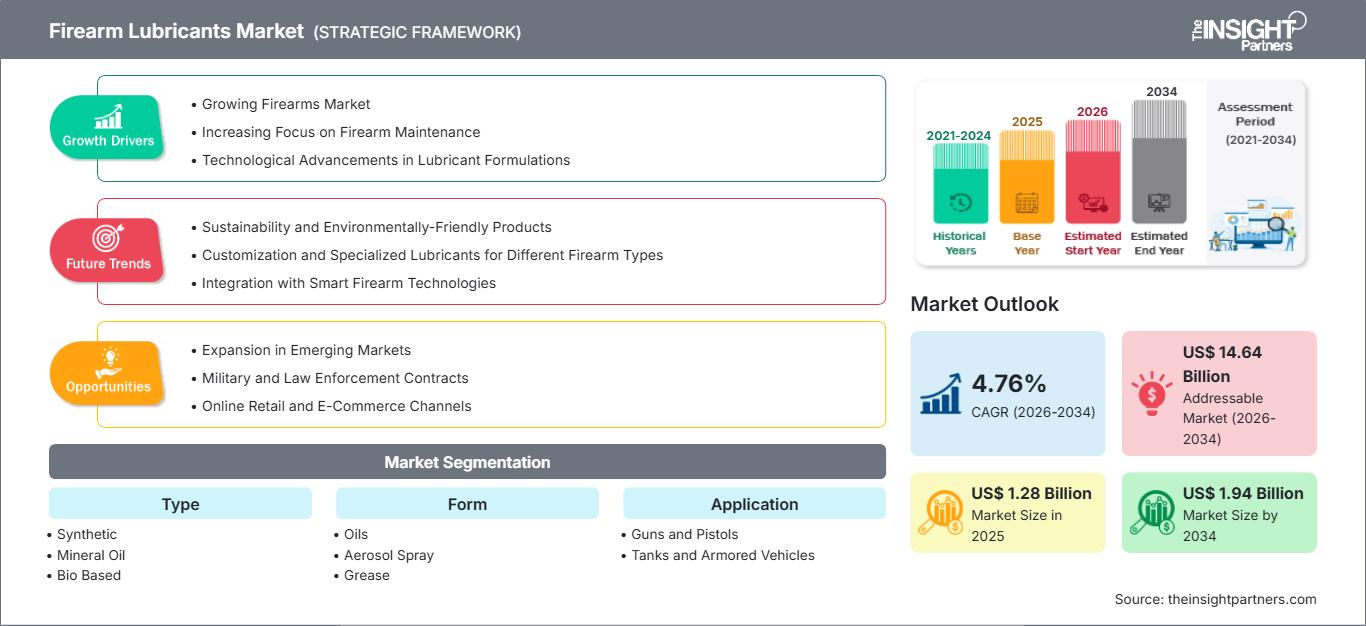
2025 Market Size
US$ 1.28 Bn
Base year value
2034 Forecast
US$ 1.94 Bn
Projected by 2034
CAGR 2026-2034
4.76 %
Growth rate
Addressable Market
US$ 14.64 Bn
(2026-2034)
The firearm lubricants market is projected to expand from US$ 1.28 Billion in 2025 to US$ 1.94 Billion by 2034, registering a 4.76% CAGR during 2026–2034. The market encompasses lubricating products formulated for firearm maintenance and protection, with demand shaped by firearm ownership, military and law-enforcement equipment maintenance, shooting activity, storage requirements, and product formulation advances. Type, form, and application remain the principal dimensions influencing product selection, procurement patterns, performance requirements, and supplier positioning across regional markets.
Market demand is increasingly influenced by requirements for reliable operation under variable temperatures, humidity, high firing cycles, and prolonged storage. The firearm lubricants market size is particularly supported by North American consumption, where a large installed base of sporting, civilian, law-enforcement, and defense firearms creates recurring maintenance requirements. North America is estimated to register a ~4% CAGR through 2034, supported by replacement demand, specialized synthetic formulations, premium maintenance products, and procurement requirements for military and institutional users.
Firearm Lubricants Market Assessment and Insights
Regional Outlook
- North America: ~42% of the global market in 2025 | ~4% CAGR through 2034. Market position: North America represents the largest regional market, supported by an extensive installed base of firearms, established maintenance practices, specialist lubricant suppliers, shooting sports, law-enforcement requirements, and sustained defense-related procurement.
- US: ~90% of North American market revenue in 2025 | ~4% CAGR through 2034. Market position: The US accounts for most North American demand, with consumption spanning sporting firearms, pistols, rifles, institutional fleets, and defense applications. Product innovation is concentrated around synthetic, high-temperature, corrosion-resistant, and easy-application formulations.
- Europe: ~29% of the global market in 2025 | ~4% CAGR through 2034. Market position: Europe is a mature market with established maintenance standards and specialist suppliers. Germany represents the leading country in Europe, followed by established demand centers including the UK, France, Italy, and Spain.
- Asia Pacific: ~23% of the global market in 2025 | ~6% CAGR through 2034. Market position: Asia Pacific is the fastest-growing region, supported by defense modernization, domestic production capabilities, institutional procurement, and increasing technical requirements for equipment operating across diverse climatic environments.
Segment Outlook
- Guns and Pistols: ~70% Share in 2025 | ~5% CAGR through 2034. Market position: Guns and pistols account for the largest application demand because lubrication is integral to routine cleaning, corrosion prevention, storage, and operating reliability across sporting, civilian, law-enforcement, and military firearms.
- Bio Based: ~10% Share in 2025 | ~7% CAGR through 2034. Market position: Bio Based formulations represent the high-growth segment as suppliers respond to environmental considerations, formulation safety requirements, and demand for lower-impact maintenance products while maintaining corrosion protection and lubrication performance.
Competitive Coverage
AMSOIL Inc., Ballistol, G96 Products Inc., ITW-ROCOL, L and R Ultrasonics, Lucas Oil Products, Inc., MPT Industries, Pacific Specialty Oils, Radco Industries, Inc., Renewable Lubricants Inc.
Methodology
The Insight Partners follows Data Collection & Secondary Research, Primary Research, Data Analysis, and Data Triangulation & Final Review to validate market estimates and insights.
Source: The Insight Partners' analysis based on proprietary research, government publications, company annual reports, investor presentations, industry databases, and expert interviews.
From the use of standard mineral oil-based products, the firearm lubricants market has moved on to the development of special formulations based on corrosion prevention, thermal stability, wear resistance, ease of use, and compatibility with modern materials used in firearms. The development of products has now begun to differentiate among general purpose oils, aerosols, heavy grease products, and multifunctional fluids. Synthetic formulations have become relevant for those who need stable performance over changes in temperature and long-term maintenance, while blended formulations are being developed to meet requirements of cost and performance.
Going forward, product development will go beyond traditional wet lubricants to formulate products with better surface protection and less environmental effects. The key growth opportunities in Asia Pacific region can be attributed to defense production and modernization programs in several countries. Environmental and product safety concerns would be significant in Europe along with performance. Thus, investment will go into formulation technologies, packaging efficiency, application specific products, and distribution rather than increasing capacity for undifferentiated lubricants.
Firearm Lubricants Market Report Scope
| Report Attribute | Details |
|---|---|
| Market size in 2025 | US$ 1.28 Billion |
| Market Size by 2034 | US$ 1.94 Billion |
| Global CAGR (2026 - 2034) | 4.76% |
| Historical Data | 2021-2024 |
| Forecast period | 2026-2034 |
Firearm Lubricants Market Analysis
Demand arises due to the need for maintenance in civilian guns, sporting equipment, law enforcement stock, and defense stock. The use of lubricants helps in meeting several maintenance objectives including reduction in friction, preventing corrosion, ease of movement of parts, and storing. The value chain consists of base oil and additives suppliers, formulators, packagers, distributors, specialized firearm retailers, institutions' procurement departments, and the final customers. The choice of product will be determined by the structure of the gun, environment of operation, frequency of maintenance, storage conditions, and the required trade-off between cleaning, lubrication, and protection.
The supply chain is determined by formulation capability, additives availability, packaging technologies, regulations, and the distribution capabilities. There could be a few applications that manufacturers would serve using common formulations, though for institutions and defense there would be performance specifications. Aerosols would bring in packaging and logistics challenges, while oils and greases would give more formulation flexibility. The supplier resilience, therefore, will not only depend on the availability of materials but also formulating capability, packaging, regulation, and distribution networks.
Competition in the firearm lubricants market report is differentiated into specialist manufacturers of firearm maintenance lubricants and lubricant suppliers who have dedicated firearms line. Competitors in the market are: AMSOIL Inc. which is engaged in synthetic firearm lubrication; Ballistol is also one of the competitors with specialized offering of firearm maintenance lubricants; and Lucas Oil Products, Inc. engages in oils, greases and multifunctional maintenance products. G96 Products Inc., MPT Industries, Pacific Specialty Oils, Radco Industries, Inc., Renewable Lubricants Inc., ITW-ROCOL, and L and R Ultrasonics are some of the other competitors in the market.
Application specificity is becoming more important factor in the strategic positioning of lubricant than just volumes of lubricant supplied. Suppliers may create differentiation by use of synthetic base stocks, corrosion inhibition, extreme temperature performance, biodegradability, aerosols and high-use equipment formulation. It would mean that investment focus would be on formulation and packaging, regulation, distribution and qualifications. Diversified lubricant companies may benefit from their existing infrastructure, whereas specialists may benefit from their product performance and firearms maintenance knowledge.
● REPORT CUSTOMIZATION
Tailor This Report To Align With Your Specific Business Requirements
This report can be customized to align precisely with your business objectives, scope, and target markets. Customization options include tailored segmentation, geography, competitive analysis, and strategic insights to support informed decision-making.
Customize This Report →WHAT YOU CAN ADJUST
- ● Segmentations
- ● Geography
- ● Competitive Analysis
- ● Language Preferences
Firearm Lubricants Market: Strategic Insights
Regional Insights
North America Firearm Lubricants Market
In 2025, North America is estimated to have contributed around ~42% of the world demand, and will grow at a ~4% CAGR till 2034. Market size of this region is driven largely by the US, where firearm maintenance is a repeated need for uses including sporting, civilian, law-enforcement, and defense use cases. The large existing inventory provides a stable cycle for the replenishment of oils, sprays, greases, and protective formulations. Well-established specialty brands along with distribution channels facilitate access to products.
The contribution of Canada in terms of regional demand is negligible, where the requirement of such products depends on their application, i.e., sports, hunting, institutional use, and maintenance. The regional companies encounter competition in terms of ease of application and performance in varying temperatures. Formulations of synthetic nature can be used by those individuals needing stability, but the requirement of protection from corrosion is vital for the guns functioning in moist conditions.
U.S. Firearm Lubricants Market
North America accounted for ~90% of revenues of the US in 2025 and is forecast to grow by ~4% CAGR until 2034. This is due to a wide range of firearm installed bases available in the country and different kinds of consumers. Requirements include maintenance of civil weapons, hunting, sport shooting, law enforcement, military devices, and long-term storage of firearms. These applications ensure regular need for oils and more viscous substances.
There is also a high degree of product differentiation in the US market. Major players in the industry, such as AMSOIL Inc., G96 Products Inc., Lucas Oil Products, Inc., MPT Industries, and Renewable Lubricants Inc. compete in the market providing consumers with choices among various products based on temperature, corrosion protection, delivery methods, and frequency of maintenance. For example, aerosols are convenient for quick application of the substance.
Europe Firearm Lubricants Market
Europe accounted for ~29% of the global firearm lubricants market Share in 2025 and is projected to grow at ~4% CAGR until 2034. Germany is the dominant country within Europe with support from its industrial manufacturing base, firearm and sports equipment industry, and technical lubricants. The UK, France, Italy, and Spain also drive demand in the region via sporting, hunting, institutional, and military applications. As markets mature, growth becomes more dependent on replacing older products with newer ones, improving formula, and achieving performance gains.
Germany and Italy have key industrial manufacturing capabilities while France and the UK continue to have institutional and military requirements. Spain adds demand via its sporting and hunting applications, as well as industrial distribution channels. Within the region, there is a growing emphasis on chemical handling, environmental impact, packaging, and documentation from the suppliers. Such an environment presents opportunities for developing biodegradable or less harmful formulations, as well as multi-functional products that can serve as both corrosion inhibitors and lubricants. Brands such as Ballistol, as well as general industrial lubricant suppliers, can compete on such grounds.
APAC Firearm Lubricants Market
In the Asia Pacific region, the firearm lubricants market share was around ~23% of the total market in 2025 and the expected growth rate was ~6% CAGR in 2034, which makes it the fastest-growing region. China is the top country in the Asia Pacific region, owing to the presence of defense manufacturing, industries, and equipment modernization. Japan and South Korea are contributing due to their advanced manufacturing and institutional uses, whereas India adds extra demand due to defense procurement and domestic production.
Australia is contributing due to the sports, hunting, and institutional maintenance needs. In the APAC region, the demand is being driven by climate diversification, operating environment of the equipment, and procurement demands for maintenance products which perform reliably. Those suppliers who can provide reliable performance in humid, hot, dusty, and different temperature environment conditions can cover many requirements.
Middle East & Africa Firearm Lubricants Market
Middle East & Africa represents a smaller portion of global demand but has specialized requirements connected with defense fleets, security applications, equipment storage, and harsh operating environments. Saudi Arabia is the leading country in the Middle East & Africa region based on defense-oriented demand and procurement activity, while the UAE represents an important regional distribution and institutional market. South Africa contributes through sporting, hunting, security, and industrial channels.
Factors contributing to regional demand include the presence of heat, dust, climatic conditions for storage, and equipment maintenance. These factors make formulations that will be able to retain their protective qualities in tough conditions suitable for use. The growth of infrastructure, modernizing of the military, and institutional purchases form the basis of future demand. Distribution capability is also relevant as market demand for the formulation will be limited to specialized institutions.
Segmentation Analysis
Type
The Type segment in the firearm lubricants market is characterized by different performance, cost, environmental, and application requirements. Synthetic products are important where users require stable viscosity and performance across temperature changes. Mineral Oil products remain relevant because of established use and cost considerations. Bio Based products are gaining attention as formulation technology improves, while Blended formulations provide manufacturers with flexibility to balance performance and economics. The Type segment is projected to record a ~5% CAGR during 2026–2034, with formulation specialization supporting premium demand.
- Synthetic: Synthetic lubricants serve applications requiring consistent performance across changing temperatures and repeated operating cycles. Their positioning is supported by durability, formulation flexibility, and suitability for users prioritizing reliability and specialized performance over minimum product cost.
- Mineral Oil: Mineral oil formulations remain established in routine firearm maintenance because of familiar handling characteristics, broad formulation availability, and competitive economics. They continue to serve applications where standard lubrication and corrosion protection requirements can be met without specialized formulation attributes.
- Bio Based: Bio based products are gaining strategic relevance as suppliers develop lower-impact formulations that retain required lubrication and corrosion-protection properties. Their adoption is particularly relevant where environmental considerations influence purchasing decisions or institutional maintenance policies.
- Blended: Blended formulations allow manufacturers to combine characteristics of different base stocks and additives. They can provide a practical balance between performance, cost, corrosion protection, temperature stability, and application requirements across diverse firearm-maintenance environments.
Form
The Form segment in the firearm lubricants market is influenced strongly by application convenience, viscosity, coverage, storage requirements, and user preference. Oils remain fundamental to controlled lubrication, while Aerosol Spray products support rapid and broad application. Grease is important where longer-lasting protection and resistance to displacement are required. Other Fluid products address specialized cleaning, protection, and maintenance functions. The Form segment is expected to register a ~5% CAGR during 2026–2034 as suppliers improve delivery formats and formulation performance.
- Oils: Oils provide controlled application to moving components and metal surfaces and remain central to routine maintenance. Their broad applicability supports demand across civilian, sporting, institutional, and defense users seeking direct application and predictable lubrication.
- Aerosol Spray: Aerosol sprays emphasize convenience, penetration, and rapid coverage. They are strategically relevant for users maintaining multiple components or requiring fast application during routine cleaning, while packaging design influences portability, dispensing precision, and distribution economics.
- Grease: Grease is positioned for applications requiring greater staying power and resistance to displacement. It is particularly relevant for high-friction interfaces, demanding operating conditions, and storage applications where a persistent protective layer is preferred.
Application
Application segment in the firearm lubricants market demand is divided between Guns and Pistols and Tanks and Armored Vehicles, reflecting differences in equipment scale, maintenance cycles, operating environments, and procurement requirements. The Application segment is projected to expand at approximately ~5% CAGR during 2026–2034. Guns and pistols account for the larger demand base because of their broad installed population and recurring individual and institutional maintenance requirements, while armored platforms require specialized high-load and harsh-environment lubrication.
- Guns and Pistols: Guns and pistols represent the largest application category, supported by recurring cleaning, lubrication, corrosion prevention, and storage requirements. Demand spans sporting, hunting, civilian, law-enforcement, and military users, creating a diversified consumption base across product forms.
- Tanks and Armored Vehicles: Tanks and armored vehicles require specialized maintenance products for demanding operating environments, high mechanical loads, dust, temperature variation, and extended deployment. Procurement is more institutionally driven, with product selection influenced by reliability, compatibility, qualification, and service conditions.
End-use
The end-use segment is a key factor influencing demand within the Firearm Lubricants Market, as lubrication requirements vary based on operational intensity, environmental conditions, weapon maintenance schedules, and performance expectations. Firearm lubricants play a critical role in reducing wear, preventing corrosion, enhancing reliability, and ensuring smooth firearm operation under demanding conditions. Growing investments in defense modernization, law enforcement equipment upgrades, and civilian firearm ownership continue to support market expansion. Among end-use segments, the Military and Defense sector is expected to register a CAGR of ~6% during 2026–2034, driven by increasing defense spending, weapon system procurement programs, and stringent firearm maintenance requirements.
- Military and Defense: This segment represents a major consumer of firearm lubricants due to extensive use of small arms, machine guns, sniper systems, and tactical weapons. Military organizations require high-performance lubricants capable of operating in extreme temperatures, harsh environments, and prolonged deployment conditions while ensuring weapon readiness and reliability.
- Police and Private Security: Law enforcement agencies and private security providers utilize firearm lubricants to maintain service weapons used in daily operations, training exercises, and emergency response activities. Demand is supported by regular maintenance schedules, equipment modernization initiatives, and increasing emphasis on operational reliability and officer safety.
- Security Individuals: Civilian firearm owners, recreational shooters, hunting enthusiasts, and personal security users rely on firearm lubricants to protect firearms from corrosion, minimize mechanical wear, and maintain accuracy. Rising awareness of firearm maintenance practices and growth in recreational shooting activities continue to contribute to demand within this segment.
Opportunity Snapshot
| Application | Revenue Contribution | Trend Tag | Adoption Stage |
| Guns and Pistols | High | Routine Maintenance | Mature |
| Tanks and Armored Vehicles | Medium | Defense Modernization | Scaling |
Firearm Lubricants Market Growth Drivers and Impact Analysis
Expansion of Specialized High-Performance Formulations
Demand for specialized formulations is increasing as users place greater emphasis on reliability under temperature variation, repeated firing, moisture exposure, and prolonged storage. Conventional lubrication remains necessary, but purchasing decisions increasingly consider viscosity stability, corrosion protection, wear control, penetration, and residue management. This encourages manufacturers to develop differentiated synthetic, blended, ceramic-enhanced, and other advanced formulations rather than competing only on basic lubrication performance. The market impact is a gradual shift toward higher-value products in applications where equipment reliability has a greater cost consequence. Suppliers able to demonstrate performance across multiple environmental conditions can strengthen institutional and specialist distribution relationships, while established manufacturers can use formulation expertise to extend existing product portfolios into higher-performance maintenance categories.
Rising Defense Equipment Maintenance Requirements
Defense equipment creates recurring demand because lubricants are consumable maintenance inputs rather than one-time equipment purchases. As military fleets undergo modernization, maintenance programs must address both new equipment and existing platforms remaining in service. Firearms and armored vehicles can operate in environments involving dust, heat, moisture, cold conditions, and extended storage, increasing the importance of products formulated for specific operating conditions. The resulting market effect is greater differentiation between consumer-oriented maintenance products and institutional-grade solutions. Suppliers serving defense customers can benefit from qualification capabilities, technical documentation, consistent production, and established procurement relationships. This driver also supports demand for products that reduce maintenance burden or extend service intervals, provided performance requirements and procurement specifications are satisfied.
Growing Preference for Environmentally Considered Lubricants
Environmental considerations are influencing lubricant formulation and purchasing decisions across several industrial maintenance categories, creating an opportunity for firearm lubricant suppliers to develop lower-impact alternatives. Bio based formulations can address this requirement when they provide adequate lubrication, corrosion protection, material compatibility, and storage stability. Adoption is likely to remain application-dependent because performance and reliability remain essential for firearm maintenance. Nevertheless, the development of improved base stocks and additive systems can narrow the performance gap between conventional and environmentally considered formulations. The commercial impact extends beyond product chemistry into packaging, labeling, regulatory documentation, and institutional procurement. Suppliers that integrate environmental attributes without compromising functional performance can create differentiated products for users and organizations with explicit sustainability requirements.
Firearm Lubricants Market Future Trends
Multifunctional Maintenance Products and Advanced Surface Protection
Future product development is likely to increasingly combine lubrication, corrosion protection, cleaning support, and surface preservation within integrated maintenance solutions. Users seek to reduce the number of products and maintenance steps required during routine servicing, particularly where equipment must be returned to service quickly. Formulators are therefore likely to focus on additive systems capable of providing multiple protective functions without creating residue or compatibility concerns. Advanced surface treatments may also complement conventional liquid lubrication, particularly for components exposed to repeated friction and harsh environments. This firearm lubricants market trend could alter competitive positioning because product performance will increasingly be evaluated as part of an overall maintenance process rather than solely by viscosity or lubricating ability. Suppliers with formulation and application-testing capabilities will be positioned to develop such integrated solutions.
Expansion of Bio Based and Low-Impact Formulation Platforms
The development of bio based lubricant technologies is expected to progress as formulators improve oxidation stability, temperature performance, corrosion protection, and material compatibility. Future products are likely to focus on maintaining firearm-specific performance while reducing environmental impact rather than relying solely on renewable content as a marketing characteristic. Institutional users may become an important target where procurement frameworks incorporate environmental considerations alongside technical requirements. Product development could also extend to lower-residue formulations and packaging systems that reduce material consumption. Adoption will remain dependent on demonstrated reliability, shelf life, and compatibility with metals, polymers, coatings, and other firearm materials. As these technical constraints are addressed, bio based formulations can move from niche positioning toward broader use in selected maintenance applications.
Firearm Lubricants Market Opportunities
Application-Specific Products for Harsh Operating Environments
An important opportunity exists in products designed specifically for high-temperature, dusty, humid, cold, or prolonged-storage environments. A single general-purpose lubricant cannot always optimize performance across all conditions, creating room for application-specific formulations with defined operating windows and maintenance objectives. Suppliers can develop differentiated products for military field use, desert environments, maritime exposure, cold-weather operations, or high-round-count applications. Such specialization can support premium positioning where product performance reduces maintenance burden or protects equipment value. Commercial execution should focus on validated performance data, clear application instructions, compatible packaging, and distribution through channels that reach professional and institutional users. This opportunity in the firearm lubricants market forecast is particularly relevant in regions where environmental conditions place greater stress on equipment maintenance.
Institutional and Defense Maintenance Supply Programs
Institutional procurement offers an opportunity to develop longer-term supply relationships rather than relying solely on individual retail purchases. Defense organizations, law-enforcement agencies, training facilities, and large equipment operators require recurring maintenance inputs and may prioritize consistency, documentation, availability, and compatibility. Suppliers can address this opportunity through standardized packaging, bulk supply arrangements, technical support, product qualification, and reliable distribution. The opportunity also extends to maintenance contractors responsible for servicing equipment fleets. Successful participation requires understanding procurement specifications and maintaining consistent formulation quality across production lots. Companies with established industrial lubricant capabilities can leverage manufacturing and quality systems, while specialist firearm brands can differentiate through application expertise and dedicated technical support.
Recent Developments
- February 2026: At IWA OutdoorClassics 2026, CICO presented their firearm care line:CICO GUNCLEANER GC 55, CICO GUNSPRAY GS 77, and CICO GUNLUBE GL 99. These solutions are engineered for real-world use—where operational safety and long-lasting protection matter most.
- March 2025: Clenzoil launched all-new carbon cleaner, synthetic oil & ultrasonic solution. All are all designed with one goal in mind: to make firearm maintenance simpler, more effective, and more customizable for every shooter.
Frequently Asked Questions

- Comprehensive Market Sizing and Forecast Analysis
- Detailed Segmentation Analysis
- In-Depth Market Dynamics Assessment
- Regional and Country-Level Insights
- Competitive Landscape and Company Benchmarking
- Strategic Business Intelligence
Recent Reports
Testimonials

The Insight Partners provided valuable market intelligence that supported our global go-to-market strategy. Their team was professional, responsive, and attentive to our feedback, providing thoughtful analysis and helpful methodological clarifications throughout the project.
Junmo Kim Chief Financial Officer (CFO), Enertech Co., Ltd.
The Insight Partners' SCADA System Market report is comprehensive, with valuable insights on current trends and future forecasts. The team was highly professional, responsive, and supportive throughout. We are very satisfied and highly recommend their services.
RAN KEDEM Partner, Reali Technologies LTDs
I requested a report on a very specific software market and the team produced the report in a few days. The information was very relevant and well presented. I then requested some changes and additions to the report. The team was again very responsive and I got the final report in less than a week.
JEAN-HERVE JENN Chairman, Future Analytica
We worked with The Insight Partners for an important market study and forecast. They gave us clear insights into opportunities and risks, which helped shape our plans. Their research was easy to use and based on solid data. It helped us make smart, confident decisions. We highly recommend them.
PIYUSH NAGPAL Sr. Vice President, High Beam Global
The Insight Partners delivered insightful, well-structured market research with strong domain expertise. Their team was professional and responsive throughout. The user-friendly website made accessing industry reports seamless. We highly recommend them for reliable, high-quality research services
YUKIHIKO ADACHI CEO, Deep Blue, LLC.
This is the first time I have purchased a market report from The Insight Partners.While I was unsure at first, I visited their web site and felt more comfortable to take the risk and purchase a market report.I am completely satisfied with the quality of the report and customer service. I had several questions and comments with the initial report, but after a couple of dialogs over email with their analyst I believe I have a report that I can use as input to our strategic planning process.Thank you so much for taking the extra time and making this a positive experience.I will definitely recommend your service to others and you will be my first call when we need further market data.
JOHN SUZUKI President and Chief Executive Officer, Board Director, BK Technologies
I wish to appreciate your support and the professionalism you displayed in the course of attending to my request for information regarding to infectious disease IVD market in Nigeria. I appreciate your patience, your guidance, and the fact that you were willing to offer a discount, which eventually made it possible for us to close a deal. I look forward to engaging The Insight Partners in the future, all thanks to the impression you have created in me as a result of this first encounter.
DR CHIJIOKE ONYIA MANAGING DIRECTOR, PineCrest Healthcare Ltd.Reason to Buy
- Informed Decision-Making
- Understanding Market Dynamics
- Competitive Analysis
- Identifying Emerging Markets
- Customer Insights
- Market Forecasts
- Risk Mitigation
- Boosting Operational Efficiency
- Strategic Planning
- Investment Justification
- Tracking Industry Innovations
- Aligning with Regulatory Trends





 Get Free Sample for