
Green and Bio-Solvents Market Share, Size & Demand by 2034
Coverage: By Type (Alcohols, Glycols, Diols, Lactate Esters, D-Limonene, Methyl Soyate, Others); Application (Industrial and Domestic Cleaners , Paints and Coatings , Adhesives and Sealants, Printing Inks , Pharmaceuticals, Others) , and Geography (North America, Europe, Asia Pacific, and South and Central America)
- Status : Data Released
- Report Code : TIPRE00019641
- Category : Chemicals and Materials
- No. of Pages : 150
- Available Report Formats :


- Last update date : November 03, 2026


2025 Market Size
US$ 5.85 Bn
Base year value
2034 Forecast
US$ 10.67 Bn
Projected by 2034
CAGR 2026-2034
6.90 %
Growth rate
Addressable Market
US$ 74.60 Bn
(2026-2034)
The Green and Bio-Solvents Market was valued at US$ 5.85 Billion in 2025 and is projected to reach US$ 10.67 Billion by 2034, registering a mathematically corrected CAGR of 6.90% during 2026–2034. Market development is supported by interest in renewable feedstocks, demand for alternative solvent chemistries, and efforts to reduce dependence on conventional petroleum-derived ingredients. Commercial adoption depends on product performance, manufacturing economics, feedstock availability, and compatibility with established industrial formulations.
North America is positioned to benefit from its established chemical manufacturing infrastructure, extensive industrial customer base, and technical capabilities in specialty formulations. Demand for lower-impact solvents across cleaning products, coatings, adhesives, and other industrial applications provides opportunities for suppliers able to demonstrate consistent performance. Regional expansion will depend on the economics of renewable feedstocks, the availability of suitable production technologies, and the ability of manufacturers to integrate alternative solvents into existing processes without compromising quality or operational efficiency.
Green and Bio-Solvents Market Assessment and Insights
Regional Outlook
- North America: ~34% of the global market in 2025 | ~7% CAGR through 2034. Market position: North America is estimated to hold the largest regional share, supported by established specialty chemical production, industrial formulation expertise, and developed distribution networks. Demand is influenced by product substitution, technical qualification, and access to renewable feedstocks.
- US: ~75% of North American market revenue in 2025 | ~7% CAGR through 2034. Market position: The US represents the principal national market in North America under the modeled allocation. Its chemical manufacturing base, diversified industrial demand, and established supplier networks support opportunities across cleaning, coatings, and specialty formulation applications.
- Europe: ~27% of the global market in 2025 | ~7% CAGR through 2034. Market position: Europe benefits from established specialty chemical industries and growing attention to renewable material sourcing. Germany is estimated to be the largest country market in Europe, with France, the UK, Italy, and Spain contributing through manufacturing and formulation demand.
- Asia Pacific: ~30% of the global market in 2025 | ~8% CAGR through 2034. Market position: Asia Pacific is the fastest-growing region in this modeled outlook, supported by expanding manufacturing activity, downstream chemical demand, and opportunities to use locally available biomass. China and India provide important growth avenues, alongside technically advanced markets in Japan and South Korea.
Segment Outlook
- Application: ~60% share in 2025 | ~7% CAGR through 2034. Market position: Application is estimated to represent the largest main segment because solvent purchasing is determined by the performance requirements of finished formulations. Industrial and domestic cleaners, coatings, adhesives, printing inks, and pharmaceutical uses present distinct opportunities and qualification requirements.
- Type: ~40% share in 2025 | ~7% CAGR through 2034. Market position: Type reflects the chemical properties that determine suitability for different end uses. Growth depends on solvent performance, purity, feedstock economics, manufacturing consistency, and the ability to substitute for conventional ingredients without creating additional formulation or processing costs.
Competitive Coverage
Archer Daniels Midland Company, BASF SE, Cremer Oleo GmbH & Co. KG, Solvay SA, Stepan Company, Dow Inc., GF Biochemicals, Cargill, Incorporated, Evonik Industries AG, and LyondellBasell Industries N.V.
Methodology
The Insight Partners follows Data Collection & Secondary Research, Primary Research, Data Analysis, and Data Triangulation & Final Review to validate market estimates and insights.
Source: The Insight Partners' analysis based on proprietary research, government publications, company annual reports, investor presentations, industry databases, and expert interviews.
Biomass processing, renewable chemicals development, and creation of new types of solvents to replace conventional petro-solvents have been crucial in developing the industry of green solvents and bio-solvents. The feedstock may be based on agricultural residues, oils, sugar, and other renewable biomass. The chemicals produced might have desirable qualities that make them applicable for purposes of cleaning, coating, bonding, printing, etc. Nevertheless, just being made of biomass is not enough to determine environmental superiority and applicability of products. It is necessary to show consistent quality and competitiveness of products as well as their sources.
Commercial success through 2034 will require investment in conversion technologies, supply chain partnerships, and the qualification of products for specific applications. Newly forming economies can take advantage of the local availability of biological feedstocks and increasing needs for formulated chemicals. Industrial markets that are already developed may provide an opening for companies to satisfy customer demands for traceability, quality control, and reduced use of nonrenewable materials. Economics play a major role, since alternatives have to compete with proven solvents in terms of both price and functionality.
Green and Bio-Solvents Market Report Scope
| Report Attribute | Details |
|---|---|
| Market size in 2025 | US$ 5.85 Billion |
| Market Size by 2034 | US$ 10.67 Billion |
| Global CAGR (2026 - 2034) | 6.90% |
| Historical Data | 2021-2024 |
| Forecast period | 2026-2034 |
Green and Bio-Solvents Market Analysis
Demand depends on the combination of the formulation performance, the purchasing needs of the industries, and the economics of the renewable resources. Customers evaluate solvents in relation to the solvency, evaporation properties, stability, compatibility, handling, and cost-in-use. Cleaners may prefer solvents which perform well in oil and residue removal, while coatings and adhesives will need a solvent which behaves predictably when reacted with resin and other formulation components. For printing inks, performance will depend on the dispersion and drying behaviors. Pharmaceutical usage will demand stringent requirements of purity and qualifications.
As such, demand for the renewable solvents is differentiated depending on their application rather than shifting uniformly from the conventional ones. The value chain involves the renewable feedstocks sourcing, conversion, purification, blending, quality control, distribution, and formulation. An integrated manufacturing process will help in the optimal use of resources and reduction in some of the logistics costs. Specialized producers can gain an edge by using proprietary chemistry and application knowledge. The supply side will be affected by feedstocks availability, competing uses of biomass, conversion efficiencies, energy costs, and purification expenses.
Competition comprises diverse chemical manufacturers, agricultural processors, specialty ingredients producers, and renewable chemical producers. BASF SE, Dow Inc., Solvay SA, and Stepan Company are competent in industrial chemicals and formulations. Archer Daniels Midland Company and Cargill, Incorporated are strong in agricultural processing, while Cremer Oleo GmbH & Co. KG is into oleochemical ingredients. GF Biochemicals, Evonik Industries AG, and LyondellBasell Industries N.V. are competent in renewable chemicals, specialty chemicals, or industrial chemicals supply. These companies have been chosen for their competency in the industry but their presence here does not imply that all the companies derive substantial income from all the product categories in this market.
The investment will probably be in process efficiency, customer qualification, distribution channels, and dependable commercial offtake. Traditional suppliers can utilize their technical services groups and customer contacts to enable trials of new products, whereas specialty suppliers might distinguish themselves with their feedstock-to-product conversion technology or specialty products. Collaboration between technology companies, biomass processing companies, and formulation companies will enable distribution of the risk of development, along with better access to customers. Investors should evaluate the established performance in production, raw material supply security, market fit for the products, and economic feasibility in scale-up.
● REPORT CUSTOMIZATION
Tailor This Report To Align With Your Specific Business Requirements
This report can be customized to align precisely with your business objectives, scope, and target markets. Customization options include tailored segmentation, geography, competitive analysis, and strategic insights to support informed decision-making.
Customize This Report →WHAT YOU CAN ADJUST
- ● Segmentations
- ● Geography
- ● Competitive Analysis
- ● Language Preferences
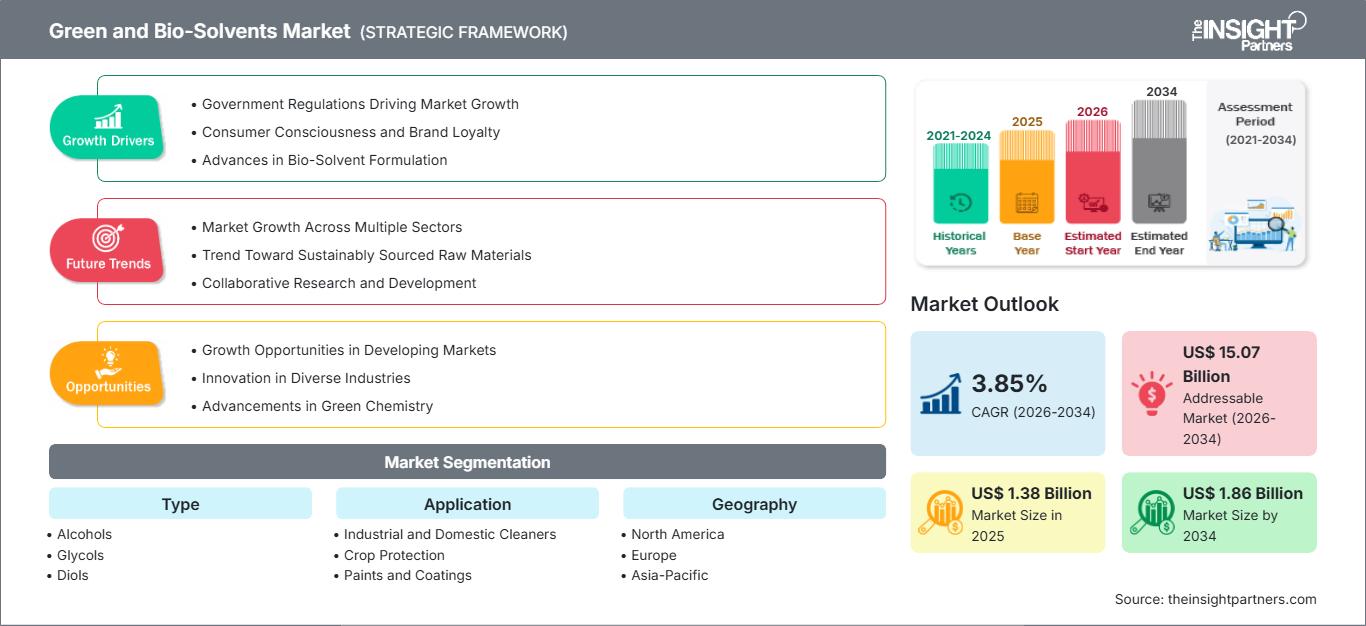
Green and Bio-Solvents Market: Strategic Insights
Regional Insights
North America Green and Bio-Solvents Market
North America is estimated to account for ~34% of global revenue in 2025 and is projected to register a CAGR of ~7% through 2034. The site location is based on existing chemical manufacturing capacity, specialty formulation abilities, and strong distribution channels. Industrial customers in the region can test alternative solvents using existing purchasing and product development methods. The US will be the major source of demand for the region in the proposed scenario while Canada and Mexico will provide the demand in terms of industrial activity, chemical distribution, and manufacturing. Development of the market depends on the ability of the renewable solvents to compete with conventional solvents in terms of performance and cost. Cleaning products need appropriate solvating and compatibility abilities, and coatings and adhesives need proper dispensing behavior. The suppliers can increase the chances of acceptance through product testing and reliable supply of products but the feedstock cost, conversion cost, and qualification criteria for customers still pose challenges.
U.S. Green and Bio-Solvents Market
The US is estimated to account for ~75% of North American market revenue in 2025 and is projected to grow at a CAGR of ~7% through 2034. Its position in North America has been facilitated by its extensive chemical production capacity, industrial customers, and well-established supply chains. Formulations and manufacturers can explore renewable possibilities in current product development and quality control systems. Archer Daniels Midland Company, Dow Inc., and Stepan Company have facilities related to agricultural processing, specialty chemicals, or formulations, but financial risks associated with such a market must be confirmed for each product individually.
Usage requirements vary depending on formulation demands. Industrial cleaners require good solvency properties and surfactant compatibility. Coatings and adhesives require proper performance in use and production. Print ink manufacturers consider dispersion and drying properties as well as print quality. Pharmaceutical buyers usually need more rigorous purity control and testing before accepting a new component. Companies combining technical advice with good availability can lower customer qualification difficulties. However, the substitution will be based on cost-in-use, consistency, and applicability to the application.
Europe Green and Bio-Solvents Market
Europe is estimated to account for ~27% of the global market in 2025 and is projected to record a CAGR of ~7% through 2034. Germany is expected to have the largest country market in Europe based on the existing chemical industry, coatings manufacturing, and manufacturing capabilities. Examples include BASF SE and Evonik Industries AG, which show the specialty chemical expertise in the region but do not represent the green solvent market shares in the region as far as their portfolio is concerned. Demand from the region is affected by industrial procurement, formulations, and renewable raw material needs.
UK adds its strength in specialty chemicals, research, and formulations. France has established itself in terms of chemistry and manufacturing. Similarly, Italy and Spain contribute to the demand for coatings, adhesives, printing, and industrial formulations. There are different aspects of adoption in the respective markets based on industrial structure, purchasing criteria, and alternative options. Customers require technical performances and documentation prior to switching formulations.
European sustainability policies and corporate sourcing objectives can encourage evaluation of renewable solvents, but their impact depends on actual application requirements and cost competitiveness. Manufacturers must consider product safety, lifecycle evidence, supply reliability, and the technical consequences of substitution. Suppliers with dependable sourcing arrangements and application-specific technical support may be better positioned to build recurring customer demand. Market development will depend on commercially viable products rather than environmental positioning alone.
APAC Green and Bio-Solvents Market
Asia Pacific is estimated to account for ~30% of global revenue in 2025 and is projected to grow at a CAGR of ~8% through 2034, making it the fastest-growing region in this modeled outlook. China is estimated to be the largest country market in Asia Pacific, supported by its extensive chemical manufacturing base and industrial demand. India offers opportunities through manufacturing expansion and the potential use of agricultural feedstocks. Japan and South Korea contribute through advanced chemical production and technically demanding industrial applications.
Australia provides additional opportunities through biomass resources and industrial chemical demand, although its market structure differs from the region's larger manufacturing economies. Growth depends on production economics, feedstock availability, formulation performance, and distribution infrastructure. Policy initiatives supporting resource efficiency may encourage product development, but adoption still requires reliable specifications and competitive pricing. Local partnerships can help connect renewable feedstock processors with established chemical manufacturers and downstream buyers.
Middle East & Africa Green and Bio-Solvents Market
The Middle East and Africa market is projected to register a CAGR of ~7% through 2034. The region's development is linked to industrial diversification, chemical manufacturing investment, and demand for cleaning and formulated products. Saudi Arabia and the United Arab Emirates have established energy and chemical infrastructure, while South Africa contributes through industrial processing and manufacturing. The availability of suitable renewable feedstocks and the economics of converting them into solvent products will influence the feasibility of local production.
Saudi Arabia is a potential leading country in the Middle East and Africa for industrial chemical investment, although a definitive market-share ranking requires compatible product-level evidence. The UAE can support regional distribution and trade, while South Africa serves several industrial and commercial applications. Infrastructure, water availability, energy costs, logistics, and technical capabilities will affect investment decisions. Import-based supply may remain commercially relevant where local production cannot achieve the required scale, consistency, and cost competitiveness.
Segmentation Analysis
Type
The Type segment reflects the chemical properties that determine how green solvents perform in industrial and commercial formulations. Selection depends on solvency, evaporation characteristics, stability, compatibility, purity, and cost-in-use. Suppliers compete through consistent specifications, efficient conversion processes, and the ability to provide application support. Bioalcohols are modeled as the largest sub-segment within the type category because of their established solvent functionality and broad industrial relevance. The overall segment is projected to register a CAGR of ~7% through 2034, subject to renewable feedstock economics and the commercial suitability of individual products.
- Bioalcohols: Bioalcohols are renewable solvent options for selected cleaning, formulation, and chemical processing applications. Their commercial relevance depends on purity, evaporation behavior, compatibility, reliable supply, and cost relative to established conventional ingredients.
- Bio-Diols: Bio-diols serve as renewable chemical building blocks where specific molecular functionality is required. Their suitability depends on consistent chemical specifications, conversion economics, compatibility with downstream synthesis, and the technical requirements of the intended application.
- Biogycols: Bioglycols, as specified in the supplied taxonomy, can be considered for applications requiring defined solvent or intermediate properties. Commercial acceptance depends on product grade, purity, processing consistency, and demonstrated compatibility with downstream formulations.
- Lactate Esters: Lactate esters provide solvent functionality for selected formulations where solvency and material compatibility are important. Their adoption depends on application testing, evaporation behavior, manufacturing economics, and the ability to meet customer performance specifications.
Application
The Application segment connects solvent properties with end-user requirements and purchasing decisions. Customers assess ingredients according to product performance, manufacturing conditions, quality requirements, and total formulation cost. Adoption patterns differ because each application has distinct technical specifications and tolerance for reformulation. Pharmaceutical applications are modeled as a relatively high-growth area within the supplied taxonomy, reflecting potential demand for suitable alternative solvents, although stringent qualification and purity requirements can limit the pace of adoption. The overall Application segment is projected to register a CAGR of ~7% through 2034.
- Industrial & Domestic Cleaners: Cleaning formulations require effective solvency, compatibility with surfactants, and stable performance during storage and use. Buyers consider cleaning efficacy, handling requirements, product stability, and the cost of maintaining formulation performance.
- Paints & Coatings: Coatings manufacturers evaluate solvents for compatibility with resins, drying behavior, application characteristics, and finished-film quality. Renewable alternatives must meet technical specifications and production requirements to become viable substitutes for conventional ingredients.
- Adhesives: Adhesive formulations require appropriate viscosity, wetting, polymer compatibility, and dependable bonding performance. Ingredient substitution depends on testing under intended manufacturing and application conditions to ensure that the finished product retains its required properties.
- Printing Inks: Printing ink producers consider solvent behavior, pigment dispersion, drying characteristics, print quality, and equipment compatibility. Adoption depends on whether alternative ingredients meet production requirements and maintain consistent results across substrates and operating conditions.
- Pharmaceuticals: Pharmaceutical applications impose rigorous expectations for purity, traceability, consistency, and process validation. Adoption of alternative solvents requires documented material specifications and qualification for the intended process, making technical assurance central to purchasing decisions.
Opportunity Snapshot
| Application | Revenue Contribution | Trend Tag | Adoption Stage |
| Industrial & Domestic Cleaners | High | Renewable Cleaning | Scaling |
| Paints & Coatings | High | Bio-Based Formulation | Scaling |
| Adhesives | Medium | Resin Compatibility | Emerging |
| Printing Inks | Medium | Solvent Substitution | Emerging |
| Pharmaceuticals | Low | High-Purity Solvents | Emerging |
Green and Bio-Solvents Market Growth Drivers and Impact Analysis
Growing Demand for Renewable Chemical Feedstocks
Industrial manufacturers are evaluating renewable feedstocks to diversify raw material sourcing and reduce dependence on fossil-derived inputs. Agricultural residues, plant-derived oils, sugars, and other biomass resources can supply starting materials for suitable chemical pathways. Their commercial value depends on composition, availability, competing uses, and conversion requirements. For solvent producers, dependable sourcing can reduce exposure to individual feedstock markets, but biomass processing may introduce additional purification and logistics costs. The market growth outlook therefore depends on the ability to turn renewable inputs into products that meet industrial specifications at competitive prices. Suppliers that coordinate feedstock contracts with manufacturing capacity and customer demand can improve supply reliability. However, renewable sourcing alone does not guarantee lower environmental impacts or superior economics, making product performance and production efficiency essential to sustained adoption.
Industrial Formulation Requirements and Performance Consistency
Solvent purchasing decisions are determined by the functional requirements of the finished formulation. Cleaning products require effective removal of contaminants, while coatings and adhesives depend on compatibility with resins and additives. Printing inks need predictable dispersion and drying behavior, and pharmaceutical applications demand rigorous quality controls. These differences create distinct adoption pathways rather than a single market-wide substitution process. Manufacturers can improve the commercial prospects of renewable solvents through application testing, reliable technical documentation, and collaboration with customers during reformulation. Buyers must also consider total cost-in-use, including material consumption, handling, waste, and any changes to manufacturing processes. Products that maintain required performance without adding disproportionate operating costs are more likely to achieve repeat purchasing. The principal commercial impact is the creation of opportunities for suppliers that combine technical expertise with consistent production quality.
Biomass Valorization and Efficient Chemical Processing
Biomass valorization creates opportunities to convert biological resources and processing residues into commercially useful chemical intermediates. Pulping operations, agricultural processing facilities, and biorefineries can generate feedstock streams that may be suitable for conversion into renewable chemicals. The economics depend on feedstock composition, separation efficiency, energy use, purification requirements, and the market value of the resulting products. Integrated facilities can improve resource utilization when several outputs have viable buyers, but the value of a co-product should not be assumed before its quality and demand are established. Investment in process optimization can improve yield and product consistency, supporting more predictable manufacturing costs. For green solvent suppliers, commercially sustainable processing requires both reliable technical performance and customer qualification. Projects with demonstrated production results and credible offtake arrangements are better positioned than those relying only on theoretical feedstock potential.
Green and Bio-Solvents Market Future Trends
Greater Emphasis on Traceability and Verified Product Attributes
The future of renewable solvent procurement is likely to place greater emphasis on documented feedstock origin, renewable content, and production practices. Industrial customers increasingly need information that enables them to evaluate material sourcing and substantiate environmental claims within their own supply chains. Traceability systems and certification approaches can support these assessments when the methods and accounting boundaries are transparent. Suppliers using mass-balance approaches must distinguish attributed renewable content from physically identifiable content in the finished product. This distinction is important for buyers whose procurement standards require specific evidence of product composition. The Green and Bio-Solvents Market trends will consequently be shaped by both chemical innovation and the credibility of product documentation. Suppliers that provide consistent specifications and verifiable information may strengthen their position in procurement processes where environmental attributes are considered alongside price and technical performance.
Application-Specific Solvent Design and Formulation Innovation
Advances in chemical synthesis, purification, and formulation technology may broaden the range of applications suitable for renewable solvents. Rather than pursuing a single ingredient for every use, manufacturers can develop products tailored to the requirements of coatings, cleaning agents, adhesives, printing inks, and specialized industrial processes. Product development may focus on solvency, evaporation behavior, compatibility, stability, and handling characteristics. The challenge is to achieve these properties without increasing production costs or creating additional environmental burdens. Laboratory results must also translate into consistent commercial-scale performance. Closer collaboration between chemical producers and downstream formulators can help identify technically feasible applications and accelerate customer qualification. Over time, product portfolios may become more differentiated, with individual grades designed around particular performance requirements. Adoption will remain dependent on measurable technical suitability, reliable supply, and economics rather than renewable content alone.
Green and Bio-Solvents Market Opportunities
Building Regional Feedstock and Manufacturing Partnerships
Suppliers can pursue investment opportunities by connecting biomass producers, conversion technology developers, chemical manufacturers, and downstream customers. Processing facilities located near suitable feedstock sources may reduce transportation requirements and improve coordination, provided that infrastructure and feedstock quality support reliable operation. Before investing, companies should evaluate seasonal availability, competing biomass uses, conversion yields, energy requirements, purification costs, and customer specifications. Long-term supply agreements and customer qualification programs can help reduce the risks associated with raw material volatility and uncertain demand. Partnerships with established distributors may also provide access to technical support and industrial customers. Green and Bio-Solvents Market Forecasts become more useful for investment decisions when they are linked to actual feedstock availability, demonstrated manufacturing economics, and credible customer commitments. A staged investment strategy can limit capital exposure while allowing successful production pathways to scale.
Expanding Specialty Applications and Customer Qualification
Commercial opportunities also exist in developing renewable solvent products for applications where customers have identifiable technical requirements and a clear incentive to evaluate alternatives. Suppliers can work with coating manufacturers, cleaning product formulators, adhesive producers, and other industrial customers to assess compatibility and performance. Initial development should prioritize applications where qualification is achievable and substitution does not require extensive changes to manufacturing equipment. Testing should cover product stability, handling, safety documentation, and cost-in-use under realistic operating conditions. Pharmaceutical applications may offer specialized opportunities, but stringent purity and process-validation requirements can lengthen the route to commercialization. Manufacturers can reduce risk by linking investment to customer trials and qualification milestones. A disciplined approach to product development helps suppliers distinguish promising technical results from applications capable of supporting sustained commercial demand.
Recent Developments
- July 13, 2026: BASF SE expanded its certified biomass-balanced additives portfolio for architectural coatings with the introduction of Dispex AA 4145 MB, Rheovis PU 1333 MB, and Rheovis HS 1169 MB. The products are designed to help coatings manufacturers reduce product carbon footprints while maintaining established application performance. The launch illustrates how certified renewable feedstocks can be incorporated into existing industrial formulations. These products are coatings additives, not direct evidence of green solvent sales.
- November 24, 2025: Stepan Company and AmphiStar announced an exclusive distribution partnership covering upcycled bio-based surfactants across Europe, the Middle East, and Africa, targeting home care and industrial and institutional cleaning applications. The partnership combines AmphiStar's biosurfactant technology with Stepan's formulation expertise and customer network. It illustrates how specialty ingredient developers can work with established chemical suppliers to expand market access for renewable ingredients. The development concerns biosurfactants rather than solvent products specifically.
Frequently Asked Questions

- Comprehensive Market Sizing and Forecast Analysis
- Detailed Segmentation Analysis
- In-Depth Market Dynamics Assessment
- Regional and Country-Level Insights
- Competitive Landscape and Company Benchmarking
- Strategic Business Intelligence
Recent Reports
Testimonials

The Insight Partners provided valuable market intelligence that supported our global go-to-market strategy. Their team was professional, responsive, and attentive to our feedback, providing thoughtful analysis and helpful methodological clarifications throughout the project.
Junmo Kim Chief Financial Officer (CFO), Enertech Co., Ltd.
The Insight Partners' SCADA System Market report is comprehensive, with valuable insights on current trends and future forecasts. The team was highly professional, responsive, and supportive throughout. We are very satisfied and highly recommend their services.
RAN KEDEM Partner, Reali Technologies LTDs
I requested a report on a very specific software market and the team produced the report in a few days. The information was very relevant and well presented. I then requested some changes and additions to the report. The team was again very responsive and I got the final report in less than a week.
JEAN-HERVE JENN Chairman, Future Analytica
We worked with The Insight Partners for an important market study and forecast. They gave us clear insights into opportunities and risks, which helped shape our plans. Their research was easy to use and based on solid data. It helped us make smart, confident decisions. We highly recommend them.
PIYUSH NAGPAL Sr. Vice President, High Beam Global
The Insight Partners delivered insightful, well-structured market research with strong domain expertise. Their team was professional and responsive throughout. The user-friendly website made accessing industry reports seamless. We highly recommend them for reliable, high-quality research services
YUKIHIKO ADACHI CEO, Deep Blue, LLC.
This is the first time I have purchased a market report from The Insight Partners.While I was unsure at first, I visited their web site and felt more comfortable to take the risk and purchase a market report.I am completely satisfied with the quality of the report and customer service. I had several questions and comments with the initial report, but after a couple of dialogs over email with their analyst I believe I have a report that I can use as input to our strategic planning process.Thank you so much for taking the extra time and making this a positive experience.I will definitely recommend your service to others and you will be my first call when we need further market data.
JOHN SUZUKI President and Chief Executive Officer, Board Director, BK Technologies
I wish to appreciate your support and the professionalism you displayed in the course of attending to my request for information regarding to infectious disease IVD market in Nigeria. I appreciate your patience, your guidance, and the fact that you were willing to offer a discount, which eventually made it possible for us to close a deal. I look forward to engaging The Insight Partners in the future, all thanks to the impression you have created in me as a result of this first encounter.
DR CHIJIOKE ONYIA MANAGING DIRECTOR, PineCrest Healthcare Ltd.Reason to Buy
- Informed Decision-Making
- Understanding Market Dynamics
- Competitive Analysis
- Identifying Emerging Markets
- Customer Insights
- Market Forecasts
- Risk Mitigation
- Boosting Operational Efficiency
- Strategic Planning
- Investment Justification
- Tracking Industry Innovations
- Aligning with Regulatory Trends





 Get Free Sample for