
Paraffin Wax Market Size, Share & Demand by 2034
Coverage: by Type (Fully Refined Wax, Semi Refined Wax, Others); Application (Candles, Packaging, Board Sizing, Rubber, Others) , and Geography (North America, Europe, Asia Pacific, and South and Central America)
- Status : Data Released
- Report Code : TIPRE00011255
- Category : Chemicals and Materials
- No. of Pages : 150
- Available Report Formats :


- Last update date : September 22, 2026


2025 Market Size
US$ 5.62 Bn
Base year value
2034 Forecast
US$ 7.06 Bn
Projected by 2034
CAGR 2026-2034
2.57 %
Growth rate
Addressable Market
US$ 57.55 Bn
(2026-2034)
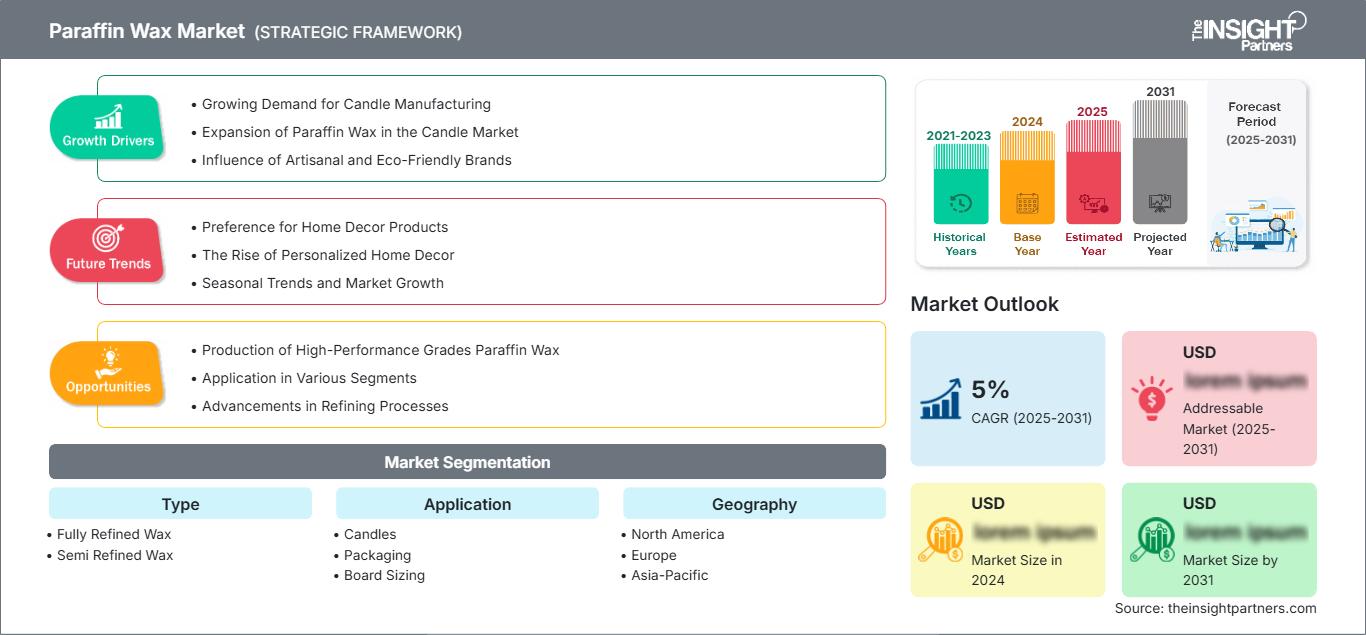
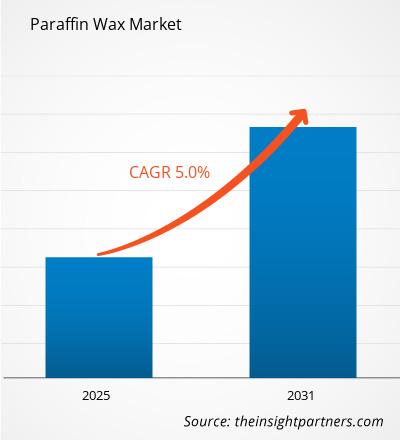
The global Paraffin Wax market was valued at US$ 5.62 billion in 2025 and is expected to reach US$ 7.06 billion by 2034; it is estimated to record a CAGR of 2.57% during 2026-2034.
Paraffin Wax Market Assessment and Insights
- North America: North America is expected to account for a 24–28% Paraffin Wax Market share in 2025 and expand at a 2.4–3.0% CAGR between 2026 and 2034, supported by candle manufacturing, packaging conversion, and established specialty wax distribution networks.
- U.S.: The U.S. represents approximately 78–84% of North America's 2025 demand, with a growth of 2.2–2.8% CAGR between 2026 and 2034, supported by candles, packaging, and industrial formulations.
- Europe: Europe is estimated at an 18–22% share in 2025 and is projected to grow at a 2.0–2.6% CAGR between 2026 and 2034, with Germany, the UK, France, Italy, and Spain supporting mature packaging, candle, rubber, and specialty applications.
- Asia Pacific: Asia Pacific is estimated to hold a 52–56% share in 2025 and grow at a 3.1–3.8% CAGR between 2026–2034, led by China and supported by India, Japan, South Korea, and expanding manufacturing activity.
- Largest Segment: Packaging is estimated at 31–34% market share in 2025, with a 2.9–3.5% CAGR from 2026–2034, reflecting sustained use of wax barriers in paperboard and converted packaging.
- High Growth Segment: Candles account for approximately 24–28% market share in 2025 and are expected to register 4.8–5.6% CAGR from 2026–2034, supported by decorative and functional candle demand.
- Key companies analyzed in detail: Exxon Mobil Corporation, Fushun Hengyi Petro and Chemical Co., Ltd., Honeywell International Inc., Nippon Seiro Co., Ltd., Numaligarh Refinery Limited, Petro-Canada Lubricants Inc., Petróleo Brasileiro S.A. - Petrobras, Repsol, S.A., Sasol Limited, China Petroleum & Chemical Corporation
Source: The Insight Partners' analysis based on proprietary research, government publications, company annual reports, investor presentations, industry databases, and expert interviews.
Economics of the products in the Paraffin Wax Market have evolved over time into the use of more specified products in purchases. Quality, oil content, melting point, color, and consistency are refined in order to determine its fit for candles, coatings, packaging, and rubber manufacture. The integrated refineries still have the upper hand in producing wax because wax manufacture is integrated into the refinery stream process. In addition, the specialty manufacturers compete by filtration, hydrogenation, mixing, packaging styles, and application support.
Expansion in future is expected to be driven by manufacturing countries with growing candle exports, packaging, production of consumer goods, and rubber manufacturing. China is structurally important and India provides growing incremental demand from manufacturing and consumer uses. Refinery integration, product purification, logistics, and food contact standards and application standards may affect the investment decision. Supply disruptions in some regions provide an opportunity for regional inventory.
Paraffin Wax Market Report Scope
| Report Attribute | Details |
|---|---|
| Market size in 2025 | US$ 5.62 Billion |
| Market Size by 2034 | US$ 7.06 Billion |
| Global CAGR (2026 - 2034) | 2.57% |
| Historical Data | 2021-2024 |
| Forecast period | 2026-2034 |
Paraffin Wax Market Analysis
The drivers for the development of the Paraffin Wax Market include low cost, phase predictability, moisture resistance, and compatibility with pigments, fragrances, polymers, and coatings. The demand cycle works in the value chain from feedstocks in crude oil and refineries, slack wax extraction, deoiling, hydrofining, blending, solidification, packaging, distribution, and subsequent processing in candles, packaging, and coatings. The candle industry focuses on melting characteristics and color while the packaging industry prefers barrier properties and coating uniformity.
Paraffin Wax Market supply largely depends on refinery utilization, choice of crude, cost of extraction, and regional flows of trade. Integrated producers have a better control of their feedstock sources in comparison with non-integrated converters; nevertheless, specialized distributors play a significant role in providing smaller customers. Disruptions in the flow of imports in West Asia have shown how dependence on imports influences delivery costs in consumer regions. Thus, consumers have started to balance spot procurement with contracted supplies, inventories, and multi-source sourcing.
Paraffin Wax Market Analysis is characterized by a competitive environment that is made up of integrated oil producers, national refineries, specialty wax manufacturers, and application-specific suppliers. Exxon Mobil Corporation has a wide range of products ranging from fully-refined to semi-refined varieties, while Repsol, S.A. caters to candle making, hot melt, paperboard coating, and other applications. Honeywell International Inc. also participates in the market through specialty waxes and wax-based additive products in formulation-sensitive markets.
Competitive positioning in the Paraffin Wax Market becomes a function of grade consistency, application engineering, geographic availability, and customization of products rather than being determined only by size of production. In this regard, China Petroleum & Chemical Corporation gains from the benefits associated with refinery integration and sizeable manufacturing base in the country, Numaligarh Refinery Limited enjoys market presence in India's wax industry, and Sasol Limited differentiates itself through Fischer-Tropsch derived waxes in addition to paraffin products.
● REPORT CUSTOMIZATION
Tailor This Report To Align With Your Specific Business Requirements
This report can be customized to align precisely with your business objectives, scope, and target markets. Customization options include tailored segmentation, geography, competitive analysis, and strategic insights to support informed decision-making.
Customize This Report →WHAT YOU CAN ADJUST
- ● Segmentations
- ● Geography
- ● Competitive Analysis
- ● Language Preferences
Paraffin Wax Market: Strategic Insights
Regional Insights
North America Paraffin Wax Market
The Paraffin Wax Market forecast shows that North America is estimated to represent a 24–28% share in 2025, with demand concentrated in the U.S. and supplemented by Canada and Mexico. The region benefits from mature candle manufacturing, packaged-food distribution, paperboard conversion, rubber processing, and established industrial wax distribution. Growth is expected at 2.4–3.0% CAGR through 2034 as buyers prioritize reliable supply, consistent melting characteristics, and application-specific grades.
United States continues to be the leading consumer, with Canada supplying via packaging, industrial applications, and special applications. Mexico offers supplementary demand from manufacturing as well as consumer products manufacturing. Regional suppliers are focusing on providing formulation services, food contact approval, low oil content, and consistent supply chain services. The established industrial capacity acts as a barrier for volume growth, but replacement applications as well as premium grade applications are expected to facilitate modest growth.
U.S. Paraffin Wax Market
The U.S. accounts for approximately 78–84% of North American demand in 2025 and is expected to grow at a 2.2–2.8% CAGR through 2034. Candles provide a significant market segment in addition to the other end uses of packaging coatings, board, rubber, cosmetics, and industrial formulations. Exxon Mobil Corporation enjoys an extensive domestic wax product line, while Honeywell International Inc. caters for specialty formulation needs.
The Paraffin Wax Market report shows that consistency, melting point, oil level, and downstream processing become more important in terms of demand. Candle manufacturers need waxes with characteristics of fragrance retention, color retention, and burning characteristics while packaging manufacturers seek moisture protection capabilities and good coating. Domestic availability through refineries and distributors offers security against disruptions from foreign suppliers. However, variations in refinery runs, crude prices, and import costs may affect regional prices.
Europe Paraffin Wax Market
Europe represents approximately 18–22% share in 2025 and is expected to expand at 2.0–2.6% CAGR through 2034. The UK and Germany still make up important markets in industries, and France, Italy, and Spain provide market opportunities through candles, packaging, cosmetics, rubber, and special formulations. Germany is a leading country with a high level of industrial processes and specifications.
Stable consumption of candles and packaging is still observed in the UK, and imports are involved in the purchase process. Production of cosmetic products, luxurious packaging, and decorated candles is beneficial to the interests of France and Italy. Production of candles, packaging, and industrial applications with regional processing and distribution systems is beneficial to Spain. More attention is paid to purity, traceability, regulatory requirements, and specifications by the European purchasers. The company Repsol, S.A. offers better supplies to the region with refined and semi-refined paraffins for candles, paperboard coatings, and industrial applications.
APAC Paraffin Wax Market
APAC is estimated at a 52–56% share in 2025 and is expected to grow at a 3.1–3.8% CAGR through 2034, making it the leading regional market. China is ahead in the production and consumption of paraffin wax, and India is one of the other growth areas. Japan and South Korea emphasize the production of higher grades for specifications. Australia is relatively small and is dependent on imports.
China derives its advantage from its refining integration, comprehensive candle making, packaging conversion, and export-oriented manufacturing processes. India has a balance of its refinery supply chain operations as well as increased production of candles and packaging, consumer goods etc. Japan and South Korea emphasize on consistency and special formulation of products. Australia benefits from imports of candles, packaging and industrial use. Industrial policy, manufacturing investment and consumer demand in the region will ensure that the demand continues. China remains the top country because of its supply chain integration.
Middle East & Africa Paraffin Wax Market
The Middle East & Africa is expected to record approximately 3.4–4.2% CAGR through 2034. Both Saudi Arabia and the UAE have hydrocarbon integration and logistical infrastructure, whereas South Africa caters to candle, packaging, rubber, and industrial use. The remainder of MEA is fragmented yet has incremental possibilities via manufacturing and imports.
Saudi Arabia has an advantage due to its refining and petrochemical infrastructure, whereas the UAE serves as a major trading and logistical center. South Africa is an important consumption node in MEA. Demand should be buoyed by infrastructure spending, industrial diversification, exports, and feedstock for refineries. Growth in the region will outpace mature markets, although disruption of trade and shipping along with uneven industrialization may cause instability in price and supply.
Segmentation Analysis
Type
Type represents an important differentiation point because oil content, melting behavior, color, and purity determine suitability across downstream applications. The segment is expected to grow at a 2.7–3.2% CAGR from 2026–2034, with fully refined grades maintaining stronger positioning in specification-sensitive applications.
- Fully Refined Wax: Fully refined wax serves applications requiring low oil content, consistent appearance, controlled melting behavior, and reliable formulation performance. It remains strategically important for candles, packaging, cosmetics, and higher-specification industrial uses.
- Semi-refined wax: Semi-refined wax provides a cost-performance balance where moderate oil content is acceptable. Its flexibility supports candle formulations, coatings, board sizing, and industrial applications requiring dependable processing at competitive material costs.
Application
Application demand is expected to increase at a 2.8–3.4% CAGR from 2026 to 2034, reflecting the broad functional role of wax as a moisture barrier, phase-change material, surface modifier, processing aid, and combustion medium across multiple industries.
- Candles: Candles represent a significant consumption base because paraffin provides controllable melting behavior, fragrance compatibility, color retention, and scalable molding characteristics. Demand spans household, decorative, religious, hospitality, and specialty candle products.
- Packaging: Packaging uses paraffin primarily for moisture resistance and protective coating performance. Paperboard and converted packaging producers value its processability, barrier characteristics, and compatibility with established coating and converting equipment.
- Board Sizing: Board sizing applications use wax to improve water resistance and surface performance in paperboard products. Demand is linked to packaging production, corrugated materials, construction-related boards, and moisture-sensitive applications.
- Rubber: Rubber processors use paraffin as an additive and protective material, including applications where surface migration can help protect compounds against environmental exposure. Tire and rubber-product manufacturing, therefore, provides a technically important outlet.
Opportunity Snapshot
| Application | Revenue Contribution | Trend Tag | Adoption Stage |
|---|---|---|---|
| Candles | High | Decorative Candles | Mature |
| Packaging | High | Moisture Barrier | Mature |
| Board Sizing | Medium | Board Protection | Mature |
| Rubber | Medium | Compound Protection | Scaling |
Paraffin Wax Market Growth Drivers and Impact Analysis
Expansion of Packaging and Moisture-Barrier Applications
Packaging is still an important structural demand center because the wax coating provides moisture protection without necessitating significant alterations to the processing system already in place for paperboard and converting. The increasing demand for packaged foods, consumer goods, transportation, and e-commerce ensures that coated paper and board will continue to be used in certain applications. This phenomenon is especially evident in areas where food processing and consumer goods production are growing. It is in the interest of manufacturers to produce grades that have high speed capability, adhesion properties, melt range and food contact suitability. The demand cannot only be attributed to sheer volume but is largely influenced by the efficiency of the process and finished board performance.
Persistent Consumption from Candle Manufacturing
Candle making is an area of resilient demand due to the ability of paraffin to withstand mass molding, fragrancing, coloring and various candle shapes. Decorative candles, household candles, hospitality items and seasonal items result in repetitive demand from developed and developing countries. Differentiation is increasing among manufacturers by way of fragrances, colors, shapes, packaging and burning characteristics leading to need for waxes that melt and set up in a consistent fashion. It will lead to continuous usage despite increasing awareness about alternate natural waxes. It affects the supplier not only in terms of quantity of materials required but also quality since manufacturers demand consistent batches and technical assistance. Suppliers who can offer various melting points and blends can cover different kinds of candles without requiring changes in downstream processes.
Refinery Integration and Regional Supply Development
Paraffin manufacturing is very closely tied to the economics of the refineries, with the integration of refining capacity as one major structural factor. The refineries are able to capture and process paraffin streams using their already existing separation, hydrogenation, storage, and logistics systems. Growth in downstream manufacturing in the Asia Pacific and the Middle East regions would consequently lead to higher demand and availability. India is an example of a country where paraffin manufacturing is linked to refineries, while China is a key player due to its highly developed refining and manufacturing system. Regional supply growth would help mitigate long-distance import dependency and decrease delivery times to converters. However, refinery shutdowns, shifts in crude, and transport problems may result in tighter supply.
Paraffin Wax Market Future Trends
Greater Emphasis on Application-Specific Wax Grades
The Paraffin Wax Market trends forecast suggests that there will be increasing customizability of wax grades based on such parameters as melting point, oil content, color, hardness, and processability downstream. Predictable fragrance release and burning rate are important criteria for candle makers, while efficient coating and moisture barrier are important considerations for packaging converters. Compatibility and protection are important criteria for rubber processors. This drives producers to diversify from general classes of full-refined and semi-refined to customized solutions per application. Technical literature, consistent product quality, and formula support will be growing procurement considerations. Electronic selection tools and advanced lab work could also help in shortening the qualification time for customers. Producers who possess their own manufacturing and mixing facilities will be better suited for formulating application-specific products without additional complications in supply chain.
Regionalization of Supply and Procurement Strategies
Procurement strategies are likely to become more regional as manufacturers seek greater protection against refinery outages, geopolitical disruptions, shipping constraints, and sudden feedstock cost changes. Buyers may maintain dual sourcing between domestic producers and international suppliers, while distributors increase inventory coverage for frequently consumed grades. Regionalization does not eliminate international trade because production remains concentrated in refinery-rich economies, but it can change purchasing patterns toward shorter replenishment cycles and diversified supply contracts. Asia Pacific is likely to retain a central role in global supply, while Middle Eastern producers can benefit from refinery integration and export logistics. North American and European customers may increasingly value local warehousing and technical service alongside product price. Consequently, competitive advantage should increasingly reflect availability, responsiveness, and supply continuity rather than manufacturing capacity alone.
Paraffin Wax Market Opportunities
Premium Fully Refined Grades for Specification-Sensitive Uses
Investment in higher-purity fully refined grades offers an opportunity to capture value from applications where appearance, oil content, melting behavior, and regulatory compliance influence purchasing decisions. Suppliers can target food-contact packaging, premium candles, cosmetics, specialty coatings, and technically demanding rubber formulations. The opportunity is particularly relevant in the Asia Pacific, where manufacturing scale is increasing while product specifications are becoming more differentiated. Producers can strengthen margins through hydrogenation, advanced filtration, controlled crystallization, and application-specific blending. Quality systems and documentation can further support customer qualification in regulated markets. Rather than competing solely on volume, suppliers can create differentiated offerings around consistency and technical performance. Partnerships with downstream formulators can also accelerate qualification and reduce the risk associated with developing grades without clear application requirements.
Integrated Regional Distribution and Supply Security
Developing regional storage, distribution, and technical-support networks presents an opportunity to address procurement risks created by concentrated production and variable international logistics. Distributors can position inventories close to candle clusters, packaging converters, board manufacturers, and rubber-processing centers, reducing lead times and improving supply continuity. Refiners can complement this strategy through contractual supply arrangements and flexible grade portfolios. India, Southeast Asia, the Middle East, and selected Latin American markets offer potential where manufacturing capacity is expanding faster than local specialty-material infrastructure. Digital inventory monitoring and demand forecasting can improve stock rotation and reduce working-capital requirements. Strategic suppliers can also offer formulation assistance, grade substitution, and emergency sourcing services. Such capabilities can increase customer retention while creating additional value beyond the underlying wax commodity.
Recent Developments
- June 2025: Lords Chloro Alkali Ltd. — Lords Chloro Alkali Ltd. announced plans to double its chlorinated paraffin wax capacity at its Rajasthan plant from 50 tonnes per day to 100 tonnes per day by FY 2025–26. The approximately ₹30 crore expansion is driven by demand exceeding 80% capacity utilization and is intended to improve production scale, operational efficiency, and downstream chlorine utilization.
- November 2025: Tropifoods — Tropifoods adopted an EU-approved plant-based wax coating for Costa Rican cassava, replacing paraffin wax following European Union regulatory requirements. The vegetable-based coating was developed through collaboration among Costa Rican companies and is applied using existing washing, drying, and waxing processes. The development highlights increasing regulatory pressure and substitution risks for paraffin wax in food-related coating applications.
- June 2025: Chennai Petroleum Corporation Limited — Chennai Petroleum Corporation Limited announced plans to expand its downstream business by launching retail fuel outlets and lubricants across India after receiving approval to process Group II and Group III lube oils. The company also identified paraffin wax among products marketed to external industrial customers, including food and pharmaceutical industries, supporting its broader downstream product strategy.
Frequently Asked Questions

- Comprehensive Market Sizing and Forecast Analysis
- Detailed Segmentation Analysis
- In-Depth Market Dynamics Assessment
- Regional and Country-Level Insights
- Competitive Landscape and Company Benchmarking
- Strategic Business Intelligence
Recent Reports
Testimonials

The Insight Partners' SCADA System Market report is comprehensive, with valuable insights on current trends and future forecasts. The team was highly professional, responsive, and supportive throughout. We are very satisfied and highly recommend their services.
RAN KEDEM Partner, Reali Technologies LTDs
I requested a report on a very specific software market and the team produced the report in a few days. The information was very relevant and well presented. I then requested some changes and additions to the report. The team was again very responsive and I got the final report in less than a week.
JEAN-HERVE JENN Chairman, Future Analytica
We worked with The Insight Partners for an important market study and forecast. They gave us clear insights into opportunities and risks, which helped shape our plans. Their research was easy to use and based on solid data. It helped us make smart, confident decisions. We highly recommend them.
PIYUSH NAGPAL Sr. Vice President, High Beam Global
The Insight Partners delivered insightful, well-structured market research with strong domain expertise. Their team was professional and responsive throughout. The user-friendly website made accessing industry reports seamless. We highly recommend them for reliable, high-quality research services
YUKIHIKO ADACHI CEO, Deep Blue, LLC.
This is the first time I have purchased a market report from The Insight Partners.While I was unsure at first, I visited their web site and felt more comfortable to take the risk and purchase a market report.I am completely satisfied with the quality of the report and customer service. I had several questions and comments with the initial report, but after a couple of dialogs over email with their analyst I believe I have a report that I can use as input to our strategic planning process.Thank you so much for taking the extra time and making this a positive experience.I will definitely recommend your service to others and you will be my first call when we need further market data.
JOHN SUZUKI President and Chief Executive Officer, Board Director, BK Technologies
I wish to appreciate your support and the professionalism you displayed in the course of attending to my request for information regarding to infectious disease IVD market in Nigeria. I appreciate your patience, your guidance, and the fact that you were willing to offer a discount, which eventually made it possible for us to close a deal. I look forward to engaging The Insight Partners in the future, all thanks to the impression you have created in me as a result of this first encounter.
DR CHIJIOKE ONYIA MANAGING DIRECTOR, PineCrest Healthcare Ltd.Reason to Buy
- Informed Decision-Making
- Understanding Market Dynamics
- Competitive Analysis
- Identifying Emerging Markets
- Customer Insights
- Market Forecasts
- Risk Mitigation
- Boosting Operational Efficiency
- Strategic Planning
- Investment Justification
- Tracking Industry Innovations
- Aligning with Regulatory Trends





 Get Free Sample for