
Printed Signage Materials Market Demand, Size & Forecast by 2034
Coverage: By Material (Paper and Paperboard, Plastic, Metal, and Others), Application (Posters, PoP Displays, Backlit Displays, Billboards' Banners, Flags and Backdrops, Vehicle/Fleet Graphics, and Others), and End-Use Industry (BFSI, Retail, Transportation and Logistics, Healthcare, Sports and Entertainment, and Others)
- Status : Upcoming
- Report Code : TIPRE00029826
- Category : Chemicals and Materials
- No. of Pages : 150
- Available Report Formats :


- Last update date : March 06, 2026


2025 Market Size
US$ 48.09 Bn
Base year value
2034 Forecast
US$ 69.65 Bn
Projected by 2034
CAGR 2026-2034
4.2 %
Growth rate
Addressable Market
US$ 534.67 Bn
(2026-2034)
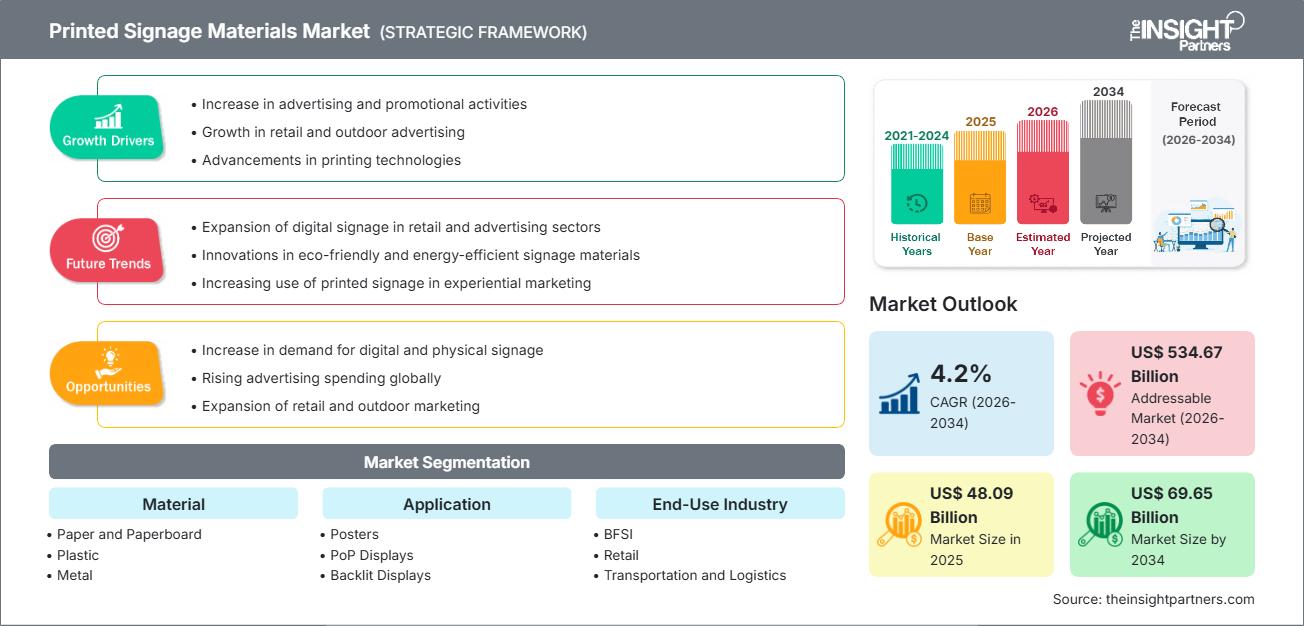
The global printed signage materials market size is projected to reach US$ 69.65 billion by 2034 from US$ 48.09 billion in 2025. The market is anticipated to register a CAGR of 4.2% during the forecast period 2026–2034.
Key market dynamics include a sustained demand for cost-effective physical branding, the rapid expansion of retail infrastructure in emerging economies, and a strategic pivot toward sustainable, PVC-free substrates. Additionally, the market is expected to benefit from advancements in UV-curable ink technology, the rising adoption of high-impact vehicle wraps, and the integration of interactive elements like QR codes that link physical signage to digital ecosystems.
Printed Signage Materials Market Analysis
The printed signage materials market analysis indicates a resilience that is successfully coexisting with digital alternatives by focusing on high-traffic durability and superior ROI for long-term installations. Procurement trends show a clear move toward polyolefin films and recyclable textiles to align with global environmental mandates. Strategic opportunities are emerging in the specialty healthcare and BFSI sectors, where antimicrobial surfaces and secure, high-contrast wayfinding materials are becoming standard. The analysis also notes that market stability is bolstered by the frequent promotional cycles of the retail industry, which requires high volumes of temporary, easily installed materials. Competitive differentiation now revolves around material longevity, UV resistance, and the ability to offer comprehensive green certifications to corporate clients.
Printed Signage Materials Market Overview
Printed signage materials have transitioned from basic paper-based products to high-performance composites and specialized fabrics. Printed Signage Materials includes everything from heavy-duty metal substrates for industrial wayfinding to lightweight, breathable textiles for soft signage. Both multinational chemical corporations and regional material converters compete in this landscape, leveraging diverse technologies such as wide-format inkjet and high-speed sheet-fed printing. Growing demand for consistent branding across global franchise networks has increased the popularity of standardized vinyl and plastic substrates. Asia-Pacific leads in revenue due to its massive manufacturing and urbanization, while North America and Europe are setting the pace for material innovation and regulatory compliance. Competition is fueling the development of self-healing films and materials that offer high-resolution output with reduced chemical waste.
North America market represents a mature and technologically advanced landscape, characterized by a high demand for premium branding and sophisticated out-of-home advertising. The market is increasingly driven by a transition toward sustainable, PVC-free substrates and the mainstreaming of high-durability vehicle wraps, reflecting the region's strong focus on environmental compliance and corporate aesthetic standards.
Market Research Highlights
- Global market for Printed Signage Materials was valued at US$ 48.09 Billion in 2025
- Annual market size is expected to reach US$ 69.65 Billion by 2034
- Total addressable market (TAM) during 2026-2034 is projected to reach approximately US$ 534.67 Billion
- Market is anticipated to register a CAGR of 4.2% during the forecast period
- The United States represents a key market, supported by Increase in advertising and promotional activities, Growth in retail and outdoor advertising, Advancements in printing technologies, as well as evolving industry dynamics
- Market analysis covers North America, Europe, Asia-Pacific, South and Central America, Middle East and Africa, with growth evaluated across the forecast period
- Market opportunities such as Increase in demand for digital and physical signage, Rising advertising spending globally, Expansion of retail and outdoor marketing are expected to influence market dynamics and addressable market
- Report profiles industry participants, including 3A Composites GmbH, Avery Dennison Corp, IGEPA group GmbH & Co KG, Spandex AG, Lintec Europe (UK) Ltd, ORAFOL Europe GmbH, Vink Holdings Ltd, Thyssenkrupp Materials Services GmbH, Antalis, Inapa Investimentos Particip Gestao SA., while analyzing competitive strategies and innovation developments
-
Source: The Insight Partners' analysis based on proprietary research, government publications, company annual reports, investor presentations, industry databases, and expert interviews.
● REPORT CUSTOMIZATION
Tailor This Report To Align With Your Specific Business Requirements
This report can be customized to align precisely with your business objectives, scope, and target markets. Customization options include tailored segmentation, geography, competitive analysis, and strategic insights to support informed decision-making.
Customize This Report →WHAT YOU CAN ADJUST
- ● Segmentations
- ● Geography
- ● Competitive Analysis
- ● Language Preferences
Printed Signage Materials Market: Strategic Insights
-
Get Top Key Market Trends of this report.This FREE sample will include data analysis, ranging from market trends to estimates and forecasts.
Printed Signage Materials Market Drivers and Opportunities
Market Drivers:
- Cost Efficiency for Long-term Branding: Printed signage remains significantly more affordable than digital displays for permanent outdoor applications, avoiding the high energy costs and hardware maintenance associated with screens.
- Rapid Urbanization and Retail Growth: The construction of new shopping malls, transit hubs, and commercial centers, particularly in India and China, is creating a continuous need for extensive signage kits and wayfinding systems.
- Technological Innovations in Printing: Improvements in ink-to-substrate bonding and the rise of 3-dimensional printing for signage allow for more creative and durable branding solutions than ever before.
Market Opportunities:
- Adoption of Sustainable Substrates: There is a growing opportunity for manufacturers to replace traditional PVC with biodegradable or 100% recyclable paperboard and fabric options to meet corporate ESG goals.
- Expansion of Vehicle and Fleet Graphics: As mobile advertising becomes a high-growth niche, there is increasing demand for premium conformable vinyl that offers easy application and residue-free removal.
- Integration of Smart Signage Technologies: Incorporating NFC tags and QR codes into printed materials offers a bridge to digital platforms, allowing for measurable consumer engagement in a traditionally static medium.
Printed Signage Materials Market Report Segmentation Analysis
The Printed Signage Materials Market share is analyzed across various segments to provide a clearer understanding of its structure, growth potential, and emerging trends. Below is the standard segmentation approach used in most industry reports
By Material:
- Paper and Paperboard: A fast-growing segment for short-term indoor promotions, highly valued for its recyclability and low cost.
- Plastic: The dominant material category, including vinyl and acrylic, is preferred for its weather resistance and versatility in outdoor settings.
- Metal: Primarily used for permanent wayfinding and architectural signage, offering the highest durability and a premium aesthetic.
By Application:
- Posters: A staple for localized advertising and event promotion across all industries.
- PoP Displays: High-volume segment driven by retail merchandising and point-of-sale influence.
- Backlit Displays: Increasingly popular in transit hubs and high-end retail for its high visibility and professional appearance.
- Billboards and Banners: The largest segment by surface area, providing mass-market reach for OOH advertising.
- Flags and Backdrops: Widely used in events and exhibitions for their portability and visual impact.
- Vehicle/Fleet Graphics: The fastest-growing application as companies leverage their logistics assets for mobile branding.
By End-Use Industry:
- BFSI: Focused on secure, professional indoor signage and branch-wide branding updates.
- Retail: The largest end-user, utilizing a wide range of materials for seasonal promotions and in-store navigation.
- Transportation and Logistics: High demand for durable, reflective signage and fleet wraps.
- Healthcare: Growing need for specialized antimicrobial signage and a clear, accessible wayfinding.
- Sports and Entertainment: Significant user of temporary banners, flags, and event-specific graphics.
By Geography:
- North America
- Europe
- Asia Pacific
- South & Central America
- Middle East & Africa
Printed Signage Materials Market Report Scope
| Report Attribute | Details |
|---|---|
| Market size in 2025 | US$ 48.09 Billion |
| Market Size by 2034 | US$ 69.65 Billion |
| Global CAGR (2026 - 2034) | 4.2% |
| Historical Data | 2021-2024 |
| Forecast period | 2026-2034 |
| Segments Covered |
By Material
|
| Regions and Countries Covered |
North America
|
| Market leaders and key company profiles |
|
Printed Signage Materials Market Players Density: Understanding Its Impact on Business Dynamics
The Printed Signage Materials Market is growing rapidly, driven by increasing end-user demand due to factors such as evolving consumer preferences, technological advancements, and greater awareness of the product's benefits. As demand rises, businesses are expanding their offerings, innovating to meet consumer needs, and capitalizing on emerging trends, which further fuels market growth.
Printed Signage Materials Market Share Analysis by Geography
Asia-Pacific is the leading region in the printed signage materials market, driven by its massive retail footprint and manufacturing base. Emerging opportunities are also rising in the Middle East and Africa due to large-scale infrastructure projects.
The global demand for printed signage materials is evolving as traditional static branding blends with smart technologies. While established markets focus on high-durability and premium finishes, emerging economies are driving volume through massive retail and infrastructure expansion.
North America
- Market Share: Holds a substantial global share, consistently driven by high advertising expenditure and a mature BFSI and Retail ecosystem.
- Key Drivers:
- Widespread adoption of high-performance Vehicle/Fleet Graphics for mobile brand impressions.
- Strong focus on Corporate Branding and identity through color-critical exhibition graphics and trade show backdrops.
- Technological leadership in UV and Latex printing, facilitating faster turnaround for custom, short-run signage.
- Trends: A shift toward premium, PVC-free materials and the integration of QR codes to bridge physical signs with digital e-commerce platforms.
Europe
- Market Share: Represents a major portion of the market, anchored by strict environmental mandates and a robust exhibition culture.
- Key Drivers:
- Stringent REACH and ESG regulations are pushing the market toward non-toxic inks and recyclable metal substrates.
- High demand for Soft Signage (textiles) due to its lighter carbon footprint and lower shipping costs.
- Steady investment from the Retail in Germany, France, and the UK for high-impact visual merchandising.
- Trends: Implementation of Circular Economy principles, where signage lifecycle management, from bio-based substrates to material reclamation, is becoming a competitive standard.
Asia-Pacific
- Market Share: The largest and fastest-growing region, currently commanding a dominant share of global revenue.
- Key Drivers:
- Rapid urbanization and the construction of new shopping malls and showrooms in India, China, and Southeast Asia.
- Mandatory safety and multi-language labeling in manufacturing hubs, driving massive volumes of durable plastic and metal signs.
- Rising literacy rates and disposable income, fueling demand for commercial publications and localized advertising boards.
- Trends: Heavy investment in large-format inkjet technology to support cost-effective, high-volume outdoor billboards and transit graphics.
South and Central America
- Market Share: An emerging market with significant untapped potential in the Retail and Sports segments.
- Key Drivers:
- Modernization of traditional retail channels into organized commercial centers requiring standardized signage.
- Growth in the Transportation and Logistics for durable, weather-resistant fleet marking.
- Trends: Expansion of urban infrastructure in countries like Argentina and Brazil, boosting the need for wayfinding and promotional banners.
Middle East and Africa
- Market Share: Developing market transitioning toward formalized commercial and tourism-led production.
- Key Drivers:
- Large-scale Smart City and infrastructure projects in the GCC requiring specialized, high-visibility wayfinding.
- Growth in the hospitality and entertainment industry, driving demand for Backlit Displays and premium flags.
- Trends: Use of high-durability, UV-stabilized materials capable of maintaining color integrity in extreme desert climates.
High Market Density and Competition
Competition is intensifying as the printed signage materials market becomes a battleground for material science and high-speed production efficiency. The landscape is characterized by a mix of global chemical and material conglomerates, such as Avery Dennison and 3A Composites, and specialized regional print-service providers. These players are increasingly contending with the rise of digital alternatives by doubling down on material durability and cost-effective static advertising.
This competitive environment pushes vendors to differentiate through:
- Substrate Innovation: Leading vendors are developing materials that are lighter, easier to install, and fully recyclable without sacrificing image quality.
- Application Specialization: Companies are offering niche products like non-slip floor graphics for retail and high-tack adhesives for textured industrial surfaces.
- Sustainability Branding: Producers are gaining market share by securing third-party eco-certifications that appeal to environmentally conscious brands.
Opportunities and Strategic Moves
- Adoption of Smart and Interactive Elements: Incorporating NFC tags, QR codes, and AR (Augmented Reality) into printed signage provides a high-value opportunity. This strategic move enables businesses to track customer engagement and provide real-time, dynamic information through a static physical medium.
- Pivot to Sustainable and PVC-Free Materials: As brands prioritize sustainability, there is a clear competitive advantage for producers who transition to biodegradable, recycled (rPET), or paper-based substrates. This shift is essential for securing long-term contracts with eco-conscious multinational corporations.
Major Companies operating in the Printed Signage Materials Market are:
- 3A Composites GmbH
- Avery Dennison Corp
- IGEPA group GmbH & Co KG
- Spandex AG
- Lintec Europe (UK) Ltd
- ORAFOL Europe GmbH
- Vink Holdings Ltd
- Thyssenkrupp Materials Services GmbH
- Antalis
- Inapa Investimentos Particip Gestao SA.
Disclaimer: The companies listed above are not ranked in any particular order.
Printed Signage Materials Market News and Recent Developments
- In December 2025, Antalis added KROMA® display board to its portfolio of eco-responsible substrates for indoor display and signage applications. The KROMA display board is characterised by excellent printability and processing properties. Available from stock in 3mm and 5mm thicknesses and 1220×2440mm and 1530×3050mm sheet sizes, it offers large format printers and their clients a sustainable alternative to plastic-based products for a variety of applications.
- In October 2025, 3A Composites GmbH announced an innovative solution for versatile printing applications. SINTREX® is a lightweight, expanded rigid PET sheet suitable for versatile printing applications. SINTREX® sheets are made of PET (polyethylene terephthalate), one of the most versatile and promising plastics, already the material of choice in many applications from food packaging to structural foams. PET is noted for its excellent recyclability and well-established recycling options.
Printed Signage Materials Market Report Coverage and Deliverables
The Printed Signage Materials Market Size and Forecast (2021–2034) report provides a detailed analysis of the market covering below areas:
- Printed Signage Materials Market size and forecast at global, regional, and country levels for all the key market segments covered under the scope
- Printed Signage Materials Market trends, as well as market dynamics such as drivers, restraints, and key opportunities
- Detailed PEST and SWOT analysis
- Printed Signage Materials Market analysis covering key market trends, global and regional framework, major players, regulations, and recent market developments
- Industry landscape and competition analysis covering market concentration, heat map analysis, prominent players, and recent developments in the Printed Signage Materials Market.
- Detailed company profiles
Frequently Asked Questions

- Comprehensive Market Sizing and Forecast Analysis
- Detailed Segmentation Analysis
- In-Depth Market Dynamics Assessment
- Regional and Country-Level Insights
- Competitive Landscape and Company Benchmarking
- Strategic Business Intelligence
Recent Reports
Testimonials

The Insight Partners' SCADA System Market report is comprehensive, with valuable insights on current trends and future forecasts. The team was highly professional, responsive, and supportive throughout. We are very satisfied and highly recommend their services.
RAN KEDEM Partner, Reali Technologies LTDs
I requested a report on a very specific software market and the team produced the report in a few days. The information was very relevant and well presented. I then requested some changes and additions to the report. The team was again very responsive and I got the final report in less than a week.
JEAN-HERVE JENN Chairman, Future Analytica
We worked with The Insight Partners for an important market study and forecast. They gave us clear insights into opportunities and risks, which helped shape our plans. Their research was easy to use and based on solid data. It helped us make smart, confident decisions. We highly recommend them.
PIYUSH NAGPAL Sr. Vice President, High Beam Global
The Insight Partners delivered insightful, well-structured market research with strong domain expertise. Their team was professional and responsive throughout. The user-friendly website made accessing industry reports seamless. We highly recommend them for reliable, high-quality research services
YUKIHIKO ADACHI CEO, Deep Blue, LLC.
This is the first time I have purchased a market report from The Insight Partners.While I was unsure at first, I visited their web site and felt more comfortable to take the risk and purchase a market report.I am completely satisfied with the quality of the report and customer service. I had several questions and comments with the initial report, but after a couple of dialogs over email with their analyst I believe I have a report that I can use as input to our strategic planning process.Thank you so much for taking the extra time and making this a positive experience.I will definitely recommend your service to others and you will be my first call when we need further market data.
JOHN SUZUKI President and Chief Executive Officer, Board Director, BK Technologies
I wish to appreciate your support and the professionalism you displayed in the course of attending to my request for information regarding to infectious disease IVD market in Nigeria. I appreciate your patience, your guidance, and the fact that you were willing to offer a discount, which eventually made it possible for us to close a deal. I look forward to engaging The Insight Partners in the future, all thanks to the impression you have created in me as a result of this first encounter.
DR CHIJIOKE ONYIA MANAGING DIRECTOR, PineCrest Healthcare Ltd.Reason to Buy
- Informed Decision-Making
- Understanding Market Dynamics
- Competitive Analysis
- Identifying Emerging Markets
- Customer Insights
- Market Forecasts
- Risk Mitigation
- Boosting Operational Efficiency
- Strategic Planning
- Investment Justification
- Tracking Industry Innovations
- Aligning with Regulatory Trends






 Get Free Sample for