
Underground Waste Containers Market Size, Demand & Growth by 2034
Coverage: by Material (Metal, Plastic, and Others); Capacity (Less than 1000 Litres, 1001-3000 Litres, and Above 3000 Litres); and Application (Residential, Commercial, Industrial, and Others), and Geography (North America, Europe, Asia Pacific, and South and Central America)
- Status : Data Released
- Report Code : TIPMC00002709
- Category : Manufacturing and Construction
- No. of Pages : 150
- Available Report Formats :


- Last update date : October 30, 2026


2025 Market Size
US$ 1.03 Bn
Base year value
2034 Forecast
US$ 1.74 Bn
Projected by 2034
CAGR 2026-2034
5.96 %
Growth rate
Addressable Market
US$ 12.52 Bn
(2026-2034)
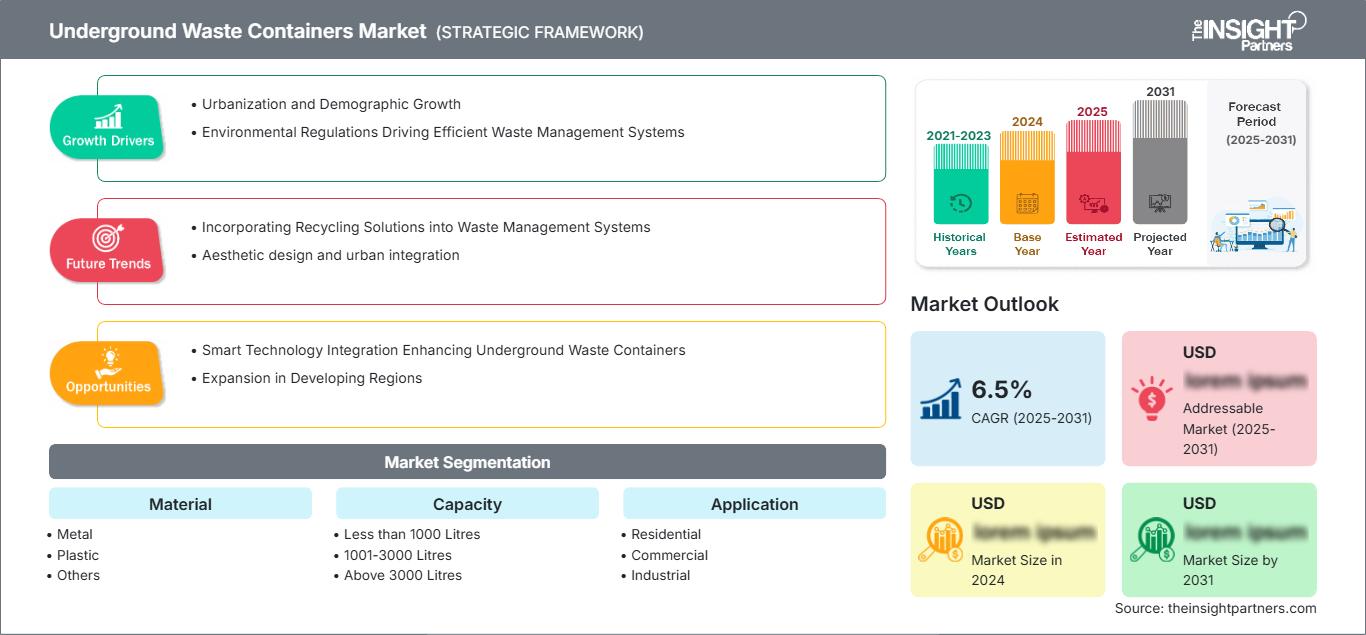
The Underground Waste Containers Market was valued at US$ 1.03 Billion in 2025 and is projected to reach US$ 1.74 Billion by 2034, growing at a CAGR of 5.96% during 2026-2034. The market includes below-ground and semi-underground systems used to store municipal, residential, commercial, industrial, and recyclable waste by material, capacity, and application. Demand is expanding as cities prioritize cleaner streetscapes, odor reduction, larger storage capacity, and more efficient collection logistics.
North America remains a structurally important market because dense residential developments, institutional campuses, parks, and commercial properties increasingly require high-capacity containment with a limited visible footprint. The underground waste containers market size in the region is supported by municipal recycling infrastructure funding, vertical-lift collection compatibility, and property-owner interest in odor- and pest-resistant containment. North America is estimated to represent ~31% of 2025 global demand and is expected to grow at ~5.4% CAGR through 2034.
Underground Waste Containers Market Assessment and Insights
- North America accounts for ~31% of 2025 global demand, supported by multi-family housing, public-space modernization, and grant-enabled recycling infrastructure upgrades. The region is expected to grow at ~5.4% CAGR as property developers and municipalities replace exposed bins with more controlled containment systems.
- The U.S. represents ~75% of North America demand and is expected to grow at ~5.5% CAGR, driven by institutional campuses, parks, foodservice grease containment, and urban redevelopment projects that require cleaner collection points and fewer surface dumpsters.
- Europe holds ~38% of 2025 global demand and is expected to grow at ~5.7% CAGR. The region benefits from municipal recycling targets, dense historic centers, and established specialists in Portugal, the Netherlands, Italy, Czechia, Spain, and Germany.
- Asia Pacific accounts for ~21% of 2025 global demand and is expected to grow at ~7.2% CAGR. China, Japan, South Korea, India, and Australia are key markets as urban density, separated collection, and smart city programs increase demand for compact and sensor-ready waste infrastructure.
- Largest Segment: By capacity, Above 3000 Litres leads and is expected to grow at ~6.2% CAGR because underground systems are typically selected where operators need higher storage density, fewer collection cycles, and improved streetscape management.
- High Growth Segment: By application, Commercial is expected to grow at ~6.6% CAGR as retail districts, hospitality venues, transport hubs, and mixed-use developments adopt underground containment to protect customer-facing environments.
- Key companies analyzed in detail: Reflex Zlín, Öge Metal, Oktagon Engineering GmbH, SOTKON Waste Systems, SUTERA In-Ground, Ecoloxia Environmental Group Inc., Meulenbroek Machinebouw B.V., Deep Waste Collection B.V., Zweva Environment, and Nord Engineering S.r.l.
Source: The Insight Partners' analysis based on proprietary research, government publications, company annual reports, investor presentations, industry databases, and expert interviews.
The market is evolving from basic below-ground storage to an advanced waste collection node that involves the use of reinforced concrete shafts, fiberglass or galvanized steel containers, stainless steel towers, safety platforms, bottom-emptying facilities, and even level sensors. At Pollutec in 2025, SOTKON focused on organic waste collection systems, underground containers, and intelligent waste management systems. These examples show how companies are designing their containers according to circular economy principles and data-driven municipal activities.
By 2034, implementation of the technology will increasingly be influenced by its economics for the entire lifecycle rather than just the container itself. Municipalities and commercial entities are assessing the cost of excavation, crane or lift suitability, ease of maintenance, safety of the emptying process, leak prevention in terms of wastewater, and routing. Companies that provide solutions involving container longevity, modular installation, anti-odor functionality, and monitoring technology will have an advantage here.
Underground Waste Containers Market Report Scope
| Report Attribute | Details |
|---|---|
| Market size in 2025 | US$ 1.03 Billion |
| Market Size by 2034 | US$ 1.74 Billion |
| Global CAGR (2026 - 2034) | 5.96% |
| Historical Data | 2021-2024 |
| Forecast period | 2026-2034 |
Underground Waste Containers Market Analysis
Underground waste containers market growth is primarily linked to the need to store larger volumes of waste in constrained urban spaces while reducing exposed bins, overflow, odor, and visual clutter. Municipalities, mixed-use developments, schools, parks, and commercial operators use underground systems to consolidate waste streams at fewer collection points, improve user access, and reduce the number of conventional containers positioned on sidewalks, courtyards, and service areas.
Underground waste containers market analysis shows that value-chain performance depends on more than container manufacturing alone. Civil works, prefabricated or reinforced sockets, lifting devices, compatibility with waste vehicles, installation services, safety features, and maintenance services form part of project implementation. This provides market opportunities for vendors who can collaborate with municipalities, construction firms, waste collectors, developers, and designers of public spaces.
Competition in the market will be specialty-driven and geographically fragmented, with differentiation based on modularity, durability of materials used, lifting devices, ease of installation, and ability to integrate into the municipal waste collection system. The European vendors such as SOTKON Waste Systems, Reflex Zlín, Nord Engineering S.r.l., Zweva Environment, Meulenbroek Machinebouw B.V., and Deep Waste Collection B.V. meet the needs of dense urban centers, public spaces, and heritage sites that may have difficulties in accommodating above-ground waste facilities.
The demands of North America are determined by organizations like SUTERA In-Ground and Ecoloxia Environmental Group Inc., where steel and concrete containment and semi-underground containers are used to manage waste disposal on the property and community level. The competition is being driven by factors like capacity, ease of installation, efficiency of the waste collection, durability, and ease of maintenance. Those suppliers who will incorporate container design with installation and waste management will be able to cater to these demands.
● REPORT CUSTOMIZATION
Tailor This Report To Align With Your Specific Business Requirements
This report can be customized to align precisely with your business objectives, scope, and target markets. Customization options include tailored segmentation, geography, competitive analysis, and strategic insights to support informed decision-making.
Customize This Report →WHAT YOU CAN ADJUST
- ● Segmentations
- ● Geography
- ● Competitive Analysis
- ● Language Preferences
Underground Waste Containers Market: Strategic Insights
Regional Insights
North America Underground Waste Containers Market
North America’s underground waste containers market share is estimated at ~31% in 2025, with ~5.4% CAGR projected through 2034. Demand is concentrated in multifamily housing, universities, parks, hospitals, commercial campuses, and urban streetscapes, where operators want to reduce visible dumpsters while improving containment. U.S. recycling infrastructure funding and city-level modernization programs support procurement of better collection assets, although excavation cost and truck compatibility remain key adoption filters.
U.S. Underground Waste Containers Market
The U.S. accounts for ~75% of North America's demand and is forecast to grow at ~5.5% CAGR. The country’s adoption profile is property- and municipality-led, with applications in residential communities, parks, dog-waste containment, restaurant grease collection, and compact commercial locations. Semi-in-ground systems are especially relevant where owners need larger storage capacity without the permitting complexity or cost of fully underground vaults.
Europe Underground Waste Containers Market
Europe represents ~38% of 2025 global demand and is expected to expand at ~5.7% CAGR. The region benefits from long-standing separated collection practices, strict recycling targets, compact city centers, and a supplier base with experience in fiberglass, metal, modular, and smart underground systems. Portugal and Spain are prominent for SOTKON installations, the Netherlands has several specialist manufacturers, Italy contributes automated and modular collection expertise, and Czechia supports fiberglass container production through Reflex Zlín.
APAC Underground Waste Containers Market
Asia Pacific accounts for ~21% of 2025 global demand and is projected to grow at ~7.2% CAGR, the fastest among major regions. China and India are driven by urbanization and municipal solid waste pressure, Japan and South Korea by compact city infrastructure and disciplined waste separation, and Australia by public-space and residential-community upgrades. Adoption is strongest where cities combine underground storage with route planning, source separation, and redevelopment of high-footfall public areas.

Segmentation Analysis
Material
The material segment covers metal, plastic, and other engineered materials used for shafts, containers, lids, chutes, and visible towers. This part of the underground waste containers market scope is influenced by corrosion resistance, fire safety, waterproofing, load-bearing requirements, lifecycle maintenance, and local manufacturing availability. The material segment is expected to grow at ~5.8% CAGR through 2034 as buyers shift toward durable combinations of steel, reinforced concrete, fiberglass, and polymer components.
- Metal supports structural strength, theft resistance, and long operating cycles in public and commercial installations.
- Plastic and fiberglass options reduce corrosion concerns and support lighter modular designs for semi-underground and separated-waste applications.
Capacity
The capacity segment includes less than 1000 liters, 1001-3000 liters, and above 3000 liters. Capacity is the largest decision variable because underground systems are commonly justified by higher storage density and reduced collection frequency. The segment is expected to grow at ~6.2% CAGR, with above 3000 liters leading because municipalities and commercial properties typically require larger underground volume to offset installation and civil-work costs.
- Less than 1000 litres serves niche public-space, dog-waste, and compact site requirements.
- 1001-3000 litres suits mid-density residential blocks and separated collection points.
- Above 3000 litres is preferred for high-footfall areas, municipalities, and larger commercial developments.
Application
The application segment includes residential, commercial, industrial, and other uses. It is expected to grow at ~6.6% CAGR, with commercial applications gaining momentum as developers, retail districts, hotels, transport hubs, and campuses prioritize cleaner circulation areas and lower visible waste exposure. Residential adoption remains broad in dense housing and master-planned communities, while industrial use is more selective and tied to site-specific safety, segregation, and storage requirements.
- Residential demand is driven by multi-family buildings, apartment complexes, and planned communities.
- Commercial demand benefits from customer-facing environments where odor, cleanliness, and aesthetics directly affect operating quality.
- Industrial demand is selective and depends on waste type, handling safety, and compatibility with site logistics.
Opportunity Snapshot
| Application | Revenue Contribution | Trend Tag | Adoption Stage |
| Residential | High | Dense Housing | Scaling |
| Commercial | High | Clean Retail | Scaling |
| Industrial | Medium | Site Safety | Emerging |
| Others | Low | Public Realm | Emerging |
Underground Waste Containers Market Growth Drivers and Impact Analysis
Urban density and streetscape pressure
Dense cities have limited curbside and public-space capacity for conventional waste bins, particularly across historic centers, mixed-use districts, high-rise residential zones, and pedestrianized areas. Underground Waste Containers Market growth is supported by the ability of these systems to shift substantial storage capacity below ground while keeping only the disposal interface visible at street level. This configuration improves space utilization, reduces visual clutter, and allows planners to maintain cleaner streetscapes without sacrificing waste-storage capacity. The benefits are especially relevant for municipal renewal programs, premium real estate developments, and high-footfall districts where land availability and urban aesthetics strongly influence infrastructure decisions.
Rising need for hygienic and odor-controlled collection
Underground waste management can minimize direct contact with waste, prevent the spread of smell, and deter pests since the stored waste is contained and segregated from other public spaces around it. These benefits make underground waste management a suitable technology for residential areas, restaurants, recreational facilities, tourist centers, commercial areas, and transportation centers, where cleaning is one of the factors that influence the purchase of products. With increasing attention to cleaning and effective management of waste by cities and property managers, underground storage becomes another way to avoid problems with surface containers, which might become overcrowded during peak periods.
Waste policy and separated collection requirements
The rise in recycling programs and organics collection is driving a greater need for well-separated, easily accessible and higher-capacity disposal receptacles. The underground system is capable of integrating separate openings for glass, paper, plastics, mixed waste and bio waste collection, thus enabling operators to have multiple streams of waste being managed at one integrated collection site. This addresses the policy-driven collection methods without having to place multiple collection receptacles in crowded areas. The emphasis on source separation enables suppliers to distinguish themselves by providing modular systems, a clean interface, contamination control, and integration with municipal collection equipment.
Underground Waste Containers Market Future Trends
Digitally monitored underground collection points
Underground Waste Containers Market Trends increasingly point toward embedded fill-level sensors, user identification systems, fleet-routing software, and centralized performance dashboards. Vendors are moving away from being passive recipients of waste because municipalities are looking for ways to reduce collection trips that are not necessary, increase overflow management, and improve service efficiency. The benefit of digital integration is especially apparent when dealing with container networks that require collection plans to adjust according to the season, tourist presence, commercial activity, and waste volume. The more integrated containers, trucks, and municipal waste management systems become, the better.
Modular and semi-underground installation formats
Module and semi-underground installation options are gaining relevance due to increasing interest in partial installation as an alternative to full replacement of the current collection infrastructure by municipalities and privately-owned entities. The semi-underground installation system decreases the visual impact and, potentially, excavation difficulties associated with the underground installation type. Thus, the relevance of such installation systems increases when limited by geographical or budgetary constraints. Such trends will create additional opportunities for private property owners, municipalities with small budgets, parks, residential communities, and commercial firms.
Underground Waste Containers Market Opportunities
Commercial redevelopment and high-footfall districts
Commercial sites offer one of the clearest Underground Waste Containers Market Forecast opportunities because retail streets, hotels, airports, campuses, and mixed-use projects require cleaner waste areas without sacrificing rentable, operational, or pedestrian space. Suppliers can target developers and facility managers with turnkey offerings that combine civil design, container selection, lift compatibility, installation, and maintenance planning. Growing emphasis on urban aesthetics and efficient public-space utilization can further support adoption in redevelopment projects. Solutions offering modular capacity, discreet integration with surrounding infrastructure, and compatibility with existing collection vehicles can strengthen supplier positioning, particularly where high waste volumes and limited surface space make conventional bins inefficient.
Bio-waste and source-separated collection networks
Organic waste and recyclable-stream separation create opportunities for underground container networks using dedicated openings, sealed containers, washable surfaces, and efficient collection planning. Municipalities working toward circular-economy targets require collection infrastructure that encourages correct disposal behavior while minimizing odor, contamination, and operational disruption. Vendors providing bio-waste-ready designs, access-control options, and data-enabled service planning can capture demand from policy-led upgrades. Additional opportunities may emerge from integrating fill-level monitoring and flexible compartment configurations, helping operators improve collection schedules and accommodate multiple waste streams. Suppliers that combine hygienic design with straightforward maintenance and adaptable collection infrastructure can address both environmental objectives and long-term operating efficiency.
Frequently Asked Questions

- Comprehensive Market Sizing and Forecast Analysis
- Detailed Segmentation Analysis
- In-Depth Market Dynamics Assessment
- Regional and Country-Level Insights
- Competitive Landscape and Company Benchmarking
- Strategic Business Intelligence
Recent Reports
Testimonials

The Insight Partners provided valuable market intelligence that supported our global go-to-market strategy. Their team was professional, responsive, and attentive to our feedback, providing thoughtful analysis and helpful methodological clarifications throughout the project.
Junmo Kim Chief Financial Officer (CFO), Enertech Co., Ltd.
The Insight Partners' SCADA System Market report is comprehensive, with valuable insights on current trends and future forecasts. The team was highly professional, responsive, and supportive throughout. We are very satisfied and highly recommend their services.
RAN KEDEM Partner, Reali Technologies LTDs
I requested a report on a very specific software market and the team produced the report in a few days. The information was very relevant and well presented. I then requested some changes and additions to the report. The team was again very responsive and I got the final report in less than a week.
JEAN-HERVE JENN Chairman, Future Analytica
We worked with The Insight Partners for an important market study and forecast. They gave us clear insights into opportunities and risks, which helped shape our plans. Their research was easy to use and based on solid data. It helped us make smart, confident decisions. We highly recommend them.
PIYUSH NAGPAL Sr. Vice President, High Beam Global
The Insight Partners delivered insightful, well-structured market research with strong domain expertise. Their team was professional and responsive throughout. The user-friendly website made accessing industry reports seamless. We highly recommend them for reliable, high-quality research services
YUKIHIKO ADACHI CEO, Deep Blue, LLC.
This is the first time I have purchased a market report from The Insight Partners.While I was unsure at first, I visited their web site and felt more comfortable to take the risk and purchase a market report.I am completely satisfied with the quality of the report and customer service. I had several questions and comments with the initial report, but after a couple of dialogs over email with their analyst I believe I have a report that I can use as input to our strategic planning process.Thank you so much for taking the extra time and making this a positive experience.I will definitely recommend your service to others and you will be my first call when we need further market data.
JOHN SUZUKI President and Chief Executive Officer, Board Director, BK Technologies
I wish to appreciate your support and the professionalism you displayed in the course of attending to my request for information regarding to infectious disease IVD market in Nigeria. I appreciate your patience, your guidance, and the fact that you were willing to offer a discount, which eventually made it possible for us to close a deal. I look forward to engaging The Insight Partners in the future, all thanks to the impression you have created in me as a result of this first encounter.
DR CHIJIOKE ONYIA MANAGING DIRECTOR, PineCrest Healthcare Ltd.Reason to Buy
- Informed Decision-Making
- Understanding Market Dynamics
- Competitive Analysis
- Identifying Emerging Markets
- Customer Insights
- Market Forecasts
- Risk Mitigation
- Boosting Operational Efficiency
- Strategic Planning
- Investment Justification
- Tracking Industry Innovations
- Aligning with Regulatory Trends





 Get Free Sample for