
Entertainment Robots Market Size, Share & Forecast by 2034
Coverage: by Type (Commercial Entertainment Robots and Non - Commercial Entertainment Robots); and Product - Based (Educational robots, Robotic Toys, and Robotic Companion Pets), and Geography (North America, Europe, Asia Pacific, and South and Central America)
- Status : Data Released
- Report Code : TIPTE100000551
- Category : Electronics and Semiconductor
- No. of Pages : 150
- Available Report Formats :


- Last update date : August 26, 2026


2025 Market Size
US$ 2.90 Bn
Base year value
2034 Forecast
US$ 21.65 Bn
Projected by 2034
CAGR 2026-2034
25.03 %
Growth rate
Addressable Market
US$ 93.68 Bn
(2026-2034)
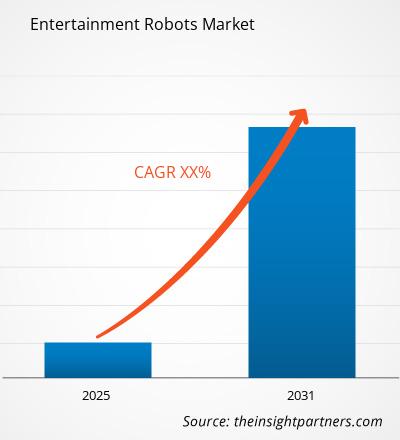
The Entertainment Robots Market size is projected to expand from US$ 2.90 billion in 2025 to US$ 21.65 billion by 2034, registering a remarkable CAGR of 25.03% during the forecast period. This robust growth trajectory is underpinned by rapid advancements in artificial intelligence, increasing consumer spending on interactive and educational technologies, and the growing integration of robotics in consumer applications. The market is witnessing a paradigm shift from traditional toys to sophisticated, AI-driven robotic systems capable of learning and interaction.
In North America, the Entertainment Robots Market is estimated to grow at a CAGR of 22-24%, driven by strong consumer adoption of smart home technologies and significant investments in educational robotics. The region's market benefits from high disposable incomes and a mature technology infrastructure that facilitates rapid product adoption. Additionally, the presence of key technology innovators and a culture of early adoption of consumer robotics substantially fuels market expansion in this region.
Entertainment Robots Market Assessment and Insights
- North America: Held a significant Entertainment Robots Market share in 2025, estimated at 30-34%, and is growing at a CAGR of 22-24% from 2026 to 2034. Growth is propelled by high consumer awareness, strong retail channels, and continuous product innovation.
- US: Accounted for over 85% of the North American market in 2025, growing at a CAGR of 23-25%. The market is characterized by high demand for robotic toys and educational robots, driven by tech-savvy consumers and strong STEM education initiatives.
- Europe: Captured a 22-26% share in 2025 with a forecast CAGR of 20-22%. Leading countries include the UK and Germany, where there is a strong emphasis on educational technology and growing interest in robotic companion pets for the aging population.
- Asia Pacific: Held a 28-32% market share in 2025 and is projected to be the fastest-growing region, with a CAGR of 28-30%. Growth is led by China and Japan, spurred by strong manufacturing capabilities, government support for robotics, and high consumer demand.
- Largest Segment: The Commercial Entertainment Robots segment held the largest market share, estimated at 55-59% in 2025. It is expected to grow at a robust CAGR of 24-26% from 2026 to 2034, driven by its wide application in public spaces and corporate events.
- High Growth Segment: The Non-Commercial Entertainment Robots segment is experiencing high growth, with a share of 41-45% and a projected CAGR of 26-28%. This growth is fueled by increasing household adoption of robotic toys and companion pets.
- Key companies analyzed in detail: Anybots, Electromechanica, Evolution Robotics, Fischertechnik, Hitachi, Honda, Innovation First, Lego, Microsoft, Toyota, Sony Corporation, Hasbro Inc.
Source: The Insight Partners' analysis based on proprietary research, government publications, company annual reports, investor presentations, industry databases, and expert interviews.
According to the Entertainment Robots Market report, evolution in the market is significantly influenced by the convergence of advanced AI, machine learning, and affordable sensor technologies. Production dynamics are shifting towards more agile, consumer-centric designs, allowing for the creation of highly interactive and personalized robotic experiences. The market is moving beyond simple programmable toys to sophisticated devices capable of emotional interaction, learning, and adaptation.
Looking ahead, the market is poised for substantial expansion, fueled by emerging geographies with rapidly growing middle-class populations and increasing technology adoption. Investment in research and development is heavily concentrated on enhancing human-robot interaction and creating more intuitive, intelligent systems. The regulatory environment is also evolving, with governments increasingly supporting robotics education and setting standards for safety and data privacy.
Entertainment Robots Market Report Scope
| Report Attribute | Details |
|---|---|
| Market size in 2025 | US$ 2.90 Billion |
| Market Size by 2034 | US$ 21.65 Billion |
| Global CAGR (2026 - 2034) | 25.03% |
| Historical Data | 2021-2024 |
| Forecast period | 2026-2034 |
Entertainment Robots Market Analysis
The primary demand drivers for the Entertainment Robots Market include the growing consumer preference for interactive, engaging, and educational experiences, along with rapid advancements in artificial intelligence, machine learning, natural language processing, computer vision, and robotics. Consumers are increasingly seeking robots that can provide entertainment, companionship, personalized interaction, gaming, storytelling, and educational support.
The value chain for the entertainment robotics industry is quite diverse and includes component manufacturers, robotics hardware manufacturers, software and AI manufacturers, systems integrators, content developers, distribution companies, and brand-name consumer goods companies. Component manufacturers are responsible for providing the industry with components such as processors, sensors, cameras, microphones, actuators, batteries, communication modules, and other electronic components. Software developers and AI companies are responsible for operating systems, voice recognition, computer vision, conversation AI, navigation abilities, and other cloud-based solutions that help robots interact with their users.
Supply considerations for the industry are heavily dependent upon the supply and prices of specialized semiconductors, sensors, batteries, motors, connectivity modules, and other precision components. The more advanced entertainment robots become, the more specialized and advanced components are required from component suppliers.
The Entertainment Robots Market forecast indicates that competitive dynamics within the industry are rather lively and include not only traditional technology companies and consumer electronics companies such as Sony but also robotics-oriented specialized companies like UBTECH. Competition within the industry moves towards software, content, user experience, and AI capabilities.
● REPORT CUSTOMIZATION
Tailor This Report To Align With Your Specific Business Requirements
This report can be customized to align precisely with your business objectives, scope, and target markets. Customization options include tailored segmentation, geography, competitive analysis, and strategic insights to support informed decision-making.
Customize This Report →WHAT YOU CAN ADJUST
- ● Segmentations
- ● Geography
- ● Competitive Analysis
- ● Language Preferences
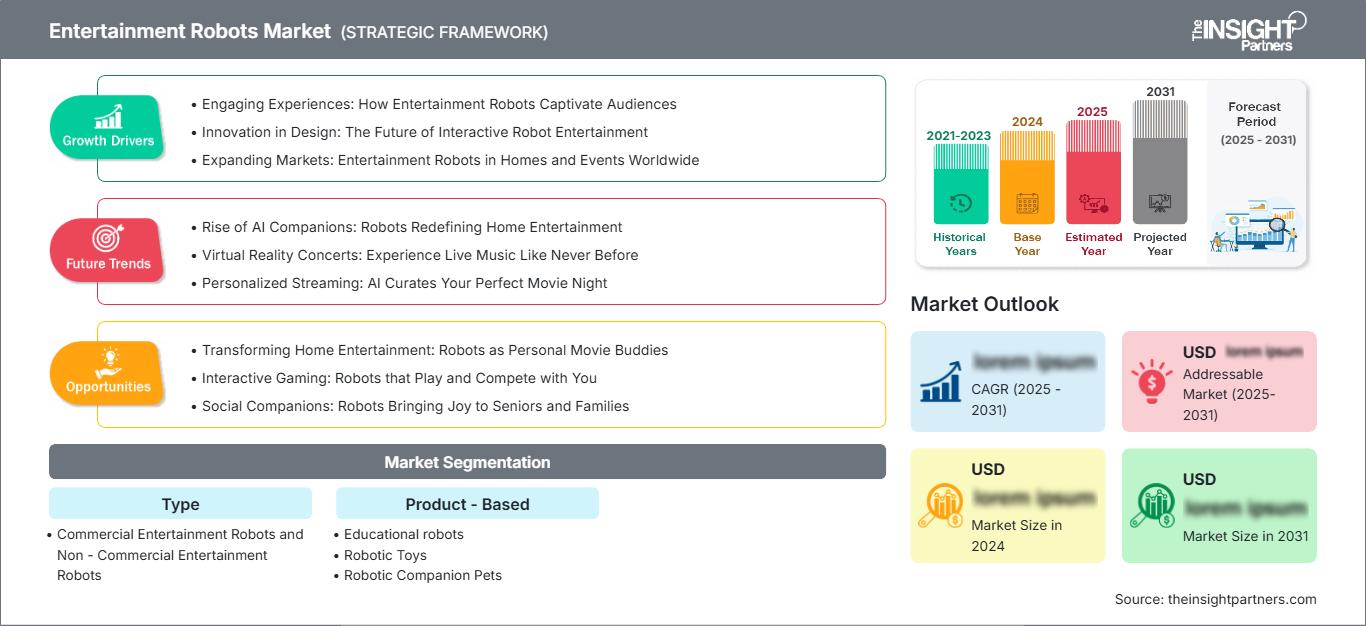
Entertainment Robots Market: Strategic Insights
Regional Insights
North America Entertainment Robots Market
North America remains a dominant region due to its high technology adoption rates and strong consumer spending power. The market is characterized by a strong preference for technologically advanced, AI-integrated robotic systems. Growth is further supported by extensive STEM education programs in schools and a thriving culture of gadget enthusiasts. The regional market is projected to witness a CAGR of 22-24% from 2026 to 2034.
The competitive environment in North America is intense, with a strong focus on product differentiation and brand loyalty. Key players are developing integrated ecosystems that offer seamless interaction with other smart home devices. The market is also seeing a trend toward the adoption of subscription-based models for software updates and content. Demand is sustained by continuous product launches and the effective use of digital marketing and social media campaigns.
U.S. Entertainment Robots Market
The U.S. holds the largest share within North America, accounting for over 85% of the region's revenue. Growth is steady at a CAGR of 23-25%, driven by high demand from both the consumer and educational sectors. The commercial transportation and utility sectors also present a substantial consumer base, seeking reliable lighting for work-zone safety. The presence of leading manufacturers ensures a constant stream of advanced products.
Some of the key Entertainment Robots Market trends in the U.S. include the increasing integration of robots into the educational framework, from elementary schools to universities. The demand for robotic toys with advanced customization and coding capabilities is rising. Market players are also focusing on developing robots that can serve as home assistants, providing both entertainment and practical functions.
Europe Entertainment Robots Market
Europe holds a significant share of the global market, estimated at 22-26%, with a forecast CAGR of 20-22%. The UK and Germany are leading markets, characterized by high consumer interest in educational and companion robots. Demand is also driven by a growing need for social robots to assist an aging population. The focus in this region is shifting towards robots that offer companionship and therapeutic benefits.
The market is characterized by a strong emphasis on data privacy and adherence to stringent EU regulations. Manufacturers are developing systems that offer high levels of customization to meet diverse cultural preferences. The integration of advanced sensors to improve environmental interaction is a key trend. Competitors are actively engaging in strategic partnerships with healthcare providers and educational institutions to expand their application scope.
APAC Entertainment Robots Market
Asia Pacific is the fastest-growing market, with a projected share of 28-32% in 2025 and a CAGR of 28-30%, led by China and Japan. Rapid industrialization, urbanization, and increasing government spending on public infrastructure and safety are key drivers. The expansion of the commercial vehicle fleet and growing awareness of industrial safety standards are fueling demand across the region.
The market is supported by strong policy drivers and the development of new smart cities, which integrate modern safety systems. Japan and South Korea are seeing growth in the adoption of advanced LED and connected lighting technologies. Market players are capitalizing on the significant production and sales volumes of new vehicles in the region.
Middle East & Africa Entertainment Robots Market
The Middle East & Africa market is growing, with a significant CAGR, driven by large-scale infrastructure and energy projects. Saudi Arabia and the UAE are leading markets, investing heavily in public safety and security systems for their smart city initiatives. The demand is also linked to the oil and gas industry, where safety is a critical operational requirement in hazardous environments.
Investment in large-scale transport and logistics infrastructure is a primary driver in this region. South Africa is a key market within Africa, with demand stemming from its mining and industrial sectors. The adoption of high-durability, heat-resistant lighting systems is essential for the region's harsh operating conditions. Market growth is also propelled by the need to modernize aging safety equipment and respond to growing traffic management and public safety concerns.
Segmentation Analysis
Type
The type segmentation includes Commercial Entertainment Robots and Non-Commercial Entertainment Robots. The Commercial Entertainment Robots segment is the dominant category, projected to grow at a CAGR of 24-26% from 2026 to 2034. Its market leadership is due to widespread use in theme parks, museums, trade shows, and events. These robots are designed for high-performance, continuous operation, and are often custom-built for specific attractions.
- Commercial Entertainment Robots: This segment is characterized by large, durable robots designed for public interaction. Their use is primarily in controlled environments like amusement parks and corporate events, where they serve as attractions.
- Non-Commercial Entertainment Robots: Non-commercial robots are designed for personal use and represent a rapidly growing segment. They are often more affordable and focus on education, companionship, and interactive play.
Product-Based
The product-based segmentation divides the market into Educational Robots, Robotic Toys, and Robotic Companion Pets. The Educational Robots segment is a significant driver of market growth, projected to grow at a substantial CAGR. This segment encompasses robots used in schools, homes, and maker spaces to teach STEM concepts, coding, and problem-solving skills.
- Educational Robots: This is a key growth area, driven by the increasing integration of technology in education. These robots are designed to be programmable and interactive, making learning engaging and practical.
- Robotic Toys: Representing the largest product category in terms of volume, robotic toys range from simple remote-controlled devices to sophisticated interactive companions. Demand is driven by consumer preference for high-tech, engaging toys.
- Robotic Companion Pets: This emerging segment focuses on robots designed to provide companionship, often featuring advanced AI for emotional interaction. These are gaining traction among seniors and individuals seeking low-maintenance pet alternatives.
Opportunity Snapshot
| Product-Based | Revenue Contribution | Trend Tag | Adoption Stage |
| Educational Robots | High | STEM Learning | Scaling |
| Robotic Toys | High | Interactive Play | Mature |
| Robotic Companion Pets | Medium | Emotional AI | Emerging |
Entertainment Robots Market Growth Drivers and Impact Analysis
Surge in Artificial Intelligence and Machine Learning
The rapid progress in artificial intelligence and machine learning is the most significant driver of the Entertainment Robots Market. Enhanced AI capabilities allow robots to learn from interactions, adapt to user preferences, and perform complex tasks that were previously impossible. This has led to the creation of more engaging, responsive, and personalized robotic companions and toys. For instance, AI-enabled robots can now recognize faces, understand voice commands, and even simulate emotions, leading to a more profound user connection and increasing the perceived value of these products.
Rising Popularity of STEM Education
The global emphasis on STEM (Science, Technology, Engineering, and Mathematics) education is a powerful driver. Governments and educational institutions are increasingly integrating robotics into their curricula to prepare students for a technology-driven future. Educational robots provide a hands-on, engaging way to teach coding, engineering, and problem-solving skills. This has created a consistent and growing demand from schools, after-school programs, and parents seeking to give their children a competitive edge, making educational robots a core product segment.
Growing Consumer Demand for Companion and Social Robots
There is a growing consumer demand for robots that provide social interaction and companionship, particularly in aging societies. These robots can alleviate loneliness, provide cognitive stimulation, and assist with daily tasks. The technological advancements in natural language processing and emotion recognition have made these robots more effective and appealing. This driver is supported by demographic shifts in regions like Japan, Europe, and North America, where populations are aging, creating a sustained market for socially assistive entertainment robots.
Entertainment Robots Market Future Trends
Integration of Advanced Emotion AI
A prominent trend is the integration of advanced Emotion AI, or affective computing, into entertainment robots. This technology enables robots to recognize, interpret, and respond to human emotions through facial expressions, tone of voice, and body language. This will lead to more nuanced and empathetic interactions, making robotic companions and toys more effective in providing emotional support and personalized engagement. This trend is expanding the application scope of entertainment robots into therapeutic and elderly care settings.
Growth of Robot-as-a-Service (RaaS) Models
There is a growing trend toward Robot-as-a-Service (RaaS) models for commercial entertainment robots. Instead of a large upfront purchase, venues can lease robots on a subscription basis, which includes maintenance, software updates, and support. This makes advanced, high-cost robotics more accessible for smaller businesses and events. RaaS is also gaining traction in the education sector, where schools can rent educational robot kits for specific semesters, lowering the barrier to entry and enabling access to the latest technology.
Entertainment Robots Market Opportunities
Expansion into Emerging Markets
The rapid economic growth and increasing middle-class population in emerging Asia Pacific economies present a significant opportunity. Companies can capitalize by developing more affordable, locally relevant robotic products and building distribution partnerships. With increasing spending on consumer electronics and education, this region offers a substantial growth avenue for entertainment robot manufacturers.
Development of Specialized Robots for Niche Applications
There is a growing opportunity to develop specialized entertainment robots for niche applications, such as therapy, elderly care, and hospitality. Creating products with highly specific functions can open new, high-value market segments and command premium pricing. This approach allows companies to differentiate themselves and establish leadership in specialized areas of the market.
Recent Developments
- April 2026: Sony AI today announced its major breakthrough in robotics and artificial intelligence (AI) with the publication of its project Ace, the first known real-world autonomous system competitive with elite and professional-level human table tennis players. The research outlining the achievement, “Outplaying Elite Table Tennis Players with an Autonomous Robot,” was published today on the cover of Nature.
- April 2026: UBTECH Robotics Corp. signed a strategic agreement with a major educational publisher to integrate its robots into a new STEM curriculum. The collaboration aims to provide a comprehensive learning solution for K-12 students, combining hardware with interactive software content.
- January 2026: The Lego Group introduced a new line of educational robotics kits designed for a wider age range, focusing on intuitive coding and creative problem-solving. The product launch is aimed at bolstering its position in the school and home education markets.
Frequently Asked Questions

- Comprehensive Market Sizing and Forecast Analysis
- Detailed Segmentation Analysis
- In-Depth Market Dynamics Assessment
- Regional and Country-Level Insights
- Competitive Landscape and Company Benchmarking
- Strategic Business Intelligence
Recent Reports
Testimonials

The Insight Partners' SCADA System Market report is comprehensive, with valuable insights on current trends and future forecasts. The team was highly professional, responsive, and supportive throughout. We are very satisfied and highly recommend their services.
RAN KEDEM Partner, Reali Technologies LTDs
I requested a report on a very specific software market and the team produced the report in a few days. The information was very relevant and well presented. I then requested some changes and additions to the report. The team was again very responsive and I got the final report in less than a week.
JEAN-HERVE JENN Chairman, Future Analytica
We worked with The Insight Partners for an important market study and forecast. They gave us clear insights into opportunities and risks, which helped shape our plans. Their research was easy to use and based on solid data. It helped us make smart, confident decisions. We highly recommend them.
PIYUSH NAGPAL Sr. Vice President, High Beam Global
The Insight Partners delivered insightful, well-structured market research with strong domain expertise. Their team was professional and responsive throughout. The user-friendly website made accessing industry reports seamless. We highly recommend them for reliable, high-quality research services
YUKIHIKO ADACHI CEO, Deep Blue, LLC.
This is the first time I have purchased a market report from The Insight Partners.While I was unsure at first, I visited their web site and felt more comfortable to take the risk and purchase a market report.I am completely satisfied with the quality of the report and customer service. I had several questions and comments with the initial report, but after a couple of dialogs over email with their analyst I believe I have a report that I can use as input to our strategic planning process.Thank you so much for taking the extra time and making this a positive experience.I will definitely recommend your service to others and you will be my first call when we need further market data.
JOHN SUZUKI President and Chief Executive Officer, Board Director, BK Technologies
I wish to appreciate your support and the professionalism you displayed in the course of attending to my request for information regarding to infectious disease IVD market in Nigeria. I appreciate your patience, your guidance, and the fact that you were willing to offer a discount, which eventually made it possible for us to close a deal. I look forward to engaging The Insight Partners in the future, all thanks to the impression you have created in me as a result of this first encounter.
DR CHIJIOKE ONYIA MANAGING DIRECTOR, PineCrest Healthcare Ltd.Reason to Buy
- Informed Decision-Making
- Understanding Market Dynamics
- Competitive Analysis
- Identifying Emerging Markets
- Customer Insights
- Market Forecasts
- Risk Mitigation
- Boosting Operational Efficiency
- Strategic Planning
- Investment Justification
- Tracking Industry Innovations
- Aligning with Regulatory Trends





 Get Free Sample for