
Home Care Robotics Market Size, Trends & Demand by 2034
Coverage: by Product Type, and Geography (North America, Europe, Asia Pacific, and South and Central America)
- Status : Data Released
- Report Code : TIPTE100000465
- Category : Electronics and Semiconductor
- No. of Pages : 150
- Available Report Formats :


- Last update date : May 27, 2026


2025 Market Size
US$ 6.38 Bn
Base year value
2034 Forecast
US$ 22.68 Bn
Projected by 2034
CAGR 2026-2034
15.13 %
Growth rate
Addressable Market
US$ 123.98 Bn
(2026-2034)
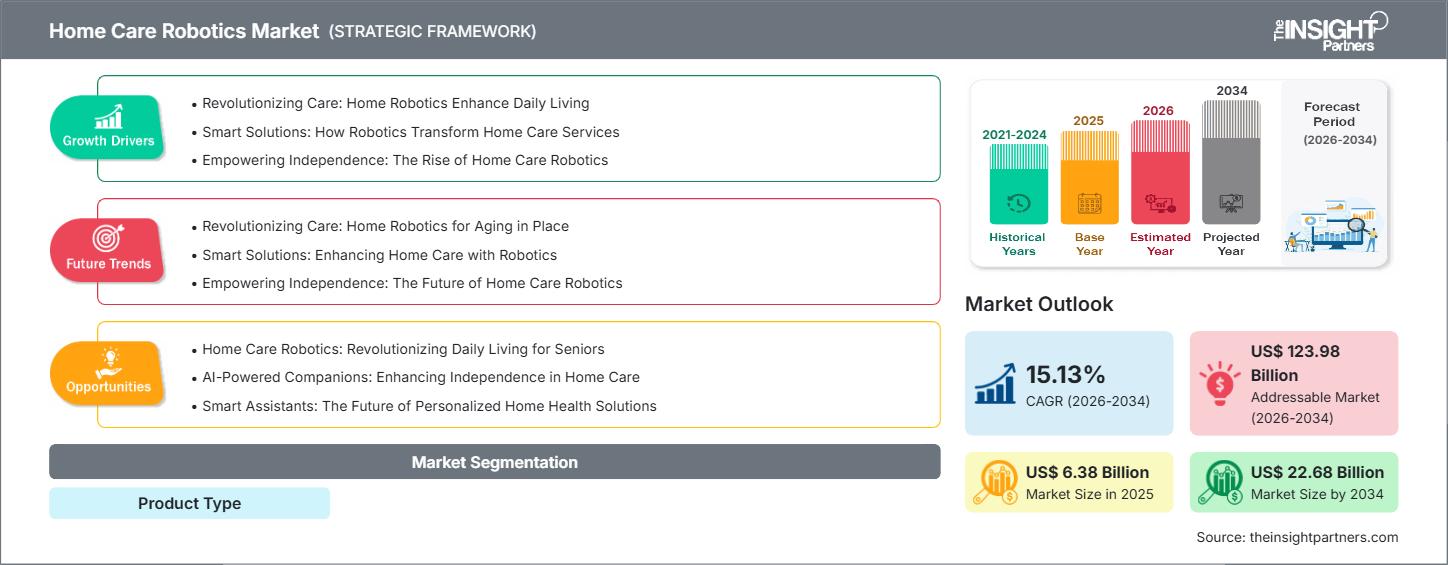
The global home care robotics market size is projected to reach US$ 22.68 billion by 2034 from US$ 6.38 billion in 2025. The market is anticipated to register a CAGR of 15.13% during the forecast period 2026–2034.
Key market dynamics include a heightening global focus on elderly assistance and independent living, rising labor costs for manual caregiving, and a significant shift toward AI-integrated household automation. Additionally, the market is expected to benefit from the growing prevalence of chronic diseases requiring home monitoring, expansion in smart-home infrastructure across emerging economies, and the increasing inclusion of social robots in mental health and companionship segments for the isolated elderly.
Home Care Robotics Market Analysis
The home care robotics market analysis shows a shift toward high-autonomy personal assistants as consumers prioritize safety and multifunctional efficiency. The market is transitioning into high-volume domestic task robots and high-growth entertainment and leisure systems designed for emotional engagement. Strategic opportunities are emerging in specialized pediatric and geriatric assistance robots, where precise automated medication dispensing and mobility aid offer a clear competitive advantage. The analysis also notes that market expansion depends on robust data privacy frameworks and 5G connectivity for real-time remote monitoring. Competitive differentiation now stands out depending on AI-driven personalization that learns user routines, ensures ethical data handling, and provides seamless integration with existing telehealth ecosystems. This approach helps premium brands charge higher prices in a market with many specialized tech suppliers.
Home Care Robotics Market Overview
Home care robots have advanced from niche vacuuming appliances to mainstream lifestyle and healthcare partners. Home care robotics includes functional companion robots, lawn management systems, and specialized assistance robots for the handicapped. Both global technology companies and robotics startups compete in this market, using sensor technologies such as LiDAR, 3D cameras, and ultrasonic arrays. Growing demand for convenient automation and independent living options among health-conscious consumers in North America and Europe has increased the popularity of care robots as a portable wellness and maintenance solution. Asia-Pacific leads in production and innovation due to its established robotics manufacturing hubs, while North America leads in revenue due to its established smart-home culture. The US market is the most developed, driven by high smart-home penetration and a tech-savvy population seeking efficient lifestyle upgrades. Rising healthcare costs and a shortage of professional caregivers have accelerated the adoption of assistive robotics. Furthermore, widespread availability of high-speed connectivity supports the seamless integration of multifunctional autonomous systems into daily domestic life.
Market Research Highlights
- Global market for Home Care Robotics was valued at US$ 6.38 Billion in 2025
- Annual market size is expected to reach US$ 22.68 Billion by 2034
- Total addressable market (TAM) during 2026-2034 is projected to reach approximately US$ 123.98 Billion
- Market is anticipated to register a CAGR of 15.13% during the forecast period
- The United States represents a key market, supported by Revolutionizing Care: Home Robotics Enhance Daily Living, Smart Solutions: How Robotics Transform Home Care Services, Empowering Independence: The Rise of Home Care Robotics, as well as evolving industry dynamics
- Market analysis covers North America, Europe, Asia-Pacific, South and Central America, Middle East and Africa, with growth evaluated across the forecast period
- Market opportunities such as Home Care Robotics: Revolutionizing Daily Living for Seniors, AI-Powered Companions: Enhancing Independence in Home Care, Smart Assistants: The Future of Personalized Home Health Solutions are expected to influence market dynamics and addressable market
- Report profiles industry participants, including iRobot Corporation, Bissell Homecare, Inc., Ecovacs Robotics, Zyrobotics, Softbank Robotics Group, ASUSTek Computer Inc., Syntouch, while analyzing competitive strategies and innovation developments
-
Source: The Insight Partners' analysis based on proprietary research, government publications, company annual reports, investor presentations, industry databases, and expert interviews.
● REPORT CUSTOMIZATION
Tailor This Report To Align With Your Specific Business Requirements
This report can be customized to align precisely with your business objectives, scope, and target markets. Customization options include tailored segmentation, geography, competitive analysis, and strategic insights to support informed decision-making.
Customize This Report →WHAT YOU CAN ADJUST
- ● Segmentations
- ● Geography
- ● Competitive Analysis
- ● Language Preferences
Home Care Robotics Market: Strategic Insights
-
Get Top Key Market Trends of this report.This FREE sample will include data analysis, ranging from market trends to estimates and forecasts.
Home Care Robotics Market Drivers and Opportunities
Market Drivers:
- Aging Global Population and Caregiver Shortage: An unprecedented rise in the elderly population has created a gap in traditional caregiving resources, driving the demand for robots that handle routine tasks and monitoring.
- Integration with Smart Home Ecosystems: The mainstreaming of connected home devices has simplified robot adoption. As robots become mobile hubs for the smart home, their utility beyond simple cleaning is driving growth.
- Advancements in AI and Machine Learning: Improved natural language processing and computer vision allow robots to navigate complex home layouts and interact more naturally with users, reducing the barrier to entry.
Market Opportunities:
- Expansion into Telehealth and Remote Monitoring: Beyond domestic chores, home care robots offer significant opportunities in acting as extensions for healthcare providers, allowing for real-time biometric data collection.
- Growth in Emerging APAC Urban Centers: Forming strategic partnerships between technology suppliers and Asian distributors may facilitate access to high-margin segments in China and Japan, where demand for premium automation is increasing.
- Focus on Mental Health and Companionship: There is a growing opportunity for producers to target the loneliness epidemic through social robots designed to provide cognitive stimulation for the elderly.
Home Care Robotics Market Report Segmentation Analysis
The home care robotics market share is analyzed across various segments to provide a clearer understanding of its structure, growth potential, and emerging trends. Below is the standard segmentation approach used in most industry reports:
By Offering:
- Products: The dominant volume driver, the physical robotic units for cleaning, mowing, and assistance, where hardware reliability is a key competitive factor.
- Services: A fast-growing niche that includes software updates, maintenance, and subscription-based cloud features. It is increasingly preferred by users seeking continuous performance enhancements and remote technical support.
By Type:
- Domestic: The primary category, representing the market. These robots are designed to automate routine household chores and maintenance tasks to save time and manual labor.
- Entertainment and Leisure: A rising segment focused on interactive functions, including robot toys, hobby systems, and educational platforms for children and adults.
By Distribution Channel:
- Online Channel: The largest and fastest-rising channel, enabling consumers to easily compare technical specifications, read user reviews, and access competitive pricing from D2C brands.
- Offline Channel: Remains critical for high-end assistance robots, where in-store demonstrations and hands-on testing allow shoppers to learn about complex functionalities before purchase.
By Application:
- Vacuuming: The most widely adopted application, serving as a core entry point for most households into the robotics market.
- Lawn Mowing: Gaining popularity in independent houses with private gardens, utilizing boundary detection and route optimization.
- Pool Cleaning: Highly concentrated in regions with high private pool ownership, focusing on autonomous debris removal and filtration.
- Companionship: Driven by a decline in extended family structures and the need for emotional interaction and social engagement.
- Elderly Assistance and Handicap Assistance: A high-value segment focused on medication reminders, fall detection, and mobility support for those with physical limitations.
- Robot Toys and Hobby Systems: Catering to the educational and recreational needs of younger demographics and tech enthusiasts.
- Others: Includes niche and emerging applications such as window cleaning, robotic kitchens, and laundry robots.
By Geography:
- North America
- Europe
- Asia Pacific
- South & Central America
- Middle East & Africa
Home Care Robotics Market Report Scope
| Report Attribute | Details |
|---|---|
| Market size in 2025 | US$ 6.38 Billion |
| Market Size by 2034 | US$ 22.68 Billion |
| Global CAGR (2026 - 2034) | 15.13% |
| Historical Data | 2021-2024 |
| Forecast period | 2026-2034 |
| Segments Covered | By Product Type |
| Regions and Countries Covered |
North America
|
| Market leaders and key company profiles |
|
Home Care Robotics Market Players Density: Understanding Its Impact on Business Dynamics
The Home Care Robotics Market is growing rapidly, driven by increasing end-user demand due to factors such as evolving consumer preferences, technological advancements, and greater awareness of the product's benefits. As demand rises, businesses are expanding their offerings, innovating to meet consumer needs, and capitalizing on emerging trends, which further fuels market growth.
Home Care Robotics Market Share Analysis by Geography
Asia-Pacific is expected to grow fastest in the coming years. Emerging markets in South & Central America, the Middle East, and Africa also have many untapped opportunities for premium automation producers and assistance robot manufacturers to expand.
The home care robotics market is witnessing a rapid geographical expansion, transitioning from a luxury niche in developed nations to a globally integrated household standard. Growth is driven by the rising cost of human labor, a surge in smart-home connectivity, and the urgent need for assisted living solutions. Below is a summary of market share and trends by region:
1. North America
- Market Share: Holds the largest revenue share globally, anchored by a mature innovation ecosystem and high consumer purchasing power.
- Key Drivers:
- Strong integration of robots within value-based care models and reimbursement support for rehabilitation technologies.
- Regulatory clarity from bodies like the U.S. FDA, which accelerates the deployment of assistive and medical-grade home robots.
- A tech-savvy millennial and Gen X demographic investing in automation for both convenience and elderly parent care.
- Trends: High adoption of subscription-based Robotics-as-a-Service (RaaS) models and a shift toward multi-functional robots that combine security, cleaning, and companionship.
2. Europe
- Market Share: Represents a significant portion of the market, driven by aging populations in Germany, Italy, and the Nordic countries.
- Key Drivers:
- Government-backed initiatives and fiscal incentives for elderly care robotics to address severe nursing shortages.
- Established smart-home standards and a strong focus on data privacy (GDPR), influencing robot design.
- High demand for eco-friendly, energy-efficient domestic robots, particularly in the lawn-mowing segment.
- Trends: Strategic prioritization of socially assistive robots in public healthcare pilots and the rise of organic integration between robots and local telehealth networks.
3. Asia-Pacific
- Market Share: The fastest-growing region, led by massive investments in China, Japan, and South Korea.
- Key Drivers:
- A robust manufacturing base that allows for rapid scaling and cost-effective production of consumer-grade electronics.
- Cultural readiness for bipedal and social robots, particularly in Japan’s aging society.
- Rapid urbanization and the rise of dual-income households in India and Southeast Asia are seeking time-saving domestic automation.
- Trends: Heavy reliance on e-commerce platforms for distribution and the emergence of ultra-low-cost LiDAR and sensor technologies that lower the barrier to entry for middle-class consumers.
4. South and Central America
- Market Share: An emerging market with a growing artisanal and tech-boutique sector in countries like Brazil and Argentina.
- Key Drivers:
- Increasing awareness of robotic safety benefits for home security and sanitation.
- Modernization of residential infrastructure in urban centers, making homes more compatible with autonomous navigation.
- Rising interest in lifestyle-enhancing technologies among high-net-worth segments.
- Trends: Growth of boutique local brands and the introduction of specialized floor-care robots tailored to regional flooring preferences (e.g., tile and hardwood focus).
5. Middle East and Africa
- Market Share: A developing market with a high CAGR, transitioning toward formalized commercial production in the GCC region.
- Key Drivers:
- Strategic investments in Smart Cities (e.g., NEOM) that prioritize AI-driven home automation.
- High demand for shelf-stable, durable hardware capable of operating in dusty or high-temperature environments.
- Government focus on technology-driven diversification to improve the quality of life and reduce reliance on migrant domestic labor.
- Trends: Implementation of high-end luxury social robots and the adoption of autonomous pool cleaners and window-cleaning systems in the high-end residential sector.
High Market Density and Competition
Competition is intensifying due to the presence of established leaders such as iRobot Corporation, Samsung Electronics, and Ecovacs Robotics. Regional experts and niche players like Blue Frog Robotics (France) and various North American innovators also contribute to a diverse and rapidly expanding market landscape. This competitive environment pushes vendors to differentiate through:
- Premiumization and Functional Branding: Positioning care robots as superior alternatives to manual help by emphasizing 24/7 reliability and AI-driven precision.
- Diversification of Offerings: Products now include more than just floor cleaners; companies offer robotic lawn mowers, companion bots, and high-end assistive exoskeletons.
- End-to-End Integration: Producers manage the entire hardware and software stack to ensure quality, transparency, and seamless updates.
Opportunities and Strategic Moves
- Partner with Healthcare and Insurance Providers: Tap into the surging demand for aging-in-place solutions by integrating robots into insurance-subsidized care plans and remote monitoring systems.
- Incorporate Sustainable Manufacturing: Use recyclable materials and energy-efficient charging technologies to appeal to environmentally conscious Gen Z and millennial consumers seeking ethical tech alternatives.
Major Companies operating in the Home Care Robotics Market are:
- iRobot Corporation
- Bissell Homecare, Inc.
- Ecovacs Robotics
- Zyrobotics
- Softbank Robotics Group
- ASUSTek Computer Inc.
- Syntouch
Disclaimer: The companies listed above are not ranked in any particular order.
Home Care Robotics Market News and Recent Developments
- In March 2026, iRobot Corporation introduced Roomba Mini, its smallest Roomba robot ever. With its powerful cleaning system and the flexibility to vacuum or mop, this beautiful little robot tackles everyday messes with ease while gliding under furniture and into hard-to-reach spots that stick vacuum cleaners and standard-size robots can't reach.
- In January 2026, ECOVACS ROBOTICS announced to showcase its latest next-generation, multi-scenario robotic solutions at CES 2026 in Las Vegas, including the all-new DEEBOT T90 PRO OMNI, the DEEBOT X12 Family, together with new robotic window cleaner WINBOT, robotic lawn mower GOAT, and more. ECOVACS ROBOTICS is also introducing its first robotic pool cleaner, ULTRAMARINE, alongside its latest embodied intelligence innovation.
Home Care Robotics Market Report Coverage and Deliverables
The Home Care Robotics Market Size and Forecast (2021–2034) report provides a detailed analysis of the market covering below areas:
- Home Care Robotics Market size and forecast at global, regional, and country levels for all the key market segments covered under the scope
- Home Care Robotics Market trends, as well as market dynamics such as drivers, restraints, and key opportunities
- Detailed PEST and SWOT analysis
- Home Care Robotics Market analysis covering key market trends, global and regional framework, major players, regulations, and recent market developments
- Industry landscape and competition analysis covering market concentration, heat map analysis, prominent players, and recent developments in the Home Care Robotics Market.
- Detailed company profiles
Frequently Asked Questions

- Comprehensive Market Sizing and Forecast Analysis
- Detailed Segmentation Analysis
- In-Depth Market Dynamics Assessment
- Regional and Country-Level Insights
- Competitive Landscape and Company Benchmarking
- Strategic Business Intelligence
Recent Reports
Testimonials

The Insight Partners' SCADA System Market report is comprehensive, with valuable insights on current trends and future forecasts. The team was highly professional, responsive, and supportive throughout. We are very satisfied and highly recommend their services.
RAN KEDEM Partner, Reali Technologies LTDs
I requested a report on a very specific software market and the team produced the report in a few days. The information was very relevant and well presented. I then requested some changes and additions to the report. The team was again very responsive and I got the final report in less than a week.
JEAN-HERVE JENN Chairman, Future Analytica
We worked with The Insight Partners for an important market study and forecast. They gave us clear insights into opportunities and risks, which helped shape our plans. Their research was easy to use and based on solid data. It helped us make smart, confident decisions. We highly recommend them.
PIYUSH NAGPAL Sr. Vice President, High Beam Global
The Insight Partners delivered insightful, well-structured market research with strong domain expertise. Their team was professional and responsive throughout. The user-friendly website made accessing industry reports seamless. We highly recommend them for reliable, high-quality research services
YUKIHIKO ADACHI CEO, Deep Blue, LLC.
This is the first time I have purchased a market report from The Insight Partners.While I was unsure at first, I visited their web site and felt more comfortable to take the risk and purchase a market report.I am completely satisfied with the quality of the report and customer service. I had several questions and comments with the initial report, but after a couple of dialogs over email with their analyst I believe I have a report that I can use as input to our strategic planning process.Thank you so much for taking the extra time and making this a positive experience.I will definitely recommend your service to others and you will be my first call when we need further market data.
JOHN SUZUKI President and Chief Executive Officer, Board Director, BK Technologies
I wish to appreciate your support and the professionalism you displayed in the course of attending to my request for information regarding to infectious disease IVD market in Nigeria. I appreciate your patience, your guidance, and the fact that you were willing to offer a discount, which eventually made it possible for us to close a deal. I look forward to engaging The Insight Partners in the future, all thanks to the impression you have created in me as a result of this first encounter.
DR CHIJIOKE ONYIA MANAGING DIRECTOR, PineCrest Healthcare Ltd.Reason to Buy
- Informed Decision-Making
- Understanding Market Dynamics
- Competitive Analysis
- Identifying Emerging Markets
- Customer Insights
- Market Forecasts
- Risk Mitigation
- Boosting Operational Efficiency
- Strategic Planning
- Investment Justification
- Tracking Industry Innovations
- Aligning with Regulatory Trends





 Get Free Sample for