
Smart Factory Market Size, Demand & Growth by 2034
Coverage: By Product Type (Machine Vision Systems, Industrial Robots, Control Devices, Sensors, Others); Technology (Enterprise Resource Planning, Product Lifecycle Management, Human Machine Interface); Industry Vertical (Automotive, Semiconductors, Oil and Gas, Others) , and Geography (North America, Europe, Asia Pacific, and South and Central America)
- Status : Data Released
- Report Code : TIPTE100000243
- Category : Electronics and Semiconductor
- No. of Pages : 150
- Available Report Formats :


- Last update date : August 13, 2026


2025 Market Size
US$ 174.45 Bn
Base year value
2034 Forecast
US$ 391.5 Bn
Projected by 2034
CAGR 2026-2034
9.40 %
Growth rate
Addressable Market
US$ 2,527.09 Bn
(2026-2034)
The Smart Factory Market was valued at US$ 174.45 billion in 2025 and is projected to reach US$ 391.5 billion by 2034, registering a CAGR of 9.40% from 2026 to 2034. This robust growth reflects the accelerating digital transformation of manufacturing operations worldwide. The fusion of the IIoT, artificial intelligence, and robotics is changing the way production is being carried out with the capability of making decisions based on real-time data and predictive maintenance.
The Smart Factory market size in North America is driven by factors such as high technological adoption in the automotive, aerospace, and electronics industries. The United States is taking the lead here, and the region is expected to have a CAGR of 8-10%. Some of the structural growth drivers include large-scale investments in semiconductor production and reshoring of production capabilities. Government actions like the CHIPS and Science Act are contributing to the increased deployment of smart factories, and the requirement of resilience in the supply chain network is pushing manufacturers to adopt smart production processes.
Smart Factory Market Assessment and Insights
- North America: North America holds a significant share of 28-32% in the global Smart Factory Market in 2025. The region is growing at a CAGR of 8-10% from 2026 to 2034, driven by investments in semiconductor fabrication and automotive electrification.
- US: The US dominates North America, accounting for approximately 80-85% of the regional market in 2025. Growth is supported by reshoring initiatives and advanced manufacturing policies, with a CAGR range of 8-10% from 2026 to 2034.
- Europe: Europe accounts for 24-28% of the global Smart Factory Market in 2025, with Germany, the UK, and France as leading countries. The region is growing at a CAGR of 9-11% from 2026 to 2034, supported by Industry 4.0 policies and sustainability regulations.
- Asia Pacific: APAC is the largest regional market, holding 33-37% share in 2025, led by China, Japan, and South Korea. Growing at a CAGR of 10-12% from 2026 to 2034, the region benefits from strong manufacturing bases and government industrial modernization programs.
- Largest Segment: Industrial robots represented an estimated 30–33% market share in 2025 within product type and are projected to expand at a 9.1–9.7% CAGR during 2026–2034.
- High Growth Segment: Sensors represented approximately 19–22% market share in 2025 within product type and are projected to register a 10.4–11.0% CAGR during 2026–2034 as connected asset architectures expand.
- Key companies analyzed in detail: ABB Ltd, Endress+Hauser AG, Emerson Electric Co., Rockwell Automation, Inc, General Electric, Honeywell International Inc., Omron Corporation, Schneider Electric, Siemens AG, Yokogawa Electric Corporation
Source: The Insight Partners' analysis based on proprietary research, government publications, company annual reports, investor presentations, industry databases, and expert interviews.
The Smart Factory Market has developed from individual automation islands to complete and integrated data-powered manufacturing ecosystems. The transition from closed, non-integrative systems to open and integrative architectures has sped up the process and made integration easier. The production process increasingly relies on digital twin models and AI-powered analytics to improve operational efficiency, allowing the factories to reach impressive gains in overall equipment effectiveness and unplanned downtimes reduction.
From an outlook perspective, the Smart Factory Market forecast looks positive, with the market experiencing additional growth due to implementation of smart factories in small and medium enterprises. Countries of emerging markets are intensively developing industrial digitalization, providing many opportunities for technology vendors. Legislation in energy efficiency and carbon emissions reduction encourages investment in smart factory technologies. 5G and edge computing will provide more applications for remote control and autonomous processes.
Smart Factory Market Report Scope
| Report Attribute | Details |
|---|---|
| Market size in 2025 | US$ 174.45 Billion |
| Market Size by 2034 | US$ 391.5 Billion |
| Global CAGR (2026 - 2034) | 9.40% |
| Historical Data | 2021-2024 |
| Forecast period | 2026-2034 |
Smart Factory Market Analysis
Smart factory solution demand is based on the need for operational excellence, efficiency, and resilience. Businesses have to work towards being more productive, more efficient, and more agile. The value chain involves component suppliers, automation firms, software firms, and system integrators, all of which have their own role in providing the necessary solutions. There have been improvements within the supply dynamics because of the presence of standardized data models and service oriented architecture to help integrate and deploy solutions faster. As per the International Federation of Robotics, there is an increase in industrial robot deployments globally, with operational stock above four million.
The competitive environment in the Smart Factory Market Report consists of industrial automation market leaders along with technology providers specializing in their niches. Siemens AG, ABB Ltd., and Schneider Electric represent the leading players that have large portfolios consisting of hardware, software, and services. Rockwell Automation, Inc. and Honeywell International Inc. hold prominent positions in North America, whereas Yokogawa Electric Corporation and Omron Corporation are the leaders in Asia-Pacific. Investments show the tendency towards the development of solutions based on artificial intelligence, cloud-based software, and cybersecurity. Strategic positioning tends to be focused on building ecosystems, where vendors collaborate to create solutions tailored to industry-specific needs.
● REPORT CUSTOMIZATION
Tailor This Report To Align With Your Specific Business Requirements
This report can be customized to align precisely with your business objectives, scope, and target markets. Customization options include tailored segmentation, geography, competitive analysis, and strategic insights to support informed decision-making.
Customize This Report →WHAT YOU CAN ADJUST
- ● Segmentations
- ● Geography
- ● Competitive Analysis
- ● Language Preferences
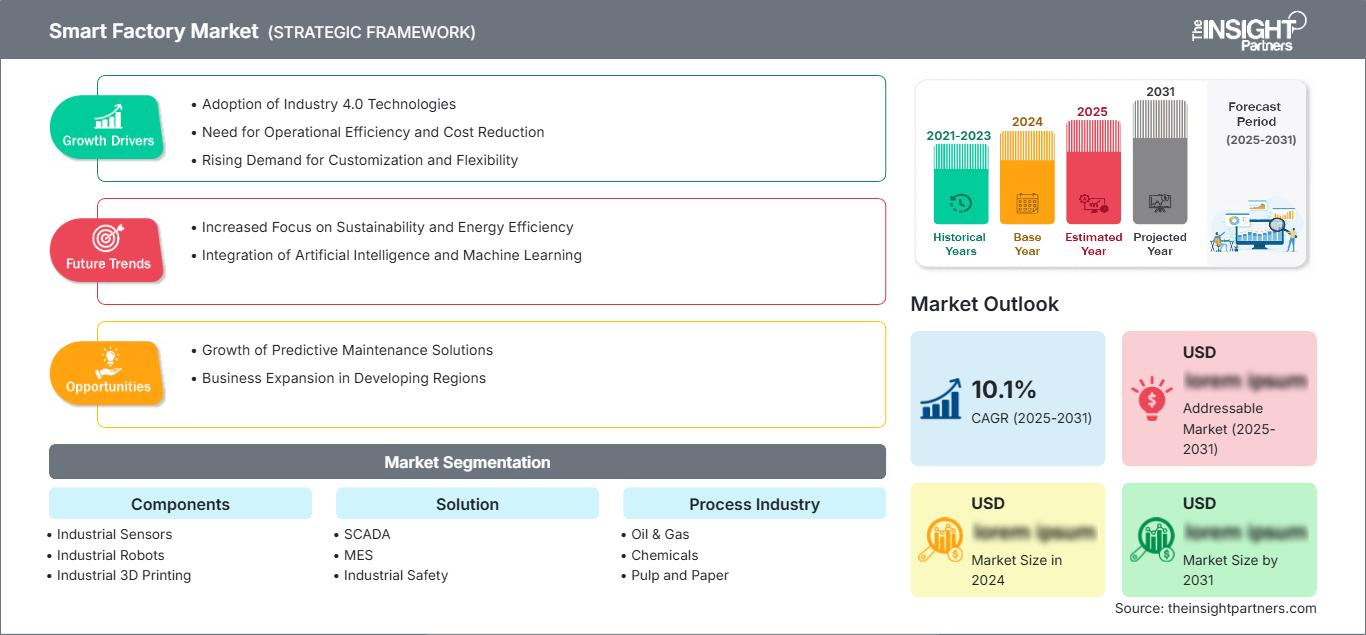
Smart Factory Market: Strategic Insights
Regional Insights
North America Smart Factory Market
Competitive landscape includes market leaders in the industrial automation space and technology suppliers who specialize in the field. Siemens AG, ABB Ltd. and Schneider Electric are the leading companies that offer a diverse portfolio including hardware, software and services. Rockwell Automation, Inc. and Honeywell International Inc. are the leading firms in North America, while Yokogawa Electric Corporation and Omron Corporation lead in Asia-Pacific. Investments indicate the trend for developing solutions that rely on artificial intelligence, cloud-based software and cybersecurity. Strategic positioning is typically aimed at creating ecosystems in which vendors develop solutions for industries.
U.S. Smart Factory Market
The US is estimated to comprise around 80-85% of the North American Smart Factory Market Share in 2025. Growth will be supported by the CHIPS and Science Act, which pours billions into the fabrication of semiconductors with advanced automation technologies. Automakers are developing EV battery manufacturing systems with AI-based quality assurance systems. There are implementations of digital twin technologies and predictive maintenance systems in the aerospace and defense industry. Major players such as Rockwell Automation, Inc, Honeywell International Inc., and Emerson Electric Co. facilitate market growth. CAGR in the US is estimated to be 8-10% between 2026 and 2034.
Europe Smart Factory Market
The European Smart Factory Market has an overall market share of 24-28% of the global smart factories' market by 2025, and Germany, the United Kingdom, and France are major contributors to this growth. Germany is leading among all other European countries due to its advanced automobile and machinery manufacturing industry along with the Industrie 4.0 concept. The UK is witnessing growing use of smart factory solutions in aerospace, life sciences, and automotive industries. France concentrates on the development of the digital transformation concept in aerospace, energy, and pharmaceutical industries.
APAC Smart Factory Market
APAC is the biggest and fast growing regional market, accounting for 33-37% of global market share in 2025. The leading country is China with "Made in China 2025" program promoting the usage of smart factories in electronics, automotive and machinery industries. Japan and South Korea have strong presence in robotics and precision manufacturing industries with high adoption rate of AI and IoT solutions. India has rapid growth through incentives in electronics and pharmaceutical manufacturing. Australia is adopting smart technologies in food processing and mining machinery industry. Growth rate forecast for 2026-2034 is 10-12% CAGR.
Middle East & Africa Smart Factory Market
Despite the current smaller market share, there are positive indicators of market growth in the Middle East & Africa region. In the Kingdom of Saudi Arabia and UAE, initiatives such as the National Industrial Strategy and Operation 300bn are investing in petrochemical facilities and advanced materials factories. In South Africa, smart factory technology adoption is being developed for mining machinery production and automotive assembly. Market CAGR in the region is expected to be 9-11% between 2026 and 2034 through greenfield construction.
Segmentation Analysis
Product Type
Product Type is projected to develop at a 9.2–9.8% CAGR during 2026–2034, reflecting continuing investment in production automation hardware. The Smart Factory Market scope encompasses Machine Vision Systems, Industrial Robots, Control Devices, Sensors, and Others. Purchasing priorities increasingly favor equipment capable of generating standardized operational data while supporting flexible production, automated quality control, predictive maintenance, and integration with factory software.
- Machine Vision Systems: Machine vision supports automated inspection, dimensional verification, identification, guidance, and defect detection. AI-enhanced vision is increasing its strategic importance in electronics, automotive, semiconductor, packaging, and precision manufacturing environments.
- Industrial Robots: Industrial robots remain the largest product category, benefiting from welding, assembly, material handling, painting, packaging, and machine-tending applications where manufacturers require repeatability, throughput, workplace safety, and production consistency.
- Control Devices: Control devices provide the operational backbone for automated machinery by coordinating processes, equipment states, motion, and safety functions. Demand remains resilient because modernization frequently requires controller upgrades alongside connected production architectures.
- Sensors: Sensors represent a high-growth category as manufacturers require continuous measurement of temperature, pressure, vibration, proximity, position, flow, and equipment condition to support predictive maintenance and data-driven production management.
Technology
Technology is projected to expand at a 9.0–9.6% CAGR during 2026–2034 as manufacturers integrate production information with planning, engineering, asset, and workforce systems. ERP, PLM, and HMI technologies increasingly operate within connected digital architectures rather than isolated functional environments, allowing production decisions to incorporate enterprise demand, engineering changes, equipment performance, and operator information.
- Enterprise Resource Planning: ERP integration connects factory execution with procurement, inventory, finance, demand planning, and production scheduling, improving coordination between commercial requirements and manufacturing capacity across geographically distributed operations.
- Product Lifecycle Management: PLM supports coordinated management of product specifications, engineering changes, configurations, and manufacturing information, becoming increasingly valuable as manufacturers shorten product cycles and introduce digitally connected design-to-production workflows.
- Human Machine Interface: HMI platforms are evolving from machine-level visualization toward contextual operator environments integrating alarms, production metrics, maintenance guidance, and analytics, supporting faster decisions and improved interaction with increasingly automated equipment.
Industry Vertical
Industry Vertical demand is projected to register a 9.4–10.0% CAGR during 2026–2034 as automation requirements broaden across discrete and process manufacturing. Automotive and semiconductor facilities remain particularly technology-intensive, while oil and gas operators increasingly deploy connected sensing, controls, analytics, and asset-management technologies. Deployment economics vary according to production volume, process complexity, downtime exposure, quality requirements, and workforce availability.
- Automotive: Automotive manufacturers remain major adopters of robotics, machine vision, connected controls, traceability, and flexible production systems because vehicle complexity, electrification, model variation, and quality requirements demand highly coordinated manufacturing processes.
- Semiconductors: Semiconductor production requires exceptionally precise automation, inspection, environmental monitoring, material handling, and process control. Capacity localization and fabrication investment are strengthening demand for digitally coordinated, data-intensive manufacturing environments.
- Oil and Gas: Oil and gas applications emphasize instrumentation, process controls, remote monitoring, predictive maintenance, safety, and asset reliability, making connected automation strategically important for facilities operating complex continuous processes.
Opportunity Snapshot
| Industry Vertical | Revenue Contribution | Trend Tag | Adoption Stage |
| Automotive | High | Flexible Automation | Mature |
| Semiconductors | High | Precision Control | Scaling |
| Oil and Gas | Medium | Asset Intelligence | Mature |
| Others | Medium | Digital Operations | Scaling |
Smart Factory Market Growth Drivers and Impact Analysis
Industrial IoT and Connected Device Adoption
The increasing number of Industrial IoT platforms represents the major factor boosting the growth of the Smart Factory Market. IIoT technologies allow collecting information, conducting preventive maintenance, and optimizing processes automatically. Thanks to common protocols and edge gateways, deployment becomes simple and inexpensive, allowing deploying them on legacy equipment. Private 5G networks ensure sub-millisecond latency, necessary for ensuring safety during human-robot interactions, especially in the automotive industry, where production takes place on assembly lines. Subsidies provided by national governments, such as the Production-Linked Incentive Scheme in India, facilitate the early stages of implementation and adoption, including small and medium businesses.
Workplace Safety and Labor Productivity Demands
Strict occupational health laws and labor shortages in the manufacturing industries are contributing to the fast adoption of smart factories. The manufacturers are leveraging automation and robots to minimize workplace accidents, cover the aging population and increase the wellbeing of their employees. The implementation of smart factories improves the overall effectiveness of the equipment, reduces unexpected downtimes and increases quality control; thus meeting the needs for productivity. According to industry reports, the adoption of smart factories improves asset efficiency by 20%, improves product quality by 30% and cuts down costs by 30%.
Technological Advancements in AI and Robotics
Advancements in artificial intelligence, robotics, and sensors continue to enhance the functions of smart factories. Predictive maintenance systems make use of artificial intelligence to monitor vibrations, temperatures, sound levels, and pressures, helping to detect possible machine breakdowns prior to actual downtime. Computer vision contributes to better quality control, worker safety, and traceability. AI-driven scheduling systems help manage labor and machine availability, material availability, power consumption, and shipping commitments. Generative AI, industrial co-pilots, reinforcement learning, and AI-driven digital twins are some examples of future smart factory developments.
Smart Factory Market Future Trends
AI-Driven Predictive and Prescriptive Analytics
Artificial intelligence is becoming the cumulative intelligence layer of the smart factory market trends. Predictive maintenance models analyze multi-sensor data to identify failure patterns and optimize maintenance schedules. Computer vision systems improve defect detection and quality control, while AI-based production scheduling enables dynamic resource allocation. Generative AI and industrial copilots are emerging to assist operators with maintenance procedures, process optimization, and root-cause analysis. The integration of AI with digital twins enables scenario-based planning, allowing manufacturers to virtually test production changes and optimize workflows before physical implementation. As AI models mature, prescriptive analytics will recommend optimal actions in real-time, further enhancing operational efficiency and reducing decision latency.
Expansion of 5G-Enabled Smart Factory Ecosystems
Private 5G networks are transforming smart factory connectivity, enabling deterministic wireless links for autonomous mobile robots and real-time control applications. The combination of 5G with time-sensitive networking creates reliable, low-latency communication essential for coordinated manufacturing operations. 5G-enabled smart factories can support massive device connectivity, enabling comprehensive monitoring of equipment, inventory, and supply chain activities. Advanced real-time connectivity capabilities are critical for enabling Industrial Internet of Things (IIoT) applications and smart factory deployments. The expansion of 5G infrastructure will unlock new use cases in remote monitoring, augmented reality-assisted maintenance, and autonomous material handling.
Smart Factory Market Opportunities
Greenfield Smart Factory Investments in Emerging Economies
Emerging economies are investing heavily in greenfield smart factory projects that embed modular, cyber-secure architectures from day one. Southeast Asian countries such as Vietnam, Thailand, and Indonesia are attracting foreign direct investment with tax holidays and digital-friendly industrial parks. Middle Eastern nations are leveraging sovereign wealth funds to establish advanced manufacturing facilities in petrochemicals and materials. India's Production Linked Incentive scheme is accelerating electronics and pharmaceutical manufacturing investments. These greenfield projects represent significant opportunities for technology vendors to deliver comprehensive solutions without the constraints of legacy system integration.
Retrofit Solutions for Brownfield Manufacturing Sites
The vast installed base of legacy manufacturing equipment presents significant opportunities for retrofit solutions that enable smart factory capabilities without complete replacement. Modular retrofit kits, subscription pricing models, and standardized protocols are making brownfield transformation more accessible. Manufacturers can connect programmable logic controllers, sensors, and machine vision systems to create unified operational data layers. The market for low-cost, easy-to-deploy IIoT sensors and edge computing devices is expanding rapidly. Companies that develop cost-effective retrofit solutions with rapid payback periods will capture significant market share in the brownfield segment.
Recent Developments
- July 2026: Verisurf Software, Inc., a leading provider of Model-Based Enterprise (MBE) quality control, celebrates its first anniversary as a member of Sandvik. Since joining Sandvik in June 2025, Verisurf has expanded its innovation roadmap, strengthened its global reach, and accelerated the delivery of advanced digital manufacturing and quality assurance technologies. Verisurf has spent more than 25 years helping manufacturers improve quality, productivity, and process control through integrated 3D metrology, inspection, scanning, reverse engineering, and machine-tool probing solutions. Now part of Sandvik’s business area Intelligent Manufacturing, Verisurf is uniquely positioned to support the industry’s transition toward Model-Based Definition (MBD), the digital thread, and data-driven manufacturing.
- November 2025: Tetra Pak unveiled its next-generation Automation and Digitalisation (A&D) portfolio, Tetra Pak® Factory OS ️at Gulfood Manufacturing in Dubai. This new suite of modular, open and scalable smart factory technologies will transform food and beverage (F&B) production and lay the foundation for AI-ready factories.
- February 2025: Delta, a global leader in power management and a provider of IoT-based smart green solutions, announced its participation in ELECRAMA 2025 under the theme of Smart Manufacturing by launching its new D-Bot series Collaborative Robots (Cobots) in the Indian market. These 6-axis cobots boast payload capacities up to 30 kg, and speeds as fast as 200 degrees per second, thus, designed to empower industries with smarter, more efficient production processes, such as electronics assembly, packaging, materials handling, and even welding. At the event, Delta will also unveil its new 240kW DC Fast EV Charger and the Industrial Power-protect Transformer-based UPS – further strengthening its commitment to energy conservation and the development of sustainable cities across India.
Frequently Asked Questions

- Comprehensive Market Sizing and Forecast Analysis
- Detailed Segmentation Analysis
- In-Depth Market Dynamics Assessment
- Regional and Country-Level Insights
- Competitive Landscape and Company Benchmarking
- Strategic Business Intelligence
Recent Reports
Testimonials

The Insight Partners' SCADA System Market report is comprehensive, with valuable insights on current trends and future forecasts. The team was highly professional, responsive, and supportive throughout. We are very satisfied and highly recommend their services.
RAN KEDEM Partner, Reali Technologies LTDs
I requested a report on a very specific software market and the team produced the report in a few days. The information was very relevant and well presented. I then requested some changes and additions to the report. The team was again very responsive and I got the final report in less than a week.
JEAN-HERVE JENN Chairman, Future Analytica
We worked with The Insight Partners for an important market study and forecast. They gave us clear insights into opportunities and risks, which helped shape our plans. Their research was easy to use and based on solid data. It helped us make smart, confident decisions. We highly recommend them.
PIYUSH NAGPAL Sr. Vice President, High Beam Global
The Insight Partners delivered insightful, well-structured market research with strong domain expertise. Their team was professional and responsive throughout. The user-friendly website made accessing industry reports seamless. We highly recommend them for reliable, high-quality research services
YUKIHIKO ADACHI CEO, Deep Blue, LLC.
This is the first time I have purchased a market report from The Insight Partners.While I was unsure at first, I visited their web site and felt more comfortable to take the risk and purchase a market report.I am completely satisfied with the quality of the report and customer service. I had several questions and comments with the initial report, but after a couple of dialogs over email with their analyst I believe I have a report that I can use as input to our strategic planning process.Thank you so much for taking the extra time and making this a positive experience.I will definitely recommend your service to others and you will be my first call when we need further market data.
JOHN SUZUKI President and Chief Executive Officer, Board Director, BK Technologies
I wish to appreciate your support and the professionalism you displayed in the course of attending to my request for information regarding to infectious disease IVD market in Nigeria. I appreciate your patience, your guidance, and the fact that you were willing to offer a discount, which eventually made it possible for us to close a deal. I look forward to engaging The Insight Partners in the future, all thanks to the impression you have created in me as a result of this first encounter.
DR CHIJIOKE ONYIA MANAGING DIRECTOR, PineCrest Healthcare Ltd.Reason to Buy
- Informed Decision-Making
- Understanding Market Dynamics
- Competitive Analysis
- Identifying Emerging Markets
- Customer Insights
- Market Forecasts
- Risk Mitigation
- Boosting Operational Efficiency
- Strategic Planning
- Investment Justification
- Tracking Industry Innovations
- Aligning with Regulatory Trends





 Get Free Sample for