
Smart Robots Market Growth, Share & Trends by 2034
Coverage: By Component (Hardware, Software); Application (Welding and painting, Assembling and disassembling, Inspection and Security, Mobility, Others); Industry Vertical (Automotive, Manufacturing, Electrical and Electronic, Food and Beverage, Chemical, Residential, Others) , and Geography (North America, Europe, Asia Pacific, and South and Central America)
- Status : Data Released
- Report Code : TIPTE100000116
- Category : Electronics and Semiconductor
- No. of Pages : 150
- Available Report Formats :


- Last update date : August 26, 2026


2025 Market Size
US$ 41.78 Bn
Base year value
2034 Forecast
US$ 333.05 Bn
Projected by 2034
CAGR 2026-2034
25.94 %
Growth rate
Addressable Market
US$ 1,413.88 Bn
(2026-2034)
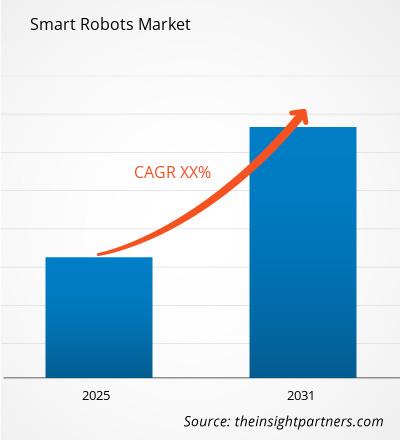
The global smart robots market was valued at US$ 41.78 billion in 2025 and is projected to reach US$ 333.05 billion by 2034, registering a compound annual growth rate (CAGR) of 25.94% from 2026 to 2034. This remarkable growth trajectory is fueled by the accelerating adoption of AI-driven automation across manufacturing, logistics, and healthcare sectors worldwide.
North America accounted for a substantial portion of the global smart robots market size in 2025, estimated at 28-32%, and is projected to grow at a CAGR of 24-26% from 2026 to 2034. Structural growth drivers in the region include significant venture capital investments in robotics startups and the early adoption of autonomous mobile robots (AMRs) and collaborative robots (cobots) across logistics and manufacturing operations .
Smart Robots Market Assessment and Insights
- North America: North America is a leading market, driven by strong technological infrastructure, early adoption of automation, and high investment in robotics innovation. It is estimated to hold a 28-32% share in 2025 and is projected to grow at a CAGR of 24-26% from 2026 to 2034.
- U.S.: The U.S. dominates the North American market, accounting for 84-88% of the region's share in 2025. Its growth is propelled by robust venture capital funding and the rapid deployment of autonomous robots in warehouses and healthcare. The market is expected to grow at a CAGR of 25-27% from 2026 to 2034 .
- Europe: Europe holds an estimated 25-29% share of the global market in 2025, with a projected CAGR of 23-25% from 2026 to 2034. Leading countries include Germany, the UK, and France, driven by strong manufacturing automation, stringent safety regulations, and the presence of major industrial robotics companies .
- Asia Pacific: APAC is estimated to hold a 30-34% share in 2025 and is projected to grow at the fastest CAGR of 27-29% from 2026 to 2034. China, Japan, South Korea, and India are key markets, fueled by rapid industrialization, government initiatives for smart manufacturing, and the strong presence of electronics and automotive industries .
- Largest Segment: The Hardware component segment is estimated to be the largest, holding a 55-60% share in 2025 and projected to grow at a CAGR of 25-27% from 2026 to 2034 .
- High Growth Segment: The Software component segment is projected to be the fastest-growing, driven by the increasing importance of AI, machine learning algorithms, and cloud platforms for robot autonomy. It holds a 20-24% share in 2025 and is expected to grow at a CAGR of 28-30% from 2026 to 2034 .
- Key companies analyzed in detail: iRobot Corporation, Hanson Robotics Limited, Yaskawa Electric Corporation, Omron Corporation, Aethon Inc., Bluefin Robotics, Intuitive Surgical, Inc., Rethink Robotics GmbH, Locus Robotics, and Epson America, Inc.
Source: The Insight Partners' analysis based on proprietary research, government publications, company annual reports, investor presentations, industry databases, and expert interviews.
The global smart robots market has undergone a significant transformation, evolving from basic programmable machines to intelligent, autonomous systems capable of learning and adapting to dynamic environments. This evolution has been driven by breakthroughs in artificial intelligence, computer vision, and sensor technology, enabling robots to perceive their surroundings, make decisions, and collaborate with humans effectively . Production dynamics have shifted toward modular hardware architectures and scalable software platforms to meet diverse application requirements.
Looking forward, the smart robots market is poised for substantial expansion in emerging economies, where rapid industrialization and labor shortages are driving automation demand. Significant investments are being channeled into Robotics as a Service (RaaS) models and AI-powered analytics platforms to lower entry barriers and enhance operational efficiency . Regulatory tailwinds, including government funding for advanced robotics research and standards development, are expected to further accelerate market growth and innovation.
Smart Robots Market Report Scope
| Report Attribute | Details |
|---|---|
| Market size in 2025 | US$ 41.78 Billion |
| Market Size by 2034 | US$ 333.05 Billion |
| Global CAGR (2026 - 2034) | 25.94% |
| Historical Data | 2021-2024 |
| Forecast period | 2026-2034 |
Smart Robots Market Analysis
The global smart robots market is propelled by escalating demand for automation to improve productivity, reduce human errors, and address labor shortages across industries. The rising deployment of IoT-integrated robots for cost-efficient predictive maintenance and the growing adoption of AI-enabled robots in newer applications, such as healthcare and logistics, are significant demand drivers . The ecosystem comprises component suppliers, hardware manufacturers, software developers, and system integrators collaborating to deliver comprehensive automation solutions.
According to the Smart Robots market report, supply-side dynamics are characterized by strategic partnerships and consolidations to enhance technology portfolios. Companies such as iRobot Corporation and Yaskawa Electric Corporation are expanding their software and AI capabilities through acquisitions and collaborations . The competitive landscape is increasingly focused on software monetization and service ecosystems, with companies offering subscription-based analytics and fleet management platforms . Investment trends indicate a strong shift toward developing modular, open-architecture platforms to reduce integration risk and accelerate deployment cycles.
● REPORT CUSTOMIZATION
Tailor This Report To Align With Your Specific Business Requirements
This report can be customized to align precisely with your business objectives, scope, and target markets. Customization options include tailored segmentation, geography, competitive analysis, and strategic insights to support informed decision-making.
Customize This Report →WHAT YOU CAN ADJUST
- ● Segmentations
- ● Geography
- ● Competitive Analysis
- ● Language Preferences
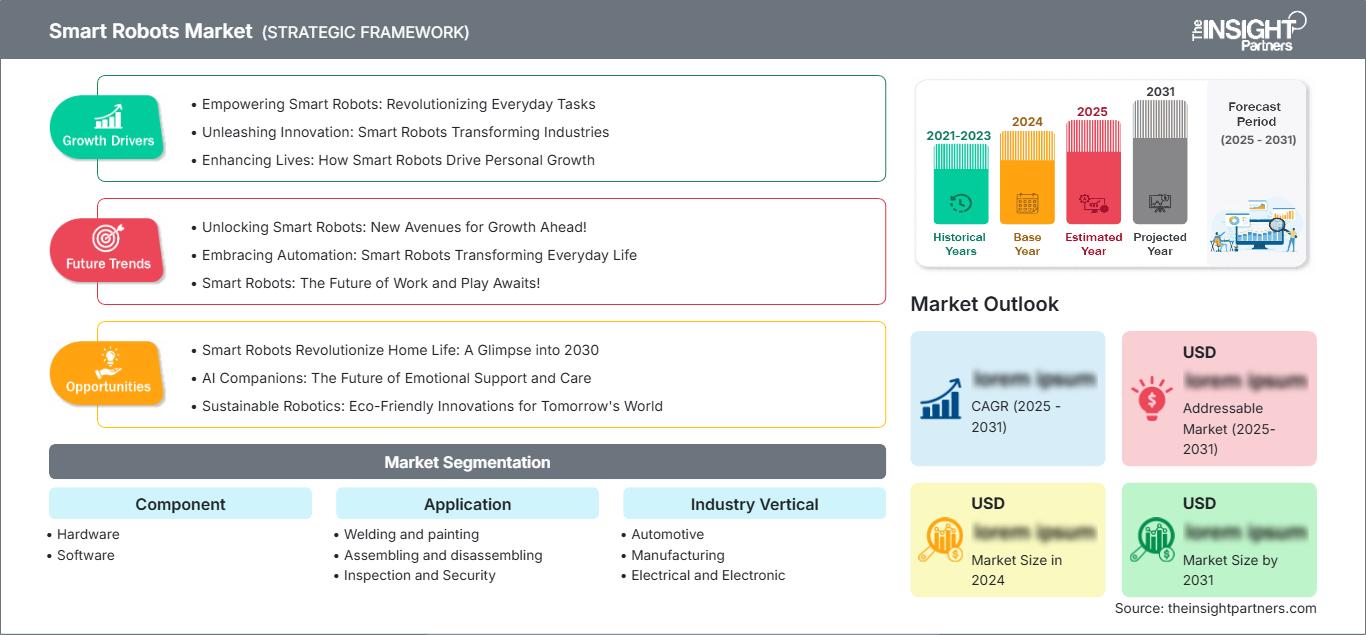
Smart Robots Market: Strategic Insights
Regional Insights
North America Smart Robots Market
North America is a dominant force in the global smart robots market, holding an estimated 28-32% share in 2025 and projected to grow at a CAGR of 24-26% from 2026 to 2034. The region's growth is underpinned by high venture capital investments in robotics startups and the rapid adoption of automation across logistics, healthcare, and manufacturing sectors. The U.S. leads the region, with strong participation from technology companies in next-generation mobility and AI-powered robotics platforms .
U.S. Smart Robots Market
The U.S. accounts for approximately 84-88% of the North American smart robots market share in 2025. The market is characterized by robust funding for robotics innovation and the deployment of autonomous mobile robots (AMRs) and collaborative robots across e-commerce fulfillment centers and hospitals. The market is projected to grow at a CAGR of 25-27% from 2026 to 2034, driven by the integration of advanced AI algorithms and cloud-based fleet management solutions .
Europe Smart Robots Market
Europe is estimated to hold a 25-29% share of the global Smart Robots market in 2025, with a projected CAGR of 23-25% from 2026 to 2034. Germany and the UK are leading countries, driven by strong industrial automation and a focus on safety standards. France, Italy, and Spain are also significant markets, with demand fueled by investments in manufacturing modernization and healthcare robotics. The region's emphasis on collaborative robots (cobots) for human-robot work environments is a key adoption factor .
APAC Smart Robots Market
APAC is estimated to hold a 30-34% share of the global market in 2025 and is projected to grow at the fastest CAGR of 27-29% from 2026 to 2034. China, Japan, South Korea, India, and Australia are key markets, driven by rapid industrialization, government initiatives like "Made in China 2025" and "Society 5.0," and strong electronics and automotive manufacturing bases. China holds the largest share in the region, supported by its strong domestic manufacturing capacity and massive investments in automation .
Middle East & Africa Smart Robots Market
According to the Smart Robots market forecast, the MEA region is estimated to hold a 3-5% share of the global market in 2025, with a projected CAGR of 20-22% from 2026 to 2034. Saudi Arabia, the UAE, and South Africa are key markets, with growth driven by economic diversification initiatives and infrastructure development projects. The UAE, particularly Dubai, is a leader in the region, implementing robotics solutions in healthcare and logistics. Energy sector automation and tourism development are important contextual factors influencing market growth.
Segmentation Analysis
Component
The component segment is categorized into Hardware and Software. The Hardware segment is estimated to be the largest, holding a 55-60% share in 2025, with a projected CAGR of 25-27% from 2026 to 2034. High-quality hardware, including sensors, actuators, and processors, is essential for ensuring robot durability, precision, and reliability across various applications . The increasing demand for advanced robotic systems is driving innovation in hardware components.
- Hardware: Hardware encompasses the physical components of smart robots, including sensors, actuators, controllers, and power supply units. Advances in sensor technology enable accurate environmental perception, while improvements in actuators and motors allow precise movements and operations .
- Software: The software segment is projected to be the fastest-growing, driven by the critical importance of AI, machine learning algorithms, and cloud platforms. Software enables robot autonomy, fleet management, and predictive maintenance, and is increasingly monetized through subscription models .
Application
The application segment includes Welding and Painting, Assembling and Disassembling, Inspection and Security, and Mobility. The Assembling and Disassembling segment is estimated to hold a 28-32% share in 2025, with a projected CAGR of 25-27% from 2026 to 2034. These tasks are critical in manufacturing and industrial processes, where smart robots provide high precision, speed, and consistency essential for maintaining product quality and meeting production targets .
- Welding and Painting: Smart robots are extensively used in automotive and industrial manufacturing for precision welding and painting. They ensure consistent quality, reduce material waste, and enhance worker safety by handling hazardous tasks.
- Assembling and Disassembling: This is the leading application segment, driven by the need for high precision in automotive, electronics, and consumer goods industries. Robots assemble complex products with minimal errors and are also used in recycling and waste management.
- Inspection and Security: Robots integrated with AI, cameras, and sensors are used to detect and analyze objects for quality control and security surveillance. This segment is growing significantly with the need for enhanced monitoring and safety.
- Mobility: Mobile robots include autonomous mobile robots (AMRs) and automated guided vehicles (AGVs) used for material handling and logistics. They are crucial for automating warehouse operations and improving operational efficiency.
Industry Vertical
The industry vertical segment is divided into Automotive, Manufacturing, Electrical and Electronic, Food and Beverage, Chemical, and Residential. The Automotive segment is estimated to be the largest, holding a 25-29% share in 2025, with a projected CAGR of 24-26% from 2026 to 2034. The automotive industry has been a pioneer in adopting robotic automation for assembly, welding, painting, and quality inspection to improve production efficiency and product quality .
- Automotive: This is the dominant vertical, driven by the early and extensive adoption of robotics for precision tasks like assembly and welding. The sector's focus on reducing labor costs and minimizing errors continues to fuel demand.
- Manufacturing: The manufacturing vertical encompasses a broad range of industries using robots for material handling, assembly, and packaging. The need for flexible automation to adapt to changing production demands is a key growth driver.
- Electrical and Electronic: This vertical utilizes smart robots for assembling circuit boards and other delicate components. High precision and speed are essential for meeting the quality standards of the electronics industry.
- Food and Beverage: Robots are increasingly used in food processing and packaging for tasks requiring hygiene and speed. The need to handle products gently and ensure food safety is driving adoption in this sector.
- Chemical: In the chemical industry, robots are used for handling hazardous materials and performing repetitive tasks in environments that are unsafe for humans, thereby improving safety and operational efficiency.
- Residential: The residential segment includes domestic robots for cleaning, lawn mowing, and personal assistance. The growing interest in home automation and the aging population are fueling demand in this segment .
Opportunity Snapshot
| Industry Vertical | Revenue Contribution | Trend Tag | Adoption Stage |
|---|---|---|---|
| Automotive | High | Factory Automation | Mature |
| Manufacturing | High | Smart Production | Scaling |
| Electrical and Electronic | Medium | Micro-Assembly | Scaling |
| Food and Beverage | Medium | Hygienic Handling | Emerging |
| Chemical | Medium | Hazardous Tasks | Emerging |
| Residential | Medium | Home Assistance | Scaling |
Smart Robots Market Growth Drivers and Impact Analysis
Growing Adoption of AI-Enabled Robots in New Applications
The increasing integration of artificial intelligence and advanced sensor technology is expanding the application scope of smart robots beyond traditional manufacturing . Robots are now being deployed in healthcare for surgery, rehabilitation, and patient assistance; in logistics for warehouse automation and last-mile delivery; and in agriculture for precision farming. This expansion into new, high-growth sectors is a primary driver of market growth, as it creates new revenue streams and diversifies the customer base.
Rising Demand for Automation to Improve Productivity and Reduce Errors
The surging demand for automation across industries to enhance operational efficiency, reduce labor costs, and improve product quality is a significant market driver . Smart robots perform repetitive and ergonomically challenging tasks with high precision and consistency, minimizing human errors. This is particularly critical in sectors like automotive, electronics, and logistics, where speed and accuracy are paramount. The need to remain competitive in a globalized market is compelling companies to invest in robotic automation.
Increasing Government Investments in Advanced Robotics Development
Governments worldwide are increasing funding for advanced robotics research and development to maintain technological leadership and address societal challenges such as aging populations and labor shortages . Initiatives like "Made in China 2025" and "Society 5.0" in Japan are providing substantial support for robotics innovation. These investments are accelerating technology development, fostering innovation, and creating a favorable environment for market growth by reducing the cost and risk of developing new robotic solutions.
Smart Robots Market Future Trends
Rise of Robotics as a Service (RaaS) Business Model
A key Smart Robots Market trend is the growing interest in the Robotics as a Service (RaaS) business model, which is creating new market opportunities . Instead of large upfront capital expenditures, customers can subscribe to robotic solutions, paying for usage or outcomes. This model lowers the barrier to entry for small and medium-sized enterprises (SMEs), accelerates adoption, and provides vendors with recurring revenue streams. RaaS is expected to become a dominant model, particularly in logistics and commercial cleaning.
Expansion of Collaborative Robots for Human-Robot Work Environments
The rising demand for collaborative robots (cobots) designed to work safely alongside humans is a defining future trend . Cobots are enhancing workplace efficiency by assisting with tasks that require human dexterity and judgment, while automating repetitive or strenuous actions. They are increasingly deployed in assembly lines, inspection, and packaging. This trend is driven by the need to combine the strengths of both humans and robots, leading to safer and more productive work environments.
Smart Robots Market Opportunities
Growing Adoption of Smart Robots for Elderly Care and Assistance
A significant opportunity lies in the growing adoption of smart robots for elderly care, disability assistance, and companionship . With an aging global population, there is an increasing need for assistive technologies to support independent living and reduce the burden on healthcare systems. Robots can assist with daily tasks, monitor health, provide reminders, and offer social interaction. Companies that develop specialized robots for this demographic are well-positioned to capture a growing market segment.
Expansion in Emerging Economies with Large-Scale Industrialization
A major opportunity exists in the expanding industrialization and infrastructure development in emerging economies across Asia Pacific, Latin America, and the Middle East. Rapid urbanization and rising manufacturing activities in these regions are creating substantial demand for automation. Companies that can establish strong partnerships with local governments and offer scalable, cost-effective robotic solutions are poised to capture significant market share in these high-growth regions.
Recent Developments
- July 2026: iRobot Corp., the maker of Roomba, and a leader in consumer robotics and intelligent floor care, today announced its most significant portfolio expansion in years with the introduction of Roomba Electro Plus, its first non-robot floor cleaning solution, alongside a reimagined generation of Roomba robots that now bring premium technologies & experiences throughout the portfolio. Together, the new products reflect iRobot's continued commitment to consumer-led innovation, expanding beyond robotic cleaning to deliver a more complete floor care ecosystem designed around the evolving needs of today's households.
- July 2025: Intuitive, a global technology leader in minimally invasive care and the pioneer of robotic-assisted surgery, announced that the da Vinci 5 Surgical System has received CE mark approval for adult and pediatric use in Europe for minimally invasive endoscopic procedures across abdominopelvic and thoracoscopic surgical procedures, including urologic, gynecologic, and general laparoscopic procedures.
- August 2022: GEODIS, a leading global transport and logistics provider, and Locus Robotics, the leader in autonomous mobile robots (AMRs) for fulfillment warehouses, announced a new expansion agreement to deploy a total of 1,000 LocusBots at GEODIS’ worldwide warehouse locations over the next 24 months.
Frequently Asked Questions

- Comprehensive Market Sizing and Forecast Analysis
- Detailed Segmentation Analysis
- In-Depth Market Dynamics Assessment
- Regional and Country-Level Insights
- Competitive Landscape and Company Benchmarking
- Strategic Business Intelligence
Recent Reports
Testimonials

The Insight Partners' SCADA System Market report is comprehensive, with valuable insights on current trends and future forecasts. The team was highly professional, responsive, and supportive throughout. We are very satisfied and highly recommend their services.
RAN KEDEM Partner, Reali Technologies LTDs
I requested a report on a very specific software market and the team produced the report in a few days. The information was very relevant and well presented. I then requested some changes and additions to the report. The team was again very responsive and I got the final report in less than a week.
JEAN-HERVE JENN Chairman, Future Analytica
We worked with The Insight Partners for an important market study and forecast. They gave us clear insights into opportunities and risks, which helped shape our plans. Their research was easy to use and based on solid data. It helped us make smart, confident decisions. We highly recommend them.
PIYUSH NAGPAL Sr. Vice President, High Beam Global
The Insight Partners delivered insightful, well-structured market research with strong domain expertise. Their team was professional and responsive throughout. The user-friendly website made accessing industry reports seamless. We highly recommend them for reliable, high-quality research services
YUKIHIKO ADACHI CEO, Deep Blue, LLC.
This is the first time I have purchased a market report from The Insight Partners.While I was unsure at first, I visited their web site and felt more comfortable to take the risk and purchase a market report.I am completely satisfied with the quality of the report and customer service. I had several questions and comments with the initial report, but after a couple of dialogs over email with their analyst I believe I have a report that I can use as input to our strategic planning process.Thank you so much for taking the extra time and making this a positive experience.I will definitely recommend your service to others and you will be my first call when we need further market data.
JOHN SUZUKI President and Chief Executive Officer, Board Director, BK Technologies
I wish to appreciate your support and the professionalism you displayed in the course of attending to my request for information regarding to infectious disease IVD market in Nigeria. I appreciate your patience, your guidance, and the fact that you were willing to offer a discount, which eventually made it possible for us to close a deal. I look forward to engaging The Insight Partners in the future, all thanks to the impression you have created in me as a result of this first encounter.
DR CHIJIOKE ONYIA MANAGING DIRECTOR, PineCrest Healthcare Ltd.Reason to Buy
- Informed Decision-Making
- Understanding Market Dynamics
- Competitive Analysis
- Identifying Emerging Markets
- Customer Insights
- Market Forecasts
- Risk Mitigation
- Boosting Operational Efficiency
- Strategic Planning
- Investment Justification
- Tracking Industry Innovations
- Aligning with Regulatory Trends





 Get Free Sample for