Control Valve Market Share, Size & Demand by 2034

Coverage: By Type (Ball Valve, Butterfly Valve, Globe Valve, Rotary Valve, Linear Valve, Others); Actuation Technology (Pneumatic Control Valve, Hydraulic Control Valve, Electrical Control Valve, Manual Control Valve); Application (Automotive, Oil and Gas, Wastewater Management, Power Generation, Pharmaceutical, Others) , and Geography (North America, Europe, Asia Pacific, and South and Central America)

Historic Data: 2021-2024 | Base Year: 2025 | Forecast Period: 2026-2034
  • Status : Data Released
  • Report Code : TIPEL00002035
  • Category : Manufacturing and Construction
  • No. of Pages : 150
  • Available Report Formats : pdf-format excel-format
  • Last update date : September 08, 2026
Control Valve Market Share, Size & Demand by 2034
Report Date: September 08, 2026   |   Report Code: TIPEL00002035 Email: sales@theinsightpartners.com

2025 Market Size

US$ 10.21 Bn

Base year value

2034 Forecast

US$ 16.49 Bn

Projected by 2034

CAGR 2026-2034

5.47 %

Growth rate

Addressable Market

US$ 121.06 Bn

(2026-2034)

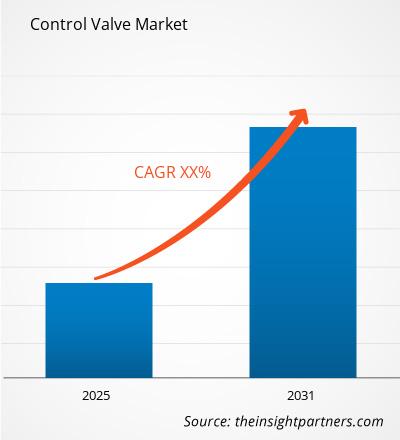
The control valve market was valued at US$ 10.21 Billion in 2025 and is projected to reach US$ 16.49 Billion by 2034, expanding at a CAGR of 5.74% during 2026–2034. Demand is advancing as process industries modernize flow, pressure, temperature, and level control across critical production assets. The outlook reflects sustained replacement cycles, new industrial capacity, and wider adoption of connected valve assemblies that improve precision, reliability, and lifecycle performance.

Across North America, the control valve market size is expected to advance at a modelled 5.2–5.8% CAGR through 2034, supported by refinery modernization, LNG and pipeline investment, and renewal of municipal water assets. Digital positioners and low-emission packing are gaining specification priority as operators pursue preventive maintenance and tighter fugitive-emission control. A deep installed base also sustains aftermarket demand for trim, actuators, diagnostics, and engineered replacements.

Control Valve Market Assessment and Insights

  • North America held 32–35% share in 2025 and is forecast to grow at 5.2–5.8% CAGR during 2026–2034, underpinned by energy infrastructure upgrades, water investment, and a large serviceable installed base.
  • US represented 78–82% of North American revenue in 2025 and is projected to expand at 5.1–5.7% CAGR through 2034 as refineries and utilities digitize maintenance.
  • Europe accounted for 25–28% share in 2025 and is expected to post 4.8–5.4% CAGR, led by Germany, the UK, France, Italy, and Spain.
  • Asia Pacific captured 31–34% share in 2025 and is forecast to grow at 6.5–7.1% CAGR, with China, Japan, India, and South Korea supporting expansion.
  • Largest Segment Pneumatic control valves held 45–49% market share in 2025 and are expected to register 5.0–5.6% CAGR during 2026–2034.
  • High Growth Segment Electrical control valves represented 20–24% market share in 2025 and are projected to record 7.2–7.8% CAGR during 2026–2034.
  • Key companies analyzed in detail: Alfa Laval AB, Christian Bürkert GmbH & Co. KG, Curtiss-Wright Corporation, Emerson Electric Co., Flowserve Corporation, GEMÜ Gebr. Müller Apparatebau GmbH & Co. KG, SAMSON AG, Spirax Group plc, IMI plc, and Baker Hughes Company.

Source: The Insight Partners' analysis based on proprietary research, government publications, company annual reports, investor presentations, industry databases, and expert interviews.

The trend is moving away from standalone mechanical throttling towards assemblies incorporating valves, actuator, positioner, sensors, and asset management software. Manufacturers are standardizing modular bodies and interchangeable trims to reduce delivery time while introducing severe service, hygienic and emissions reductions options. Additive manufacturing and digital size calculation are reducing costs of customization, while regional manufacturing and assembling will limit the logistic exposure. This development benefits the supplier companies that combine application engineering with installed base services and diagnostics integration into the brownfield control systems.

For the period till 2034, capital spending will move beyond well-established petrochemical regions into Asian water systems, Middle Eastern gas processing facilities and pharmaceutical plants in India and Southeast Asia. Increased regulation on methane emission, safety, quality of water and energy efficiency drives installation of the new assets that replace old leaking and insufficiently instrumented equipment. According to the IEA estimates, $3.3 trillion of global energy investment is expected by 2025, which is a good project pipeline. Localization programs should drive demand for regional manufacturing and assembling.

Control Valve Market Report Scope

Report Attribute Details
Market size in 2025 US$ 10.21 Billion
Market Size by 2034 US$ 16.49 Billion
Global CAGR (2026 - 2034)5.47%
Historical Data 2021-2024
Forecast period 2026-2034
Inquire More about this report.
Inquire More

Control Valve Market Analysis

Control valve market growth is based on investment in automation and necessity to stabilize the process under variable flow rates. As a result, owners take into account cost of ownership, not the cost of the valve itself, because inadequate sizing, cavitation, noise or packing problems could limit the entire process line. So demand goes from engineering contractors and OEMs to authorized distributors, with the major specification activity being done by process and reliability engineers.

Supply chain economics depend on castings, forgings, specialty alloys, elastomers, electronics and actuators that must be calibrated. Commodity valves are subjected to price competition, but high-performance and hygienic assemblies have premium prices due to engineering content. Valve manufacturers use dual-source procurement strategy, keep stock of crucial trim elements and assemble valves closer to customers. The aftermarket is still relatively healthy, since inspection, repair and replacement activities continue despite reduced greenfield CapEx.

The control valve market analysis reveals the emergence of competition in the following segments: automation systems suppliers, severe service specialists, and hygienic fluid control suppliers. Emerson Electric Co. and Flowserve Corporation offer integrated installations with digital diagnostics whereas SAMSON AG and Christian Bürkert GmbH & Co. KG specialize in modular systems and accurate actuation technologies. Alfa Laval AB and GEMÜ Gebr. Müller Apparatebau GmbH & Co. KG have a unique offering for sanitary processing because of cleanability and validation criteria.

Strategic investment is related to software-enabled services, electric actuation, low-leakage solutions, and portfolio development. Curtiss-Wright Corporation and IMI plc have a focus on critical mission power applications, while Baker Hughes Company serves demanding energy environments. The Spirax Group plc offers the expertise in steam system application solutions. The recent acquisitions reflect the importance of the installed bases and aftermarket entitlement, thus the suppliers have a motivation to position themselves through application experience and certification.

● REPORT CUSTOMIZATION

Tailor This Report To Align With Your Specific Business Requirements

This report can be customized to align precisely with your business objectives, scope, and target markets. Customization options include tailored segmentation, geography, competitive analysis, and strategic insights to support informed decision-making.

Customize This Report →

WHAT YOU CAN ADJUST

  • Segmentations
  • Geography
  • Competitive Analysis
  • Language Preferences

Control Valve Market: Strategic Insights
control-valve-market
Download Free sample to check more details about report.
This FREE sample will include data analysis, ranging from market trends to estimates and forecasts.
Download Free Sample

Regional Insights

North America control valve market

North America generated an estimated 32–35% control valve market share in 2025 and is modelled to expand at 5.2–5.8% CAGR during 2026–2034. The area boasts of extensive facilities of refineries, petrochemicals, gas treatment, energy production, pharmaceuticals, and municipal water works. The brownfield modernization process necessitates a continual need for valves that are compatible with their distributed control system, while methane and fugitive emission processes lead to an increased need for certified packing and reliable shut off valves.

Intensity of investment is supported by LNG capacity, pipeline integrity programs, power grid reliability investments, and water system renewal. Customers prefer suppliers who offer engineering services, have repair centers, and have proven performance of products throughout the life cycle due to the cost implications of unavailability during production. Electric actuators are becoming popular due to the absence of air compression or reduction in carbon emissions in pneumatic losses even as pneumatic assemblies remain widely accepted.

U.S. Control Valve Market

The U.S. represented 78–82% of North American revenue in 2025 and is projected to achieve 5.1–5.7% CAGR through 2034. Refining, petrochemical, LNG, and natural gas processing in the Gulf Coast region form a demand cluster supplemented by nuclear, thermal, municipal water, and biopharmaceutical spending. End-users now insist on digital positioners, partial stroke testing, anti-cavitation trim, and environmentally friendly valve packing at turnarounds for higher uptime and compliance with operating licenses.

Emerson Electric Co., Flowserve Corporation, Curtiss-Wright Corporation, Baker Hughes Company, and IMI plc have considerable access to customers via local engineering, production, services, or sales organizations. Valve application is differentiated based on usage, as globes are still needed for precise steam and pressure regulation, rotary valves are used for large liquid and gas flows, while sanitary valves are required for sterile manufacturing processes. Purchase orders now often include not only hardware but also commissioning and diagnostics, spare parts and long-term repairs.

Europe Control Valve Market

Europe held 25–28% share in 2025 and is forecast to grow at 4.8–5.4% CAGR through 2034. Germany is ahead in chemicals, machinery, pharmaceuticals, and municipal infrastructure sectors with highly automated production. The existing industrial plant in Germany favors installation of retrofit compatible positioners, efficient electric actuators, and valves that fulfill leakage, pressure equipment, and functional safety standards. In addition, engineering capabilities of local firms facilitate exports of skids and process plants.

The United Kingdom provides market opportunities in energy, water, pharmaceutical and power industries, where offshore assets make for a harsh environment for replacements. France specializes in nuclear power generation, chemicals, and water treatment, whereas Italy specializes in machinery and process equipment manufacturing for OEM consumption. Spain provides market opportunity in desalination and water reuse, energy, and food processing. Common features of end users from these countries include traceability, emissions compliance, and service accessibility. Electrification is gaining traction where savings on compressed air justifies electrification.

APAC Control Valve Market

Asia Pacific captured 31–34% share in 2025 and is projected to expand at 6.5–7.1% CAGR, the fastest regional pace. China leads through chemicals, refining, power, water, and industrial equipment production, while India benefits from manufacturing localization, city infrastructure, and pharmaceutical capacity.

Japan and South Korea sustain demand for high-specification automation, semiconductors, energy, and shipbuilding. Australia contributes mining, LNG, and water applications. Policy support for industrial upgrading, cleaner production, wastewater reuse, and energy security expands project pipelines, although price competition encourages suppliers to localize assembly and service.

Middle East & Africa Control Valve Market

The Middle East and Africa market is expected to grow at 5.7–6.3% CAGR through 2034. Saudi Arabia leads as oil, gas, refining, petrochemical, desalination, and industrial diversification programs require engineered flow control across new and existing assets. The UAE adds LNG, utilities, water, and downstream projects.

South Africa generates demand from power, mining, chemicals, and municipal water, while the rest of MEA presents selective opportunities tied to energy access and urban infrastructure. Severe temperatures, corrosive media, and remote sites elevate the importance of material selection, diagnostics, local spares, and field service.

control-valve-market-cagr-image
Get a regional analysis of this market.
Download Free Sample Brochure

Segmentation Analysis

Type

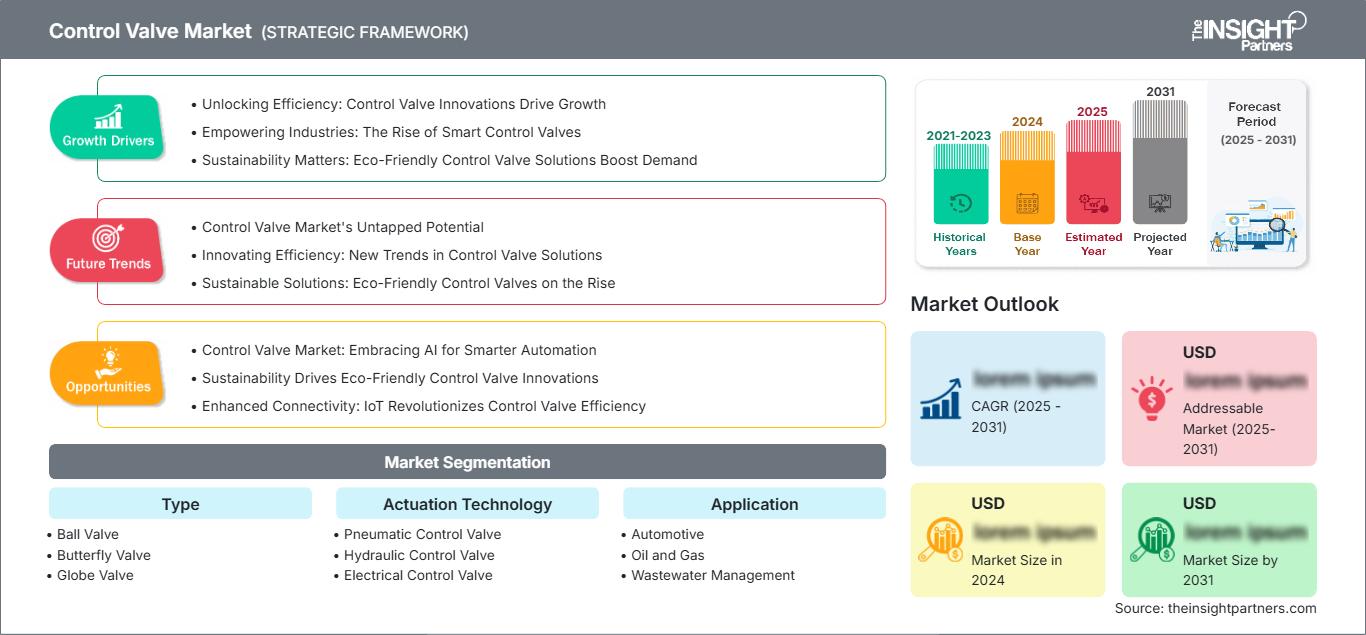
The Type segment is projected to record 5.4–6.0% CAGR during 2026–2034. The control valve market scope spans precision throttling, isolation-assisted control, and high-capacity flow duties. Selection depends on rangeability, pressure drop, cavitation risk, media properties, footprint, maintenance access, and required shutoff. Modular trim and materials broaden addressable applications while digital sizing reduces specification error.

  • Ball Valve configurations suit high-capacity flow, tight shutoff, and demanding hydrocarbon duties, balancing compact rotary motion with engineered trims that improve controllability across wide operating envelopes.
  • Butterfly Valve products hold a strong position in large-diameter water, HVAC, power, and general industrial lines where low weight, compact installation, and competitive lifecycle economics matter.
  • Globe Valve designs remain strategically important for accurate throttling, steam conditioning, and high differential pressure because established trim options manage noise, cavitation, and challenging process variability.
  • Rotary Valve architectures serve high-flow applications with compact actuators and rapid response, supporting capacity-intensive pipelines and process skids where space, weight, and maintainability guide specification.
  • Linear Valve assemblies deliver precise stem travel and broad severe-service customization, retaining importance in critical pressure, temperature, and flow loops that demand predictable installed performance.

Actuation Technology

Actuation Technology is forecast to expand at 5.8–6.4% CAGR during 2026–2034. Pneumatics retain scale because of proven fail-safe behavior and hazardous-area suitability, while electric systems gain from lower utility requirements, simpler connectivity, and precise positioning. Hydraulic actuation remains essential for high-force duties, and manual systems preserve relevance in noncritical or infrequently operated lines where automation economics are limited.

  • Pneumatic Control Valve systems lead installed demand through fast response, robust fail action, and compatibility with established plant air networks, particularly in oil, gas, chemicals, and power.
  • Hydraulic Control Valve assemblies address high-thrust, remote, offshore, marine, and heavy-duty applications where compact force density and dependable movement under demanding pressure conditions are decisive.
  • Electrical Control Valve adoption is scaling as facilities reduce compressed-air losses, connect assets digitally, and require precise modulation in water, buildings, pharmaceuticals, and distributed energy systems.
  • Manual Control Valve products remain mature for isolation-adjacent adjustment, bypasses, and low-frequency operations, offering straightforward maintenance where remote control, diagnostics, or rapid response provide limited value.

Application

Application demand is expected to grow at 5.6–6.2% CAGR during 2026–2034. Oil and gas sustains severe-service and replacement requirements, while wastewater, power, and pharmaceuticals diversify the project pipeline. Automotive manufacturing adds process utilities and thermal management. Each application imposes distinct standards for leakage, cleanability, materials, response time, and validation, rewarding suppliers with focused engineering and service expertise.

  • Automotive demand centers on paint shops, thermal systems, compressed air, test benches, and emerging battery processes, where repeatable control supports quality, energy efficiency, and flexible production.
  • Oil and Gas remains strategically significant across upstream, pipelines, LNG, refining, and petrochemicals, requiring severe-service trim, low-emission packing, dependable fail action, and extensive aftermarket support.
  • Wastewater Management applications favor corrosion resistance, large-diameter flow capacity, remote monitoring, and low-maintenance actuation as utilities expand treatment, reuse, desalination, and network resilience programs.
  • Power Generation uses engineered valves for steam, feedwater, cooling, emissions control, and auxiliary systems, with nuclear and flexible generation elevating qualification, reliability, and service requirements.
  • Pharmaceutical installations prioritize hygienic design, drainability, validated materials, batch accuracy, and automation integration, making documentation and contamination control central to vendor selection.

Opportunity Snapshot

Application

Revenue Contribution

Trend Tag

Adoption Stage

Automotive

Medium

Battery Cooling

Scaling

Oil and Gas

High

Methane Control

Mature

Wastewater Management

High

Water Reuse

Scaling

Power Generation

High

Nuclear Renewal

Mature

Pharmaceutical

Medium

Sterile Automation

Scaling

Request for Customization for extensive market insights.
Customize This Report

Control Valve Market Growth Drivers and Impact Analysis

Industrial Automation Raises Final-Control Investment

In the effort of ensuring high-quality production processes and safety while consuming minimal energy and employing fewer people, manufacturers are opting to automate their process loops. In today's valve assemblies, the controller output is used in making process changes. This means that the accuracy of the valve is directly related to efficiency and variability in the system. With digital positioners, process data such as travel, friction, air consumption, and responsiveness becomes available to maintenance personnel. In this regard, the valves and analog positioners become measurable components, which makes it easier to replace them during system upgrading. The effect is felt more in industries such as chemical, refining, pharmaceuticals, and power.

Water Infrastructure Expansion Broadens Demand

As a consequence of the population explosion, water stress due to industrialization, leakage prevention, and stricter discharge requirements, there is greater need for investment in treatment, pumping, desalination, and reuse processes. Such systems call for reliable modulating action at the point of intake, filtration, chemical injection, membranes, sludge, and distribution. Large valve diameters are suitable for bulk handling purposes, whereas ball valves and globe valves are suitable for dosing and pressure regulation. Remote installations are best controlled by electric and intelligent actuators, which provide position and condition feedback to central control operations. Water utilities also place great importance on valves that are corrosion resistant and require less maintenance in their lifecycles. Field maintenance is expensive after all.

Energy Security and Asset Renewal Sustain Orders

For the year 2025, the International Energy Agency predicted that global energy investments would be at US$3.3 trillion, with investments going into clean energy and traditional fuel sources. All processes related to generation, processing, transportation, and storage include the task of flow control from steam and cooling water through to gas compression and chemical injection. Old plants, refineries, and pipelines also need new trim, actuators, and assemblies to maintain their availability. Projects such as increased use of LNG, extension of life of nuclear facilities, and the generation of hydrogen involve stringent specifications in relation to cryogenic conditions and rapid fail actions.

Control Valve Market Future Trends

Embedded Diagnostics Move Toward Predictive Control

The global control valve market trends will center on diagnostic intelligence embedded within positioners and connected asset platforms. Algorithms will compare commanded versus actual travel, pressure signatures, friction, and cycle history to identify packing wear, stiction, air leakage, or actuator degradation before process performance deteriorates. Edge processing will reduce data volumes while open protocols improve integration with distributed control and maintenance systems. Vendors will increasingly sell performance assurance rather than isolated hardware, using remote analysis to prioritize shutdown work. Adoption will progress first in critical continuous-process loops, then expand to utility and water networks as cybersecurity, interoperability, and workforce capabilities mature.

Electric Actuation Gains Design-In Momentum

Electric actuators will secure a larger role as projects pursue all-electric architectures, distributed automation, and lower compressed-air consumption. Advances in motor control, energy storage for fail-safe movement, sealing, and hazardous-area certification will extend applicability beyond traditional building and water duties. Precise low-speed positioning and native connectivity suit pharmaceutical skids, battery plants, hydrogen systems, and remote pipelines. Pneumatics will remain important where fast response and proven spring-return behavior dominate, so conversion will be selective rather than universal. Manufacturers that offer common valve bodies with interchangeable pneumatic and electric actuation can help customers standardize spares while preserving application flexibility.

Control Valve Market Opportunities

Build Lifecycle Service Around Installed Assets

An actionable opportunity lies in converting fragmented aftermarket work into structured lifecycle programs. Suppliers can inventory installed valves, rank loop criticality, establish diagnostic baselines, and schedule repair before turnarounds. The control valve market forecasts indicate that replacement and service will benefit from aging process infrastructure even when greenfield spending varies. Regional service hubs, exchange assemblies, certified remanufacturing, and guaranteed response times can reduce customer downtime while generating recurring, higher-visibility revenue. Digital records linking serial numbers, materials, trim, and maintenance history also improve compliance and spare planning. Investment should prioritize technician coverage, mobile test equipment, application engineering, and secure customer portals rather than relying solely on new-product launches.

Localize Engineered Packages in High-Growth Regions

Asia Pacific and the Middle East offer room for suppliers to localize assembly without commoditizing their engineering proposition. A viable strategy combines globally qualified designs with regional machining, actuator mounting, testing, certification, and inventory. This shortens delivery, improves bid responsiveness, and supports local-content requirements while preserving control over critical trim and intellectual property. Partnerships with engineering contractors and system integrators can position valve packages earlier in project design, particularly for water reuse, LNG, pharmaceuticals, and power. Companies should fund application laboratories and training centers that demonstrate cavitation control, emissions performance, and digital integration. The strongest returns will come from coupling local capacity with dependable field service.

Recent Developments

  • June 2026: Flowserve Corporation completed the acquisition of Trillium Flow Technologies’ Valves Division, expanding its mission-critical valve and actuation portfolio for nuclear, conventional power, industrial, and infrastructure applications. The acquired installed base exceeds 200,000 units across 115 operating nuclear reactors, strengthening recurring aftermarket exposure and extending Flowserve’s support footprint across more than 300 reactors worldwide.
  • May 2025: Emerson Electric Co. introduced the Fisher GX Bolted Bonnet Globe Valve and actuator system for critical downstream oil and gas, chemical, and petrochemical fluids. A separate high-strength locknut lets technicians remove or service the actuator without lifting the bonnet or exposing internals. The compact system supports pneumatic actuation and compatible electric actuators, improving maintenance flexibility.

Frequently Asked Questions

Correct installed sizing usually creates more value than negotiating the lowest purchase price. It limits cavitation, noise, hunting, and trim wear. Buyers should evaluate actual operating cases, not merely design maximums, and require documented rangeability, actuator margin, leakage class, and maintainability.

Rank loops by safety, production constraint, energy loss, maintenance frequency, and poor control performance. Valves showing excessive travel deviation, friction, leakage, or recurring repair should move first. A criticality-based program produces faster returns than replacing assets solely by age.

Electric actuation is compelling where plant air is unavailable, expensive, or leakage-prone, and where native digital connectivity matters. The business case improves for remote, distributed, or intermittently operated assets, but users must verify fail-safe needs, hazardous-area certification, speed, thrust, and ambient limits.

Documentation depth, material traceability, cleanability, qualification evidence, and change control frequently outweigh catalog breadth. The control valve market report perspective indicates that pharmaceutical and nuclear buyers benefit from vendors able to reproduce certified configurations and support audits throughout long asset lives.

Standardize preferred bodies, trims, actuators, and accessories by duty class, then hold only critical long-lead components. Framework agreements with regional assembly and tested alternates improve resilience. Early engineering engagement also prevents late specification changes that trigger recertification or custom casting requirements.
Nivedita Upadhyay
Manager,
Market Research & Consulting

Nivedita is an accomplished research professional with over 9 years of experience in Market Research and Business Consulting. Currently serving as a Project Manager in the ICT domain at The Insight Partners, she brings deep expertise in managing and executing Syndicated, Custom, Subscription-based, and Consulting research assignments across diverse technology sectors.

With a proven track record of delivering data-driven analysis and actionable insights, Nivedita has been a key contributor to several critical projects. Her work involves end-to-end project execution—right from understanding client objectives, analyzing market trends, to deriving strategic recommendations. She has collaborated extensively with leading ICT companies, helping them identify market opportunities and navigate industry shifts.

Nivedita holds an MBA in Management from IMS, Dehradun. Prior to joining The Insight Partners, she gained valuable experience at MarketsandMarkets and Future Market Insights in Pune, where she held various research roles and built a strong foundation in industry analysis and client engagement.

  • Comprehensive Market Sizing and Forecast Analysis
  • Detailed Segmentation Analysis
  • In-Depth Market Dynamics Assessment
  • Regional and Country-Level Insights
  • Competitive Landscape and Company Benchmarking
  • Strategic Business Intelligence

Testimonials

Reason to Buy

  • Informed Decision-Making
  • Understanding Market Dynamics
  • Competitive Analysis
  • Identifying Emerging Markets
  • Customer Insights
  • Market Forecasts
  • Risk Mitigation
  • Boosting Operational Efficiency
  • Strategic Planning
  • Investment Justification
  • Tracking Industry Innovations
  • Aligning with Regulatory Trends
Sales Assistance
US: +1-646-491-9876
UK: +44-20-8125-4005
DUNS Logo
ISO Certified Logo
GDPR
CCPA