
Digital Signage Market Growth, Trends, and Forecast by 2034
Coverage: By Component (Hardware, Software, and Service), Display Type (LED, LCD, OLED, and Others), Display Size (Less than 19 Inches, 19–32 Inches, 32–52 Inches, and Greater than 52 Inches), Application (Retail, Healthcare, Corporate, Hospitality, Government, Transportation, Entertainment, BFSI, Education, and Others), and Geography
- Status : Data Released
- Report Code : TIPTE100000118
- Category : Electronics and Semiconductor
- No. of Pages : 150
- Available Report Formats :


- Last update date : August 27, 2026


2025 Market Size
US$ 21.11 Bn
Base year value
2034 Forecast
US$ 41.84 Bn
Projected by 2034
CAGR 2026-2034
7.9 %
Growth rate
Addressable Market
US$ 283.25 Bn
(2026-2034)
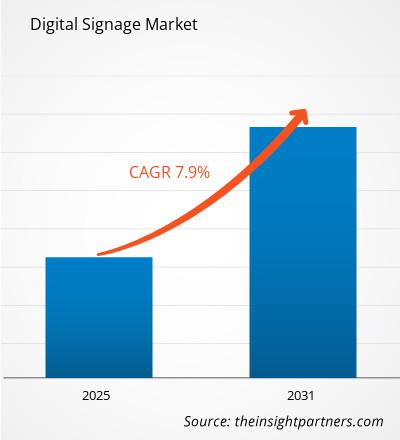
The Digital Signage Market size reached US$ 21.11 Billion in 2025 and is expected to grow up to US$ 41.84 Billion in 2034, growing at a CAGR of 7.90% during 2026-2034. The growth is fueled by enterprise adoption of interactive display systems that enable real-time content management, personalized communications, and centralized operations within retail, transportation, corporate, hospitality, healthcare, and government sector landscapes.
The North American market represents a mature yet reinvestment-based market with a 2026-2034 CAGR growth range of 6.8-7.4%. Digital Signage Market size in North America is driven by retail media networks, airport modernization, wayfinding solutions within healthcare facilities, and digitization of corporate workplaces. Replacement trends related to 4K displays, cloud-based platforms for managing content and energy-efficient digital signage expand the need further.
Digital Signage Market Assessment and Insights
- North America held 32–35% Digital Signage Market share in 2025 and is projected to grow at a CAGR of 6.8–7.4% during 2026–2034, supported by retail media, airport upgrades, and enterprise communication investments.
- US accounted for 78–82% of North America in 2025 and is expected to grow at 6.9–7.5% CAGR through 2034.
- Europe represented 24–27% share in 2025 and is expected to record 6.6–7.2% CAGR, led by Germany, the UK, France, Italy, and Spain.
- Asia Pacific held 28–31% share in 2025 and is forecast to expand at 8.6–9.4% CAGR, led by China, Japan, South Korea, India, and Australia.
- Largest Segment Hardware held 58–62% market share in 2025 and is expected to grow at 6.9–7.6% CAGR through 2034.
- High Growth Segment Software accounted for 22–26% market share in 2025 and is forecast to grow at 8.7–9.6% CAGR during 2026–2034.
- Key companies analyzed in detail: Microsoft Corporation, Cisco Systems, Inc., Intel Corporation, Panasonic Holdings Corporation, Samsung Electronics Co., Ltd., LG Electronics Inc., Sony Corporation, Sharp NEC Display Solutions, Hewlett Packard Enterprise Company, Sharp Corporation, Broadsign International LLC, AUO Corporation, BrightSign LLC, BenQ Corporation, Intuiface SAS, Delta Electronics, Inc., YCD Multimedia Ltd., Layered Solutions, Barco NV, Visix, Inc.
Source: The Insight Partners' analysis based on proprietary research, government publications, company annual reports, investor presentations, industry databases, and expert interviews.
Applications have transformed from display-only projects to media, analytics, and device management platforms. LED video walls, chip displays, cloud-based content management, and edge computing have disrupted the production process since the value proposition moves away from panel manufacturing to software orchestration, reliability, and ad revenue generated through data. The hardware still forms the core, but there is increased spending on software and service components.
Future demand is forecast to become stronger in high foot traffic urban zones, airports, hospitals, quick service restaurants, and campuses where real-time communication is essential. Public infrastructure spending, retail media monetization, energy-efficient e-paper displays, and increasing disability compliance regulations define the procurement strategy. New markets are implementing standardized network infrastructure at an accelerated pace due to ease of cloud platform deployment.
Digital Signage Market Report Scope
| Report Attribute | Details |
|---|---|
| Market size in 2025 | US$ 21.11 Billion |
| Market Size by 2034 | US$ 41.84 Billion |
| Global CAGR (2026 - 2034) | 7.9% |
| Historical Data | 2021-2024 |
| Forecast period | 2026-2034 |
Digital Signage Market Analysis
The forces influencing demand include content flexibility, employee communications, audience analytics, and the imperative to make money from physical space. Digital Signage Market growth is most apparent in retail and transportation applications that leverage dynamic pricing, queue information, routing updates, and context-based advertising to optimize operations while generating additional media revenue.
There are shifts happening on the supply side as well, with display manufacturers, media players, software providers, systems integrators, and managed service providers aligning behind extended equipment life cycles. Availability of components, low-power display engineering, and remote diagnostics are minimizing equipment downtime for network owners. In this environment, installation quality and content management are driving cost of ownership more than just screen costs.
The Digital Signage market is divided among the world’s leading electronics companies and companies specialized in signage software. Samsung Electronics Co., Ltd., LG Electronics Inc., Sony Corporation, Panasonic Holdings Corporation, Sharp NEC Display Solutions, and AUO Corporation offer competition based on the quality of displays, energy-efficiency, and diversity, while Broadsign International LLC, BrightSign LLC, Intuiface SAS, Visix, Inc., and YCD Multimedia Ltd. differentiate themselves through content distribution and network management capabilities.
Capital investments tend to shift towards turnkey platforms, scheduling powered by artificial intelligence, programmatic advertising, and secure device management. According to the Digital Signage Market report, strategic positioning of an organization involves integration with enterprise systems, cybersecurity, analytics, and service capability. Companies that affect the infrastructure layer include Microsoft Corporation, Cisco Systems, Inc., Intel Corporation, Barco NV, Delta Electronics, Inc., and Hewlett Packard Enterprise Company.
● REPORT CUSTOMIZATION
Tailor This Report To Align With Your Specific Business Requirements
This report can be customized to align precisely with your business objectives, scope, and target markets. Customization options include tailored segmentation, geography, competitive analysis, and strategic insights to support informed decision-making.
Customize This Report →WHAT YOU CAN ADJUST
- ● Segmentations
- ● Geography
- ● Competitive Analysis
- ● Language Preferences
Digital Signage Market: Strategic Insights

Regional Insights
North America Digital Signage Market
In 2025, North America had a Digital Signage market share of 32–35% and is forecasted to grow at a CAGR of 6.8–7.4% from 2026 to 2034. Growth drivers include the expansion of retail media networks, recovery of airport passengers, menu board refreshments of quick service restaurants, and hospital wayfinding initiatives. North America is favored by advanced broadband infrastructure, cloud software usage, and multisite enterprise buying models.
The Digital Signage Market share in North America is dominated by the US, whereas the Canadian contribution includes transport, educational, and government communication programs. Energy consumption, accessibility, security updates, and content workflow efficiency are becoming important criteria for buyers and shifting purchases from singular displays to managed networks of hardware, software, and services.
U.S. Digital Signage Market
The United States accounted for 78-82% of North America in 2025, and it is forecast to record a CAGR of 6.9-7.5% from 2026 to 2034. There has been steady growth in the adoption of digital signage due to increased demand for content refresh, messaging personalization, and audience analytics, which are becoming necessary features.
The companies operating in the market include Samsung Electronics Co., Ltd., LG Electronics Inc., Sony Corporation, BrightSign LLC, Broadsign International LLC, Cisco Systems, Inc., and Microsoft Corporation. The emerging applications include media revenue from the retail sector, drive-through menu boards, town hall meetings for corporations, and transport information systems.
Europe Digital Signage Market
Europe held a share of 24–27% in 2025 and is expected to grow at 6.6–7.2% CAGR. Germany holds the lead in adoption among other regions as there are many uses of high-resolution displays in manufacturing plants, retail stores, transportation centers, and event arenas. UK continues to be strong in retail media, finance, and transport due to the use of programmatic advertising approaches.
There are increased deployments of signage solutions in France within hospitality industry, airports, luxury retailing, and information systems. Italy and Spain have been showing strong demand in their tourism, foodservice, education, and municipal sectors. Energy efficiency regulations and procurement guidelines affect the choice of replacement. Consumers prefer to have durable signage solutions, workflow processes for multilingual content, and central software.
APAC Digital Signage Market
APAC will command 28-31% market share in 2025 and is projected to expand at 8.6%-9.4% CAGR. China dominates in deployment based on smart retail, metro transport, commercial real estate, and large LED production expertise, while Japan and South Korea opt for advanced display technology in the transportation sector, entertainment venues, and corporate environments.
India and Australia boost market growth with deployments from airports, education campuses, banking branches, and urban commercial real estate developments. Policy-driven smart city deployments, 5G connectivity, and local manufacturing support uptake. The region’s buyers are increasingly looking to integrate displays with analytics, content automation, and remote management capabilities.
Middle East & Africa Digital Signage Market
Middle East & Africa is projected to grow at 7.3–8.1% CAGR, led by the UAE and Saudi Arabia. Airports, malls, hotels, stadiums, and government service centers are investing in dynamic communication as tourism, aviation, and smart infrastructure programs expand.
South Africa contributes demand from retail banking, education, and transport nodes, while Rest of MEA remains project-led. Energy context matters because buyers are shifting toward efficient LED displays, centralized shutdown scheduling, and durable systems suited to high-temperature environments and long operating hours.
Segmentation Analysis
Component
The component segment is projected to grow at a CAGR of 7.4–8.2% from 2026 to 2034. The Digital Signage Market scope across components is broadening as enterprises combine displays, media players, content software, installation, integration, and support contracts. Procurement is shifting from device-only purchases toward performance-based networks that require uptime, cybersecurity, content governance, and analytics across distributed locations.
- Hardware remains the largest component because screens, mounts, media players, and embedded processors represent the initial capital base for most networks and determine brightness, durability, and service life.
- Software is gaining strategic relevance as operators need scheduling, content approval, analytics, remote updates, and integrations with advertising, enterprise communication, and facility-management systems.
- Service demand is linked to site surveys, installation, maintenance, network monitoring, and lifecycle support, especially for multisite retailers, airports, hospitals, and corporate campuses.
Display Type
The display type segment is expected to grow at a CAGR of 7.2–8.0% during 2026–2034. LED, LCD, and OLED technologies address different use cases based on brightness, viewing distance, energy performance, and cost. LED is favored for large-format and outdoor visibility, LCD remains practical for indoor networks, and OLED is selected where contrast, design flexibility, and premium visual quality justify higher costs.
- LED is preferred for video walls, transport hubs, retail façades, stadiums, and outdoor advertising because high brightness and modular construction support larger display formats.
- LCD remains widely deployed in indoor signage, corporate spaces, healthcare, education, and menu boards due to established supply chains, competitive pricing, and dependable image quality.
- OLED serves premium retail, hospitality, and corporate installations where thin form factors, contrast, and design differentiation are more important than lowest upfront cost.
Display Size
The display size segment is forecast to grow at a CAGR of 7.1–7.9% from 2026 to 2034. Demand varies by viewing distance, installation footprint, content format, and venue economics. Smaller displays support shelf-level and room-level communication, mid-sized screens dominate indoor customer engagement, and larger formats are gaining preference in transport, entertainment, and flagship retail environments.
- Less than 19 Inches is used for shelf-edge messaging, meeting rooms, kiosks, and point-of-care instructions where proximity, compact placement, and low power consumption are critical priorities.
- 19-32 Inches supports menu boards, corridor guidance, information desks, and branch communications where moderate viewing distance and flexible mounting are required.
- 32-52 Inches remains a core indoor format for retail, corporate lobbies, classrooms, and healthcare areas because it balances visibility, cost, and content versatility.
- Greater than 52 Inches is gaining importance in airports, malls, entertainment venues, and outdoor advertising where immersive video walls and high-impact messaging justify premium investment.
Application
The application segment is projected to grow at a CAGR of 7.6–8.5% during 2026–2034. Retail remains the most visible adopter, but healthcare, transportation, corporate, hospitality, government, entertainment, BFSI, and education are expanding use cases. Digital Signage Market Forecasts indicate that application growth will be strongest where real-time information, safety communication, brand consistency, and measurable audience engagement converge.
- Retail uses displays for promotions, product education, retail media, loyalty messaging, and omnichannel engagement, making it central to revenue-focused deployment strategies.
- Healthcare relies on signage for wayfinding, queue updates, patient education, safety alerts, and staff communication across hospitals, clinics, and specialist facilities.
- Corporate adoption is driven by workplace communication, visitor management, hybrid meeting support, dashboards, and internal engagement across offices and campuses.
- Hospitality applies signage in lobbies, conference areas, restaurants, elevators, and guest-service zones to improve information flow and operational consistency.
- Government demand is tied to public notifications, service-center guidance, emergency messaging, transport information, and citizen-facing digital transformation programs.
- Transportation represents a critical use case for arrivals, departures, safety alerts, advertising, queue control, and multilingual passenger information systems.
- Entertainment venues use displays for ticketing, concessions, sponsor messaging, crowd guidance, and immersive visual experiences across cinemas, arenas, and events.
- BFSI uses signage for branch transformation, product communication, queue management, financial education, compliance messaging, and customer-service optimization.
- Education deployments support campus announcements, emergency alerts, room scheduling, digital noticeboards, donor recognition, and student engagement across institutions.
Opportunity Snapshot
| Application | Revenue Contribution | Trend Tag | Adoption Stage |
| Retail | High | Retail Media | Mature |
| Healthcare | Medium | Patient Flow | Scaling |
| Corporate | Medium | Workplace Comms | Scaling |
| Hospitality | Medium | Guest Guidance | Scaling |
| Government | Medium | Public Alerts | Scaling |
| Transportation | High | Passenger Info | Mature |
| Entertainment | Medium | Venue Media | Scaling |
| BFSI | Medium | Branch Digital | Scaling |
| Education | Low | Campus Alerts | Emerging |
Digital Signage Market Growth Drivers and Impact Analysis
Retail Media Networks Move Displays Into Revenue Infrastructure
Screens are being viewed by retailers as measurable media properties rather than store fixtures, which impacts the budgeting and the business case. Grocery stores, electronic stores, convenience retailers, malls, and quick service restaurants all utilize signage to sell advertising inventory, localize marketing campaigns, price testing, and in-store navigation. This driver results in increased adoption as screens become justifiable based on campaign sales revenue, supplier-funded marketing campaigns, and increased conversion rates at the point of purchase. The resulting impact includes a demand for greater investment in content management systems, audience analysis tools, proof-of-play technology, and bright displays that work in multiple lighting environments.
Transportation Modernization Expands Mission-Critical Networks
Airport terminals, train stations, metro, highway and bus stations need live information systems that allow updates to be provided instantaneously in case of traffic jams, delays, security issues or any schedule changes. Passenger growth, terminal renovations at airports, and mobility studies require the implementation of durable displays, multiple media players, control rooms and multilingual media processing. Digital screens help with navigation and reduce staff workload, but also provide an advertising surface in highly trafficked areas. The implications of the market reach further than just buying screens, because transport organizations have needs for long-term service agreements, cybersecurity, durability and accessibility.
Enterprise Communication Needs Strengthen Cloud Platform Adoption
Enterprises with distributed locations such as offices, hospitals, campus, banks, manufacturing plants, and other public places require seamless communication without depending on manual updates from individual locations. Cloud-based digital signage systems allow organizations to centralize scheduling, template management, emergency announcements, screen health management, and manage permissions for users. This trend is generating software attach rates and providing opportunities for recurring revenues for vendors. Its actual implication can be seen in shortened content update cycles, effective brand management, and visibility of operations. Security, identity access, and compatibility with collaboration solutions are important factors enterprises take into account, thus making infrastructure and software providers more valuable in buying processes.
Digital Signage Market Future Trends
AI-Based Content Automation and Audience-Aware Scheduling
AI is likely to transform the Digital Signage market trends from pre-programmed playlists to content decision-making based on time, location, inventory, contextual understanding of audiences, and operational signals. Retail businesses will be able to adapt messages as footfall in their stores alters, hospitals will give precedence to instructions on safety during the influx period, and transit authorities can modify layouts during disruptions. This trend will create demand for edge computing, privacy-friendly analytics, and content management guidelines to avoid any kind of inconsistency in messaging. Vendors who will be able to offer intelligent software solutions along with display hardware via secure APIs are likely to be positioned to enable valuable networks.
Lower-Power Displays and Sustainability-Led Procurement
Energy performance is becoming a purchasing filter as operators run hundreds or thousands of screens for long hours. Lower-power LED modules, automatic brightness control, e-paper information boards, efficient processors, and centralized power scheduling will shape future specifications. The change is important for airports, malls, universities, hospitals, and government buildings where operating cost and sustainability reporting are scrutinized. Suppliers that document power consumption, device longevity, repairability, and recyclable materials can strengthen competitive positioning. This trend will also encourage lifecycle service models because buyers want fewer replacements, better preventive maintenance, and clearer measurement of electricity savings across distributed networks.
Digital Signage Market Opportunities
Retail Media Monetization for Multisite Operators
Multisite retailers, fuel stations, foodservice chains, pharmacies, and malls can unlock new revenue by converting owned screens into measurable advertising networks. The opportunity depends on consistent screen placement, centralized content approval, proof-of-play reporting, and integration with shopper data systems. Digital Signage Market Report users evaluating investment should prioritize locations with repeat footfall, supplier-funded campaign potential, and operational teams capable of maintaining content quality. Vendors can capture value by offering bundled displays, media players, ad-serving software, and managed services. For investors and solution providers, the most attractive projects are networks that combine sales uplift, advertising yield, and reduced print-material costs.
Healthcare and Education Network Standardization
Hospitals, clinics, universities, and school systems offer a strong opportunity because many facilities still operate fragmented noticeboards, manual wayfinding, and disconnected emergency communication tools. Standardized signage networks can improve queue visibility, patient navigation, campus safety, room scheduling, and policy communication. Buyers in these environments value reliability, accessibility, role-based content control, and integration with emergency alert systems. Vendors can differentiate through templates, managed updates, secure cloud administration, and service-level agreements. The opportunity is especially relevant where institutions manage multiple buildings and need consistent communication without adding staff workload or increasing printing costs.
Recent Developments
- February 2026: Samsung Electronics launched its glasses-free 3D Spatial Signage globally at ISE 2026, introducing AI-powered immersive commercial displays alongside the 130-inch Micro RGB signage. The portfolio is designed to enhance retail, corporate, and public-space engagement with advanced visualization technologies.
- January 2026: signageOS introduced Supra, a next-generation digital signage technology that uses patent-pending local rendering to enable advanced interactive applications on existing display networks. The platform helps organizations extend hardware lifespan while improving signage performance without replacing displays.
- July 2026: Avocor and NowSignage announced a strategic partnership, initially targeting the UK digital signage market across education, enterprise, and retail sectors. The collaboration combines Avocor's display solutions with NowSignage's cloud-based CMS, with a phased global rollout planned for 2027.
Frequently Asked Questions

- Comprehensive Market Sizing and Forecast Analysis
- Detailed Segmentation Analysis
- In-Depth Market Dynamics Assessment
- Regional and Country-Level Insights
- Competitive Landscape and Company Benchmarking
- Strategic Business Intelligence
Recent Reports
Testimonials

The Insight Partners' SCADA System Market report is comprehensive, with valuable insights on current trends and future forecasts. The team was highly professional, responsive, and supportive throughout. We are very satisfied and highly recommend their services.
RAN KEDEM Partner, Reali Technologies LTDs
I requested a report on a very specific software market and the team produced the report in a few days. The information was very relevant and well presented. I then requested some changes and additions to the report. The team was again very responsive and I got the final report in less than a week.
JEAN-HERVE JENN Chairman, Future Analytica
We worked with The Insight Partners for an important market study and forecast. They gave us clear insights into opportunities and risks, which helped shape our plans. Their research was easy to use and based on solid data. It helped us make smart, confident decisions. We highly recommend them.
PIYUSH NAGPAL Sr. Vice President, High Beam Global
The Insight Partners delivered insightful, well-structured market research with strong domain expertise. Their team was professional and responsive throughout. The user-friendly website made accessing industry reports seamless. We highly recommend them for reliable, high-quality research services
YUKIHIKO ADACHI CEO, Deep Blue, LLC.
This is the first time I have purchased a market report from The Insight Partners.While I was unsure at first, I visited their web site and felt more comfortable to take the risk and purchase a market report.I am completely satisfied with the quality of the report and customer service. I had several questions and comments with the initial report, but after a couple of dialogs over email with their analyst I believe I have a report that I can use as input to our strategic planning process.Thank you so much for taking the extra time and making this a positive experience.I will definitely recommend your service to others and you will be my first call when we need further market data.
JOHN SUZUKI President and Chief Executive Officer, Board Director, BK Technologies
I wish to appreciate your support and the professionalism you displayed in the course of attending to my request for information regarding to infectious disease IVD market in Nigeria. I appreciate your patience, your guidance, and the fact that you were willing to offer a discount, which eventually made it possible for us to close a deal. I look forward to engaging The Insight Partners in the future, all thanks to the impression you have created in me as a result of this first encounter.
DR CHIJIOKE ONYIA MANAGING DIRECTOR, PineCrest Healthcare Ltd.Reason to Buy
- Informed Decision-Making
- Understanding Market Dynamics
- Competitive Analysis
- Identifying Emerging Markets
- Customer Insights
- Market Forecasts
- Risk Mitigation
- Boosting Operational Efficiency
- Strategic Planning
- Investment Justification
- Tracking Industry Innovations
- Aligning with Regulatory Trends





 Get Free Sample for