
Extruded Polystyrene Market Size, Share & Demand by 2034
Coverage: by Application (Foundation, Roof, Wall, Floor and Ceiling, Others); End Use (Residential, Commercial, Others) , and Geography (North America, Europe, Asia Pacific, and South and Central America)
- Status : Data Released
- Report Code : TIPRE00008118
- Category : Chemicals and Materials
- No. of Pages : 150
- Available Report Formats :


- Last update date : September 17, 2026


2025 Market Size
US$ 6.12 Bn
Base year value
2034 Forecast
US$ 10.61 Bn
Projected by 2034
CAGR 2026-2034
6.30 %
Growth rate
Addressable Market
US$ 75.69 Bn
(2026-2034)
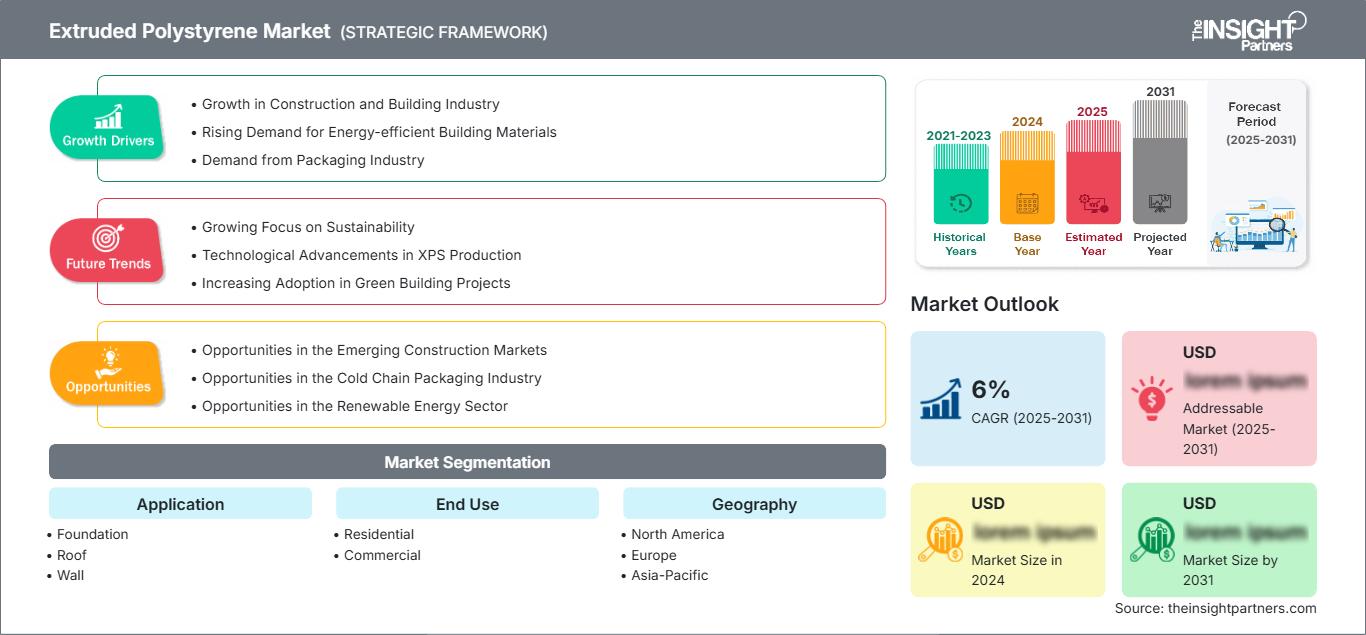
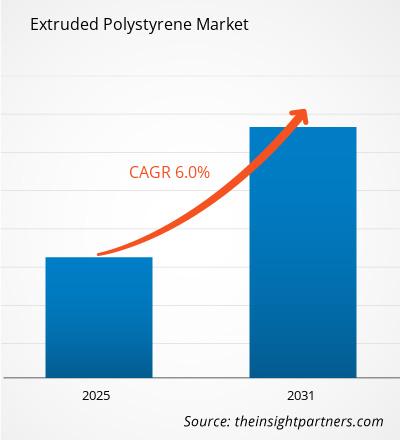
The Extruded Polystyrene Market was valued at US$ 6.12 Billion in 2025 and is projected to reach US$ 10.61 Billion by 2034, advancing at a CAGR of 6.30% during 2026–2034. Moisture resistance, compressive strength, dimensional stability, and thermal performance continue to support XPS adoption across construction applications.
Across North America, the Extruded Polystyrene Market size is supported by renovation activity, increasingly stringent building-envelope requirements, and demand for continuous insulation in residential and commercial structures. The regional market is expected to expand at approximately 5.8–6.4% CAGR from 2026–2034, with below-grade foundations, protected membrane roofing, and energy-efficient wall systems remaining important demand centers.
Extruded Polystyrene Market Assessment and Insights
- North America: North America is estimated to represent a 23–27% Extruded Polystyrene Market share in 2025, supported by renovation, energy-code compliance, and below-grade construction. The region is projected to grow at a 5.8–6.4% CAGR between 2026–2034, with XPS retaining relevance in foundations and roofing.
- US: The US accounts for approximately 68–74% of North American demand in 2025, while commercial construction, residential renovation, and cold-storage development support a 5.9–6.5% CAGR during 2026–2034.
- Europe: Europe holds an estimated 31–35% share in 2025, with Germany, France, the UK, Italy, and Spain representing important consumption centers. Energy-efficiency requirements, renovation programs, and established insulation manufacturing support a 5.7–6.3% CAGR during 2026–2034.
- Asia Pacific: Asia Pacific represents approximately 26–30% of the market in 2025 and is expected to register a 6.6–7.2% CAGR during 2026–2034, led by China, Japan, India, and South Korea as construction activity and building-efficiency standards strengthen.
- Largest Segment: Foundation is the largest application, with a 36–40% market share in 2025 and a 6.1–6.6% CAGR during 2026–2034, reflecting strong below-grade insulation requirements.
- High Growth Segment: Commercial is the high-growth end-use segment, representing a 38–42% share in 2025 and advancing at a 6.5–7.0% CAGR during 2026–2034.
- Key companies analyzed in detail: BASF SE, Synthos S.A., Kingspan Group plc, DuPont de Nemours, Inc., Owens Corning, Saint-Gobain, Ravago Manufacturing Greece S.A., Versalis S.p.A., Knauf Insulation, and TechnoNICOL Corporation.
Source: The Insight Partners' analysis based on proprietary research, government publications, company annual reports, investor presentations, industry databases, and expert interviews.
This Extruded Polystyrene forecast takes into account the move from traditional thermal insulation applications to engineered building envelope solutions that need moisture resistance, compressive strength, and consistent performance throughout their lifetime. By using continuous extrusion, producers have the ability to manufacture boards with specific density and thickness. Blowing agent systems are also being modified by producers for reduced environmental effect without compromising thermal efficiency. Increasing product differentiation will include compressive strength, geometry, drainage capabilities, dimensional stability, and suitability with protected roof and below-ground assemblies.
Investment during the forecast period is expected to be driven by production capacity near markets for construction development, including Asia Pacific and select Middle Eastern nations. Increased focus on energy efficiency of buildings should favor increased insulation density per project, while renovations should generate demand regardless of new construction cycles. Producers with localized manufacturing, well-established networks of contractors, and low global warming potential products can respond to evolving procurement needs.
Extruded Polystyrene Market Report Scope
| Report Attribute | Details |
|---|---|
| Market size in 2025 | US$ 6.12 Billion |
| Market Size by 2034 | US$ 10.61 Billion |
| Global CAGR (2026 - 2034) | 6.30% |
| Historical Data | 2021-2024 |
| Forecast period | 2026-2034 |
Extruded Polystyrene Market Analysis
The demand for XPS is mostly driven by construction projects where durable insulation is required in foundation, roof, wall, and floor constructions. Thus, the pathway of growth of the Extruded Polystyrene Market is tied both to building starts and insulation intensity per square meter. The characteristics of XPS such as low moisture absorption and high compressive strength make it especially advantageous when insulation is subjected to ground moisture, mechanical stress or water management needs. The residential sector represents the main consumer base for the insulation; however, commercial construction generates demand for roof and floor engineered systems.
Value chain starts with the feedstocks and additives from styrene and involves such steps as extrusion, foaming, board making, cutting, surface treating, packing and distribution. Energy used in the process of extrusion and cost of feedstocks are key elements influencing producers' business. Hence, production facilities represent an important element because of the logistics costs for bulky insulation boards.
Extruded Polystyrene Market trends reveal that competition is driven by performance attributes, production capacity, regulatory requirements, and technical support in addition to prices. The market includes such companies as BASF SE, Synthos S.A., Kingspan Group plc, DuPont de Nemours, Inc., Owens Corning, Saint-Gobain, Ravago Manufacturing Greece S.A., Versalis S.p.A., Knauf Insulation, and TechnoNICOL Corporation via regional product lines, insulation systems, production capacities, or distribution networks.
The Extruded Polystyrene Market research shows that strategic positioning is becoming more and more dependent on low-GWP blowing agents, recycling programs, environmental product declarations, and performance certifications for particular products. For example, Kingspan increased its GreenGuard XPS range, while Owens Corning focused on next generation XPS products. Also, DuPont has developed low-GWP Styrofoam variants. Such actions demonstrate that the differentiation of products will be based on their environmental performance along with thermal and mechanical characteristics.
● REPORT CUSTOMIZATION
Tailor This Report To Align With Your Specific Business Requirements
This report can be customized to align precisely with your business objectives, scope, and target markets. Customization options include tailored segmentation, geography, competitive analysis, and strategic insights to support informed decision-making.
Customize This Report →WHAT YOU CAN ADJUST
- ● Segmentations
- ● Geography
- ● Competitive Analysis
- ● Language Preferences
Extruded Polystyrene Market: Strategic Insights
Regional Insights
North America Extruded Polystyrene Market
North America is estimated to account for 23–27% of global demand in 2025, with the US representing the majority of regional consumption. The market should expand at a 5.8–6.4% CAGR through 2034, supported by energy-code requirements, renovation, commercial roofing, below-grade insulation, and cold-storage construction. XPS remains valuable where moisture resistance and compressive strength are required.
Canada will contribute through better building envelopes in residences and non-residential buildings, and the US will be the major demand driver. Protected Membrane Roofs, Foundations, Walls, and Floor Systems continue to be major applications. Regulations concerning high-GWP blowing agents are motivating suppliers to switch to more environmentally friendly solutions. Hence, product development increasingly relates to regulatory requirements, environmental declarations, and continuous insulation needs. Regional demand will likely stay resilient since renovation/replacement can compensate for cyclic declines in new constructions.
U.S. Extruded Polystyrene Market
The US represents approximately 68–74% of North American demand in 2025, with a projected 5.9–6.5% CAGR through 2034. Foundation insulation, commercial roofing, wall assemblies, and refrigerated facilities remain major application areas. Owens Corning, DuPont de Nemours, Inc., and Kingspan Group plc maintain significant product visibility across construction channels.
Demand for these boards has been influenced increasingly by building energy specifications, moisture performance specifications, and the need for continuous insulation. XPS boards with improved compressive strength performance have relevance in such applications as parking deck applications, protected roof systems, freezer floor systems, and sub-slab applications. Renovation has expanded the applicability since old structures may require building envelope improvements. Regulatory changes toward lower-GWP blowing agents and durability considerations will continue to influence product development and specifications.
Europe Extruded Polystyrene Market
Europe represents an estimated 31–35% share in 2025 and is projected to grow at a 5.7–6.3% CAGR through 2034. Germany is a leading market, supported by renovation and established insulation manufacturing. The UK maintains demand through energy-efficiency upgrades and commercial refurbishment. France, Italy, and Spain contribute through residential renovation, roofing, and new construction. Regional procurement increasingly considers embodied carbon, product declarations, and thermal performance.
Germany profits from the presence of a well-established ecosystem for building materials and the extensive use of below grade insulation products. France and Italy drive demand via renovation activities and construction of commercial buildings, whereas Spain sees residential construction and need for cooling due to climate conditions. The competitive environment in this region includes Kingspan Group plc, BASF SE, Synthos S.A., Saint-Gobain, and Ravago Manufacturing Greece S.A.
APAC Extruded Polystyrene Market
APAC is estimated at 26–30% of global demand in 2025 and is expected to grow at a 6.6–7.2% CAGR. China leads regional consumption, followed by Japan, South Korea, India, and Australia. Urban construction, industrial construction, cold storage construction, and the enhancement of insulation standards fuel the demand.
China enjoys the advantage of its large construction sector, while India utilizes urbanization coupled with increased focus on energy-efficient buildings. Japan and South Korea emphasize performance and quality, but Australia focuses on building envelope. Manufacturing and distribution will be vital since transport costs affect board economics. Growth in manufacturing capabilities and adoption of high-performance insulation systems will keep APAC the fastest-growing region.
Middle East & Africa Extruded Polystyrene Market
Middle East and Africa demand is estimated to represent a smaller portion of global consumption, with growth projected at approximately 5.9–6.6% CAGR through 2034. The leading countries in the region include Saudi Arabia and UAE due to their extensive commercial, infrastructure, hospitality, and mixed-used developments.
South Africa forms the key market in the sub-Saharan area, whereas other areas in MEA continue to be driven by infrastructure and urban development projects. Cooling needs play a big part in making the economics of thermal insulation more compelling. XPS insulation can be very applicable where there is a need for moisture resistance and mechanical strength.
Segmentation Analysis
Application
By application, the Extruded Polystyrene Market scope is shaped by the performance requirements of each building-envelope location. Foundation applications benefit from XPS's moisture resistance and compressive strength, while roofs require dimensional stability and durability. Walls, floors, and ceilings provide additional demand as continuous-insulation practices become more common. The application segment is expected to advance at a 6.0–6.5% CAGR during 2026–2034.
- Foundation: Foundation insulation remains the dominant application because boards can provide thermal continuity beneath slabs and around below-grade structures. Moisture resistance and load-bearing capability strengthen specification demand in residential and commercial construction.
- Roof: Roofing applications benefit from XPS performance in protected membrane assemblies, where insulation must tolerate moisture exposure and mechanical loading. Demand is supported by commercial refurbishment, flat-roof construction, and high-performance envelope designs.
- Wall: Wall applications increasingly incorporate XPS where continuous insulation and moisture management are priorities. Adoption is influenced by facade design, local energy codes, installation practices, and compatibility with cladding or masonry systems.
- Floor and Ceiling: Floor and ceiling applications use XPS where thermal continuity, compressive strength, and moisture resistance are important. Commercial floors, residential slabs, and specialized temperature-controlled spaces provide meaningful demand opportunities.
End Use
Residential and commercial construction create different purchasing dynamics, with residential projects emphasizing installation simplicity and energy performance while commercial projects place greater weight on structural loading, system compatibility, technical certification, and lifecycle economics. The end-use segment is expected to register a 6.3–6.8% CAGR during 2026–2034.
- Residential: Residential demand is supported by new housing, renovation, basement insulation, floor systems, and energy-efficiency upgrades. Contractor familiarity, board availability, code compliance, and installation productivity strongly influence product selection.
- Commercial: Commercial applications increasingly require engineered insulation for roofs, foundations, parking structures, cold storage, and high-performance envelopes. Procurement decisions emphasize compressive strength, moisture management, lifecycle performance, certification, and compatibility with complete building systems.
Opportunity Snapshot
| End Use | Revenue Contribution | Trend Tag | Adoption Stage |
|---|---|---|---|
| Residential | High | Energy Retrofit | Mature |
| Commercial | Medium | High-Load Roofing | Scaling |
Extruded Polystyrene Market Growth Drivers and Impact Analysis
Stricter Building-Energy Performance Requirements
Building-energy regulations are increasing the amount of attention given to insulation thickness, thermal bridging, and whole-envelope performance. For XPS suppliers, this creates demand not simply from higher construction volumes but from greater insulation intensity within each project. Products now become more and more often evaluated on the basis of their thermal resistance, moisture performance, compressive strength, and system compatibility. It gives the advantage to those companies who can provide a well-documented performance and design support. Energy-code changes in North America and Europe, as well as building-code development in emerging Asian economies, are going to the same path, whereas from a commercial perspective, this means that there is more potential to specify high-performance boards in roofs, foundations, and walls.
Expansion of Renovation and Building-Envelope Upgrades
Renovation provides an important structural demand source because existing buildings require insulation improvements even when new construction cycles slow. Older foundations, roofs, floors, and wall assemblies can suffer from inadequate thermal performance, moisture intrusion, or thermal bridging. XPS can address several of these issues through rigid board installation and moisture resistance. Renovation demand also creates opportunities for manufacturers to supply standardized board dimensions and systems that reduce installation complexity. In mature markets, public and private investment in energy-efficient refurbishment can sustain insulation consumption across multiple construction cycles. Commercial property owners are particularly attentive to operating costs and asset performance, creating demand for solutions that combine insulation upgrades with roofing or facade rehabilitation. This supports steady replacement and retrofit-oriented sales channels.
Growth of Cold Storage and Specialized Commercial Facilities
Expansion of temperature-controlled warehouses, food distribution infrastructure, pharmaceutical facilities, and specialized commercial buildings is broadening demand for high-performance insulation. These structures require materials that can maintain thermal performance under demanding moisture and loading conditions. XPS is suited to selected floor, foundation, and envelope applications where compressive strength and water resistance are valuable. Growth in organized food distribution and pharmaceutical logistics also increases investment in controlled-temperature infrastructure across emerging economies. For manufacturers, this application provides opportunities to develop higher-strength boards, specialized surface treatments, and system-compatible products. It can also support premium pricing where insulation performance directly influences facility energy consumption and operating reliability. Suppliers with technical engineering capabilities can therefore deepen relationships with developers, contractors, and cold-chain specialists.
Extruded Polystyrene Market Future Trends
Low-GWP Formulations and Environmental Transparency
The Extruded Polystyrene Market forecast shows that future product development is likely to place greater emphasis on low-global-warming-potential blowing agents, environmental product declarations, recycled content, and measurable embodied-carbon reductions. Regulatory pressure on fluorinated blowing agents will accelerate formulation changes and encourage manufacturers to communicate environmental performance more precisely. Procurement teams are also expected to compare insulation products using lifecycle information rather than thermal properties alone. This trend could create a competitive divide between commodity products and differentiated boards supported by verified environmental documentation. Manufacturers that redesign formulations without sacrificing compressive strength, moisture resistance, dimensional stability, or long-term thermal performance can strengthen their positions with architects and large contractors. Over time, environmental transparency may become a standard specification requirement rather than a differentiating feature.
Higher-Performance Building Envelope Systems
The next stage of market development is likely to involve greater integration of XPS into complete building-envelope systems rather than treating insulation as an isolated material. Roof assemblies, foundation drainage solutions, wall systems, membranes, and thermal-control layers can increasingly be designed together to improve installation reliability and long-term performance. Digital design tools and building information modeling may also make product specifications more precise, allowing designers to match board properties with structural and environmental requirements. This favors suppliers with broad technical portfolios and strong contractor support. Product innovation may increasingly focus on drainage channels, higher compressive strengths, specialized thicknesses, surface configurations, and compatibility with prefabricated systems. Such developments can expand XPS applications beyond conventional board insulation.
Extruded Polystyrene Market Opportunities
Localized Capacity in High-Growth Construction Markets
Manufacturers can pursue capacity expansion or partnerships in Asia Pacific and selected Middle Eastern markets where construction activity is increasing and imported insulation can face logistics constraints. Local production can shorten lead times, reduce transportation costs, improve distributor responsiveness, and enable products to match regional construction practices. Investment priorities should focus on facilities capable of producing multiple board thicknesses and compressive-strength grades while maintaining consistent dimensional quality. Strategic localization can also improve access to government-backed infrastructure projects and large developer accounts. Companies should evaluate local feedstock availability, energy costs, contractor networks, regulatory requirements, and proximity to major construction clusters before committing capital. A regional manufacturing model can therefore provide both cost advantages and stronger customer relationships.
Premium Solutions for Commercial and Industrial Buildings
Commercial roofing, cold storage, parking structures, industrial floors, and specialized facilities offer opportunities for higher-value XPS products. Buyers in these applications generally place greater importance on compressive strength, moisture resistance, dimensional stability, and lifecycle performance than on basic material cost. Suppliers can capitalize by developing engineered boards and complete application systems tailored to specific loading, drainage, and thermal requirements. Technical collaboration with architects, engineering consultants, roofing contractors, and developers can improve specification rates before projects reach procurement. Premium products can also be supported through environmental documentation, installation guidance, and system warranties. Companies that combine material innovation with application-specific engineering may capture greater value per project and reduce exposure to commodity-level price competition.
Recent Developments
- January 2026: DuPont de Nemours, Inc. announced a partnership with HydroBlok to supply Styrofoam Brand XPS for HydroBlok One building panels. The collaboration combines XPS insulation with a lightweight waterproof panel system, targeting simplified installation and durable building-envelope performance for contractors and builders across North America.
- July 2025: BASF SE completed the sale of its Styrodur extruded polystyrene insulation business, including the Styrodur brand, to Karl Bachl Kunststoffverarbeitung GmbH & Co. KG. The transaction followed regulatory approval and became effective June 30, 2025, changing ownership of an established European XPS product portfolio.
- June 2025: Kingspan Group plc expanded its GreenGuard XPS portfolio with additional thicknesses and a four-sided routed drainage-channel board. The products target commercial roofing, cold storage, below-grade, and wall applications, strengthening the company's engineered XPS offering for applications requiring drainage and higher compressive performance.
Frequently Asked Questions

- Comprehensive Market Sizing and Forecast Analysis
- Detailed Segmentation Analysis
- In-Depth Market Dynamics Assessment
- Regional and Country-Level Insights
- Competitive Landscape and Company Benchmarking
- Strategic Business Intelligence
Recent Reports
Testimonials

The Insight Partners' SCADA System Market report is comprehensive, with valuable insights on current trends and future forecasts. The team was highly professional, responsive, and supportive throughout. We are very satisfied and highly recommend their services.
RAN KEDEM Partner, Reali Technologies LTDs
I requested a report on a very specific software market and the team produced the report in a few days. The information was very relevant and well presented. I then requested some changes and additions to the report. The team was again very responsive and I got the final report in less than a week.
JEAN-HERVE JENN Chairman, Future Analytica
We worked with The Insight Partners for an important market study and forecast. They gave us clear insights into opportunities and risks, which helped shape our plans. Their research was easy to use and based on solid data. It helped us make smart, confident decisions. We highly recommend them.
PIYUSH NAGPAL Sr. Vice President, High Beam Global
The Insight Partners delivered insightful, well-structured market research with strong domain expertise. Their team was professional and responsive throughout. The user-friendly website made accessing industry reports seamless. We highly recommend them for reliable, high-quality research services
YUKIHIKO ADACHI CEO, Deep Blue, LLC.
This is the first time I have purchased a market report from The Insight Partners.While I was unsure at first, I visited their web site and felt more comfortable to take the risk and purchase a market report.I am completely satisfied with the quality of the report and customer service. I had several questions and comments with the initial report, but after a couple of dialogs over email with their analyst I believe I have a report that I can use as input to our strategic planning process.Thank you so much for taking the extra time and making this a positive experience.I will definitely recommend your service to others and you will be my first call when we need further market data.
JOHN SUZUKI President and Chief Executive Officer, Board Director, BK Technologies
I wish to appreciate your support and the professionalism you displayed in the course of attending to my request for information regarding to infectious disease IVD market in Nigeria. I appreciate your patience, your guidance, and the fact that you were willing to offer a discount, which eventually made it possible for us to close a deal. I look forward to engaging The Insight Partners in the future, all thanks to the impression you have created in me as a result of this first encounter.
DR CHIJIOKE ONYIA MANAGING DIRECTOR, PineCrest Healthcare Ltd.Reason to Buy
- Informed Decision-Making
- Understanding Market Dynamics
- Competitive Analysis
- Identifying Emerging Markets
- Customer Insights
- Market Forecasts
- Risk Mitigation
- Boosting Operational Efficiency
- Strategic Planning
- Investment Justification
- Tracking Industry Innovations
- Aligning with Regulatory Trends





 Get Free Sample for