
가정용 에너지 관리 시장: 규모·동향·수요·전망 2034
가정용 에너지 관리 시장 규모 및 전망(2021년~2034년), 글로벌 및 지역별 점유율, 트렌드 및 성장 기회 분석 보고서 범위: 제품 유형별(조명 제어, 자가 모니터링 시스템 및 서비스, 프로그래밍 가능 통신형 온도 조절기, 고급 중앙 제어기, 지능형 HVAC 제어기), 기술별(Z-Wave, ZigBee, Wi-Fi, 이더넷, 기타), 지역별(북미, 유럽, 아시아 태평양, 남미 및 중미)
- 상태 : 데이터 공개
- 보고서 코드 : TIPRE00012070
- 범주 : 전자 및 반도체
- 페이지 수 : 150
- 사용 가능한 보고서 형식 :


- 최종 업데이트 일자 : September 17, 2026


2025년 시장 규모
64억 7 천만 달러
기준연도 값
2034년 전망
221억 3 천만 달러
2034년까지 예상됨
2026-2034년 연평균 성장률
14.64 %
성장률
공략 가능 시장
1226 억 1천만 달러
(2026-2034)
가정용 에너지 관리 시장은 2025년 64억 7천만 달러 규모였으며, 2034년에는 221억 3천만 달러에 이를 것으로 예상되며, 2026년부터 2034년까지 연평균 14.64%의 성장률을 기록할 전망입니다. 이러한 성장은 가정용 전기 보급률 증가, 기기 연결성 향상, 그리고 조명, 난방, 환기 및 냉방 시스템, 가전제품, 에너지 생산 및 저장 장치의 통합 관리 필요성에 의해 주도되고 있습니다.
북미 지역의 주택 에너지 관리 시장 규모는 2034년까지 연평균 13.8~14.6% 성장할 것으로 예상됩니다. 첨단 계량 인프라, 시간대별 요금제, 그리고 전력 회사의 수요 반응 프로그램 덕분에 스마트 온도 조절 장치와 주택 전체 제어 시스템의 경제적 매력이 높아지고 있습니다. 태양광 발전, 배터리, 히트 펌프, 전기 자동차의 주택 사용 증가로 가격, 탄소 배출량, 그리고 비상 전력 수요를 기반으로 부하 스케줄링을 관리하는 소프트웨어의 가치가 더욱 높아지고 있습니다.
가정 에너지 관리 시장 평가 및 분석
- 북미: 2025년에는 35~38%의 시장 점유율을 기록할 것으로 예상되며, 스마트 미터, 공공요금 보조금, 연결형 냉난방 시스템, 그리고 주거용 분산 에너지 자원의 확장에 힘입어 2026년부터 2034년까지 연평균 13.8~14.6%의 성장률을 보일 것으로 전망됩니다.
- 미국: 2025년 북미 매출의 84~88%를 차지했으며, 전력 회사들이 수요 유연성을 확대함에 따라 2026년부터 2034년까지 연평균 14.0~14.8%의 성장률을 보일 것으로 예상됩니다.
- 유럽: 2025년에는 시장 점유율이 27~30%에 달할 것으로 예상되며, 독일, 영국, 프랑스의 전력화 및 건물 효율 정책에 힘입어 2026년부터 2034년까지 연평균 13.2~14.0%의 성장률을 보일 것으로 전망됩니다.
- 아시아 태평양 지역: 2025년에는 25~28%의 시장 점유율을 확보할 것으로 예상되며, 2026년부터 2034년까지 연평균 16.0~17.2%의 성장률을 기록할 것으로 전망됩니다. 특히 중국, 일본, 한국, 인도, 호주가 스마트홈 도입을 적극적으로 추진하고 있습니다.
- 가장 큰 부문인 하드웨어는 2025년에 45~49%의 시장 점유율을 차지할 것으로 예상되며, 컨트롤러, 센서 및 온도 조절 장치의 규모가 커짐에 따라 2026년부터 2034년까지 연평균 13.0~13.9%의 성장률을 기록할 것으로 전망됩니다.
- 고성장 부문: 소프트웨어는 2025년에 30~34%의 시장 점유율을 차지할 것으로 예상되며, 2026년부터 2034년까지 연평균 16.2~17.4%의 성장률을 보일 것으로 전망됩니다.
- 상세 분석 대상 주요 기업은 General Electric Company, Honeywell International Inc., Alphabet Inc., Vivint, Inc., Comcast Cable Communications, LLC, EcoFactor, Inc., EnergyHub, Inc., ecobee Inc., Panasonic Holdings Corporation 및 Schneider Electric SE입니다.
Source: The Insight Partners' analysis based on proprietary research, government publications, company annual reports, investor presentations, industry databases, and expert interviews.
Home energy management has moved from standalone timers and programmable thermostats to interoperable systems integrating cloud analytics, edge control, smart meters, sensors, and apps. Wi-Fi is still key for end-user connectivity, while Zigbee and Z-Wave handle low-power devices' network and Ethernet ensures solid backhaul for gateways. The economics of manufacturing lean towards module controllers and software-based functions, giving manufacturers the capability of updating their forecasting, automation and tariffs without changing the existing physical infrastructure.
Investment in home energy management systems will move from the expensive smart homes category to the utility-connected homes category, multifamily buildings, and fast-electrified regions by 2034. The energy efficiency measures, electricity price dynamic, energy incentive policies, and grid flexibility measures will improve the economics of home energy management systems. As per the IEA, global energy efficiency improvements achieved a record of 1.8% in 2025, with more than 250 energy efficiency policies enacted in economies that account for 85% of world energy use.
Home Energy Management Market Report Scope
| Report Attribute | Details |
|---|---|
| Market size in 2025 | US$ 6.47 Billion |
| Market Size by 2034 | US$ 22.13 Billion |
| Global CAGR (2026 - 2034) | 14.64% |
| Historical Data | 2021-2024 |
| Forecast period | 2026-2034 |
Home Energy Management Market Analysis
Home Energy Management Market growth is due to increased electricity costs, residential electrification, and the need to integrate more complex devices. These devices include heat pumps, electric cars, rooftop PVs, batteries, and smart home devices that allow shifting load according to tariffs and events on the network. The hardware suppliers, software providers, installers, utility companies, and aggregators act as a dependent ecosystem as opposed to separate products.
Vendor opportunities lie with suppliers who ease the commissioning process and ensure device connectivity regardless of the brands used. Availability of components is usually high; however, issues such as cybersecurity, radio approvals, cloud service security, and installer competency dictate the deployment process. It is noted by ENERGY STAR that about half of the average cost of energy in a typical US household is devoted to heating and cooling.
Home Energy Management Market Report suggests the competition is shifting from owning the device to being relevant in the control plane. Schneider Electric SE offers a combination of electrical distribution, storage, and connected loads, Honeywell International Inc. and ecobee Inc. compete with intelligent thermostats, Alphabet Inc. connects Nest products with the consumer’s broader ecosystem, while EnergyHub, Inc. connects distributed household assets with utilities.
General Electric Company and Panasonic Holdings Corporation bring appliances and electronics into their portfolios, while EcoFactor, Inc. brings cloud-based optimization to the game. Vivint, Inc. and Comcast Cable Communications, LLC bring energy plus subscription services for a smart home into their portfolios. Strategic investments emphasize increasingly AI, interoperability, security, and involvement in the virtual power plant. Defensibility of the position depends on savings, ease of deployment, utility telemetry, and permissioning protocols.
● REPORT CUSTOMIZATION
Tailor This Report To Align With Your Specific Business Requirements
This report can be customized to align precisely with your business objectives, scope, and target markets. Customization options include tailored segmentation, geography, competitive analysis, and strategic insights to support informed decision-making.
Customize This Report →WHAT YOU CAN ADJUST
- ● Segmentations
- ● Geography
- ● Competitive Analysis
- ● Language Preferences
Home Energy Management Market:
요구 사항에 맞게 이 보고서를 사용자 정의하십시오.
이 보고서의 일부, 국가 수준 분석, Excel 데이터 팩을 포함하여 모든 보고서에 대한 사용자 정의를 무료로 받을 수 있을 뿐만 아니라 스타트업 및 대학을 위한 훌륭한 제안 및 할인을 이용할 수 있습니다
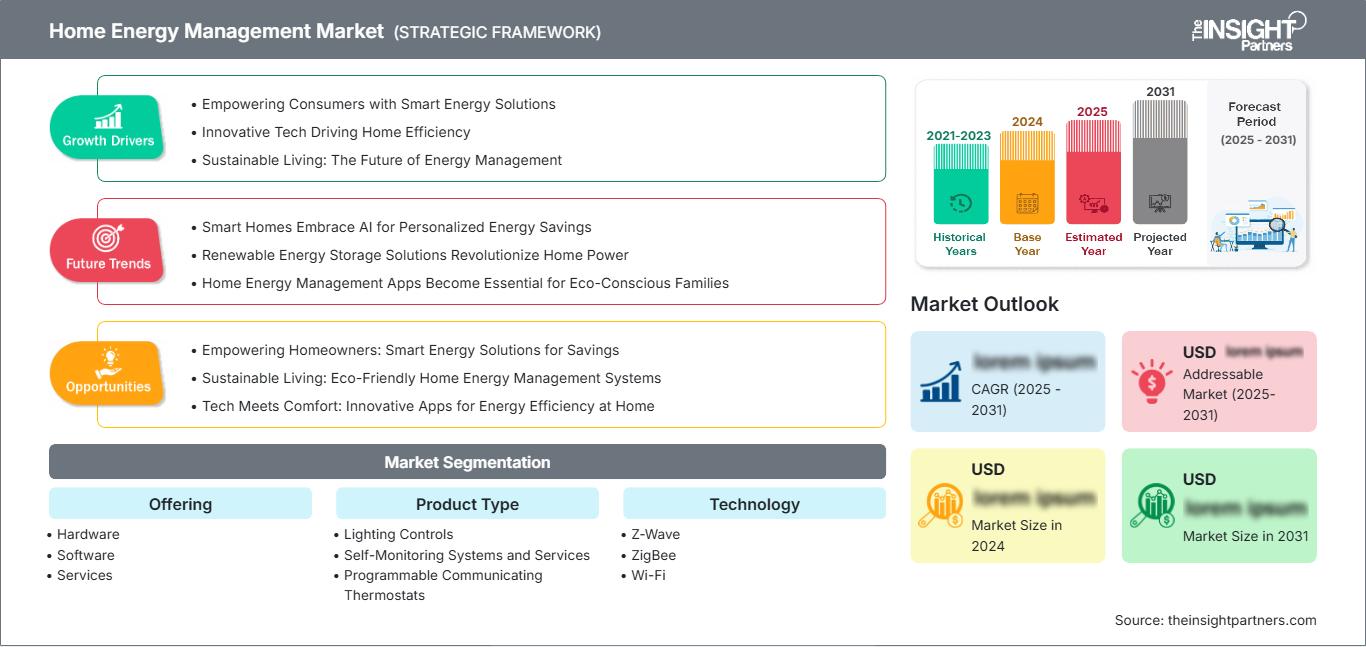
홈 에너지 관리 시장: 전략적 통찰력
-
이 보고서의 주요 주요 시장 동향을 확인하세요.이 무료 샘플에는 시장 동향부터 추정 및 예측에 이르기까지 데이터 분석이 포함됩니다.
Regional Insights
North America Home Energy Management Market
The North American market occupied a modeled market share of 35–38% in the Home Energy Management Market Share in 2025 and is projected to register a CAGR of 13.8–14.6% through 2034. High adoption potential is fueled by smart meters, demand response portfolio of utilities, weather-driven HVAC loads, and advanced connected home distribution channels. The ENERGY STAR qualification program uses actual field data to boost consumer trust in smart thermostats.
Market growth is increasingly shifting away from the thermostat and towards other devices such as electrical panels, batteries, solar inverters, EV chargers, and load controllers with single user interface. Companies with strong commercial or ecosystem presence in the space include Schneider Electric SE, Honeywell International Inc., Alphabet Inc., ecobee Inc., EnergyHub, Inc., Vivint, Inc., and Comcast Cable Communications, LLC. Implementation issues include cybersecurity standards and fragmented state legislation, while time-of-use rates and resilience are in favor of whole-house systems.
U.S. Home Energy Management Market
Modelled, the US accounted for 84–88% of the North American revenue in 2025, and is expected to witness a CAGR growth of 14.0–14.8% up to 2034. Utility rebates, advanced metering, residential solar, storage, and adoption of heat pumps and EVs create large pools of controllable loads. The applications are moving away from remote control of the thermostat to demand-response peak reduction, prioritization of backup power, scheduling of appliances, and utility events.
Some of the competitive companies are Alphabet Inc., ecobee Inc., Honeywell International Inc., EnergyHub, Inc., Vivint, Inc., Comcast Cable Communications, LLC, General Electric Company, and Schneider Electric SE through their devices, platforms, distribution channels or utilities. It has been indicated by ENERGY STAR that the smart thermostats can help the average home to save US$ 50 per year and additional spending on heating and cooling can result in more savings.
Europe Home Energy Management Market
Europe is projected to have a modelled share of 27-30% in 2025 and needs to grow at a CAGR of 13.2-14.0% between 2025 and 2034. Germany stands out because of rooftop solar, home battery, heat pump, dynamic tariffing, and excellent electric installation channel. Increasingly, homeowners in Germany will need integration solutions that optimize their self-consumption and peak import requirements in order to connect inverters, meters, HVAC, and controllable appliances.
In the UK, integration of smart meter deployment with flexible tariffs and active energy retailers is expected to drive the market, while in France, electrification of heating and building renovation will be the key driver. In Italy and Spain, solar economics and increasing storage will be the key driving factors. Interoperability and data protection affect the choice of platform in Europe. The companies providing solutions are Schneider Electric SE, Honeywell International Inc., Alphabet Inc., Panasonic Holdings Corporation, and ecobee Inc.
APAC Home Energy Management Market
Asia Pacific grabbed a modelled share of 25-28% in 2025 and is expected to register a CAGR of 16.0-17.2% up to 2034. China dominates on account of smart appliances production, digital ecosystems, and distributed solar. Japan and South Korea focus on energy-efficient houses, automation, and resilience, thanks to their developed electronics industries.
Growing requirements of energy generation, urban buildings, and solar rooftops favor India's future, while abundant residential solar panels and batteries make Australia a perfect fit for high-end load orchestration. Panasonic Holdings Corporation and Schneider Electric SE both have a robust sales and marketing network in the region. The fragmented housing sector and sensitivity to prices favor modular systems due to instant benefits from automation.
Middle East & Africa Home Energy Management Market
Middle East and Africa region is expected to see growth rates in a range of 12.5% -13.5% CAGR during 2026-2034. UAE takes the lead due to high-end connected housing, solar energy use, and smart city projects, while Saudi Arabia's high number of residential projects offers possibilities for embedded controls and efficient cooling management solutions.
South Africa profits from solar, battery, and outage resilience interest; Rest of MEA grows selectively in upscale urban areas and utility upgrades. Cooling loads, grid reliability, and infrastructure development drive demand. Adoption relies on local hardware support, mobile connections, installer availability, and systems able to integrate self-generation and critical load backup.
Segmentation Analysis
Offering
The Offering segment is expected to grow at 14.2–15.1% CAGR during 2026–2034. Its Home Energy Management Market scope spans physical controls, analytics platforms, and implementation services. Hardware supplies the installed base, software captures recurring value through optimization and updates, and services reduce integration friction. Revenue mix should gradually shift toward software and managed programs as utilities and households demand continuous intelligence.
- Hardware: Controllers, sensors, smart thermostats, switches, and gateways form the operational layer, with demand tied to retrofits, new construction, electrification assets, and reliable local control.
- Software: Platforms translate tariffs, weather, occupancy, and device data into schedules and recommendations, making interoperability, cybersecurity, mobile experience, and utility connectivity strategically important differentiators.
- Services: Installation, integration, maintenance, analytics, and demand-response enrollment support adoption where homeowners or utilities require verified configuration, ongoing optimization, and accountable performance across diverse equipment.
Product Type
The Product Type segment should expand at 14.0–14.9% CAGR through 2034. Thermostats remain a practical entry point because HVAC represents a large household load, while advanced controllers and intelligent HVAC systems enable broader optimization. Growth depends on balancing automated savings with comfort, transparent overrides, equipment compatibility, and installer-friendly commissioning across both new and existing homes.
- Lighting Controls: Connected switches, dimmers, occupancy sensors, and schedules deliver familiar automation and incremental savings, often serving as an accessible first purchase within wider smart-home ecosystems.
- Self-Monitoring Systems and Services: Dashboards and alerts give households appliance-level or circuit-level visibility, supporting behavioral change, fault detection, bill validation, and prioritization of future efficiency investments.
- Programmable Communicating Thermostats: These devices combine schedules, remote control, occupancy logic, and utility connectivity, maintaining strong demand because heating and cooling offer measurable savings and flexible-load potential.
- Advanced Central Controllers: Central hubs coordinate multiple energy assets and protocols, becoming strategically important as solar, storage, EV charging, appliances, and backup requirements converge within one household.
- Intelligent HVAC Controllers: Advanced controls optimize variable-speed equipment, zones, humidity, weather response, and tariffs, supporting comfort while addressing the largest controllable residential energy loads.
Technology
The Technology segment is forecast to grow at 14.3–15.2% CAGR during 2026–2034. No single protocol fits every device. Wi-Fi delivers direct consumer connectivity, Zigbee and Z-Wave support low-power mesh networks, and Ethernet provides dependable gateway backhaul. Market success increasingly depends on gateways and software that abstract protocol differences, enable secure updates, and preserve local operation during cloud or broadband disruptions.
- Z-Wave: A mature low-power mesh protocol with broad smart-home device support, valued for interoperable sensors and controls where dependable in-home coverage matters more than high bandwidth.
- ZigBee: Widely used for low-power lighting, sensors, and energy devices, Zigbee remains strategically relevant through large ecosystems, mesh capability, and utility-adjacent smart-meter implementations.
- Wi-Fi: Direct router connectivity and consumer familiarity make Wi-Fi central to thermostats, appliances, and gateways, although power consumption, network congestion, and credential management require careful design.
- Ethernet: Wired connectivity provides stable, low-latency backhaul for central controllers, smart panels, and fixed gateways, supporting dependable local orchestration and secure links to broadband equipment.
Opportunity Snapshot
|
Product Type |
Revenue Contribution |
Trend Tag |
Adoption Stage |
|
Lighting Controls |
Medium |
Occupancy Logic |
Mature |
|
Self-Monitoring Systems and Services |
Medium |
Energy Insights |
Scaling |
|
Programmable Communicating Thermostats |
High |
Demand Response |
Mature |
|
Advanced Central Controllers |
High |
Whole-Home |
Scaling |
|
Intelligent HVAC Controllers |
High |
Adaptive HVAC |
Scaling |
Home Energy Management Market Growth Drivers and Impact Analysis
Household Electrification Expands Controllable Load
Heat pumps, electric vehicles, induction cooking, and electric water heating increase household electricity use while creating loads that can be shifted without materially reducing comfort. The International Energy Agency reported global electricity demand rose 4.3% in 2024, with electrification contributing across major economies. Home management systems translate this complexity into automated schedules based on tariffs, weather, occupancy, and household priorities. The commercial impact extends across controllers, sensors, software subscriptions, and installation services. Utilities gain a channel for reducing peaks, while homeowners can avoid simultaneous high-load operation and potential electrical-service upgrades. Vendors that integrate equipment APIs and provide understandable controls can capture value at each electrification event rather than relying on a one-time smart-home purchase.
Distributed Energy Resources Require Coordination
Residential solar, batteries, generators, and EVs turn households into active energy nodes. Without orchestration, self-generation may be exported at low value, batteries may cycle at suboptimal times, and backup capacity may be exhausted on nonessential loads. Advanced controllers can forecast generation, prioritize circuits, schedule charging, and respond to tariff windows. This creates measurable value beyond convenience, particularly in regions facing outages or widening peak-to-off-peak price spreads. The market impact is a shift from isolated devices toward integrated systems linking electrical distribution, power conversion, and software. Equipment manufacturers gain attachment opportunities, installers can offer higher-value projects, and aggregators can enroll coordinated fleets into demand-response or virtual power plant programs.
Utility Flexibility Programs Reduce Adoption Barriers
Utilities increasingly view connected homes as dispatchable flexibility resources rather than passive customers. Rebates can lower device cost, while recurring incentives compensate households for allowing temporary thermostat, battery, water-heater, or EV adjustments during constrained periods. ENERGY STAR reports that approximately one-third of US households can access rebates for certified smart thermostats, illustrating how program design can broaden adoption. For suppliers, utility channels provide scale but impose stricter requirements for cybersecurity, telemetry, consent, and performance verification. The resulting market impact favors platforms that support fleet enrollment, event dispatch, opt-out controls, and auditable measurement. Successful programs convert consumer hardware into longer-lived grid assets, creating recurring software and service revenue alongside initial equipment sales.
Home Energy Management Market Future Trends
Artificial Intelligence Moves From Insight to Autonomous Control
가정용 에너지 관리 시장 트렌드는 예측 기반의 폐쇄 루프 제어에 점점 더 집중될 것입니다. 시스템은 기상 예보, 동적 요금제, 거주 패턴, 장비 상태, 태양광 발전량 등을 결합하여 사용자가 개입하기 전에 부하를 미리 제어할 수 있도록 계획될 것입니다. 인공지능은 비정상적인 소비를 감지하고 유지보수를 권장할 수도 있지만, 이러한 기능의 도입은 투명한 추론 과정과 손쉬운 재정의 기능에 달려 있습니다. 엣지 프로세싱은 연결 장애 발생 시에도 필수적인 자동화 기능을 유지하고 불필요한 클라우드 데이터 전송을 최소화해야 합니다. 공급업체는 대시보드 용량보다는 예측 정확도, 쾌적한 실내 환경 유지, 그리고 설명 가능한 의사 결정 기능을 통해 차별화를 꾀할 것입니다. 가변 속도 HVAC 시스템이 보편화됨에 따라 시뮬레이션 기반 벤치마킹은 기존 런타임 방식과 상호 보완적인 역할을 하여 알고리즘 성능에 대한 신뢰도를 높일 수 있을 것입니다.
상호 운용 가능한 통합 홈 플랫폼이 기기 분리형 시스템을 대체합니다
미래의 플랫폼들은 전기 패널, 온도 조절 장치, 가전제품, 배터리, 태양광 인버터 및 충전기 등 다양한 브랜드와 프로토콜을 통합적으로 관리하는 능력으로 경쟁할 것입니다. 전기화가 심화됨에 따라 소비자들은 각 기기마다 개별 애플리케이션을 사용하는 것을 더 이상 선호하지 않을 것입니다. 개방형 API, 프로토콜 브리지, 그리고 새롭게 등장하는 상호 운용성 표준은 통합 비용을 절감하는 동시에, 로컬 컨트롤러는 안정적인 작동을 유지할 수 있도록 지원할 것입니다. 전략적 가치는 가정의 제약 조건을 이해하고 이를 여러 기기에 걸쳐 실행 가능한 조치로 전환할 수 있는 플랫폼으로 이동할 것입니다. 제조업체는 차별화된 하드웨어를 유지하면서도 안전한 제어 인터페이스를 제공할 수 있습니다. 이러한 아키텍처는 모듈식 도입을 지원하여 가정에서 모니터링이나 냉난방 시스템(HVAC)으로 시작하여 나중에 복원력과 분산형 리소스를 추가할 수 있도록 합니다.
가정용 에너지 관리 시장 기회
동적 요금제를 위한 유틸리티 통합 플랫폼
동적 가격 책정은 가정 에너지 관리 시장에서 지속적인 관리가 필요 없는 자동화된 가정 대응 플랫폼에 대한 투자 기회를 창출합니다. 공급업체는 요금 입력, 가전제품 예약, 온도 조절기 최적화, 전기차 충전, 배터리 관리 등을 유틸리티에서 바로 사용할 수 있는 프로그램으로 통합할 수 있습니다. 상용화를 위해서는 청구 시스템과의 통합, 안전한 등록, 고객 동의, 그리고 정산 수준의 보고가 필수적입니다. 공급업체는 스마트 미터가 있고, 가격 차이가 크며, 유연한 구매가 활발한 시장을 우선적으로 공략하고, 통제된 배포를 통해 요금 절감 및 최대 부하 감소 효과를 입증해야 합니다. 화이트 라벨 솔루션은 유틸리티 회사가 고객 관계를 유지하면서 더 빠르게 사업을 확장할 수 있도록 지원합니다. 플랫폼 사용료, 성과 기반 요금, 기기 부착 수수료 등을 통해 하드웨어 교체 주기에 덜 의존하는 다각화된 수익 모델을 구축할 수 있습니다.
다세대 주택 및 중저가 주택용 개조 키트
기존 주택 대부분은 통합 에너지 제어 시스템을 고려하여 설계되지 않았기 때문에 대규모 개조 기회가 있습니다. 게이트웨이, 회로 모니터링, 온도 조절기 통합 및 선별된 스마트 릴레이를 결합한 모듈식 키트를 사용하면 모든 가전제품을 교체하지 않고도 즉각적인 에너지 사용량 파악이 가능합니다. 다세대 주택은 공용 공간 최적화, 세입자 개별 계량, 전체 단지 유지보수 알림 등을 통해 가치를 높일 수 있지만, 소유권 및 동의 구조에 따라 맞춤형 워크플로우가 필요합니다. 공급업체는 설치 과정의 마찰을 줄이기 위해 전기 기술자, HVAC 업체, 부동산 관리자 및 보험사와 협력해야 합니다. 제품은 다양한 연식의 장비를 지원하고, 안전한 원격 진단 기능을 제공하며, 단계적 확장이 가능해야 합니다. 금융 또는 구독 모델을 통해 초기 비용을 월별 절감액과 연계하고 태양광, 에너지 저장 장치 또는 전기차 통합으로 나아갈 수 있는 기반을 마련할 수 있습니다.
최근 동향
- 2026년 8월: 엔페이스 에너지(Enphase Energy)는 엔페이스 앱(Enphase App)에 새로운 AI 기반 어시스턴트를 출시하여 주거용 에너지 관리에 에이전트형 인공지능을 도입했습니다. 이 어시스턴트는 주택 소유자가 에너지 시스템을 이해하고, 문제를 파악하며, 자연어 상호 작용을 통해 적절한 조치를 취할 수 있도록 설계되었습니다. 이 새로운 시스템은 기존 챗봇을 뛰어넘어 대규모 언어 모델, 모델 라우팅, 검색 증강 생성 및 특수 에너지 관리 도구를 결합하여 각 가정의 특정 에너지 시스템 및 운영 조건에 기반한 답변을 제공합니다.
- 2026년 3월: 엔페이스 에너지(Enphase Energy)는 호주와 뉴질랜드에 인공지능(AI) 기반 제어 기능을 갖춘 주거용 태양광 및 에너지 저장 시스템 관리 솔루션인 IQ 에너지 관리(IQ Energy Management)를 출시했습니다. 이 플랫폼은 주택 소유주가 전기를 더욱 효율적으로 사용하고, 에너지 비용을 절감하며, 가정 내 태양광 발전량을 늘릴 수 있도록 설계되었습니다. 이 시스템은 엔페이스 태양광 및 IQ 배터리 시스템과 통합되어 변동하는 전기 요금 및 태양광 발전량과 같은 요소를 기반으로 전력 사용량을 지능적으로 관리할 수 있습니다.
- 2025년 11월: 코노우(Conow)는 차세대 가정용 소형 에너지 저장 시스템인 CBE2000 Pro를 출시했습니다. 이 시스템은 배터리 저장, 태양광 발전 관리, AI 기반 에너지 최적화 기능을 하나의 플러그 앤 플레이 솔루션으로 결합했습니다. 출시 가격은 1,099유로입니다. CBE2000 Pro는 발코니 태양광 시스템의 편리함과 가정용 배터리의 기능을 결합했습니다. 이 시스템의 목표는 가정에서 에너지 자립도를 높이고, 전기 요금을 절감하며, 재생 에너지를 더욱 효율적으로 활용할 수 있도록 돕는 것입니다.
자주 묻는 질문

나빈은 맞춤형, 신디케이트 및 컨설팅 프로젝트 전반에 걸쳐 9년 이상의 전문 지식을 보유한 시장 조사 및 컨설팅 전문가입니다. 현재 부사장으로 재직 중이며, 프로젝트 가치 사슬 전반의 이해관계자들을 성공적으로 관리해 왔으며, 100편 이상의 연구 보고서와 30건 이상의 컨설팅 업무를 수행했습니다. 그는 산업 및 정부 프로젝트 전반에 걸쳐 다양한 업무를 수행하며 고객 성공과 데이터 기반 의사 결정에 크게 기여하고 있습니다.
나빈은 카르나타카주 VTU에서 전자통신 공학 학위를, 마니팔 대학교에서 마케팅 및 운영 MBA를 취득했습니다. 그는 9년 동안 IEEE 회원으로 활발하게 활동하며 컨퍼런스, 기술 심포지엄에 참여하고 지역 및 지역 차원에서 자원봉사 활동을 해왔습니다. 현재 직책을 맡기 전에는 IndustryARC에서 준전략 컨설턴트로, 휴렛팩커드(HP Global)에서 산업용 서버 컨설턴트로 근무했습니다.
- 포괄적인 시장 규모 산정 및 전망 분석
- 상세 시장 세분화 분석
- 심층적인 시장 동향 및 요인 분석
- 지역 및 국가별 인사이트
- 경쟁 구도 및 기업 벤치마킹
- 전략적 비즈니스 인텔리전스
사용 후기

Insight Partners의 SCADA 시스템 시장 보고서는 포괄적이며, 현재 동향과 미래 전망에 대한 귀중한 통찰력을 제공합니다. 팀은 매우 전문적이고, 신속하게 대응하며, 처음부터 끝까지 지원해 주었습니다. 저희는 매우 만족하며 Insight Partners의 서비스를 적극 추천합니다.
란 케뎀 파트너, Reali Technologies LTDs
아주 구체적인 소프트웨어 시장에 대한 보고서를 요청했는데, 팀에서 며칠 만에 보고서를 작성해 주셨습니다. 정보는 매우 관련성이 높고 잘 정리되어 있었습니다. 그 후 보고서에 몇 가지 수정과 추가 사항을 요청했습니다. 팀원들의 응답도 매우 빨랐고, 일주일도 채 되지 않아 최종 보고서를 받았습니다.
장-에르브 젠 의장, 퓨처 애널리티카
The Insight Partners와 함께 중요한 시장 조사 및 예측 작업을 진행했습니다. Insight Partners는 기회와 위험에 대한 명확한 통찰력을 제공하여 계획을 세우는 데 큰 도움이 되었습니다. The Insight Partners의 조사는 사용하기 쉬웠고, 탄탄한 데이터를 기반으로 했습니다. 덕분에 현명하고 자신 있는 결정을 내릴 수 있었습니다. The Insight Partners를 강력 추천합니다.
피유시 나그팔 수석 부사장, 하이빔 글로벌
Insight Partners는 탄탄한 분야 전문성을 바탕으로 통찰력 있고 체계적인 시장 조사를 제공했습니다. Insight Partners 팀은 처음부터 끝까지 전문적이고 신속하게 대응했습니다. 사용자 친화적인 웹사이트 덕분에 업계 보고서에 쉽게 접근할 수 있었습니다. 신뢰할 수 있고 고품질의 조사 서비스를 원하신다면 Insight Partners를 강력 추천합니다.
아다치 유키히코 대표이사, 딥블루 주식회사
The Insight Partners에서 시장 보고서를 구매한 것은 이번이 처음입니다. 처음에는 확신이 없었지만, 웹사이트를 방문하고 나서 위험을 감수하고 시장 보고서를 구매하는 것이 더 편하다는 것을 알게 되었습니다. 보고서의 품질과 고객 서비스에 매우 만족합니다. 처음 보고서를 보고 몇 가지 질문과 의견이 있었지만, 분석가와 이메일로 몇 차례 대화를 나눈 후, 전략 기획 과정에 참고할 수 있는 보고서를 확보했다고 생각합니다. 시간을 내어 긍정적인 경험을 선사해 주셔서 정말 감사합니다. 다른 사람들에게도 귀사의 서비스를 적극 추천할 것이며, 추가적인 시장 데이터가 필요할 때면 가장 먼저 귀사에 연락하겠습니다.
존 스즈키 사장 겸 최고 경영자, 이사회 이사, BK 테크놀로지스
나이지리아 감염성 질환 IVD 시장 관련 정보 요청에 응해 주신 귀사의 지원과 전문성에 감사드립니다. 귀사의 인내심과 지도, 그리고 할인 혜택을 기꺼이 제공해 주셔서 결국 계약을 성사시킬 수 있었습니다. 첫 만남을 통해 귀사가 저에게 심어주신 좋은 인상을 바탕으로 앞으로도 The Insight Partners와 함께할 수 있기를 기대합니다.
치지오케 박사 오니아 전무이사, 파인크레스트 헬스케어 유한회사구매 이유
- 정보에 기반한 의사 결정
- 시장 역학 이해
- 경쟁 분석
- 고객 인사이트
- 시장 예측
- 위험 완화
- 전략 기획
- 투자 타당성 분석
- 신흥 시장 파악
- 마케팅 전략 강화
- 운영 효율성 향상
- 규제 동향에 발맞춰 대응




















 무료 샘플 받기 -