
레아치 스타크어 시장: 규모·성장·동향·전망 2034
리치 스태커 시장 규모 및 전망(2021~2034), 글로벌 및 지역별 점유율, 트렌드 및 성장 기회 분석 보고서 범위: 적용 분야별(컨테이너 적재, 트레일러 상하차, 부품 운송), 운영 방식별(제1 레일 운영, 제2 레일 운영, 제3 레일 운영), 톤수별(저톤급, 중톤급, 대형), 구동 방식별(내연기관(ICE), 배터리 구동, 가스 구동), 지역별(북미, 유럽, 아시아 태평양, 남미 및 중미)
- 상태 : 데이터 공개
- 보고서 코드 : TIPRE00008395
- 범주 : 제조 및 건설
- 페이지 수 : 150
- 사용 가능한 보고서 형식 :


- 최종 업데이트 일자 : September 02, 2026


2025년 시장 규모
25 억 3 천만 달러
기준연도 값
2034년 전망
41 억 2 천만 달러
2034년까지 예상됨
2026-2034년 연평균 성장률
5.57 %
성장률
공략 가능 시장
301 억 5 천만 달러
(2026-2034)
리치 스태커 시장은 2025년 25억 3천만 달러 규모였으며, 2026년부터 2034년까지 연평균 5.57%의 성장률을 기록하며 2034년에는 41억 2천만 달러에 이를 것으로 예상됩니다. 이 시장은 컨테이너 적재, 트레일러 적재, 복합 운송 및 중량 화물 작업에 사용되는 특수 이동식 하역 장비를 포괄합니다. 수요는 터미널 현대화, 컨테이너 무역, 선대 교체, 운영 생산성 요구 사항 및 저배출 추진 시스템으로의 점진적인 전환에 의해 영향을 받습니다.
북미 지역에서는 복합 운송 활동, 내륙 컨테이너 야적장, 항만 현대화, 노후 자재 하역 장비 교체 등이 리치 스태커 도입을 뒷받침하고 있습니다. 이 지역의 리치 스태커 시장 규모는 2026년부터 2034년까지 연평균 4.8~5.3% 성장할 것으로 예상되며, 이는 장비 전동화, 강화된 배출가스 규제, 물류 인프라 투자에 힘입은 결과입니다. 수요는 고정 터미널 시스템보다는 유연한 이동식 하역 작업이 필요한 분야에 집중되어 있습니다.
리치 스태커 시장 평가 및 분석
- 북미: 북미는 2025년에 24~28%의 시장 점유율을 차지할 것으로 예상되며, 복합운송 터미널, 항만 현대화, 교체 수요 및 친환경 장비 요구 사항에 힘입어 2026년부터 2034년까지 연평균 4.8~5.3%의 성장률을 보일 것으로 전망됩니다.
- 미국: 미국은 2025년 북미 시장의 72~78%를 차지할 것으로 예상되며, 화물 허브 구축과 터미널 시설 개선에 힘입어 2026년부터 2034년까지 연평균 4.9~5.4% 성장할 것으로 전망됩니다.
- 유럽: 유럽은 2025년에 25~29%의 시장 점유율을 차지할 것으로 예상되며, 2026년부터 2034년까지 연평균 4.6~5.1%의 성장률을 보일 것으로 전망됩니다. 독일, 이탈리아, 네덜란드, 프랑스, 스페인은 물류 현대화 및 탈탄소화 프로그램을 통해 수요 증가를 견인할 것입니다.
- 아시아 태평양 지역: 아시아 태평양 지역은 중국, 인도, 일본, 한국, 호주를 중심으로 항만 및 내륙 물류 확장에 힘입어 2025년에는 30~34%의 시장 점유율을 차지하고 2026년부터 2034년까지 연평균 5.8~6.4%의 성장률을 기록할 것으로 예상됩니다.
- 가장 큰 시장 부문인 내연기관은 2025년에 64~68%의 시장 점유율을 차지할 것으로 예상되며, 2026년부터 2034년까지 연평균 4.5~5.0%의 성장률을 보일 것으로 전망됩니다. 이는 내연기관의 견고한 작동 성능을 반영한 결과입니다.
- 고성장 부문: 배터리 구동식 차량은 2025년에 11~14%의 시장 점유율을 차지하고, 전기화에 힘입어 2026년부터 2034년까지 연평균 12.0~14.0%의 성장률을 보일 것으로 예상됩니다.
- Key companies analyzed in detail: CVS Ferrari S.p.A., Doosan Corporation Industrial Vehicle, Kalmar Corporation, Konecranes Plc, Liebherr-International AG, SANY Group, Taylor Machine Works, Inc., Terex Corporation, Toyota Material Handling, and Hoist Liftruck Mfg., Inc.
Source: The Insight Partners' analysis based on proprietary research, government publications, company annual reports, investor presentations, industry databases, and expert interviews.
There have been changes in equipment used to include machines that are capable of energy recovery, electronically controlled and assisted systems as well as machine connectivity and monitoring systems. Reach stackers will increasingly integrate flexible booms with efficient hydraulics and stabilization systems. Equipment manufacturers will diversify their offering as clients assess the total cost of ownership, emissions, duty cycle needs, charging capabilities, along with lifting capacity.
In terms of purchasing decisions made during the forecast period, there will be differentiation based on duty cycles and environments of operation. Availability of charging capacity at ports will fast-track the adoption of battery technology, whereas remote terminals and intense duty cycle applications will continue to favor combustion engines or hybrids. New logistical corridors in South and Southeast Asia, the Middle East and Latin America are anticipated to offer new opportunities.
Reach Stacker Market Report Scope
| Report Attribute | Details |
|---|---|
| Market size in 2025 | US$ 2.53 Billion |
| Market Size by 2034 | US$ 4.12 Billion |
| Global CAGR (2026 - 2034) | 5.57% |
| Historical Data | 2021-2024 |
| Forecast period | 2026-2034 |
Reach Stacker Market Analysis
The reach stacker market growth is linked to containerized freight handling, inland logistics expansion, terminal throughput requirements, and the need for mobile equipment capable of operating without extensive fixed infrastructure. Engine, hydraulics, transmission, axle, tire, spreader, electrical control system, and chassis are obtained by the manufacturer prior to assembly into fully operational machines. Some of the major downstream players include equipment distributors, equipment leasing firms, equipment service providers, and terminal operators.
Supply issues are becoming increasingly complex due to the balancing act required between the load-carrying capability and fuel economy. Well-known manufacturers have an advantage due to their established international servicing facilities and large installed base, whereas smaller regional manufacturers compete on the basis of local manufacture and price. Factors affecting the cost of the machine include component availability, steel prices, power train sourcing, and logistics costs.
Other companies are represented by global material-handling specialists and diversified industrial equipment manufacturers. Kalmar Corporation has a diverse range of both conventional and electric reach stackers, while Konecranes Plc focuses on development of electrified lift trucks. High capacity equipment and hybrid energy recovery technologies are key for Liebherr-International AG, while SANY Group relies on various equipment designs and innovative safety systems. CVS Ferrari S.p.A. still remains competitive in the niche of specialized container-handling equipment.
Increasing strategic investments go into electrification, digital control systems, operator assistance, and production flexibility. Other competitors include Taylor Machine Works, Inc., Terex Corporation, Toyota Material Handling, and Hoist Liftruck Mfg., Inc. Doosan Corporation Industrial Vehicle and other well-known equipment manufacturers can benefit from their wider dealer and service networks in supporting the needs of lifecycle reliability, while port equipment specialists can differentiate themselves through high-capacity solutions.
● REPORT CUSTOMIZATION
Tailor This Report To Align With Your Specific Business Requirements
This report can be customized to align precisely with your business objectives, scope, and target markets. Customization options include tailored segmentation, geography, competitive analysis, and strategic insights to support informed decision-making.
Customize This Report →WHAT YOU CAN ADJUST
- ● Segmentations
- ● Geography
- ● Competitive Analysis
- ● Language Preferences
Reach Stacker Market:
요구 사항에 맞게 이 보고서를 사용자 정의하십시오.
이 보고서의 일부, 국가 수준 분석, Excel 데이터 팩을 포함하여 모든 보고서에 대한 사용자 정의를 무료로 받을 수 있을 뿐만 아니라 스타트업 및 대학을 위한 훌륭한 제안 및 할인을 이용할 수 있습니다
리치 스태커 마켓: 전략적 통찰력
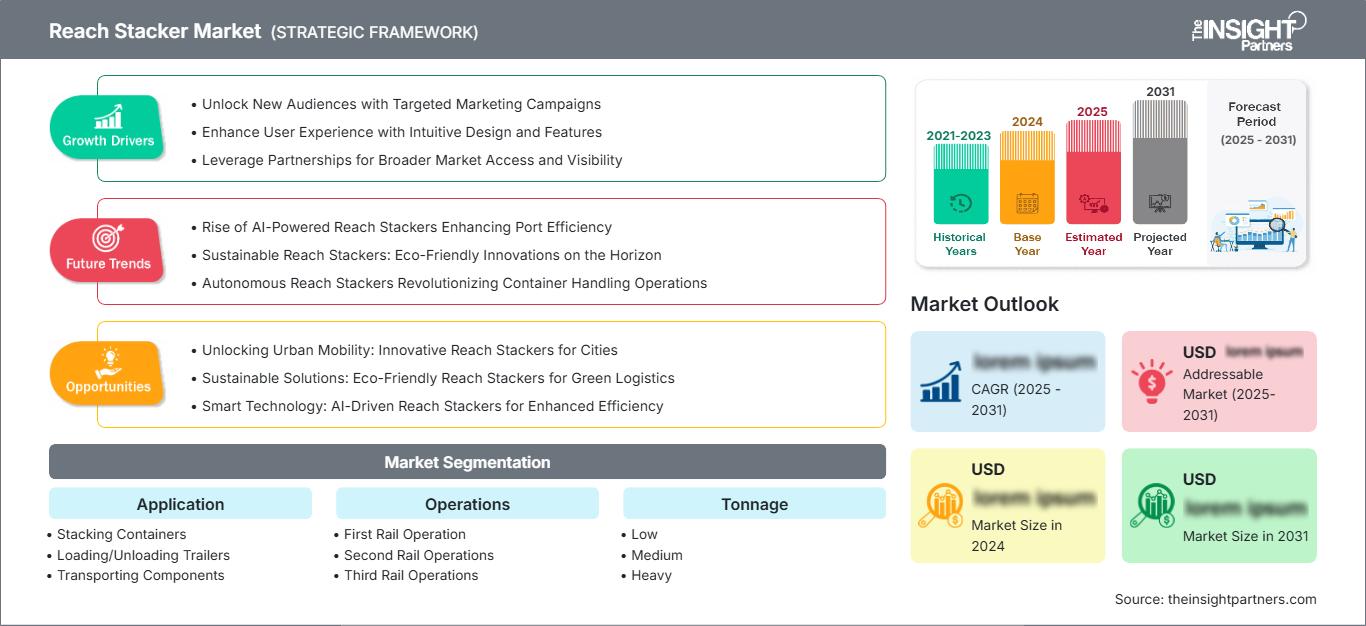
-
이 보고서의 주요 주요 시장 동향을 확인하세요.이 무료 샘플에는 시장 동향부터 추정 및 예측에 이르기까지 데이터 분석이 포함됩니다.
Regional Insights
North America reach stacker market
North America is estimated to hold a 24–28% share of the 2025 Reach Stacker Market and expand at a 4.8–5.3% CAGR through 2034. The US continues to be the main consumer of electric forklift trucks due to the presence of intermodal freight corridors, container terminals, inland ports, distribution centers, and the need to update older diesel powered equipment. Canada supports the growth by using electric forklifts in ports, rail logistics, mining, and industrial operations that require mobile heavy lifting equipment.
Regional purchase decisions continue to focus on uptime, safety of operators, accessibility of services, and performance in terms of emissions. Electrification becomes more effective when terminals have charging capabilities and operate predictably. The US enjoys the advantages of its well-developed logistics network, whereas Canada's need for electric trucks is less distributed but rather focuses on ports, rail-connected terminals, and industrial sites.
U.S. reach stacker Market
The US represents approximately 72–78% of North America's 2025 Reach Stacker Market and is projected to grow at a 4.9–5.4% CAGR through 2034. Demand is concentrated around container ports, inland intermodal facilities, rail-linked freight yards, and industrial logistics operations. Equipment buyers typically prioritize lifting capacity, maneuverability, visibility, uptime, and dealer-supported maintenance.
Application patterns vary by terminal scale and cargo profile. High-throughput facilities increasingly evaluate electric and lower-emission machines, while remote or intensive operations continue to depend heavily on combustion platforms. CVS Ferrari S.p.A., Kalmar Corporation, Konecranes Plc, Taylor Machine Works, Inc., Terex Corporation, Toyota Material Handling, and Hoist Liftruck Mfg., Inc. provide competitive alternatives through different equipment configurations. Fleet replacement cycles and total-cost-of-ownership analysis remain important purchasing criteria.
Europe reach stacker market
Europe is projected to represent a 25–29% share of the Reach Stacker Market in 2025 and expand at a 4.6–5.1% CAGR through 2034, with Germany serving as a leading national market. Regulation, decarbonization of industries, intermodal transportation, and port and yard modernizations will impact the choice of equipment. The regional market continues to reward the productivity of equipment that produces less pollution and uses energy efficiently.
The UK and Germany continue to be vital for the logistics equipment market, where the need for equipment is linked to ports, inland freight terminals, production, and distribution activities. France, Italy, and Spain participate in terms of container terminals, industrial logistics, and the Mediterranean corridor. Germany possesses a developed industrial equipment sector, while in Italy, port and industrial activities are prevalent. Electrification and efficiency of hydraulics become more important across Europe.
APAC reach stacker market
APAC is estimated to hold a 30–34% of the Reach Stacker Market share in 2025 and grow at a 5.8–6.4% CAGR through 2034. China remains the biggest buyer, followed by Japan, South Korea, India, and Australia. The development of container handling facilities, industrial manufacturing, logistics, and port infrastructure development promotes the growth of equipment requirements in the region.
China has integrated large-scale manufacturing with its extensive port activities, while India has invested in developing multimodal logistics infrastructure. Efficient and technology-driven operations in terminals are the focus of Japan and South Korea, while Australia has invested in logistics for specific industrial and natural resources.
Middle East & Africa reach stacker Market
Middle East and Africa Reach Stacker Market demand is expected to expand at a 4.2–4.8% CAGR through 2034. Saudi Arabia and the UAE represent leading Middle Eastern markets because of port expansion, logistics-zone development, industrial diversification, and investment in freight infrastructure. South Africa remains a major African demand center for port, mining, and inland logistics applications.
The region's operating environment favors robust equipment capable of sustained use in demanding climates. Energy availability supports combustion-based fleets, while new logistics developments create opportunities for electric and hybrid machinery where charging infrastructure can be incorporated. Saudi Arabia and the UAE are particularly relevant as integrated logistics and industrial hubs develop, while South Africa and other African markets remain focused on reliability, maintainability, and flexible cargo handling.
Segmentation Analysis
Propulsion Type
Propulsion Type remains a critical purchasing variable because operators balance power, duty-cycle endurance, emissions, maintenance, and infrastructure availability. The segment is projected to expand at a 5.1–5.8% CAGR during 2026–2034, according to the Reach Stacker Market Report. Internal combustion remains dominant, while battery-operated equipment is gaining relevance in regulated terminals and facilities capable of supporting charging infrastructure.
- Petrol: Petrol-powered equipment serves selected light-duty and specialized applications where equipment availability and straightforward refueling are valued. Its role remains narrower than diesel because reach stacker operations typically demand high torque and sustained heavy-load performance.
- Diesel: Diesel remains the principal propulsion choice for intensive container handling, long operating shifts, and locations where rapid refueling is essential. Mature component ecosystems and established maintenance capabilities reinforce its position across ports and industrial yards.
- Electric: Electric propulsion is gaining strategic importance as terminal operators seek lower local emissions, reduced noise, and improved energy efficiency. Adoption is strongest where predictable duty cycles, charging access, and sustainability requirements justify higher initial investment.
Application
Application determines equipment configuration, duty intensity, maneuverability requirements, and attachment specifications. The segment is expected to grow at a 5.3–5.9% CAGR during 2026–2034. Container stacking remains the core use case, while trailer handling and component transportation broaden demand across industrial logistics environments.
- Stacking Containers: Container stacking represents the central operating application, requiring precise boom control, strong residual capacity, stable handling, and visibility. Demand is closely linked to terminal throughput and available yard space.
- Loading/Unloading Trailers: Trailer loading and unloading applications benefit from the machine's mobility and reach capability. Adoption is relevant in inland depots, logistics yards, and industrial facilities where fixed lifting infrastructure is limited.
- Transporting Components: Component transportation supports manufacturing, energy, construction, and industrial logistics. Reach stackers can reposition heavy or containerized loads across yards, reducing reliance on multiple specialized handling assets.
Operations
Operations influence machine configuration according to rail access, handling frequency, and terminal layout. This segment is estimated to expand at a 4.9–5.6% CAGR during 2026–2034. Intermodal facilities increasingly require equipment capable of coordinating container movements across rail-linked operating zones.
- First Rail Operation: First rail operations support initial container handling around rail-connected terminals, where speed, stability, and positioning accuracy are important for transferring freight between storage areas and rail equipment.
- Second Rail Operations: Second rail operations involve intermediate handling activities and repositioning within intermodal facilities. Flexible reach capability helps operators manage container flows where fixed cranes cannot economically cover every movement.
- Third Rail Operations: Third rail operations involve additional transfer or positioning requirements within rail logistics chains. Equipment selection emphasizes maneuverability, availability, and compatibility with varying container-handling patterns.
Tonnage
Tonnage determines lifting performance, machine structure, hydraulic capacity, and operating economics in the Reach Stacker Market. The segment is expected to expand at a 5.0–5.7% CAGR through 2034. Medium and heavy machines remain strategically important for containerized freight, while lower-tonnage equipment serves specialized industrial applications.
- Low: Low-tonnage machines address lighter containers and specialized handling requirements. Their smaller footprint can improve maneuverability in constrained facilities, supporting applications where maximum lifting capacity is not the primary procurement criterion.
- Medium: Medium-tonnage equipment balances lifting capability, operating cost, and flexibility. It is suitable for many intermodal and container-yard tasks and can provide a practical fleet configuration for diversified terminal operations.
- 중장비: 중량급 장비는 대용량 컨테이너, 산업 화물 및 까다로운 물류 작업에 사용됩니다. 작업자가 높은 총하중을 정기적으로 취급하는 환경에서는 견고한 구조 설계와 유압 성능이 필수적입니다.
구동 방식
구동 방식은 리치 스태커 시장에서 점점 더 중요한 기술적 결정 요소로 자리 잡고 있습니다. 운영자들이 연료비, 배출가스, 전력 가용성 및 장비 활용도를 비교함에 따라, 이 부문은 2026년부터 2034년까지 연평균 5.7~6.5%의 성장률을 기록할 것으로 예상됩니다.
- 내연기관: 내연기관은 장시간 가동, 고부하 작업, 빠른 연료 보급이 가능하기 때문에 여전히 널리 사용되고 있습니다. 잘 구축된 서비스 네트워크와 연료 인프라는 많은 고객에게 운영 전환 장벽을 낮춰줍니다.
- 배터리 구동식: 배터리 구동식 시스템은 적절한 충전 인프라가 갖춰진 항만 및 산업 현장에서 주목받고 있습니다. 이러한 시스템은 적절한 작동 주기 하에서 보다 예측 가능한 운영 비용을 지원하는 동시에 지역 배출가스 및 소음을 줄일 수 있습니다.
- 가스 구동식: 가스 구동식 장비는 연소 기반의 유연성과 다양한 배출 특성을 원하는 운영자에게 대안을 제공합니다. 도입 여부는 연료 가용성, 지역 규정, 인프라 및 각 터미널의 운영 특성에 따라 결정됩니다.
기회 개요
|
애플리케이션 |
수익 기여 |
트렌드 태그 |
입양 단계 |
|
쌓을 수 있는 컨테이너 |
높은 |
마당 밀도 |
성숙한 |
|
트레일러 적재/하역 |
중간 |
트레일러 이송 |
확장 |
|
부품 운송 |
중간 |
중량물류 |
확장 |
리치 스태커 시장 성장 동인 및 영향 분석
복합운송 인프라 확장
복합운송 시설의 확장은 항만, 내륙 터미널, 철도 야적장, 물류센터 등 여러 장소에서 활용 가능한 이동식 컨테이너 하역 장비에 대한 수요 증가로 이어지고 있습니다. 리치 스태커는 크레인처럼 복잡한 고정 구조물이 필요하지 않아 신규 시설 및 중규모 터미널에 적합합니다. 야적장의 유연한 활용과 신속한 컨테이너 재배치가 요구되는 곳에서 시장 반응이 가장 크게 나타날 것으로 예상됩니다. 물류 회랑의 확장은 도로에서 철도로 화물을 이동시키는 데 필요한 장비의 수요를 더욱 증가시킬 것입니다. 터미널 운영이 점점 더 긴밀하게 연결되는 환경에서 구매자들은 비용 외에도 가용성, 인양 능력, 회전 반경, 응답 시간 등의 요소를 고려합니다.
항공기 현대화 및 총 소유 비용 최적화
장비 교체는 노후화뿐 아니라 비용 효율성 확보라는 측면에서도 중요한 요인으로 대두되고 있습니다. 오래된 장비는 연료 효율 저하, 유지보수 비용 증가, 가동 중단 가능성 증가, 배출가스 규제 준수 비용 상승 등 여러 문제점을 야기합니다. 리치 스태커 제조업체들은 유압 시스템 설계 혁신, 전자 제어 기능 강화, 효율적인 엔진 설계, 에너지 회수 시스템 도입, 예측 유지보수 서비스 제공 등을 통해 이러한 문제들을 해결하고 있습니다. 터미널 운영사들은 새로운 장비를 도입하기 전에 연료 효율, 유지보수 비용, 잔존 가치, 생산성 등을 고려하여 비용 효율성을 계산할 수 있게 되므로, 장비 교체율은 더욱 높아질 것으로 예상됩니다. 이는 물류 인프라가 성장하고 있는 개발도상국뿐 아니라, 노후 장비 비중이 여전히 높은 선진 시장에서도 장비 교체율을 높이는 요인이 될 수 있습니다.
탈탄소화 요구사항 및 전동화된 자재 취급
탈탄소화는 중장비 자재 운반 기계의 기술 발전 방향에 영향을 미치고 있습니다. 항만이나 산업 시설을 운영하는 기업들은 기계 교체 시 배출가스, 소음 수준, 에너지 소비, 그리고 전반적인 지속가능성 목표와의 통합 측면을 더욱 중요하게 고려하는 경향이 있습니다. 배터리 구동식 리치 스태커는 충전 필요성, 높은 배터리 가격, 작업 주기 제한, 적재 용량 등의 제약에 직면해 있지만, 기술 발전으로 이러한 장비의 활용 가능성이 점차 확대되고 있습니다. 기업들은 모듈형 배터리 팩, 하이브리드 기술, 에너지 회수, 효율적인 유압 구조 설계 등을 활용하고 있습니다. 이러한 기술 발전은 특히 운영 주기가 예측 가능하고 전기 에너지원을 지원할 수 있는 지역의 시장에 큰 영향을 미칠 것입니다.
리치 스태커 시장 미래 동향
전력화와 모듈형 에너지 시스템의 결합
리치 스태커 시장 동향은 단일 범용 배터리 아키텍처보다는 모듈형 전동화에 더욱 집중될 것으로 예상됩니다. 제조업체들은 특정 작업 주기에 맞춰 구성 가능한 배터리 용량, 충전 옵션, 에너지 관리 소프트웨어를 제공할 가능성이 높습니다. 이러한 접근 방식은 사용 빈도가 낮은 용도에 과도한 사양의 배터리를 사용하는 위험을 줄이는 동시에 사용 빈도가 높은 터미널에서 더 긴 작동 시간을 지원할 수 있습니다. 배터리 교환 방식은 충전 중단 시간이 생산성에 상당한 영향을 미치는 시설에서 중요해질 수 있습니다. 하이브리드 시스템 또한 기존 연소 기술과 에너지 회수 기능을 결합하기 때문에 전환 기간 동안 상업적으로 유용할 것으로 예상됩니다. 국가별 에너지 가격과 배출 규제가 달라짐에 따라 모듈형 추진 전략은 제조업체에게 제품 현지화에 대한 더 큰 유연성을 제공하고, 운영자는 모든 운영 환경에 단일 기술을 적용하는 대신 현장별 경제성에 따라 파워트레인을 선택할 수 있도록 해줍니다.
연결된 운영 및 운영자 지원 기술
미래 장비 개발은 첨단 텔레매틱스, 진단, 카메라 기술, 적재 관리 및 운전자 지원 시스템을 리치 스태커에 통합하는 방향으로 나아갈 가능성이 높습니다. 디지털 기술의 활용으로 터미널 관리자는 장비 활용률, 유휴 시간, 유지 보수 상태, 에너지 소비량 및 그 위치와 같은 매개변수를 모니터링할 수 있게 됩니다. 첨단 안전 시스템은 센서와 같은 메커니즘을 사용하여 붐과 스프레더 작동 중 전복 방지, 시야 확보, 충돌 방지 등의 기능을 수행할 수 있습니다. 이러한 기술은 컨테이너 하역 작업과 같이 반복적인 작업이 요구되는 터미널 야드에서 반자동화를 구현하는 데 유용할 것입니다. 장비 데이터와 차량 관리 및 터미널 운영 시스템 간의 연결 필요성이 증가함에 따라 데이터 호환성의 중요성도 더욱 커질 것입니다.
리치 스태커 시장 기회
제어 제어 단말기용 전력화 솔루션
리치 스태커 시장 전망에 따르면 장비 공급업체는 배터리 작동에 필요한 작업 주기, 충전 시간대, 장비 이동 경로를 충분히 예측할 수 있는 터미널을 공략할 수 있는 기회가 있습니다. 공급업체는 단순히 장비 사양만으로 경쟁하는 대신, 충전 인프라, 에너지 관리 시스템, 유지보수 지원, 배터리 모니터링, 금융 지원 등을 통합된 형태로 제공할 수 있습니다. 산업 플랜트, 물류 센터, 그리고 일부 내륙 터미널은 변동성이 큰 항만보다 운영 조건을 효과적으로 제어할 수 있기 때문에 초기 적용에 적합한 장소가 될 수 있습니다. 또한 공급업체는 고객이 전기 장비를 단계적으로 도입할 수 있도록 개조 및 차량 전환 프로그램을 개발할 수 있습니다. 이러한 접근 방식은 구매 위험을 줄이는 동시에 서비스 계약 및 에너지 관리 지원을 통해 지속적인 수익을 창출할 수 있습니다. 충전 서비스 제공업체 및 유틸리티 회사와의 전략적 파트너십은 프로젝트 경제성을 더욱 향상시키고, 저배출 자재 취급 작업을 추구하는 고객을 위한 차별화된 솔루션을 구축하는 데 도움이 될 수 있습니다.
특수 중량물 및 산업 물류 애플리케이션
이 시장은 에너지 저장 컨테이너, 산업 부품, 철강 제품 및 기타 중량 화물의 특수 처리를 통해 기존 컨테이너 터미널을 넘어 추가적인 기회를 제공합니다. 이러한 용도에는 표준 컨테이너 야드 사용과는 다른 리프팅 구성, 스프레더, 안전 시스템 및 작업 환경이 필요할 수 있습니다. 제조업체는 맞춤형 톤수, 부착 장치, 제어 소프트웨어 및 응용 엔지니어링을 통해 이러한 틈새 시장을 공략할 수 있습니다. 특히 에너지 인프라 프로젝트 관련 수요는 대형 장비 부품 및 저장 시스템의 경우 설치 전 유연한 야드 이동이 필요한 경우가 많기 때문에 매우 중요합니다. 강력한 엔지니어링 역량을 갖춘 공급업체는 특수 용도를 활용하여 수익을 다각화하고 기존 항만 교체 주기에 대한 의존도를 줄일 수 있습니다. 상업 모델에는 장비 맞춤화, 시운전, 운영자 교육, 예방 유지 보수 및 장기 서비스 계약이 포함될 수 있으며, 이는 일회성 장비 판매를 넘어 더욱 폭넓은 고객 관계를 구축할 수 있게 해줍니다.
자주 묻는 질문

니베디타는 시장 조사 및 비즈니스 컨설팅 분야에서 9년 이상의 경력을 보유한 뛰어난 리서치 전문가입니다. 현재 The Insight Partners에서 ICT 분야 프로젝트 매니저로 재직 중인 그녀는 다양한 기술 분야에서 신디케이트, 맞춤형, 구독 기반 및 컨설팅 리서치 과제를 관리하고 수행하는 데 있어 심도 있는 전문 지식을 보유하고 있습니다.
데이터 기반 분석과 실행 가능한 인사이트를 제공하는 데 있어 입증된 실적을 바탕으로 니베디타는 여러 주요 프로젝트에 핵심적인 기여를 해왔습니다. 그녀의 업무는 고객 목표 파악, 시장 동향 분석, 전략적 권고 도출에 이르기까지 프로젝트 전반의 실행을 포함합니다. 그녀는 주요 ICT 기업들과 폭넓게 협력하여 시장 기회를 발굴하고 산업 변화를 헤쳐나가는 데 도움을 주었습니다.
니베디타는 데라둔에 위치한 IMS에서 경영학 MBA 학위를 취득했습니다. The Insight Partners에 합류하기 전에는 푸네에 위치한 MarketsandMarkets와 Future Market Insights에서 다양한 리서치 업무를 수행하며 산업 분석 및 고객 참여에 대한 탄탄한 기반을 다지는 귀중한 경험을 쌓았습니다.
- 포괄적인 시장 규모 산정 및 전망 분석
- 상세 시장 세분화 분석
- 심층적인 시장 동향 및 요인 분석
- 지역 및 국가별 인사이트
- 경쟁 구도 및 기업 벤치마킹
- 전략적 비즈니스 인텔리전스
사용 후기

The Insight Partners는 당사의 글로벌 시장 진출 전략을 뒷받침하는 가치 있는 시장 정보를 제공했습니다. 담당 팀은 전문적이고 신속하게 대응했으며 당사의 의견을 세심하게 반영했습니다. 또한 프로젝트 전반에 걸쳐 깊이 있는 분석과 유용한 방법론적 설명을 제공했습니다.
Junmo Kim 최고재무책임자(CFO), Enertech Co., Ltd.
Insight Partners의 SCADA 시스템 시장 보고서는 포괄적이며, 현재 동향과 미래 전망에 대한 귀중한 통찰력을 제공합니다. 팀은 매우 전문적이고, 신속하게 대응하며, 처음부터 끝까지 지원해 주었습니다. 저희는 매우 만족하며 Insight Partners의 서비스를 적극 추천합니다.
란 케뎀 파트너, Reali Technologies LTDs
아주 구체적인 소프트웨어 시장에 대한 보고서를 요청했는데, 팀에서 며칠 만에 보고서를 작성해 주셨습니다. 정보는 매우 관련성이 높고 잘 정리되어 있었습니다. 그 후 보고서에 몇 가지 수정과 추가 사항을 요청했습니다. 팀원들의 응답도 매우 빨랐고, 일주일도 채 되지 않아 최종 보고서를 받았습니다.
장-에르브 젠 의장, 퓨처 애널리티카
The Insight Partners와 함께 중요한 시장 조사 및 예측 작업을 진행했습니다. Insight Partners는 기회와 위험에 대한 명확한 통찰력을 제공하여 계획을 세우는 데 큰 도움이 되었습니다. The Insight Partners의 조사는 사용하기 쉬웠고, 탄탄한 데이터를 기반으로 했습니다. 덕분에 현명하고 자신 있는 결정을 내릴 수 있었습니다. The Insight Partners를 강력 추천합니다.
피유시 나그팔 수석 부사장, 하이빔 글로벌
Insight Partners는 탄탄한 분야 전문성을 바탕으로 통찰력 있고 체계적인 시장 조사를 제공했습니다. Insight Partners 팀은 처음부터 끝까지 전문적이고 신속하게 대응했습니다. 사용자 친화적인 웹사이트 덕분에 업계 보고서에 쉽게 접근할 수 있었습니다. 신뢰할 수 있고 고품질의 조사 서비스를 원하신다면 Insight Partners를 강력 추천합니다.
아다치 유키히코 대표이사, 딥블루 주식회사
The Insight Partners에서 시장 보고서를 구매한 것은 이번이 처음입니다. 처음에는 확신이 없었지만, 웹사이트를 방문하고 나서 위험을 감수하고 시장 보고서를 구매하는 것이 더 편하다는 것을 알게 되었습니다. 보고서의 품질과 고객 서비스에 매우 만족합니다. 처음 보고서를 보고 몇 가지 질문과 의견이 있었지만, 분석가와 이메일로 몇 차례 대화를 나눈 후, 전략 기획 과정에 참고할 수 있는 보고서를 확보했다고 생각합니다. 시간을 내어 긍정적인 경험을 선사해 주셔서 정말 감사합니다. 다른 사람들에게도 귀사의 서비스를 적극 추천할 것이며, 추가적인 시장 데이터가 필요할 때면 가장 먼저 귀사에 연락하겠습니다.
존 스즈키 사장 겸 최고 경영자, 이사회 이사, BK 테크놀로지스
나이지리아 감염성 질환 IVD 시장 관련 정보 요청에 응해 주신 귀사의 지원과 전문성에 감사드립니다. 귀사의 인내심과 지도, 그리고 할인 혜택을 기꺼이 제공해 주셔서 결국 계약을 성사시킬 수 있었습니다. 첫 만남을 통해 귀사가 저에게 심어주신 좋은 인상을 바탕으로 앞으로도 The Insight Partners와 함께할 수 있기를 기대합니다.
치지오케 박사 오니아 전무이사, 파인크레스트 헬스케어 유한회사구매 이유
- 정보에 기반한 의사 결정
- 시장 역학 이해
- 경쟁 분석
- 고객 인사이트
- 시장 예측
- 위험 완화
- 전략 기획
- 투자 타당성 분석
- 신흥 시장 파악
- 마케팅 전략 강화
- 운영 효율성 향상
- 규제 동향에 발맞춰 대응



















 무료 샘플 받기 -