
Reach Stacker Market Demand, Share & Growth by 2034
Coverage: By Application (Stacking Containers, Loading/Unloading Trailers, Transporting Components); Operations (First Rail Operation, Second Rail Operations, Third Rail Operations); Tonnage (Low, Medium, Heavy); Drive Type (Internal Combustion Engine (ICE), Battery Operated, Gas Powered) , and Geography (North America, Europe, Asia Pacific, and South and Central America)
- Status : Data Released
- Report Code : TIPRE00008395
- Category : Manufacturing and Construction
- No. of Pages : 150
- Available Report Formats :


- Last update date : September 02, 2026


2025 Market Size
US$ 2.53 Bn
Base year value
2034 Forecast
US$ 4.12 Bn
Projected by 2034
CAGR 2026-2034
5.57 %
Growth rate
Addressable Market
US$ 30.15 Bn
(2026-2034)
The reach stacker market was valued at US$ 2.53 Billion in 2025 and is projected to reach US$ 4.12 Billion by 2034, expanding at a CAGR of 5.57% during 2026–2034. The market encompasses specialized mobile handling equipment used for container stacking, trailer loading, intermodal movement, and heavy cargo operations. Demand is influenced by terminal modernization, containerized trade, fleet replacement, operational productivity requirements, and the gradual transition toward lower-emission propulsion systems.
North American adoption is supported by intermodal freight activity, inland container depots, port modernization, and replacement of aging material-handling fleets. The reach stacker market size in the region is expected to advance at an estimated 4.8–5.3% CAGR between 2026 and 2034, supported by fleet electrification, stricter emissions requirements, and investments in logistics infrastructure. Demand remains concentrated in applications requiring flexible mobile handling rather than fixed terminal systems.
Reach Stacker Market Assessment and Insights
- North America: North America is expected to represent a 24–28% share in 2025 and grow at a 4.8–5.3% CAGR between 2026–2034, supported by intermodal terminals, port modernization, replacement demand, and cleaner equipment requirements.
- US: The US is expected to account for 72–78% of North America's 2025 market and expand at a 4.9–5.4% CAGR between 2026–2034, led by freight hubs and terminal upgrades.
- Europe: Europe is projected to hold a 25–29% share in 2025 and expand at a 4.6–5.1% CAGR between 2026–2034, with Germany, Italy, the Netherlands, France, and Spain supporting demand through logistics modernization and decarbonization programs.
- Asia Pacific: Asia Pacific is expected to command a 30–34% share in 2025 and register a 5.8–6.4% CAGR between 2026–2034, led by China, India, Japan, South Korea, and Australia amid expanding ports and inland logistics.
- Largest Segment: Internal Combustion Engine is expected to hold a 64–68% market share in 2025, with a 4.5–5.0% CAGR during 2026–2034, reflecting established heavy-duty operating capability.
- High Growth Segment: Battery Operated is expected to represent an 11–14% market share in 2025 and grow at a 12.0–14.0% CAGR during 2026–2034, supported by electrification.
- Key companies analyzed in detail: CVS Ferrari S.p.A., Doosan Corporation Industrial Vehicle, Kalmar Corporation, Konecranes Plc, Liebherr-International AG, SANY Group, Taylor Machine Works, Inc., Terex Corporation, Toyota Material Handling, and Hoist Liftruck Mfg., Inc.
Source: The Insight Partners' analysis based on proprietary research, government publications, company annual reports, investor presentations, industry databases, and expert interviews.
There have been changes in equipment used to include machines that are capable of energy recovery, electronically controlled and assisted systems as well as machine connectivity and monitoring systems. Reach stackers will increasingly integrate flexible booms with efficient hydraulics and stabilization systems. Equipment manufacturers will diversify their offering as clients assess the total cost of ownership, emissions, duty cycle needs, charging capabilities, along with lifting capacity.
In terms of purchasing decisions made during the forecast period, there will be differentiation based on duty cycles and environments of operation. Availability of charging capacity at ports will fast-track the adoption of battery technology, whereas remote terminals and intense duty cycle applications will continue to favor combustion engines or hybrids. New logistical corridors in South and Southeast Asia, the Middle East and Latin America are anticipated to offer new opportunities.
Reach Stacker Market Report Scope
| Report Attribute | Details |
|---|---|
| Market size in 2025 | US$ 2.53 Billion |
| Market Size by 2034 | US$ 4.12 Billion |
| Global CAGR (2026 - 2034) | 5.57% |
| Historical Data | 2021-2024 |
| Forecast period | 2026-2034 |
Reach Stacker Market Analysis
The reach stacker market growth is linked to containerized freight handling, inland logistics expansion, terminal throughput requirements, and the need for mobile equipment capable of operating without extensive fixed infrastructure. Engine, hydraulics, transmission, axle, tire, spreader, electrical control system, and chassis are obtained by the manufacturer prior to assembly into fully operational machines. Some of the major downstream players include equipment distributors, equipment leasing firms, equipment service providers, and terminal operators.
Supply issues are becoming increasingly complex due to the balancing act required between the load-carrying capability and fuel economy. Well-known manufacturers have an advantage due to their established international servicing facilities and large installed base, whereas smaller regional manufacturers compete on the basis of local manufacture and price. Factors affecting the cost of the machine include component availability, steel prices, power train sourcing, and logistics costs.
Other companies are represented by global material-handling specialists and diversified industrial equipment manufacturers. Kalmar Corporation has a diverse range of both conventional and electric reach stackers, while Konecranes Plc focuses on development of electrified lift trucks. High capacity equipment and hybrid energy recovery technologies are key for Liebherr-International AG, while SANY Group relies on various equipment designs and innovative safety systems. CVS Ferrari S.p.A. still remains competitive in the niche of specialized container-handling equipment.
Increasing strategic investments go into electrification, digital control systems, operator assistance, and production flexibility. Other competitors include Taylor Machine Works, Inc., Terex Corporation, Toyota Material Handling, and Hoist Liftruck Mfg., Inc. Doosan Corporation Industrial Vehicle and other well-known equipment manufacturers can benefit from their wider dealer and service networks in supporting the needs of lifecycle reliability, while port equipment specialists can differentiate themselves through high-capacity solutions.
● REPORT CUSTOMIZATION
Tailor This Report To Align With Your Specific Business Requirements
This report can be customized to align precisely with your business objectives, scope, and target markets. Customization options include tailored segmentation, geography, competitive analysis, and strategic insights to support informed decision-making.
Customize This Report →WHAT YOU CAN ADJUST
- ● Segmentations
- ● Geography
- ● Competitive Analysis
- ● Language Preferences
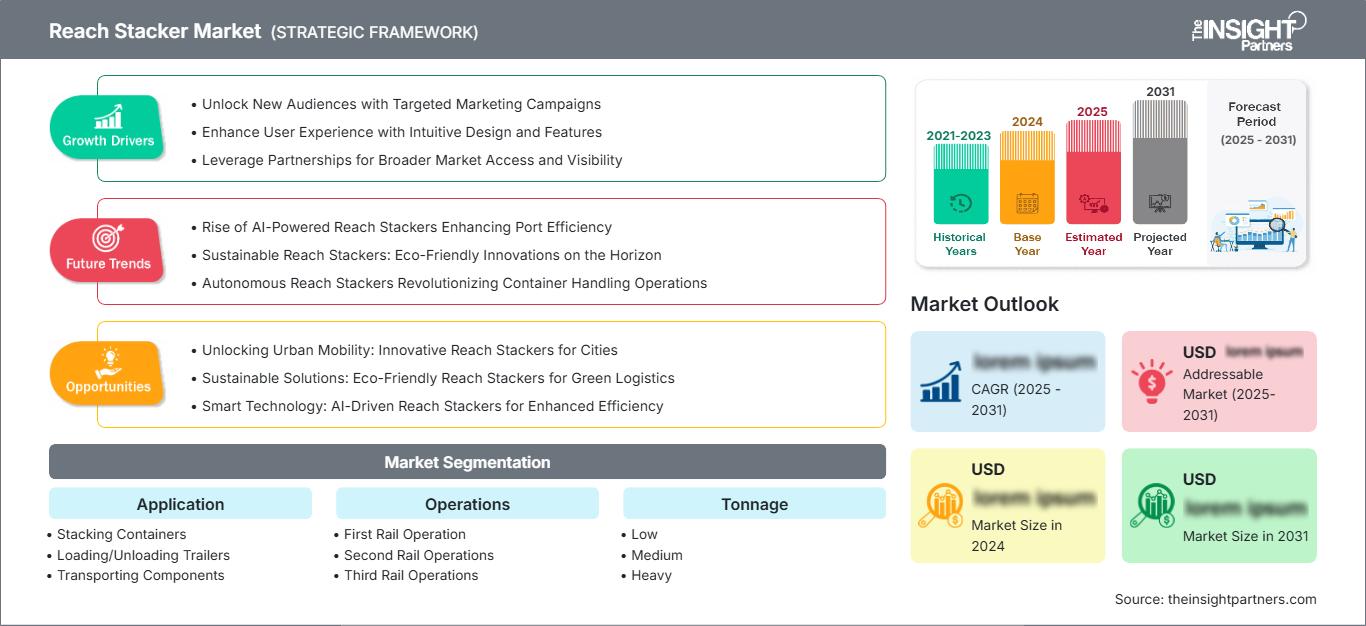
Reach Stacker Market: Strategic Insights
Regional Insights
North America reach stacker market
North America is estimated to hold a 24–28% share of the 2025 Reach Stacker Market and expand at a 4.8–5.3% CAGR through 2034. The US continues to be the main consumer of electric forklift trucks due to the presence of intermodal freight corridors, container terminals, inland ports, distribution centers, and the need to update older diesel powered equipment. Canada supports the growth by using electric forklifts in ports, rail logistics, mining, and industrial operations that require mobile heavy lifting equipment.
Regional purchase decisions continue to focus on uptime, safety of operators, accessibility of services, and performance in terms of emissions. Electrification becomes more effective when terminals have charging capabilities and operate predictably. The US enjoys the advantages of its well-developed logistics network, whereas Canada's need for electric trucks is less distributed but rather focuses on ports, rail-connected terminals, and industrial sites.
U.S. reach stacker Market
The US represents approximately 72–78% of North America's 2025 Reach Stacker Market and is projected to grow at a 4.9–5.4% CAGR through 2034. Demand is concentrated around container ports, inland intermodal facilities, rail-linked freight yards, and industrial logistics operations. Equipment buyers typically prioritize lifting capacity, maneuverability, visibility, uptime, and dealer-supported maintenance.
Application patterns vary by terminal scale and cargo profile. High-throughput facilities increasingly evaluate electric and lower-emission machines, while remote or intensive operations continue to depend heavily on combustion platforms. CVS Ferrari S.p.A., Kalmar Corporation, Konecranes Plc, Taylor Machine Works, Inc., Terex Corporation, Toyota Material Handling, and Hoist Liftruck Mfg., Inc. provide competitive alternatives through different equipment configurations. Fleet replacement cycles and total-cost-of-ownership analysis remain important purchasing criteria.
Europe reach stacker market
Europe is projected to represent a 25–29% share of the Reach Stacker Market in 2025 and expand at a 4.6–5.1% CAGR through 2034, with Germany serving as a leading national market. Regulation, decarbonization of industries, intermodal transportation, and port and yard modernizations will impact the choice of equipment. The regional market continues to reward the productivity of equipment that produces less pollution and uses energy efficiently.
The UK and Germany continue to be vital for the logistics equipment market, where the need for equipment is linked to ports, inland freight terminals, production, and distribution activities. France, Italy, and Spain participate in terms of container terminals, industrial logistics, and the Mediterranean corridor. Germany possesses a developed industrial equipment sector, while in Italy, port and industrial activities are prevalent. Electrification and efficiency of hydraulics become more important across Europe.
APAC reach stacker market
APAC is estimated to hold a 30–34% of the Reach Stacker Market share in 2025 and grow at a 5.8–6.4% CAGR through 2034. China remains the biggest buyer, followed by Japan, South Korea, India, and Australia. The development of container handling facilities, industrial manufacturing, logistics, and port infrastructure development promotes the growth of equipment requirements in the region.
China has integrated large-scale manufacturing with its extensive port activities, while India has invested in developing multimodal logistics infrastructure. Efficient and technology-driven operations in terminals are the focus of Japan and South Korea, while Australia has invested in logistics for specific industrial and natural resources.
Middle East & Africa reach stacker Market
Middle East and Africa Reach Stacker Market demand is expected to expand at a 4.2–4.8% CAGR through 2034. Saudi Arabia and the UAE represent leading Middle Eastern markets because of port expansion, logistics-zone development, industrial diversification, and investment in freight infrastructure. South Africa remains a major African demand center for port, mining, and inland logistics applications.
The region's operating environment favors robust equipment capable of sustained use in demanding climates. Energy availability supports combustion-based fleets, while new logistics developments create opportunities for electric and hybrid machinery where charging infrastructure can be incorporated. Saudi Arabia and the UAE are particularly relevant as integrated logistics and industrial hubs develop, while South Africa and other African markets remain focused on reliability, maintainability, and flexible cargo handling.
Segmentation Analysis
Propulsion Type
Propulsion Type remains a critical purchasing variable because operators balance power, duty-cycle endurance, emissions, maintenance, and infrastructure availability. The segment is projected to expand at a 5.1–5.8% CAGR during 2026–2034, according to the Reach Stacker Market Report. Internal combustion remains dominant, while battery-operated equipment is gaining relevance in regulated terminals and facilities capable of supporting charging infrastructure.
- Petrol: Petrol-powered equipment serves selected light-duty and specialized applications where equipment availability and straightforward refueling are valued. Its role remains narrower than diesel because reach stacker operations typically demand high torque and sustained heavy-load performance.
- Diesel: Diesel remains the principal propulsion choice for intensive container handling, long operating shifts, and locations where rapid refueling is essential. Mature component ecosystems and established maintenance capabilities reinforce its position across ports and industrial yards.
- Electric: Electric propulsion is gaining strategic importance as terminal operators seek lower local emissions, reduced noise, and improved energy efficiency. Adoption is strongest where predictable duty cycles, charging access, and sustainability requirements justify higher initial investment.
Application
Application determines equipment configuration, duty intensity, maneuverability requirements, and attachment specifications. The segment is expected to grow at a 5.3–5.9% CAGR during 2026–2034. Container stacking remains the core use case, while trailer handling and component transportation broaden demand across industrial logistics environments.
- Stacking Containers: Container stacking represents the central operating application, requiring precise boom control, strong residual capacity, stable handling, and visibility. Demand is closely linked to terminal throughput and available yard space.
- Loading/Unloading Trailers: Trailer loading and unloading applications benefit from the machine's mobility and reach capability. Adoption is relevant in inland depots, logistics yards, and industrial facilities where fixed lifting infrastructure is limited.
- Transporting Components: Component transportation supports manufacturing, energy, construction, and industrial logistics. Reach stackers can reposition heavy or containerized loads across yards, reducing reliance on multiple specialized handling assets.
Operations
Operations influence machine configuration according to rail access, handling frequency, and terminal layout. This segment is estimated to expand at a 4.9–5.6% CAGR during 2026–2034. Intermodal facilities increasingly require equipment capable of coordinating container movements across rail-linked operating zones.
- First Rail Operation: First rail operations support initial container handling around rail-connected terminals, where speed, stability, and positioning accuracy are important for transferring freight between storage areas and rail equipment.
- Second Rail Operations: Second rail operations involve intermediate handling activities and repositioning within intermodal facilities. Flexible reach capability helps operators manage container flows where fixed cranes cannot economically cover every movement.
- Third Rail Operations: Third rail operations involve additional transfer or positioning requirements within rail logistics chains. Equipment selection emphasizes maneuverability, availability, and compatibility with varying container-handling patterns.
Tonnage
Tonnage determines lifting performance, machine structure, hydraulic capacity, and operating economics in the Reach Stacker Market. The segment is expected to expand at a 5.0–5.7% CAGR through 2034. Medium and heavy machines remain strategically important for containerized freight, while lower-tonnage equipment serves specialized industrial applications.
- Low: Low-tonnage machines address lighter containers and specialized handling requirements. Their smaller footprint can improve maneuverability in constrained facilities, supporting applications where maximum lifting capacity is not the primary procurement criterion.
- Medium: Medium-tonnage equipment balances lifting capability, operating cost, and flexibility. It is suitable for many intermodal and container-yard tasks and can provide a practical fleet configuration for diversified terminal operations.
- Heavy: Heavy-tonnage equipment supports high-capacity containers, industrial cargo, and demanding logistics applications. Strong structural design and hydraulic performance are essential where operators regularly handle high gross loads.
Drive Type
Drive Type represents an increasingly important technology decision within the reach stacker market scope. The segment is forecast to grow at a 5.7–6.5% CAGR during 2026–2034 as operators compare fuel costs, emissions, power availability, and equipment utilization.
- Internal Combustion Engine: Internal combustion engines remain widely deployed because they support long shifts, high-load applications, and rapid refueling. Established service networks and fuel infrastructure reduce operational transition barriers for many customers.
- Battery Operated: Battery-operated systems are gaining attention in ports and industrial yards with suitable charging infrastructure. They can reduce local emissions and noise while supporting more predictable operating costs under suitable duty cycles.
- Gas Powered: Gas-powered machines offer an alternative where operators seek combustion-based flexibility with different emissions characteristics. Adoption is influenced by fuel availability, local regulations, infrastructure, and the operating profile of individual terminals.
Opportunity Snapshot
| Application | Revenue Contribution | Trend Tag | Adoption Stage |
| Stacking Containers | High | Yard Density | Mature |
| Loading/Unloading Trailers | Medium | Trailer Transfer | Scaling |
| Transporting Components | Medium | Heavy Logistics | Scaling |
Reach Stacker Market Growth Drivers and Impact Analysis
Expansion of intermodal freight infrastructure
The expansion of intermodal freight facilities is leading to a greater need for mobile container handling machines, which will work across multiple sites such as ports, inland terminals, railway yards, and distribution centers. The reach stacker can be utilized without the need for elaborate fixed structures that a crane would require, and is hence an appropriate choice for new facilities and medium-scale terminals. The greatest market effect will arise at locations where there is a need for flexible use of the yard and fast repositioning of containers. The expansion of logistics corridors will increase the need for machines that facilitate the movement of cargo from road to rail. In the increasingly connected world of terminal operations, buyers look at factors like availability, lifting ability, turning radius, and response times in addition to cost.
Fleet modernization and total-cost-of-ownership optimization
Fleet replacement is becoming a result of cost efficiencies as much as the aging of machinery. Old machines will incur higher expenses in terms of fuel efficiency, maintenance, downtime susceptibility, and the costs involved in maintaining emissions compliance. Reach stacker manufacturers are addressing these problems with innovations in the design of their hydraulic systems, electronic control capabilities, efficient engine designs, energy harvesting systems, and predictive maintenance services. This has commercial implications as terminal operators will be able to calculate cost efficiency in terms of fuel efficiency, maintenance, residual value, and productivity before acquiring new equipment. This could increase fleet replacement rates not only in developing countries with growing logistics infrastructures but also in mature markets where old fleets may still be quite large.
Decarbonization requirements and electrified material handling
Decarbonization is affecting the technological path of heavy-duty material handling machines. There is a greater tendency for companies operating ports or industries to look at the aspects of emissions, noise levels, energy consumption, and integration with overall sustainability goals while choosing to replace their machinery. Although battery-powered reach stackers continue to face restrictions because of the need to charge, high costs of batteries, duty cycle restrictions, and loading capabilities, advances in technology are opening up a wider array of possibilities for such vehicles. Companies are using modular battery packs, hybridization, energy recapture, and efficient hydraulic architecture designs. This will affect the market mostly in places that have predictable operational cycles and can support electric energy sources.
Reach Stacker Market Future Trends
Electrification paired with modular energy systems
The reach stacker market trends are expected to increasingly center on modular electrification rather than a single universal battery architecture. Manufacturers are likely to offer configurable battery capacities, charging options, and energy-management software matched to specific duty cycles. This approach can reduce the risk of over-specifying batteries for lower-utilization applications while supporting longer operating windows in intensive terminals. Battery swapping may become relevant in facilities where charging downtime materially affects productivity. Hybrid systems are also likely to remain commercially useful during the transition because they combine energy recovery with established combustion technology. As energy prices and emissions requirements diverge across countries, modular propulsion strategies can give manufacturers greater flexibility in product localization and allow fleet operators to select powertrains according to site-level economics rather than adopting one technology across every operating environment.
Connected operations and operator-assistance technologies
The development of future equipment will likely be characterized by the integration of reach stackers with more advanced telematics, diagnostics, camera technology, load management, and assistance systems for operators. The use of digital technology will allow terminal management to monitor such parameters as equipment utilization, idle time, condition of maintenance, energy consumption and its whereabouts. Advanced safety systems could possibly use mechanisms as sensors to limit rollover, enhance visibility, and avoid any collision while moving booms and spreaders. Such technology will be useful in achieving semi-automation processes in a terminal yard due to the repetitive nature of operations in the case of handling containers. The importance of data compatibility will increase due to the need for connectivity between equipment data and fleet management and terminal operation systems.
Reach Stacker Market Opportunities
Electrification solutions for controlled-duty terminals
The reach stacker market Forecasts indicate an opportunity for equipment suppliers to target terminals where duty cycles, charging windows, and machine routes are sufficiently predictable for battery operation. Instead of competing solely on machine specifications, suppliers can package charging infrastructure, energy-management systems, maintenance support, battery monitoring, and financing into integrated deployment models. Industrial plants, logistics centers, and selected inland terminals may provide attractive early applications because operating conditions can be controlled more effectively than at highly variable ports. Suppliers can also develop retrofit and fleet-transition programs that allow customers to introduce electric units incrementally. Such approaches can reduce procurement risk while creating recurring revenue through service agreements and energy-management support. Strategic partnerships with charging providers and utilities can further improve project economics and help manufacturers establish differentiated solutions for customers pursuing lower-emission material-handling operations.
Specialized heavy-load and industrial logistics applications
The market offers additional opportunities beyond conventional container terminals through specialized handling of energy-storage containers, industrial components, steel products, and other heavy cargo. These applications can require lifting configurations, spreaders, safety systems, and operating envelopes different from standard container-yard use. Manufacturers can address these niches through customized tonnage classes, attachments, control software, and application engineering. Demand from energy infrastructure projects is particularly relevant because large equipment components and storage systems often require flexible yard movement before installation. Suppliers with strong engineering capabilities can use specialized applications to diversify revenue and reduce dependence on conventional port replacement cycles. The commercial model can include equipment customization, commissioning, operator training, preventive maintenance, and long-term service contracts, creating a broader customer relationship than a one-time machine sale.
Frequently Asked Questions

- Comprehensive Market Sizing and Forecast Analysis
- Detailed Segmentation Analysis
- In-Depth Market Dynamics Assessment
- Regional and Country-Level Insights
- Competitive Landscape and Company Benchmarking
- Strategic Business Intelligence
Recent Reports
Testimonials

The Insight Partners provided valuable market intelligence that supported our global go-to-market strategy. Their team was professional, responsive, and attentive to our feedback, providing thoughtful analysis and helpful methodological clarifications throughout the project.
Junmo Kim Chief Financial Officer (CFO), Enertech Co., Ltd.
The Insight Partners' SCADA System Market report is comprehensive, with valuable insights on current trends and future forecasts. The team was highly professional, responsive, and supportive throughout. We are very satisfied and highly recommend their services.
RAN KEDEM Partner, Reali Technologies LTDs
I requested a report on a very specific software market and the team produced the report in a few days. The information was very relevant and well presented. I then requested some changes and additions to the report. The team was again very responsive and I got the final report in less than a week.
JEAN-HERVE JENN Chairman, Future Analytica
We worked with The Insight Partners for an important market study and forecast. They gave us clear insights into opportunities and risks, which helped shape our plans. Their research was easy to use and based on solid data. It helped us make smart, confident decisions. We highly recommend them.
PIYUSH NAGPAL Sr. Vice President, High Beam Global
The Insight Partners delivered insightful, well-structured market research with strong domain expertise. Their team was professional and responsive throughout. The user-friendly website made accessing industry reports seamless. We highly recommend them for reliable, high-quality research services
YUKIHIKO ADACHI CEO, Deep Blue, LLC.
This is the first time I have purchased a market report from The Insight Partners.While I was unsure at first, I visited their web site and felt more comfortable to take the risk and purchase a market report.I am completely satisfied with the quality of the report and customer service. I had several questions and comments with the initial report, but after a couple of dialogs over email with their analyst I believe I have a report that I can use as input to our strategic planning process.Thank you so much for taking the extra time and making this a positive experience.I will definitely recommend your service to others and you will be my first call when we need further market data.
JOHN SUZUKI President and Chief Executive Officer, Board Director, BK Technologies
I wish to appreciate your support and the professionalism you displayed in the course of attending to my request for information regarding to infectious disease IVD market in Nigeria. I appreciate your patience, your guidance, and the fact that you were willing to offer a discount, which eventually made it possible for us to close a deal. I look forward to engaging The Insight Partners in the future, all thanks to the impression you have created in me as a result of this first encounter.
DR CHIJIOKE ONYIA MANAGING DIRECTOR, PineCrest Healthcare Ltd.Reason to Buy
- Informed Decision-Making
- Understanding Market Dynamics
- Competitive Analysis
- Identifying Emerging Markets
- Customer Insights
- Market Forecasts
- Risk Mitigation
- Boosting Operational Efficiency
- Strategic Planning
- Investment Justification
- Tracking Industry Innovations
- Aligning with Regulatory Trends





 Get Free Sample for