
3D Cell Culture Market Analysis, Size, and Share by 2031
Coverage: By Product (Scaffold Based, Scaffold Free, 3D Bio Printing and Magnetic Levitation, Microfluidics Based); Application (Drug Discovery, Regenerative Medicine, Cancer and Stem Cell Research); End User (Biotechnological and Pharmaceutical Institutes, Research Institutes, Others), and Geography (North America, Europe, Asia Pacific, and South and Central America)
- Status : Data Released
- Report Code : TIPHE100000962
- Category : Life Sciences
- No. of Pages : 150
- Available Report Formats :


- Last update date : July 30, 2026


2024 Market Size
US$ 1.90 Bn
Base year value
2031 Forecast
US$ 4.66 Bn
Projected by 2031
CAGR 2025-2031
13.7 %
Growth rate
Addressable Market
US$ 22.97 Bn
(2025-2031)
The 3D Cell Culture Market size was valued at US$ 1.90 Billion in 2025 and is projected to reach US$ 4.66 Billion by 2034, registering a CAGR of 13.7% during 2026–2034. The market will grow in size with the provision of alternative options to 2D culture through the development of spheroids, organoids, scaffolds, microfludics, magnetic levitation models, and bioprinting systems.
In North America, the market size of 3D Cell Culture is driven by high biopharma R&D spend and translational research and regulations on the use of human relevant models in tests. The region is expected to grow at the rate of 12.8-13.6% during the period from 2026 to 2034. In its roadmap on the reduction of animal tests, the FDA promotes the use of organ-on-chips technology and in vitro testing methods.
3D Cell Culture Market Assessment and Insights
- North America held 39–42% of the 3D Cell Culture Market share in 2025 and is projected to grow at a CAGR between 2026–2034 of 12.8–13.6%, supported by pharmaceutical R&D, organoid adoption, and NAM-aligned testing.
- US represented 86–89% of North America in 2025 and is expected to grow at a CAGR between 2026–2034 of 12.7–13.5%, led by oncology models and toxicology screening.
- Europe accounted for 27–30% share in 2025 and is forecast to expand at a CAGR between 2026–2034 of 12.1–12.9%, with Germany, the UK, Switzerland, France, and the Netherlands leading adoption.
- Asia Pacific captured 22–25% share in 2025 and is projected to grow at a CAGR between 2026–2034 of 14.6–15.5%, driven by China, Japan, South Korea, India, and Australia.
- Largest Segment Scaffold Based held 39–43% market share in 2025 and is expected to grow at a CAGR range of 12.6–13.4% during 2026–2034 due to broad matrix use.
- High Growth Segment Microfluidics Based represented 15–18% share in 2025 and is forecast to grow at a CAGR range of 15.2–16.1% during 2026–2034 as organ-on-chip adoption rises.
- Key companies analyzed in detail: Merck KGaA, Kuraray Co., Ltd., Corning Incorporated, Lonza Group AG, Thermo Fisher Scientific Inc., Synthecon, Inc., REPROCELL Inc., 3D Biotek LLC, Nano3D Biosciences, Inc., MIMETAS B.V., TissUse GmbH, InSphero AG, CN Bio Innovations Limited, Hamilton Company, and Advanced BioMatrix, Inc.
Source: The Insight Partners' analysis based on proprietary research, government publications, company annual reports, investor presentations, industry databases, and expert interviews.
From simple hydrogel embedding and spheroid plates, the market has advanced to platforms that integrate matrices, defined media, perfused microfluidics, automated imaging, and high throughput analysis. Dynamics of production are gradually leaning towards standardized extracellular matrices, low attachment plates, organoid kits, and assays for ready-to-go microtissues. Also, the 3D Cell Culture Market has become very application specific as manufacturers develop solutions for oncology, liver toxicity, stem cell differentiation, immune interactions, and barrier tissues studies.
Drivers of the future market will include regulatory approval of more predictive and human-relevant models, pressure from pharmaceuticals to increase predictability during the preclinical stage, and growing organoid research in connection with biobanks. Oncological applications are also a driver of the market with WHO and IARC noting an estimated 20 million new cases and 9.7 million cancer deaths in 2022. Investments are flowing towards automated cultures, multi-organ chips, and patient-derived assays.
3D Cell Culture Market Report Scope
| Report Attribute | Details |
|---|---|
| Market size in 2024 | US$ 1.90 Billion |
| Market Size by 2031 | US$ 4.66 Billion |
| Global CAGR (2025 - 2031) | 13.7% |
| Historical Data | 2021-2023 |
| Forecast period | 2025-2031 |
3D Cell Culture Market Analysis
The demand is generated by issues related to drug attrition, precision oncology, stem cells, toxicity testing, and the desire to develop more realistic models of tissue architecture. Factors driving the 3D Cell Culture Market growth include the realization by the FDA that more than 90 percent of animal-tested drug candidates fail in humans, which creates interest in superior human platforms.
With regard to the value chain, these segments are part of the process: biomaterials suppliers, plate and scaffold makers, organoid makers, microfluidic specialists, imaging systems, automation vendors, contract research organizations, academia, and pharma. From a supply-side point of view, there is demand for vendors who can supply validated protocols, compatibility, consumables, and repeatability.
The competitive environment is diverse among life sciences major companies and specialist platform manufacturers. According to 3D Cell Culture Market report, Corning Incorporated, Merck KGaA, Thermo Fisher Scientific Inc., Lonza Group AG, and Advanced BioMatrix, Inc. compete with each other using materials, media, matrices, and laboratory tools.
MIMETAS B.V., InSphero AG, CN Bio Innovations Limited, TissUse GmbH, Nano3D Biosciences, Inc., 3D Biotek LLC, Synthecon, Inc., REPROCELL Inc., Hamilton Company, and Kuraray Co., Ltd. create their competitive advantage through spheroids, organ-on-chip platforms, magnetic levitation, rotational cell culture, automation, and cell-model solutions. Distinction is made due to the biological relevance, throughput, reproducibility, assay compatibility, and scientific proof that 3D models support better decision-making.
● REPORT CUSTOMIZATION
Tailor This Report To Align With Your Specific Business Requirements
This report can be customized to align precisely with your business objectives, scope, and target markets. Customization options include tailored segmentation, geography, competitive analysis, and strategic insights to support informed decision-making.
Customize This Report →WHAT YOU CAN ADJUST
- ● Segmentations
- ● Geography
- ● Competitive Analysis
- ● Language Preferences
3D Cell Culture Market: Strategic Insights
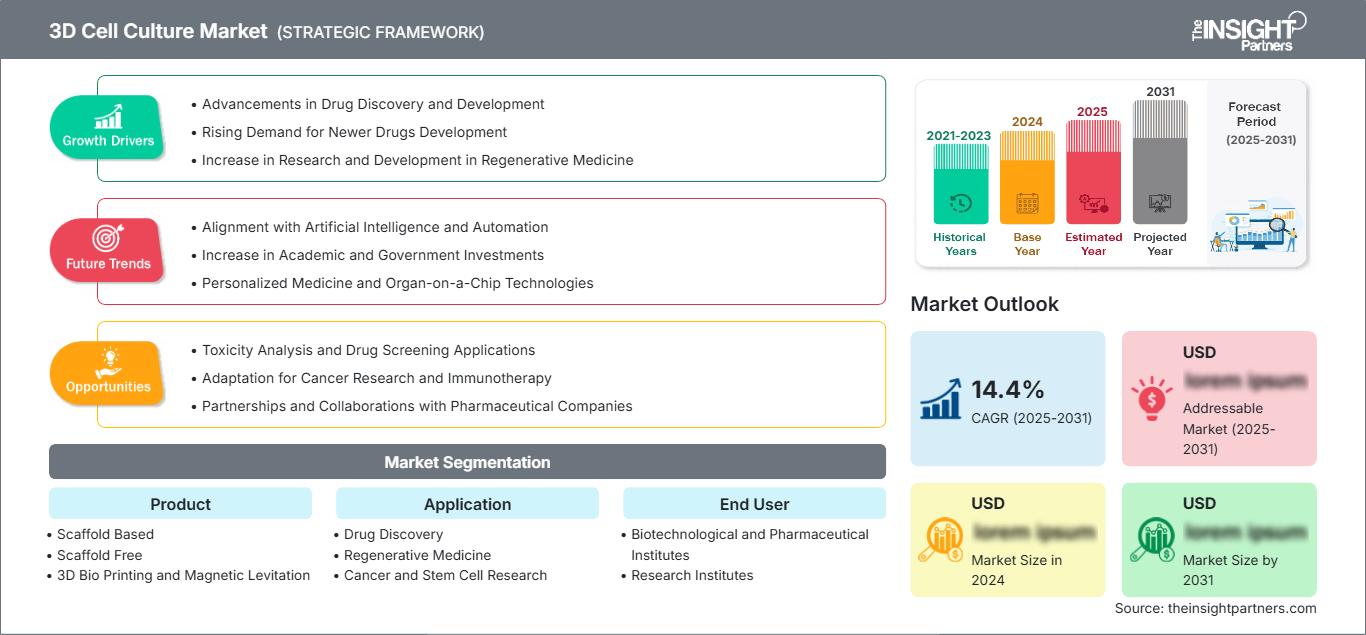
Regional Insights
North America 3D Cell Culture Market
North America held 39–42% share in 2025 and is projected to grow at a CAGR of 12.8–13.6% during 2026–2034. Advantages include concentrated pharmaceutical research & development, cancer center network, translational science at NIH, and early usage of organoids, spheroids, and microphysiological systems. In addition to this, the roadmap of FDA’s NAM provides an advantage of human-relevant assays for drugs safety assessment.
High-throughput screening and robust supplier network make The 3D Cell Culture Market share in North America stronger. At the 2025 3D Cell Culture Summit of Corning, it was evident that researchers are showing interest in physiologically relevant models, patient-derived organoids, CNS discovery, and workflow optimization.
U.S. 3D Cell Culture Market
The U.S. represented 86–89% of North America in 2025 and is expected to grow at a CAGR of 12.7–13.5% during 2026–2034.The extent of its size is based on the level of bio-pharma concentration, contract research, oncology studies, toxicology innovations, and the use of automation friendly platforms in repetitive screening.
Organizations that use this include Corning Incorporated, Thermo Fisher Scientific Inc., Merck KGaA, InSphero AG, MIMETAS B.V., CN Bio Innovations Limited, Advanced BioMatrix, Inc., Nano3D Biosciences, Inc., and Hamilton Company. Its applications lie mostly in tumor spheres, liver toxicity, organoids, immune-oncology models, and drugs response profile.
Europe 3D Cell Culture Market
Europe accounted for 27–30% share in 2025 and is forecast to expand at a CAGR of 12.1–12.9% during 2026–2034. Germany leads, based on the contribution of pharmaceutical R&D, engineering, and biotech applications. The UK derives its power from organoid R&D, CROs, and interest in alternative methods of testing.
The German market has been influenced by life science instrument R&D, cancer research networks, and tissue engineering efforts. The UK market develops on account of microphysiological systems, translational oncology, and cooperation between universities and industry players. Switzerland provides support through InSphero AG, whereas The Netherlands through MIMETAS B.V. and organ-on-a-chip commercialization.
The market in France, Italy, and Spain has flourished owing to their academic cancer programs, stem cell labs, and regenerative medicine programs. The public involvement in R&D is notable in France, while the scaffolds and biomaterials research can be seen in Italy and the increased uptake in oncology and pharmaceutical screening is visible in Spain.
APAC 3D Cell Culture Market
APAC held 22–25% share in 2025 and is projected to grow at a CAGR of 14.6–15.5% during 2026–2034. China leads the regional volume through biotech manufacturing, oncology research, and national support in the life sciences sector, while Japan, South Korea, India, and Australia lead through stem cell and drug research.
Industrial drivers are the local production of reagents, growth of CROs, biobanks established at universities, and greater use of organoids in cancer and toxicological studies. Japan promotes the improvement of cell culture technologies and regenerative medicine, and India creates effective discovery services.
Middle East & Africa 3D Cell Culture Market
Middle East & Africa is projected to grow at a CAGR of 9.3–10.1% during 2026–2034. Saudi Arabia is the leading regional consumer on the back of research hospitals, biotechnology funding, and healthcare modernization. UAE comes second based on academic collaboration, centers of medical innovation, and high-quality life sciences infrastructure.
South Africa plays a pivotal role in driving the African demand for the segment owing to its biomedical research programs at universities and cancer biology. Rest of MEA is in the nascent stage and adoption in the segment is hampered by high reagents cost, specialist training, and lab infrastructure.
Segmentation Analysis
Product
The Product segment is expected to grow at a CAGR of 13.2–14.0% during 2026–2034. 3D Cell Culture Market scope across product categories is defined by model complexity, assay throughput, matrix dependence, imaging compatibility, and automation readiness. Scaffold-based systems remain widely used, while scaffold-free, magnetic, bioprinted, and microfluidic platforms address increasingly specialized needs in oncology, toxicology, and regenerative research.
- Scaffold Based products hold the largest position because hydrogels, matrices, and engineered scaffolds provide structural support for organoids, stem cells, tumor models, and tissue engineering experiments.
- Scaffold Free systems are important for spheroids and microtissues where self-assembly, uniform geometry, and reduced matrix interference support drug testing and high-content imaging.
- 3D Bio Printing and Magnetic Levitation products support spatial organization, custom tissue architecture, and rapid spheroid formation. Their strategic value is strongest in specialized research and advanced model development.
- Microfluidics Based platforms are expanding rapidly because perfusion, shear stress, and multi-tissue interactions improve physiological relevance for toxicity, barrier function, and disease modeling.
Application
The Application segment is projected to grow at a CAGR of 13.4–14.2% during 2026–2034. Application demand is led by drug discovery because 3D models can support target validation, compound screening, toxicity testing, and patient-derived response analysis. Regenerative medicine and cancer and stem cell research are also expanding as model complexity and reproducibility improve.
- Drug Discovery generates high revenue contribution because pharmaceutical teams use spheroids, organoids, and organ-on-chip models to improve translational predictability and prioritize compounds earlier.
- Regenerative Medicine uses 3D models to study tissue maturation, biomaterial compatibility, stem cell behavior, and repair mechanisms, supporting long-term development of replacement and restorative therapies.
- Cancer and Stem Cell Research is strategically important because tumor organoids, immune co-cultures, and stem cell-derived models enable disease-specific biology and personalized therapy assessment.
End User
The End User segment is forecast to grow at a CAGR of 13.1–13.9% during 2026–2034. Biotechnological and pharmaceutical institutes dominate spending because they require scalable, reproducible, and automation-compatible systems for screening. Research institutes remain critical for model innovation, disease biology, and validation studies that later support industry adoption.
- Biotechnological and Pharmaceutical Institutes are the largest users because they apply 3D models to drug discovery, toxicity testing, candidate prioritization, and translational decision-making.
- Research Institutes remain strategically important because they develop new organoid systems, stem cell protocols, microfluidic models, and disease platforms that expand future commercial applications.
Opportunity Snapshot
| Segment Name | Revenue Contribution | Trend Tag | Adoption Stage |
| Drug Discovery | High | Human Models | Scaling |
| Regenerative Medicine | Medium | Tissue Repair | Emerging |
| Cancer and Stem Cell Research | High | Tumor Organoids | Scaling |
3D Cell Culture Market Growth Drivers and Impact Analysis
Regulatory Shift Toward Human-Relevant Testing Models
FDA’s roadmap to reduce animal testing in preclinical safety studies is a major structural driver because it recognizes NAMs such as organ-on-chip systems, computational modeling, and advanced in vitro assays. The agency’s NAM materials state that these approaches can improve predictive relevance while reducing or replacing animal use. The 3D Cell Culture Market benefits as pharmaceutical companies seek models that generate human biology-based evidence for toxicity, pharmacodynamics, and disease mechanisms. Market impact is strongest for validated spheroids, organoids, microfluidic systems, and assay-ready tissue platforms that can support reproducibility, auditability, and regulatory confidence across drug development programs.
Rising Cancer Burden and Need for Predictive Oncology Models
Cancer research is a core demand driver because conventional two-dimensional cultures often fail to capture tumor architecture, nutrient gradients, extracellular matrix interactions, and therapy resistance. WHO and IARC estimated 20 million new cancer cases and 9.7 million deaths in 2022, with new cases projected to rise substantially by 2050. This burden increases demand for patient-derived organoids, tumor spheroids, and immune-oncology co-culture systems. The real-world impact is greater use of 3D models in drug-response testing, resistance biology, biomarker exploration, and combination therapy screening. Suppliers that provide consistent matrices, imaging-compatible plates, and validated oncology protocols can capture recurring demand.
Automation and High-Throughput Workflow Adoption
Automation is accelerating adoption because pharmaceutical users need scalable, consistent, and data-rich models rather than artisanal cultures. InSphero describes automation-compatible 96-well and 384-well spheroid platforms, while MIMETAS’ OrganoPlate supports 40 to 96 microfluidic chips in standard plate formats compatible with automated workflows. These capabilities reduce manual variability, improve throughput, and make 3D models more practical for screening campaigns. The market impact is visible in demand for standardized plates, robotic liquid handling, high-content imaging, and integrated analysis. Vendors that align biological performance with automation requirements will be favored by biopharma and CRO customers.
3D Cell Culture Market Future Trends
Microphysiological Systems Enter Mainstream Screening
Microphysiological systems will define 3D Cell Culture Market trends as organ-on-chip platforms move from specialist laboratories into broader drug discovery workflows. MIMETAS highlights perfused 3D tissue models and MIMETAS OrganoPlate formats designed for scalable chip-based tissue culture, while CN Bio launched PhysioMimix Core in 2025 to combine single-organ, multi-organ, and higher-throughput configurations. Future adoption will depend on validated contexts of use, robust consumables, and clear workflows for ADME, toxicity, immune-mediated injury, and disease modeling. Companies that combine microfluidics with automated imaging and analytics will be better positioned as human-relevant testing becomes more operationally standardized.
Patient-Derived Organoids Become Translational Assets
Patient-derived organoids are expected to become more important for precision medicine, particularly in oncology, gastrointestinal disease, neurological research, and rare disease modeling. Corning’s 2025 summit agenda included pancreatic cancer organoids, AI-powered brain organoid platforms, and cardiac spheroid research, reflecting the shift from general 3D culture toward clinically relevant model systems. Future growth will come from biobanks, standardized culture media, viability-preserving logistics, and validated response assays. The strongest commercial models will connect patient-derived samples with pharmaceutical screening, biomarker discovery, and contract testing services that generate actionable translational data.
3D Cell Culture Market Opportunities
Pharma-Grade Assay Services and Validated Model Libraries
3D Cell Culture Market Forecasts point to strong opportunity in assay services that convert complex biology into validated, repeatable workflows for pharma and biotech customers. Companies can build recurring revenue through customized organoids, spheroids, toxicity panels, disease-specific microtissues, and integrated imaging readouts. InSphero’s acquisition of PhenoVista expands advanced imaging and phenotypic analysis capabilities, reinforcing the commercial logic of combining 3D biology with analytics services. The most attractive opportunity lies in model libraries with defined performance metrics, batch-level quality control, and decision-ready outputs for lead optimization, safety testing, and translational research support.
Emerging APAC Research Infrastructure and CRO Expansion
Asia Pacific presents a major opportunity as China, Japan, South Korea, India, and Australia expand biopharmaceutical research, organoid programs, and CRO capabilities. CN Bio’s partnership with Pharmaron to validate and integrate PhysioMimix technology across global R&D sites illustrates how CRO adoption can accelerate organ-on-chip deployment. Suppliers can win by offering tiered consumables, local technical support, workflow training, and compatibility with automated screening. The opportunity is strongest where cost-efficient research services intersect with global pharma demand for human-relevant assays, especially in oncology, liver toxicity, and immune-mediated drug safety.
Recent Developments
- May 2026: InSphero AG acquired PhenoVista Biosciences, Inc., a California-based provider of high-content imaging and phenotypic assay services. The transaction expanded InSphero’s U.S. presence and strengthened capabilities across advanced 3D models, predictive in vitro biology, microphysiological systems, oncology, neuroscience, fibrosis, and safety assessment.
- October 2025: CN Bio Innovations Limited launched PhysioMimix Core, an all-in-one organ-on-chip system combining single-organ, multi-organ, and higher-throughput configurations within one scalable microphysiological system. The platform supports up to 288 samples simultaneously and is compatible with existing PhysioMimix accessories, protocols, consumables, and organ model kits.
- September 2025: Corning Incorporated hosted its 2025 3D Cell Culture Summit roadshow across San Diego, Houston, Toronto, and Cambridge, bringing researchers together to discuss advanced 3D models, workflow optimization, patient-derived organoids, CNS drug discovery, high-throughput practices, and Corning-supported culture applications.
Frequently Asked Questions

- Comprehensive Market Sizing and Forecast Analysis
- Detailed Segmentation Analysis
- In-Depth Market Dynamics Assessment
- Regional and Country-Level Insights
- Competitive Landscape and Company Benchmarking
- Strategic Business Intelligence
Recent Reports
Testimonials

The Insight Partners' SCADA System Market report is comprehensive, with valuable insights on current trends and future forecasts. The team was highly professional, responsive, and supportive throughout. We are very satisfied and highly recommend their services.
RAN KEDEM Partner, Reali Technologies LTDs
I requested a report on a very specific software market and the team produced the report in a few days. The information was very relevant and well presented. I then requested some changes and additions to the report. The team was again very responsive and I got the final report in less than a week.
JEAN-HERVE JENN Chairman, Future Analytica
We worked with The Insight Partners for an important market study and forecast. They gave us clear insights into opportunities and risks, which helped shape our plans. Their research was easy to use and based on solid data. It helped us make smart, confident decisions. We highly recommend them.
PIYUSH NAGPAL Sr. Vice President, High Beam Global
The Insight Partners delivered insightful, well-structured market research with strong domain expertise. Their team was professional and responsive throughout. The user-friendly website made accessing industry reports seamless. We highly recommend them for reliable, high-quality research services
YUKIHIKO ADACHI CEO, Deep Blue, LLC.
This is the first time I have purchased a market report from The Insight Partners.While I was unsure at first, I visited their web site and felt more comfortable to take the risk and purchase a market report.I am completely satisfied with the quality of the report and customer service. I had several questions and comments with the initial report, but after a couple of dialogs over email with their analyst I believe I have a report that I can use as input to our strategic planning process.Thank you so much for taking the extra time and making this a positive experience.I will definitely recommend your service to others and you will be my first call when we need further market data.
JOHN SUZUKI President and Chief Executive Officer, Board Director, BK Technologies
I wish to appreciate your support and the professionalism you displayed in the course of attending to my request for information regarding to infectious disease IVD market in Nigeria. I appreciate your patience, your guidance, and the fact that you were willing to offer a discount, which eventually made it possible for us to close a deal. I look forward to engaging The Insight Partners in the future, all thanks to the impression you have created in me as a result of this first encounter.
DR CHIJIOKE ONYIA MANAGING DIRECTOR, PineCrest Healthcare Ltd.Reason to Buy
- Informed Decision-Making
- Understanding Market Dynamics
- Competitive Analysis
- Identifying Emerging Markets
- Customer Insights
- Market Forecasts
- Risk Mitigation
- Boosting Operational Efficiency
- Strategic Planning
- Investment Justification
- Tracking Industry Innovations
- Aligning with Regulatory Trends





 Get Free Sample for