
3D Cone Beam Computed Tomography (CBCT) Systems Market Share, Size & Demand by 2034
3D Cone Beam Computed Tomography (CBCT) Systems Market Size and Forecasts (2021–2034), Global and Regional Share, Trends, and Growth Opportunity Analysis Report Coverage : by Patient Position (Single Position); Detector Type (Image Intensifier Detector, Flat-Panel Imager Detector); Application (Dental, Non-Dental); End User (Hospitals, Clinics, Diagnostic Centers, Research Institutes); and Geography (North America, Europe, Asia Pacific, and South and Central America)
- Status : Data Released
- Report Code : TIPRE00039984
- Category : Life Sciences
- No. of Pages : 150
- Available Report Formats :


- Last update date : July 29, 2026


2025 Market Size
US$ 840.35 Mn
Base year value
2034 Forecast
US$ 1,529.3 Mn
Projected by 2034
CAGR 2026-2034
6.88 %
Growth rate
Addressable Market
US$ 10,704.70 Mn
(2026-2034)
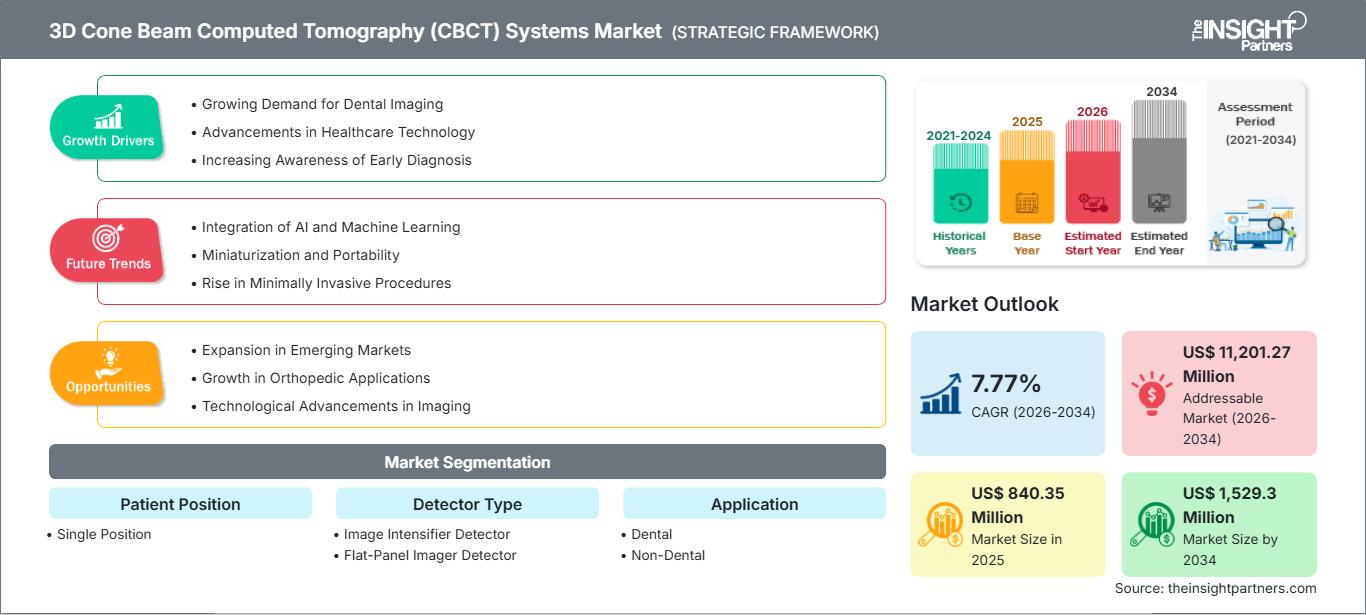
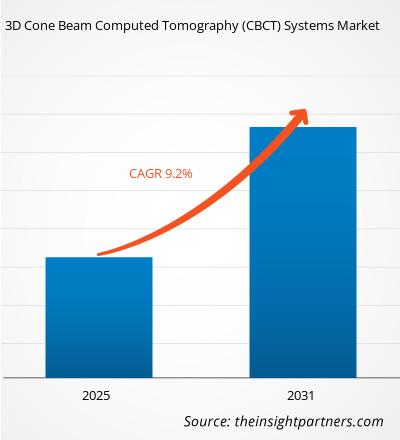
The 3D Cone Beam Computed Tomography (CBCT) Systems market was valued at US$ 840.35 million in 2025 and is expected to reach US$ 1529.3 million by 2034; it is estimated to record a CAGR of 6.88% during 2026-2034.
3D Cone Beam Computed Tomography (CBCT) Systems Market Assessment and Insights
- North America held 36–39% 3d cone beam computed tomography systems market share in 2025 and is projected to grow at a CAGR between 2026–2034 of 7.2–7.9%, supported by implant dentistry, DSO networks, and digital imaging replacement demand.
- US represented 84–87% of North America in 2025 and is expected to grow at a CAGR between 2026–2034 of 7.1–7.8%, led by specialty clinics and diagnostic centers.
- Europe accounted for 28–31% share in 2025 and is forecast to expand at a CAGR between 2026–2034 of 6.8–7.5%, with Germany, France, Italy, Spain, and the UK leading adoption.
- Asia Pacific captured 23–26% share in 2025 and is projected to grow at a CAGR between 2026–2034 of 8.5–9.3%, driven by China, Japan, South Korea, India, and Australia.
- Largest Segment Dental held 72–76% market share in 2025 and is expected to grow at a CAGR range of 7.4–8.1% during 2026–2034 due to implant and orthodontic demand.
- High Growth Segment Flat-Panel Imager Detector represented 68–72% share in 2025 and is forecast to grow at a CAGR range of 8.2–9.0% during 2026–2034 as image quality improves.
- Key companies analyzed in detail: Carestream Health, Inc., Planmeca Oy, Vatech Co., Ltd., Dentsply Sirona Inc., FUJIFILM Holdings Corporation, GE HealthCare Technologies Inc., FUJIFILM Healthcare Corporation, 3Shape A/S, J. Morita Mfg. Corp., and Cefla S.C.
Source: The Insight Partners' analysis based on proprietary research, government publications, company annual reports, investor presentations, industry databases, and expert interviews.
The market has shifted from bulky, high-volume imaging solutions for hospitals to small, compact solutions for dental and maxillofacial applications with low doses, flexible field of view, and software integration. The production trends will be moving towards flat panel detectors, artificial intelligence reconstruction technology, cloud connectivity, and DICOM workflows. The 3d cone beam computed tomography systems market will also be impacted by the demands for fast scanning, patient positioning ease, and improved outputs for implants in clinics.
The future demand will be driven by the development of new dental chains, ENT applications, and regulations on radiation optimization. The advanced CBCT solutions increasingly integrate panoramic, cephalometric, and 3D imaging in a single unit, minimizing duplications in equipment. Investments into AI segmentation, radiation dose optimization, and connectivity with CAD/CAM and intraoral scanning ecosystem will keep the manufacturers ahead of the game in digital dentistry workflows.
3D Cone Beam Computed Tomography (CBCT) Systems Market Report Scope
| Report Attribute | Details |
|---|---|
| Market size in 2025 | US$ 840.35 Million |
| Market Size by 2034 | US$ 1,529.3 Million |
| Global CAGR (2026 - 2034) | 6.88% |
| Historical Data | 2021-2024 |
| Forecast period | 2026-2034 |
3D Cone Beam Computed Tomography (CBCT) Systems Market Analysis
The demand is driven by dental implant planning, impacted tooth analysis, endodontic diagnosis, orthodontic airway analysis, surgical navigation, and imaging for maxillofacial trauma. Growth in 3D Cone Beam Computed Tomography systems market can be attributed to the presence of high incidence of oral diseases since according to WHO, untreated dental caries occur in 2.5 billion people while 1 billion suffers from severe periodontal disease.
The value chain comprises detector providers, x-ray generator providers, reconstruction software providers, dental equipment providers, imaging centers, clinics, and service providers. The supply chain favors providers who offer installation, calibration, training, documentation on radiation safety, software upgrades, and technical support promptly since downtime impacts treatment planning revenue adversely.
This sector is technology-driven and service-oriented. Market analysis suggests that Planmeca Oy, Dentsply Sirona Inc., Vatech Co., Ltd., J. Morita Mfg. Corp., Carestream Health, Inc., and Cefla S.C. compete in terms of field of view solutions, dosing, image quality, and dental workflow integration.
FUJIFILM Holdings Corporation, GE HealthCare Technologies Inc., FUJIFILM Healthcare Corporation, and 3Shape A/S reinforce the whole ecosystem by providing expertise in radiology, software connection, and scan-to-plan solutions. Positioning is crucial in terms of detector capability, artificial intelligence solutions, financing, service in installed base, and interconnection with implant, orthodontic, ENT, and CAD/CAM planning systems.
● REPORT CUSTOMIZATION
Tailor This Report To Align With Your Specific Business Requirements
This report can be customized to align precisely with your business objectives, scope, and target markets. Customization options include tailored segmentation, geography, competitive analysis, and strategic insights to support informed decision-making.
Customize This Report →WHAT YOU CAN ADJUST
- ● Segmentations
- ● Geography
- ● Competitive Analysis
- ● Language Preferences
3D Cone Beam Computed Tomography (CBCT) Systems Market: Strategic Insights
Regional Insights
North America 3d cone beam computed tomography systems Market
In 2025, the market share in North America was around 36–39%, with growth expected at a CAGR of 7.2–7.9% between 2026 and 2034. The adoption drivers include dental services organizations, specialized implant facilities, orthodontic facilities, and dental diagnostic imaging facilities. Increasing need for 3D anatomy for implant placement, root canal procedure, impacted tooth treatment, airway assessment, and temporomandibular joint evaluation.
Market share for 3d cone beam computed tomography system in North America is bolstered by the replacement of conventional panoramic technology by combined 2D/3D technology. Choice of device includes features such as field of view customization, low radiation dose, automatic positioning, artificial intelligence software, and after-sale services. Oral health disease burden and preference for elective reconstructive dentistry drive adoption within both individual and multi-practice dental facilities.
U.S. 3d cone beam computed tomography systems Market
The U.S. represented 84–87% of North America in 2025 and is expected to grow at a CAGR of 7.1–7.8% during 2026–2034. Its scale reflects large private dental spending, implant volumes, DSO procurement, and broader use of 3D imaging in oral surgery, orthodontics, and endodontics.
Company presence is strong through direct sales, dental dealers, and imaging service networks. Planmeca Oy, Dentsply Sirona Inc., Vatech Co., Ltd., Carestream Health, Inc., J. Morita Mfg. Corp., FUJIFILM Holdings Corporation, and 3Shape A/S serve practices requiring CBCT integration with intraoral scans, CAD/CAM, implant guides, and patient consultation workflows. Application demand concentrates on dental and maxillofacial procedures.
Europe 3d cone beam computed tomography systems Market
Europe accounted for 28–31% share in 2025 and is forecast to expand at a CAGR of 6.8–7.5% during 2026–2034. Germany is the leading country, supported by dental technology adoption, specialist clinics, and strong equipment distribution. France, Italy, Spain, and the UK also show steady replacement demand.
The German market is influenced by implantology, orthodontics, and oral surgery clinics, which necessitate 3D imaging with accurate dosing control. The UK focuses on the proper use of imaging procedures and cost savings, while France fosters adoption through hospital-based dental and maxillofacial practices. Image quality versus radiation dose considerations often determine procurement choices.
Italy and Spain continue to grow through private dental practices, dental tourism, and specialization clinics. There is a need for compact solutions and software in the Nordics and Benelux countries. Growth in Europe as a whole will be steady since there are established clinical protocols, although detector and software advances drive replacement cycles.
APAC 3d cone beam computed tomography systems Market
APAC captured 23-26% share in 2025 and is expected to rise at a CAGR of 8.5-9.3% between 2026 and 2034. China dominates the region’s volume due to expansion of clinics and in-house imaging facility. Japan, South Korea, India, and Australia drive up the demand owing to sophisticated dentistry and diagnostics.
The factors driving the market include private dental chains, medical devices, and dental tourism. South Korea gains an edge from companies like Vatech Co., Ltd., while Japan drives the premium imaging sector via J. Morita Mfg. Corp. India presents opportunities for growth through urban dental clinics, but financing and training act as barriers.
Middle East & Africa 3d cone beam computed tomography systems Market
Middle East & Africa is projected to grow at a CAGR of 6.4–7.2% during 2026–2034. Saudi Arabia leads demand through hospital investment, specialized dental centers, and healthcare infrastructure modernization. The UAE follows through premium dental clinics, medical tourism, and demand for aesthetic and implant dentistry.
Private dental practices and diagnostic centers drive the demand for CBCT in South Africa while the rest of MEA is still focused on urban hospitals and specialty clinics since CBCT requires skilled operators, radiation management, and service provisions. The energy-related healthcare investments in the Gulf countries help with the purchase of the CBCT technology.
Segmentation Analysis
Patient Position
The Patient Position segment is expected to grow at a CAGR of 7.3–8.0% during 2026–2034. 3d cone beam computed tomography systems market scope across patient position is narrow because the input category includes single position systems. Adoption is driven by compact clinic footprints, standardized workflows, and simplified operating protocols that reduce training burden while supporting consistent 3D imaging in dental and maxillofacial environments.
- Single Position systems are strategically important because they suit dental clinics requiring predictable positioning, space efficiency, and workflow standardization for routine implant, orthodontic, endodontic, and oral surgery planning.
Detector Type
The Detector Type segment is projected to grow at a CAGR of 7.6–8.3% during 2026–2034. Detector selection affects image resolution, dose efficiency, artifact management, maintenance requirements, and system price. Flat-panel imagers dominate newer installations because they support digital reconstruction, better workflow integration, and compact designs, while image intensifier systems remain present in older installed bases.
- Image Intensifier Detector systems remain relevant in cost-sensitive and legacy environments. Their market position is declining gradually as clinics prioritize digital flat-panel quality, lower maintenance, and software compatibility.
- Flat-Panel Imager Detector systems lead new demand because they provide high-resolution digital acquisition, improved dose efficiency, and stronger integration with AI reconstruction, implant planning, and DICOM workflows.
Application
The Application segment is forecast to grow at a CAGR of 7.4–8.1% during 2026–2034. Dental imaging remains the largest application because CBCT is well suited for anatomy-focused oral diagnosis. Non-dental applications are expanding selectively in ENT, orthopedics, and extremity imaging where targeted 3D visualization can reduce reliance on conventional CT for specific indications.
- Dental applications dominate through implantology, endodontics, orthodontics, oral surgery, temporomandibular joint assessment, and impacted tooth evaluation requiring accurate bone and root visualization.
- Non-Dental applications include ENT, sinus, airway, and selected orthopedic imaging. Strategic value comes from targeted anatomy, lower-dose protocols, and compact imaging for specialty care settings.
End User
The End User segment is expected to grow at a CAGR of 7.5–8.2% during 2026–2034. Clinics dominate because CBCT has become a chairside planning and consultation tool in advanced dental practices. Hospitals and diagnostic centers support complex cases, while research institutes use CBCT for imaging studies, algorithm development, and device evaluation.
- Hospitals generate demand for maxillofacial surgery, trauma, ENT, and multidisciplinary dental care where 3D imaging supports complex diagnosis and procedural planning.
- Clinics remain the strongest end-user base because implant, orthodontic, endodontic, and oral surgery practices use CBCT to improve consultation, planning, and treatment confidence.
- Diagnostic Centers support referral imaging where smaller clinics cannot justify ownership. Their importance increases in urban markets with concentrated specialist demand and shared imaging economics.
- Research Institutes use systems for dental imaging studies, reconstruction algorithms, dose analysis, anatomical research, and training programs that influence future clinical adoption.
Opportunity Snapshot
| Segment Name | Revenue Contribution | Trend Tag | Adoption Stage |
| Hospitals | Medium | Maxillofacial Imaging | Scaling |
| Clinics | High | Implant Planning | Mature |
| Diagnostic Centers | Medium | Referral Imaging | Scaling |
| Research Institutes | Low | Algorithm Testing | Emerging |
3D Cone Beam Computed Tomography (CBCT) Systems Market Growth Drivers and Impact Analysis
Rising Dental Implant and Orthodontic Planning Needs
Implantology and orthodontics are now moving toward volumetric imaging because bone height, nerve positions, root proximity, airway structure, and the position of impacted teeth are difficult to evaluate with 2D imaging. There will be significant benefit to the 3D cone-beam computed tomography (CBCT) market as CBCT is used for better diagnoses, treatment planning, and reduced surgical uncertainties. Data provided by WHO about oral diseases reveal high prevalence of such diseases across the globe, as there are 2.5 billion people suffering from untreated dental caries and 1 billion from serious periodontal diseases, which means need for diagnostic procedures will remain high.
Shift Toward Low-Dose Digital Imaging Platforms
The ability to optimize radiation exposure is another key factor driving market adoption, as dental clinics must balance diagnostics and patient safety. Modern CBCT machines come with features such as focal fields of view, low doses of radiation, motion corrections, and artifact reduction to make them more useful clinically. The CBCT machines offered by Planmeca, for example, include Ultra Low Dose imaging, automatic patient motion correction, and different sizes of volumes depending on the model of Viso or ProMax series. These factors drive demand for replacement of older machines and new installations in clinics dealing with children, orthodontics, and repetitive imaging patients.
Integration of AI, Software, and Digital Dentistry Workflows
CBCT purchasing is increasingly linked to software ecosystems rather than hardware alone. Vatech introduced Clever One in the U.S. after FDA clearance of its AI-driven lesion detection feature, integrating panoramic, CBCT, intraoral, facial, and STL data in one viewer. Planmeca also unveiled Romexis 7 with AI-powered imaging tools at IDS 2025, alongside new Viso imaging systems. The 3d cone beam computed tomography systems market benefits because AI segmentation, implant simulation, and cloud sharing create measurable workflow gains. Vendors with open interfaces and strong software support can defend premiums and increase installed-base loyalty.
3D Cone Beam Computed Tomography (CBCT) Systems Market Future Trends
AI-Assisted 3D Diagnosis and Treatment Planning
AI-assisted workflows will define 3d cone beam computed tomography systems market trends as clinicians seek faster segmentation, anatomy recognition, implant planning, and treatment simulation. Vatech’s Clever One integrates diagnostic support and 3D segmentation, while Planmeca Romexis 7 adds AI-powered tools for anatomy recognition, tooth numbering, and implant planning. Future demand will shift from image acquisition alone toward decision-support tools that reduce manual tracing, improve consistency, and enhance patient communication. Commercial success will depend on regulatory clearance, explainability, workflow fit, data security, and clinician confidence in AI outputs.
Compact Multi-Modality Systems for Dental Chains
Dental chains and multisite clinics are expected to favor compact systems that combine panoramic, cephalometric, and CBCT imaging while connecting to centralized planning software. Planmeca’s Viso product family and Dentsply Sirona’s Axeos and Orthophos platforms illustrate the industry move toward multi-function imaging, modular field-of-view choices, and integrated practice software. Future procurement will prioritize standardized configurations, remote service, staff training, and network reporting. This trend favors manufacturers that can support fleet-level deployment for dental service organizations, specialist groups, and diagnostic networks across multiple locations.
3D Cone Beam Computed Tomography (CBCT) Systems Market Opportunities
AI-Enabled Upgrade Pathways for Installed Bases
3d cone beam computed tomography systems market Forecasts indicate strong opportunity in AI-enabled software upgrades for clinics that already own CBCT hardware but need better planning efficiency. Manufacturers can generate recurring revenue through segmentation modules, implant libraries, cloud sharing, dose analytics, and diagnostic support tools. Vatech’s Clever One launch shows how software can unify CBCT, panoramic, intraoral, facial, and STL files within one clinical workflow. The opportunity is strongest where dental groups seek higher productivity without replacing every imaging unit. Success depends on compatibility, regulatory clearance, cybersecurity, training, and measurable time savings.
Emerging Market Clinic Modernization
Emerging markets offer meaningful opportunity as private dental clinics in India, China, Southeast Asia, the Middle East, and Latin America upgrade from 2D imaging to CBCT. Demand is strongest among implant dentists, orthodontists, oral surgeons, and diagnostic centers serving referral networks. Vatech reports operations across more than 70 countries through its U.S. subsidiary profile, highlighting the importance of global distribution depth in dental imaging. Manufacturers can improve penetration with smaller field-of-view systems, financing programs, local service teams, and bundled training. The investment case depends on affordability, uptime, radiation safety education, and integration with digital dentistry tools.
Recent Developments
- June 2026: Vatech Co., Ltd. announced completion of EU Medical Device Regulation certification across its entire dental imaging portfolio, covering all three dental imaging categories and 2026 model launches. The certification strengthens its European regulatory position and supports continued commercialization of dental imaging systems, including CBCT-related platforms, under stricter medical device requirements.
- March 2025: Planmeca Oy introduced Planmeca Viso G1 at IDS 2025, expanding its Viso imaging family with a CBCT unit offering a field of view up to 11 x 11 cm, advanced sensor technology, intuitive user interface, and integration with Romexis 7 software featuring AI-powered tools.
- August 2025: Vatech Co., Ltd. launched Vatech Clever One in the U.S. following FDA clearance of its AI-driven lesion detection feature. The platform integrates panoramic, CBCT, intraoral, facial, and STL files into a unified viewer, supporting diagnosis, segmentation, treatment planning, consultation, and cloud-enabled clinical workflows.
Frequently Asked Questions

- Comprehensive Market Sizing and Forecast Analysis
- Detailed Segmentation Analysis
- In-Depth Market Dynamics Assessment
- Regional and Country-Level Insights
- Competitive Landscape and Company Benchmarking
- Strategic Business Intelligence
Recent Reports
Testimonials

The Insight Partners provided valuable market intelligence that supported our global go-to-market strategy. Their team was professional, responsive, and attentive to our feedback, providing thoughtful analysis and helpful methodological clarifications throughout the project.
Junmo Kim Chief Financial Officer (CFO), Enertech Co., Ltd.
The Insight Partners' SCADA System Market report is comprehensive, with valuable insights on current trends and future forecasts. The team was highly professional, responsive, and supportive throughout. We are very satisfied and highly recommend their services.
RAN KEDEM Partner, Reali Technologies LTDs
I requested a report on a very specific software market and the team produced the report in a few days. The information was very relevant and well presented. I then requested some changes and additions to the report. The team was again very responsive and I got the final report in less than a week.
JEAN-HERVE JENN Chairman, Future Analytica
We worked with The Insight Partners for an important market study and forecast. They gave us clear insights into opportunities and risks, which helped shape our plans. Their research was easy to use and based on solid data. It helped us make smart, confident decisions. We highly recommend them.
PIYUSH NAGPAL Sr. Vice President, High Beam Global
The Insight Partners delivered insightful, well-structured market research with strong domain expertise. Their team was professional and responsive throughout. The user-friendly website made accessing industry reports seamless. We highly recommend them for reliable, high-quality research services
YUKIHIKO ADACHI CEO, Deep Blue, LLC.
This is the first time I have purchased a market report from The Insight Partners.While I was unsure at first, I visited their web site and felt more comfortable to take the risk and purchase a market report.I am completely satisfied with the quality of the report and customer service. I had several questions and comments with the initial report, but after a couple of dialogs over email with their analyst I believe I have a report that I can use as input to our strategic planning process.Thank you so much for taking the extra time and making this a positive experience.I will definitely recommend your service to others and you will be my first call when we need further market data.
JOHN SUZUKI President and Chief Executive Officer, Board Director, BK Technologies
I wish to appreciate your support and the professionalism you displayed in the course of attending to my request for information regarding to infectious disease IVD market in Nigeria. I appreciate your patience, your guidance, and the fact that you were willing to offer a discount, which eventually made it possible for us to close a deal. I look forward to engaging The Insight Partners in the future, all thanks to the impression you have created in me as a result of this first encounter.
DR CHIJIOKE ONYIA MANAGING DIRECTOR, PineCrest Healthcare Ltd.Reason to Buy
- Informed Decision-Making
- Understanding Market Dynamics
- Competitive Analysis
- Identifying Emerging Markets
- Customer Insights
- Market Forecasts
- Risk Mitigation
- Boosting Operational Efficiency
- Strategic Planning
- Investment Justification
- Tracking Industry Innovations
- Aligning with Regulatory Trends





 Get Free Sample for