
3D Engineering Animation Market Growth, Trends & Demand by 2034
Coverage: By Service (3D Modeling and Rendering, Visual Effects, Motion Graphics, Others); End-user (Automotive, Manufacturing, Aerospace and Defense, Architecture, Others) , and Geography (North America, Europe, Asia Pacific, and South and Central America)
- Status : Data Released
- Report Code : TIPRE00017887
- Category : Technology, Media and Telecommunications
- No. of Pages : 150
- Available Report Formats :


- Last update date : August 05, 2026


2025 Market Size
US$ 28.16 Bn
Base year value
2034 Forecast
US$ 83.16 Bn
Projected by 2034
CAGR 2026-2034
12.79 %
Growth rate
Addressable Market
US$ 485.28 Bn
(2026-2034)
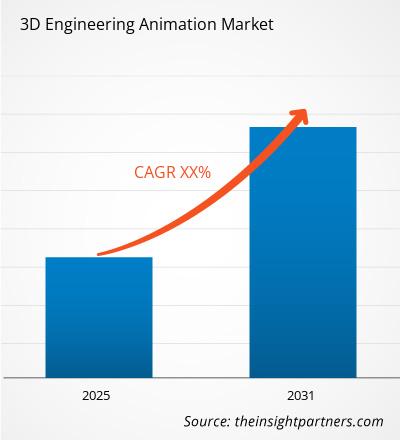
The 3D engineering animation market was valued at US$ 28.16 Billion in 2025 and is projected to reach US$ 83.16 Billion by 2034, registering a CAGR of 12.79% during 2026–2034. The market is expanding as engineering-intensive industries increasingly rely on advanced visualization technologies to communicate product functionality, manufacturing processes, equipment performance, and infrastructure designs. Demand is particularly strong across automotive, aerospace, industrial manufacturing, and architecture sectors where complex technical information must be transformed into clear and interactive visual formats.
Driven by industrial digitalization and engineering software adoption, North America remains a major revenue contributor. The 3D engineering animation market size across the region is supported by investments in digital twins, automation programs, and advanced manufacturing initiatives. Engineering organizations increasingly utilize visualization services to improve collaboration, training, and operational planning. Sustained demand from aerospace contractors, industrial equipment manufacturers, and infrastructure developers is expected to support regional expansion at an estimated CAGR range of 11.5–13.5% through 2034.
3D Engineering Animation Market Assessment and Insights
- North America: Share in 2025 of 34–36% and CAGR between 11.5–13.5% during 2026–2034. Advanced industrial automation, digital engineering adoption, and strong aerospace activity continue strengthening market demand across the region.
- US: Represents 76–80% of North American revenue in 2025 and is expected to grow at a CAGR of 11.8–13.8%. High engineering software penetration and defense-related investments support market expansion.
- Europe: Share in 2025 of 26–29% and CAGR between 11.0–13.0%. Germany leads regional demand, followed by the UK and France, driven by manufacturing modernization and engineering innovation.
- Asia Pacific: Share in 2025 of 28–31% and CAGR between 13.5–15.5%. China, Japan, South Korea, and India continue investing heavily in smart manufacturing and industrial digitization.
- Largest Segment: End-user segment with a market share of 56–60% in 2025 and CAGR of 12.5–14.5%. Industry-specific engineering visualization requirements support dominant revenue contribution.
- High Growth Segment: Aerospace and Defense with a 3D engineering animation market share of 14–18% in 2025 and CAGR of 14.5–16.5%. Advanced simulation, training, and design validation needs accelerate adoption.
- Key companies analyzed in detail: Arise Engineering Services, CMG Designs, EAXPS, GAWWK LTD (KINESOMANIA), Industrial3D Inc., ThePro3DStudio, Total OutSource, Inc., UR CAD Services, Vee Technologies, Video Caddy.
Source: The Insight Partners' analysis based on proprietary research, government publications, company annual reports, investor presentations, industry databases, and expert interviews.
Engineering visualization solutions have transitioned from supporting static product presentations to becoming integral components of digital engineering ecosystems. Organizations increasingly require interactive animations capable of illustrating operating mechanisms, assembly sequences, maintenance procedures, and virtual simulations. Improvements in cloud rendering, GPU computing, artificial intelligence-assisted workflows, and digital twin integration have significantly enhanced production efficiency while expanding the application scope of engineering animation across industrial environments. Rising demand for technical communication solutions is further reinforcing long-term market development across both product-centric and asset-intensive industries.
Looking ahead, emerging opportunities are expected to arise across rapidly industrializing economies, defense modernization programs, and smart infrastructure initiatives. Public and private investments in transportation systems, manufacturing facilities, aerospace development, and industrial automation are increasing requirements for advanced engineering visualization. Regulatory emphasis on workplace safety, equipment training, and operational transparency is encouraging greater utilization of animation-based communication tools. As engineering projects become increasingly complex, visualization technologies are expected to play a more central role in decision-making and stakeholder engagement processes.
3D Engineering Animation Market Report Scope
| Report Attribute | Details |
|---|---|
| Market size in 2025 | US$ 28.16 Billion |
| Market Size by 2034 | US$ 83.16 Billion |
| Global CAGR (2026 - 2034) | 12.79% |
| Historical Data | 2021-2024 |
| Forecast period | 2026-2034 |
3D Engineering Animation Market Analysis
Growing demand for advanced technical communication is a primary factor supporting the 3D engineering animation market growth trajectory. Industrial organizations increasingly require visual representations of product functionality, manufacturing workflows, and operational processes to improve stakeholder understanding and reduce communication barriers. Engineering animation helps organizations minimize errors during planning, installation, and maintenance activities by translating highly technical concepts into visual narratives. This capability is particularly important for industries such as aerospace, automotive, and industrial manufacturing where products involve substantial engineering complexity.
The broader ecosystem supporting market expansion includes CAD software developers, digital twin platform providers, simulation technology vendors, visualization specialists, and cloud infrastructure providers. Integration between engineering design applications and animation platforms has improved workflow efficiency, enabling service providers to deliver highly accurate digital content within shorter project timelines. Increased outsourcing of design visualization functions is also expanding opportunities for specialized service firms.
Competitive differentiation within the 3D engineering animation market analysis increasingly depends on industry expertise, engineering accuracy, technological capabilities, and service scalability. Organizations are seeking providers that can combine engineering knowledge with advanced visualization expertise. Industrial3D Inc. maintains strong visibility in industrial communication applications, while Vee Technologies leverages broader engineering service capabilities to support complex customer requirements. Specialized providers such as UR CAD Services, ThePro3DStudio, CMG Designs, and Total OutSource, Inc. continue focusing on customized project delivery and vertical-specific expertise.
3D engineering animation market participants are increasing investments in real-time rendering engines, immersive technologies, and artificial intelligence-supported production processes. Companies including Arise Engineering Services, EAXPS, Video Caddy, and GAWWK LTD (KINESOMANIA) are expanding service portfolios to accommodate evolving customer expectations for interactive and highly detailed engineering content. Strategic positioning increasingly revolves around the ability to support digital transformation objectives, enabling customers to integrate engineering visualization into broader operational and product lifecycle management frameworks.
● REPORT CUSTOMIZATION
Tailor This Report To Align With Your Specific Business Requirements
This report can be customized to align precisely with your business objectives, scope, and target markets. Customization options include tailored segmentation, geography, competitive analysis, and strategic insights to support informed decision-making.
Customize This Report →WHAT YOU CAN ADJUST
- ● Segmentations
- ● Geography
- ● Competitive Analysis
- ● Language Preferences
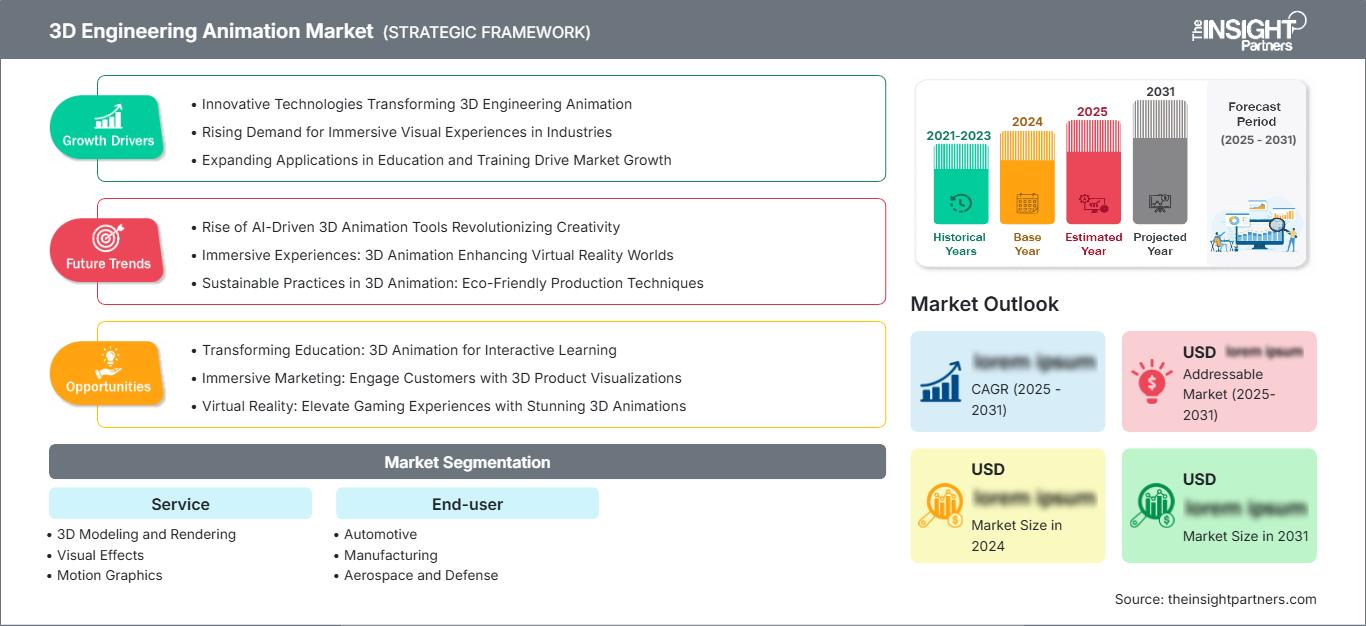
3D Engineering Animation Market: Strategic Insights
Regional Insights
North America 3D engineering animation market
North America accounted for 34–36% of global revenue in 2025 and is projected to grow at a CAGR of 11.5–13.5% through 2034. The region benefits from mature engineering software adoption, high levels of industrial automation, and significant investment in product development activities. Manufacturing organizations increasingly deploy engineering animation to improve communication throughout design, production, installation, and maintenance phases. Aerospace manufacturers, industrial equipment suppliers, and automotive companies continue allocating resources toward visualization technologies that can support operational efficiency while reducing project complexity.
Strong technological infrastructure further supports market development. The growing implementation of digital twins and simulation-based engineering environments is generating new opportunities for visualization service providers. Engineering organizations are increasingly required to communicate technical details across globally distributed teams, creating sustained demand for advanced animation solutions. Increased modernization of industrial facilities, combined with continued investment in Industry 4.0 initiatives, reinforces market expansion. Engineering animation is increasingly integrated into training programs, safety procedures, maintenance planning, and stakeholder communication, making it a strategic component of industrial digital transformation efforts throughout the region.
U.S. 3D engineering animation Market
The United States represents 76–80% of North American market revenue and is expected to record a CAGR of 11.8–13.8% during the 3D engineering animation market forecast period. The country's leadership position is supported by substantial spending on aerospace, defense, advanced manufacturing, and infrastructure development. Engineering-intensive sectors increasingly require advanced visualization technologies to improve communication and accelerate project execution. The adoption of digital engineering workflows continues to create opportunities for animation providers capable of transforming complex technical information into highly accessible visual formats.
A strong presence of engineering service providers, software developers, and industrial technology companies reinforces market competitiveness. Engineering animation is increasingly used to support virtual prototyping, design validation, employee training, and customer engagement initiatives. Organizations are also leveraging animation technologies to enhance adoption of digital twin frameworks and predictive maintenance programs. As industrial operations become more data-driven and interconnected, demand for effective visualization tools is expected to expand further. Investment in automation, robotics, and industrial AI applications will continue supporting the integration of engineering animation across multiple end-use sectors.
Europe 3D engineering animation market
Europe held approximately 26–29% of global market revenue in 2025 and is forecast to expand at a CAGR of 11.0–13.0% through 2034. Germany remains the largest contributor due to its strong automotive manufacturing base, industrial automation leadership, and engineering innovation capabilities. The country's large concentration of industrial equipment producers and advanced manufacturing facilities supports continuous demand for engineering visualization services. German companies increasingly incorporate animation into product development, equipment demonstrations, and digital transformation initiatives.
The United Kingdom is experiencing growing adoption across architecture, engineering consultancy, aerospace, and infrastructure development applications. Demand is supported by rising implementation of building information modeling, digital construction tools, and engineering communication platforms. France, Italy, and Spain collectively contribute meaningful market opportunities through industrial modernization, transportation projects, and infrastructure investment programs. These countries continue encouraging digital engineering adoption to improve efficiency and project coordination. As sustainability objectives drive upgrades to industrial assets and construction practices, visualization technologies are expected to play a larger role in design communication and stakeholder engagement across Europe.
APAC 3D engineering animation market
Asia Pacific accounted for 28–31% of global revenue in 2025 and is projected to grow at a CAGR of 13.5–15.5%, the highest among major regions. China remains the largest market due to extensive manufacturing activity, industrial modernization efforts, and growing investment in advanced engineering technologies. Japan and South Korea continue to strengthen demand through automotive, electronics, and industrial equipment sectors.
India is emerging as a significant growth contributor through engineering services expansion, infrastructure development, and increasing digitalization initiatives. Australia supports market demand through mining, energy, transportation, and industrial engineering applications. Regional governments continue promoting smart manufacturing and technology-led industrial transformation programs, creating favorable conditions for long-term adoption of engineering visualization solutions.
Middle East & Africa 3D engineering animation market
The Middle East & Africa 3D engineering animation market is expected to register a CAGR of 10.5–12.5% during 2026–2034. Saudi Arabia and the United Arab Emirates remain the leading regional markets, supported by industrial diversification programs, large-scale infrastructure development, and smart city investments. Engineering animation is increasingly utilized to support planning, design communication, and project management activities.
South Africa continues to generate demand through mining, industrial processing, and infrastructure-related applications. Across the broader region, governments and private operators are investing in energy facilities, transportation assets, and industrial modernization programs. These investments are increasing requirements for technical visualization and engineering communication solutions capable of supporting complex project environments.
Segmentation Analysis
Service
The Service segment is expected to grow at a CAGR of 12.0-14.0% during the forecast period of 2026-2034. The growth is driven by the increasing trend in outsourcing engineering visualization processes due to a lack of specialization in the manufacturing, architectural, and aerospace industries. Services are improving their offerings by adding features such as cloud rendering, simulation, artificial intelligence, and digital twin compatibility.
- 3D Modeling and Rendering: This sub-segment represents the foundation of engineering visualization projects, supporting digital prototyping, detailed product representation, design validation, and stakeholder communication across industrial and infrastructure applications.
- Visual Effects: Demand remains strong for advanced effects that illustrate internal mechanical processes, airflow behavior, assembly operations, and operational simulations that cannot be effectively communicated through conventional engineering documentation.
- Motion Graphics: Organizations increasingly utilize motion graphics to simplify technical information, support workforce training, explain manufacturing workflows, and improve customer understanding of engineering systems and industrial equipment.
End-user
The End-user segment is expected to grow at a CAGR of 12.5–14.5% between 2026 and 2034 and remains the largest contributor with a share of 56–60% in 2025. Adoption is accelerating as industries rely more heavily on virtual communication tools to improve project planning, operational efficiency, and technical training. The segment benefits from growing investments in automation, digital engineering ecosystems, and lifecycle asset management across multiple industrial sectors.
- Automotive: Manufacturers use engineering animation to demonstrate vehicle systems, streamline development reviews, support assembly planning, and communicate technical innovations to suppliers, regulators, and customers.
- Manufacturing: Strong usage stems from factory modernization initiatives, process optimization programs, machine commissioning projects, and workforce training activities that require highly visual communication methods.
- Aerospace and Defense: This high-growth sub-segment supports complex design reviews, simulation environments, maintenance planning, technical training, and operational readiness activities for mission-critical systems.
- Architecture: Firms increasingly apply engineering animation to infrastructure projects, commercial developments, urban planning initiatives, and construction sequencing to improve stakeholder collaboration and project transparency.
Opportunity Snapshot
| End-user | Revenue Contribution | Trend Tag | Adoption Stage |
| Automotive | High | Digital Twin | Mature |
| Manufacturing | High | Smart Factory | Scaling |
| Aerospace and Defense | Medium | Virtual Testing | Scaling |
| Architecture | Medium | BIM Visualization | Mature |
3D Engineering Animation Market Growth Drivers and Impact Analysis
Expansion of Industrial Digital Twin Ecosystems
Industrial operators increasingly deploy digital twin platforms to improve monitoring, design validation, predictive maintenance, and operational optimization. Engineering animation is crucial to these systems, as it converts engineering data into visual forms that can be understood by both technical and non-technical individuals. Engineering organizations such as manufacturers, aerospace companies, energy firms, and infrastructure organizations use engineering animations to minimize implementation risks and improve decision-making throughout the asset lifecycle. With the increasing use of digital twin technology in large-scale industrial facilities, demand for professional visualization solutions is also growing. The need to visualize the performance of assets, operations, and maintenance practices, and to identify ways to enhance them, is increasingly necessary.
Accelerating Investments in Advanced Manufacturing Programs
Global investments in Industry 4.0 technologies continue driving demand for engineering visualization solutions. Smart factories increasingly require digital communication tools that explain automated processes, production workflows, robotics integration, and equipment operations. Engineering animation helps companies simplify implementation and enhance employee understanding during modernization initiatives. Organizations interested in boosting efficiency and productivity are implementing simulation-driven plans that can be greatly enhanced with visualization tools. Visualization is also helpful in planning for safety, optimizing processes, and scheduling maintenance work. As more manufacturing companies continue to integrate connected devices, IoT platforms, robotics, and AI into their production processes, there will be an increased need for engineering animation services. Companies that can support manufacturing companies through the transformation process are expected to see continued growth in the industry.
Growing Demand for Technical Training and Operational Safety
Industrial assets continue to become more technologically sophisticated, increasing the complexity of training and operational management requirements. Engineering animation provides a tangible way to explain maintenance procedures, equipment operation, emergency procedures, and safety standards without putting people at risk. Engineering animation has increasingly become part of the learning resources used by organizations in the aerospace, manufacturing, defense, energy, and infrastructure industries as an effective method for workforce development. Engineering animation increases the efficiency of knowledge acquisition processes and reduces training costs and operational disruptions. As regulatory pressures on workplace safety increase, organizations are investing in visualization technologies to improve the effectiveness of their training programs.
3D Engineering Animation Market Future Trends
Transition Toward Real-Time Engineering Experiences
The most influential among current 3D engineering animation market trends is the shift towards real-time engineering visualization. Organizations prefer an environment where designs, simulations, and operations can be reviewed and revised immediately. Future developments will depend on improvements in graphics processing technologies, cloud rendering services, and collaborative engineering environments. Real-time visualization is anticipated to reduce review times, increase stakeholder participation, and enhance communication during product development. Service providers tend to offer services for creating immersive environments for virtual collaboration and technical presentations. With engineering projects getting increasingly globalized, real-time visualization is likely to become a norm rather than an optional service.
Integration of Artificial Intelligence Into Production Pipelines
The field of artificial intelligence will influence the future processes of creating and distributing engineering animation content over the next ten years. Artificial intelligence may help automate modeling tasks, improve rendering performance, accelerate scene creation, and manage assets efficiently. All these possibilities may accelerate project implementation and enable providers to undertake more complex projects. Further service delivery models will involve engineering know-how and sophisticated automation technologies, resulting in increased accuracy and productivity. Companies that use AI-based production platforms may have an advantage over competitors due to improved scalability and the ability to respond promptly to customers' needs. Over time, engineering visualization providers will make large investments in intelligent workflow solutions.
3D Engineering Animation Market Opportunities
Expansion Opportunities Across Emerging Industrial Economies
Rapid industrialization across Southeast Asia, the Middle East, and selected Latin American economies is creating favorable investment conditions for engineering visualization providers. The government has been shifting investments to centers of manufacturing, transportation, power generation, and intelligent industrial parks, which require technically superior communication channels. Engineering animation companies can establish centers, form partnerships, and develop specialized services to tap into this demand. Most industrial users in emerging economies are moving straight to engineering processes that involve advanced visualization rather than relying on traditional methods of communication. With multinational manufacturers expanding their manufacturing bases into emerging economies, there will be an increased need to standardize training, equipment demonstrations, and virtual commissioning services.
High-Value Aerospace and Defense Engineering Programs
The aerospace and defense industry continues to represent a highly attractive opportunity due to increasing investment in modernization, system integration, simulation training, and lifecycle support initiatives. Complex platforms require clear communication among designers, manufacturers, regulators, operators, and maintenance teams. Animation solutions for engineering offer an effective way to illustrate important procedures, concepts, and scenarios. Companies that can offer technical and security-compliant visualization services will be able to attract repeat business and secure longer-term contracts. The growing usage of engineering systems in aerospace development programs is creating the need for more visual simulation solutions. When combined with the procurement of defense products in several regions, there will be plenty of opportunities for companies with such skills.
Frequently Asked Questions

- Comprehensive Market Sizing and Forecast Analysis
- Detailed Segmentation Analysis
- In-Depth Market Dynamics Assessment
- Regional and Country-Level Insights
- Competitive Landscape and Company Benchmarking
- Strategic Business Intelligence
Recent Reports
Testimonials

The Insight Partners' SCADA System Market report is comprehensive, with valuable insights on current trends and future forecasts. The team was highly professional, responsive, and supportive throughout. We are very satisfied and highly recommend their services.
RAN KEDEM Partner, Reali Technologies LTDs
I requested a report on a very specific software market and the team produced the report in a few days. The information was very relevant and well presented. I then requested some changes and additions to the report. The team was again very responsive and I got the final report in less than a week.
JEAN-HERVE JENN Chairman, Future Analytica
We worked with The Insight Partners for an important market study and forecast. They gave us clear insights into opportunities and risks, which helped shape our plans. Their research was easy to use and based on solid data. It helped us make smart, confident decisions. We highly recommend them.
PIYUSH NAGPAL Sr. Vice President, High Beam Global
The Insight Partners delivered insightful, well-structured market research with strong domain expertise. Their team was professional and responsive throughout. The user-friendly website made accessing industry reports seamless. We highly recommend them for reliable, high-quality research services
YUKIHIKO ADACHI CEO, Deep Blue, LLC.
This is the first time I have purchased a market report from The Insight Partners.While I was unsure at first, I visited their web site and felt more comfortable to take the risk and purchase a market report.I am completely satisfied with the quality of the report and customer service. I had several questions and comments with the initial report, but after a couple of dialogs over email with their analyst I believe I have a report that I can use as input to our strategic planning process.Thank you so much for taking the extra time and making this a positive experience.I will definitely recommend your service to others and you will be my first call when we need further market data.
JOHN SUZUKI President and Chief Executive Officer, Board Director, BK Technologies
I wish to appreciate your support and the professionalism you displayed in the course of attending to my request for information regarding to infectious disease IVD market in Nigeria. I appreciate your patience, your guidance, and the fact that you were willing to offer a discount, which eventually made it possible for us to close a deal. I look forward to engaging The Insight Partners in the future, all thanks to the impression you have created in me as a result of this first encounter.
DR CHIJIOKE ONYIA MANAGING DIRECTOR, PineCrest Healthcare Ltd.Reason to Buy
- Informed Decision-Making
- Understanding Market Dynamics
- Competitive Analysis
- Identifying Emerging Markets
- Customer Insights
- Market Forecasts
- Risk Mitigation
- Boosting Operational Efficiency
- Strategic Planning
- Investment Justification
- Tracking Industry Innovations
- Aligning with Regulatory Trends





 Get Free Sample for