
3D Intraoral Scanners Market Demand, Share & Growth by 2034
Coverage: By Product (Desktop or Laboratory 3D Dental Scanners, Intraoral 3D Dental Scanners, Confocal Microscopic Imaging Technology, Optical Wand Technology, Hand Held 3D Dental Scanners, Cone Beam Computerized Tomography (CBCT)); Technology (3D Dental Light Scanner, 3D Dental Laser Scanner); Application (Hospital, Clinic, Others) , and Geography (North America, Europe, Asia Pacific, and South and Central America)
- Status : Data Released
- Report Code : TIPRE00020472
- Category : Life Sciences
- No. of Pages : 150
- Available Report Formats :


- Last update date : July 30, 2026


2025 Market Size
US$ 2.87 Bn
Base year value
2034 Forecast
US$ 6.19 Bn
Projected by 2034
CAGR 2026-2034
8.93 %
Growth rate
Addressable Market
US$ 40.59 Bn
(2026-2034)
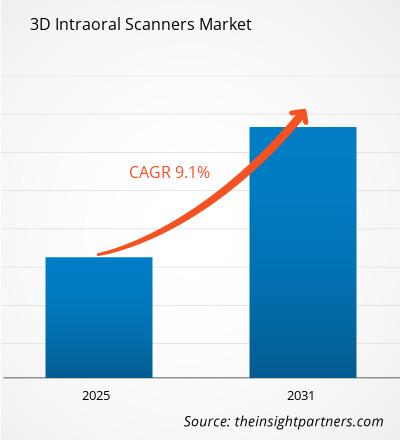
The 3d intraoral scanners market was assessed at a valuation of US$ 2.87 Billion in 2025 and expected to grow up to a value of US$ 6.19 Billion by 2034, with a compound annual growth rate (CAGR) of 8.93%. Factors driving growth include chairside digital impressions, orthodontic aligner procedures, dental restoration procedures, implant planning, and the integration of intraoral scans with CAD/CAM, CBCT, 3D printing, and cloud-based dental treatment systems.
In North America, the 3d intraoral scanners market size is driven by high private dental care expenditure, procurement practices of dental service organizations, rapid adoption of aligners, and the replacement of traditional impression material in clinics. The region is expected to have a CAGR range of 8.3–9.1% over 2026–2034. According to WHO, oral disease affects approximately 3.5 billion people worldwide.
3D Intraoral Scanners Market Assessment and Insights
- North America held 38–41% share in 2025 and is projected to grow at a CAGR between 2026–2034 of 8.3–9.1%, supported by digital impressions, DSO procurement, orthodontic workflows, and restorative scanner upgrades.
- US represented 85–88% of North America in 2025 and is expected to grow at a CAGR between 2026–2034 of 8.2–9.0%, led by aligners, implants, and chairside restorations.
- Europe accounted for 27–30% share in 2025 and is forecast to expand at a CAGR between 2026–2034 of 7.8–8.6%, with Germany, France, Italy, Spain, and the UK leading adoption.
- Asia Pacific captured 22–25% share in 2025 and is projected to grow at a CAGR between 2026–2034 of 9.8–10.7%, driven by China, Japan, South Korea, India, and Australia.
- Largest Segment Intraoral 3D Dental Scanners held 46–50% market share in 2025 and is expected to grow at a CAGR range of 8.8–9.6% during 2026–2034 due to direct chairside use.
- High Growth Segment Hand Held 3D Dental Scanners represented 19–23% share in 2025 and is forecast to grow at a CAGR range of 10.4–11.3% during 2026–2034 as ergonomics improve.
- Key companies analyzed in detail: 3M Company, 3Shape A/S, AICON 3D Systems GmbH, Age Solutions S.r.l., Align Technology, Inc., Adstar Co., Ltd., Carestream Dental LLC, Carl Zeiss Optotechnik GmbH, Condor Technologies NV, Danaher Corporation, Densys3D Ltd., Dental Wings Inc., Straumann Holding AG, Dipro Co., Ltd., GC Corporation, GT Medical Co., Ltd., Kulzer GmbH, Hint-ELS GmbH, imes-icore GmbH, Imetric 3D SA, and LaserDentium Co., Ltd.
Source: The Insight Partners' analysis based on proprietary research, government publications, company annual reports, investor presentations, industry databases, and expert interviews.
Markets have transformed from stand-alone impression replacement to interconnected scanning ecosystems for diagnosing, designing, treatment planning, communicating with patients, and working together with laboratories. Product trends are tilting towards smaller wand designs, wider scanning areas, faster scan speeds, powderless scanning processes, and automatic self-aligning functions. The market for 3d intraoral scanners is becoming more dependent on AI-based disease detection technology, cloud case transfer technology, and compatibility with restorative, orthodontic, implants, and prosthetics treatments.
Future demands would be impacted by increased access to digital dentistry in the Asia Pacific region, formation of multi-site dental networks, and scanner monetization through software. AI diagnostics regulation, cybersecurity measures, and interoperable data may affect the product designs of market players. Investments are being made on subscription modules, patient-oriented apps, scanner to printer workflows, and platforms that save chair times.
3D Intraoral Scanners Market Report Scope
| Report Attribute | Details |
|---|---|
| Market size in 2025 | US$ 2.87 Billion |
| Market Size by 2034 | US$ 6.19 Billion |
| Global CAGR (2026 - 2034) | 8.93% |
| Historical Data | 2021-2024 |
| Forecast period | 2026-2034 |
3D Intraoral Scanners Market Analysis
The demand is based on lower impressions re-take rates, quick alignment delivery, accuracy of implant planning, restorations processing, and preference of patients to scan comfortably. The market growth of 3D intraoral scanners is supported by WHO data indicating that untreated dental caries affects 2.5 billion people, while severe periodontal disease affects 1 billion people worldwide.
The value chain comprises optical sensors, scanner, imaging software, AI software module, dental laboratories, aligners solutions, CAD/CAM solutions, case portals in the cloud, distributors, and services providers. The supply is supported by companies providing open file export, training, warranty support, calibration replacement and integration with dental design software.
It is characterized by being highly innovation-oriented. Analysis of 3d intraoral scanner market reveals that 3Shape A/S, Align Technology, Inc., Carestream Dental LLC, Straumann Holding AG, Dental Wings Inc., and Densys3D Ltd. compete in terms of fast scan capability, diagnostics software, orthodontic compatibility, and restorative process integration.
3M Company, AICON 3D Systems GmbH, Age Solutions S.r.l., Condor Technologies NV, Danaher Corporation, Carl Zeiss Optotechnik GmbH, GC Corporation, Kulzer GmbH, Imetric 3D SA, imes-icore GmbH, and LaserDentium Co., Ltd. expand the ecosystem using scanning, metrology, dental materials, manufacturing, and laboratory techniques. Unique selling propositions include clinical precision, open architecture, software retention, ergonomics, and service availability.
● REPORT CUSTOMIZATION
Tailor This Report To Align With Your Specific Business Requirements
This report can be customized to align precisely with your business objectives, scope, and target markets. Customization options include tailored segmentation, geography, competitive analysis, and strategic insights to support informed decision-making.
Customize This Report →WHAT YOU CAN ADJUST
- ● Segmentations
- ● Geography
- ● Competitive Analysis
- ● Language Preferences
3D Intraoral Scanners Market: Strategic Insights

Regional Insights
North America 3d intraoral scanners Market
North America had a share of 38-41% in 2025 and is expected to witness growth with a CAGR of 8.3-9.1% for 2026-2034. The factors driving the adoption are the availability of dental service organizations, dental care for individuals, dental alignment, dental implants, and chairside restoration. The clinics are increasingly using the scanning process to substitute for impression material.
The 3D intraoral scanners market share in North America is due to the high volume of procedures and digital platforms adopted. Align technology provides examples like faster scanning, small wand, wider field of view, intraoral camera capability, and near-infrared imaging interproximal caries detection system.
U.S. 3d intraoral scanners Market
The U.S. accounted for 85–88% of North America in 2025 and is projected to witness a CAGR of 8.2–9.0% between 2026 and 2034. The U.S. represents a large market owing to substantial investments made by individuals in private dentistry services, DSO acquisitions, aligner systems, laboratory digitalization, and the requirement for planning of restoration on the same day.
Geographic reach is broad across dental dealerships, direct selling, and software partnerships. Align Technology, Inc., 3Shape A/S, Carestream Dental LLC, Straumann Holding AG, 3M Company, Dental Wings Inc., and Densys3D Ltd. are some companies serving practices where scan-to-aligner, scan-to-restoration, scan-to-CBCT, and scan-to-labor
Europe 3d intraoral scanners Market
Europe accounted for 27–30% share in 2025 and is forecast to expand at a CAGR of 7.8–8.6% during 2026–2034. Germany is the leading country, supported by dental technology adoption, laboratory networks, and implantology. France, Italy, Spain, and the UK show steady demand for digital impression and prosthetic workflows.
The German market is driven by premium restorative dentistry, laboratory cooperation, and high penetration of CAD/CAM. Productivity in private practices, aligners, and patient communication drive the UK market. Implantology and prosthodontics help in driving adoption in France, where accuracy and open system compatibility drive the choice of scanner.
Italy and Spain are growing through aesthetic dentistry, updating of private clinics, and restorative dentistry from dental tourism. Cloud-based collaboration and digital documentation are becoming increasingly popular in Nordic and Benelux countries. The future of Europe looks steady because scanners are fully adopted in advanced clinics, yet AI diagnostics and software upgrades motivate their replacement.
APAC 3d intraoral scanners Market
APAC had a share of 22-25% in 2025 and is forecast to have a CAGR of 9.8-10.7% for the period between 2026 and 2034. China dominates volume-wise owing to expansion of clinic and investment in digital dentistry, while Japan, South Korea, India, and Australia make contributions owing to premium care and orthodontic demands respectively.
Drivers of the market include device manufacturing, digital laboratories, chain dentistry, and awareness of cosmetic dentistry. Japan and South Korea have higher adoption of premium scanners, while India has potential due to urban clinics, aligners, and low-cost digital solutions.
Middle East & Africa 3d intraoral scanners Market
MEA is expected to witness growth at a CAGR of 7.0-7.8% during 2026-2034. Demand in MEA is dominated by Saudi Arabia due to investments in dental infrastructure, specialty clinics, and health facilities modernization. UAE stands second owing to premium aesthetic dentistry, private dental organizations, and restorative dentistry for medical tourists.
In Africa, South Africa serves as a dominant market driver due to its private dental clinics, labs, and specialty dental organizations. The MEA market will remain concentrated in urban areas due to the need for trained operators and procedure volumes.
Segmentation Analysis
Product
The Product segment is expected to grow at a CAGR of 8.7–9.5% during 2026–2034. 3d intraoral scanners market scope across product categories is defined by location of use, capture method, workflow integration, and clinical purpose. Intraoral and hand-held scanners drive chairside adoption, while desktop scanners, CBCT, confocal imaging, and optical wand technologies support laboratory, diagnostic, and advanced planning environments.
- Desktop or Laboratory 3D Dental Scanners remain important for dental laboratories handling models, impressions, prosthetic design, and batch processing, especially where high precision and controlled scanning conditions are required.
- Intraoral 3D Dental Scanners dominate demand because dentists use them directly for digital impressions, aligners, crowns, implants, patient monitoring, and communication without conventional impression materials.
- Confocal Microscopic Imaging Technology supports high-detail surface capture and depth measurement, making it valuable for accuracy-sensitive digital dentistry workflows requiring reliable three-dimensional reconstruction.
- Optical Wand Technology is strategically important for chairside usability because wand ergonomics, field of view, and capture distance influence comfort, scan speed, and operator learning curves.
- Hand Held 3D Dental Scanners are gaining demand due to lighter designs, portability, faster capture, and improved performance in full-arch, denture, palate, and edentulous cases.
- Cone Beam Computerized Tomography complements intraoral scanning by providing skeletal and root anatomy for implant planning, orthodontics, oral surgery, and integrated digital treatment planning.
</h3> Technology</h3>
The Technology segment is projected to grow at a CAGR of 8.5–9.3% during 2026–2034. Technology choice depends on capture accuracy, surface detail, scan speed, color imaging, powder-free operation, cost, and compatibility with design software. Light-based scanners dominate chairside workflows, while laser systems remain relevant for laboratory scanning and specialized measurement tasks.
- 3D Dental Light Scanner products hold the leading position because structured light and related optical methods support fast, powder-free capture, high-quality visualization, and patient-friendly chairside scanning.
- 3D Dental Laser Scanner products remain relevant where precise surface measurement, laboratory use, and controlled scan conditions are priorities, especially for specialized prosthetic and model-based workflows.
Application
The Application segment is forecast to grow at a CAGR of 8.6–9.4% during 2026–2034. Clinics dominate adoption because scanners directly affect daily chairside efficiency, case acceptance, prosthetic communication, and aligner submissions. Hospitals use scanners selectively in oral surgery and dental departments, while other users include laboratories, training centers, and specialty networks.
- Hospital applications are concentrated in oral surgery, dental departments, maxillofacial care, and complex restorative cases where digital records support multidisciplinary treatment planning.
- Clinic applications dominate because scanners reduce impression materials, enable rapid restorative workflows, support aligner and implant cases, and improve patient communication through visual treatment planning.
- Others include dental laboratories, academic programs, mobile dental providers, and training centers that use scanners for model digitization, education, prosthetic design, and workflow demonstration.
Opportunity Snapshot
| Segment Name | Revenue Contribution | Trend Tag | Adoption Stage |
| Hospital | Medium | Digital Records | Scaling |
| Clinic | High | Chairside Capture | Mature |
| Others | Medium | Lab Digitization | Scaling |
3D Intraoral Scanners Market Growth Drivers and Impact Analysis
Digital Impression Replacement Across Clinical Workflows
The adoption of digital impressions is a key driver because scanning helps reduce impression materials, increase patient comfort, enable file resubmission, and facilitate communication with the laboratory. The 3D intraoral scanners market is influenced positively by the fact that clinics use the technology in creating crowns, bridges, aligners, dentures, implants, and monitoring. This effect is most pronounced among multisite practices that require consistent workflow, fast case submissions, and reduced number of remakes. The WHO oral health data highlight high global prevalence of diseases such as untreated caries and periodontal disease.
Expansion of Restorative, Aligner, and Implant Applications
There is increasing adoption of scanners because restorative procedures, aligner treatment plans, and implant treatments rely heavily on digital scans. Align Technology introduced restorative functionality in the iTero Lumina line of scanners, which featured a bigger field of view and faster scans. There were plans to use these scanners to treat complex cases such as dentures and palates. In addition, Carestream Dental launched its IDS 2025 update, which features AI-assisted implant treatment planning and integration of CBCT volume into digital impressions.
AI-Enabled Diagnosis and Patient Communication
The use of AI-based scanners is shifting value from data capture to clinical interpretation and patient engagement. 3Shape launched TRIOS 6 with hyperspectral imaging and TRIOS Dx Plus software to detect caries on the surface and proximally, dental plaque, tooth wear, and gingival recession. These devices assist dentists to visualize the results, track the developments, and better understand what they need to do. The market implication is great since the return on investment for scanners now requires better case acceptance and monitoring prevention among other factors.
3D Intraoral Scanners Market Future Trends
Diagnostics-Integrated Scanning Platforms
Diagnostics-integrated platforms will define 3d intraoral scanners market trends as devices combine surface scans, near-infrared imaging, fluorescence, intraoral photography, and AI-assisted visualization. 3Shape’s TRIOS 6 captures white, fluorescent, and near-infrared light simultaneously, while Align’s iTero Lumina Pro supports NIRI-enabled caries detection. Future devices will increasingly support enamel monitoring, tooth wear tracking, gingival assessment, plaque visualization, and restorative fit review. Commercial success will depend on diagnostic reliability, regulatory clearance, workflow simplicity, and whether visual outputs improve patient acceptance.
Cloud-Connected Dental Ecosystems
Cloud platforms are expected to become essential as scans move between clinics, laboratories, aligner providers, implant planners, and 3D printing services. Straumann launched Straumann AXS as a cloud-based digital workflow platform and announced integration with Carestream Dental imaging to connect CBCT and scanner data into implant planning and laboratory workflows. Future scanner selection will depend on open file transfer, cybersecurity, subscription cost, collaboration tools, and fleet management for dental groups. This trend favors vendors that support integrated yet flexible digital ecosystems.
3D Intraoral Scanners Market Opportunities
Recurring Software and Diagnostic Modules
3d intraoral scanners market Forecasts indicate strong opportunity in software subscriptions that extend scanner value after purchase. Suppliers can monetize AI diagnostics, patient apps, treatment simulation, lab communication, cloud storage, restorative design, and scan monitoring tools. 3Shape’s DentalHealth app and TRIOS Dx Plus show how diagnostic visualization and patient engagement can become recurring ecosystem features. The opportunity is strongest among dental service organizations and high-volume clinics seeking standardized workflows. Success will require transparent pricing, compliance, cybersecurity, and measurable chairside productivity gains.
Emerging Market Digitization of Dental Clinics
Emerging markets present a major opportunity as urban clinics in India, China, Southeast Asia, the Middle East, and Latin America move from analog impressions to digital workflows. IDS 2025 reporting noted that intraoral scanners are becoming more powerful and more affordable, while AI is increasingly embedded across digital dentistry. Manufacturers can improve adoption through lower-cost models, financing, local-language training, distributor support, and bundled access to labs or design software. Demand will be strongest in clinics offering aligners, implants, aesthetic restorations, and same-day dentistry.
Recent Developments
- September 2025: Align Technology, Inc. announced availability of restorative capabilities on its next-generation iTero Lumina intraoral scanner and new iTero Lumina Pro Dental Imaging System, supporting diagnostic, restorative, and multidisciplinary ortho-restorative workflows with larger field of view, faster scanning, single-pass restorative capture, and NIRI-enabled interproximal caries detection support.
- March 2025: 3Shape A/S introduced TRIOS 6, TRIOS Dx Plus diagnostic software, and the DentalHealth patient app at IDS 2025. The wireless scanner incorporates hyperspectral technology, AI-assisted diagnostic support for oral health conditions, higher scan resolution than previous 3Shape scanners, and patient-facing visual communication tools.
- March 2025: Carestream Dental LLC showcased CS 8200 3D Advance Edition and AI-assisted implant planning software at IDS 2025, while previewing collaboration with Straumann to integrate Carestream imaging with the Straumann digital ecosystem for CBCT and intraoral scan workflows supporting implant planning and laboratory collaboration.
Frequently Asked Questions

- Comprehensive Market Sizing and Forecast Analysis
- Detailed Segmentation Analysis
- In-Depth Market Dynamics Assessment
- Regional and Country-Level Insights
- Competitive Landscape and Company Benchmarking
- Strategic Business Intelligence
Recent Reports
Testimonials

The Insight Partners' SCADA System Market report is comprehensive, with valuable insights on current trends and future forecasts. The team was highly professional, responsive, and supportive throughout. We are very satisfied and highly recommend their services.
RAN KEDEM Partner, Reali Technologies LTDs
I requested a report on a very specific software market and the team produced the report in a few days. The information was very relevant and well presented. I then requested some changes and additions to the report. The team was again very responsive and I got the final report in less than a week.
JEAN-HERVE JENN Chairman, Future Analytica
We worked with The Insight Partners for an important market study and forecast. They gave us clear insights into opportunities and risks, which helped shape our plans. Their research was easy to use and based on solid data. It helped us make smart, confident decisions. We highly recommend them.
PIYUSH NAGPAL Sr. Vice President, High Beam Global
The Insight Partners delivered insightful, well-structured market research with strong domain expertise. Their team was professional and responsive throughout. The user-friendly website made accessing industry reports seamless. We highly recommend them for reliable, high-quality research services
YUKIHIKO ADACHI CEO, Deep Blue, LLC.
This is the first time I have purchased a market report from The Insight Partners.While I was unsure at first, I visited their web site and felt more comfortable to take the risk and purchase a market report.I am completely satisfied with the quality of the report and customer service. I had several questions and comments with the initial report, but after a couple of dialogs over email with their analyst I believe I have a report that I can use as input to our strategic planning process.Thank you so much for taking the extra time and making this a positive experience.I will definitely recommend your service to others and you will be my first call when we need further market data.
JOHN SUZUKI President and Chief Executive Officer, Board Director, BK Technologies
I wish to appreciate your support and the professionalism you displayed in the course of attending to my request for information regarding to infectious disease IVD market in Nigeria. I appreciate your patience, your guidance, and the fact that you were willing to offer a discount, which eventually made it possible for us to close a deal. I look forward to engaging The Insight Partners in the future, all thanks to the impression you have created in me as a result of this first encounter.
DR CHIJIOKE ONYIA MANAGING DIRECTOR, PineCrest Healthcare Ltd.Reason to Buy
- Informed Decision-Making
- Understanding Market Dynamics
- Competitive Analysis
- Identifying Emerging Markets
- Customer Insights
- Market Forecasts
- Risk Mitigation
- Boosting Operational Efficiency
- Strategic Planning
- Investment Justification
- Tracking Industry Innovations
- Aligning with Regulatory Trends





 Get Free Sample for