
3D printed medical implant systems Market Share, Demand & Growth by 2034
Coverage: by Component (Materials, Services, System); Implantation Technology (Laser Beam Melting, Electronic Beam Melting, Droplet Deposition, Others); Application (Dental, Orthopedic, Cranio-Maxillofacial); End-User (Hospitals, Medical Device Companies, Research and Academic Institutes, Others), and Geography (North America, Europe, Asia Pacific, and South and Central America)
- Status : Data Released
- Report Code : TIPRE00008524
- Category : Life Sciences
- No. of Pages : 150
- Available Report Formats :


- Last update date : July 30, 2026


2025 Market Size
US$ 1.9 Bn
Base year value
2034 Forecast
US$ 5.77 Bn
Projected by 2034
CAGR 2026-2034
13.13 %
Growth rate
Addressable Market
US$ 33.32 Bn
(2026-2034)
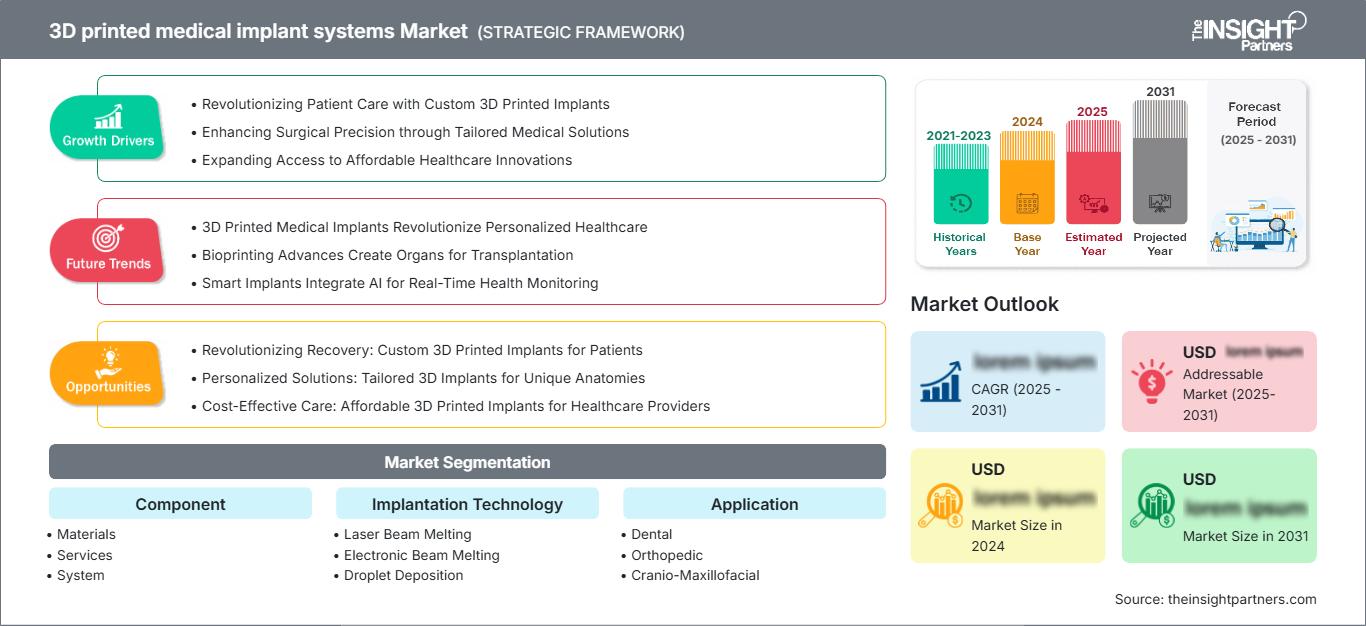
The 3d printed medical implant systems market was valued at US$ 1.9 Billion in 2025 and is projected to reach US$ 5.77 Billion by 2034, registering a CAGR of 13.13% during 2026–2034. Growth is being driven by patient-specific implants, porous orthopedic structures, dental restorations, cranio-maxillofacial reconstruction, surgical planning, and additive manufacturing workflows that support complex geometries and anatomical customization.
Across North America, 3d printed medical implant systems market size is supported by high orthopedic procedure volumes, FDA pathways for additive manufactured devices, and hospital adoption of patient-matched solutions. The region is estimated to grow at a CAGR range of 12.5–13.4% during 2026–2034. FDA notes that 3D printing enables devices matched to patient anatomy and complex internal structures, including orthopedic and cranial implants.
3D printed medical implant systems Market Assessment and Insights
- North America held 39–42% share in 2025 and is projected to grow at a CAGR between 2026–2034 of 12.5–13.4%, supported by orthopedic reconstruction, dental implant workflows, FDA-cleared device pathways, and hospital planning capabilities.
- US represented 86–89% of North America in 2025 and is expected to grow at a CAGR between 2026–2034 of 12.4–13.3%, led by patient-specific orthopedic and cranio-maxillofacial adoption.
- Europe accounted for 27–30% share in 2025 and is forecast to expand at a CAGR between 2026–2034 of 11.8–12.7%, with Germany, Belgium, the UK, France, and Italy leading adoption.
- Asia Pacific captured 22–25% share in 2025 and is projected to grow at a CAGR between 2026–2034 of 14.4–15.3%, driven by China, Japan, South Korea, India, and Australia.
- Largest Segment Orthopedic held 48–52% market share in 2025 and is expected to grow at a CAGR range of 12.8–13.7% during 2026–2034 due to porous implants.
- High Growth Segment Cranio-Maxillofacial represented 18–22% share in 2025 and is forecast to grow at a CAGR range of 15.1–16.0% during 2026–2034 as patient-specific reconstruction advances.
- Key companies analyzed in detail: Aspect Biosystems Ltd., 3D Bioprinting Solutions, Allevi, Inc., Formlabs Inc., Cyfuse Biomedical K.K., Materialise NV, Organovo Holdings, Inc., Medprin Regenerative Medical Technologies Co., Ltd., Zimmer Biomet Holdings, Inc., and DePuy Synthes, Inc.
Source: The Insight Partners' analysis based on proprietary research, government publications, company annual reports, investor presentations, industry databases, and expert interviews.
The market has evolved from prototyping and surgical models toward regulated implant production, porous titanium structures, bioresorbable devices, dental guides, and patient-specific craniofacial implants. Production dynamics now emphasize powder management, laser parameters, post-processing, sterilization, traceability, and mechanical validation. The 3d printed medical implant systems market is increasingly shaped by additive manufacturing’s ability to create lattice structures, patient-matched geometry, and implant surfaces designed to improve fixation and osseointegration.
Future demand will be influenced by hospital-based planning centers, orthopedic personalization, dental digital workflows, and expanding regulatory clarity for point-of-care manufacturing. FDA guidance highlights design, manufacturing, material characterization, process validation, and device testing considerations for additive-manufactured medical devices. Emerging markets will scale through specialist hospitals and medical device manufacturing partnerships, while developed markets should focus on faster turnaround, customized reconstruction, and validated implant-performance data.
3D printed medical implant systems Market Report Scope
| Report Attribute | Details |
|---|---|
| Market size in 2025 | US$ 1.9 Billion |
| Market Size by 2034 | US$ 5.77 Billion |
| Global CAGR (2026 - 2034) | 13.13% |
| Historical Data | 2021-2024 |
| Forecast period | 2026-2034 |
3D printed medical implant systems Market Analysis
Demand is driven by orthopedic revision complexity, dental implant planning, craniofacial trauma, tumor reconstruction, and the need for implants that match individual anatomy. 3d printed medical implant systems market growth is reinforced by clinical literature describing 3D printing as a transformative force in orthopedic surgery for patient-specific implants, surgical guides, prosthetics, and tissue engineering scaffolds.
The value chain includes imaging data acquisition, segmentation software, implant design, materials, additive manufacturing systems, post-processing, sterilization, quality assurance, hospital procurement, and surgeon training. Supply dynamics favor vendors that combine validated manufacturing, medical-grade materials, regulatory documentation, and rapid engineer-surgeon collaboration.
The competitive landscape is increasingly focused on personalization and regulated manufacturing. 3d printed medical implant systems market analysis shows Materialize NV, Zimmer Biomet Holdings, Inc., DePuy Synthes, Inc., Formlabs Inc., and Medprin Regenerative Medical Technologies Co., Ltd. competing through software, implant design, dental and orthopedic workflows, and validated production capabilities.
Aspect Biosystems Ltd., 3D Bioprinting Solutions, Allevi, Inc., Cyfuse Biomedical K.K., and Organovo Holdings, Inc. strengthen the broader regenerative and bioprinting side through tissue engineering platforms, biological printing experience, and translational research know-how. Strategic positioning depends on material certification, surgeon workflow support, clinical evidence, production repeatability, and compatibility with hospital planning systems.
● REPORT CUSTOMIZATION
Tailor This Report To Align With Your Specific Business Requirements
This report can be customized to align precisely with your business objectives, scope, and target markets. Customization options include tailored segmentation, geography, competitive analysis, and strategic insights to support informed decision-making.
Customize This Report →WHAT YOU CAN ADJUST
- ● Segmentations
- ● Geography
- ● Competitive Analysis
- ● Language Preferences
3D printed medical implant systems Market: Strategic Insights
Regional Insights
North America 3d printed medical implant systems Market
North America held 39–42% share in 2025 and is projected to grow at a CAGR of 12.5–13.4% during 2026–2034. Adoption is supported by orthopedic reconstruction volumes, dental digitization, FDA medical device pathways, and academic hospital programs. FDA states that 3D printed medical devices include orthopedic and cranial implants, surgical instruments, dental crowns, and external prosthetics.
The 3d printed medical implant systems market share in North America is strengthened by surgeon demand for patient-specific fit and porous structures. Michigan Medicine and Materialize opened a clinical trial for a 3D-printed bioresorbable tracheobronchial splint planned for at least 35 infants and children, illustrating specialized clinical translation.
U.S. 3d printed medical implant systems Market
The U.S. represented 86–89% of North America in 2025 and is expected to grow at a CAGR of 12.4–13.3% during 2026–2034. Its scale reflects orthopedic implant volumes, FDA-cleared additive device pathways, university-hospital research, and digital surgical planning adoption across dental and cranio-maxillofacial care.
Company presence is strong through medical device companies, software providers, and healthcare additive manufacturing networks. Materialize NV, Zimmer Biomet Holdings, Inc., DePuy Synthes, Inc., Formlabs Inc., Organovo Holdings, Inc., and Aspect Biosystems Ltd. serve different parts of the ecosystem. Applications concentrate on orthopedic implants, surgical guides, dental implant templates, cranial reconstruction, and pediatric airway innovation.
Europe 3d printed medical implant systems Market
Europe accounted for 27–30% share in 2025 and is forecast to expand at a CAGR of 11.8–12.7% during 2026–2034. Germany is the leading country due to medical engineering, additive manufacturing adoption, and orthopedic device expertise. Belgium, the UK, France, and Italy support adoption through implant planning and specialist reconstruction.
Germany’s market is shaped by implant manufacturing, hospital engineering, and metal additive production expertise. Belgium benefits from Materialize NV’s medical 3D printing and planning capabilities, including cranio-maxillofacial implant services. The UK shows demand through orthopedic research, hospital innovation programs, and point-of-care planning centers.
France, Italy, and Spain are expanding through dental implantology, maxillofacial reconstruction, and academic additive manufacturing projects. Europe’s regulatory environment encourages traceability and quality management, which benefits established suppliers. Adoption remains strongest where surgeon-specific planning, reimbursement clarity, and validated production processes align with clinical demand.
APAC 3d printed medical implant systems Market
APAC held 22–25% share in 2025 and is projected to grow at a CAGR of 14.4–15.3% during 2026–2034. China leads regional volume through domestic implant manufacturing and hospital modernization, while Japan, South Korea, India, and Australia contribute through advanced orthopedic, dental, and regenerative medicine programs.
Industrial drivers include local additive manufacturing capacity, medical device exports, and expanding specialist hospitals. Japan supports scaffold-free and regenerative approaches through Cyfuse Biomedical K.K., while China benefits from companies such as Medprin Regenerative Medical Technologies Co., Ltd. India offers growth through orthopedic trauma and dental implant demand.
Middle East & Africa 3d printed medical implant systems Market
Middle East & Africa is projected to grow at a CAGR of 9.3–10.1% during 2026–2034. Saudi Arabia leads demand through tertiary hospitals, healthcare infrastructure investment, and orthopedic modernization. The UAE follows through premium hospitals, dental implant centers, and medical innovation programs.
South Africa anchors African adoption through private orthopedic and maxillofacial care, while the rest of MEA remains early-stage. Energy-linked public healthcare investment in Gulf countries supports advanced imaging and surgical planning, but wider adoption is restrained by cost, specialist availability, and limited local additive manufacturing infrastructure.
Segmentation Analysis
Component
The Component segment is expected to grow at a CAGR of 12.9–13.8% during 2026–2034. 3d printed medical implant systems market scope across components is defined by the interaction of implant-grade materials, engineering services, and validated production systems. Materials and services are recurring revenue drivers, while systems are essential for device companies and hospitals moving from prototyping to controlled manufacturing.
- Materials remain strategically important because titanium alloys, PEEK, bioresorbable polymers, ceramics, and medical resins determine strength, osseointegration, imaging compatibility, and regulatory acceptance for implantable or surgical-use products.
- Services support design, segmentation, case planning, manufacturing, sterilization coordination, and surgeon collaboration, making them critical where patient-specific implants require rapid and documented workflows.
- System demand is rising among medical device companies and specialized hospitals that need controlled production capabilities, validated machines, software, monitoring, and post-processing workflows.
Implantation Technology
The Implantation Technology segment is projected to grow at a CAGR of 13.0–13.9% during 2026–2034. Technology choice depends on implant material, surface finish, dimensional tolerance, build speed, porosity, and mechanical performance. Laser beam melting remains central for metal implants, electronic beam melting supports selected titanium structures, and droplet deposition is relevant for polymers, guides, and biological research.
- Laser Beam Melting dominates metal implant production because it supports precise titanium and cobalt-chrome structures, porous surfaces, and complex geometries for orthopedic, dental, and cranio-maxillofacial implants.
- Electronic Beam Melting is strategically relevant for titanium orthopedic structures where high energy density, vacuum processing, and porous architecture support bone ingrowth and implant performance.
- Droplet Deposition supports polymer, resin, and biofabrication applications where material placement, prototype flexibility, and patient-specific templates are more important than high-load metal performance.
Application
The Application segment is forecast to grow at a CAGR of 13.2–14.1% during 2026–2034. Orthopedic applications dominate because additive manufacturing enables porous structures and patient-matched implants for complex anatomy. Dental applications benefit from digital workflows, while cranio-maxillofacial use is expanding as surgeons adopt personalized plates, meshes, and reconstructive implants.
- Dental applications include implant guides, crowns, bridges, surgical drilling templates, and patient-specific restorations where digital impressions and CBCT data connect directly to additive workflows.
- Orthopedic applications hold the largest position because porous titanium cups, spinal cages, custom joint components, and revision implants benefit from lattice design and bone ingrowth surfaces.
- Cranio-Maxillofacial applications are growing rapidly because patient-specific implants can restore facial contour, cranial defects, trauma damage, and tumor resection sites with improved anatomical fit.
End-User
The End-User segment is expected to grow at a CAGR of 12.7–13.6% during 2026–2034. Medical device companies dominate commercial-scale manufacturing, while hospitals are gaining relevance through surgical planning centers and patient-specific workflows. Research and academic institutes remain essential for biomaterial testing, translational studies, and early clinical validation.
- Hospitals use additive workflows for surgical planning, patient-specific implants, anatomical models, and complex reconstruction cases that require close collaboration between clinicians and engineers.
- Medical Device Companies generate the highest revenue contribution because they manage regulated production, quality systems, design controls, validation, and commercialization of implantable devices.
- Research and Academic Institutes support early-stage innovation in biomaterials, lattice design, bioprinting, mechanical testing, and clinical feasibility studies that expand applications over time.
Opportunity Snapshot
| Segment Name | Revenue Contribution | Trend Tag | Adoption Stage |
|---|---|---|---|
| Hospitals | Medium | Surgical Planning | Scaling |
| Medical Device Companies | High | Regulated Production | Mature |
| Research and Academic Institutes | Medium | Biomaterial Testing | Scaling |
3D printed medical implant systems Market Growth Drivers and Impact Analysis
Rising Demand for Patient-Specific Implant Fit
Patient-specific design is one of the major growth factors, as many procedures in orthopedics, dentistry, and cranio-maxillofacial reconstructive surgeries have complex anatomy requirements that off-the-shelf implants fail to satisfy. The FDA says that 3D printing technology allows manufacturers to make patient-specific devices and internal complex structures that help with customization and porous structure design of implants. This makes 3d printed medical implant systems market benefit from surgeons using CT or MRI scan results for the purpose of designing the implant's shape, fixation points, and lattices. The real-life effect is most pronounced in revision orthopedics, cranial defects, facial traumas, dental implant surgery, and rare anatomical cases.
Advances in Porous Metals and Biocompatible Materials
Advances in materials science have led to increased clinical significance of additively manufactured implants. Orthopedic literature discusses 3D printing techniques like powder bed fusion, extrusion techniques, and bioink printing, among materials like titanium alloys, PEEK, bioactive materials, and cell-filled inks. This allows for the manufacturing of structures made from materials that have mechanical strength, promote bone growth, reduce weight, and are customized to fit the specific anatomy of a patient. Porous metal surfaces allow for better fixation of the implant without requiring any coating or machining process and contribute to the market of 3d printed medical implant systems.
Regulatory and Clinical Translation of Additive Devices
Improved regulation is allowing additive manufacturing technology to be implemented from innovation centers into commercial device pipelines. Guidance by the FDA includes design, manufacturing, material characterization, process validation, post-processing, and performance testing of additively manufactured devices. Materialize and the University of Michigan took part in an FDA pivotal clinical study involving the fabrication of a 3D-printed bioresorbable tracheobronchial splint, an example of patient-specific devices that have been developed through additive manufacturing and their way towards clinical implementation. Market implications include increased confidence among investors and hospitals.
3D printed medical implant systems Market Future Trends
Hybrid Digital Surgery and Implant Planning
Trends in the 3D printing of medical implants market will be driven by hybrid digital surgery because imaging, surgery planning, robotics, and additive implants will merge together. The future of workflows will involve the conversion of CT and MRI scans into surgical plans and the implant designs through the use of validated software environments. Zimmer Biomet featured the latest developments in the field of orthopedics at AAOS 2025, which included robotic technology and artificial intelligence-based hip tools for surgeries, which is indicative of the trend towards a digital procedure environment as well.
Bioresorbable and Polymer-Based Personalized Implants
Implants made out of biodegradable materials and polymers are likely to surpass metallic implants when temporary structures and imaging capability are of significant importance. The use of a biodegradable tracheobronchial splint by Materialize through its clinical trial and the development of customized PEEK cranio-maxillofacial implants in 2026 provides an example of this. Demand in the future will revolve around implants used in pediatrics, craniofacial shaping, airways, and reconstruction surgery, where permanent metallic implants may not be preferable. Suppliers need to demonstrate degradation, stability, sterilization capability, and safety first.
3D printed medical implant systems Market Opportunities
Patient-Specific Cranio-Maxillofacial Reconstruction
3D-printed medical implant systems market. There is an indication of a bright future in the field of cranio-maxillofacial reconstructive surgery because defects must be anatomically fitted, aesthetically restored, and surgically planned. The company Materialize added customized PEEK implants for use in the cranio-maxillofacial region by making available both titanium and polymer implants to the surgeon using the same process. Differentiation may be achieved by quick planning, engineer/surgeon collaboration, validation of materials, and order portal design for hospitals. Trauma, oncological resections, congenital reconstructions, and revision surgeries offer more opportunities.
Hospital and Dental Point-of-Care Production Networks
Opportunities arise where speed and customization help with the surgery process. The FDA describes 3D printed medical devices used for point-of-care, listing their usage in implants, surgical guides, dental restorations, and anatomical models. Formlabs supports dentistry through the use of biocompatible Surgical Guide Resin to create drilling guides and guides for surgeries, showcasing a serviceable portion of this opportunity. However, commercial success requires proven workflows, material accountability, sterilization processes, and accountability between hospitals, medical device manufacturers, and software providers.
Recent Developments
- February 2026: Materialise NV added custom-made PEEK implants to its cranio-maxillofacial portfolio in Europe, enabling surgeons to select titanium or PEEK patient-specific implants through its digital planning and case management workflow. The polymer option supports cranial reconstruction, facial contour restoration, and applications where reduced imaging artifacts are valuable.
- March 2025: Zimmer Biomet Holdings, Inc. highlighted orthopedic and musculoskeletal innovations at AAOS 2025, including hip reconstruction technologies, newly launched knee and upper extremities reconstructive technologies, robotic solution components, and ZBX ambulatory surgery center solutions. The showcase reflected continued investment in orthopedic reconstruction, digital surgery, and procedure efficiency.
- March 2025: Materialise NV and University of Michigan entered an FDA pivotal clinical trial for a bioresorbable 3D-printed tracheobronchial splint device. The study opened in January 2025 and is planned to enroll at least 35 infants and children over eight years at U-M Health C.S. Mott Children’s Hospital and additional sites.
Frequently Asked Questions

- Comprehensive Market Sizing and Forecast Analysis
- Detailed Segmentation Analysis
- In-Depth Market Dynamics Assessment
- Regional and Country-Level Insights
- Competitive Landscape and Company Benchmarking
- Strategic Business Intelligence
Recent Reports
Testimonials

The Insight Partners' SCADA System Market report is comprehensive, with valuable insights on current trends and future forecasts. The team was highly professional, responsive, and supportive throughout. We are very satisfied and highly recommend their services.
RAN KEDEM Partner, Reali Technologies LTDs
I requested a report on a very specific software market and the team produced the report in a few days. The information was very relevant and well presented. I then requested some changes and additions to the report. The team was again very responsive and I got the final report in less than a week.
JEAN-HERVE JENN Chairman, Future Analytica
We worked with The Insight Partners for an important market study and forecast. They gave us clear insights into opportunities and risks, which helped shape our plans. Their research was easy to use and based on solid data. It helped us make smart, confident decisions. We highly recommend them.
PIYUSH NAGPAL Sr. Vice President, High Beam Global
The Insight Partners delivered insightful, well-structured market research with strong domain expertise. Their team was professional and responsive throughout. The user-friendly website made accessing industry reports seamless. We highly recommend them for reliable, high-quality research services
YUKIHIKO ADACHI CEO, Deep Blue, LLC.
This is the first time I have purchased a market report from The Insight Partners.While I was unsure at first, I visited their web site and felt more comfortable to take the risk and purchase a market report.I am completely satisfied with the quality of the report and customer service. I had several questions and comments with the initial report, but after a couple of dialogs over email with their analyst I believe I have a report that I can use as input to our strategic planning process.Thank you so much for taking the extra time and making this a positive experience.I will definitely recommend your service to others and you will be my first call when we need further market data.
JOHN SUZUKI President and Chief Executive Officer, Board Director, BK Technologies
I wish to appreciate your support and the professionalism you displayed in the course of attending to my request for information regarding to infectious disease IVD market in Nigeria. I appreciate your patience, your guidance, and the fact that you were willing to offer a discount, which eventually made it possible for us to close a deal. I look forward to engaging The Insight Partners in the future, all thanks to the impression you have created in me as a result of this first encounter.
DR CHIJIOKE ONYIA MANAGING DIRECTOR, PineCrest Healthcare Ltd.Reason to Buy
- Informed Decision-Making
- Understanding Market Dynamics
- Competitive Analysis
- Identifying Emerging Markets
- Customer Insights
- Market Forecasts
- Risk Mitigation
- Boosting Operational Efficiency
- Strategic Planning
- Investment Justification
- Tracking Industry Innovations
- Aligning with Regulatory Trends





 Get Free Sample for