
3D Printed Oncology Prosthetic Market Trends, Size & Forecast by 2034
Coverage: By Material (Polypropylene, Polyurethane, Acrylics, Polyethylene, and Others); End Users (Medical and Surgical Centers, Pharma and Biotech Companies, Academic Institutions, Hospitals, Rehabilitation Centers, and Others), and Geography (North America, Europe, Asia Pacific, and South and Central America)
- Status : Data Released
- Report Code : TIPRE00023424
- Category : Life Sciences
- No. of Pages : 150
- Available Report Formats :


- Last update date : July 29, 2026


2025 Market Size
US$ 1.43 Bn
Base year value
2034 Forecast
US$ 3.67 Bn
Projected by 2034
CAGR 2026-2034
12.50 %
Growth rate
Addressable Market
US$ 24.28 Bn
(2026-2034)
The 3d printed oncology prosthetic market was valued at US$ 1.43 Billion in 2025 and is projected to reach US$ 3.67 Billion by 2034, registering a CAGR of 12.50% during 2026–2034. Demand is expanding as cancer reconstruction teams use patient-specific prosthetics, anatomical models, surgical guides, and digitally designed implants to restore function, anatomy, and appearance after tumor resection.
Across North America, 3d printed oncology prosthetic market size is supported by advanced cancer centers, orthopedic oncology programs, cranio-maxillofacial reconstruction capabilities, and hospital access to additive manufacturing services. The region is estimated to grow at a CAGR range of 11.9–12.8% during 2026–2034. WHO and IARC estimated 20 million new cancer cases and 9.7 million cancer deaths in 2022, supporting sustained reconstructive demand.
3D Printed Oncology Prosthetic Market Assessment and Insights
- North America held 38–41% share in 2025 and is projected to grow at a CAGR between 2026–2034 of 11.9–12.8%, supported by oncology reconstruction centers, imaging infrastructure, and point-of-care planning.
- US represented 86–89% of North America in 2025 and is expected to grow at a CAGR between 2026–2034 of 11.8–12.7%, led by orthopedic oncology and craniofacial reconstruction.
- Europe accounted for 27–30% share in 2025 and is forecast to expand at a CAGR between 2026–2034 of 11.2–12.1%, with Germany, the UK, the Netherlands, Belgium, and France leading adoption.
- Asia Pacific captured 22–25% share in 2025 and is projected to grow at a CAGR between 2026–2034 of 13.7–14.6%, driven by China, Japan, South Korea, India, and Australia.
- Largest Segment Hospitals held 36–40% market share in 2025 and is expected to grow at a CAGR range of 12.0–12.9% during 2026–2034 due to surgical reconstruction volumes.
- High Growth Segment Rehabilitation Centers represented 12–15% share in 2025 and is forecast to grow at a CAGR range of 14.3–15.2% during 2026–2034 as survivorship care expands.
- Key companies analyzed in detail: GE HealthCare Technologies Inc., Xilloc Medical B.V., Neusoft Medical Systems Co., Ltd., Koninklijke Philips N.V., Siemens Healthineers AG, 3D LifePrints Limited, Canon Inc., Organovo Holdings, Inc., Stratasys Ltd., Formlabs Inc., Materialise NV, and Aspect Biosystems Ltd.
Source: The Insight Partners' analysis based on proprietary research, government publications, company annual reports, investor presentations, industry databases, and expert interviews.
The market has moved from generic prosthetic fitting toward anatomy-matched reconstruction supported by CT, MRI, CAD design, and additive manufacturing. Production dynamics now emphasize imaging accuracy, segmentation, material selection, sterilization, and rapid clinician-engineer iteration. The 3d printed oncology prosthetic market is shaped by the need to replace bone, soft-tissue support, cranial structures, facial contours, and limb-salvage components after cancer surgery.
Future demand will be influenced by multidisciplinary tumor boards, reconstruction planning, and increasing hospital acceptance of patient-specific devices. FDA notes that medical 3D printing can create devices matched to patient anatomy and complex internal structures, including orthopedic and cranial implants. Emerging markets will scale through specialist cancer hospitals, while developed markets focus on faster case turnaround and validated outcomes.
3D Printed Oncology Prosthetic Market Report Scope
| Report Attribute | Details |
|---|---|
| Market size in 2025 | US$ 1.43 Billion |
| Market Size by 2034 | US$ 3.67 Billion |
| Global CAGR (2026 - 2034) | 12.50% |
| Historical Data | 2021-2024 |
| Forecast period | 2026-2034 |
3D Printed Oncology Prosthetic Market Analysis
Demand is driven by limb salvage, craniofacial tumor resection, breast and facial reconstruction, bone defect repair, and post-treatment rehabilitation. 3d printed oncology prosthetic market growth is reinforced by rising cancer incidence and the clinical need for prosthetics that restore mobility, appearance, and surgical precision after complex resections.
The value chain includes diagnostic imaging, segmentation, virtual surgical planning, material supply, additive manufacturing, sterilization, hospital procurement, rehabilitation fitting, and follow-up adjustment. Supply dynamics favor providers that combine imaging data, regulated production, surgeon collaboration, and patient-centered design.
The competitive landscape blends imaging leaders, additive manufacturing providers, and patient-specific implant specialists. 3d printed oncology prosthetic market analysis shows Materialise NV, Xilloc Medical B.V., 3D LifePrints Limited, Stratasys Ltd., and Formlabs Inc. competing through planning platforms, surgical guides, anatomical models, and personalized device workflows.
GE HealthCare Technologies Inc., Koninklijke Philips N.V., Siemens Healthineers AG, Canon Inc., and Neusoft Medical Systems Co., Ltd. strengthen the imaging foundation by enabling accurate CT and MRI inputs. Organovo Holdings, Inc. and Aspect Biosystems Ltd. add translational bioprinting relevance, while strategic positioning depends on regulatory compliance, turnaround time, clinical engineering support, and material reliability.
● REPORT CUSTOMIZATION
Tailor This Report To Align With Your Specific Business Requirements
This report can be customized to align precisely with your business objectives, scope, and target markets. Customization options include tailored segmentation, geography, competitive analysis, and strategic insights to support informed decision-making.
Customize This Report →WHAT YOU CAN ADJUST
- ● Segmentations
- ● Geography
- ● Competitive Analysis
- ● Language Preferences
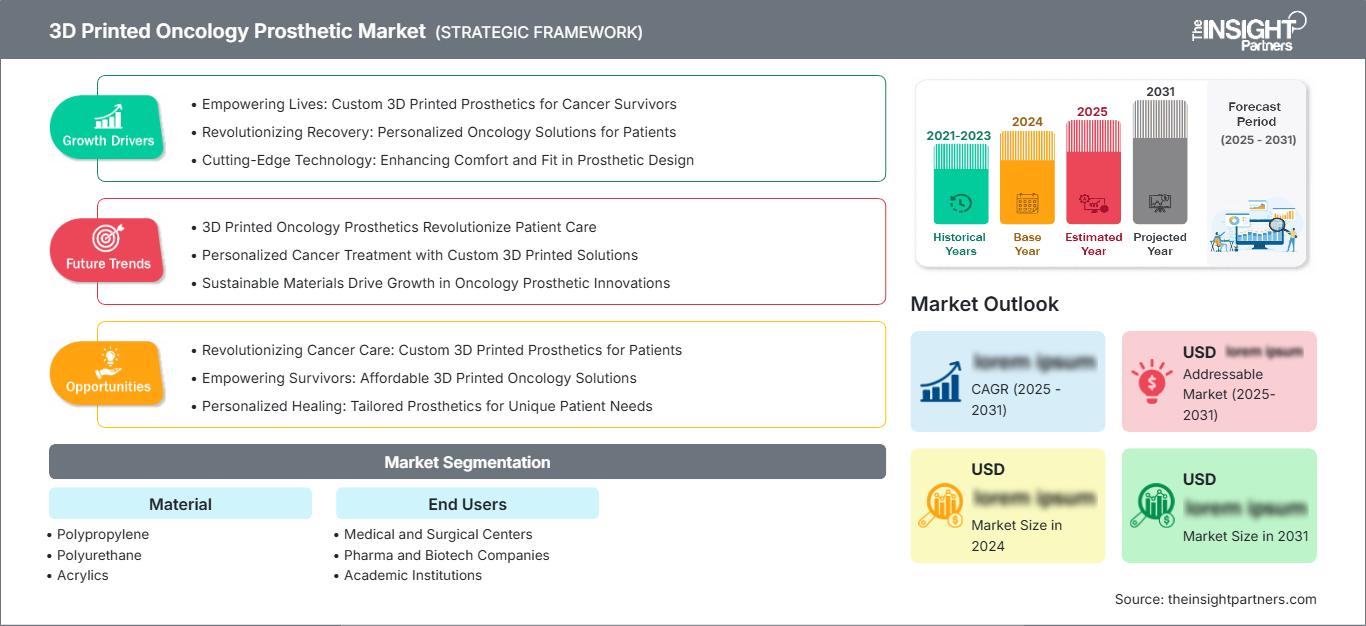
3D Printed Oncology Prosthetic Market: Strategic Insights
Regional Insights
North America 3d printed oncology prosthetic Market
North America held 38–41% share in 2025 and is projected to grow at a CAGR of 11.9–12.8% during 2026–2034. Adoption is supported by comprehensive cancer centers, orthopedic oncology expertise, advanced imaging, and stronger reimbursement capacity for complex reconstruction. Hospitals use patient-specific guides, anatomical models, and prosthetics to plan tumor resections and reconstruct defects.
The 3d printed oncology prosthetic market share in North America is strengthened by FDA-regulated additive manufacturing pathways and point-of-care planning programs. Materialize states that hospital 3D planning can support oncology by revealing spatial relationships between tumors, soft tissue, hard tissue, and critical structures.
U.S. 3d printed oncology prosthetic Market
The U.S. represented 86–89% of North America in 2025 and is expected to grow at a CAGR of 11.8–12.7% during 2026–2034. Its scale reflects cancer center concentration, orthopedic oncology volumes, medical imaging access, and additive manufacturing adoption across pediatric and adult reconstructive care.
Company presence is strong through hospitals, engineering service providers, and imaging networks. GE HealthCare Technologies Inc., Siemens Healthineers AG, Canon Inc., Stratasys Ltd., Formlabs Inc., Materialise NV, 3D LifePrints Limited, and Aspect Biosystems Ltd. support workflows spanning imaging, modeling, surgical planning, guides, and prosthetics. Applications concentrate on bone tumors, craniofacial defects, limb salvage, and rehabilitation fitting.
Europe 3d printed oncology prosthetic Market
Europe accounted for 27–30% share in 2025 and is forecast to expand at a CAGR of 11.2–12.1% during 2026–2034. Germany stands out owing to its hospital engineering, oncological surgery, and additive manufacturing capabilities. The UK, the Netherlands, Belgium, and France contribute through their reconstruction centers and personalized surgical planning.
Germany has its market defined by its imaging capabilities, implant engineering, and orthopedic reconstruction programs. The UK has its market defined by 3D LifePrints Limited and the experience of patient-specific planning associated with the NHS. The Netherlands contributes through Xilloc Medical B.V., a firm that designs and manufactures patient-specific cranio-maxillofacial implants and surgical guides.
Belgium and France have their markets defined through the personalized surgical solutions provided by Materialize NV and their hospital reconstruction programs. Italy and Spain continue to grow owing to their oncological surgery, maxillofacial practice, and rehabilitation programs.
APAC 3d printed oncology prosthetic Market
APAC held 22–25% share in 2025 and is projected to grow at a CAGR of 13.7–14.6% during 2026–2034. China leads regional volume through cancer hospital expansion and domestic imaging capacity, while Japan, South Korea, India, and Australia contribute through orthopedic oncology and digital surgical planning.
Industrial drivers include local additive manufacturing, medical imaging investment, and growing reconstructive surgery capacity. Japan supports precision medical devices, South Korea advances digital healthcare, and India offers growth through tertiary cancer centers. Australia contributes through specialist oncology hospitals and rehabilitation networks.
Middle East & Africa 3d printed oncology prosthetic Market
The Middle East & Africa is projected to grow at a CAGR of 9.1–9.9% during 2026–2034. Saudi Arabia drives demand through its oncology centers, tertiary care hospitals, and health infrastructure investments. The UAE is next with its high-end surgical programs, medical tourism, and private hospital adoptions.
South Africa drives demand in Africa through its private oncology and reconstructive surgery facilities. RO-MEA is at an early stage due to the need for imaging accuracy, engineering skills, and rehabilitation expertise for Additive Manufacturing technology. High healthcare spending by the energy sector in Gulf nations helps in buying imaging and planning solutions.
Segmentation Analysis
Material
The Material segment is expected to grow at a CAGR of 12.1–13.0% during 2026–2034. 3d printed oncology prosthetic market scope across materials is defined by biocompatibility, strength, flexibility, weight, surface finish, sterilization compatibility, and patient comfort. Polymer materials remain important for external prosthetics, surgical models, guides, and rehabilitation devices that require anatomical customization after oncologic procedures.
- Polypropylene is valued for lightweight, chemical-resistant, and durable prosthetic components. Demand is strongest where external prosthetic fit, repeatable fabrication, and cost control matter.
- Polyurethane supports flexible and cushioning applications, making it strategically relevant for interfaces, soft-touch prosthetic parts, rehabilitation attachments, and comfort-focused oncology prosthetic designs.
- Acrylics remain important for rigid, form-stable components and aesthetic prosthetics. Their value lies in surface quality, color matching, and use in custom craniofacial or dental-related restorations.
- Polyethylene provides toughness, low friction, and wear resistance for selected prosthetic and support applications. Its role is practical in devices requiring durability and patient-specific shaping.
End Users
The End Users segment is projected to grow at a CAGR of 12.3–13.2% during 2026–2034. Adoption varies by clinical role: hospitals and surgical centers drive reconstruction planning, rehabilitation centers support fitting and adjustment, and academic institutions contribute validation and workflow innovation. Pharma and biotech companies remain relevant for tumor models and translational prosthetic research.
- Medical and Surgical Centers use patient-specific models, guides, and prosthetic components to plan tumor resections and reconstruction, especially in orthopedic oncology and cranio-maxillofacial surgery.
- Pharma and Biotech Companies apply 3D models and printed constructs in oncology research, treatment simulation, and translational studies where tumor anatomy and personalized design are relevant.
- Academic Institutions remain strategically important for developing new materials, surgical workflows, biomechanical evaluation, and clinical evidence supporting wider adoption of printed oncology prosthetics.
- Hospitals generate the greatest demand because they manage cancer surgery, imaging, reconstruction, procurement, sterilization, and multidisciplinary decision-making for complex patient-specific cases.
- Rehabilitation Centers are growing rapidly as cancer survivorship programs focus on prosthetic comfort, socket adjustment, mobility training, and long-term functional recovery after tumor treatment.
Opportunity Snapshot
| Segment Name | Revenue Contribution | Trend Tag | Adoption Stage |
|---|---|---|---|
| Medical and Surgical Centers | High | Resection Guides | Scaling |
| Pharma and Biotech Companies | Medium | Tumor Models | Emerging |
| Academic Institutions | Medium | Material Testing | Scaling |
| Hospitals | High | Reconstruction Planning | Mature |
| Rehabilitation Centers | Medium | Survivorship Fit | Scaling |
3D Printed Oncology Prosthetic Market Growth Drivers and Impact Analysis
Growing Cancer Reconstruction Burden
The post-cancer surgery patients have defects of the bones, face, head, teeth, and limbs that require repair both functionally and aesthetically. According to WHO and IARC estimates in 2022, there will be 20 million new cancer cases, with a considerable future need for services related to cancer management. In the 3d printed oncology prosthesis market, it helps greatly since the prosthesis for each patient can be fabricated using the computer tomography or magnetic resonance imaging data corresponding to the shape of the defect left by the surgical removal of the tumor.
Precision Surgery Enabled by Imaging and Planning
With advanced visualization and virtual planning, prosthetics will soon be coming close to what was actually planned surgically. Xilloc Medical B.V. is one organization that makes use of patient-specific CMF implants and surgical instruments, aided through CT uploads, collaboration between surgeons and engineers, and structured manufacturing processes. According to Materialize, personalized technology can be characterized by 3D planning, surgical guides, splints, plates and implants used for orthognathic surgery, reconstruction, cranium surgery, trauma and tumor-related procedures. This driver is important because oncologic reconstruction necessitates a perfect fit after tissue resection.
Material and Printing Improvements for Patient Fit
Materials science is enhancing the comfort, longevity, and practicality of prostheses. In research into custom-made 3D printed prostheses following tumor removal surgery to the foot and ankle, functional performance was noted to have improved for those patients who had undergone the procedure, along with stable radiographic positioning, emphasizing the clinical significance of complex anatomical defects. The 3d Printed Oncology Prosthetic market gains from the improved pairing of polypropylene, polyurethane, acrylics, and polyethylene materials with advancements in scanning, design, and post-processing technology. Materials improvement aids in reducing weight and providing comfortable external prosthetics.
3D Printed Oncology Prosthetic Market Future Trends
AI-Assisted Prosthetic Design and Surgical Planning
AI-assisted planning will define 3d printed oncology prosthetic market trends as segmentation, tumor boundary visualization, and prosthetic design become more automated. A 2026 analysis highlights how AI-driven design and optimization may benefit patient-specific medical devices, implants, and the use of 3D printing in healthcare, but pose validation and data governance challenges as well. The new process is expected to incorporate image acquisition, AI segmentation, margin generation, and additive manufacturing all into one workflow. Clinical involvement, interpretability, regulatory requirements, and integration with the hospital’s image acquisition systems will be crucial for implementation. Vendors who can minimize design time without sacrificing control of surgeons will see greater success.
Point-of-Care Oncology Printing Networks
Point-of-care 3D planning and printing will grow as hospitals move anatomical models and guides closer to the surgical suite. Materialize pointed to oncology as an emerging point-of-care specialty in 2025, with hospitals using patient-specific models, surgical guides, and radiation delivery devices to make tumor surgery and radiation treatments more precise. The future may see centralized quality systems integrated with local design reviews and rapid manufacturing. This will favor vendors who offer validated software, traceable materials, clinical engineering, and training. The key obstacle will be governance around accountability for device quality and post-market information.
3D Printed Oncology Prosthetic Market Opportunities
Orthopedic Oncology Limb-Salvage Solutions
3d printed oncology prosthetic market Forecasts indicate a strong opportunity in limb-salvage reconstruction, where tumor resections create irregular bone defects and require personalized fit. Insight Surgery provides solutions for orthopedic oncology with customized 3D planning, anatomical models, sterile templates, and implant partner collaboration for tumor resection and reconstruction procedures. Companies can distinguish themselves by providing fast response, sterile delivery, imaging-based planning, and prosthetic modification related to rehabilitation. The business potential is highest in cases involving pediatric bone tumors, difficult pelvic or foot reconstructions, and prosthetic revisions due to issues of fit and fixation.
Hospitals Offering Integrated Cancer Reconstruction Pathways
Hospitals could generate value through integrating imaging, surgical planning, prosthesis design, and rehabilitation through an oncologic reconstruction workflow. According to Materialise, 3D planning allows oncologists to visualize anatomical structures, assess organ preservation approaches and safeguard vital anatomical structures during removal of solid tumors. There is an opportunity for equipment manufacturers, software developers, and service bureaus in facilitating standard procedures in tumor boards and operating theaters. The success of commercial ventures would be dependent on clinician training, financial justification, time reliability, and evidence that patient-specific prostheses decrease surgical uncertainty and improve function and aesthetics.
Recent Developments
- February 2026: Materialise NV added custom-made PEEK implants to its cranio-maxillofacial portfolio in Europe, giving surgeons a polymer option alongside titanium through its digital planning and case management workflow. The addition supports cranial reconstruction, facial contour restoration, and cases where reduced imaging artifacts are clinically valuable.
- November 2025: Stratasys Ltd. announced that Addion GmbH and the University of Innsbruck adopted Stratasys Digital Anatomy technology to create Europe’s first 3D-printed anatomical eye models for eyelid surgery training, supporting reconstruction training, rare pathology simulation, and more reproducible surgical education workflows.
- March 2025: Siemens Healthineers AG and Stratasys Ltd. advanced patient-specific anatomical modeling using Stratasys Digital Anatomy and RadioMatrix materials, enabling CT-visible models for surgical planning, imaging education, and procedure rehearsal. The collaboration highlighted medical imaging’s role in producing realistic case-specific models for complex surgical decision-making.
Frequently Asked Questions

- Comprehensive Market Sizing and Forecast Analysis
- Detailed Segmentation Analysis
- In-Depth Market Dynamics Assessment
- Regional and Country-Level Insights
- Competitive Landscape and Company Benchmarking
- Strategic Business Intelligence
Recent Reports
Testimonials

The Insight Partners' SCADA System Market report is comprehensive, with valuable insights on current trends and future forecasts. The team was highly professional, responsive, and supportive throughout. We are very satisfied and highly recommend their services.
RAN KEDEM Partner, Reali Technologies LTDs
I requested a report on a very specific software market and the team produced the report in a few days. The information was very relevant and well presented. I then requested some changes and additions to the report. The team was again very responsive and I got the final report in less than a week.
JEAN-HERVE JENN Chairman, Future Analytica
We worked with The Insight Partners for an important market study and forecast. They gave us clear insights into opportunities and risks, which helped shape our plans. Their research was easy to use and based on solid data. It helped us make smart, confident decisions. We highly recommend them.
PIYUSH NAGPAL Sr. Vice President, High Beam Global
The Insight Partners delivered insightful, well-structured market research with strong domain expertise. Their team was professional and responsive throughout. The user-friendly website made accessing industry reports seamless. We highly recommend them for reliable, high-quality research services
YUKIHIKO ADACHI CEO, Deep Blue, LLC.
This is the first time I have purchased a market report from The Insight Partners.While I was unsure at first, I visited their web site and felt more comfortable to take the risk and purchase a market report.I am completely satisfied with the quality of the report and customer service. I had several questions and comments with the initial report, but after a couple of dialogs over email with their analyst I believe I have a report that I can use as input to our strategic planning process.Thank you so much for taking the extra time and making this a positive experience.I will definitely recommend your service to others and you will be my first call when we need further market data.
JOHN SUZUKI President and Chief Executive Officer, Board Director, BK Technologies
I wish to appreciate your support and the professionalism you displayed in the course of attending to my request for information regarding to infectious disease IVD market in Nigeria. I appreciate your patience, your guidance, and the fact that you were willing to offer a discount, which eventually made it possible for us to close a deal. I look forward to engaging The Insight Partners in the future, all thanks to the impression you have created in me as a result of this first encounter.
DR CHIJIOKE ONYIA MANAGING DIRECTOR, PineCrest Healthcare Ltd.Reason to Buy
- Informed Decision-Making
- Understanding Market Dynamics
- Competitive Analysis
- Identifying Emerging Markets
- Customer Insights
- Market Forecasts
- Risk Mitigation
- Boosting Operational Efficiency
- Strategic Planning
- Investment Justification
- Tracking Industry Innovations
- Aligning with Regulatory Trends





 Get Free Sample for