
3D Printing in Education Market Size, Share & Forecast by 2034
Coverage: By Product Type (3D Printers, Materials, Software); Application (Scientific Research, Prototyping Designs, STEM Lessons, 3D Visual Aids) , and Geography (North America, Europe, Asia Pacific, and South and Central America)
- Status : Data Released
- Report Code : TIPRE00009323
- Category : Technology, Media and Telecommunications
- No. of Pages : 150
- Available Report Formats :


- Last update date : August 04, 2026


2025 Market Size
US$ 1.57 Bn
Base year value
2034 Forecast
US$ 3.47 Bn
Projected by 2034
CAGR 2026-2034
9.23 %
Growth rate
Addressable Market
US$ 22.55 Bn
(2026-2034)
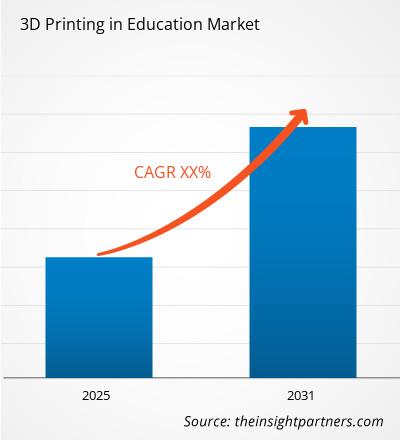
The 3D printing in education market was valued at US$ 1.57 Billion in 2025 and is anticipated to reach US$ 3.47 Billion by 2034, registering a CAGR of 9.23% during 2026–2034. The market continues to evolve as educational institutions increasingly adopt additive manufacturing technologies to support experiential learning, design innovation, product development education, and scientific visualization. Growing integration of digital fabrication tools into curricula across schools, colleges, universities, and research centers is strengthening long-term market demand.
Driven by strong investments in STEM education, workforce development, and advanced manufacturing training, North America remains the most mature regional market. The 3D printing in education market size across the region benefits from extensive university research ecosystems, well-established maker spaces, and public funding programs supporting technology-enabled learning. Regional adoption is expected to advance at a CAGR range of 8.5–9.5% through 2034, supported by continuous modernization of engineering and technical education infrastructure.
3D Printing in Education Market Assessment and Insights
- North America: Share in 2025 of 34–38%, CAGR between 8.5–9.5%. Strong institutional budgets, widespread implementation of fabrication laboratories, and advanced engineering education programs continue to support regional leadership across educational additive manufacturing deployments.
- US: Share in 2025 of 72–76% of North America, CAGR between 8.7–9.7%. Research universities, community colleges, and technical institutions are actively integrating additive manufacturing tools into curriculum development, innovation centers, and applied product design programs.
- Europe: Share in 2025 of 27–31%, CAGR between 8.0–9.0%. Germany, the United Kingdom, and France remain leading adopters due to strong industrial engineering traditions and expanding collaboration between academia and manufacturing industries.
- Asia Pacific: Share in 2025 of 24–28%, CAGR between 10.5–11.5%. China, Japan, South Korea, and India are driving demand through education digitalization strategies, manufacturing initiatives, and increasing adoption of hands-on technical learning.
- Largest Segment: 3D Printers with market share of 44–48% in 2025 and CAGR of 8.5–9.5%. Hardware infrastructure remains the foundation for educational deployment, supporting laboratory development and curriculum integration.
- High Growth Segment: STEM Lessons with market share of 24–28% in 2025 and CAGR of 10.5–11.5%. Rising demand for practical science and engineering instruction continues to accelerate implementation across educational institutions.
- Key companies analyzed in detail: 3D Systems, Inc.; EnvisionTEC, Inc.; Formlabs Inc.; HP Development Company, L.P.; Materialise NV; Stratasys Ltd.; The ExOne Company; Ultimaker B.V.; voxeljet AG; Y Soft Corporation.
Source: The Insight Partners' analysis based on proprietary research, government publications, company annual reports, investor presentations, industry databases, and expert interviews.
The educational additive manufacturing ecosystem has undergone significant transformation as institutions move beyond basic demonstration models toward comprehensive digital fabrication environments. Improvements in printer reliability, cloud-connected design platforms, classroom-safe materials, and curriculum-aligned software solutions have expanded adoption across a wider range of disciplines. Engineering, architecture, healthcare, industrial design, and scientific research programs increasingly use additive manufacturing technologies to support hands-on learning outcomes, collaborative innovation, and practical skills development. Growing emphasis on experiential education continues to elevate the strategic importance of these technologies within academic settings.
3D printing in education market is expected to be influenced by increasing investments in technical education, vocational training, and innovation-focused learning frameworks. Emerging economies are allocating resources toward digital manufacturing skills development to improve workforce competitiveness and industrial capability. Educational institutions are simultaneously expanding access to fabrication laboratories, remote design tools, and multidisciplinary research facilities. Combined with supportive government initiatives promoting STEM education and advanced manufacturing awareness, these developments are expected to sustain favorable market conditions throughout the forecast period.
3D Printing in Education Market Report Scope
| Report Attribute | Details |
|---|---|
| Market size in 2025 | US$ 1.57 Billion |
| Market Size by 2034 | US$ 3.47 Billion |
| Global CAGR (2026 - 2034) | 9.23% |
| Historical Data | 2021-2024 |
| Forecast period | 2026-2034 |
3D Printing in Education Market Analysis
The 3D printing in education market growth is being driven by a global shift toward experiential and project-based learning methodologies. Educational institutions increasingly recognize the value of additive manufacturing technologies in helping students translate theoretical concepts into physical models and functional prototypes. Adoption is particularly strong within engineering, healthcare, architecture, design, and research-oriented programs where practical application is critical to learning outcomes. The ability to rapidly create complex structures while reducing development time has strengthened the role of additive manufacturing within modern academic environments.
The market ecosystem consists of hardware manufacturers, software developers, educational content providers, service organizations, and material suppliers that collectively support implementation across educational institutions. Universities and technical colleges increasingly establish dedicated fabrication laboratories equipped with integrated design and production workflows. This environment enables students to gain direct exposure to digital manufacturing processes while fostering interdisciplinary collaboration among engineering, science, and design departments. Continued improvements in material diversity, cloud connectivity, and workflow automation are further strengthening adoption.
The 3D printing in education market analysis highlights an increasingly competitive environment characterized by technology innovation, strategic partnerships, and curriculum-focused solution development. Major participants such as Stratasys Ltd., Materialise NV, Formlabs Inc., 3D Systems, Inc., and Ultimaker B.V. have expanded educational programs designed to improve accessibility and user engagement. Competition is gradually shifting beyond hardware specifications toward integrated ecosystems that combine software, training, technical support, and educational content. Vendors are also investing in simplified workflows that reduce operational complexity for educators and students.
Market participants are strengthening their strategic positioning through collaborations with academic institutions, research organizations, and government-sponsored innovation programs. HP Development Company, L.P., voxeljet AG, Y Soft Corporation, EnvisionTEC, Inc., and The ExOne Company continue to explore opportunities associated with specialized educational applications and advanced fabrication technologies. Investment activity remains focused on user-friendly systems, cloud-based learning environments, and scalable deployment models capable of supporting long-term institutional adoption. Organizations that successfully combine affordability, reliability, and educational relevance are expected to strengthen their competitive positions throughout the forecast period.
● REPORT CUSTOMIZATION
Tailor This Report To Align With Your Specific Business Requirements
This report can be customized to align precisely with your business objectives, scope, and target markets. Customization options include tailored segmentation, geography, competitive analysis, and strategic insights to support informed decision-making.
Customize This Report →WHAT YOU CAN ADJUST
- ● Segmentations
- ● Geography
- ● Competitive Analysis
- ● Language Preferences
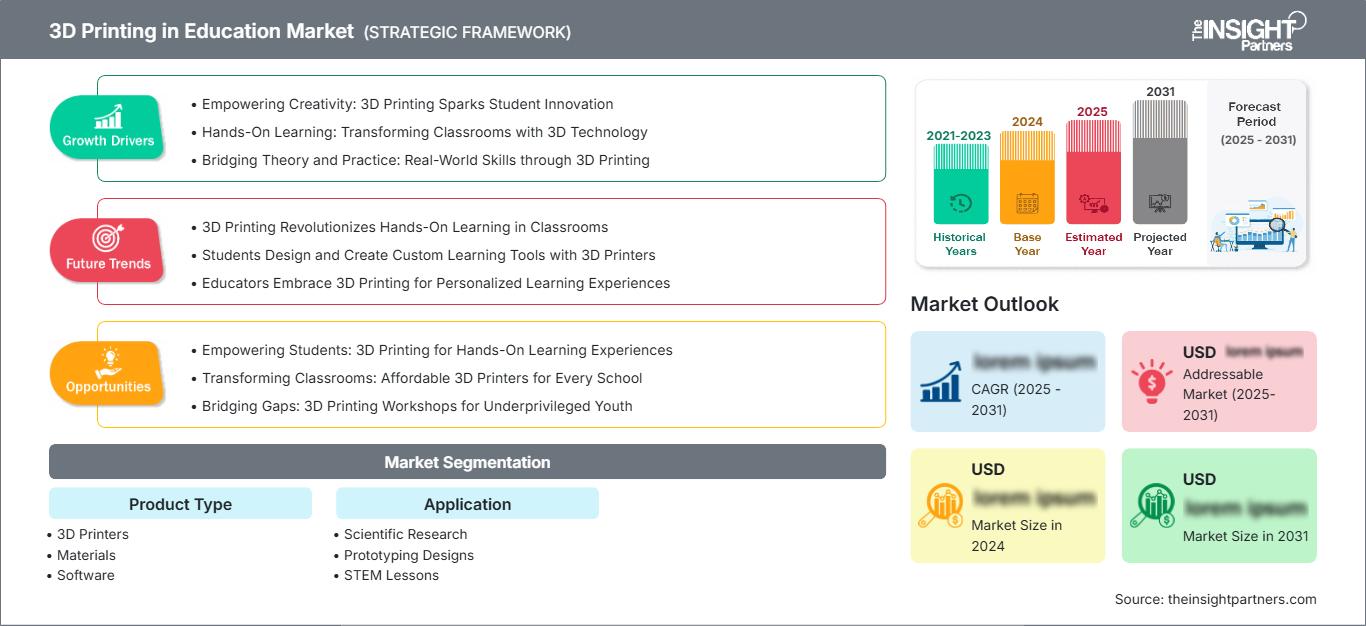
3D Printing in Education Market: Strategic Insights
Regional Insights
North America 3D printing in education market
North America accounted for approximately 34–38% of the 3D printing in education market share in 2025 and is forecast to register a CAGR of 8.5–9.5% between 2026 and 2034. The region benefits from strong educational funding frameworks, extensive research infrastructure, and high awareness of advanced manufacturing technologies. Universities and technical institutions continue to expand investments in fabrication laboratories, innovation centers, and engineering research facilities to strengthen student engagement and workforce readiness.
The presence of established additive manufacturing suppliers and technology partners further supports adoption throughout the region. Educational institutions increasingly integrate digital fabrication into engineering, architecture, healthcare, and design programs to improve practical learning outcomes. Growing emphasis on interdisciplinary education, combined with continued public and private investment in STEM initiatives, is expected to sustain market expansion. Widespread availability of curriculum resources and educator training programs also contributes to stronger implementation across both higher education and secondary education segments.
U.S. 3D printing in education market
The United States represented 72–76% of North American revenue in 2025 and is expected to grow at a CAGR of 8.7–9.7% throughout the forecast period. The country maintains one of the most advanced educational technology ecosystems globally, supported by a large concentration of research universities, engineering schools, and innovation-focused institutions. Adoption remains strongest in engineering design, biomedical education, aerospace research, product development, and applied manufacturing disciplines.
Major industry suppliers maintain extensive partnerships with educational organizations across the country. These collaborations enable institutions to access professional-grade equipment, software, and training resources that align with industry requirements. Demand is further supported by federal and state initiatives promoting advanced manufacturing capabilities and workforce development. Expansion of maker spaces, entrepreneurship programs, and interdisciplinary innovation centers continues to create opportunities for broader technology integration. As institutions seek to prepare graduates for increasingly digital industrial environments, additive manufacturing is expected to remain a priority educational investment.
Europe 3D printing in education market
Europe held 27–31% of global 3D printing in education market revenue in 2025 and is projected to expand at a CAGR of 8.0–9.0% through 2034. The region benefits from strong industrial manufacturing capabilities, extensive research networks, and established engineering education systems. Germany remains the leading national market due to its powerful manufacturing sector, long-standing technical education traditions, and close cooperation between universities and industrial organizations. Educational institutions increasingly deploy additive manufacturing technologies across engineering and industrial design programs.
In the UK, the adoption of technology is being further improved via e-learning, advanced design education, and research at universities. In addition, universities adopt additive manufacturing technology to improve prototyping, scientific visualization, and multidisciplinary project collaboration. France, Italy, and Spain pursue similar adoption policies by modernizing education systems and constructing technology and laboratory facilities. Growing interest in sustainable and digital manufacturing technologies also encourages adoption. As schools seek to be better prepared for future industrial needs, the capabilities of additive manufacturing are becoming increasingly important.
APAC 3D printing in education market
Asia Pacific region contributed between 24%-28% of the worldwide revenue in 2025 and is expected to exhibit the highest regional CAGR of 10.5%-11.5% during the forecast period. The region is dominated by China due to the country's manufacturing strength, innovative strategies, and high-end technology education programs.
Japan and South Korea have been making increased use of the product as part of their engineering and technology learning process. India and Australia are experiencing rising adoption of the product at universities, research institutions, and vocational education centers. Digital transformation and manufacturing competitiveness have created favorable market conditions for growth. Increased awareness of practical learning techniques makes it possible.
Middle East & Africa 3D printing in education market
The Middle East and Africa market is projected to expand at a CAGR of 8.8–9.8% through 2034. Saudi Arabia and the United Arab Emirates are leading adoption through investments in innovation ecosystems, smart education initiatives, and advanced technical training infrastructure.
South Africa and other regions have been witnessing slow adoption due to efforts by governments and educational institutions to advance workforce development and diversify industry. Increased technological knowledge and infrastructure development will be crucial in the future adoption process in educational settings.
Segmentation Analysis
Product Type
The Product Type segment is forecasted to exhibit a CAGR of 8.9-9.9% for the period from 2026 to 2034. Schools are inclined towards additive manufacturing platforms with an integrated ecosystem that includes hardware, materials, and software components. The procurement decision depends on the ease of integration, learning results, operational expenses, maintenance needs, and alignment with education programs. With the advent of fabrication labs in schools, demand for all products has increased.
- 3D Printers: Represent the largest product category, providing the physical infrastructure required for classroom demonstrations, engineering projects, research applications, and hands-on student learning. Continued improvements in reliability and affordability are supporting broader institutional adoption.
- Materials: Educational adoption of polymers, resins, and specialty materials is increasing as institutions seek greater flexibility for prototyping, scientific studies, healthcare modeling, and multidisciplinary innovation projects across diverse academic departments.
- Software: Design, simulation, and workflow management platforms are gaining importance as institutions prioritize collaborative learning environments, cloud-based accessibility, and streamlined design-to-production processes that improve educational effectiveness.
Application
The Applications segment is forecast to grow at a 9.4-10.4% CAGR from 2026-2034. The adoption pattern is increasingly tied to curriculum updates and requirements for hands-on teaching techniques. Educational institutions are increasing their use of additive manufacturing in research projects, innovation, and technical training.
- Scientific Research: Universities and research centers utilize additive manufacturing to create experimental components, customized laboratory equipment, and functional prototypes that accelerate innovation and support interdisciplinary scientific investigations.
- Prototyping Designs: This application enables students to rapidly transform digital concepts into physical models, strengthening product development education while enhancing creativity, design validation, and engineering problem-solving capabilities.
- STEM Lessons: The fastest-expanding application area supports interactive science, technology, engineering, and mathematics education through practical demonstrations that improve conceptual understanding and student participation.
- 3D Visual Aids: Widely used to create anatomical models, architectural structures, engineering assemblies, and scientific representations that improve comprehension of complex concepts through physical interaction and visualization.
Opportunity Snapshot
| Application | Revenue Contribution | Trend Tag | Adoption Stage |
| Scientific Research | High | Research Models | Mature |
| Prototyping Designs | High | Design Validation | Scaling |
| STEM Lessons | High | Interactive STEM | Scaling |
| 3D Visual Aids | Medium | Physical Visualization | Mature |
3D Printing in Education Market Growth Drivers and Impact Analysis
Expansion of Advanced STEM Education Programs Worldwide
Educational authorities across developed and emerging economies are increasing investments in STEM-focused learning frameworks to develop technologically skilled workforces. The use of additive manufacturing tools enables students to engage with engineering concepts, scientific research, and product development through practical training. Unlike traditional classroom teaching, fabrication-based learning helps individuals improve their problem-solving, innovation, and design skills. Fabrication labs are being set up at universities, technical institutions, and high schools to support project-based learning. The government's growing interest in technical and digital education is expected to drive demand for additive manufacturing tools during the forecast period.
Rising Industry Demand for Digital Manufacturing Competencies
Manufacturing industries are undergoing rapid technological transformation characterized by automation, digital design workflows, and advanced production systems. There is a growing need for graduates with knowledge and experience in applying new manufacturing techniques such as additive manufacturing, computer-aided design, and rapid prototyping. Schools are incorporating fabrication skills in engineering, architecture, health care, and industrial design programs. Industrial-academic collaboration is also growing to ensure that educational programs align with industry needs. Students who gain experience in additive manufacturing techniques while in school are likely to be better prepared for the manufacturing industry. Consequently, educational institutions are increasing investments in hardware platforms, instructional resources, and facility upgrades to strengthen competitiveness and improve graduate employability across rapidly evolving industrial sectors.
Improved Accessibility Through Affordable and User-Friendly Platforms
The development of technology has greatly helped address issues surrounding its implementation in education. Current systems offer improved workflows, automated calibration, greater reliability, and cloud-based management that ensures efficiency. Educational institutions that were constrained by budgetary and technological limitations now have an opportunity to implement solutions designed specifically for the learning environment. Most companies now offer integrated packages consisting of all components, like the hardware, software, materials, training, and support services that facilitate easy implementation of these solutions. Improvements in safety and material handling ensure wider applicability across different levels of education, including primary, secondary, and higher education institutions.
3D Printing in Education Market Future Trends
Artificial Intelligence Integration in Design and Learning Workflows
The 3D printing in education market trends are increasingly shaped by the integration of artificial intelligence into design, modeling, and fabrication processes. There are instances where institutions of learning are beginning to implement AI technology as a tool to simplify design processes, automate optimization, and guide students through design projects. Within the next ten years, AI-based additive manufacturing platforms will make the technology more accessible to non-technical people and improve learning outcomes in engineering, architecture, and product design. These tools can help teachers make the experience more personalized, shorter, and more efficient in their classes. With digital transformations taking place across educational institutions worldwide, the integration of AI with additive manufacturing is set to introduce new teaching methods.
Expansion of Connected and Distributed Fabrication Ecosystems
Learning institutions have been trying to create networked fabrication environments comprising multiple campuses, labs, and centers connected through a common digital infrastructure. Cloud-based additive manufacturing tools enable students and researchers to collaborate remotely on design tasks using shared production resources. Future evolution will help increase the efficiency of resource use, reduce infrastructure redundancy, and make advanced manufacturing tools more accessible. Learning institutions with multiple campuses across geographic regions can benefit in particular from centralized workflow management and digital collaboration opportunities. As educational organizations invest in smart learning environments and digital labs, distributed fabrication environments will be a key element of advanced technical education.
3D Printing in Education Market Opportunities
Growing Penetration Across Vocational and Technical Education Systems
Vocational and technical education institutions present a substantial opportunity for additive manufacturing vendors seeking long-term growth. Governments in many nations are adopting workforce development initiatives that emphasize manufacturing, industrial automation, and digital manufacturing technologies. In such a situation, training institutions need practical equipment to facilitate effective learning and delivery of curricula. In the 3D Printing in Education Market Forecast, vocational training is expected to become a significant channel for adoption, as employers require graduates with practical skills for the modern manufacturing environment. Companies that provide low-cost offerings and offer training, certification, and curriculum content are most likely to benefit from the growing number of customers. Another way to increase market penetration is to collaborate with organizations engaged in workforce development and industry players.
Subscription-Based Educational Manufacturing Ecosystems
Another significant opportunity is to develop an integrated subscription ecosystem that incorporates hardware, software platforms, digital content, materials, and technical support services. Increasingly, educational organizations are opting for bundled solutions to avoid complications in procurement and maintenance. The subscription model will be more affordable, enabling the organization to stay up to date with technology and learning resources. The model will ensure that the vendor receives steady income and better customer retention, while the educational organization will be guaranteed budget stability and lower maintenance needs. This solution is especially valuable for schools and universities looking to implement it without incurring huge upfront costs.
Frequently Asked Questions

- Comprehensive Market Sizing and Forecast Analysis
- Detailed Segmentation Analysis
- In-Depth Market Dynamics Assessment
- Regional and Country-Level Insights
- Competitive Landscape and Company Benchmarking
- Strategic Business Intelligence
Recent Reports
Testimonials

The Insight Partners provided valuable market intelligence that supported our global go-to-market strategy. Their team was professional, responsive, and attentive to our feedback, providing thoughtful analysis and helpful methodological clarifications throughout the project.
Junmo Kim Chief Financial Officer (CFO), Enertech Co., Ltd.
The Insight Partners' SCADA System Market report is comprehensive, with valuable insights on current trends and future forecasts. The team was highly professional, responsive, and supportive throughout. We are very satisfied and highly recommend their services.
RAN KEDEM Partner, Reali Technologies LTDs
I requested a report on a very specific software market and the team produced the report in a few days. The information was very relevant and well presented. I then requested some changes and additions to the report. The team was again very responsive and I got the final report in less than a week.
JEAN-HERVE JENN Chairman, Future Analytica
We worked with The Insight Partners for an important market study and forecast. They gave us clear insights into opportunities and risks, which helped shape our plans. Their research was easy to use and based on solid data. It helped us make smart, confident decisions. We highly recommend them.
PIYUSH NAGPAL Sr. Vice President, High Beam Global
The Insight Partners delivered insightful, well-structured market research with strong domain expertise. Their team was professional and responsive throughout. The user-friendly website made accessing industry reports seamless. We highly recommend them for reliable, high-quality research services
YUKIHIKO ADACHI CEO, Deep Blue, LLC.
This is the first time I have purchased a market report from The Insight Partners.While I was unsure at first, I visited their web site and felt more comfortable to take the risk and purchase a market report.I am completely satisfied with the quality of the report and customer service. I had several questions and comments with the initial report, but after a couple of dialogs over email with their analyst I believe I have a report that I can use as input to our strategic planning process.Thank you so much for taking the extra time and making this a positive experience.I will definitely recommend your service to others and you will be my first call when we need further market data.
JOHN SUZUKI President and Chief Executive Officer, Board Director, BK Technologies
I wish to appreciate your support and the professionalism you displayed in the course of attending to my request for information regarding to infectious disease IVD market in Nigeria. I appreciate your patience, your guidance, and the fact that you were willing to offer a discount, which eventually made it possible for us to close a deal. I look forward to engaging The Insight Partners in the future, all thanks to the impression you have created in me as a result of this first encounter.
DR CHIJIOKE ONYIA MANAGING DIRECTOR, PineCrest Healthcare Ltd.Reason to Buy
- Informed Decision-Making
- Understanding Market Dynamics
- Competitive Analysis
- Identifying Emerging Markets
- Customer Insights
- Market Forecasts
- Risk Mitigation
- Boosting Operational Efficiency
- Strategic Planning
- Investment Justification
- Tracking Industry Innovations
- Aligning with Regulatory Trends





 Get Free Sample for