
3D Printing In Healthcare Market Growth, Trends, and Analysis by 2031
Coverage: By Component (System and Material); Type (Selective Laser Sintering, Photopolymerization, Thermal Inkjet Printers, Fused Deposition Modeling, Stereo lithography, Electron Beam Melting and Others); and Application (Tissues & Organs, Implants & Prostheses, Orthopedics, Hearing Aids, Drug Delivery Devices and Others), and Geography (North America, Europe, Asia Pacific, and South and Central America)
- Status : Data Released
- Report Code : TIPTE100000717
- Category : Life Sciences
- No. of Pages : 150
- Available Report Formats :


- Last update date : July 28, 2026


2024 Market Size
US$ 6.52 Bn
Base year value
2031 Forecast
US$ 21.14 Bn
Projected by 2031
CAGR 2025-2031
18.3 %
Growth rate
Addressable Market
US$ 94.52 Bn
(2025-2031)
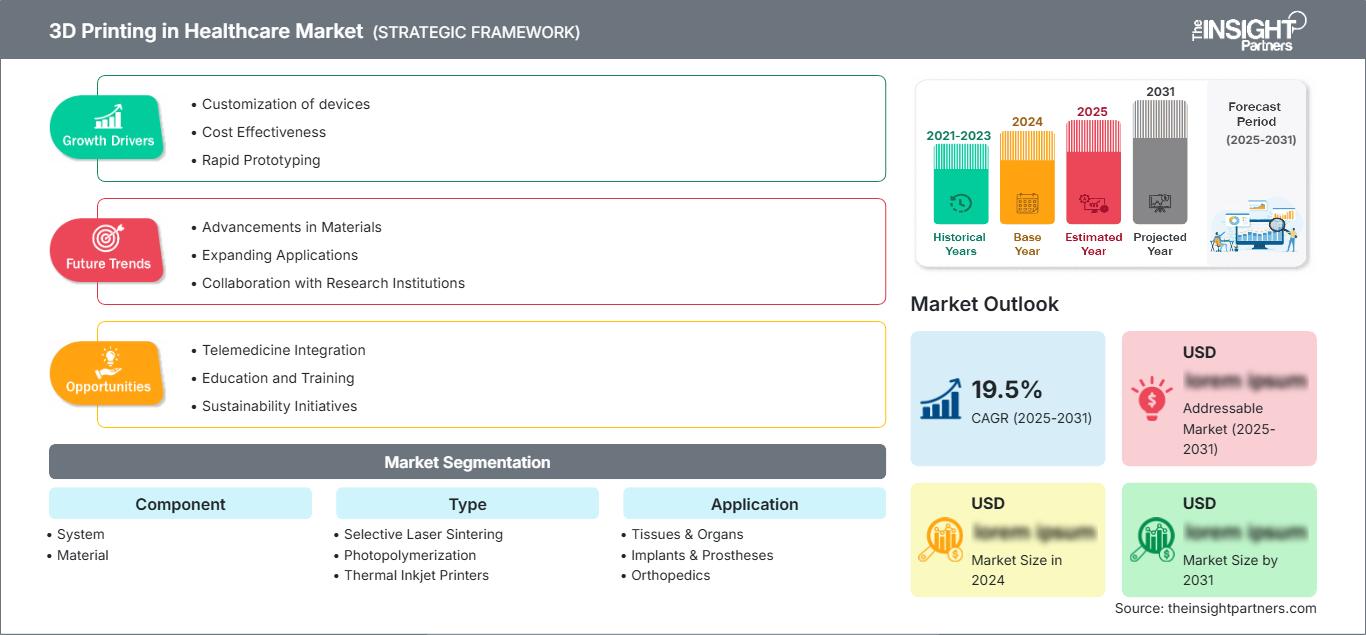
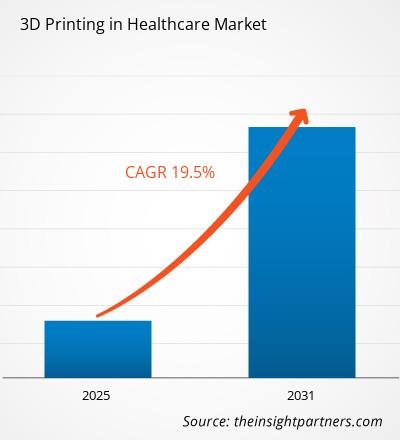
The 3d printing in healthcare market size stoood at US$ 6.52 Billion in 2025, and expected to reach US$ 21.14 Billion by 2034, growing at a CAGR of 18.3% during 2026–2034. The market continues to grow owing to the growing adoption of additive manufacturing in hospitals, medical devices companies, and dentists & orthopedics professionals for producing implants, models, prosthesis, and other tissue-engineering applications.
In North America, the growth in the adoption rate is estimated to remain strong with a high CAGR of 17.5–18.5% till 2034, driven by POC printing facilities, quality system aligned with FDA, and payers’ interest in efficient procedures. The size of the 3d printing in healthcare market depends on hospital investment in anatomical modeling, customized orthopedic implants, and biocompatible materials minimizing fittings cycles.
3D Printing in Healthcare Market Assessment and Insights
- North America accounted for 38–41% share in 2025 and is projected to grow at a CAGR between 17.5–18.5% during 2026–2034, led by hospital-based printing, FDA familiarity, and strong medical device outsourcing.
- US represented 83–87% of North America in 2025 and is expected to grow at a CAGR between 17.6–18.6% during 2026–2034, supported by certified contract manufacturing.
- Europe held 25–28% share in 2025 and is projected to expand at a CAGR between 16.5–17.5% during 2026–2034, with Germany, the UK, France, Italy, and Spain leading regulated adoption.
- Asia Pacific captured 21–24% share in 2025 and is forecast to grow at a CAGR between 19.5–20.5% during 2026–2034, led by China, Japan, South Korea, India, and Australia.
- Largest Segment Implants & Prostheses held 34–37% market share in 2025 and is projected to grow at a CAGR between 18.0–19.0% during 2026–2034.
- High Growth Segment Tissues & Organs held 8–11% market share in 2025 and is projected to grow at a CAGR between 22.0–23.5% during 2026–2034.
- Key companies analyzed in detail: 3D Systems Corporation, Arcam AB, EnvisionTEC GmbH, Nikon SLM Solutions AG, Stratasys Ltd., Javelin Technologies Inc., Tissue Regeneration Systems, Inc., Materialise NV, Organovo Holdings, Inc., Biomedical Modeling Inc.
Source: The Insight Partners' analysis based on proprietary research, government publications, company annual reports, investor presentations, industry databases, and expert interviews.
Clinical additive manufacturing is transitioning from prototype development to production as software, imaging, materials science, and quality control come together. Prior early adopters focused on anatomical models and dental guides, while present applications are more focused on implants, prosthetics, orthopedic parts, and surgical planning aids. The production paradigm will evolve towards a hybrid model where hospitals will take care of designing and validating, while specialty manufacturers will contribute with certified printing capabilities, traceability, sterilization assistance, and consistent material properties.
The future is shaped by regions that adopt localized manufacturing, reimbursement data, and specific medical device regulations. Emerging markets are building infrastructure in tertiary hospitals, trauma centers, dental chains, and orthopedic capabilities, while mature markets are establishing quality procedures for point-of-care labs. It will also benefit from advancements in digital health records, medical imaging, AI-based segmentation, and robust supply chain management that enables patient-specific devices to reach patients faster than traditional tool-based devices.
3D Printing in Healthcare Market Report Scope
| Report Attribute | Details |
|---|---|
| Market size in 2024 | US$ 6.52 Billion |
| Market Size by 2031 | US$ 21.14 Billion |
| Global CAGR (2025 - 2031) | 18.3% |
| Historical Data | 2021-2023 |
| Forecast period | 2025-2031 |
3D Printing in Healthcare Market Analysis
Demand will be amplified by increasing procedural complexity, an aging population, and the requirement for customized devices in orthopedic surgeries, cranio-maxillofacial reconstructions, hearing aids, and dental implants. Growth in 3D printing in the healthcare industry largely depends on imaging-driven workflows, in which CT or MRI scans are used to create 3D models of implants to be used in surgery.
The supply chain consists of scanner manufacturers, segmentation software vendors, materials suppliers, printer manufacturers, contract manufacturers, hospitals, and regulatory agencies. Supply chains will become more efficient due to increased standardization of biocompatible resins, titanium powder, PEEK materials, and validation processes. However, production is mostly centered within certified vendors thus making quality management important in procurement processes.
The level of competition is determined not by printer sales but by the depth of the platform itself. Such companies as 3D Systems Corporation, Stratasys Ltd., Materialise NV, and Nikon SLM Solutions AG compete using materials, software, services, and medical applications, while Organovo Holdings, Inc. and Tissue Regeneration Systems, Inc. focus on regenerative and scaffold-specific developments.
As it was seen in the 3d printing in healthcare market analysis, the strategic position is shifting towards full control over the workflow. Companies with regulated facilities, software for clinical planning, collaboration with hospitals, and materials specifically for certain applications can maintain higher margins than hardware suppliers.
● REPORT CUSTOMIZATION
Tailor This Report To Align With Your Specific Business Requirements
This report can be customized to align precisely with your business objectives, scope, and target markets. Customization options include tailored segmentation, geography, competitive analysis, and strategic insights to support informed decision-making.
Customize This Report →WHAT YOU CAN ADJUST
- ● Segmentations
- ● Geography
- ● Competitive Analysis
- ● Language Preferences
3D Printing in Healthcare Market: Strategic Insights
Regional Insights
North America 3d printing in healthcare market
North America accounted for 38–41% share in 2025 and is expected to grow at a CAGR between 17.5–18.5% during 2026–2034. The region benefits from advanced hospital networks, strong academic medical centers, and wider use of outsourced medical device prototyping. The 3d printing in healthcare market share is concentrated in implants, prostheses, surgical guides, and anatomical models. Demand is supported by regulatory experience with additive manufactured devices, ISO 13485 manufacturing capacity, and growing collaboration between radiology, surgery, and biomedical engineering teams. Adoption is strongest where procedure planning can reduce operating room uncertainty, shorten device iteration cycles, and improve fit for complex orthopedic and craniofacial cases.
U.S. 3d printing in healthcare Market
The U.S. represented 83–87% of North America in 2025 and is projected to grow at a CAGR between 17.6–18.6% during 2026–2034. The country has a dense base of medical device innovators, contract manufacturers, academic hospitals, and dental laboratories using additive manufacturing for prototypes and regulated end-use parts. Application trends center on patient-specific implants, radiopaque anatomical models, orthotics, surgical planning, and device development support. 3D Systems Corporation, Stratasys Ltd., Materialise NV, and Biomedical Modeling Inc. maintain visible U.S. healthcare exposure through planning tools, manufacturing services, and clinical modeling capabilities, helping buyers manage design control and validation requirements.
Europe 3d printing in healthcare Market
Share of Europe was 25–28% in 2025 and is projected to grow at CAGR between 16.5–17.5% during 2026–2034. The leading countries in Europe include Germany, which relies on the depth of engineering, manufacturing of orthopedic devices, and hospital adoption based on the quality requirements of EU MDR. There is increasing adoption in the UK for surgical planning, oncology, and maxillofacial applications. Adoption is growing in France, Italy, and Spain via specialty hospitals, dental laboratories, and reconstructive surgery centers. Materialise NV, Nikon SLM Solutions AG, and Arcam AB contribute to the supply chain in Europe through software, metal additive manufacturing, and manufacturing of devices.
APAC 3d printing in healthcare Market
APAC captured 21–24% share in 2025 and is forecast to grow at a CAGR between 19.5–20.5% during 2026–2034. China is the leading country, followed by Japan, South Korea, India, and Australia, as hospitals and device manufacturers invest in localized production and imaging-led surgical planning. Industrial capacity, government-backed medtech programs, dental digitization, and expanding orthopedic volumes support adoption. Japan and South Korea emphasize precision devices, while India is developing cost-efficient prosthetics and implants for trauma and reconstructive procedures.
Middle East & Africa 3d printing in healthcare Market
Middle East & Africa is projected to grow at a CAGR between 15.0–16.0% during 2026–2034, with the UAE leading regional adoption. Saudi Arabia and the UAE are investing in advanced hospitals, medical tourism, and point-of-care innovation, supported by broader infrastructure modernization. South Africa remains the key African market due to academic medical expertise and trauma-care needs. Rest of MEA adoption is gradual, constrained by funding, specialist workforce availability, and clinical validation capacity, but supported by prosthetics and surgical modeling needs.
Segmentation Analysis
Component
Component is projected to grow at a CAGR between 17.8–18.8% during 2026–2034. The segment reflects the combined demand for printer systems and validated materials used in clinical and medical device workflows. The 3d printing in healthcare market scope is widening as buyers evaluate system uptime, biocompatibility, sterilization compatibility, quality documentation, and lifecycle service rather than purchase price alone.
- System demand is led by hospitals, dental laboratories, and device manufacturers seeking reliable platforms for surgical models, implants, guides, and prosthetic components where repeatability and software integration determine procurement decisions.
- Material adoption is strategically important because biocompatible resins, titanium alloys, PEEK, ceramics, and bioinks influence device safety, mechanical performance, regulatory documentation, and application expansion across clinical specialties.
Type
Type is expected to grow at a CAGR between 18.1–19.1% during 2026–2034. Technology selection depends on required resolution, material compatibility, mechanical strength, surface finish, throughput, and regulatory documentation. Metal powder bed systems serve implants, photopolymerization supports dental and anatomical models, and extrusion technologies are expanding in PEEK implants, prosthetics, and scaffold-related research.
- Selective Laser Sintering is valued for durable polymer parts, orthotic devices, and complex geometries, supporting batch production where tooling avoidance and material efficiency are important.
- Photopolymerization maintains strong demand in dental, surgical planning, and anatomical models because high resolution, material variety, and surface quality align with patient-specific workflows.
- Thermal Inkjet Printers support selected tissue engineering and drug delivery research where controlled droplet deposition, biological material handling, and laboratory flexibility remain central.
- Fused Deposition Modeling is widely used for cost-efficient models, prosthetic prototypes, and selected PEEK applications where accessibility, material availability, and workflow simplicity support adoption.
- Stereo lithography is strategically important in high-detail anatomical models, dental guides, and surgical planning tools requiring smooth surfaces, dimensional precision, and validated photopolymer materials.
- Electron Beam Melting supports metal implants and orthopedic applications where porous structures, titanium compatibility, and bone in growth potential provide differentiation in load-bearing device design.
Application
Application is projected to expand at a CAGR between 18.6–19.6% during 2026–2034. Applications are diversifying as hospitals and manufacturers move beyond visualization into implantable devices, prostheses, orthopedics, hearing aids, drug delivery platforms, and tissue research. Clinical value is highest where customization improves fit, reduces surgical uncertainty, or enables complex geometries that conventional manufacturing cannot deliver efficiently.
- Tissues & Organs is an emerging research-led application where bioinks, cell viability, vascularization strategies, and scaffold design are central to long-term regenerative medicine commercialization.
- Implants & Prostheses remains the largest application, supported by patient-matched cranial, dental, orthopedic, and facial devices where fit, comfort, and functional restoration create measurable clinical value.
- Orthopedics benefits from porous metal implants, surgical guides, and customized reconstruction devices, particularly in trauma, revision surgery, spinal cases, and joint-related procedures.
- Hearing Aids represent a mature digital manufacturing use case, where ear-specific geometry, rapid production, and consistent shell quality have established additive workflows across audiology supply chains.
- Drug Delivery Devices are gaining strategic interest as printed geometries support controlled release, personalized dosing concepts, and complex internal structures for next-generation therapeutic delivery.
Opportunity Snapshot
| Segment Name | Revenue Contribution | Trend Tag | Adoption Stage |
|---|---|---|---|
| Tissues & Organs | Low | Bioprinting | Emerging |
| Implants & Prostheses | High | Patient Fit | Scaling |
| Orthopedics | High | Porous Implants | Scaling |
| Hearing Aids | Medium | Ear Shells | Mature |
| Drug Delivery Devices | Low | Controlled Release | Emerging |
3D Printing in Healthcare Market Growth Drivers and Impact Analysis
Expansion of Patient-Specific Implants
The personalized implants have become a feasible driver owing to the availability of high-resolution images, appropriate materials, and advanced designing software that would enable them to mimic the anatomical structures better than any inventory of devices. This helps in positioning where a small difference in dimensions could prolong surgery times or cause complications in the cranial, facial, dental, spinal, and orthopedic applications. In addition, hospitals are using digital planning to bring surgeons, engineers, and manufacturers onto a single platform before manufacturing begins. The business effect of this trend is being seen in terms of high value added devices, increasing titanium and PEEK material usage, and out-sourcing to ISO compliant additive manufacturing vendors.
Point-of-Care Printing Moves into Regulated Workflows
This driver involves moving from the creation of models used in education to manufacturing through a clinical process. 3D labs are being developed in hospitals where the radiology, surgical, biomedical engineering, and purchasing departments work together in order to facilitate quicker review and planning processes. The business benefit is more pronounced during complex surgical procedures where the use of models, surgical guides, and customized devices lowers the risk of uncertainties and improves communication. It is important to have regulatory requirements met, which means that adoption occurs within organizations that can provide documentation, material management, personnel training, and quality control.
Biocompatible Materials Broaden Clinical Use Cases
The material base is expanding from standard polymers into certified resins, metals, ceramics, PEEK, and early-stage bioinks, enabling more applications to move closer to clinical use. The choice of material influences strength, fatigue properties, sterilization capability, radiodensity, surface quality, and tissue interaction, making it a critical adoption criterion rather than a mere consumable choice. The device makers are now choosing platforms on the basis of material libraries that have been tested and have supporting documents. This helps remove obstacles to adopting devices such as dental appliances, orthopedic implants, surgical guides, anatomical models, and certain parts of prosthetics. Increased materials availability is beneficial to both suppliers and purchasers of healthcare solutions.
3D Printing in Healthcare Market Future Trends
AI-Enabled Planning and Automated Segmentation
The next wave of 3d printing in healthcare market trends will be shaped by AI-enabled segmentation, automated design checks, and cloud-based clinical collaboration. These tools can reduce manual image processing time, improve repeatability, and support higher case volumes in hospital 3D labs. Future workflows will increasingly compare preoperative images, virtual plans, and post-operative outcomes in one environment. This will improve evidence generation, support reimbursement discussions, and help manufacturers scale personalized devices without proportional increases in engineering labor. Suppliers that combine AI, traceability, and regulatory documentation into unified platforms will gain advantage as healthcare systems demand faster case-to-care delivery.
Radiopaque and Functional Anatomical Models
Functional anatomical models are expected to move beyond visual training into imaging calibration, device testing, and procedural simulation. Radiopaque materials that reproduce tissue-like imaging behavior can support CT-based training, algorithm validation, and interventional planning without relying solely on cadavers or generic phantoms. This trend will benefit radiology departments, medical device developers, and teaching hospitals seeking repeatable, ethical, and patient-specific simulation assets. Commercially, it creates demand for multi-material printers, advanced resins, and partnerships between imaging companies and additive manufacturing providers. The result is a broader role for printed models across education, product development, and clinical quality improvement.
3D Printing in Healthcare Market Opportunities
Scaling Certified Contract Manufacturing Capacity
Medical device companies need reliable partners that can translate additive designs into repeatable production under documented quality systems. This creates an investment opportunity in certified contract manufacturing facilities equipped for polymers, metals, finishing, inspection, sterilization coordination, and traceability. The 3d printing in healthcare market Forecasts suggest that outsourced capacity will remain important because many device innovators lack the capital or regulatory depth to operate specialized additive lines internally. Providers that offer design optimization, process validation, and manufacturing scale-up can capture higher-margin projects. The strongest opportunities will emerge where contractors serve both development and production, reducing customer risk across commercialization stages.
Localized Prosthetics and Orthopedic Access
Localized production can improve access to prosthetics, orthotics, and orthopedic solutions in regions with limited specialist supply chains. Additive manufacturing allows digital scans or imaging files to support distributed design, while certified hubs complete production and quality checks. This model is attractive for emerging economies, rehabilitation centers, military healthcare, and trauma-heavy systems where customization and turnaround time matter. Investors can build regional networks linking clinics, scanning partners, and manufacturing hubs. The opportunity is not limited to low-cost devices; it includes premium patient-matched solutions for urban hospitals and affordable functional prosthetics for underserved populations.
Recent Developments
- December 2025: Stratasys Ltd. announced broader U.S. commercial availability of RadioMatrix radiopaque material for medical imaging applications, enabling patient-specific models with tunable X-ray visibility for training, research, and device testing. The development strengthened its Digital Anatomy platform for radiology and procedural simulation use cases.
- April 2025: 3D Systems Corporation announced that its EXT 220 MED point-of-care solution enabled University Hospital Basel to produce the first MDR-compliant 3D-printed PEEK facial implant manufactured within a hospital setting, with the implant used in successful surgery completed on March 18, 2025.
- February 2025: Stratasys Ltd. announced that its Stratasys Direct manufacturing facility in Tucson, Arizona achieved ISO 13485 certification, addressing medical device quality management requirements and supporting production of 3D-printed components for medical manufacturers seeking regulated manufacturing pathways.
Frequently Asked Questions

- Comprehensive Market Sizing and Forecast Analysis
- Detailed Segmentation Analysis
- In-Depth Market Dynamics Assessment
- Regional and Country-Level Insights
- Competitive Landscape and Company Benchmarking
- Strategic Business Intelligence
Recent Reports
Testimonials

The Insight Partners' SCADA System Market report is comprehensive, with valuable insights on current trends and future forecasts. The team was highly professional, responsive, and supportive throughout. We are very satisfied and highly recommend their services.
RAN KEDEM Partner, Reali Technologies LTDs
I requested a report on a very specific software market and the team produced the report in a few days. The information was very relevant and well presented. I then requested some changes and additions to the report. The team was again very responsive and I got the final report in less than a week.
JEAN-HERVE JENN Chairman, Future Analytica
We worked with The Insight Partners for an important market study and forecast. They gave us clear insights into opportunities and risks, which helped shape our plans. Their research was easy to use and based on solid data. It helped us make smart, confident decisions. We highly recommend them.
PIYUSH NAGPAL Sr. Vice President, High Beam Global
The Insight Partners delivered insightful, well-structured market research with strong domain expertise. Their team was professional and responsive throughout. The user-friendly website made accessing industry reports seamless. We highly recommend them for reliable, high-quality research services
YUKIHIKO ADACHI CEO, Deep Blue, LLC.
This is the first time I have purchased a market report from The Insight Partners.While I was unsure at first, I visited their web site and felt more comfortable to take the risk and purchase a market report.I am completely satisfied with the quality of the report and customer service. I had several questions and comments with the initial report, but after a couple of dialogs over email with their analyst I believe I have a report that I can use as input to our strategic planning process.Thank you so much for taking the extra time and making this a positive experience.I will definitely recommend your service to others and you will be my first call when we need further market data.
JOHN SUZUKI President and Chief Executive Officer, Board Director, BK Technologies
I wish to appreciate your support and the professionalism you displayed in the course of attending to my request for information regarding to infectious disease IVD market in Nigeria. I appreciate your patience, your guidance, and the fact that you were willing to offer a discount, which eventually made it possible for us to close a deal. I look forward to engaging The Insight Partners in the future, all thanks to the impression you have created in me as a result of this first encounter.
DR CHIJIOKE ONYIA MANAGING DIRECTOR, PineCrest Healthcare Ltd.Reason to Buy
- Informed Decision-Making
- Understanding Market Dynamics
- Competitive Analysis
- Identifying Emerging Markets
- Customer Insights
- Market Forecasts
- Risk Mitigation
- Boosting Operational Efficiency
- Strategic Planning
- Investment Justification
- Tracking Industry Innovations
- Aligning with Regulatory Trends





 Get Free Sample for