
48 Volt Battery System Market Trends, Demand & Growth by 2034
Coverage: By Component (48-volt Lithium Ion Battery, Battery Controller, DC-DC converter, Combined starter-generator, Others); Vehicle Type (Passenger Vehicle, Light Commercial Vehicle) , and Geography (North America, Europe, Asia Pacific, and South and Central America)
- Status : Data Released
- Report Code : TIPRE00010253
- Category : Automotive and Transportation
- No. of Pages : 150
- Available Report Formats :


- Last update date : August 07, 2026


2025 Market Size
US$ 5.25 Bn
Base year value
2034 Forecast
US$ 67.29 Bn
Projected by 2034
CAGR 2026-2034
32.77 %
Growth rate
Addressable Market
US$ 251.43 Bn
(2026-2034)
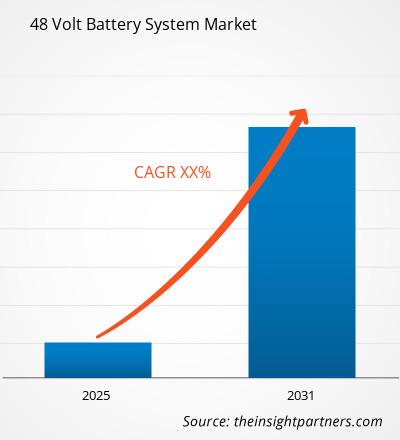
The 48 volt battery system market was valued at US$ 5.25 Billion in 2025 and is projected to reach US$ 67.29 Billion by 2034, registering a CAGR of 32.77% during 2026–2034. Market expansion is closely associated with the automotive industry's increasing focus on low-emission mobility solutions, wider deployment of mild-hybrid architectures, and growing integration of advanced energy-management systems. The combination of regulatory pressure and cost-effective electrification continues to support adoption across passenger and commercial vehicle categories.
Driven by vehicle-electrification investments and efficiency-focused transportation policies, North America remains a strategically important regional market. The 48 volt battery system market size across the region benefits from rising integration of starter-generators, increased demand for lithium-ion battery technologies, and strong participation from automotive OEMs and component suppliers. Regional demand is expected to progress at a CAGR range of 29.0–32.0% through the forecast period as manufacturers expand electrified vehicle portfolios.
48 Volt Battery System Market Assessment and Insights
- North America: Strong automotive technology adoption and favorable emission-compliance strategies support continued demand. Share in 2025: 32–34%. CAGR between 2026–2034: 29.0–32.0%.
- US: Advanced vehicle-electrification programs and extensive OEM investments position the country as the regional leader. Share in 2025: 74–78% of North America. CAGR between 2026–2034: 29.5–32.5%.
- Europe: Germany, the UK, France, Italy, and Spain drive demand through stringent vehicle-emission regulations and hybrid-technology investment. Share in 2025: 28–30%. CAGR between 2026–2034: 30.0–33.0%.
- Asia Pacific: China, Japan, South Korea, and India benefit from large-scale vehicle production and battery-manufacturing ecosystems. Share in 2025: 34–36%. CAGR between 2026–2034: 34.0–37.0%.
- Largest Segment: Passenger Vehicle remains the leading revenue contributor with a 48 volt battery system market share of 72–76% in 2025 and is anticipated to grow at a CAGR of 32.0–35.0% through 2034.
- High Growth Segment: 48-volt Lithium Ion Battery accounts for a market share of 34–38% in 2025 and is expected to expand at a CAGR of 35.0–38.0% during the forecast period.
- Key companies analyzed in detail: A123 Systems LLC, Delphi Technologies PLC, Vitesco Technologies GmbH, EnerSys, Furukawa Electric Co., Ltd., GS Yuasa International Ltd., Hitachi, Ltd., Johnson Controls International plc, Robert Bosch GmbH, Valeo SA
Source: The Insight Partners' analysis based on proprietary research, government publications, company annual reports, investor presentations, industry databases, and expert interviews.
Vehicle electrification strategies have evolved rapidly as global automotive manufacturers seek practical solutions for reducing fleet emissions while preserving affordability. The transition from conventional electrical architectures toward 48-volt platforms has accelerated adoption of lithium-ion batteries, advanced battery controllers, and regenerative energy-management systems. Production ecosystems increasingly emphasize localized manufacturing, software-enabled control functions, and integrated power electronics. These developments have improved system efficiency, enhanced vehicle performance, and strengthened the business case for widespread mild-hybrid deployment across mainstream vehicle segments worldwide.
The 48 volt battery system market report momentum is expected to be reinforced by rising investments in automotive electronics, battery-manufacturing facilities, and low-carbon transportation technologies. Countries across Asia Pacific and selected European economies continue introducing supportive electrification frameworks that encourage deployment of intermediate hybrid solutions. Growing collaboration among OEMs, battery suppliers, and technology companies is anticipated to accelerate commercialization, improve supply-chain resilience, and expand the addressable market for advanced 48-volt systems.
48 Volt Battery System Market Report Scope
| Report Attribute | Details |
|---|---|
| Market size in 2025 | US$ 5.25 Billion |
| Market Size by 2034 | US$ 67.29 Billion |
| Global CAGR (2026 - 2034) | 32.77% |
| Historical Data | 2021-2024 |
| Forecast period | 2026-2034 |
48 Volt Battery System Market Analysis
The 48 volt battery system market growth trajectory is strongly supported by the need for economical electrification solutions that bridge the gap between internal-combustion vehicles and fully electric mobility. Automotive manufacturers increasingly deploy 48-volt systems to achieve measurable fuel-efficiency gains while minimizing redesign costs associated with high-voltage hybrid platforms. Integration of regenerative braking, electric torque assistance, and enhanced start-stop capabilities has improved vehicle performance and compliance with tightening emission standards. Growing consumer demand for lower operating costs and stricter fuel-efficiency requirements are further strengthening industry demand across major automotive markets.
Supply-chain activity continues to expand across battery manufacturing, electronics integration, and power-management technologies. The ecosystem includes battery-cell manufacturers, battery-management specialists, semiconductor suppliers, and vehicle OEMs collaborating to improve system efficiency and reliability. Expansion of mild-hybrid vehicle production volumes has increased demand for battery controllers, DC-DC converters, and starter-generator technologies. Additionally, advancements in lithium-ion chemistry are supporting higher energy density, improved cycling performance, and longer system life, contributing to broader adoption across global vehicle fleets.
Current 48 volt battery system market analysis indicates a competitive environment characterized by technology innovation, strategic partnerships, and platform integration capabilities. Major industry participants are focusing on complete system architectures rather than standalone components. Robert Bosch GmbH and Valeo SA continue emphasizing integrated electrification technologies, while Delphi Technologies PLC and Vitesco Technologies GmbH focus on efficient power-management and hybrid-system solutions. Competitive positioning increasingly depends on software-enabled functionality, battery durability, and the ability to deliver scalable platforms suitable for multiple vehicle categories.
Investment activity across the industry reflects long-term confidence in vehicle electrification pathways. Companies such as GS Yuasa International Ltd., A123 Systems LLC, EnerSys, Furukawa Electric Co., Ltd., Hitachi, Ltd., and Johnson Controls International plc are expanding capabilities across energy storage and intelligent power systems. Industry participants are also pursuing additional manufacturing capacity and localized sourcing strategies to improve resilience against supply disruptions. These initiatives are expected to support sustained market expansion while enabling greater penetration of electrified vehicle technologies throughout the forecast period.
● REPORT CUSTOMIZATION
Tailor This Report To Align With Your Specific Business Requirements
This report can be customized to align precisely with your business objectives, scope, and target markets. Customization options include tailored segmentation, geography, competitive analysis, and strategic insights to support informed decision-making.
Customize This Report →WHAT YOU CAN ADJUST
- ● Segmentations
- ● Geography
- ● Competitive Analysis
- ● Language Preferences
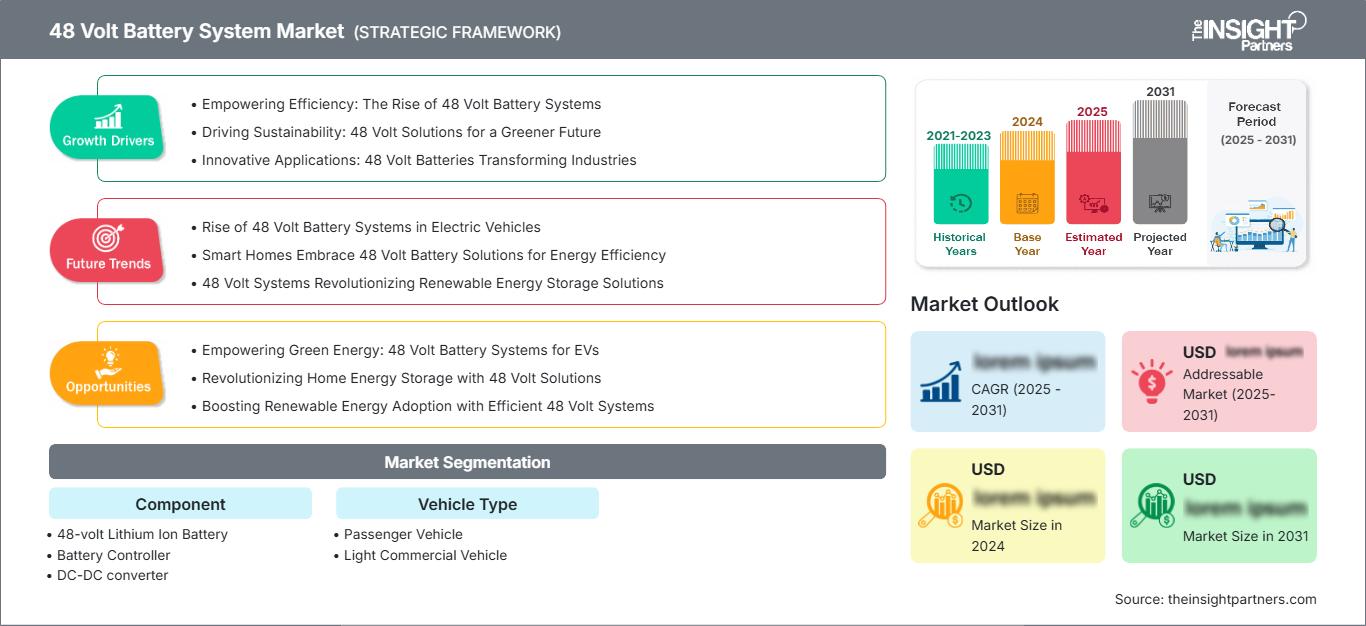
48 Volt Battery System Market: Strategic Insights
Regional Insights
North America 48 Volt Battery System Market
North America accounted for 32–34% of global revenue in 2025 and remains one of the most established automotive electrification markets. Adoption is supported by increasing deployment of mild-hybrid technologies, ongoing investments in vehicle efficiency improvements, and growing demand for advanced power-management systems. Automotive manufacturers across the region continue integrating 48-volt architectures to meet fuel-economy objectives while maintaining cost competitiveness. These dynamics are expected to support a regional growth rate of 29.0–32.0% CAGR during 2026–2034.
The 48 volt battery system market share in North America is strengthened by a mature supplier ecosystem, established automotive manufacturing capacity, and rising investment in battery production. Increasing application of low-voltage electrification systems within passenger vehicles and fleet-oriented commercial vehicles contributes to sustained demand. Additional support comes from investments in advanced automotive electronics and localized supply-chain development. As manufacturers continue introducing electrified models across multiple vehicle segments, regional adoption levels are expected to maintain a strong upward trajectory throughout the forecast period.
U.S. 48 Volt Battery System Market
The United States represented approximately 74–78% of North American 48 volt battery system market revenue in 2025, making it the largest national market within the region. Growth is supported by high automotive technology spending, robust research and development activity, and widespread deployment of electrified vehicle platforms. Major vehicle manufacturers continue integrating low-voltage hybrid systems to improve fuel efficiency and meet evolving regulatory requirements. The market is projected to expand at a 29.5–32.5% CAGR through 2034.
Strong participation from leading technology suppliers and automotive OEMs supports commercialization of advanced 48-volt architectures. Demand is expanding across passenger vehicles, pickup-based hybrid platforms, and selected light commercial vehicle applications. The country also benefits from growing investments in domestic battery manufacturing and vehicle-electronics production. Increasing collaboration between component vendors and automakers is expected to accelerate system integration while improving the availability of next-generation electrification technologies across the U.S. transportation sector.
Europe 48 Volt Battery System Market
Europe held a 28–30% 48 volt battery system market share in 2025 and is projected to record a 30.0–33.0% CAGR through the forecast period. The region remains a significant adopter of vehicle electrification technologies because of stringent emission-reduction targets and ongoing transition toward sustainable mobility. Germany serves as the leading national market due to its concentration of vehicle manufacturers, advanced engineering capabilities, and extensive hybrid vehicle development activities.
The United Kingdom continues investing in low-emission transportation programs and electrification-focused automotive production. France, Italy, and Spain are witnessing increasing deployment of mild-hybrid technologies as manufacturers seek cost-efficient compliance solutions for emissions regulations. Growth is further supported by expanding charging infrastructure ecosystems, government-backed sustainability initiatives, and continued investment in battery technologies. These combined factors position Europe as one of the most influential regional markets for 48-volt vehicle systems.
APAC 48 Volt Battery System Market
Asia Pacific represented 34–36% of global revenue in 2025, making it the largest regional 48 volt battery system market. Robust automotive production volumes, extensive battery-manufacturing capabilities, and increasing hybrid-vehicle adoption support strong demand. The region is expected to advance at a 34.0–37.0% CAGR during the forecast period.
China remains the leading market, followed by Japan, South Korea, India, and Australia. Government support for vehicle electrification, investments in battery production, and growing consumer demand for fuel-efficient transportation continue driving adoption. Expanding automotive exports and strong supplier ecosystems further reinforce regional growth prospects.
Middle East & Africa 48 Volt Battery System Market
The Middle East & Africa market is developing steadily as vehicle-efficiency considerations gain importance across transportation sectors. Although starting from a smaller base than major automotive regions, growing awareness of electrification technologies is supporting gradual adoption.
Saudi Arabia leads regional demand, followed by the UAE and South Africa. Investments in infrastructure modernization, transportation development, and energy-efficiency initiatives contribute to market expansion. The region is anticipated to grow at a 27.0–30.0% CAGR through 2034, supported by increasing automotive technology deployment and evolving mobility strategies.
Segmentation Analysis
Component
The component segment is expected to expand at a CAGR of 33.0–36.0% during 2026–2034. Market development is being driven by continuous innovation in energy storage, power conversion, and intelligent battery management technologies. As vehicle manufacturers accelerate electrification roadmaps, demand for integrated component architectures is increasing. The 48 volt battery system market scope continues broadening due to rising deployment of mild-hybrid systems, enhanced regenerative braking functionality, and the growing need for efficient low-voltage energy management across passenger and commercial vehicle applications.
- 48-volt Lithium Ion Battery – Functions as the primary energy-storage unit for mild-hybrid systems, enabling regenerative energy capture, electric torque assistance, and improved fuel economy. Rising energy-density improvements and falling battery manufacturing costs continue supporting long-term adoption.
- Battery Controller – Serves as the intelligence layer of the system by monitoring charging cycles, battery health, voltage stability, and safety performance. Increasing software sophistication is enhancing operational efficiency and reliability across electrified vehicle platforms.
- DC-DC Converter – Plays a critical role in connecting 48-volt and traditional 12-volt electrical architectures while ensuring stable power delivery. Expanding use of advanced in-vehicle electronics is increasing strategic demand for efficient conversion technologies.
- Combined Starter-Generator – Enables regenerative braking, seamless engine restart functionality, and electric boost capabilities. Its contribution to fuel-consumption reduction and emissions compliance makes it a key enabler of mild-hybrid vehicle adoption.
Vehicle Type
The vehicle type segment is anticipated to achieve a CAGR of 32.0–35.0% from 2026 to 2034. The adoption pattern is determined by regulations, fuel-efficiency goals, and the desire for more efficient solutions. There is an increasing trend towards the use of 48-volt technology across various vehicle classes to improve powertrain efficiency while maintaining affordability. Adoption of hybridization across passenger and commercial vehicles is expected to strengthen as it becomes a mainstream strategy in global automotive manufacturing.
- Passenger Vehicle – Represents the dominant segment due to high production volumes and widespread implementation of mild-hybrid solutions. Consumer preference for lower fuel consumption and enhanced vehicle performance continues driving demand across this category.
- Light Commercial Vehicle – Benefits from fleet operators’ focus on operational efficiency, reduced fuel expenditure, and emissions compliance. Increasing logistics activity and urban-delivery applications are contributing to greater system integration within commercial fleets.
Opportunity Snapshot
| Vehicle Type | Revenue Contribution | Trend Tag | Adoption Stage |
| Passenger Vehicle | High | Mild Hybrid | Mature |
| Light Commercial Vehicle | Medium | Fleet Efficiency | Scaling |
48 Volt Battery System Market Growth Drivers and Impact Analysis
Accelerating Global Emission Compliance Requirements
Automobile makers in various automotive zones around the world are facing ever-growing pressure regarding emissions and efficiency requirements. Various governments, particularly those in Europe, North America, and the Asia-Pacific, are implementing policies to reduce transportation carbon emissions and promote cost-effective electrification technologies. In such an environment, 48-volt technology can be considered an effective solution, helping them achieve considerable efficiency gains without increasing costs. Regenerative braking technology, improved start-stop systems, and electric boosting are some features that can help reduce fuel consumption in vehicles. Over the forecast period, stricter regulations would drive demand for low-voltage hybrid solutions in both passenger cars and commercial vehicles. This trend will continue supporting demand for batteries, controllers, converters, and starter-generators while strengthening overall industry growth prospects.
Increasing Adoption of Mild-Hybrid Vehicle Platforms
Deployment of mild-hybrid vehicles is beginning to take shape as one of the most potent forces driving industry growth. It is becoming clear that carmakers are coming to understand the benefit of a good balance in performance and cost efficiency offered by 48-volt configurations. Unlike other high-voltage hybrid systems, these systems can be easily installed with fewer vehicle modifications, thus minimizing the complexities and expenses associated with the development process. Additionally, customers benefit from increased efficiency and improved vehicle performance without paying for a fully electric system. The growing demand for SUVs, passenger cars, and light commercial vehicles with mild-hybrid systems creates consistent pressure on the components market. The 48 volt battery system market trends are supported by automotive companies’ desire for more practical means to meet their environmental goals without sacrificing profitability or accessibility.
Advancements in Lithium-Ion Battery and Power Electronics
Constant improvements in lithium-ion battery technology and power management electronics are adding value to the 48V battery systems. Companies are releasing new batteries with higher energy density, longer service life, improved thermal properties, and rapid-charging capabilities. In addition, new developments in battery control systems, power semiconductors, and DC-DC converters are improving overall system efficiency. The improvements mentioned enable auto manufacturers to achieve maximum benefit while keeping losses to a minimum. Increased reliability and durability are also reducing long-term ownership costs, thus making electrified vehicles more appealing to end users. With further technological maturity, it is expected that industry players will adopt 48V battery systems across a wider range of vehicle segments, creating additional opportunities for suppliers and integrators throughout the forecast horizon.
48 Volt Battery System Market Future Trends
Expansion of Software-Defined Energy Management Ecosystems
Product development for the future seems to be driven by software-based energy efficiency capabilities. There have been efforts to implement sophisticated algorithms that monitor battery health, estimate energy requirements, and help balance power supply across different vehicle parts. Connected and software-driven vehicles seem to benefit from a software architecture that enhances energy efficiency and reduces maintenance needs. The ability to use diagnostics, over-the-air updates, and performance monitoring may become an expected element in future systems. These solutions would help increase efficiency and reliability while opening new markets for companies providing intelligent power management systems. It is expected that the convergence of electrification and digitalization will be a key driver of future competitive dynamics in the industry.
Growing Integration of Multi-Function 48-Volt Architectures
The increasing efforts by carmakers have focused on developing designs that integrate batteries, controllers, converters, and starter-generators into a single package. Integration of such systems is expected to result in simplified design, reduced installation cost, and increased packaging efficiency. Going forward, designs are expected to offer better performance optimization and fewer individual parts. These developments will be consistent with the overall goals of the automobile industry to minimize vehicle weight and maximize energy efficiency. Engineering innovations will continue to make integrated technologies more appealing. The resulting scalability and manufacturing efficiency are expected to make such designs more marketable throughout the forecast period.
48 Volt Battery System Market Opportunities
Investment Expansion Across Emerging Vehicle Production Centers
Emerging automotive manufacturing regions are becoming increasingly attractive destinations for investment in electrification technologies in the 48 volt battery system market forecasts. There are several nations in Southeast Asia, India, Eastern Europe, and the Middle East that are expanding their automotive production capabilities and attracting automotive investment from other countries. Some of the advantages of production in these countries include economies of scale, an emerging consumer base, and efforts towards industrialization. With automakers increasingly focusing on manufacturing diversity and supply chain resilience, there will be a greater need for electrification components that can be manufactured locally. Such opportunities exist in battery manufacturing, power electronics manufacturing, and system integration services. Partnerships between global technology companies and local manufacturing partners can yield strategic advantages while contributing to the widespread adoption of low-voltage hybrid technology.
Next-Generation Battery Innovation and Localization Strategies
New developments in battery technology, manufacturing efficiency, and regional manufacturing capacity present many business opportunities. The industry is currently exploring ways to improve energy capacity, heat resistance, sustainability, and life cycles, thereby leading to more competitive products. Regionalization is also gaining relevance, as it will help minimize risks associated with long supply chains and build robust domestic manufacturing clusters. It could help companies become more competitive and comply with regional industrial policy frameworks. Innovation in software and intelligent energy storage systems could further increase efficiency and add value to vehicles produced by automakers. Businesses that can integrate technological developments with scalable production models are expected to be particularly well positioned to capitalize on future industry expansion.
Frequently Asked Questions

- Comprehensive Market Sizing and Forecast Analysis
- Detailed Segmentation Analysis
- In-Depth Market Dynamics Assessment
- Regional and Country-Level Insights
- Competitive Landscape and Company Benchmarking
- Strategic Business Intelligence
Recent Reports
Testimonials

The Insight Partners' SCADA System Market report is comprehensive, with valuable insights on current trends and future forecasts. The team was highly professional, responsive, and supportive throughout. We are very satisfied and highly recommend their services.
RAN KEDEM Partner, Reali Technologies LTDs
I requested a report on a very specific software market and the team produced the report in a few days. The information was very relevant and well presented. I then requested some changes and additions to the report. The team was again very responsive and I got the final report in less than a week.
JEAN-HERVE JENN Chairman, Future Analytica
We worked with The Insight Partners for an important market study and forecast. They gave us clear insights into opportunities and risks, which helped shape our plans. Their research was easy to use and based on solid data. It helped us make smart, confident decisions. We highly recommend them.
PIYUSH NAGPAL Sr. Vice President, High Beam Global
The Insight Partners delivered insightful, well-structured market research with strong domain expertise. Their team was professional and responsive throughout. The user-friendly website made accessing industry reports seamless. We highly recommend them for reliable, high-quality research services
YUKIHIKO ADACHI CEO, Deep Blue, LLC.
This is the first time I have purchased a market report from The Insight Partners.While I was unsure at first, I visited their web site and felt more comfortable to take the risk and purchase a market report.I am completely satisfied with the quality of the report and customer service. I had several questions and comments with the initial report, but after a couple of dialogs over email with their analyst I believe I have a report that I can use as input to our strategic planning process.Thank you so much for taking the extra time and making this a positive experience.I will definitely recommend your service to others and you will be my first call when we need further market data.
JOHN SUZUKI President and Chief Executive Officer, Board Director, BK Technologies
I wish to appreciate your support and the professionalism you displayed in the course of attending to my request for information regarding to infectious disease IVD market in Nigeria. I appreciate your patience, your guidance, and the fact that you were willing to offer a discount, which eventually made it possible for us to close a deal. I look forward to engaging The Insight Partners in the future, all thanks to the impression you have created in me as a result of this first encounter.
DR CHIJIOKE ONYIA MANAGING DIRECTOR, PineCrest Healthcare Ltd.Reason to Buy
- Informed Decision-Making
- Understanding Market Dynamics
- Competitive Analysis
- Identifying Emerging Markets
- Customer Insights
- Market Forecasts
- Risk Mitigation
- Boosting Operational Efficiency
- Strategic Planning
- Investment Justification
- Tracking Industry Innovations
- Aligning with Regulatory Trends





 Get Free Sample for