
Auto Dimming Mirror Market Size, Share & Forecast by 2034
Coverage: By Type (Connected, Non-Connected); Function (Outer Rear View, Inside Rear View); Fuel Type (Internal Combustion Engine, Electric Vehicle, Others); Vehicle Type (Light Commercial Vehicles, Passenger Cars) , and Geography (North America, Europe, Asia Pacific, and South and Central America)
- Status : Data Released
- Report Code : TIPRE00005569
- Category : Automotive and Transportation
- No. of Pages : 150
- Available Report Formats :


- Last update date : August 24, 2026


2025 Market Size
US$ 2.42 Bn
Base year value
2034 Forecast
US$ 3.67 Bn
Projected by 2034
CAGR 2026-2034
4.75 %
Growth rate
Addressable Market
US$ 27.67 Bn
(2026-2034)
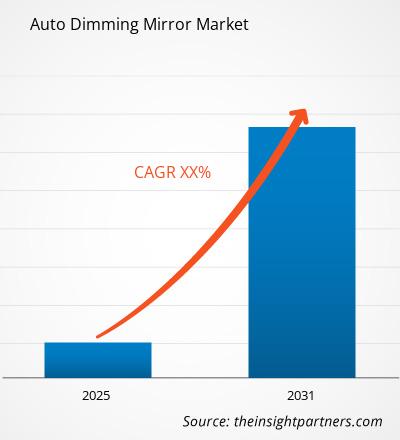
The auto-dimming mirror market is valued at US$ 2.42 Billion in 2025 and is projected to reach US$ 3.67 Billion by 2034, expanding at a CAGR of 4.75% during 2026–2034. Demand is being shaped by glare-reduction safety expectations, premium cabin electronics, connected mirror functions, and wider use of electrochromic mirrors across passenger cars and light commercial vehicles.
North America auto dimming mirror market size expansion is expected to remain steady, with a CAGR of 4.3–4.8% during 2026–2034. Regional growth is supported by strong penetration of advanced driver assistance systems, preference for premium vehicle features, and OEM adoption of mirrors integrated with displays, sensors, garage controls, and connected vehicle electronics.
Auto Dimming Mirror Market Assessment and Insights
- North America accounted for 29–32% share in 2025 and is expected to grow at a CAGR of 4.3–4.8% during 2026–2034, supported by high ADAS penetration and premium vehicle fitment.
- US represented 78–81% of North America share in 2025 and is projected to grow at a CAGR of 4.4–4.9% through 2034, led by passenger car and SUV demand.
- Europe held 25–28% share in 2025 and is forecast to grow at a CAGR of 4.1–4.6%, led by Germany, the UK, France, Italy, and Spain.
- Asia Pacific captured 34–37% share in 2025 and is expected to grow at a CAGR of 5.0–5.6%, driven by China, Japan, South Korea, India, and Australia.
- Largest Segment: Passenger Cars held 61–64% market share in 2025 and is expected to grow at a CAGR of 4.6–5.1%, reflecting broad OEM fitment in premium and mid-range models.
- High Growth Segment: Connected held 39–42% market share in 2025 and is forecast to grow at a CAGR of 5.2–5.8%, supported by smart mirror electronics and display integration.
- Key companies analyzed in detail: Ficosa Internacional SA, Flabeg Automotive Holding GmbH, Gentex Corporation, Honda Lock Mfg. Co., Ltd., Ichikoh Industries, Ltd., Konview Electronics Corporation Limited, Magna International Inc., Murakami Corporation, Samvardhana Motherson International Limited, and SL Corporation.
Source: The Insight Partners' analysis based on proprietary research, government publications, company annual reports, investor presentations, industry databases, and expert interviews.
Auto-dimming mirrors have transitioned from comfort amenities into safety-related vision products. Earlier deployment was focused on interior rearview mirrors, but present-day technologies incorporate electrochromic glass, light sensors, camera display, blind spot indicators, and connectivity module. Production trends have changed, too, as mirror manufacturers are collaborating with electronics in vehicles to ensure reduced glare, night vision comfort, and development of overall ADAS architecture.
Future demand is going to depend upon electric vehicle launches, the premiumization of emerging markets, and regulation on indirect vision systems. Automakers are developing connected cabin electronics, which integrate mirrors along with cameras, displays, telematics, and user convenience features. Asia Pacific is going to remain important for volume sales, whereas North America and Europe will focus on technology integration and high-value mirror assembly.
Auto Dimming Mirror Market Report Scope
| Report Attribute | Details |
|---|---|
| Market size in 2025 | US$ 2.42 Billion |
| Market Size by 2034 | US$ 3.67 Billion |
| Global CAGR (2026 - 2034) | 4.75% |
| Historical Data | 2021-2024 |
| Forecast period | 2026-2034 |
Auto Dimming Mirror Market Analysis
Auto-dimming mirror market growth is linked to rising consumer expectations for safer night driving and higher-value cabin electronics. Dimming mirrors are used by OEMs to reduce headlight glare and enhance drivers' comfort, and suppliers install sensors, compass functionality, garage operation, and displays. Electrochromic glass suppliers, mirror case makers, electronic controls suppliers, Tier 1 suppliers, and vehicle producers represent the value chain.
Positive supply dynamics are experienced by suppliers with the ability to integrate optical quality, size of electronics, aesthetics of the vehicle, and price. Inside rear-view mirrors are extensively used, and outside rear-view mirrors are increasingly used due to the inclusion of dimming, heating, memory, and camera-related features in high-end trim levels. The demand for electric vehicles increases the use of intelligent mirrors.
Auto-dimming mirror market analysis shows a competitive field led by global mirror and automotive electronics suppliers. OEMs, scale benefits, and electrochromic technology know-how of Gentex Corporation, Magna International Inc., Samvardhana Motherson International Limited, Ficosa Internacional SA, and Murakami Corporation make them the companies to be considered as potential suppliers for passenger car and light commercial vehicle mirrors.
Specialists in the manufacturing of mirror products include Flabeg Automotive Holding GmbH, Ichikoh Industries, Ltd., Konview Electronics Corporation Limited, and Honda Lock Mfg. Co., Ltd., and SL Corporation. Investments should focus on display mirrors, camera-ready housings, low-power electronics, and networked mirror systems.
● REPORT CUSTOMIZATION
Tailor This Report To Align With Your Specific Business Requirements
This report can be customized to align precisely with your business objectives, scope, and target markets. Customization options include tailored segmentation, geography, competitive analysis, and strategic insights to support informed decision-making.
Customize This Report →WHAT YOU CAN ADJUST
- ● Segmentations
- ● Geography
- ● Competitive Analysis
- ● Language Preferences
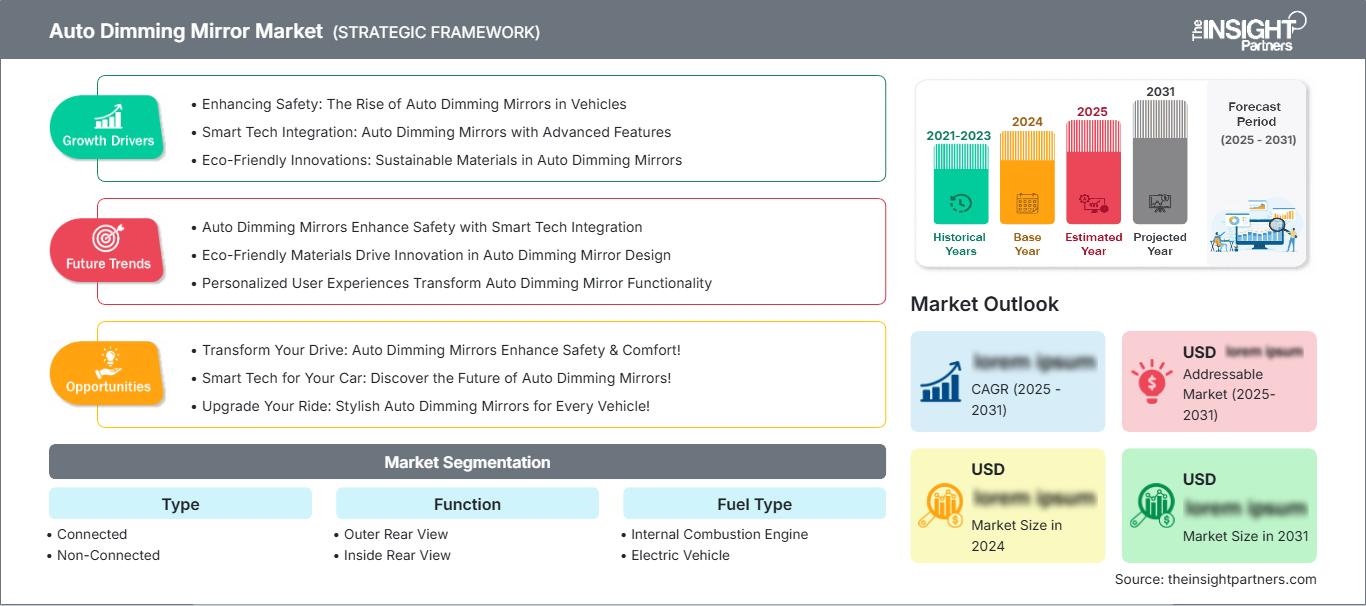
Auto Dimming Mirror Market: Strategic Insights
Regional Insights
North America auto dimming mirror market
North America's auto dimming mirror market share is estimated at 29–32% in 2025, with a CAGR of 4.3–4.8% during 2026–2034. Demand is supported by high SUV and pickup adoption, premium trim penetration, and consumer focus on glare reduction during long-distance and night driving conditions.
The region also benefits from established suppliers, ADAS adoption, and connected vehicle electronics. Automakers increasingly package dimming mirrors with HomeLink-style functions, camera displays, blind-spot indicators, and digital rear-view systems. Fleet and light commercial vehicle buyers are also adding safety-oriented mirror upgrades where nighttime visibility and driver fatigue reduction support operational value.
U.S. auto dimming mirror Market
The U.S. represented 78–81% of North America share in 2025 and is projected to grow at a CAGR of 4.4–4.9% during 2026–2034. Adoption is strongest across passenger cars, SUVs, pickups, and premium electric vehicles, where OEMs use dimming mirrors as part of comfort and safety packages.
Company presence is reinforced by Gentex Corporation, Magna International Inc., and global suppliers supporting North American assembly plants. Application trends include inside rear-view mirrors with displays, outside mirrors with dimming and blind-spot indicators, and connected mirror modules. Automakers are also using mirror electronics to integrate camera feeds and cabin convenience controls.
Europe auto dimming mirror Market
Europe held 25–28% share in 2025 and is expected to grow at a CAGR of 4.1–4.6% during 2026–2034. Germany leads adoption through premium vehicle production, strong Tier 1 supplier networks, and advanced lighting and visibility technologies.
The UK supports demand through premium brands, aftermarket upgrades, and technology-focused vehicle trims. France, Italy, and Spain contribute through passenger car production and supplier integration across compact and mid-size models. Regional emphasis on road safety, vehicle electronics, and indirect vision rules supports the adoption of automatic dimming and camera-integrated mirror systems.
APAC auto dimming mirror Market
APAC accounted for 34–37% share in 2025 and is forecast to grow at a CAGR of 5.0–5.6% through 2034. China is the leading country, supported by high vehicle production, EV adoption, and expanding premium feature penetration.
Japan and South Korea contribute through advanced supplier capabilities and export-oriented vehicle platforms. India and Australia show rising demand as SUVs, premium hatchbacks, and connected vehicle features expand. Regional cost-competitive manufacturing and fast-growing EV ecosystems make APAC central to volume growth and future technology localization.
Middle East & Africa auto dimming mirror Market
The Middle East & Africa market is projected to grow at a CAGR of 3.8–4.3% during 2026–2034. The UAE leads adoption through premium vehicle sales, fleet modernization, and strong demand for comfort features in high-glare driving environments.
Saudi Arabia, South Africa, and the Rest of MEA show selective adoption across passenger cars, SUVs, and light commercial fleets. Growth is supported by premium imports, dealership-led upgrades, and road safety awareness, though price sensitivity limits penetration in entry-level vehicles.
Segmentation Analysis
Type
Type is segmented into Connected and Non-Connected. The auto-dimming mirror market scope is expanding as connected models integrate displays, sensors, navigation links, garage controls, and camera inputs. The type segment is expected to grow at a CAGR of 4.7–5.3% during 2026–2034 as OEMs increase electronic content in mirrors.
- Connected mirrors are gaining strategic value because they combine glare control with displays, telematics, cameras, and convenience modules, supporting premium positioning and future cockpit integration.
- Non-Connected mirrors remain important in cost-sensitive models because they deliver core glare reduction and night-driving comfort without adding complex electronics or higher system integration costs.
Function
Function includes Outer Rear View and Inside Rear View. This segment is projected to grow at a CAGR of 4.5–5.0% during 2026–2034. Inside rear-view mirrors retain wide fitment, while outer rear-view applications gain value through blind-spot indicators, heating, memory adjustment, and camera-supportive housings.
- Outer Rear View mirrors are gaining adoption in higher trims where dimming improves side visibility, reduces glare from adjacent lanes, and supports integration with indicators and driver assistance sensors.
- Inside Rear View mirrors remain the foundational application because a single interior unit can control glare, integrate displays, and support driver visibility across most passenger vehicle platforms.
Fuel Type
Fuel Type is segmented into Internal Combustion Engine and Electric Vehicle. The segment is expected to grow at a CAGR of 4.8–5.4% during 2026–2034 as EV platforms use cabin electronics to differentiate user experience, while ICE vehicles continue volume-led adoption.
- Internal Combustion Engine vehicles remain the largest installed base, sustaining mirror demand across passenger cars and light commercial vehicles where safety, trim upgrades, and replacement cycles matter.
- Electric Vehicle platforms create high-value opportunities because manufacturers often combine dimming mirrors with cameras, digital displays, low-power electronics, and premium cabin technology packages.
Vehicle Type
Vehicle Type includes Light Commercial Vehicles and Passenger Cars. The segment is forecast to grow at a CAGR of 4.6–5.2% during 2026–2034. Passenger cars lead due to higher model availability, while light commercial vehicles adopt mirrors where driver safety and operational comfort support productivity.
- Light Commercial Vehicles use dimming mirrors to reduce driver fatigue during night routes, support fleet safety, and improve visibility in delivery, service, and regional transport applications.
- Passenger Cars represent the largest vehicle category because premium trims, SUVs, EVs, and mid-range models increasingly include auto-dimming mirrors as comfort and safety equipment.
Opportunity Snapshot
| Segment Name | Revenue Contribution | Trend Tag | Adoption Stage |
| Light Commercial Vehicles | Medium | Fleet Safety | Scaling |
| Passenger Cars | High | Premium Fitment | Mature |
Auto Dimming Mirror Market Growth Drivers and Impact Analysis
Rising Focus on Night-Driving Safety
Headlight glare is still a realistic safety problem because headlights are becoming more powerful, and traffic is getting denser. Auto-dimming mirrors minimize the amount of reflected light and thus assist drivers in keeping their visibility at night while driving on highways or during rain. These systems allow automakers to enhance their safety perception without changing anything else inside the cabin. This effect is most noticeable in passenger cars and SUVs, in which safety is an important part of choosing trim levels.
Integration with ADAS and Connected Cabin Electronics
Auto manufacturers are looking at mirrors in terms of being electronic nodes and not just reflective hardware. Today's mirrors may be able to incorporate sensors, cameras, displays, indicators, microphones, garage controls, and connectivity. This will enable ADAS visibility, digital rearview capability, and cockpit intelligence. For the business environment, this means increased value of mirrors from supplier companies able to integrate optical, electronic, and software technologies. It will also benefit original equipment manufacturers in terms of adding premium trims and electric vehicle platform differentiation through intelligent interiors.
Premiumization and EV-Led Feature Expansion
The growing number of premium cars, SUVs, and electric vehicles (EVs) is driving up the demand for sophisticated mirror systems. People buying EVs usually demand quiet cabins and a lot of digital content, and features that highlight their new-generation cars. Auto-dimming mirrors correspond with this positioning in that they offer all of these features in a small product. This is especially true for China, North America, Europe, Japan, and South Korea, where carmakers compete based on cabin innovations.
Auto Dimming Mirror Market Future Trends
Display-Based Digital Rear-View Integration
Auto-dimming mirror market trends point toward mirrors that combine electrochromic dimming with camera-fed display functions. Digital rear-view systems help improve visibility when passengers, cargo, or vehicle structure blocks the conventional rear view. Future designs will integrate dimming glass, displays, and image processing into compact assemblies that preserve familiar mirror behavior while adding digital capability. This trend is likely to accelerate in SUVs, EVs, and light commercial vehicles, where rear visibility, cabin packaging, and premium technology expectations create strong demand for hybrid mirror-display solutions.
Lower-Power Smart Mirror Electronics
Energy-efficient electronics of the mirrors would be in higher demand as the EV platforms fine-tune all cabin components for energy consumption and heat dissipation purposes. The suppliers would need to improve the sensors, controllers, the electrochromic layer, and the display unit to minimize energy consumption while still retaining the quick dimming performance. Energy-efficient systems would provide better accessory run time, increase reliability, and facilitate integration with central vehicle electronics.
Auto Dimming Mirror Market Opportunities
Connected Mirror Packages for Mid-Range Vehicles
Auto-dimming mirror market forecasts indicate a strong opportunity for connected mirror packages designed for mid-range passenger cars and SUVs. Automakers can offer dimming, display, compass, garage control, and blind-spot support in modular configurations without redesigning the full cockpit. Suppliers that provide scalable platforms can serve different trims using shared electronics and housings. This approach lowers development cost, improves feature availability, and helps OEMs move premium functions into higher-volume models, especially in China, India, North America, and Europe.
Fleet-Focused Safety Upgrades for Light Commercial Vehicles
This presents a good opportunity for several reasons. Drivers work late into the evening, in city traffic, and on extensive delivery routes. Dimming mirrors for cars can help eliminate glare, facilitate fatigue management, and increase confidence when changing lanes or reversing, especially when used with camera systems. This opportunity would be more effective if there were a measure of the total cost of ownership in terms of safety, downtime, and driver retention.
Frequently Asked Questions

- Comprehensive Market Sizing and Forecast Analysis
- Detailed Segmentation Analysis
- In-Depth Market Dynamics Assessment
- Regional and Country-Level Insights
- Competitive Landscape and Company Benchmarking
- Strategic Business Intelligence
Recent Reports
Testimonials

The Insight Partners' SCADA System Market report is comprehensive, with valuable insights on current trends and future forecasts. The team was highly professional, responsive, and supportive throughout. We are very satisfied and highly recommend their services.
RAN KEDEM Partner, Reali Technologies LTDs
I requested a report on a very specific software market and the team produced the report in a few days. The information was very relevant and well presented. I then requested some changes and additions to the report. The team was again very responsive and I got the final report in less than a week.
JEAN-HERVE JENN Chairman, Future Analytica
We worked with The Insight Partners for an important market study and forecast. They gave us clear insights into opportunities and risks, which helped shape our plans. Their research was easy to use and based on solid data. It helped us make smart, confident decisions. We highly recommend them.
PIYUSH NAGPAL Sr. Vice President, High Beam Global
The Insight Partners delivered insightful, well-structured market research with strong domain expertise. Their team was professional and responsive throughout. The user-friendly website made accessing industry reports seamless. We highly recommend them for reliable, high-quality research services
YUKIHIKO ADACHI CEO, Deep Blue, LLC.
This is the first time I have purchased a market report from The Insight Partners.While I was unsure at first, I visited their web site and felt more comfortable to take the risk and purchase a market report.I am completely satisfied with the quality of the report and customer service. I had several questions and comments with the initial report, but after a couple of dialogs over email with their analyst I believe I have a report that I can use as input to our strategic planning process.Thank you so much for taking the extra time and making this a positive experience.I will definitely recommend your service to others and you will be my first call when we need further market data.
JOHN SUZUKI President and Chief Executive Officer, Board Director, BK Technologies
I wish to appreciate your support and the professionalism you displayed in the course of attending to my request for information regarding to infectious disease IVD market in Nigeria. I appreciate your patience, your guidance, and the fact that you were willing to offer a discount, which eventually made it possible for us to close a deal. I look forward to engaging The Insight Partners in the future, all thanks to the impression you have created in me as a result of this first encounter.
DR CHIJIOKE ONYIA MANAGING DIRECTOR, PineCrest Healthcare Ltd.Reason to Buy
- Informed Decision-Making
- Understanding Market Dynamics
- Competitive Analysis
- Identifying Emerging Markets
- Customer Insights
- Market Forecasts
- Risk Mitigation
- Boosting Operational Efficiency
- Strategic Planning
- Investment Justification
- Tracking Industry Innovations
- Aligning with Regulatory Trends





 Get Free Sample for