
Automotive Closure Market Size, Share & Growth by 2034
Coverage: Component (Switch, ECU, Latch, Relay, Motor/Actuator, and Others); Application (Power Window, Sunroof, Tailgate, Convertible Roof, Side Door, and Sliding Door), and Geography
- Status : Data Released
- Report Code : TIPAT00002107
- Category : Automotive and Transportation
- No. of Pages : 150
- Available Report Formats :


- Last update date : August 19, 2026


2025 Market Size
US$ 33.54 Bn
Base year value
2034 Forecast
US$ 63.64 Bn
Projected by 2034
CAGR 2026-2034
7.38 %
Growth rate
Addressable Market
US$ 438.27 Bn
(2026-2034)
The automotive closure market was valued at US$ 33.54 Billion in 2025 and is projected to reach US$ 63.64 Billion by 2034, registering a CAGR of 7.38% during 2026–2034. Market expansion is supported by increasing vehicle production, growing adoption of electric and premium vehicles, and rising integration of intelligent closure systems that enhance vehicle safety, convenience, and energy efficiency. Continuous advancements in electronic control technologies and lightweight components are further strengthening product innovation across global automotive platforms.
Driven by technological innovation and consumer demand for convenience features, the automotive closure market size in North America is anticipated to expand at a CAGR of 6.8–7.3% during 2026–2034. Strong production of SUVs, pickup trucks, and electric vehicles, combined with increasing penetration of powered tailgates, automatic side doors, and smart latching systems, continues to support sustained regional demand. Investments in vehicle electrification and advanced driver assistance technologies further reinforce long-term market development.
Automotive Closure Market Assessment and Insights
- North America: North America accounted for 30–34% share in 2025 and is projected to register a CAGR of 6.8–7.3% during 2026–2034. Rising production of premium vehicles, rapid adoption of power-operated closure systems, and continuous investments in automotive electronics continue to support regional market expansion.
- US: The U.S. represented 76–80% of the North American market in 2025 and is expected to grow at a CAGR of 6.9–7.4% during 2026–2034, supported by strong OEM presence, increasing electric vehicle production, and growing integration of intelligent closure technologies.
- Europe: Europe captured 27–31% share in 2025 and is anticipated to expand at a CAGR of 6.6–7.1% during 2026–2034. Germany, France, the UK, Italy, and Spain continue driving demand through advanced automotive manufacturing and increasing production of premium passenger vehicles.
- Asia Pacific: Asia Pacific held 35–39% share in 2025 and is forecast to record the highest regional growth with a CAGR of 7.9–8.4% during 2026–2034. China, Japan, South Korea, and India remain major contributors owing to expanding automotive production, increasing vehicle ownership, and accelerating electrification.
- Largest Segment: Side Door accounted for a market share of 38–42% in 2025 and is expected to register a CAGR of 7.2–7.7% during 2026–2034, supported by universal installation across passenger and commercial vehicles.
- High Growth Segment: Tailgate represented 15–19% market share in 2025 and is projected to expand at a CAGR of 8.6–9.1% during 2026–2034, driven by rising adoption of power liftgate systems in SUVs, crossovers, and electric vehicles.
- Key companies analyzed in detail: Continental AG, Magna International Inc., DENSO Corporation, Aisin Corporation, Johnson Electric Holdings Limited, OMRON Corporation, Robert Bosch GmbH, Panasonic Holdings Corporation, Aptiv PLC, Valeo SA.
Source: The Insight Partners' analysis based on proprietary research, government publications, company annual reports, investor presentations, industry databases, and expert interviews.
The development of vehicle access technologies is continuing, as the incorporation of more electronic control systems, lightweight actuators, and intelligent latches has been increasingly used in today's vehicles. The increasing need for automated and convenient solutions, along with electrification and software-based vehicle architectures, is motivating vehicle makers to design new closure systems for better safety, performance, and user experience. Vehicle manufacturers are also improving their manufacturing processes using modular components and advanced electronic platforms to facilitate assembly.
Funding in smart mobility solutions, connected vehicle systems, and regional manufacturing capabilities in new automotive markets will further support future developments. The focus on passenger and pedestrian safety, along with vehicle performance, will further motivate vehicle manufacturers to use electronic closure systems. Collaboration between automotive OEMs and suppliers will help to facilitate the commercialization of intelligent closures.
Automotive Closure Market Report Scope
| Report Attribute | Details |
|---|---|
| Market size in 2025 | US$ 33.54 Billion |
| Market Size by 2034 | US$ 63.64 Billion |
| Global CAGR (2026 - 2034) | 7.38% |
| Historical Data | 2021-2024 |
| Forecast period | 2026-2034 |
Automotive Closure Market Analysis
Growing vehicle electrification, rising consumer expectations for convenience features, and expanding production of premium automobiles continue driving the automotive closure market growth. Current automobiles are now featuring electronically actuated doors, tailgates, locking mechanisms, and windows that not only increase safety but also user friendliness. Increased usage of sport utility vehicles, luxury sedans, and battery-electric automobiles is expected to augment the market for such electronically operated closure mechanisms. Enhanced efficiency in motors, actuators, sensors, and electronic control units not only adds to the reliability of products but also reduces energy usage and the weight of automobiles.
Electronic components' vendors, actuators providers, software providers, and original equipment manufacturers are collaborating closely as the automotive value chain keeps changing. Modular designs of automobiles are gaining increasing attention and are facilitating greater standardization of closure mechanisms used in different types of automobiles.
Competition remains technology-driven as suppliers focus on intelligent actuation systems, software-enabled closure controls, and lightweight structural components. The automotive closure market analysis indicates that Continental AG, Magna International Inc., DENSO Corporation, Aisin Corporation, Robert Bosch GmbH, Valeo SA, Aptiv PLC, Johnson Electric Holdings Limited, Panasonic Holdings Corporation, and OMRON Corporation continue strengthening competitive positions through product innovation, strategic partnerships, regional manufacturing expansion, and investments in advanced automotive electronics. Their continued emphasis on integrated smart closure systems helps cater to the changing needs of original equipment manufacturers in conventional, hybrid, and electric vehicles.
Increasing investment is now concentrated on software-defined vehicles, advanced sensors, automation in production, and efficient actuator systems. Automotive companies are working alongside their component providers to build scalable closure modules that can be used in the coming era of connected mobility systems. Growing production of electric vehicles, along with increasing demand for automated access systems in vehicles, will bring substantial growth in the long run.
● REPORT CUSTOMIZATION
Tailor This Report To Align With Your Specific Business Requirements
This report can be customized to align precisely with your business objectives, scope, and target markets. Customization options include tailored segmentation, geography, competitive analysis, and strategic insights to support informed decision-making.
Customize This Report →WHAT YOU CAN ADJUST
- ● Segmentations
- ● Geography
- ● Competitive Analysis
- ● Language Preferences
Automotive Closure Market: Strategic Insights
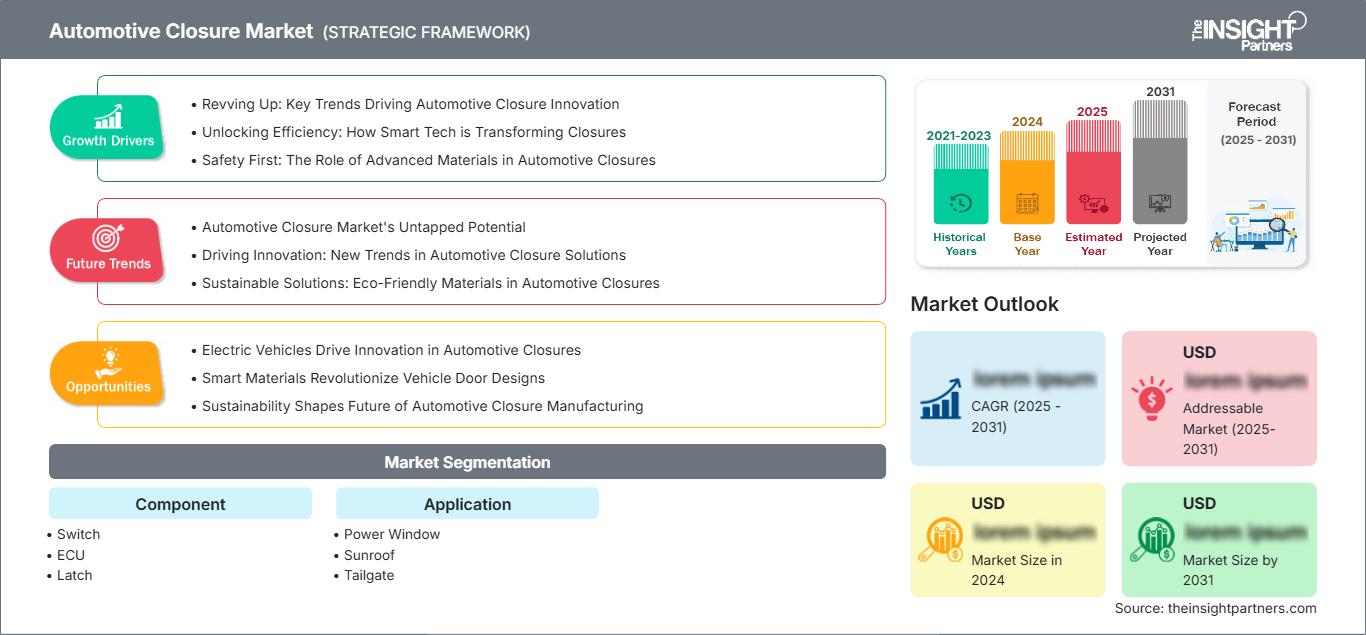
Regional Insights
North America Automotive Closure Market
North America accounted for 30–34% of the automotive closure market share in 2025 and is projected to expand at a CAGR of 6.8–7.3% during 2026–2034. The high manufacturing of pickup trucks, luxury SUVs, and electric vehicles remains a key reason for the high demand for advanced closure systems that include electric latch systems, powered tailgates, and advanced side doors.
The U.S., Canada, and Mexico have the advantage of having a well-developed automotive manufacturing environment due to the availability of advanced components suppliers and automotive assembly units. The constant investment in the field of automotive electronics, lightweight components, and advanced actuation technology helps manufacturers to operate efficiently and at the same time offer improved vehicle access and safety. Increased manufacturing of electric vehicles will be a key reason for the increased adoption of electronically-controlled closure systems in the coming years.
U.S. Automotive Closure Market
The U.S. represented 76–80% of the North American automotive closure market in 2025 and is expected to register a CAGR of 6.9–7.4% during 2026–2034. The increased production levels of SUVs, crossovers, luxury cars, and battery electric vehicles are still driving the demand for intelligent closure systems. High expectations from consumers about automation and safety systems of the vehicle also motivate manufacturers to incorporate electronically controlled doors, tailgates, and windows.
Magna International Inc., Continental AG, Robert Bosch GmbH, DENSO Corporation, Aptiv PLC, and Johnson Electric Holdings Limited are some of the big companies that continue to build their engineering, R&D, and manufacturing capabilities in the nation. Increasing usage of software-defined vehicle architecture and electronic control systems is paving the way for more efficient and energy-efficient closure systems in future vehicles.
Europe Automotive Closure Market
Europe captured 27–31% of the global automotive closure market in 2025 and is anticipated to register a CAGR of 6.6–7.1% during 2026–2034. Germany remains the leading regional market due to its advanced automotive manufacturing industry, strong premium vehicle production, and continuous investment in intelligent vehicle technologies. Increasing regulatory emphasis on passenger safety, lightweight vehicle design, and electrification further supports technological innovation across automotive closure systems.
There is an ongoing rise in the adoption of electronically controlled doors and tailgates in the UK, backed by the production of luxury vehicles and electric cars. Manufacturers are continuing to invest in advanced automotive electronics that enhance the comfort, reliability, and safety of the vehicles.
Germany holds its leading position due to its OEMs' presence, technological advancement, and high-level implementation of intelligent closures in luxury vehicles. Ongoing investments in smart manufacturing and connected mobility ensure long-term demand for advanced closures.
France, Italy, and Spain make substantial contributions due to growing production, exports, and upgrades of manufacturing plants. Increasing adoption of electric vehicles and luxury features keeps fueling the market growth in Southern Europe.
APAC Automotive Closure Market
Asia Pacific accounted for 35–39% of the global automotive closure market in 2025 and is projected to record the fastest regional expansion at a CAGR of 7.9–8.4% during 2026–2034. China leads regional demand owing to its large automotive manufacturing capacity, increasing electric vehicle production, and expanding domestic vehicle ownership.
Japan, South Korea, India, and Australia continue supporting regional growth through technological innovation, expanding automotive exports, government support for advanced manufacturing, and increasing investment in connected mobility. Rising disposable income and premium vehicle demand continue to strengthen the adoption of intelligent automotive closure systems.
Middle East & Africa Automotive Closure Market
The Middle East & Africa automotive closure market is projected to register a CAGR of 6.1–6.6% during 2026–2034, supported by increasing premium vehicle sales, expanding automotive assembly operations, and rising consumer demand for technologically advanced vehicle features. Saudi Arabia remains the leading regional market, followed by the UAE and South Africa.
Infrastructure modernization, economic diversification initiatives, and growing investment in automotive distribution networks continue to support market expansion. Increasing demand for SUVs and luxury vehicles, together with the gradual adoption of electric mobility, is expected to create additional opportunities for intelligent automotive closure technologies across the region.
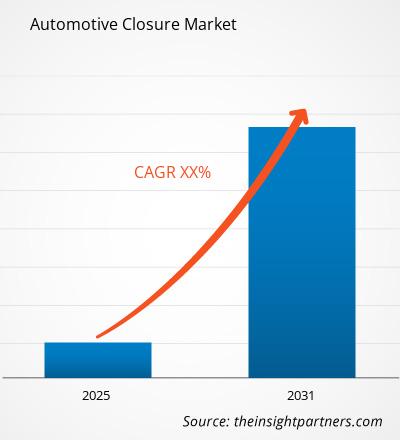
Segmentation Analysis
Component
The Component segment is projected to register a CAGR of 7.5–8.0% during 2026–2034. Growing integration of intelligent electronics, lightweight actuators, and advanced safety technologies continues driving innovation across automotive closure systems. Manufacturers are increasingly developing compact, energy-efficient components that improve operational reliability, reduce maintenance requirements, and support software-defined vehicle architectures. The automotive closure market scope continues expanding as OEMs adopt modular closure systems that enhance manufacturing flexibility while improving passenger safety, convenience, and overall vehicle functionality.
- Switch – Switches remain fundamental to automotive closure operation by enabling accurate user input and reliable communication with electronic control systems. Increasing adoption of touch-sensitive interfaces and smart controls continues to strengthen their strategic importance.
- ECU – Electronic control units coordinate multiple closure functions, enabling intelligent monitoring, safety diagnostics, anti-pinch protection, and seamless integration with advanced driver assistance and connected vehicle platforms.
- Latch – Latches remain essential mechanical and electronic security components, ensuring reliable door locking, occupant safety, and vehicle integrity. Advanced electronic latch technologies continue improving operational durability and user convenience.
- Relay – Relays facilitate dependable electrical switching within closure systems while protecting sensitive electronic circuits. Continuous improvements in compact relay design support higher system reliability and reduced energy consumption.
- Motor/Actuator – Motors and actuators power automated door movement, tailgates, windows, and sliding door systems. Rising adoption of powered closure functions across premium and electric vehicles continues to strengthen demand for high-performance actuation technologies.
Application
The Application segment is anticipated to expand at a CAGR of 7.3–7.8% during 2026–2034. Increasing consumer preference for automated vehicle access, premium convenience features, and intelligent electronic controls is accelerating adoption across diverse closure applications. Automotive manufacturers continue integrating electronically controlled access systems that improve safety, accessibility, operational efficiency, and user experience while supporting next-generation connected mobility platforms.
- Power Window – Power window systems remain standard across most passenger vehicles, benefiting from continuous improvements in anti-pinch protection, electronic control integration, and enhanced operational reliability.
- Sunroof – Sunroof closure systems continue gaining popularity within premium and mid-range vehicles as consumers increasingly value enhanced cabin comfort, aesthetics, and intelligent electronic control functionality.
- Tailgate – Powered tailgate systems experience strong demand owing to increasing SUV and crossover production, offering hands-free access, improved convenience, and seamless integration with smart vehicle technologies.
- Convertible Roof – Convertible roof systems remain concentrated within premium and performance vehicle segments, utilizing advanced motors, actuators, and electronic synchronization technologies for reliable roof operation.
- Side Door – Side door applications account for the largest installation volume because every passenger and commercial vehicle requires durable, safe, and electronically controlled closure mechanisms to support daily vehicle operation.
- Sliding Door – Sliding door systems continue expanding across multipurpose vehicles and commercial transport applications, providing improved passenger accessibility, automated operation, and enhanced convenience in urban mobility environments.
Opportunity Snapshot
| Application | Revenue Contribution | Trend Tag | Adoption Stage |
|---|---|---|---|
| Power Window | High | Smart Glass | Mature |
| Sunroof | Medium | Panoramic Roof | Scaling |
| Tailgate | High | Hands-Free | Scaling |
| Convertible Roof | Low | Premium Mobility | Emerging |
| Side Door | High | Smart Access | Mature |
| Sliding Door | Medium | Urban Mobility | Scaling |
Automotive Closure Market Growth Drivers and Impact Analysis
Growing Adoption of Smart Vehicle Access Systems
There will be a greater acceleration in the demand for advanced automobile closure systems due to the adoption of intelligent access technology. Customers will demand features such as power-operated side doors, intelligent tailgates, remote window opening, and smart key systems in both luxury and mid-market automobiles. In order to meet consumer expectations and increase the safety of the operation, there will be a need to introduce electronic locking, intelligent actuators, and intelligent control systems. The adoption of connected car technologies and the smartphone-based vehicle access system will revolutionize closure systems. As a result of the introduction of the software-based architecture of vehicles, there will be increased demand for electronically controllable closure systems.
Expansion of Electric Vehicle Manufacturing Worldwide
The fast growth in the manufacture of battery electric and hybrid cars is generating many great prospects for automotive closure systems that operate intelligently. The car manufacturers are now focusing on making cars with light parts, efficient actuators, and electronics that make the car light while ensuring maximum efficiency of the battery. Intelligent closure systems that include advanced motorized systems, optimized algorithms, and light structural materials facilitate all these goals by enhancing the performance levels without increasing power usage. Investments in specialized factories of electric cars in Asia-Pacific, North America, and Europe will continue motivating suppliers to build closure systems that work in the new types of vehicles.
Increasing Vehicle Safety and Regulatory Requirements
Global vehicle safety regulations continue encouraging manufacturers to adopt more advanced closure technologies capable of improving occupant protection and operational reliability. Modern closure systems increasingly incorporate anti-pinch protection, electronic child safety locks, collision-responsive unlocking functions, and intelligent monitoring capabilities that enhance passenger safety during both normal operation and emergency situations. Regulatory emphasis on pedestrian protection, crashworthiness, and electronic system reliability further encourages continuous investment in innovative closure technologies. Automotive manufacturers continue collaborating with component suppliers to integrate advanced sensing technologies, diagnostic functions, and intelligent electronic controls that improve compliance while enhancing customer confidence, supporting sustained technological progress across passenger and commercial vehicle segments.
Automotive Closure Market Future Trends
Software-Defined Intelligent Closure Architectures
The automotive closure market trends indicate growing adoption of software-controlled closure systems that integrate seamlessly with connected vehicle platforms and centralized electronic architectures. Future closure technologies are expected to combine artificial intelligence, predictive diagnostics, intelligent sensing, and over-the-air software updates to improve operational reliability and user convenience. Vehicle manufacturers are increasingly replacing isolated mechanical systems with integrated electronic modules capable of communicating with advanced driver assistance systems and digital cockpit environments. This evolution is expected to improve safety, personalization, and maintenance efficiency while supporting next-generation mobility solutions across passenger and commercial vehicles.
Lightweight Integrated Closure Module Development
Manufacturers are accelerating the development of lightweight closure modules combining structural components, electronic controls, sensors, and actuation systems into compact integrated assemblies. Advanced aluminum alloys, engineered polymers, and high-strength composite materials continue to reduce component weight while maintaining durability and crash performance. Integration of multiple functions within modular closure systems also simplifies manufacturing, improves assembly efficiency, and reduces overall production costs. These developments are expected to strengthen competitiveness while supporting automotive manufacturers pursuing lightweight vehicle architectures and improved energy efficiency.
Automotive Closure Market Opportunities
Expansion of Intelligent Closure Technologies in Emerging Markets
The automotive closure market Forecasts indicate considerable investment opportunities as vehicle manufacturers expand production across emerging automotive markets. Rising disposable income, increasing urbanization, and growing demand for premium vehicle features are encouraging OEMs to introduce electronically controlled doors, power tailgates, and intelligent window systems into higher-volume vehicle segments. Suppliers capable of delivering affordable, scalable closure technologies tailored to regional manufacturing requirements are expected to benefit from increasing production volumes. Strategic localization of manufacturing facilities and engineering capabilities will further strengthen supply chain resilience while supporting sustained long-term market expansion.
Development of Advanced Modular Closure Platforms
Growing emphasis on flexible vehicle architectures creates substantial opportunities for suppliers developing standardized modular closure platforms compatible with multiple vehicle models. Modular designs simplify production, reduce engineering complexity, and shorten vehicle development cycles while allowing manufacturers to integrate advanced electronic functions more efficiently. Investment in intelligent actuators, integrated control modules, lightweight structural materials, and digital manufacturing technologies will strengthen competitiveness across global automotive markets. Strategic collaboration between automotive OEMs and technology providers is expected to accelerate the commercialization of highly efficient closure systems supporting conventional, hybrid, and electric vehicle platforms.
Frequently Asked Questions

- Comprehensive Market Sizing and Forecast Analysis
- Detailed Segmentation Analysis
- In-Depth Market Dynamics Assessment
- Regional and Country-Level Insights
- Competitive Landscape and Company Benchmarking
- Strategic Business Intelligence
Recent Reports
Testimonials

The Insight Partners' SCADA System Market report is comprehensive, with valuable insights on current trends and future forecasts. The team was highly professional, responsive, and supportive throughout. We are very satisfied and highly recommend their services.
RAN KEDEM Partner, Reali Technologies LTDs
I requested a report on a very specific software market and the team produced the report in a few days. The information was very relevant and well presented. I then requested some changes and additions to the report. The team was again very responsive and I got the final report in less than a week.
JEAN-HERVE JENN Chairman, Future Analytica
We worked with The Insight Partners for an important market study and forecast. They gave us clear insights into opportunities and risks, which helped shape our plans. Their research was easy to use and based on solid data. It helped us make smart, confident decisions. We highly recommend them.
PIYUSH NAGPAL Sr. Vice President, High Beam Global
The Insight Partners delivered insightful, well-structured market research with strong domain expertise. Their team was professional and responsive throughout. The user-friendly website made accessing industry reports seamless. We highly recommend them for reliable, high-quality research services
YUKIHIKO ADACHI CEO, Deep Blue, LLC.
This is the first time I have purchased a market report from The Insight Partners.While I was unsure at first, I visited their web site and felt more comfortable to take the risk and purchase a market report.I am completely satisfied with the quality of the report and customer service. I had several questions and comments with the initial report, but after a couple of dialogs over email with their analyst I believe I have a report that I can use as input to our strategic planning process.Thank you so much for taking the extra time and making this a positive experience.I will definitely recommend your service to others and you will be my first call when we need further market data.
JOHN SUZUKI President and Chief Executive Officer, Board Director, BK Technologies
I wish to appreciate your support and the professionalism you displayed in the course of attending to my request for information regarding to infectious disease IVD market in Nigeria. I appreciate your patience, your guidance, and the fact that you were willing to offer a discount, which eventually made it possible for us to close a deal. I look forward to engaging The Insight Partners in the future, all thanks to the impression you have created in me as a result of this first encounter.
DR CHIJIOKE ONYIA MANAGING DIRECTOR, PineCrest Healthcare Ltd.Reason to Buy
- Informed Decision-Making
- Understanding Market Dynamics
- Competitive Analysis
- Identifying Emerging Markets
- Customer Insights
- Market Forecasts
- Risk Mitigation
- Boosting Operational Efficiency
- Strategic Planning
- Investment Justification
- Tracking Industry Innovations
- Aligning with Regulatory Trends





 Get Free Sample for