
Automotive Cylinder Liner Market Size, Share & Demand by 2034
Coverage: By Liner Type (Dry, Wet); Material Type (Aluminum Alloy, Steel, Cast Iron, Others); Vehicle Type (Passenger Cars, Commercial Vehicles) , and Geography (North America, Europe, Asia Pacific, and South and Central America)
- Status : Data Released
- Report Code : TIPRE00008797
- Category : Automotive and Transportation
- No. of Pages : 150
- Available Report Formats :


- Last update date : August 12, 2026


2025 Market Size
US$ 7.32 Bn
Base year value
2034 Forecast
US$ 9.89 Bn
Projected by 2034
CAGR 2026-2034
3.40 %
Growth rate
Addressable Market
US$ 78.16 Bn
(2026-2034)
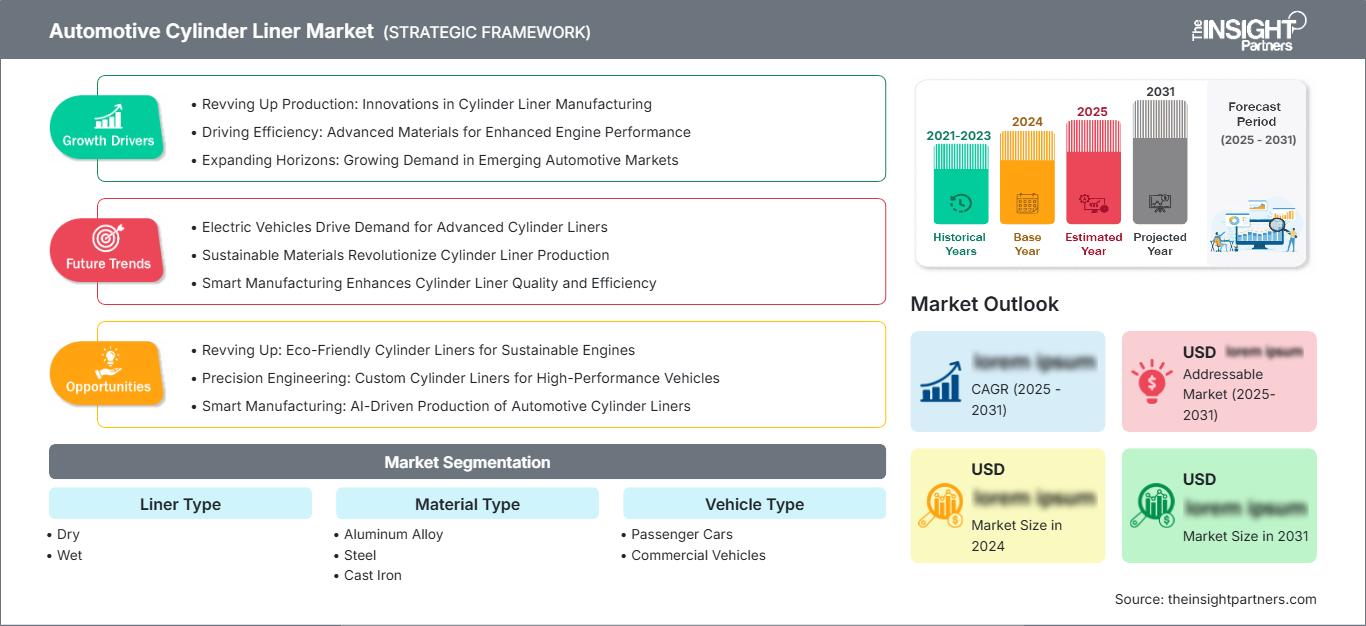
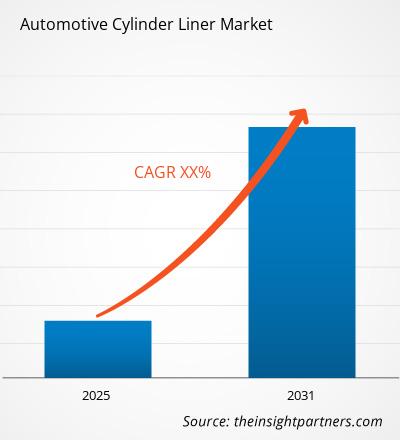
The automotive cylinder liner market was valued at US$ 7.32 Billion in 2025 and is projected to reach US$ 9.89 Billion by 2034, registering a CAGR of 3.40% during 2026–2034. The market continues to benefit from stable production of internal combustion engine (ICE) vehicles, increasing demand for durable engine components, and continuous improvements in engine efficiency. Cylinder liners remain essential for minimizing friction, improving heat transfer, and extending engine service life across passenger and commercial vehicle applications.
North America represents a technologically mature automotive manufacturing region where the automotive cylinder liner market size is expected to expand at an estimated CAGR of 3.0–3.6% through 2034. Demand is supported by commercial vehicle production, replacement requirements for heavy-duty engines, and ongoing investments in lightweight engine components, advanced machining technologies, and higher-performance engine platforms that improve durability while meeting stringent emission regulations.
Automotive Cylinder Liner Market Assessment and Insights
- North America: North America accounted for 30–33% share in 2025 and is expected to expand at a CAGR of 3.0–3.6% during 2026–2034. Strong commercial vehicle manufacturing, advanced engine technologies, and aftermarket replacement demand continue supporting regional market development.
- US: The US represented 74–78% of the North American market in 2025 and is projected to register a CAGR of 3.0–3.5%, supported by continued production of gasoline, diesel, and hybrid powertrains.
- Europe: Europe captured 27–30% market share in 2025 and is forecast to grow at a CAGR of 3.0–3.5%. Germany, France, Italy, and the United Kingdom continue leading regional production of precision engine components.
- Asia Pacific: Asia Pacific accounted for 33–36% of global revenue in 2025 and is anticipated to expand at a CAGR of 3.8–4.5%, driven by large-scale vehicle manufacturing across China, Japan, India, and South Korea.
- Largest Segment: Passenger Cars accounted for 60–64% market share in 2025 and are expected to grow at a CAGR of 3.2–3.7%, supported by consistently high global production volumes.
- High Growth Segment: Aluminum Alloy held 27–31% market share in 2025 while expanding at a CAGR of 4.2–4.8%, reflecting increasing preference for lightweight engine components.
- Key companies analyzed in detail: Aichi Machine Industry Co., Ltd., Bryan Automotive, Darton International, Inc., MAHLE GmbH, Melling Engine Parts, Nippon Piston Ring Co., Ltd., Tenneco Inc., TPR Co., Ltd., Westwood Cylinder Liners Ltd., ZYNP (Anhui) Co., Ltd.
Source: The Insight Partners' analysis based on proprietary research, government publications, company annual reports, investor presentations, industry databases, and expert interviews.
Advancements in precision casting, metallurgical engineering, and surface coating technologies continue transforming the automotive cylinder liner market. Manufacturers increasingly develop lightweight yet wear-resistant cylinder liners capable of reducing engine friction, improving thermal conductivity, and enhancing combustion efficiency. Contemporary production processes like centrifugal casting, plasma coating, and machining have enabled better accuracy and durability of engines in difficult environments.
Further development will still be facilitated by the production of hybrid cars, the upgrading of commercial vehicle fleets, and the development of more efficient engines that work on internal combustion principles. Despite the impact of electrification on future demand for engine components, production of gasoline, diesel, and hybrid vehicles around the world is expected to ensure the growth of cylinder liners production over the forecast period.
Automotive Cylinder Liner Market Report Scope
| Report Attribute | Details |
|---|---|
| Market size in 2025 | US$ 7.32 Billion |
| Market Size by 2034 | US$ 9.89 Billion |
| Global CAGR (2026 - 2034) | 3.40% |
| Historical Data | 2021-2024 |
| Forecast period | 2026-2034 |
Automotive Cylinder Liner Market Analysis
Growing demand for fuel-efficient passenger vehicles and commercial transportation continues to support automotive cylinder liner market growth worldwide. Cylinder liners are important in mitigating the wear of pistons, heat transmission, ensuring efficient compression, and increasing the longevity of engines. The automobile industry uses advanced alloys and surface finishes and precision engineering technologies to enhance the reliability of engines while complying with the changing standards for fuel economy and emissions. The growing production of hybrid cars further justifies the need for quality engine parts that are durable and can cope with harsh conditions.
The value chain comprises suppliers of raw materials, foundry houses, precision engineering firms, engine manufacturers, automotive original equipment manufacturers, and aftermarket distribution. Increased localization of production plants in the Asia Pacific region and the upgrading of the production process in North America and Europe boost supply chain efficiency, along with steady production of passenger and commercial vehicles globally.
Competitive intensity within the automotive cylinder liner market analysis continues to increase as manufacturers invest in advanced metallurgy, automated machining systems, and innovative coating technologies. Companies including MAHLE GmbH, Tenneco Inc., TPR Co., Ltd., Nippon Piston Ring Co., Ltd., Darton International, Inc., Aichi Machine Industry Co., Ltd., Westwood Cylinder Liners Ltd., Bryan Automotive, Melling Engine Parts, and ZYNP (Anhui) Co., Ltd. continue expanding production capabilities while improving product quality, durability, and manufacturing efficiency.
Investment strategies increasingly emphasize lightweight materials, plasma coating technologies, digital manufacturing systems, and precision quality inspection to reduce production variability and improve operational efficiency. Strategic collaborations between engine manufacturers and component suppliers continue accelerating innovation in cylinder liner design, enabling manufacturers to enhance combustion efficiency, reduce friction losses, and strengthen long-term competitiveness across global automotive markets.
● REPORT CUSTOMIZATION
Tailor This Report To Align With Your Specific Business Requirements
This report can be customized to align precisely with your business objectives, scope, and target markets. Customization options include tailored segmentation, geography, competitive analysis, and strategic insights to support informed decision-making.
Customize This Report →WHAT YOU CAN ADJUST
- ● Segmentations
- ● Geography
- ● Competitive Analysis
- ● Language Preferences
Automotive Cylinder Liner Market: Strategic Insights
Regional Insights
North America Automotive Cylinder Liner Market
North America accounted for 30–33% of the global automotive cylinder liner market share in 2025 and is projected to expand at a CAGR of 3.0–3.6% during 2026–2034. Stable demand for light trucks, pickup vehicles, heavy-duty commercial vehicles, and off-highway equipment continues to support cylinder liner consumption across the region. Manufacturers increasingly invest in precision machining, automated casting, and advanced surface treatment technologies to improve durability, fuel efficiency, and engine reliability.
There is a mutual gain enjoyed by the three countries through integration into an ecosystem of automotive manufacture that includes OEMs and Tier-1 suppliers. The focus of regulations on improved fuel economy and reduced emissions spurs engine design, which leads to the increased use of lighter cylinder liners and coatings. Engine re-manufacturing and replacement is another factor contributing to the growth of demand for coatings.
U.S. Automotive Cylinder Liner Market
The U.S. represented 74–78% of the North American market in 2025 and is expected to register a CAGR of 3.0–3.5% through 2034. Due to the mature automotive industry of the nation, along with the large production of commercial vehicles, there is a high requirement for precisely machined cylinder liners. In this connection, domestic manufacturers are still actively investing in digital machining technology and metallurgy in order to improve their productivity and reduce their manufacturing costs of manufacturing.
Numerous engine manufacturers, parts suppliers, and after-sales service providers ensure growth stability in the market. Transportation, construction, agriculture, and industrial machinery will be among the major applications of heavy-duty diesel engines. In addition, the increased popularity of hybrid drive systems ensures higher demand for reliable cylinder liners, which are able to operate under high temperatures.
Europe Automotive Cylinder Liner Market
Europe captured 27–30% of the global market in 2025 and is forecast to expand at a CAGR of 3.0–3.5% throughout the forecast period. Germany still leads in this aspect due to the advanced technology of producing automobiles. In addition, the UK will continue advancing the precision engineering of engines for passenger and commercial vehicles. Continued investments in lightweight engines will ensure regional competitiveness.
Germany retains its leadership due to the advanced production of high-end vehicles and advanced internal combustion engines. The UK will gain from its specialized production of engines and increased investments in automotive components. The regions of France, Italy and Spain will still continue meeting the demands of the region through the production and exportation of assembled vehicles, in addition to the advanced component manufacture. Adoption of hybrid vehicles will lead to advancements in cylinder liner production techniques.
APAC Automotive Cylinder Liner Market
Asia Pacific accounted for 33–36% of global revenue in 2025 and is projected to record the fastest regional expansion with a CAGR of 3.8–4.5%. China remains the largest manufacturing hub, while Japan, India, and South Korea continue strengthening production of advanced engine components for domestic consumption and exports.
Rapid industrialization, expanding vehicle ownership, and large-scale investments in automotive manufacturing capacity continue driving regional demand. Government initiatives supporting domestic manufacturing, improved supply chains, and increasing localization of engine component production reinforce Asia Pacific's leadership position within the global automotive cylinder liner market.
Middle East & Africa Automotive Cylinder Liner Market
The Middle East & Africa market is anticipated to register a CAGR of 2.5–3.2% during 2026–2034. Saudi Arabia and the United Arab Emirates continue investing in industrial diversification and automotive manufacturing capabilities, while South Africa remains the region's leading vehicle production hub, supported by established export-oriented automotive facilities.
Growth is further supported by increasing commercial vehicle demand, infrastructure development projects, mining operations, and expanding logistics activities. Although the regional automotive manufacturing base remains comparatively smaller than other regions, modernization of industrial infrastructure and rising investment in aftermarket engine services continue to create opportunities for cylinder liner suppliers.
Segmentation Analysis
Liner Type
The Liner Type segment is projected to expand at a CAGR of 3.3–3.8% during 2026–2034. The automotive cylinder liner market scope continues to broaden as engine manufacturers adopt liner configurations that improve thermal management, wear resistance, and maintenance efficiency. Selection between dry and wet liners depends on engine architecture, cooling requirements, manufacturing cost, and long-term serviceability. Demand remains strong across passenger and commercial vehicle engines, where durability and fuel efficiency are essential design priorities.
- Dry – Dry liners remain widely adopted in compact passenger vehicle engines because of their structural rigidity, lower manufacturing complexity, reduced production costs, and compatibility with high-volume engine manufacturing platforms.
- Wet – Wet liners continue gaining preference in commercial vehicles and heavy-duty engines due to superior cooling performance, easier replacement during engine overhaul, and improved thermal stability under continuous high-load operating conditions.
Material Type
The Material Type segment is anticipated to register a CAGR of 3.4–4.0% during 2026–2034. Continuous innovation in metallurgy and lightweight engineering is encouraging manufacturers to optimize cylinder liner materials according to engine performance, durability, emission compliance, and production efficiency. Improved wear resistance and heat dissipation remain the primary factors influencing material selection across global automotive manufacturers.
- Aluminum Alloy – Aluminum alloy liners continue witnessing increasing adoption in lightweight engine platforms owing to excellent thermal conductivity, reduced vehicle weight, improved fuel efficiency, and compatibility with modern coating technologies.
- Steel – Steel cylinder liners are utilized in high-performance engines requiring superior mechanical strength, dimensional stability, and resistance to extreme operating pressures while supporting extended engine operating life.
- Cast Iron – Cast iron remains an important material because of its outstanding wear resistance, cost-effectiveness, machining characteristics, and long-established use across conventional passenger and commercial vehicle engines.
Vehicle Type
The Vehicle Type segment is expected to grow at a CAGR of 3.0–3.4% during 2026–2034. Vehicle production volumes, fleet replacement cycles, engine downsizing strategies, and emission regulations continue influencing demand for automotive cylinder liners worldwide. Manufacturers increasingly focus on improving engine durability while reducing component weight and operating friction across different vehicle categories.
- Passenger Cars – Passenger cars represent the dominant market owing to high global production volumes, continuous demand for fuel-efficient engines, increasing hybrid vehicle adoption, and regular technological improvements in gasoline powertrains.
- Commercial Vehicles – Commercial vehicles generate strong demand for heavy-duty cylinder liners because engines operate under higher loads and longer service intervals, requiring exceptional wear resistance, thermal stability, and operational reliability.
Opportunity Snapshot
| Vehicle Type | Revenue Contribution | Trend Tag | Adoption Stage |
|---|---|---|---|
| Passenger Cars | High | Engine Downsizing | Mature |
| Commercial Vehicles | Medium | Fleet Efficiency | Scaling |
Automotive Cylinder Liner Market Growth Drivers and Impact Analysis
Increasing Production of Commercial Vehicles Worldwide
Increased output from commercial vehicles is one of the key elements of demand for cylinder liners of the automotive type. Commercial vehicles such as heavy-duty trucks, buses, machinery, and farm equipment experience high loads and have high duty cycles, which ensures steady demand for reliable parts with good wear resistance. The need for engine durability and low maintenance costs leads to the use of advanced materials and technologies for cylinder liners. Investments into the logistics industry, infrastructure development and cargo transport in Asia Pacific, North America and Europe will ensure steady development of the engine market. Demand for diesel and hybrid commercial engines will be increasing due to increased global trade flows.
Advancements in Lightweight Engine Component Manufacturing
Auto industry companies keep working on developing lightweight engines in order to enhance fuel efficiency and comply with more stringent requirements regarding emissions. The advancements in materials technology, casting techniques, plasma coating, and precision machining have improved cylinder liner performance and reliability. Due to modern technologies, it is possible to ensure less friction, high thermal conductivity and increased engine life; thus, lightweight liners are becoming more popular among passenger cars and hybrid engines. On the other hand, suppliers use automated manufacturing facilities and digital quality control systems to increase dimensional accuracy and reliability of the production process.
Growing Demand for Engine Durability and Lower Maintenance Costs
Vehicle owners and fleet operators increasingly seek engines capable of operating reliably over extended service intervals with minimal maintenance. High-quality cylinder liners contribute directly to reduced piston wear, improved combustion efficiency, enhanced lubrication performance, and greater engine longevity. Commercial transportation, mining, agriculture, and construction industries particularly benefit from durable engine components that minimize downtime and lifecycle costs. Manufacturers continue improving material compositions and surface engineering techniques to enhance resistance against corrosion, abrasion, and thermal stress. As vehicle operating costs become increasingly important for fleet operators worldwide, durable cylinder liner solutions are expected to remain a strategic priority for both OEMs and aftermarket suppliers.
Automotive Cylinder Liner Market Future Trends
Advanced Surface Coating Technologies Transform Engine Performance
One of the most significant automotive cylinder liner market trends is the rapid adoption of advanced surface engineering technologies. The use of plasma spraying, laser cladding, thermal spray and nanocoating is helping to make engines more durable and reduce friction between pistons and cylinder liners. This allows companies to manufacture lightweight engines without compromising on quality or heat capacity. As hybrid cars expand their market share all around the world, there will be an increased need for coated liners that can withstand stop-start cycles.
Digital Manufacturing and Smart Quality Inspection
The increasing adoption of Industry 4.0 technologies by automobile manufacturers has been seen on production sites where cylinder liners are manufactured. This technology leads to improved manufacturing efficiency and lower levels of defects in the production process. In addition, smart manufacturing increases traceability, reduces wastage of material, and ensures dimensional accuracy. In light of the stiff competition in the automotive supply chains around the globe, suppliers using digital manufacturing technologies will enhance their efficiency and strengthen their relationship with automotive OEMs.
Automotive Cylinder Liner Market Opportunities
Expansion of Hybrid Vehicle Engine Manufacturing
Although electrification continues expanding globally, hybrid powertrains will remain a significant opportunity for cylinder liner manufacturers throughout the forecast period. Hybrid vehicles continue utilizing highly efficient internal combustion engines requiring advanced cylinder liner technologies capable of operating under higher thermal loads and frequent engine start-stop cycles. Automotive cylinder liner market Forecasts indicate that suppliers investing in lightweight alloys, advanced coatings, and precision manufacturing capabilities will be well positioned to capture increasing demand from hybrid vehicle manufacturers while supporting evolving emission compliance requirements across major automotive markets.
Localization of Advanced Manufacturing Across Emerging Economies
Vehicle manufacturers will keep on expanding their localized manufacturing plants in Asia Pacific, Latin America, Eastern Europe, and certain parts of the Middle East to boost their supply chain efficiency. Local manufacturing in the regions will lead to reduced transportation costs, greater production flexibility, and better compliance with OEM demands. The establishment of high-tech cylinder liner manufacturing plants in the vicinity of vehicle assembling plants will enable such companies to boost competitiveness in the industry as well as take advantage of local manufacturing incentives provided by governments.
Frequently Asked Questions

- Comprehensive Market Sizing and Forecast Analysis
- Detailed Segmentation Analysis
- In-Depth Market Dynamics Assessment
- Regional and Country-Level Insights
- Competitive Landscape and Company Benchmarking
- Strategic Business Intelligence
Recent Reports
Testimonials

The Insight Partners' SCADA System Market report is comprehensive, with valuable insights on current trends and future forecasts. The team was highly professional, responsive, and supportive throughout. We are very satisfied and highly recommend their services.
RAN KEDEM Partner, Reali Technologies LTDs
I requested a report on a very specific software market and the team produced the report in a few days. The information was very relevant and well presented. I then requested some changes and additions to the report. The team was again very responsive and I got the final report in less than a week.
JEAN-HERVE JENN Chairman, Future Analytica
We worked with The Insight Partners for an important market study and forecast. They gave us clear insights into opportunities and risks, which helped shape our plans. Their research was easy to use and based on solid data. It helped us make smart, confident decisions. We highly recommend them.
PIYUSH NAGPAL Sr. Vice President, High Beam Global
The Insight Partners delivered insightful, well-structured market research with strong domain expertise. Their team was professional and responsive throughout. The user-friendly website made accessing industry reports seamless. We highly recommend them for reliable, high-quality research services
YUKIHIKO ADACHI CEO, Deep Blue, LLC.
This is the first time I have purchased a market report from The Insight Partners.While I was unsure at first, I visited their web site and felt more comfortable to take the risk and purchase a market report.I am completely satisfied with the quality of the report and customer service. I had several questions and comments with the initial report, but after a couple of dialogs over email with their analyst I believe I have a report that I can use as input to our strategic planning process.Thank you so much for taking the extra time and making this a positive experience.I will definitely recommend your service to others and you will be my first call when we need further market data.
JOHN SUZUKI President and Chief Executive Officer, Board Director, BK Technologies
I wish to appreciate your support and the professionalism you displayed in the course of attending to my request for information regarding to infectious disease IVD market in Nigeria. I appreciate your patience, your guidance, and the fact that you were willing to offer a discount, which eventually made it possible for us to close a deal. I look forward to engaging The Insight Partners in the future, all thanks to the impression you have created in me as a result of this first encounter.
DR CHIJIOKE ONYIA MANAGING DIRECTOR, PineCrest Healthcare Ltd.Reason to Buy
- Informed Decision-Making
- Understanding Market Dynamics
- Competitive Analysis
- Identifying Emerging Markets
- Customer Insights
- Market Forecasts
- Risk Mitigation
- Boosting Operational Efficiency
- Strategic Planning
- Investment Justification
- Tracking Industry Innovations
- Aligning with Regulatory Trends





 Get Free Sample for