
Automotive Heat Shield Market Size, Growth & Demand by 2034
Coverage: By Product (Exhaust and Header Wrap, Thermal and Heat Shield Sleeving, Turbo Heat Shields, Exhaust Heat Shield Insulation, Heat Shield and Thermal Barriers, Spark Plug Boot Heat Shield); Type (Rigid heat shield, Flexible heat shield, Textile heat shield); Application (Under Chasis, Under Bonnet, Engine Compartment, Exhaust system, Turbocharger); Vehicle type (Passenger Car Light, Commercial Vehicle, Heavy Commercial Vehicle); Sales Channel (OEM, Aftermarket) , and Geography (North America, Europe, Asia Pacific, and South and Central America)
- Status : Data Released
- Report Code : TIPRE00003850
- Category : Automotive and Transportation
- No. of Pages : 150
- Available Report Formats :


- Last update date : August 06, 2026


2025 Market Size
US$ 13.76 Bn
Base year value
2034 Forecast
US$ 17.47 Bn
Projected by 2034
CAGR 2026-2034
3.03 %
Growth rate
Addressable Market
US$ 144.20 Bn
(2026-2034)
The Automotive Heat Shield Market is projected to grow from US$ 13.76 Billion in 2025 to US$ 17.47 Billion by 2034, registering a CAGR of 3.03% during 2026–2034. Demand is supported by tighter thermal protection requirements around exhaust systems, underbody zones, turbochargers, engine compartments, and increasingly compact hybrid and electric vehicle layouts.
North America remains a quality-led demand center where the Automotive Heat Shield Market size is supported by pickup, SUV, performance vehicle, and fleet platforms. The region is estimated to hold 22–25% share in 2025 and expand at a 2.7–3.1% CAGR during 2026–2034, driven by emission compliance, turbocharged engines, heat-sensitive electronics, and replacement activity.
Automotive Heat Shield Market Assessment and Insights
- North America: Held an estimated 22–25% share in 2025 and is projected to grow at a 2.7–3.1% CAGR during 2026–2034, supported by SUVs, pickups, turbocharged powertrains, and aftermarket replacement.
- US: Represented 78–82% of North America demand in 2025 and is expected to expand at a 2.8–3.2% CAGR, led by high vehicle parc and thermal retrofit demand.
- Europe: Accounted for 24–27% share in 2025 and is forecast to grow at a 2.6–3.0% CAGR, with Germany, the UK, France, Italy, and Spain leading thermal shielding adoption.
- Asia Pacific: Represented 40–44% share in 2025 and is expected to grow at a 3.4–3.9% CAGR, led by China, Japan, South Korea, India, and ASEAN vehicle production.
- Largest Segment: Exhaust system applications held 32–36% market share in 2025 and are projected to grow at a 2.8–3.2% CAGR during 2026–2034.
- High Growth Segment: Turbocharger applications held 13–16% share in 2025 and are projected to grow at a 3.7–4.2% CAGR due to power-dense engine architectures.
- Key companies analyzed in detail: ACS Industries, Inc.; Dana Incorporated; Tenneco Inc.; Fitwel Gasket Company (India) Pvt. Ltd.; HAPPICH GmbH; Heatshield Products, Inc.; ISOLITE GmbH; Lydall, Inc.; Morgan Advanced Materials plc; TKG Automotive.
Source: The Insight Partners' analysis based on proprietary research, government publications, company annual reports, investor presentations, industry databases, and expert interviews.
Automotive heat shielding has evolved from basic metallic barriers into engineered thermal, acoustic, and lightweight protection systems. The Automotive Heat Shield Market growth is tied to rising underhood temperatures, emission after-treatment packages, turbocharger penetration, and compact vehicle architecture. OEMs increasingly require shields that reduce radiant heat transfer while also supporting noise control, component durability, and platform packaging efficiency.
Factors affecting future demand include electrics for drivetrains, heat management for high temperature exhausts, commercial vehicles, and higher expectations on durability. Manufacturers are looking at multilaminate layers, textile sleeves, formed metal shields, and composite insulations. Regionalization of sourcing will become increasingly important as manufacturers balance costs and heat resistances, among other factors, in their global and regional platforms.
Automotive Heat Shield Market Report Scope
| Report Attribute | Details |
|---|---|
| Market size in 2025 | US$ 13.76 Billion |
| Market Size by 2034 | US$ 17.47 Billion |
| Global CAGR (2026 - 2034) | 3.03% |
| Historical Data | 2021-2024 |
| Forecast period | 2026-2034 |
Automotive Heat Shield Market Analysis
Thermal loads are increasing as automakers downsize engines, add turbochargers, and package exhaust after-treatment closer to engine compartments. It results in the need for rigid, flexible and fabric-based heat shielding to protect wires, electronics, fuel lines, floor panels, and passenger compartments. The industry value chain consists of metal manufacturers, insulation materials producers, gaskets producers, tier one thermal experts and OEM platforms.
The Automotive Heat Shield Market analysis shows that supplier differentiation depends on formability, heat resistance, acoustic performance, and program-specific tooling. Aluminum, stainless steel, basalt fiber, silica fabrics, and multilayer composites are selected according to temperature range, vibration, installation space, and cost. Material price volatility remains a constraint, but validated designs can reduce warranty exposure and improve vehicle reliability.
Competition includes global and specialist companies serving OEM and aftermarket channels. Dana Incorporated, Tenneco Inc., Morgan Advanced Materials plc, ISOLITE GmbH, Lydall, Inc., and HAPPICH GmbH support advanced thermal and acoustic solutions, while ACS Industries, Inc., Heatshield Products, Inc., Fitwel Gasket Company (India) Pvt. Ltd., and TKG Automotive address targeted component, insulation, and regional requirements.
Investment priorities are moving toward lightweight shielding, EV-compatible thermal barriers, and automated forming processes. Strategic positioning favors suppliers that can engineer shields for exhaust, turbocharger, under chassis, and under bonnet applications without adding excessive mass. OEMs also value partners with regional validation support, scalable production, and materials expertise for both combustion and electrified platforms.
● REPORT CUSTOMIZATION
Tailor This Report To Align With Your Specific Business Requirements
This report can be customized to align precisely with your business objectives, scope, and target markets. Customization options include tailored segmentation, geography, competitive analysis, and strategic insights to support informed decision-making.
Customize This Report →WHAT YOU CAN ADJUST
- ● Segmentations
- ● Geography
- ● Competitive Analysis
- ● Language Preferences
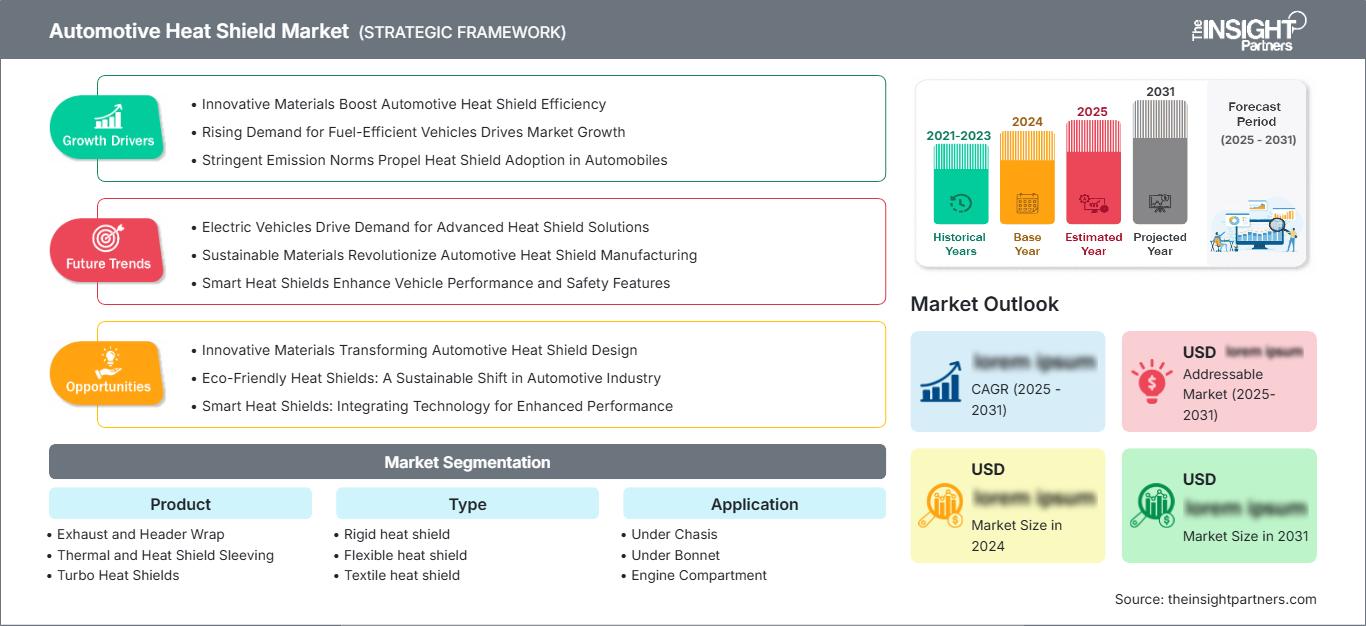
Automotive Heat Shield Market: Strategic Insights
Regional Insights
North America Automotive Heat Shield Market
North America accounted for an estimated 22–25% Automotive Heat Shield Market share in 2025 and is projected to grow at a 2.7–3.1% CAGR during 2026–2034. Demand is concentrated in light trucks, SUVs, performance trims, and commercial fleets, where thermal shielding protects underbody components, exhaust routing, wiring harnesses, and cabin floor structures.
US assembly scale, high vehicle parc, and aftermarket replacement activity support steady demand. Mexico contributes through regional manufacturing integration, while Canada supports commercial vehicle and parts production. Rising hybrid content and turbocharged gasoline engines increase shielding around catalytic converters, turbochargers, batteries, and electronic control modules.
U.S. Automotive Heat Shield Market
The US represented an estimated 78–82% of North American demand in 2025 and is forecast to expand at a 2.8–3.2% CAGR through 2034. High pickup and SUV penetration supports rigid shields for exhaust tunnels, under chassis locations, and engine compartments, while performance vehicles require enhanced turbocharger and header insulation.
Supplier presence is supported by OEM programs, aftermarket brands, and thermal material specialists. Dana Incorporated, Tenneco Inc., ACS Industries, Inc., Heatshield Products, Inc., and Lydall, Inc. participate through component supply, thermal insulation, replacement products, or engineered materials. EV platforms add selective demand for battery, electronics, and cabin thermal barriers.
Europe Automotive Heat Shield Market
Europe held an estimated 24–27% share in 2025 and is expected to grow at a 2.6–3.0% CAGR during 2026–2034. Germany leads regional demand through premium vehicle platforms, turbocharged engines, and high emission-control content. The UK supports performance and commercial applications, while France, Italy, and Spain contribute volume vehicle and component manufacturing demand.
European regulations encourage compact thermal protection around exhaust after-treatment, under bonnet areas, and passenger compartments. Suppliers such as ISOLITE GmbH, HAPPICH GmbH, Morgan Advanced Materials plc, and Tenneco Inc. support advanced materials, insulation, and formed shielding requirements. The region also benefits from hybrid launches that require heat isolation without compromising vehicle weight targets.
APAC Automotive Heat Shield Market
APAC represented 40–44% share in 2025 and is projected to grow at a 3.4–3.9% CAGR through 2034. China remains the leading country due to vehicle production scale, EV growth, and localized component ecosystems. Japan and South Korea support advanced material engineering, while India and ASEAN expand cost-sensitive volume demand.
Regional demand is supported by passenger cars, two-box compact vehicles, LCVs, and export platforms. Suppliers benefit from localized stamping, insulation, and assembly operations. Heat shielding requirements are expanding around turbochargers, underbody areas, exhaust systems, and increasingly battery-adjacent thermal zones in hybrid and electric models.
Middle East & Africa Automotive Heat Shield Market
The Middle East & Africa market is expected to grow at a 2.3–2.7% CAGR during 2026–2034. Saudi Arabia and the UAE lead demand due to high ambient temperatures, SUV preference, and premium vehicle imports. South Africa supports regional assembly, fleet replacement, and aftermarket thermal protection demand.
Operating conditions in the region increase stress on exhaust systems, under chassis parts, and engine bay components. Commercial fleets, off-road vehicles, and infrastructure-linked mobility require durable shields that resist vibration, corrosion, and heat cycling. EV demand remains early but adds opportunities for battery and electronics insulation.
Segmentation Analysis
Product
Product is projected to grow at a 2.9–3.4% CAGR during 2026–2034. The Automotive Heat Shield Market scope by product reflects different temperature loads, installation spaces, and maintenance needs across engine, exhaust, and underbody systems. Demand is shifting toward multilayer barriers and sleeving that combine heat reflection, insulation, and durability.
- Exhaust and Header Wrap is used in performance and replacement applications to contain heat near exhaust manifolds, protect adjacent components, and improve thermal control in compact engine layouts.
- Thermal and Heat Shield Sleeving protects hoses, wiring, and lines from radiant heat, especially near turbochargers, exhaust routing, and high-temperature under bonnet areas requiring flexible installation.
- Turbo Heat Shields address localized temperature spikes around turbochargers, supporting power-dense engines, reduced heat soak, and improved durability for nearby electronics and plastic components.
- Exhaust Heat Shield Insulation remains critical in OEM platforms because exhaust routing under the floor can affect cabin comfort, fuel lines, brake lines, and underbody materials.
- Heat Shield and Thermal Barriers include formed and layered solutions that protect structural zones, battery-adjacent areas, and acoustic-sensitive locations from heat transfer and vibration effects.
- Spark Plug Boot Heat Shield protects ignition components from manifold heat, supporting stable engine performance, replacement longevity, and reliability in high-temperature gasoline powertrain environments.
Type
Type is expected to grow at a 2.8–3.3% CAGR during 2026–2034. Rigid designs dominate structural and underbody protection, while flexible and textile shields are gaining relevance where installation space, vibration, and service access are challenging. Material selection is increasingly linked to weight, durability, and acoustic objectives.
- Rigid heat shield solutions are commonly used around exhaust systems, under chassis areas, and engine compartments because they provide stable geometry, robust mounting, and repeatable protection.
- Flexible heat shield designs support curved surfaces, hoses, and wiring routes, making them suitable for retrofits, complex packaging zones, and applications requiring easier installation.
- Textile heat shield products use woven or layered insulation to protect localized components, manage vibration, and provide lighter thermal protection in performance and specialty applications.
Application
Application is forecast to grow at a 3.0–3.5% CAGR during 2026–2034. Exhaust and engine compartment uses remain the largest demand sources, while turbocharger and under bonnet applications expand as engines become more compact and heat-dense. Application engineering determines shield geometry, materials, and mounting approach.
- Under Chassis applications protect floor panels, brake lines, fuel systems, and wiring from exhaust heat, road debris exposure, corrosion, and repeated thermal cycling.
- Under Bonnet applications manage heat around compact engine layouts, helping protect plastic parts, electronics, hoses, and safety-critical components from radiant heat accumulation.
- Engine Compartment shielding supports thermal balance around manifolds, catalytic converters, sensors, and nearby assemblies, improving reliability in downsized and turbocharged powertrains.
- Exhaust system applications form the largest demand area because exhaust tunnels, mufflers, catalytic converters, and underfloor routing require durable heat isolation across vehicle classes.
- Turbocharger applications are growing as turbocharged engines increase localized temperature intensity and require precise shields to reduce heat soak and protect adjacent modules.
Vehicle type
Vehicle type is projected to grow at a 2.9–3.4% CAGR during 2026–2034. Passenger cars generate the largest volume, while light and heavy commercial vehicles require more durable shielding due to longer duty cycles, payload demands, and exposure to harsher operating environments.
- Passenger Car Light demand is supported by compact engine bays, turbocharged gasoline platforms, hybrid systems, and consumer expectations for cabin comfort and component reliability.
- Commercial Vehicle applications rely on shields for uptime, exhaust durability, underbody protection, and thermal safety in delivery vans, pickup-based fleets, and regional logistics vehicles.
- Heavy Commercial Vehicle platforms require high-durability thermal protection around exhaust after-treatment, turbochargers, engine compartments, and chassis areas exposed to long operating cycles.
Opportunity Snapshot
| Application | Revenue Contribution | Trend Tag | Adoption Stage |
| Under Chassis | Medium | Floor Shielding | Mature |
| Under Bonnet | High | Compact Bays | Scaling |
| Engine Compartment | High | Heat Isolation | Mature |
| Exhaust System | High | Emission Heat | Mature |
| Turbocharger | Medium | Boost Heat | Scaling |
Automotive Heat Shield Market Growth Drivers and Impact Analysis
Turbocharged Engines Increase Localized Thermal Loads
Turbocharged engines operate with concentrated heat around turbine housings, exhaust manifolds, catalytic converters, and intake-adjacent components. Due to the reduction in engine size by manufacturers for efficient production and reduced emissions, plastic, rubber, and other electronic or wiring parts are subjected to high temperatures. This creates a need for products like heat shields and under bonnet shields. The effect is more pronounced in the passenger and light commercial vehicle segment since there is limited room around the engine in small compartments.
Emission After-Treatment Systems Require Better Heat Isolation
Modern emission systems need higher operating temperatures to support catalytic conversion and particulate control, but that heat must be isolated from nearby vehicle structures. The purpose of the heat shield is to prevent the underside components, such as fuel lines, brake lines, cabins, and wire harnesses from the heat emanating from the exhaust system. This aspect is critical in cars where there are close-mounted catalysts, diesel aftertreatment, and long routed exhaust systems. The operator places higher demands on the metal shields, insulations, and thermal barriers.
Electrification Expands Thermal Protection Beyond Engines
Hybrid and electric vehicles reduce some traditional engine heat sources but introduce new protection needs around batteries, power electronics, charging systems, and thermal runaway mitigation zones. The Automotive Heat Shield Market is therefore not limited to exhaust applications. Manufacturers are adopting textile, composite, and layered insulation technologies for EV components that call for thermal insulation, fire resistance, and flexible packaging. This trend provides new openings for firms with knowledge of materials science, particularly when an OEM needs thermal insulation without adding significant weight or complexity to the component.
Automotive Heat Shield Market Future Trends
Multifunctional Thermal and Acoustic Shields
Automotive Heat Shield Market trends point toward shields that combine thermal insulation, acoustic damping, vibration control, and lightweight construction in one engineered component. The use of multi-functional parts by OEMs is on the rise since it decreases the number of individual parts that need to be assembled. The future will see more applications of multi-layer metal and non-metal materials for automobiles, particularly luxury cars, EVs, and commercial vehicles. These products will be judged based not only on their heat resistance but also on noise insulation, recyclability, and durability.
EV-Specific Fire and Battery Protection Barriers
EV platforms will increase demand for thermal barriers that protect battery packs, underfloor modules, and electronic control units from external heat and internal fault events. These shields will require thickness control, fire retardant, light weight, and compatibility with vehicle assembly automation. The suppliers will probably produce insulation systems in modules which are scalable for various vehicle platforms. Materials like ceramics, silica cloth, mica sheets, and composite coatings will start gaining importance due to higher battery safety requirements.
Automotive Heat Shield Market Opportunities
Localized Shield Manufacturing for OEM Programs
Automotive Heat Shield Market Forecasts indicate strong opportunity for suppliers that localize stamping, forming, insulation cutting, and assembly near OEM plants. Heat shields tend to be platform-dependent, geometry-dependent, and logistics-heavy due to their dimensions and configurations. Manufacturing heat shields regionally could help to reduce shipping expenses, increase launch speed, and facilitate design modifications during the validation process. This approach may prove to be particularly advantageous in the APAC and North American regions owing to manufacturing scale and procurement policies in place.
Aftermarket Upgrades for Performance and Fleet Vehicles
Aftermarket demand provides an attractive opportunity in performance cars, off-road vehicles, commercial fleets, and older vehicles facing heat-related wear. Exhaust wraps, spark plug boot shields, sleeves, and turbo barriers are among products that do not require complete revamping of platforms. Fleet owners will be interested in minimizing downtime and protecting components, while the performance enthusiasts would like to minimize heat dissipation and increase stability in the engine bay. The suppliers with fitment information and distribution channels can benefit from recurring orders.
Frequently Asked Questions

- Comprehensive Market Sizing and Forecast Analysis
- Detailed Segmentation Analysis
- In-Depth Market Dynamics Assessment
- Regional and Country-Level Insights
- Competitive Landscape and Company Benchmarking
- Strategic Business Intelligence
Recent Reports
Testimonials

The Insight Partners' SCADA System Market report is comprehensive, with valuable insights on current trends and future forecasts. The team was highly professional, responsive, and supportive throughout. We are very satisfied and highly recommend their services.
RAN KEDEM Partner, Reali Technologies LTDs
I requested a report on a very specific software market and the team produced the report in a few days. The information was very relevant and well presented. I then requested some changes and additions to the report. The team was again very responsive and I got the final report in less than a week.
JEAN-HERVE JENN Chairman, Future Analytica
We worked with The Insight Partners for an important market study and forecast. They gave us clear insights into opportunities and risks, which helped shape our plans. Their research was easy to use and based on solid data. It helped us make smart, confident decisions. We highly recommend them.
PIYUSH NAGPAL Sr. Vice President, High Beam Global
The Insight Partners delivered insightful, well-structured market research with strong domain expertise. Their team was professional and responsive throughout. The user-friendly website made accessing industry reports seamless. We highly recommend them for reliable, high-quality research services
YUKIHIKO ADACHI CEO, Deep Blue, LLC.
This is the first time I have purchased a market report from The Insight Partners.While I was unsure at first, I visited their web site and felt more comfortable to take the risk and purchase a market report.I am completely satisfied with the quality of the report and customer service. I had several questions and comments with the initial report, but after a couple of dialogs over email with their analyst I believe I have a report that I can use as input to our strategic planning process.Thank you so much for taking the extra time and making this a positive experience.I will definitely recommend your service to others and you will be my first call when we need further market data.
JOHN SUZUKI President and Chief Executive Officer, Board Director, BK Technologies
I wish to appreciate your support and the professionalism you displayed in the course of attending to my request for information regarding to infectious disease IVD market in Nigeria. I appreciate your patience, your guidance, and the fact that you were willing to offer a discount, which eventually made it possible for us to close a deal. I look forward to engaging The Insight Partners in the future, all thanks to the impression you have created in me as a result of this first encounter.
DR CHIJIOKE ONYIA MANAGING DIRECTOR, PineCrest Healthcare Ltd.Reason to Buy
- Informed Decision-Making
- Understanding Market Dynamics
- Competitive Analysis
- Identifying Emerging Markets
- Customer Insights
- Market Forecasts
- Risk Mitigation
- Boosting Operational Efficiency
- Strategic Planning
- Investment Justification
- Tracking Industry Innovations
- Aligning with Regulatory Trends





 Get Free Sample for