
Bone Replacement Market Share, Demand & Growth by 2034
Coverage: By Product Type (Hip, Knee, Extremities); Material (Allografts, Autografts, Synthetic Materials, Bone Morphogenetic Proteins); Age Group (45 Years, 45-64 Years, 65+ Years) , and Geography (North America, Europe, Asia Pacific, and South and Central America)
- Status : Data Released
- Report Code : TIPRE00027688
- Category : Life Sciences
- No. of Pages : 150
- Available Report Formats :


- Last update date : July 29, 2026


2025 Market Size
US$ 24.56 Bn
Base year value
2034 Forecast
US$ 33.36 Bn
Projected by 2034
CAGR 2026-2034
3.90 %
Growth rate
Addressable Market
US$ 268.95 Bn
(2026-2034)
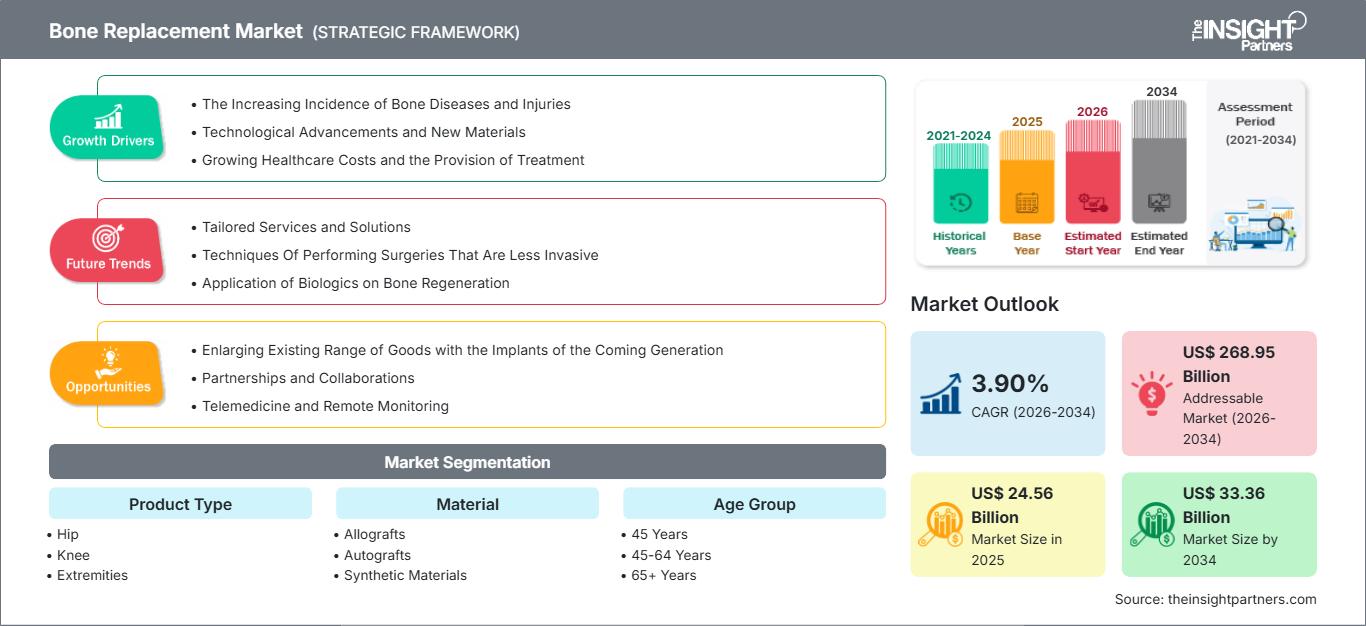
The Bone Replacement Market size is worth US$ 24.56 Billion in 2025 and is anticipated to rise up to US$ 33.36 Billion by 2034, growing at a CAGR of 3.90% during the period from 2026 to 2034. The growth path will be fuelled by consistent recovery in orthopaedic procedures, rise in usage of reconstructive implants, and strong clinical demand in hips, knees, and extremities replacements.
In North America, the Bone Replacement Market is fueled by high procedure rate, well-developed arthroplasty registries, and availability of revision surgeries. The region is forecasted to grow at a CAGR of 3.4-3.8% from 2026 to 2034. This growth would be driven by aging population, reimbursement for private payers, and quick implementation of robotic-assisted surgery in hips and knees reconstructions.
Bone Replacement Market Assessment and Insights
- North America held a 41–43% Bone Replacement Market share in 2025 and is expected to grow at a CAGR range of 3.4–3.8% during 2026–2034, supported by implant standardization, ambulatory orthopedic centers, and high revision procedure capacity.
- US accounted for 82–85% of North America in 2025 and is projected to expand at a CAGR range of 3.5–3.9% during 2026–2034, led by hospital networks, ASCs, and robotic arthroplasty platforms.
- Europe represented a 27–29% share in 2025 and is forecast to grow at a CAGR range of 3.1–3.5% during 2026–2034, with Germany, the UK, France, Italy, and Spain leading procedural demand.
- Asia Pacific held a 20–22% share in 2025 and is anticipated to grow at a CAGR range of 4.8–5.4% during 2026–2034, led by China, Japan, South Korea, India, and Australia.
- Largest Segment: Hip accounted for 43–46% market share in 2025 and is projected to grow at a CAGR range of 3.1–3.5% during 2026–2034, reflecting mature procedural acceptance.
- High Growth Segment: Extremities held a 14–16% market share in 2025 and is expected to grow at a CAGR range of 5.1–5.7% during 2026–2034, supported by shoulder, ankle, and trauma-linked reconstruction.
- Key companies analyzed in detail: AK Medical Holdings Limited, B. Braun SE, Enovis Corporation, Exactech, Inc., Johnson & Johnson MedTech, Smith & Nephew plc, Stryker Corporation, United Orthopedic Corporation, Waldemar Link GmbH & Co. KG, Zimmer Biomet Holdings, Inc.
Source: The Insight Partners' analysis based on proprietary research, government publications, company annual reports, investor presentations, industry databases, and expert interviews.
There has been a shift from standard metal implants for orthopedic reconstruction to procedure-specific implantation, porosity, enhanced polyethylene, biological support, and planning ecosystem. In the Bone Replacement market, there has been a shift from product availability towards manufacturing precision, implant compatibility, and surgeon workflow integration. Additive manufacturing is enhancing the complex acetabular cups and extremity implants while sterilization and coating validations as well as traceability are bringing discipline to titanium, cobalt-chromium, ceramics, and polymer implants.
Going forward, the emerging geographies will provide incremental volumes through expansion of hospital infrastructure, trauma network, and training of orthopedic surgeons. There is a push from the regulatory bodies for post-market evidence, implant registry, and device traceability which is going to be favorable for quality-driven firms. Robotic compatibility, ambulatory surgical center instruments, and revision portfolio will be the investment priorities for reducing surgery time with predictable patient outcomes.
Bone Replacement Market Report Scope
| Report Attribute | Details |
|---|---|
| Market size in 2025 | US$ 24.56 Billion |
| Market Size by 2034 | US$ 33.36 Billion |
| Global CAGR (2026 - 2034) | 3.90% |
| Historical Data | 2021-2024 |
| Forecast period | 2026-2034 |
Bone Replacement Market Analysis
The underlying demand drivers include osteoarthritis, fractures, deformities, and revisions. The Bone Replacement Market growth is driven by aging populations; however, procedure demand is on the rise among younger populations who require regaining mobility after sports injury or traumatic incidents. Data from WHO proving osteoarthritis as the biggest musculoskeletal disorder and procedure counts from OECD on hip and knee replacements provide the structural basis of ongoing implant use.
Suppliers' considerations revolve around qualified biomaterial providers, precision machinery production, sterilization and packaging, and surgeons' education. Cost-effectiveness assessment of total procedure cost, and not just the implant cost, by hospitals drives suppliers toward inventory management and instrumentation optimization. Digital templating, robotics, and patient-specific alignment devices are becoming part of the supply chain, especially in cases when reproducibility is required for high volume of arthroplasty procedures.
There is high competitive intensity in this market, which indicates the division into global arthroplasty market leaders and specialists. Such companies as Zimmer Biomet Holdings, Inc., Stryker Corporation, Johnson & Johnson MedTech, and Smith & Nephew plc compete in terms of breadth of their portfolios, robotics, and evidence-based medicine, while companies like United Orthopedic Corporation, AK Medical Holdings Limited, Waldemar Link GmbH & Co. KG, Exactech, Inc., B. Braun SE, and Enovis Corporation enhance niches in regional coverage, extremities, and revision.
The investment approach is becoming more and more portfolio-driven. Big players are reinvesting resources into platforms comprising implants, enabling technologies, and procedural data, whereas small specialists focus on cost-effective manufacturing, surgeon education, and regional distribution. The future success will be based on regulatory performance, innovative bearing materials, and ability to service not only tertiary care facilities but ambulatory surgery centers as well.
● REPORT CUSTOMIZATION
Tailor This Report To Align With Your Specific Business Requirements
This report can be customized to align precisely with your business objectives, scope, and target markets. Customization options include tailored segmentation, geography, competitive analysis, and strategic insights to support informed decision-making.
Customize This Report →WHAT YOU CAN ADJUST
- ● Segmentations
- ● Geography
- ● Competitive Analysis
- ● Language Preferences
Bone Replacement Market: Strategic Insights
Regional Insights
North America Bone Replacement Market
Share held by North America was 41–43% in 2025 due to high arthroplasty penetrations, reimbursement framework, and a large number of revision-ready hospitals. The CAGR of the region for 2026–2034, at 3.4–3.8%, is because of high volume growth and not price growth. Market share in the Bone Replacement is dominant where there is integration of imaging, robotics, implant inventory, and rehabilitation pathway in orthopedic centers.
The demand is boosted by prevalence of osteoarthritis, joint degeneration due to obesity, and reconstructive surgery in case of trauma. More ambulatory surgical centers are performing selected primary hip and knee surgeries, while complex revisions are performed in hospitals. Manufacturers are focusing on robotic compatibility, prevention of infection, and low profile instruments. There is also evidence-based research in North America on bearing surface, fixation, and revision implants.
U.S. Bone Replacement Market
North America consists of 82-85% share held by the U.S. in 2025 and is estimated to experience a CAGR of 3.5-3.9% between 2026-2034. This market is characterized by the presence of large orthopedic organizations, payor review, and demand for reconstruction of hips and knees. Robotic-assisted surgeries have gone beyond the phase of differentiation to become workflow architecture in many centers.
Some of the key players such as Zimmer Biomet Holdings, Inc., Stryker Corporation, Johnson & Johnson MedTech, Enovis Corporation, Exactech, Inc., and Smith & Nephew plc possess notable presence in the U.S. via their sales teams and surgeons’ training programs. Applications that are currently on trend include outpatient primary knees, anterior approach hips, revision acetabular implants, and extremities reconstruction.
Europe Bone Replacement Market
Europe is forecasted to hold a market share of 27–29% in 2025 and is estimated to grow at a CAGR of 3.1–3.5% from 2026 to 2034. Germany accounts for the largest position and is driven by high orthopedic and device engineering capacities. The UK adds value through NHS backlog management and private hospitals but maintains price- and evidence-driven procurement.
Germany is fueled by specialized orthopedic facilities, registry data, and wide adoption of premium hip and knee systems. The competition in Germany features Waldemar Link GmbH & Co. KG, B. Braun SE, and multinational companies offering revision, cemented and cementless fixation alternatives. In addition, the clinical environment fosters the use of modular revision systems and validated bearing pairs in elderly and active patients.
France, Italy, and Spain add stable demand due to aging demographics, fracture management, and hospital replacement in the public sector. France focuses on clinical validation and stringent reimbursement policies, while Italy maintains solid regional hospital networks. Lastly, Spain helps to recover elective arthroplasty through the public and private facilities.
APAC Bone Replacement Market
The APAC segment has 20-22% share in 2025 and is projected to have a CAGR between 4.8% and 5.4% in 2026-2034. China is the largest country in this market due to the development of hospitals, domestic manufacturing, and increased availability of arthroplasty treatments. Japan and South Korea promote the utilization of high-end implants through their surgical facilities.
India and Australia contribute other growth dynamics. India is expanding its trauma and joint replacement capability within the metropolitan hospitals, while Australia continues to be research-oriented through registry surveillance and survivorship analysis. The policies favoring the development of indigenous devices in China and India lead to more competitive market environment, reduced barriers to access, and localization for international players.
Middle East & Africa Bone Replacement Market
Middle East & Africa is expected to grow at a CAGR range of 3.8–4.4% during 2026–2034, with Saudi Arabia as the leading country. Demand is linked to hospital infrastructure investment, medical tourism in the UAE, and better trauma care access. South Africa remains the most developed orthopedic market in Sub-Saharan Africa.
Energy-linked public investment supports specialty hospitals and imported implant availability in Gulf countries. UAE providers emphasize private care and international surgeon networks, while Saudi Arabia is expanding tertiary orthopedic capacity under healthcare transformation programs. Rest of MEA demand remains uneven due to affordability, procurement delays, and limited revision surgery infrastructure outside major urban centers.
Segmentation Analysis
Product Type
Product Type is projected to grow at a CAGR range of 3.6–4.2% during 2026–2034. The segment defines the Bone Replacement Market scope because procedural planning, implant design, and hospital inventory are organized around anatomical reconstruction needs. Hip and knee replacements remain high-volume categories, while extremities are gaining strategic relevance due to shoulder, ankle, and trauma-driven replacement demand.
- Hip remains the largest anatomical category, supported by established clinical pathways, durable bearing materials, and high acceptance of cementless fixation among active patients requiring mobility restoration after degeneration or fracture.
- Knee demand is driven by osteoarthritis burden, robotic alignment tools, and outpatient procedure expansion, making it central to hospital implant contracts and surgeon workflow optimization.
- Extremities are strategically important as shoulder, ankle, and small joint reconstruction gain adoption, supported by trauma care, sports injury repair, and improved implant sizing options.
Material
Material is projected to grow at a CAGR range of 3.8–4.4% during 2026–2034. Material selection is increasingly tied to fixation performance, biocompatibility, revision risk, and regulatory evidence. Hospitals and surgeons evaluate allograft availability, autograft morbidity, synthetic substitutes, and biologic proteins according to defect type, patient risk, procedural complexity, and expected healing response.
- Allografts are used where structural support or bone void filling is needed, particularly in revision and trauma cases, with demand influenced by donor screening, tissue bank reliability, and regulatory oversight.
- Autografts remain clinically valued for osteogenic potential, but adoption is constrained by donor-site morbidity, harvest time, and limited volume in complex reconstruction procedures.
- Synthetic Materials are gaining importance through ceramics, calcium phosphates, bioactive glass, and engineered composites that offer sterility, predictable supply, and tailored mechanical properties for orthopedic defects.
- Bone Morphogenetic Proteins serve specialized indications where bone formation support is clinically justified, though use requires careful patient selection, cost evaluation, and compliance with approved surgical applications.
Age Group
Age Group is projected to grow at a CAGR range of 3.7–4.3% during 2026–2034. Demand differs by mobility expectation, comorbidity burden, revision probability, and procedure timing. Younger patients often require durable implants that preserve bone and allow activity, while older groups need predictable fixation, lower complication risk, and coordinated rehabilitation.
- 45 Years patients represent a selective but important cohort, typically linked to trauma, congenital deformity, sports injury, or early degenerative disease requiring durable and bone-preserving reconstruction.
- 45-64 Years patients are increasingly important due to active lifestyles, obesity-related joint stress, and willingness to undergo earlier intervention when pain limits work and mobility.
- 65+ Years remains a core demand base, supported by osteoarthritis prevalence, fracture reconstruction, and functional restoration needs across hip and knee replacement pathways.
Opportunity Snapshot
| Product Type | Revenue Contribution | Trend Tag | Adoption Stage |
| Hip | High | Cementless Fixation | Mature |
| Knee | High | Robotic Alignment | Scaling |
| Extremities | Medium | Shoulder Reconstruction | Scaling |
Bone Replacement Market Growth Drivers and Impact Analysis
Rising Osteoarthritis and Fracture Burden
Osteoarthritis will continue to be the primary medical reason behind the drive as it causes reduced mobility and eventually leads to joint replacement surgery when other treatment methods fail. The WHO figures showing millions of individuals around the world suffering from osteoarthritis make the continuous demand for hip and knee replacements inevitable. Old age is another reason for increased cases of bone fractures in hips and shoulders, hence increased demand for joint replacements through the acute trauma pathway. In actuality, this will cause an increase in the drive to demand in both elective and emergency cases. Hospitals will increase their list of arthroplasty patients, implant systems standardization, and prehabilitation.
Shift Toward Enabling Technologies in Surgery
Robotics, navigation, digital templating, and preoperative planning tools are changing how orthopedic replacement procedures are selected and executed. These technologies help surgeons manage alignment, component positioning, bone preparation, and soft-tissue balancing with greater consistency. Their market impact is significant because enabling platforms influence implant loyalty and hospital purchasing strategy. Vendors that integrate implants with surgical guidance can defend account relationships even in price-sensitive environments. The approach also supports outpatient migration, where reproducible workflows and lower complication risk matter to payors and surgery centers. Over the forecast period, enabling technologies will increasingly separate premium systems from commodity implants.
Expansion of Ambulatory Orthopedic Care
Ambulatory surgical centers are becoming important for selected primary hip and knee procedures, particularly in the U.S. and other private-care markets. This shift creates demand for streamlined instrument trays, efficient sterilization cycles, shorter operating times, and implants that support rapid mobilization. The impact reaches the full value chain because suppliers must reduce inventory complexity while maintaining surgeon choice. Hospitals retain complex revisions and high-risk patients, but ASCs are changing procedure economics for suitable cases. Vendors that design ASC-compatible logistics, education, and digital planning services can capture share without relying solely on implant discounting.
Bone Replacement Market Future Trends
Personalized Reconstruction Planning
The Bone Replacement Market trends point toward greater use of patient-specific planning based on anatomy, activity level, bone quality, and soft-tissue behavior. Future systems will combine imaging, AI-supported templating, and intraoperative feedback to optimize component position before implantation. This will be especially relevant for knees, complex hips, and extremities where alignment variability affects outcomes. Manufacturers will need interoperable platforms, data governance, and surgeon-friendly interfaces. Personalized planning may also improve revision decision-making by identifying bone loss patterns earlier, reducing operative uncertainty and supporting more predictable implant selection.
Materials Designed for Longevity and Biological Response
Future material innovation will focus on implants and substitutes that combine mechanical durability with improved biological interaction. Porous titanium, additive manufactured surfaces, ceramicized metals, advanced polyethylene, and bioactive substitutes are expected to shape next-generation reconstruction. The objective is not only longer survivorship but also better fixation, lower wear, and reduced inflammatory response. Regulatory scrutiny will require strong testing and post-market evidence, making clinical data generation a competitive necessity. Companies with integrated material science, manufacturing control, and registry-supported outcomes will be better positioned to justify premium adoption.
Bone Replacement Market Opportunities
Localized Manufacturing and Emerging Market Access
Emerging countries offer an actionable route for volume expansion if companies align implant affordability with quality, training, and supply reliability. The Bone Replacement Market Forecasts indicate that Asia Pacific will outpace mature regions, making localization strategically important. Companies can invest in regional machining, sterilization partnerships, and surgeon education centers to reduce import dependency and shorten lead times. Localized portfolios should prioritize commonly used hip and knee sizes, trauma-linked replacement options, and modular systems suitable for public hospitals. The opportunity is strongest where policy supports domestic medtech production while still requiring internationally comparable quality standards.
Revision and Complex Reconstruction Portfolios
Revision procedures create a higher-value opportunity because they require specialized implants, advanced instruments, bone defect management, and experienced surgical support. As primary procedures accumulate over time, revision volume naturally rises due to loosening, infection, wear, instability, or trauma around existing implants. Companies can differentiate by offering modular revision stems, augments, cones, biologic substitutes, and planning tools that reduce intraoperative uncertainty. This opportunity is particularly relevant in North America, Europe, Japan, and Australia, where long-term implant surveillance identifies failure patterns. Strong revision offerings can deepen surgeon relationships and protect accounts beyond commodity primary replacement systems.
Recent Developments
- October 2025: Zimmer Biomet Holdings, Inc. highlighted robotics and musculoskeletal innovations at the 2025 American Association of Hip and Knee Surgeons meeting, including comprehensive hip and knee portfolios and robotic technologies following its Monogram Technologies acquisition. The update reinforced the company’s strategy of pairing implant systems with data-enabled surgical platforms.
- March 2025: Smith & Nephew plc showcased advanced orthopedic reconstruction technologies at AAOS 2025, including CORIOGRAPH planning support for hip procedures, CORI Digital Tensioner functionality, CATALYSTEM Primary Hip System, and knee revision offerings. The development emphasized personalized surgical planning and expanded hip, knee, and shoulder reconstruction capabilities.
- January 2025: Stryker Corporation announced a definitive agreement to sell its U.S. spinal implants business to Viscogliosi Brothers, LLC, creating VB Spine, LLC. The transaction was positioned to sharpen Stryker’s focus while allowing the spine implant portfolio to operate with dedicated resources and strategic access to enabling technologies.
Frequently Asked Questions

- Comprehensive Market Sizing and Forecast Analysis
- Detailed Segmentation Analysis
- In-Depth Market Dynamics Assessment
- Regional and Country-Level Insights
- Competitive Landscape and Company Benchmarking
- Strategic Business Intelligence
Recent Reports
Testimonials

The Insight Partners' SCADA System Market report is comprehensive, with valuable insights on current trends and future forecasts. The team was highly professional, responsive, and supportive throughout. We are very satisfied and highly recommend their services.
RAN KEDEM Partner, Reali Technologies LTDs
I requested a report on a very specific software market and the team produced the report in a few days. The information was very relevant and well presented. I then requested some changes and additions to the report. The team was again very responsive and I got the final report in less than a week.
JEAN-HERVE JENN Chairman, Future Analytica
We worked with The Insight Partners for an important market study and forecast. They gave us clear insights into opportunities and risks, which helped shape our plans. Their research was easy to use and based on solid data. It helped us make smart, confident decisions. We highly recommend them.
PIYUSH NAGPAL Sr. Vice President, High Beam Global
The Insight Partners delivered insightful, well-structured market research with strong domain expertise. Their team was professional and responsive throughout. The user-friendly website made accessing industry reports seamless. We highly recommend them for reliable, high-quality research services
YUKIHIKO ADACHI CEO, Deep Blue, LLC.
This is the first time I have purchased a market report from The Insight Partners.While I was unsure at first, I visited their web site and felt more comfortable to take the risk and purchase a market report.I am completely satisfied with the quality of the report and customer service. I had several questions and comments with the initial report, but after a couple of dialogs over email with their analyst I believe I have a report that I can use as input to our strategic planning process.Thank you so much for taking the extra time and making this a positive experience.I will definitely recommend your service to others and you will be my first call when we need further market data.
JOHN SUZUKI President and Chief Executive Officer, Board Director, BK Technologies
I wish to appreciate your support and the professionalism you displayed in the course of attending to my request for information regarding to infectious disease IVD market in Nigeria. I appreciate your patience, your guidance, and the fact that you were willing to offer a discount, which eventually made it possible for us to close a deal. I look forward to engaging The Insight Partners in the future, all thanks to the impression you have created in me as a result of this first encounter.
DR CHIJIOKE ONYIA MANAGING DIRECTOR, PineCrest Healthcare Ltd.Reason to Buy
- Informed Decision-Making
- Understanding Market Dynamics
- Competitive Analysis
- Identifying Emerging Markets
- Customer Insights
- Market Forecasts
- Risk Mitigation
- Boosting Operational Efficiency
- Strategic Planning
- Investment Justification
- Tracking Industry Innovations
- Aligning with Regulatory Trends





 Get Free Sample for