
Cell Analysis Instruments Market Share, Demand & Growth by 2034
Coverage: By Product Type (Consumables, Instruments); Process (Cell Identification, Cell Signaling Pathways/Signal Transduction, Cell Viability, Cell Proliferation, Cell Counting and Quality Control, Cell Interaction, Cell Structure Study, Target Identification and Validation, Single-Cell Analysis); End User (Hospitals, Cell Culture Collection Repositories, Laboratories, Pharmaceutical and Biotechnology Companies, Academic and Research Institutes, Contract Research Organizations (CROS), Other End Users) , and Geography (North America, Europe, Asia Pacific, and South and Central America)
- Status : Data Released
- Report Code : TIPRE00006955
- Category : Life Sciences
- No. of Pages : 150
- Available Report Formats :


- Last update date : September 09, 2026


2025 Market Size
US$ 23.31 Bn
Base year value
2034 Forecast
US$ 45.41 Bn
Projected by 2034
CAGR 2026-2034
8.69 %
Growth rate
Addressable Market
US$ 325.64 Bn
(2026-2034)
The Cell Analysis Instruments Market was valued at US$ 23.31 Billion in 2025 and is projected to reach US$ 45.41 Billion by 2034, registering a CAGR of 8.69% during 2026–2034. Expanding growth is driven by increasing complexity in cell studies, higher adoption of high-content imaging solutions, higher incorporation of flow cytometry in translation processes, and consistent demand for devices and consumables for drug discovery, bioprocessing, disease models, and precision medicine applications.
The North American Cell Analysis Instruments Market size is poised to register growth at a projected CAGR of 7.9-8.5% through 2026-2034. Regional market growth is driven by a consolidated biotech ecosystem, high penetration of flow cytometry core labs, and increasing adoption of single cell workflows in cancer and immunology research. Increased automation in pharma labs also promotes replacement of traditional devices with advanced ones.
Cell Analysis Instruments Market Assessment and Insights
- North America: The region accounted for 36–39% share in 2025 and is projected to register a CAGR between 7.9–8.5% during 2026–2034, supported by biopharmaceutical research intensity, core laboratory infrastructure, and clinical translation of advanced cellular assays.
- US: The country represented 82–85% of North American revenue in 2025 and is expected to record a CAGR between 8.0–8.6% during 2026–2034.
- Europe: Europe held 27–30% share in 2025 and is forecast to expand at a CAGR between 7.6–8.2% through 2034, led by Germany, the UK, and France.
- Asia Pacific: Asia Pacific captured 23–26% share in 2025 and is projected to grow at a CAGR between 10.0–10.8% during 2026–2034, with China, Japan, South Korea, and India leading adoption.
- Largest Segment: Consumables accounted for 56–60% market share in 2025 and are expected to grow at a CAGR between 8.8–9.4% during 2026–2034, reflecting recurring assay requirements.
- High Growth Segment: Single-cell analysis represented 10–13% market share in 2025 and is projected to register a CAGR between 12.2–13.0% during 2026–2034 as multiomics applications scale.
- Key companies analyzed in detail: Becton, Dickinson and Company, Merck KGaA, Thermo Fisher Scientific Inc., Danaher Corporation, Sartorius AG, Agilent Technologies, Inc., Olympus Corporation, Revvity, Inc., Promega Corporation, and Tecan Trading AG.
Source: The Insight Partners' analysis based on proprietary research, government publications, company annual reports, investor presentations, industry databases, and expert interviews.
The development of instruments has evolved from stand-alone counting and analysis tools for cell counting and fluorescence towards multi-parameter instruments that employ spectral analysis, high content imaging, automation, and computational analysis. The production cycle is moving more towards modular platforms that create repeat demands for reagents, microplates, antibodies, dyes, and calibration. Instrument manufacturers are also working towards creating standardized interfaces, kits, and cloud-computing friendly software that help increase laboratory consistency. This evolution of platforms is in line with the needs of drug screening, cell therapies, and academic core facilities.
In the years leading up to 2034, laboratories in China, India, South Korea, and certain Middle Eastern nations will account for a growing number of new placements. Governments' spending on genomics, oncology, bioprocessing, and advanced therapies will increase the target customer population. Needs for traceability, assay validation, and quality control will encourage integrated platform sales; and shared lab facilities and contract labs will allow use of these instruments even by smaller firms unable to afford a large-scale platform.
Cell Analysis Instruments Market Report Scope
| Report Attribute | Details |
|---|---|
| Market size in 2025 | US$ 23.31 Billion |
| Market Size by 2034 | US$ 45.41 Billion |
| Global CAGR (2026 - 2034) | 8.69% |
| Historical Data | 2021-2024 |
| Forecast period | 2026-2034 |
Cell Analysis Instruments Market Analysis
The Cell Analysis Instruments Market will be influenced by the intricacy of biopharmaceutical pipelines, increasing research in cell and gene therapies, and the necessity to define heterogeneous cells. The demand is driven through an ecosystem that consists of reagent providers, optical and sensor vendors, instrument manufacturers, software providers, distributors, core labs, and researchers. Instruments and consumables have repeatable purchases, which result in recurring revenues from service, software, training, and validation of instruments. Supply chain is dependent upon laser, detectors, precise fluidic systems, imaging systems, and semiconductors.
Increasingly purchasing decisions are made based upon total workflow economics rather than the acquisition cost only. Laboratories assess the number of samples processed per day, the number of channels available, time required to run the assays, and data handling. Instrument companies compete through bundling the instruments and the reagents, maintenance and application services. The use of standardized consumables can help decrease user variability; however, proprietary consumables can increase switching costs and customer relationship.
Cell Analysis Instruments Market Report reveals an aggressive market characterized by diversified life science companies and platform-focused players. Becton, Dickinson and Company, and Thermo Fisher Scientific Inc. have comprehensive offerings for flow cytometry and reagents, while Danaher Corporation takes part in the market via cellular imaging, cytometry, automation, and analytics businesses. Sartorius AG and Agilent Technologies, Inc. focus on live-cell analysis, impedance measurement, and drug discovery solutions.
Software usability, high-dimensional data management, and compatibility become increasingly important for strategic positioning in this space. Merck KGaA, Promega Corporation, and Tecan Trading AG gain advantages from their involvement in consumables, assays, and automation; Olympus Corporation and Revvity, Inc. deal with imaging and high content analysis. Investment flows are moving toward spectral detection, artificial intelligence-driven classification, organoid analysis, and automation modules. Those vendors that can link sample preparation, measurement, interpretation, and documentation could get more share from laboratories' budgets.
● REPORT CUSTOMIZATION
Tailor This Report To Align With Your Specific Business Requirements
This report can be customized to align precisely with your business objectives, scope, and target markets. Customization options include tailored segmentation, geography, competitive analysis, and strategic insights to support informed decision-making.
Customize This Report →WHAT YOU CAN ADJUST
- ● Segmentations
- ● Geography
- ● Competitive Analysis
- ● Language Preferences
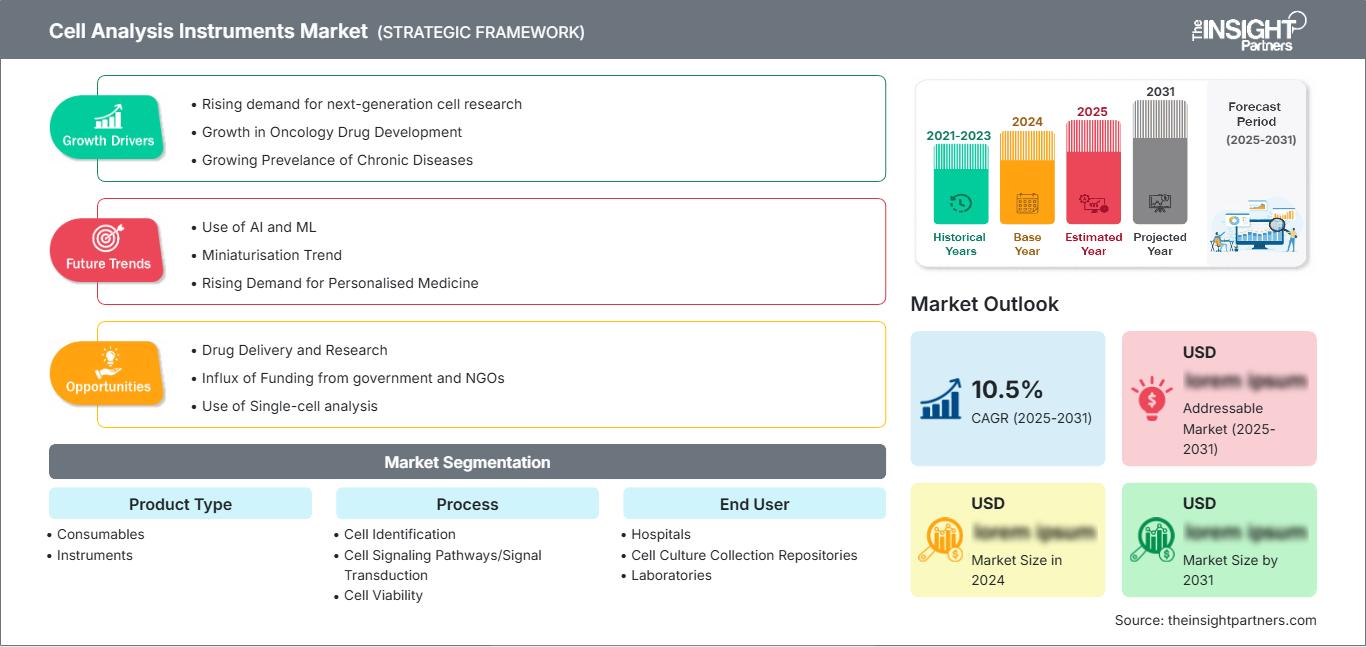
Cell Analysis Instruments Market: Strategic Insights
Regional Insights
North America Cell Analysis Instruments Market
North America accounted for 36-39% of worldwide revenues in 2025 and is expected to grow at a CAGR of 7.9-8.5% between 2026 and 2034. The Cell Analysis Instruments Market share is a result of a high number of academic core labs, well-established pharmaceutical research centers, and broad access to complex cytometric and imaging instrumentation. Research on oncology, immunology, infectious diseases, and cell therapy process development continue to be common uses driving repeated reagent purchases.
Upgrades of lab equipment from traditional fluorescence-based technology to spectral, imaging, and automation based systems contribute to the demand for such products. Techniques for conducting assays using standardized cell models are becoming more common in discovery, translational and manufacturing process controls within biopharmaceutical companies. While Canada is doing its bit by means of research and development in universities and biotech centers, Mexico finds some selective opportunities in contract testing and pharmaceutical manufacturing. Service, compatibility of software, and training for applications remain necessary purchasing factors because of customization requirements in high-dimensional assays.
U.S. Cell Analysis Instruments Market
North America was responsible for 82%–85% of revenue generated from this region in 2025 and is expected to grow at a CAGR of 8.0%–8.6% between 2026 and 2034. The strong market presence of firms, robust biomedical research infrastructure, and clusters of biotechnology located in Massachusetts, California, and Mid-Atlantic area keep instrument placements up. Cell analysis by pharmaceutical and biotech companies is employed for target validation, phenotypic screening, immune profiling, and bioprocessing.
There is a shift in application requirements towards spectral flow cytometry, real-time cellular imaging, organoid screening, and single-cell multiomics. Becton, Dickinson and Company, Thermo Fisher Scientific Inc., Danaher Corporation, Agilent Technologies, Inc., and Promega Corporation have considerable commercial or operational footprint that serves US labs. There are academic core facilities that facilitate access to expensive instruments. Increasingly, contract research organizations are offering assay development and analytical services. In addition, developers of cell therapy are looking to obtain reliable viability, identity, potency, and quality measurements.
Europe Cell Analysis Instruments Market
Europe accounted for 27–30% of the global market revenue in 2025 and projected growth rate of 7.6–8.2% CAGR through 2026-2034. The driving force of regional demand is Germany with strong presence in pharmaceutical production, biotech industry and academic laboratories. Automated imaging, live-cell observation and reproducible quality control process are preferred by German users and tailored for biologics and advanced therapy development.
The UK market is benefited with genomics technologies, translational medicine projects and biotechnology activity in Cambridge, Oxford and London. Research facilities facilitate high dimensional cytometry and single cell analysis, contract research organization extends the access to smaller biotechnology players. Regulatory compliance and research cooperation enable cross-border instrument usage.
In France, there is combination of public biomedical institutions and pharmaceutical research. Italy and Spain are gaining traction because of presence of oncology centers, universities and biotechnology activity in the regions. France is projected to be the leading market share among these three countries. Limited budget for instrument procurement leads to long replacement cycles, but demand for consumable items, service agreements and assays is sustaining recurring revenue.
APAC Cell Analysis Instruments Market
The Asia Pacific region contributed 23–26% of global revenues in 2025 and is expected to grow at a CAGR of 10.0–10.8% from 2026 to 2034. Leading revenue in the region includes biopharmaceutical manufacturing, hospital R&D, and biotechnology development through government assistance. There continues to be strong demand for precision equipment in Japan, and investment in biologics and cell therapy in South Korea.
India has witnessed increased use of R&D contracts and biosimilars while Australia offers its contribution through universities and clinical research projects. Manufacturing incentives, lab development, and increasing the scientist teams have ensured that platforms become more accessible. Increased demand consists of scalable analyzers, automated cell counters, and affordable assay consumables.
Middle East & Africa Cell Analysis Instruments Market
The Middle East and Africa market is projected to grow at a CAGR of 7.2–7.8% during 2026–2034. Saudi Arabia leads regional investment through healthcare transformation, research infrastructure, and biotechnology localization. The UAE is developing genomics and precision medicine capabilities, while South Africa remains an important academic, infectious disease, and clinical research center.
Demand for RoMEA comes from reference labs and universities. The research campus, reliability of lab services, cold storage capabilities, and skilled personnel will make the difference. Support by distributors and common facilities continue to be critical where individual labs are constrained.
Segmentation Analysis
Product Type
Product Type is projected to register a CAGR of 8.4–9.0% during 2026–2034. The Cell Analysis Instruments Market scope across this segment encompasses recurring assay materials and capital equipment used for cellular measurement, visualization, and interpretation. Instrument placements establish long-term demand for compatible reagents and maintenance, while consumable pull-through improves revenue predictability. Procurement increasingly favors integrated workflows combining hardware, validated assays, software, and technical support.
- Consumables: Consumables hold the leading position because antibodies, dyes, assay kits, microplates, beads, buffers, and calibration materials require replenishment, supporting predictable demand across routine and high-throughput workflows.
- Instruments: Instruments remain strategically important as laboratories upgrade to spectral cytometers, automated counters, live-cell imagers, and high-content systems capable of processing complex samples with reduced operator intervention.
Process
Process segmentation in the Cell Analysis Instruments Market is expected to expand at a CAGR of 8.7–9.3% during 2026–2034. Demand reflects diversification from routine counting and viability assessment toward functional, structural, and high-dimensional cellular characterization. Pharmaceutical screening requires scalable and reproducible measurements, whereas translational research prioritizes rare-cell detection and phenotype resolution. Software-supported interpretation is becoming increasingly important as multiplexed experiments generate larger datasets.
- Cell Identification: Cell identification remains foundational in immunophenotyping, disease research, and sample characterization, with demand favoring multiparameter detection capable of distinguishing rare or closely related cellular populations.
- Cell Signaling Pathways/Signal Transduction: Signal-transduction assays support mechanism-of-action studies and compound evaluation by measuring intracellular responses, receptor activity, and pathway modulation under controlled experimental conditions.
- Cell Viability: Viability testing records steady demand across cell culture, bioprocessing, toxicology, and therapy manufacturing because users must distinguish healthy, stressed, apoptotic, and necrotic populations.
- Cell Proliferation: Proliferation analysis is important for cancer research, immunology, regenerative medicine, and compound screening, supporting imaging, fluorescence, luminescence, and label-free measurement approaches.
- Cell Counting and Quality Control: Automated counting and quality control reduce manual variability, improve documentation, and support consistent cell inputs across research, manufacturing, and repository workflows.
- Cell Interaction: Cell-interaction studies gain strategic importance in immuno-oncology, infection biology, and tissue modeling as researchers examine communication between immune, tumor, stromal, and microbial cells.
- Cell Structure Study: Structural analysis supports morphology, organelle, cytoskeletal, and localization studies, driving demand for high-resolution imaging systems and probes that reveal spatial cellular changes.
- Target Identification and Validation: This process connects cellular phenotype with therapeutic hypotheses, helping developers prioritize targets, confirm biological relevance, and reduce downstream failure during drug discovery.
- Single-Cell Analysis: Single-cell analysis is the high-growth process because it resolves cellular heterogeneity and integrates genomic, transcriptomic, proteomic, spatial, and phenotypic data for precision research.
End User
End User segment in the Cell Analysis Instruments Market is projected to grow at a CAGR of 8.5–9.1% during 2026–2034. Adoption varies according to throughput, funding, regulatory exposure, and analytical complexity. Pharmaceutical and biotechnology companies prioritize automation and validated workflows, while universities often use shared core facilities. Hospitals focus on clinically relevant research and specialized diagnostics, whereas contract research organizations seek flexible platforms supporting multiple sponsors and assay formats.
- Hospitals: Hospitals use cell analysis in hematology, oncology, pathology, immune monitoring, and translational research, favoring standardized workflows, dependable service, and rapid sample processing.
- Cell Culture Collection Repositories: Repositories require counting, viability, identity, contamination monitoring, and quality control to maintain authenticated cell banks and distribute reproducible biological materials.
- Laboratories: Independent and reference laboratories demand versatile systems capable of supporting multiple assay types, sample volumes, and customer requirements without extensive workflow reconfiguration.
- Pharmaceutical and Biotechnology Companies: These companies represent high-value users because cellular assays inform target discovery, candidate evaluation, safety testing, biomarker development, and biomanufacturing process control.
- Academic and Research Institutes: Institutes generate broad instrument demand through basic biology, disease modeling, immunology, neuroscience, and collaborative projects, frequently concentrating advanced platforms within shared facilities.
- Contract Research Organizations: Contract research organizations prioritize throughput, analytical flexibility, data integrity, and rapid method transfer as sponsors outsource cellular screening, characterization, and regulated development work.
Opportunity Snapshot
| End User | Revenue Contribution (High/Medium/Low) | Trend Tag | Adoption Stage (Emerging/Scaling/Mature) |
| Hospitals | Medium | Immune Profiling | Scaling |
| Cell Culture Collection Repositories | Low | Cell Authentication | Mature |
| Laboratories | Medium | Workflow Automation | Mature |
| Pharmaceutical and Biotechnology Companies | High | Phenotypic Screening | Scaling |
| Academic and Research Institutes | High | Core Facilities | Mature |
| Contract Research Organizations | Medium | Assay Outsourcing | Scaling |
| Other End Users | Low | Distributed Testing | Emerging |
Cell Analysis Instruments Market Growth Drivers and Impact Analysis
Expansion of Cell and Gene Therapy Development
The development of cell and gene therapies will lead to an increase in demand for tools to quantify cell identity, viability, proliferation, phenotype, potency, and process reproducibility. Characterization of variable biological materials is required at various stages in drug discovery, process development, product release, and post-process analyses. This justifies the use of flow cytometers, automated cell counters, imaging systems, and standard reagents. The commercial implications go beyond the initial purchase of an instrument since workflows validated using the instrument will create a continuous need for controls, antibodies, dyes, and service. Suppliers offering a scalable approach from research to manufacturing could overcome method transfer issues. Demand would be highest from biotechnology companies, CDMOs, and specialty laboratories conducting tests on various therapy programs.
Rising Pharmaceutical Use of Phenotypic Screening
Phenotypic screening is expanding as drug developers seek cellular evidence that complements target-based discovery. High-content imaging, live-cell analysis, and label-free measurement allow researchers to observe morphology, proliferation, toxicity, signaling, and functional response in biologically complex models. Three-dimensional cultures, spheroids, and organoids further increase the need for precise imaging, environmental control, and computational segmentation. The commercial effect is greater demand for automated sample handling, image acquisition, and analysis software capable of comparing large experimental datasets. Platform suppliers can strengthen customer retention by offering validated assay templates and integrated analytics. Pharmaceutical users benefit from earlier identification of ineffective or toxic candidates, improving resource allocation before expensive preclinical development.
Need for Reproducible High-Throughput Laboratory Workflows
Laboratory capacity is increasingly constrained by complex protocols, limited specialist availability, and rising sample volumes. Automated loading, fluid handling, autofocus, gating assistance, quality checks, and standardized reporting reduce manual intervention and improve reproducibility. These capabilities are particularly valuable for multicenter studies, contract research, and biopharmaceutical development, where inconsistent methods can delay decisions or require repeated experiments. Instrument manufacturers are responding with walkaway operation, modular configurations, and software-guided workflows. Market impact includes replacement of manually intensive systems and greater attachment of service agreements, software licenses, and validated consumables. Laboratories can increase throughput without proportional staffing growth, while suppliers gain recurring revenue and stronger integration into customers’ experimental operations.
Cell Analysis Instruments Market Future Trends
Convergence of Spectral Detection and Real-Time Imaging
Cell Analysis Instruments Market trends increasingly point toward platforms that combine spectral measurement with morphological imaging in the same analytical run. This convergence enables researchers to interpret marker expression together with spatial localization, cell shape, and interaction behavior. Over the forecast period, integrated systems should reduce dependence on separate cytometry and microscopy experiments, improving sample efficiency and analytical continuity. Adoption will depend on data-processing speed, intuitive software, and standardized quality controls. As detector configurations become more accessible, mid-sized laboratories may adopt capabilities previously concentrated in specialized core facilities, widening demand for modular instruments, application training, compatible fluorophores, and computational analysis packages.
Artificial Intelligence for Cellular Classification
Artificial intelligence will move from optional image-processing functionality toward a central layer connecting acquisition, quality control, classification, and experimental decision-making. Algorithms can identify subtle phenotypes, segment complex three-dimensional models, flag technical anomalies, and prioritize cellular populations for further investigation. Future systems are likely to incorporate explainable models, audit trails, and user-controlled thresholds to support reproducibility. Commercial differentiation will increasingly depend on curated training datasets, workflow-specific models, and interoperability with laboratory information systems. Vendors must also manage cybersecurity, version control, and validation expectations. Successful implementation can shorten analysis time while allowing scientists to focus on biological interpretation rather than repetitive data processing.
Cell Analysis Instruments Market Opportunities
Scalable Platforms for Emerging Biotechnology Clusters
Instrument providers can address emerging biotechnology clusters with modular configurations, reagent rental models, shared-service installations, and application support tailored to developing laboratory networks. Customers in India, China, South Korea, Saudi Arabia, and selected Southeast Asian markets often require advanced analytical capability but face variable capital budgets and specialist availability. Suppliers can lower adoption barriers through staged upgrades, remote diagnostics, standardized training, and local consumable inventories. Partnerships with universities, contract research organizations, and biotechnology parks can aggregate demand across multiple users. Investment should prioritize regional service capacity and workflow localization, because platform uptime and technical support directly influence purchasing decisions and long-term consumable pull-through.
Integrated Solutions for Organoid and Three-Dimensional Models
Organoid and three-dimensional cell models in the Cell Analysis Instruments Market Forecast create an opportunity for vendors to combine environmental control, automated culture handling, high-content imaging, and advanced segmentation software. These models offer greater biological relevance than conventional monolayer cultures but introduce challenges involving focus depth, sample variability, and complex image interpretation. Suppliers can develop purpose-built objectives, microplates, assay kits, and analysis templates for oncology, toxicology, neuroscience, and regenerative medicine. Investment in interoperable workflows can position providers across culture, measurement, and interpretation rather than isolated instrument categories. Pharmaceutical partnerships and reference datasets will be important for demonstrating reproducibility and accelerating standardized adoption in screening and translational research programs.
Recent Developments
- December 2025: Becton, Dickinson and Company launched three-laser and four-laser configurations of the BD FACSDiscover A8 Cell Analyzer, expanding access to spectral flow cytometry and real-time cellular imaging. The configurations complement the five-laser platform introduced earlier in 2025 and include software-upgrade options intended to accommodate different laboratory budgets and application requirements.
- June 2025: Thermo Fisher Scientific Inc. introduced the Orbitrap Astral Zoom and Orbitrap Excedion Pro mass spectrometers for biopharmaceutical and omics research. The Astral Zoom platform was reported to provide 35% faster scanning, 40% higher throughput, and 50% greater multiplexing capacity, strengthening the company’s connected proteomics and molecular-analysis ecosystem.
- January 2025: Danaher Corporation’s Molecular Devices business presented the ImageXpress HCS.ai High-Content Screening System at SLAS 2025. The platform combines automated high-quality cellular imaging with artificial intelligence-enabled IN Carta image analysis and is positioned for complex assays involving conventional cell cultures, stem cells, spheroids, and organoids.
Frequently Asked Questions

- Comprehensive Market Sizing and Forecast Analysis
- Detailed Segmentation Analysis
- In-Depth Market Dynamics Assessment
- Regional and Country-Level Insights
- Competitive Landscape and Company Benchmarking
- Strategic Business Intelligence
Recent Reports
Testimonials

The Insight Partners' SCADA System Market report is comprehensive, with valuable insights on current trends and future forecasts. The team was highly professional, responsive, and supportive throughout. We are very satisfied and highly recommend their services.
RAN KEDEM Partner, Reali Technologies LTDs
I requested a report on a very specific software market and the team produced the report in a few days. The information was very relevant and well presented. I then requested some changes and additions to the report. The team was again very responsive and I got the final report in less than a week.
JEAN-HERVE JENN Chairman, Future Analytica
We worked with The Insight Partners for an important market study and forecast. They gave us clear insights into opportunities and risks, which helped shape our plans. Their research was easy to use and based on solid data. It helped us make smart, confident decisions. We highly recommend them.
PIYUSH NAGPAL Sr. Vice President, High Beam Global
The Insight Partners delivered insightful, well-structured market research with strong domain expertise. Their team was professional and responsive throughout. The user-friendly website made accessing industry reports seamless. We highly recommend them for reliable, high-quality research services
YUKIHIKO ADACHI CEO, Deep Blue, LLC.
This is the first time I have purchased a market report from The Insight Partners.While I was unsure at first, I visited their web site and felt more comfortable to take the risk and purchase a market report.I am completely satisfied with the quality of the report and customer service. I had several questions and comments with the initial report, but after a couple of dialogs over email with their analyst I believe I have a report that I can use as input to our strategic planning process.Thank you so much for taking the extra time and making this a positive experience.I will definitely recommend your service to others and you will be my first call when we need further market data.
JOHN SUZUKI President and Chief Executive Officer, Board Director, BK Technologies
I wish to appreciate your support and the professionalism you displayed in the course of attending to my request for information regarding to infectious disease IVD market in Nigeria. I appreciate your patience, your guidance, and the fact that you were willing to offer a discount, which eventually made it possible for us to close a deal. I look forward to engaging The Insight Partners in the future, all thanks to the impression you have created in me as a result of this first encounter.
DR CHIJIOKE ONYIA MANAGING DIRECTOR, PineCrest Healthcare Ltd.Reason to Buy
- Informed Decision-Making
- Understanding Market Dynamics
- Competitive Analysis
- Identifying Emerging Markets
- Customer Insights
- Market Forecasts
- Risk Mitigation
- Boosting Operational Efficiency
- Strategic Planning
- Investment Justification
- Tracking Industry Innovations
- Aligning with Regulatory Trends





 Get Free Sample for