
Dental Cabinet Market Share, Growth & Forecast by 2034
Coverage: By Product Type (Mobile Dental Cabinets, Wall-Mounted Dental Cabinets, Portable Dental Cabinets, Others); Material (Wood, Metal, Plastic, Others); End-User (Dental Clinics, Hospitals, Ambulatory Surgical Centers, Others); Distribution Channel (Online Stores and Offline Stores), and Geography (North America, Europe, Asia Pacific, and South and Central America)
- Status : Data Released
- Report Code : TIPRE00023792
- Category : Life Sciences
- No. of Pages : 150
- Available Report Formats :


- Last update date : September 03, 2026


2025 Market Size
US$ 1.7 Bn
Base year value
2034 Forecast
US$ 3.28 Bn
Projected by 2034
CAGR 2026-2034
7.59 %
Growth rate
Addressable Market
US$ 22.45 Bn
(2026-2034)
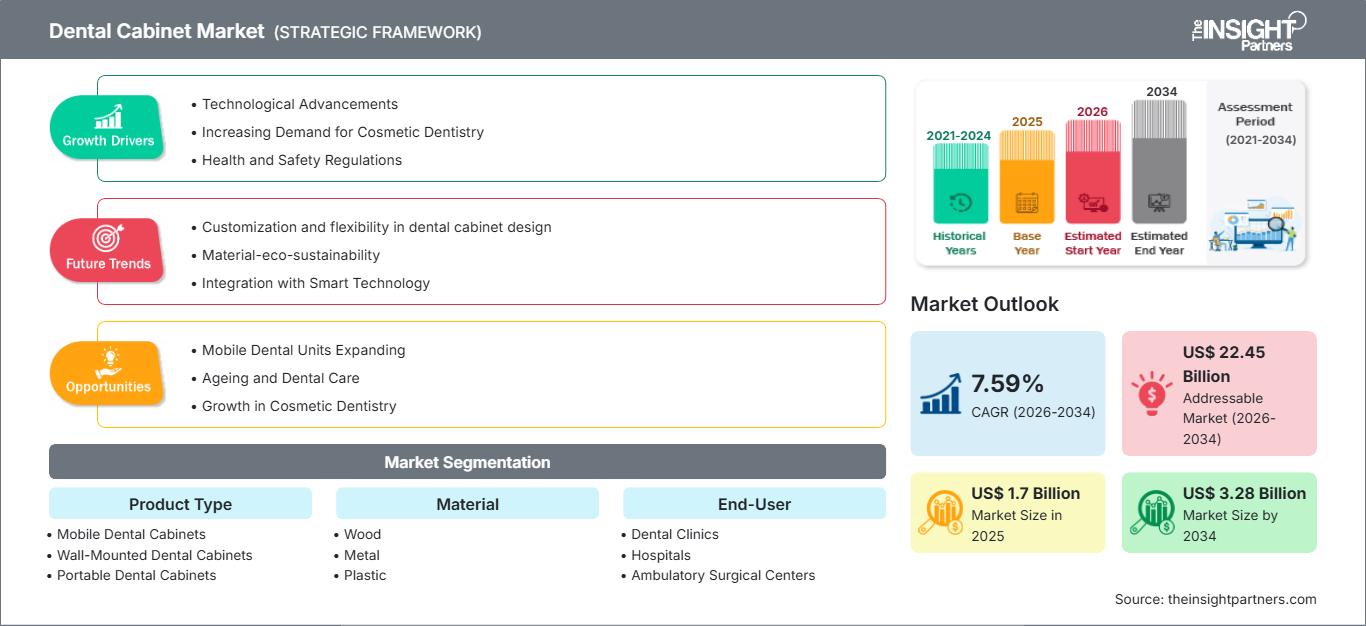
The Dental Cabinet Market was valued at US$ 1.7 Billion in 2025 and is projected to reach US$ 3.28 Billion by 2034, registering a CAGR of 7.59% from 2026 to 2034. The growth of dental facilities, the modernization of dental operatories, the need for effective infection control, and the growing need for ergonomic working environment are contributing towards increased investments in cabinetry solutions in clinics, hospitals, and ambulatory care centers across the world.
The geography of North America continues to hold structural attractiveness, driven by the replacement of older operatories, high dental facility spendings, and growing use of modular dental furniture. The Dental Cabinet Market size will also be affected by practice consolidation and renovation trends, and the region is expected to grow at a CAGR of 7.1-7.5% from 2026 to 2034.
Dental Cabinet Market Assessment and Insights
- North America: The region is projected to represent a 36–40% share in 2025 and grow at a CAGR of 7.1–7.5% between 2026 and 2034, supported by replacement demand, practice consolidation, and high expenditure on operatory infrastructure.
- US: The US is estimated to account for 74–78% of North America's 2025 share, expanding at a 7.0–7.4% CAGR as dental practices modernize furniture and optimize clinical workflows.
- Europe: Europe is estimated to hold a 27–31% share in 2025 and grow at a 7.3–7.7% CAGR through 2034, with Germany, the UK, France, Italy, and Spain supporting demand through refurbishment and private dental investment.
- Asia Pacific: Asia Pacific is estimated at a 23–27% share in 2025 and is expected to grow at an 8.4–8.9% CAGR, led by China, Japan, South Korea, India, and Australia as clinic capacity and modern dental infrastructure expand.
- Largest Segment: Wall-Mounted Dental Cabinets are estimated to hold a 37–41% market share in 2025 and grow at a 7.2–7.6% CAGR, reflecting efficient space utilization and fixed operatory workflows.
- High Growth Segment: Online Stores are estimated to represent an 18–22% market share in 2025 and expand at a 9.1–9.7% CAGR as standardized cabinetry becomes easier to compare and purchase digitally.
- Key companies analyzed in detail: A-dec, Inc.; DentalEZ, Inc.; Pelton & Crane; Dental Planet; Planmeca; Dentsply Sirona, Inc.; Midmark Corporation; SDS Dental; Takara Belmont Corporation; Sinol Dental Limited.
Source: The Insight Partners' analysis based on proprietary research, government publications, company annual reports, investor presentations, industry databases, and expert interviews.
Dental Cabinet Market has changed its focus from simple storage furniture to modular clinical system that works along with treatment room operations. Now, there is an emphasis being laid by manufacturers on cleanability, soft closing, modularity of storage systems, disposal system integration, lighting, and ergonomics. The manufacturing process has also moved to modular manufacturing process that allows for flexibility and customization based on room sizes.
For the future, investments are expected to be made in flexible cabinetry for digital operatories, small room sizes, and multi-chair clinics. New market development will benefit from clinics construction, while existing markets will depend more on refitting and replacing. Infection control requirements, sustainability requirements, durability of materials, and treatment room design requirements are expected to drive specifications along with traditional storage needs.
Dental Cabinet Market Report Scope
| Report Attribute | Details |
|---|---|
| Market size in 2025 | US$ 1.7 Billion |
| Market Size by 2034 | US$ 3.28 Billion |
| Global CAGR (2026 - 2034) | 7.59% |
| Historical Data | 2021-2024 |
| Forecast period | 2026-2034 |
Dental Cabinet Market Analysis
Demand will be boosted by the development of the Dental Cabinet Market because of the increasing number of dental practices, renovation schedules, and the requirement of arranging dental instruments, consumable materials, sterilizing materials, and clinical wastes near the work area. The value chain covers cabinet designers, raw materials providers, parts producers, wholesalers, installation firms, and dental equipment installers. The increasing operational costs of practices make buyers focus on the durability and life cycle cost.
Supply factors include laminated boards, metals, plastics, hardware, countertops, lighting parts, and fittings. The local manufacture plays a significant role in customized cabinets, whereas modularized cabinets provide opportunities for manufacturers to produce more effectively. The business environment increasingly includes cabinets along with chairs, delivery systems, sterilizing zones, imaging machines, and plumbing installations.
Product longevity, modularity of construction, extent of service coverage, design adaptability, and compatibility with other operatory systems have become key drivers of competitive positioning. According to the Dental Cabinet Market report, existing producers distinguish themselves with their installed base, while distributors and specialty dealers do so with customization capabilities and installation assistance. A-dec, Inc. integrates dental furniture and operatory equipment, while Midmark Corporation focuses on operatory design and workflow optimization.
Dentsply Sirona, Inc., Planmeca, and Takara Belmont Corporation compete via their overall dental equipment eco-systems, which could affect cabinet specifications. Different combinations of dental equipment and furniture, distribution and customization needs are satisfied by DentalEZ, Inc., Pelton & Crane, Dental Planet, SDS Dental, and Sinol Dental Limited. Thus, capital expenditure is being directed towards modular product platforms, reliable after-sales service, and digital-operatory room planning as opposed to cabinets as furniture.
● REPORT CUSTOMIZATION
Tailor This Report To Align With Your Specific Business Requirements
This report can be customized to align precisely with your business objectives, scope, and target markets. Customization options include tailored segmentation, geography, competitive analysis, and strategic insights to support informed decision-making.
Customize This Report →WHAT YOU CAN ADJUST
- ● Segmentations
- ● Geography
- ● Competitive Analysis
- ● Language Preferences
Dental Cabinet Market: Strategic Insights
Regional Insights
North America Dental Cabinet Market
North America is forecast to have a 36-40% of the Dental Cabinet market share by 2025 and grow at a CAGR of 7.1-7.5% until 2034. The region enjoys an already existing dental infrastructure, high cost of replacement, and an existing stock of operatories which require renovation. The United States spent US$189 billion on dental care in 2024, thus offering a solid economic base for investments into equipment and facilities.
Dental practice consolidation also influences the market. Large dental practices are able to standardize their cabinetry specifications for several offices, and therefore favor products that are modular in nature, having standard dimensions, installation process and service needs. Infection control issues also favor smooth and cleanable surfaces along with accessible storage. Canada brings steady demand through private and institutional dentistry practices.
U.S. Dental Cabinet Market
According to projections, the US will account for 74–78% of North America's share in 2025 and exhibit a 7.0–7.4% CAGR. The expenditure on dental services stood at US$189 billion in 2024, while the American Dental Association noted sustained growth in consumers' spending in 2025 and the beginning of 2026. This situation allows for sustained investments into practice infrastructure in spite of cost challenges.
The market players in equipment and operatory segments include A-dec, Inc., DentalEZ, Inc., Midmark Corporation, Dental Planet, Dentsply Sirona, Inc., and others. The demand for equipment is high in dental clinics, where cabinetry enables sterilization, instrument management, waste management, and easy access from the dentist's chair. More specific designs are needed for hospitals and ambulatory surgical centers, with emphasis on robust surfaces and proper storage arrangements.
Europe Dental Cabinet Market
Europe is expected to command 27-31% share in 2025 and grow at a 7.3-7.7% CAGR. Germany holds the top position among the European countries with an advanced base of dental equipment manufacturing, clinical setting and replacement-based purchasing pattern. Private dentistry, refurbishment and investment into new dental office setup drive demand in the UK, France, Italy, and Spain.
The UK segment of the market sees growth due to active private dentistry as well as continuous pressure on public dental care. In Germany, the focus lies on engineered quality, ergonomics and clinical furniture durability that enables premium modular setups. France and Italy have active private dental networks and modernization plans, while Spain sees growth due to demand from private clinics and dental groups. Sustainability, traceability of materials, cleaning and space optimization become increasingly important criteria in the EU.
APAC Dental Cabinet Market
APAC region is expected to hold a 23-27% market share in 2025 and to exhibit an 8.4-8.9% CAGR, thus becoming the most rapidly growing region. Chinese demand dominates, followed by Japan, South Korea, India, and Australia. Growing clinics networks and upgrading of dental facilities drive the purchase of cabinets.
Development of industrial sector in China and India provides for local manufacturing and cost-efficient supplies, while Japanese and South Korean demands require accuracy, ergonomic design and compactness. Public support of healthcare system improvement and private investments in dental business will promote modern operatory construction. Australia provides for replacement demand and advanced clinical standards.
Middle East & Africa Dental Cabinet Market
The demand in MEA will rise at a rate of 6.6–7.0% CAGR. In terms of opportunity in the region, Saudi Arabia stands out, followed by UAE and South Africa, whereas MEA apart from these countries will be more fragmented. Investments through Vision 2030 program, growth in private healthcare and dental tourism help in modernization of clinics and facilities.
In terms of energy earnings in Gulf countries, there is capacity for investing in healthcare facilities, and new hospitals and specialist clinics provide opportunities in cabinetry. UAE will get a boost from dental tourism and private investments, Saudi Arabia from large-scale healthcare projects, and South Africa from its existing private dental market.
Segmentation Analysis
Product Type
Product Type is expected to expand at a 7.4–7.8% CAGR from 2026 to 2034. Demand reflects differing treatment-room layouts, mobility requirements, storage density, and installation constraints. The Dental Cabinet Market scope is broadening as manufacturers offer modular configurations that can be adapted to new construction and refurbishment projects without requiring complete operatory replacement.
- Mobile Dental Cabinets: Mobile configurations provide flexibility where room layouts change frequently, enabling clinics to reposition storage and equipment while maintaining access to instruments and consumables.
- Wall-Mounted Dental Cabinets: Wall-mounted designs remain central to fixed operatories because they conserve floor area, simplify organization, and provide predictable storage positions for routine clinical workflows.
- Portable Dental Cabinets: Portable products address temporary treatment spaces, satellite clinics, educational environments, and facilities requiring equipment mobility without permanent cabinetry installation.
Material
Material is projected to grow at a 7.3–7.7% CAGR through 2034. Material selection increasingly balances durability, cleanability, moisture resistance, appearance, weight, and lifecycle economics. Buyers in clinical settings evaluate surfaces according to repeated disinfection requirements and expected service life, while designers also consider aesthetics and compatibility with broader operatory furniture.
- Wood: Wood-based cabinetry remains important for premium clinical interiors, offering design flexibility, familiar aesthetics, and broad finishing options for practices emphasizing patient-facing environments.
- Metal: Metal provides structural strength and durability, making it suitable for high-use settings where resistance to impact, moisture, and repeated cleaning is particularly important.
- Plastic: Plastic components support lightweight construction and easy cleaning, making them useful for selected storage modules and applications where corrosion resistance and simplified maintenance are priorities.
End-User
End-User demand is forecast to increase at a 7.5–7.9% CAGR. Dental clinics represent the core purchasing environment because cabinetry is integral to everyday operatory organization. Hospitals and ambulatory surgical centers require more specialized configurations, while laboratories and institutional users prioritize storage efficiency, durability, and workflow-specific layouts. The Dental Cabinet Market analysis therefore varies substantially by facility scale and clinical intensity.
- Dental Clinics: Clinics require compact, ergonomic cabinetry that supports routine procedures, sterilization workflows, instrument access, and efficient use of limited treatment-room space.
- Hospitals: Hospitals favor durable, standardized cabinetry capable of supporting higher utilization, infection-control requirements, multiple specialties, and integration with broader clinical infrastructure.
- Ambulatory Surgical Centers: These facilities prioritize cleanable surfaces, organized storage, and reliable access to supplies where procedure turnover and infection-control processes influence room configuration.
Distribution Channel
Distribution Channel is expected to grow at a 8.1–9.7% CAGR through 2034, reflecting wider digital procurement alongside established dealer relationships. Standardized products are particularly suitable for online comparison, while customized cabinetry continues to depend on local distributors, room planners, installation teams, and direct manufacturer engagement.
- Online Stores: Online purchasing is gaining relevance for standardized cabinets and accessories because buyers can compare configurations, specifications, finishes, delivery terms, and replacement components before ordering.
- Offline Stores: Offline channels remain essential for customized projects requiring site measurement, design consultation, installation, technical support, and coordination with dental equipment infrastructure.
Opportunity Snapshot
| End-User | Revenue Contribution (High/Medium/Low) | Trend Tag | Adoption Stage |
|---|---|---|---|
| Dental Clinics | High | Operatory Fit | Mature |
| Hospitals | Medium | Clinical Storage | Scaling |
| Ambulatory Surgical Centers | Medium | Procedure Support | Scaling |
| Others | Low | Flexible Rooms | Emerging |
Dental Cabinet Market Growth Drivers and Impact Analysis
Expansion of Dental Practice Networks
Increasingly, the proliferation of multi-site dental practices and dental support organizations will drive a need for standardization in operating room design and cabinet specifications. Indeed, within the United States, the American Dental Association has shown that there is an increasing trend towards larger dental practices and dental support organization affiliations, which increases the need for scalability in procurement. From the perspective of cabinet makers, this may result in long-term procurement deals, standard modules, centralized purchasing, and repeat orders from a geographically distributed set of facilities. It is not just unit volumes which matter in such cases, as bigger businesses look for installation times, serviceability, parts availability, and product performance over its lifetime.
Infection-Control and Ergonomic Design Requirements
Cabinets used in healthcare practices are now judged as components of the infection-control and workflow environment, as opposed to simply furniture pieces. Smooth surfaces, fewer seams, accessible storage spaces, touch-reducing options, and easily cleaned surfaces may help overcome some of the challenges associated with regular environmental cleaning. Positioning that takes into consideration ergonomics may also affect the way staff moves around the workspace and the organization of the treatment room. Infection prevention and control continue to be important concerns for the CDC in dentistry environments, adding more importance to the subject matter of surfaces and workflow. The manufacturers who include storage, waste separation, dispensers, lighting, and ergonomic positioning in one product can take care of a number of concerns through one installation. This helps distinguish themselves by offering functionality and longevity of the products, not just aesthetics.
Renovation of Aging Dental Infrastructure
The replacement of old cabinetry provides a cycle of demand that operates independently of any new clinics being built. It is possible for dentists to continue to keep their existing dental chairs and other systems while simply upgrading cabinetry that has been affected by wear and tear, out-of-date designs, inadequate storage solutions, or difficulties with infection control. This type of limited renovation could help cabinetry to become a good capital expense opportunity for dentists who want to improve the functionality of their room but don’t have to completely reconstruct the operatory. This issue becomes especially important in the case of established markets with significant installed bases. Suppliers will be able to take advantage of this market potential by providing modular replacement packages, dimensional compatibility, and staged installations..
Dental Cabinet Market Future Trends
Connected Operatory Planning and Modular Configuration
Digital room-planning tools are likely to become increasingly important in Dental Cabinet Market Trends as dental practices seek faster and more predictable installation. Three-dimensional visualization can allow buyers to test cabinet positions, storage capacity, equipment clearances, finishes, and workflow arrangements before fabrication. Integration with chair, delivery, imaging, and sterilization specifications can further reduce installation errors. Modular architectures should support this shift because standardized cabinet dimensions can be represented digitally and configured around individual room requirements. Over time, suppliers may connect configurators with quotations, manufacturing instructions, installation schedules, and service records, creating a more continuous purchasing process. The trend could shorten sales cycles for standardized products while preserving customization through digital configuration. It may also allow manufacturers to capture room-level data that informs future product development and inventory planning.
Sustainable Materials and Lifecycle-Oriented Purchasing
Sustainability is likely to influence cabinetry specifications more strongly as dental operators assess material sourcing, durability, repairability, and end-of-life handling. Longer product lifecycles can reduce replacement frequency and installation waste, while modular construction can permit individual components to be replaced instead of entire cabinets. Manufacturers may increasingly offer recycled or lower-impact materials, water-resistant finishes with longer service lives, and hardware designed for repeated maintenance. Procurement teams could also evaluate warranties, local service capacity, packaging, and refurbishment options alongside purchase prices. These criteria favor suppliers capable of documenting material characteristics and lifecycle performance. Sustainability is therefore likely to develop from an architectural preference into a procurement consideration, especially for larger dental groups, hospitals, and institutional customers with formal environmental policies and standardized facility-design requirements.
Dental Cabinet Market Opportunities
Regional Manufacturing and Localization
Manufacturers can pursue localized production and assembly in Asia Pacific and selected Middle Eastern markets where clinic construction and healthcare infrastructure are expanding. Regional manufacturing can reduce transportation costs, shorten lead times, and improve responsiveness to local dimensions, materials, and regulatory requirements. China and India offer established manufacturing ecosystems, while Gulf markets provide opportunities for distributors and assemblers serving rapidly developing private healthcare facilities. A localization strategy should distinguish between standardized cabinet modules and locally customized components, allowing manufacturers to preserve scale efficiencies while adapting final configurations. Partnerships with dental equipment distributors, architects, and clinic planners could provide market access without requiring a fully owned commercial footprint. The Dental Cabinet Market Forecast therefore favor business models combining standardized core products with localized finishing, installation, and after-sales support.
Integrated Furniture and Equipment Platforms
An attractive investment opportunity lies in integrating cabinetry with dental equipment, sterilization workflows, utility connections, and digital treatment-room planning. Rather than selling standalone storage, suppliers can create coordinated room packages that simplify procurement and installation for new practices and major refurbishments. Such platforms can reduce interface problems between cabinets, chairs, delivery systems, lighting, suction, electrical connections, and plumbing. The approach is particularly relevant to dental groups seeking consistent layouts across multiple facilities. Companies with existing equipment portfolios can use cabinetry to deepen customer relationships and increase the share of each operatory project. Independent cabinet manufacturers can pursue partnerships with equipment companies and specialist installers. The strongest opportunity is likely to come from modular packages that retain customization while reducing the engineering effort required for each individual treatment room.
Recent Developments
- July 2026: Midmark Corporation introduced refreshed Synthesis and Artizan Expressions cabinetry colors, adding warm woodgrains, solids, and metallic finishes designed for modern clinical environments. The update reflects increasing attention to coordinated room aesthetics and patient experience while retaining the clinical-grade positioning of its cabinetry collections.
- June 2026: Planmeca expanded its dental-unit portfolio with Pro40 and Pro50 S, emphasizing compact layouts, ergonomic workflows, digital connectivity, automated waterline cleaning, and modular configurations. The launches reinforce the broader movement toward integrated and space-efficient operatory environments in which furniture specifications increasingly interact with equipment architecture.
- February 2026: A-dec, Inc extended its strategic partnership with Dentsply Sirona, integrating the Dentsply Sirona Midwest Motor System into A-dec 500 Pro and A-dec 300 Pro delivery systems. The development strengthens equipment integration and demonstrates the broader industry shift toward coordinated operatory platforms spanning furniture, delivery systems, and digital clinical workflows.
Frequently Asked Questions

- Comprehensive Market Sizing and Forecast Analysis
- Detailed Segmentation Analysis
- In-Depth Market Dynamics Assessment
- Regional and Country-Level Insights
- Competitive Landscape and Company Benchmarking
- Strategic Business Intelligence
Recent Reports
Testimonials

The Insight Partners' SCADA System Market report is comprehensive, with valuable insights on current trends and future forecasts. The team was highly professional, responsive, and supportive throughout. We are very satisfied and highly recommend their services.
RAN KEDEM Partner, Reali Technologies LTDs
I requested a report on a very specific software market and the team produced the report in a few days. The information was very relevant and well presented. I then requested some changes and additions to the report. The team was again very responsive and I got the final report in less than a week.
JEAN-HERVE JENN Chairman, Future Analytica
We worked with The Insight Partners for an important market study and forecast. They gave us clear insights into opportunities and risks, which helped shape our plans. Their research was easy to use and based on solid data. It helped us make smart, confident decisions. We highly recommend them.
PIYUSH NAGPAL Sr. Vice President, High Beam Global
The Insight Partners delivered insightful, well-structured market research with strong domain expertise. Their team was professional and responsive throughout. The user-friendly website made accessing industry reports seamless. We highly recommend them for reliable, high-quality research services
YUKIHIKO ADACHI CEO, Deep Blue, LLC.
This is the first time I have purchased a market report from The Insight Partners.While I was unsure at first, I visited their web site and felt more comfortable to take the risk and purchase a market report.I am completely satisfied with the quality of the report and customer service. I had several questions and comments with the initial report, but after a couple of dialogs over email with their analyst I believe I have a report that I can use as input to our strategic planning process.Thank you so much for taking the extra time and making this a positive experience.I will definitely recommend your service to others and you will be my first call when we need further market data.
JOHN SUZUKI President and Chief Executive Officer, Board Director, BK Technologies
I wish to appreciate your support and the professionalism you displayed in the course of attending to my request for information regarding to infectious disease IVD market in Nigeria. I appreciate your patience, your guidance, and the fact that you were willing to offer a discount, which eventually made it possible for us to close a deal. I look forward to engaging The Insight Partners in the future, all thanks to the impression you have created in me as a result of this first encounter.
DR CHIJIOKE ONYIA MANAGING DIRECTOR, PineCrest Healthcare Ltd.Reason to Buy
- Informed Decision-Making
- Understanding Market Dynamics
- Competitive Analysis
- Identifying Emerging Markets
- Customer Insights
- Market Forecasts
- Risk Mitigation
- Boosting Operational Efficiency
- Strategic Planning
- Investment Justification
- Tracking Industry Innovations
- Aligning with Regulatory Trends





 Get Free Sample for