
Piston Cylinder Market Growth, Size & Forecast by 2034
Coverage: By Product Type (Single Pole, Double Pole); End User Industry (Marine, Agriculture, Automotive) , and Geography (North America, Europe, Asia Pacific, and South and Central America)
- Status : Data Released
- Report Code : TIPRE00017652
- Category : Manufacturing and Construction
- No. of Pages : 150
- Available Report Formats :


- Last update date : September 30, 2026


2025 Market Size
US$ 14.55 Bn
Base year value
2034 Forecast
US$ 24.76 Bn
Projected by 2034
CAGR 2026-2034
6.09 %
Growth rate
Addressable Market
US$ 178.04 Bn
(2026-2034)
The Piston Cylinder Market size is valued at US$ 14.55 Billion in 2025 and is projected to reach US$ 24.76 Billion by 2034, expanding at a CAGR of 6.09% from 2026 to 2034. The market covers piston-cylinder solutions used to convert hydraulic pressure into controlled linear force and motion across equipment and machinery, segmented by Product Type into Single Pole and Double Pole and by End User Industry into Marine, Agriculture, and Automotive.
North America is estimated to account for 28.00% of the global Piston Cylinder Market in 2025, with a 5.65% CAGR from 2026 to 2034. Demand is supported by replacement requirements for construction and industrial equipment, established hydraulic manufacturing capabilities, and continued investment in mobile machinery. The region also benefits from sophisticated aftermarket channels and strong adoption of engineered cylinders where durability, contamination resistance, precise motion, and rapid servicing influence equipment uptime.
Piston Cylinder Market Assessment and Insights
- North America: North America is estimated to hold 28.00% of the global Piston Cylinder Market share in 2025 and expand at a 5.65% CAGR through 2034, supported by a mature installed equipment base, replacement demand, and specialized hydraulic manufacturing. Its established service infrastructure strengthens recurring cylinder demand.
- U.S.: The U.S. is estimated to represent 68.00% of North America's market in 2025 and grow at a 5.48% CAGR through 2034, supported by construction equipment, industrial machinery, agricultural equipment, and a broad hydraulic aftermarket.
- Europe: Europe is estimated to hold 24.00% of global demand in 2025 and register a 5.72% CAGR. Germany leads regional demand, followed by the UK, France, Italy, and Spain, with engineering quality, industrial automation, machinery exports, and efficiency requirements differentiating the region.
- Asia Pacific: Asia Pacific is estimated to represent 31.00% of the global market in 2025 and expand at a 6.88% CAGR. China leads, supported by construction equipment manufacturing, agricultural mechanization, industrial production, and localization of hydraulic components, while Japan, South Korea, and India reinforce the regional supply base.
- Largest Segment: Double Pole is estimated to be the largest Product Type segment and is projected to grow at a 6.21% CAGR from 2026 to 2034, reflecting broad suitability for equipment requiring controlled bidirectional actuation and repeatable load movement.
- High Growth Segment: Agriculture is projected to be the fastest-growing End User Industry segment at a 6.48% CAGR from 2026 to 2034, supported by mechanization, precision equipment, hydraulic implements, and demand for reliable actuation under variable field conditions.
- Key companies analyzed in detail: Bosch Rexroth; Canara Hydraulics Private Limited; Caterpillar Inc.; Dong Yang Co., Ltd.; Eaton Corporation plc; Enerpac Tool Group Corp.; Dellner Hydratech ApS; Komatsu Ltd.; Ligon Industries, LLC; Parker-Hannifin Corporation.
Source: The Insight Partners' analysis based on proprietary research, government publications, company annual reports, investor presentations, industry databases, and expert interviews.
Piston-cylinder design has moved from generic hydraulic actuation towards custom-designed cylinders prioritizing capacity, sealing, corrosion-resistance, size, and service. Recent equipment development has also incorporated cylinders into systems involving electronics, position sensing, and load management. Komatsu, for instance, installs stroke sensing hydraulic cylinders on its excavator machines as a way of providing position feedback. Rods, seals, coating, and barrel finishing are some of the component areas that manufacturers are working on to prevent contamination and increase service cycles. All these developments are moving the buying decision from standard replacement parts to motion solutions.
Between now and 2034, the outlook for the Piston Cylinder Market will include localization of component manufacture, automation of machining and welding operations, and closer integration of mechanical cylinders and electronics controls. The significance of Asia Pacific will increase as a result of increased equipment production and agricultural mechanization, while North America and Europe continue to supply specialized, high-duty cylinder types. Regulations for equipment efficiency and reduced cost of operation will drive the development of cylinder technology that reduces leakage and friction losses. Commercialization will include configurable digital design tools, rapid replacement schemes, remanufacturing, and specialized engineering.
Piston Cylinder Market Report Scope
| Report Attribute | Details |
|---|---|
| Market size in 2025 | US$ 14.55 Billion |
| Market Size by 2034 | US$ 24.76 Billion |
| Global CAGR (2026 - 2034) | 6.09% |
| Historical Data | 2021-2024 |
| Forecast period | 2026-2034 |
Piston Cylinder Market Analysis
The demand driver in the Piston Cylinder Market involves the usage of hydraulic cylinders in converting the energy of hydraulic pressure into the linear motion of equipment. Higher usage of excavators, agricultural, material handling, marine and industrial machinery means higher utilization of cylinders, which leads to more original equipment and replacement sales. Higher importance of stroke accuracy, ability to withstand side loads, sealing performance, corrosion protection and speed of servicing drives the value chain from steel and tube makers, to piston rod manufacturers, seal producers, machining and welding companies, assembly houses, OEM, distributors and service providers.
The supply situation in the Piston Cylinder Market is becoming more and more influenced by customization and localization. The producers of cylinders need to combine a set of standard products with different bores, strokes, mounts, pressures, coatings and seals. Canara Hydraulics provides an example of such specialization as it produces specialized cylinders for construction, mining, agriculture and material handling, while Bosch Rexroth is capable of providing configurable cylinder engineering to meet the needs of specific applications. The market implication here is that the trend towards flexible manufacturing will continue.
Competitors in the marketplace are categorized into diversified fluid-power companies, equipment firms with hydraulic design expertise, and specialty cylinder manufacturers. The competition strategy of Bosch Rexroth involves engineered hydraulic solutions and customizable cylinders, whereas the approach used by Caterpillar entails cylinder designs that are based on its equipment design and an elaborate process for maintenance and replacement. On the other hand, Parker-Hannifin specializes in a wide range of actuators and digital configurations, and Enerpac places a lot of emphasis on high force lifting and positioning.
Funding is increasingly being focused towards manufacturing flexibility, digital engineering, durability of products and lifecycle services. Ligon Industries is a combination of cylinder manufacturing and vertical integrated metal processing, while Dellner Hydratech caters to high-end offshore, marine and industrial applications. Hence, strategic positioning does not just entail cylinder performance but also includes regional manufacturing, customization, aftermarket capabilities and customer lifecycle support.
● REPORT CUSTOMIZATION
Tailor This Report To Align With Your Specific Business Requirements
This report can be customized to align precisely with your business objectives, scope, and target markets. Customization options include tailored segmentation, geography, competitive analysis, and strategic insights to support informed decision-making.
Customize This Report →WHAT YOU CAN ADJUST
- ● Segmentations
- ● Geography
- ● Competitive Analysis
- ● Language Preferences
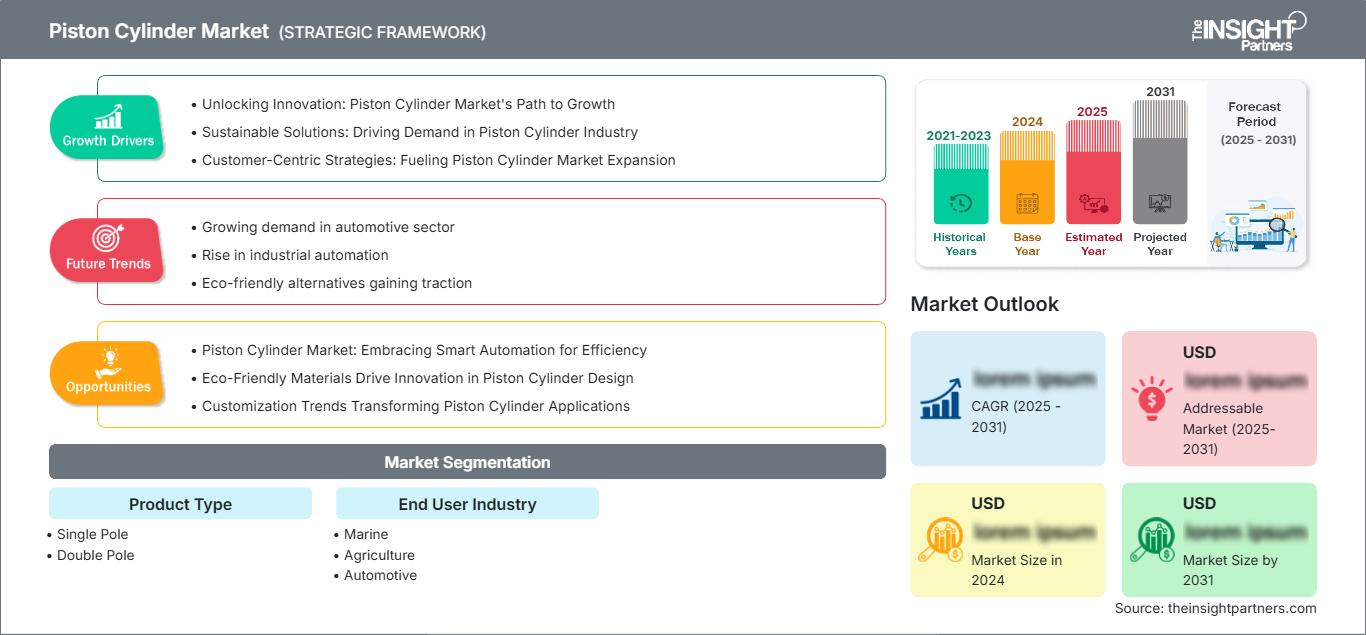
Piston Cylinder Market: Strategic Insights
Regional Insights
North America Piston Cylinder Market
North America is estimated to account for 28.00% of the global Piston Cylinder Market in 2025, with a 5.65% CAGR through 2034. One advantage is that there is considerable installed capacity of machinery for construction, agriculture, industry, and material handling. One aspect that is important for cylinder replacement is in situations of high utilization, contamination, side loading, corrosion, and seal deterioration leading to machine availability issues. There is also an established aftermarket ecosystem through manufacturers and specialists in the U.S. to lessen dependence on full equipment replacement.
The U.S. contributes 68.00% of the North American market share in 2025, growing at a 5.48% CAGR. The Ligon Industries company is a major manufacturer specialist, while Caterpillar has a wide aftermarket ecosystem tied to cylinders in their machinery. The demand includes excavators, loaders, agricultural equipment, industrial presses, and lifting equipment. One unique aspect is that there is an established aftermarket service ecosystem where it could be economical to have repair, rebuild, and remanufacturing rather than complete hydraulic replacement.
U.S. Piston Cylinder Market
The Piston Cylinder Market report shows that the U.S. is estimated to represent 68.00% of North America's market in 2025 and is expected to expand at a 5.48% CAGR through 2034. The demand exists mainly in mobile machines, construction machines, agricultural machinery, industrial machinery, and heavy-lift equipment. The equipment base in this country gives rise to the need for replacement and the requirement for OEM machines.
The Cat cylinder ecosystem that is specialized to its equipment line and the manufacturing expertise of Ligon Industries show the significance of domestic engineering and service capabilities. More emphasis is being placed on durability, remanufacturing, expedient delivery, and component lifecycle management. The U.S. market also requires application-specific cylinders where bore, stroke, rod protection, mounting type, and seals have to be matched to the equipment application conditions.
Europe Piston Cylinder Market
Europe is estimated to hold 24.00% of global demand in 2025 and is projected to register a 5.72% CAGR through 2034, with Germany serving as the leading national market. Germany enjoys the advantage of an excellent manufacturing environment of machinery and demand for high precision hydraulic components. The UK enjoys consistent demand in construction machinery, agriculture machinery, material handling machines, and marine machinery, while France enjoys a combination of mechanization in agriculture as well as machinery applications. Italy has a good base for machinery and hydraulic component manufacture, and Spain offers demand in agricultural equipment, construction machinery, industrial machinery, and infrastructure applications. Efficiency, leak tightness, durability, and systems integration have become key demands in the region. Suppliers of Europe compete based on customized engineering, automation, computer aided design, and manufacturing for compliance.
APAC Piston Cylinder Market
According to the Piston Cylinder Market forecast, Asia Pacific is estimated to represent 31.00% of global demand in 2025 and is expected to expand at a 6.88% CAGR through 2034, making it the leading regional market by share and growth. The China region is a large consumer owing to the country’s construction machinery manufacturing capabilities, industrial equipment manufacturing, agricultural mechanization, and an extensive internal hydraulic supply chain.
Japan and South Korea participate in the region owing to their precision machinery production, auto manufacturing, industrial automation, and marine applications. India relies on agricultural mechanization, construction equipment, infrastructure development, and localization of hydraulic manufacturing. Australia has a higher level of concentration with respect to demands for mining, agriculture, construction, and equipment of the resources industry. Canara Hydraulics serves as a specialized local cylinder producer in India.
Middle East & Africa Piston Cylinder Market
Middle East and Africa is estimated to grow at a 6.21% CAGR through 2034, supported by infrastructure construction, oil and gas equipment, ports, mining, material handling, and heavy machinery. Saudi Arabia and the UAE provide important demand centers because large infrastructure and industrial projects require heavy-duty hydraulic equipment and maintenance capabilities.
While South Africa participates through mining, agriculture, construction, and material handling industries, the remainder of the region is still largely reliant on hydraulic parts that are imported from overseas manufacturers. The demand for local support services has been on the rise as equipment operators look for ways to minimize downtime and maximize component longevity.
South & Central America Piston Cylinder Market
South and Central America is supported by agriculture, mining, construction, forestry, and material-handling equipment. Brazil is the principal market because of its agricultural machinery base and large industrial economy, while Argentina has a strong agricultural equipment requirement. The regional supply chain remains partly dependent on imported components, creating opportunities for localized machining, assembly, and repair.
Brazil's agricultural mechanization supports demand for durable cylinders exposed to variable loads, dust, moisture, and field conditions. Argentina's demand is closely connected to agricultural machinery utilization. Other South and Central American markets are smaller but benefit from mining, construction, and infrastructure activity. Regional buyers increasingly value replacement availability and engineering support because equipment downtime can directly affect agricultural and industrial productivity.
Segmentation Analysis
Product Type (Single Pole)
Single Pole cylinders provide a comparatively straightforward actuation architecture for applications where hydraulic force is applied predominantly in one direction and return is achieved through load, spring, gravity, or another mechanism. The segment is projected to grow at a 5.84% CAGR from 2026 to 2034. Demand is supported by lifting, positioning, agricultural implements, and specialized machinery where compact construction and straightforward maintenance are valued. Suppliers compete through seal reliability, rod protection, corrosion resistance, and application-specific mounting.
- Single Pole designs support controlled linear movement where the return stroke does not require equivalent hydraulic actuation, making them useful in lifting and positioning equipment.
- Agricultural and industrial users favor these configurations where straightforward maintenance, compact packaging, and reliable force generation reduce system complexity.
- Specialized designs can incorporate enhanced coatings, seals, and mounting arrangements for dusty, wet, corrosive, or high-cycle operating environments.
Product Type (Double Pole)
Double Pole cylinders are projected to register a 6.21% CAGR from 2026 to 2034 and represent the largest Product Type segment because bidirectional hydraulic control supports demanding machinery requiring powered extension and retraction. Construction, material handling, marine systems, and industrial equipment benefit from controlled movement in both directions. Competition centers on pressure capability, side-load management, sealing systems, rod finish, and dimensional customization, while advanced equipment increasingly pairs actuation with position sensing.
- Double Pole configurations enable powered movement in both directions and are suited to machinery requiring controlled extension and retraction under changing loads.
- Construction and industrial equipment use these cylinders where operator control, repeatability, and bidirectional force are central to machine performance.
- Marine and heavy-duty applications place greater emphasis on corrosion protection, sealing integrity, structural strength, and resistance to environmental exposure.
End User Industry (Marine)
Marine applications are projected to grow at a 5.77% CAGR from 2026 to 2034, supported by steering, deck machinery, hatch systems, stabilization, lifting, and offshore equipment. Cylinder selection is strongly influenced by corrosion resistance, sealing, compact installation, and reliability under vibration and saltwater exposure. Suppliers with marine engineering expertise and robust coatings are positioned to address replacement and original-equipment requirements.
- Marine cylinders support steering, lifting, hatch, deck, and offshore functions where controlled hydraulic movement must remain reliable in corrosive environments.
- Buyers prioritize stainless or protected components, advanced seals, pressure stability, and resistance to vibration and saltwater exposure.
- Specialist suppliers gain relevance when cylinders require customized dimensions, marine-grade materials, or integration with vessel-specific hydraulic systems.
End User Industry (Agriculture)
Agriculture is projected to achieve a 6.48% CAGR from 2026 to 2034, making it the fastest-growing End User Industry segment. Mechanized farming requires hydraulic actuation for implements, steering, harvesting, lifting, folding, and adjustment functions. Demand is supported by increasing equipment sophistication and the need for reliable operation across variable field conditions. Cylinder suppliers increasingly focus on contamination resistance, compact design, and easy servicing.
- Agricultural cylinders operate implements and machinery used for lifting, steering, adjustment, folding, harvesting, and material handling throughout farming operations.
- Demand is influenced by equipment mechanization and the requirement for dependable hydraulic motion under dust, moisture, vibration, and fluctuating loads.
- Manufacturers differentiate through robust seals, corrosion protection, serviceability, and configurations tailored to tractors, harvesters, sprayers, and implements.
End User Industry (Automotive)
Automotive applications are projected to expand at a 6.14% CAGR from 2026 to 2034, supported by vehicle manufacturing equipment, testing systems, material handling, specialized vehicles, and hydraulic functions in commercial equipment. Demand increasingly favors precise and repeatable actuation, compact installation, and integration with automated control systems. Suppliers must meet tighter dimensional and reliability requirements while supporting customized OEM designs.
- Automotive-related hydraulic cylinders serve production equipment, lifting systems, material handling, testing machinery, and specialized vehicle functions.
- Buyers prioritize repeatability, compact packaging, controlled movement, and compatibility with automated manufacturing systems.
- Competitive differentiation increasingly depends on engineering support, consistent dimensional quality, rapid customization, and integration with electronic monitoring systems.
Opportunity Snapshot
| End User Industry | Revenue Contribution | Trend Tag | Adoption Stage |
| Marine | Medium | Corrosion Control | Mature |
| Agriculture | High | Mechanized Farming | Scaling |
| Automotive | High | Smart Actuation | Mature |
Piston Cylinder Market Growth Drivers and Impact Analysis
Rising Hydraulic Equipment Utilization in Mobile Machinery
Greater utilization of excavators, loaders, agricultural machinery, material-handling equipment, and other hydraulic machines directly increases demand for piston-cylinder assemblies. Higher duty cycles expose cylinders to seal wear, rod damage, contamination, side loading, and pressure fluctuations, creating both original-equipment and replacement requirements. Equipment owners increasingly evaluate cylinder durability against total operating costs rather than initial component price alone. This shifts demand toward engineered rods, improved sealing systems, corrosion-resistant surfaces, and rebuildable designs. Caterpillar's multi-level repair and remanufacturing approach illustrates how cylinder lifecycle management has become part of equipment productivity strategies. The resulting mechanism is higher equipment utilization leading to greater component wear, more maintenance activity, and sustained demand for replacement and upgraded piston-cylinder solutions.
Demand for Higher Precision and Longer Component Life
Modern equipment operators increasingly require hydraulic motion that is smoother, more repeatable, and easier to monitor. This is encouraging manufacturers to improve machining tolerances, sealing systems, rod finishes, mounting arrangements, and position-sensing capabilities. Komatsu's use of stroke-sensing hydraulic cylinders demonstrates how cylinder assemblies are becoming connected to machine guidance and operator information rather than functioning solely as mechanical actuators. The mechanism is straightforward: greater precision requirements increase the technical specifications imposed on cylinders, which raises demand for engineered components and integrated feedback. Suppliers able to combine hydraulic durability with sensing and digital control compatibility can capture higher-value applications in construction, agriculture, industrial automation, and specialized mobile machinery.
Expansion of Agricultural and Infrastructure Mechanization
Agricultural mechanization and infrastructure development are increasing the number and sophistication of machines that rely on hydraulic actuation. Tractors, harvesters, sprayers, construction machinery, lifting systems, and road-building equipment use cylinders for steering, positioning, lifting, folding, and work functions. Agricultural equipment must operate reliably under dust, moisture, vibration, and variable loads, while infrastructure machinery faces high utilization and severe mechanical stress. These conditions create demand for robust sealing, corrosion resistance, controlled motion, and serviceable designs. The market implication is a broader addressable equipment base across developing and developed economies, with particularly strong potential for cylinder suppliers that can localize production, provide customized configurations, and support aftermarket repair networks.
Piston Cylinder Market Future Trends
Integration of Sensing and Electrohydraulic Control
The Piston Cylinder Market trends show that piston cylinders are increasingly being incorporated into electrohydraulic architectures that combine mechanical actuation with sensors, valves, controllers, and machine software. The change is driven by demand for precise positioning, automated machine functions, operator assistance, and improved energy management. Construction and agricultural OEMs are particularly affected because variable work cycles benefit from real-time position and pressure information. Cylinder suppliers will increasingly need to design around sensor integration, feedback compatibility, and digital configuration rather than treating the cylinder as an isolated component. The likely implication is a gradual premiumization of technically sophisticated assemblies, with basic cylinders retaining volume in cost-sensitive applications while sensor-ready products gain relevance in advanced machinery.
Lifecycle Service and Remanufacturing as Product Strategy
Cylinder purchasing is increasingly shifting from one-time component replacement toward lifecycle management. Manufacturers and equipment OEMs are expanding resealing, repair, rebuilding, remanufacturing, and rapid replacement options because hydraulic cylinder failures can create costly machine downtime. This trend is reinforced by customer interest in extending equipment life and reducing material consumption. Caterpillar's structured repair and remanufacturing approach illustrates the movement toward multiple service pathways based on component condition. Distributors and manufacturers are therefore affected alongside OEMs, as availability of replacement seals, rods, barrels, and complete cylinders becomes strategically important. The implication is greater competition around service responsiveness, diagnostic capability, repair quality, and lifecycle economics.
Piston Cylinder Market Opportunities
Localized Cylinder Manufacturing for Agricultural Machinery
Agricultural machinery manufacturers and distributors in India, Brazil, Southeast Asia, and other mechanizing markets represent a significant opportunity for localized piston-cylinder production. Buyers need dependable cylinders for tractors, harvesters, implements, sprayers, and material-handling equipment but can face long lead times for imported components or application-specific replacements. Localized manufacturing can reduce logistics exposure while allowing bore, stroke, mounting, sealing, and rod specifications to be adapted to regional machinery. The opportunity is strongest for suppliers that establish engineering and testing capabilities near agricultural equipment clusters. Strategic beneficiaries include cylinder manufacturers, OEM suppliers, machining specialists, and service providers capable of supporting both original equipment and replacement demand.
Marine and Offshore Corrosion-Resistant Actuation
Marine operators, shipbuilders, offshore equipment manufacturers, and port-equipment providers offer an opportunity for specialized piston cylinders designed for corrosive and high-load environments. Conventional components can face accelerated degradation from saltwater exposure, vibration, pressure cycling, and difficult maintenance access. This creates demand for enhanced coatings, corrosion-resistant materials, advanced seals, and condition-oriented maintenance. Europe, East Asia, the Gulf region, and established North American marine clusters provide relevant customer bases. Suppliers can differentiate by offering application-engineered cylinders, replacement programs, inspection support, and lifecycle services rather than commodity components. Such strategies address the cost of downtime and maintenance complexity that remains a barrier to marine hydraulic reliability.
Frequently Asked Questions

- Comprehensive Market Sizing and Forecast Analysis
- Detailed Segmentation Analysis
- In-Depth Market Dynamics Assessment
- Regional and Country-Level Insights
- Competitive Landscape and Company Benchmarking
- Strategic Business Intelligence
Recent Reports
Testimonials

The Insight Partners' SCADA System Market report is comprehensive, with valuable insights on current trends and future forecasts. The team was highly professional, responsive, and supportive throughout. We are very satisfied and highly recommend their services.
RAN KEDEM Partner, Reali Technologies LTDs
I requested a report on a very specific software market and the team produced the report in a few days. The information was very relevant and well presented. I then requested some changes and additions to the report. The team was again very responsive and I got the final report in less than a week.
JEAN-HERVE JENN Chairman, Future Analytica
We worked with The Insight Partners for an important market study and forecast. They gave us clear insights into opportunities and risks, which helped shape our plans. Their research was easy to use and based on solid data. It helped us make smart, confident decisions. We highly recommend them.
PIYUSH NAGPAL Sr. Vice President, High Beam Global
The Insight Partners delivered insightful, well-structured market research with strong domain expertise. Their team was professional and responsive throughout. The user-friendly website made accessing industry reports seamless. We highly recommend them for reliable, high-quality research services
YUKIHIKO ADACHI CEO, Deep Blue, LLC.
This is the first time I have purchased a market report from The Insight Partners.While I was unsure at first, I visited their web site and felt more comfortable to take the risk and purchase a market report.I am completely satisfied with the quality of the report and customer service. I had several questions and comments with the initial report, but after a couple of dialogs over email with their analyst I believe I have a report that I can use as input to our strategic planning process.Thank you so much for taking the extra time and making this a positive experience.I will definitely recommend your service to others and you will be my first call when we need further market data.
JOHN SUZUKI President and Chief Executive Officer, Board Director, BK Technologies
I wish to appreciate your support and the professionalism you displayed in the course of attending to my request for information regarding to infectious disease IVD market in Nigeria. I appreciate your patience, your guidance, and the fact that you were willing to offer a discount, which eventually made it possible for us to close a deal. I look forward to engaging The Insight Partners in the future, all thanks to the impression you have created in me as a result of this first encounter.
DR CHIJIOKE ONYIA MANAGING DIRECTOR, PineCrest Healthcare Ltd.Reason to Buy
- Informed Decision-Making
- Understanding Market Dynamics
- Competitive Analysis
- Identifying Emerging Markets
- Customer Insights
- Market Forecasts
- Risk Mitigation
- Boosting Operational Efficiency
- Strategic Planning
- Investment Justification
- Tracking Industry Innovations
- Aligning with Regulatory Trends





 Get Free Sample for