
Vision Care Market Size, Trends & Growth by 2034
Coverage: By Product Type (Eye Glasses, Contact Lens, Intraocular Lens, and Others) and Distribution Channel (Retail Stores, E-Commerce, Clinics, and Hospitals), and Geography (North America, Europe, Asia Pacific, and South and Central America)
- Status : Data Released
- Report Code : TIPRE00011953
- Category : Life Sciences
- No. of Pages : 150
- Available Report Formats :


- Last update date : June 26, 2026


2025 Market Size
US$ 46.10 Bn
Base year value
2034 Forecast
US$ 70.50 Bn
Projected by 2034
CAGR 2026-2034
4.83 %
Growth rate
Addressable Market
US$ 529.16 Bn
(2026-2034)
The global vision care market size is projected to reach US$ 70.50 billion by 2034 from US$ 46.10 billion in 2025. The market is anticipated to register a CAGR of 4.83% during the forecast period 2026–2034.
Key market dynamics include a heightening global focus on eye health due to increased screen time, rising prevalence of myopia among the pediatric population, and a significant shift toward premium, high-index lens materials. Additionally, the market is expected to benefit from the growing popularity of daily disposable contact lenses, expansion in optical retail chains across emerging economies, and the increasing inclusion of advanced coatings, such as blue-light filtering and anti-reflective technologies, in standard prescription eyewear.
Vision Care Market Analysis
The vision care market analysis shows a shift toward personalized eye care as consumers prioritize both visual acuity and aesthetic appeal. The market is diversifying into high-volume value segments and high-growth premium featuring digital lens surfacing and smart eyewear. Strategic opportunities are emerging in myopia management for children, where specialized corrective lenses and contact lenses offer a clear competitive advantage over traditional options. The market growth depends on the integration of tele-optometry for remote diagnostics and efficient supply chain management for rapid lens finishing. Competitive differentiation now stands out depending on branding that highlights ocular wellness, UV protection, and sustainable frame materials like bio-acetates. This approach helps premium brands charge higher prices in a market with diverse retail players.
Vision Care Market Overview
Vision care products have advanced from basic functional tools to essential health and lifestyle accessories. The vision care includes specialized contact lenses for astigmatism, multifocal intraocular lenses, and performance eyewear for sports. Both global conglomerates and D2C startups compete in this market, using materials such as polycarbonate, Trivex, and silicone hydrogel. Growing demand for preventative eye care among health-conscious consumers in North America and Europe has increased the popularity of premium lens coatings as a standard wellness solution. North America leads in revenue due to its advanced healthcare infrastructure, while Asia-Pacific is advancing in manufacturing innovation and retail adoption. The US market is the most developed, driven by an aging population and the broad availability of vision insurance. Competition among brands is fueling greater frame variety and the inclusion of smart features like photochromic technology and augmented reality interfaces.
● REPORT CUSTOMIZATION
Tailor This Report To Align With Your Specific Business Requirements
This report can be customized to align precisely with your business objectives, scope, and target markets. Customization options include tailored segmentation, geography, competitive analysis, and strategic insights to support informed decision-making.
Customize This Report →WHAT YOU CAN ADJUST
- ● Segmentations
- ● Geography
- ● Competitive Analysis
- ● Language Preferences
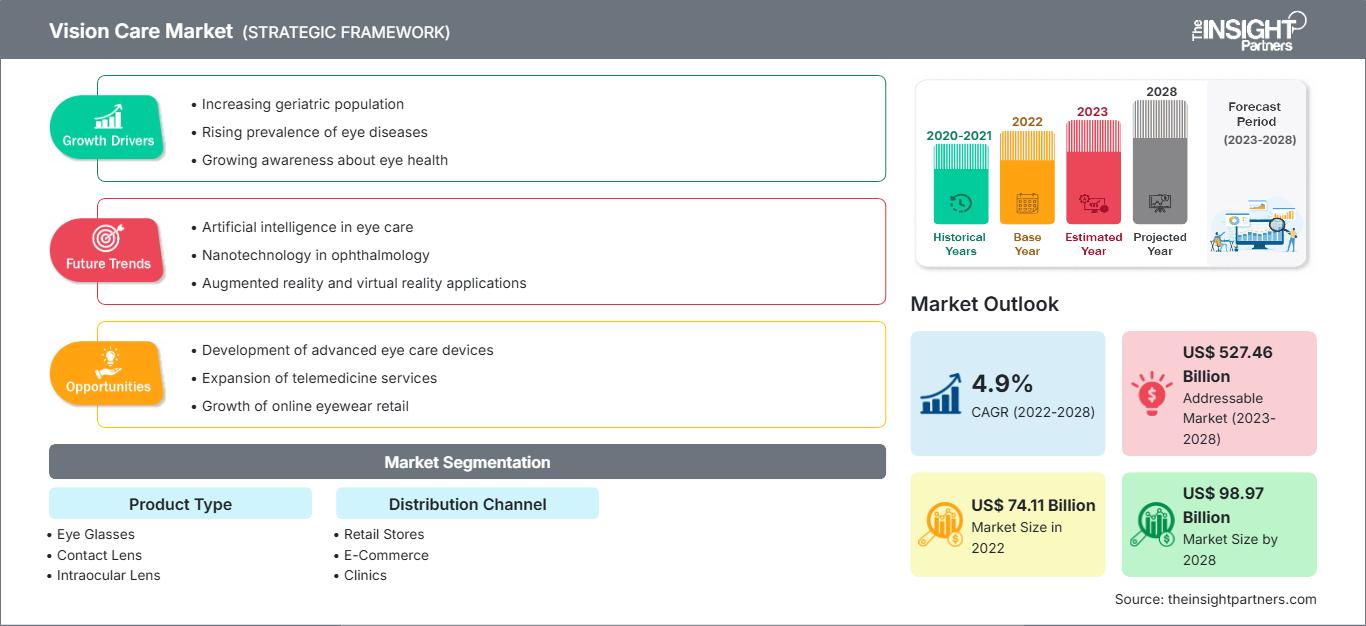
Vision Care Market: Strategic Insights
-
Get Top Key Market Trends of this report.This FREE sample will include data analysis, ranging from market trends to estimates and forecasts.
Vision Care Market Drivers and Opportunities
Market Drivers:
- Rising Prevalence of Vision Disorders: The global increase in myopia, hyperopia, and presbyopia, driven by aging populations and digital device usage, is a primary driver for prescription eyewear and contact lenses.
- Technological Advancements in Lens Design: The expansion of digital surfacing and wavefront technology has sustained high demand for high-definition lenses. As consumers trade up to superior visual clarity, progressive lenses continue to see stable volume gains.
- Rapid Expansion of Omni-channel Retail: Online optical retail has removed traditional barriers to entry. This is particularly evident in the rapid adoption of D2C eyewear brands and subscription-based contact lens services in North America and Europe.
Market Opportunities:
- Expansion into Myopia Management: Beyond standard correction, specialized lenses designed to slow the progression of myopia in children offer significant opportunities for optical manufacturers.
- Growth in Emerging APAC Corridors: Forming strategic partnerships between global vision care leaders and local distributors may facilitate access to high-margin market segments in China and India, where eye health awareness is rising.
- Diversification into Eco-Friendly Eyewear: There is a growing opportunity for brands to target environmentally conscious demographics through certifications such as Recycled Content and Bio-based materials.
Vision Care Market Report Segmentation Analysis
The Vision Care Market share is analyzed across various segments to provide a clearer understanding of its structure, growth potential, and emerging trends. Below is the standard segmentation approach used in most industry reports:
By Product Type:
- Eyeglasses: The largest segment by volume, encompassing frames and lenses. It remains the primary choice for vision correction globally, driven by fashion trends and technological lens coatings.
- Contact Lens: A rapidly growing segment catering to consumers seeking convenience and aesthetic freedom. Innovations in silicone hydrogel materials have improved comfort and wearability.
- Intraocular Lens: Primarily driven by the rising number of cataract surgeries and advancements in ophthalmic surgical procedures for an aging global population.
- Others: Includes cleaning solutions, lens cases, and specialized ocular accessories that support the maintenance of primary vision care products.
By Distribution Channel:
- Retail Stores: The dominant channel for purchasing eyeglasses and sunglasses, providing customers with professional fitting services and in-person consultations.
- E-Commerce: The fastest-growing distribution channel, offering a wide variety of frames and contact lenses with the convenience of home delivery and virtual try-on features.
- Clinics: A vital channel for specialized diagnostic vision care and the prescription of medical-grade contact lenses or therapeutic products.
- Hospitals: Focuses on surgical vision care and the distribution of intraocular lenses during cataract or refractive surgeries.
By Geography:
- North America
- Europe
- Asia Pacific
- South & Central America
- Middle East & Africa
Vision Care Market Report Scope
| Report Attribute | Details |
|---|---|
| Market size in 2025 | US$ 46.10 Billion |
| Market Size by 2034 | US$ 70.50 Billion |
| Global CAGR (2026 - 2034) | 4.83% |
| Historical Data | 2021-2024 |
| Forecast period | 2026-2034 |
| Segments Covered |
By Product Type
|
| Regions and Countries Covered |
North America
|
| Market leaders and key company profiles |
|
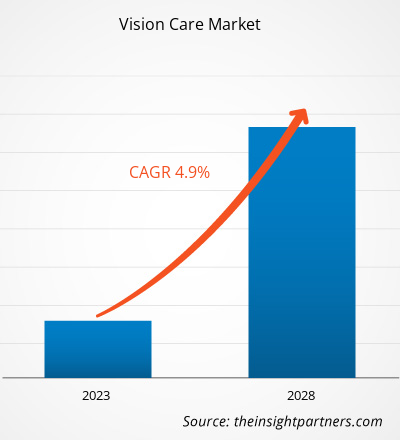
Vision Care Market Players Density: Understanding Its Impact on Business Dynamics
The Vision Care Market is growing rapidly, driven by increasing end-user demand due to factors such as evolving consumer preferences, technological advancements, and greater awareness of the product's benefits. As demand rises, businesses are expanding their offerings, innovating to meet consumer needs, and capitalizing on emerging trends, which further fuels market growth.
Vision Care Market Share Analysis by Geography
Asia-Pacific is expected to grow fastest in the coming years. Emerging markets in South & Central America, the Middle East, and Africa also have many untapped opportunities for eyewear manufacturers and corrective lens providers to expand. The vision care market is undergoing a significant transformation, moving from a necessity-based medical to a global technology-driven health and lifestyle industry. Growth is driven by the rising prevalence of digital eye strain, a surge in pediatric myopia, and the expansion of the luxury designer eyewear sector. Below is a summary of market share and trends by region:
North America
- Market Share: A mature but consistently growing segment, driven by advanced diagnostic infrastructure and high insurance penetration.
- Key Drivers:
- High prevalence of presbyopia in the aging Baby Boomer population requiring multifocal solutions
- Mainstreaming of blue-light filtering technology in corporate wellness and remote work environments
- Increased adoption of daily disposable contact lenses over traditional reusable variants
- Trends: Rapid scaling of tele-optometry services and the successful integration of virtual try-on technologies to enhance the e-commerce consumer journey.
Europe
- Market Share: Holds a significant global share, anchored by a deep-seated heritage in premium frame design and precision lens engineering in Italy, Germany, and France.
- Key Drivers:
- High consumer demand for iconic luxury brands and high-quality craftsmanship in eyewear
- Established regulatory frameworks for ophthalmic medical devices and professional standards
- Robust public and private healthcare support for vision screening and corrective procedures
- Trends: A strategic shift toward sustainable manufacturing, with brands prioritizing bio-acetates and recycled materials. There is also an increasing focus on high-index lens materials to meet the demands of style-conscious European consumers.
Asia-Pacific
- Market Share: The fastest-growing region, with China and India acting as the primary markets for the entire continent, particularly for myopia control products.
- Key Drivers:
- Massive student and young-adult population seeking specialized lenses to manage myopia progression
- Government-supported public health initiatives focused on large-scale vision screening in schools
- Rapid urbanization and rising disposable incomes are leading to a preference for Westernized luxury optical brands
- Trends: Heavy reliance on omni-channel retail platforms and a surge in demand for affordable yet stylish private-label frames in emerging urban centers.
South and Central America
- Market Share: Emerging market with a growing professional optical industry in countries like Brazil and Chile.
- Key Drivers:
- Increasing awareness of the importance of UV protection for ocular health in high-sunlight regions
- Modernization of independent optical practices into formalized retail chains to supply urban hubs
- Rising interest in elective refractive surgeries among middle-to-high income segments
- Trends: Growth of value-based boutique brands and the introduction of regional manufacturing hubs to reduce reliance on expensive imported eyewear.
Middle East and Africa
- Market Share: Developing market with significant growth potential, transitioning toward formalized commercial eye care services.
- Key Drivers:
- Traditional demand for high-end fashion eyewear in the Gulf Cooperation Council (GCC) countries
- High demand for specialized lenses capable of withstanding harsh, dusty, and high-glare environments
- Strategic investments in medical tourism hubs to provide advanced ophthalmic surgeries
- Trends: Implementation of mobile eye clinics to serve rural populations, coupled with a focus on cost-effective corrective solutions for the pediatric segment.
High Market Density and Competition
Competition is intensifying due to the presence of established leaders such as EssilorLuxottica, Johnson & Johnson Vision Care, and Alcon. Regional experts and niche players like Hoya Corporation and Carl Zeiss Meditec, alongside innovators such as Warby Parker and Zenni Optical, also contribute to a diverse market landscape.
This competitive environment pushes vendors to differentiate through:
- Technological Integration: Positioning smart glasses and digital-surfaced lenses as superior alternatives to standard optics.
- Product Diversification: Offering a full suite of products from dry-eye drops to surgical intraocular lenses and fashion-forward frames.
- Vertical Integration: Managing the entire value chain from lens manufacturing and frame design to retail insurance and eye clinics.
Opportunities and Strategic Moves
- Partner with telehealth platforms to tap into the surging demand for online eye prescriptions and virtual try-on features.
- Incorporate sustainable manufacturing processes to appeal to Gen Z consumers seeking ethical and low-carbon footprint eyewear.
Major Companies operating in the Vision Care Market are:
- Alcon Inc
- Bausch Health Companies Inc
- Carl Zeiss AG
- Cooper Companies Inc
- Essilorluxottica SA
- Johnson & Johnson Services Inc.
- Hoya Corporation
- Rodenstock GmbH
- Menicon Co. Ltd
- Rayner Intraocular Lenses Limited
Disclaimer: The companies listed above are not ranked in any particular order.
Vision Care Market News and Recent Developments
- In March 2026, ZEISS Vision Care announced a strategic partnership with Medical Eyeglass Center (MEC), a nationally recognized, full-service optical dispensary management organization. The collaboration establishes ZEISS as the exclusive laboratory and service provider within MEC’s optical dispensary management organization. MEC will serve as the exclusive optical dispensary management organization aligned with ZEISS within participating practices.
- In January 2026, HOYA® Vision Care, a global leader in ophthalmic lens technology, announced the launch of the HOYA LensPreview™, an advanced virtual try-on solution integrated into the HOYA Hub™ ecosystem.
Vision Care Market Report Coverage and Deliverables
The Vision Care Market Size and Forecast (2021–2034) report provides a detailed analysis of the market covering below areas:
- Vision Care Market size and forecast at global, regional, and country levels for all the key market segments covered under the scope
- Vision Care Market trends, as well as market dynamics such as drivers, restraints, and key opportunities
- Detailed PEST and SWOT analysis
- Vision Care Market analysis covering key market trends, global and regional framework, major players, regulations, and recent market developments
- Industry landscape and competition analysis covering market concentration, heat map analysis, prominent players, and recent developments in the Vision Care Market.
- Detailed company profiles
Frequently Asked Questions

- Comprehensive Market Sizing and Forecast Analysis
- Detailed Segmentation Analysis
- In-Depth Market Dynamics Assessment
- Regional and Country-Level Insights
- Competitive Landscape and Company Benchmarking
- Strategic Business Intelligence
Recent Reports
Testimonials

The Insight Partners' SCADA System Market report is comprehensive, with valuable insights on current trends and future forecasts. The team was highly professional, responsive, and supportive throughout. We are very satisfied and highly recommend their services.
RAN KEDEM Partner, Reali Technologies LTDs
I requested a report on a very specific software market and the team produced the report in a few days. The information was very relevant and well presented. I then requested some changes and additions to the report. The team was again very responsive and I got the final report in less than a week.
JEAN-HERVE JENN Chairman, Future Analytica
We worked with The Insight Partners for an important market study and forecast. They gave us clear insights into opportunities and risks, which helped shape our plans. Their research was easy to use and based on solid data. It helped us make smart, confident decisions. We highly recommend them.
PIYUSH NAGPAL Sr. Vice President, High Beam Global
The Insight Partners delivered insightful, well-structured market research with strong domain expertise. Their team was professional and responsive throughout. The user-friendly website made accessing industry reports seamless. We highly recommend them for reliable, high-quality research services
YUKIHIKO ADACHI CEO, Deep Blue, LLC.
This is the first time I have purchased a market report from The Insight Partners.While I was unsure at first, I visited their web site and felt more comfortable to take the risk and purchase a market report.I am completely satisfied with the quality of the report and customer service. I had several questions and comments with the initial report, but after a couple of dialogs over email with their analyst I believe I have a report that I can use as input to our strategic planning process.Thank you so much for taking the extra time and making this a positive experience.I will definitely recommend your service to others and you will be my first call when we need further market data.
JOHN SUZUKI President and Chief Executive Officer, Board Director, BK Technologies
I wish to appreciate your support and the professionalism you displayed in the course of attending to my request for information regarding to infectious disease IVD market in Nigeria. I appreciate your patience, your guidance, and the fact that you were willing to offer a discount, which eventually made it possible for us to close a deal. I look forward to engaging The Insight Partners in the future, all thanks to the impression you have created in me as a result of this first encounter.
DR CHIJIOKE ONYIA MANAGING DIRECTOR, PineCrest Healthcare Ltd.Reason to Buy
- Informed Decision-Making
- Understanding Market Dynamics
- Competitive Analysis
- Identifying Emerging Markets
- Customer Insights
- Market Forecasts
- Risk Mitigation
- Boosting Operational Efficiency
- Strategic Planning
- Investment Justification
- Tracking Industry Innovations
- Aligning with Regulatory Trends





 Get Free Sample for