
Wound Care Market Size, Growth & Demand by 2034
Coverage: By Product (Advanced Wound Dressing, Surgical Wound Care, Traditional Wound Care, and Wound Therapy Devices), Wound Type (Chronic Wound and Acute Wound), and End User (Hospital, Specialty Clinics, Home Healthcare, and Others)
- Status : Data Released
- Report Code : TIPRE00029834
- Category : Life Sciences
- No. of Pages : 150
- Available Report Formats :


- Last update date : March 19, 2026


2025 Market Size
US$ 23.52 Bn
Base year value
2034 Forecast
US$ 40.04 Bn
Projected by 2034
CAGR 2026-2034
6.09 %
Growth rate
Addressable Market
US$ 287.81 Bn
(2026-2034)
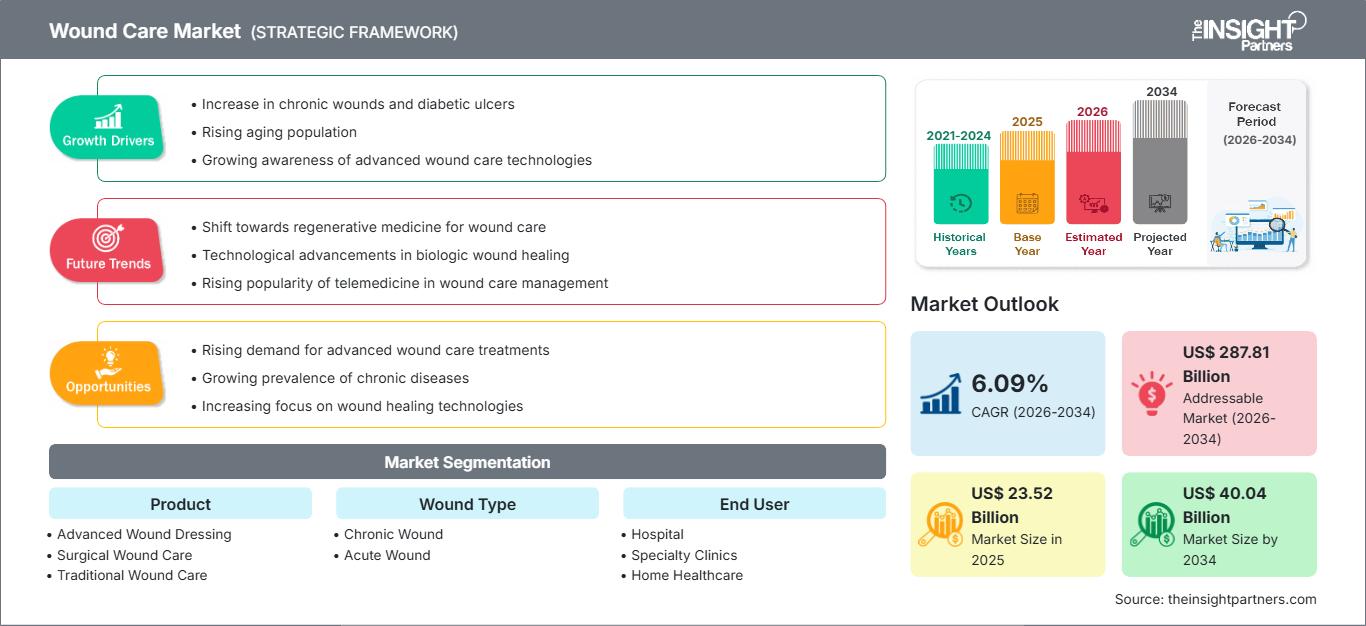
The global Wound Care Market size is projected to reach US$ 40.04 billion by 2034 from US$ 23.52 billion in 2025. The market is anticipated to register a CAGR of 6.09% during the forecast period 2026–2034.
Key market dynamics include an escalating global prevalence of chronic conditions such as diabetes and obesity, a rapidly aging population susceptible to pressure ulcers, and a significant technological shift toward bioactive and smart wound dressings. Additionally, the market is expected to benefit from the rising volume of surgical procedures worldwide, the expansion of specialized wound care centers, and the growing integration of digital health tools for remote wound monitoring and assessment.
Wound Care Market Analysis
The wound care market analysis indicates a strategic transition toward personalized and proactive healing protocols. Procurement trends suggest a growing preference for advanced wound management over traditional dressings, as healthcare systems prioritize reduced hospital stays and lower overall treatment costs. Strategic opportunities are emerging in the development of regenerative medicine and bioengineered skin substitutes, which offer superior clinical outcomes for hard-to-heal chronic wounds compared to conventional therapies. The analysis also highlights that market success is increasingly dependent on navigating complex reimbursement landscapes and demonstrating clear pharmacoeconomic value. Competitive differentiation is now centered on integrated care solutions that combine physical products with digital tracking software, allowing clinicians to monitor healing trajectories in real-time and intervene early to prevent infections.
Wound Care Market Overview
Wound care is evolving from basic injury management to a highly specialized field of regenerative therapy. While historically dominated by simple gauze and bandages, the industry has expanded into high-value segments like negative pressure wound therapy (NPWT), antimicrobial dressings, and cellular-based biologics. Market participants range from diversified multinational conglomerates to niche biotech firms focusing on tissue engineering. The rising burden of diabetic foot ulcers and venous leg ulcers in both developed and emerging economies has shifted the focus toward moist wound healing environments and infection control. As healthcare delivery moves toward outpatient and home-based settings, manufacturers are innovating with portable, user-friendly devices and tele-wound care platforms to ensure continuity of care. For instance, the market in the US represents a mature yet dynamic landscape characterized by high healthcare expenditure and a strong emphasis on advanced clinical outcomes. The market is driven by a robust infrastructure of specialized wound clinics and a significant patient pool requiring complex care for surgical site infections and chronic ulcers.
Market Assessment and Insights
- Global market for Wound Care was valued at US$ 23.52 Billion in 2025
- Annual market size is expected to reach US$ 40.04 Billion by 2034
- Total addressable market (TAM) during 2026-2034 is projected to reach approximately US$ 287.81 Billion
- Market is anticipated to register a CAGR of 6.09% during the forecast period
- The United States represents a key market, supported by Increase in chronic wounds and diabetic ulcers, Rising aging population, Growing awareness of advanced wound care technologies, as well as evolving industry dynamics
- Market analysis covers North America, Europe, Asia-Pacific, South and Central America, Middle East and Africa, with growth evaluated across the forecast period
- Market opportunities such as Rising demand for advanced wound care treatments, Growing prevalence of chronic diseases, Increasing focus on wound healing technologies are expected to influence market dynamics and addressable market
- Report profiles industry participants, including Smith & Nephew, Ethicon USA LLC, Convatec Group Plc, BAXTER International Inc., COLOPLAST AS, Paul HARTMANN AG, MEDTRONIC PLC, 3M COMPANY, MIMEDX, Integra LifeSciences Holdings Corporation, while analyzing competitive strategies and innovation developments
-
Source: The Insight Partners' analysis based on proprietary research, government publications, company annual reports, investor presentations, industry databases, and expert interviews.
● REPORT CUSTOMIZATION
Tailor This Report To Align With Your Specific Business Requirements
This report can be customized to align precisely with your business objectives, scope, and target markets. Customization options include tailored segmentation, geography, competitive analysis, and strategic insights to support informed decision-making.
Customize This Report →WHAT YOU CAN ADJUST
- ● Segmentations
- ● Geography
- ● Competitive Analysis
- ● Language Preferences
Wound Care Market: Strategic Insights
-
Get Top Key Market Trends of this report.This FREE sample will include data analysis, ranging from market trends to estimates and forecasts.
Wound Care Market Drivers and Opportunities
Market Drivers:
- Rising Prevalence of Chronic Diseases: The global surge in diabetes and cardiovascular disorders is a primary driver, as these conditions significantly impair the natural healing process, leading to a higher incidence of complex, non-healing chronic wounds.
- Technological Advancements in Advanced Dressings: Innovations in material science, such as hydrocolloids, alginates, and silver-infused antimicrobials, are driving market growth by providing superior moisture management and infection protection compared to traditional products.
- Increasing Geriatric Population: As the global population ages, there is a higher susceptibility to age-related skin fragilities and mobility issues, resulting in a growing volume of pressure ulcers and venous insufficiency cases requiring long-term care.
Market Opportunities:
- Expansion of Home Healthcare Solutions: There is a significant opportunity for the development of portable NPWT devices and easy-to-apply advanced dressings designed for use in home settings, catering to the growing preference for decentralized care.
- Integration of Artificial Intelligence and Digital Monitoring: Strategic moves into AI-driven wound assessment tools and smart dressings with embedded sensors offer a path to high-margin growth by improving diagnostic accuracy and patient compliance.
- Emerging Markets in Asia-Pacific and Latin America: Rapidly improving healthcare infrastructure and rising medical tourism in these regions provide untapped potential for premium wound care brands to establish a foothold and expand their distribution networks.
Wound Care Market Report Segmentation Analysis
The Wound Care Market share is analyzed across various segments to provide a clearer understanding of its structure, growth potential, and emerging trends. Below is the standard segmentation approach used in most industry reports:
By Product:
- Advanced Wound Dressing: A high-growth segment including foam, hydrocolloid, and film dressings that maintain an optimal healing environment.
- Surgical Wound Care: Focuses on sutures, staples, and tissue adhesives used primarily in operating rooms to ensure secure wound closure.
- Traditional Wound Care: The foundational segment consisting of bandages, medical tapes, and gauzes, primarily used for minor injuries.
- Wound Therapy Devices: Includes advanced technologies such as Negative Pressure Wound Therapy (NPWT) and hyperbaric oxygen equipment.
By Wound Type:
- Chronic Wound: Includes diabetic foot ulcers, pressure ulcers, and venous leg ulcers, requiring specialized and long-term treatment protocols.
- Acute Wound: Encompasses surgical incisions and traumatic injuries like burns and lacerations that typically follow a standard healing timeline.
By End User:
- Hospital: The primary channel for acute care and complex surgical wound management, benefiting from advanced inpatient facilities.
- Specialty Clinics: Growing centers dedicated to outpatient wound care, offering specialized expertise and advanced therapy modalities.
- Home Healthcare: An emerging segment driven by the shift toward remote monitoring and the use of portable wound care devices.
- Others: Includes long-term care facilities and ambulatory surgical centers focused on post-operative recovery.
By Geography:
- North America
- Europe
- Asia Pacific
- South & Central America
- Middle East & Africa
Wound Care Market Report Scope
| Report Attribute | Details |
|---|---|
| Market size in 2025 | US$ 23.52 Billion |
| Market Size by 2034 | US$ 40.04 Billion |
| Global CAGR (2026 - 2034) | 6.09% |
| Historical Data | 2021-2024 |
| Forecast period | 2026-2034 |
| Segments Covered |
By Product
|
| Regions and Countries Covered |
North America
|
| Market leaders and key company profiles |
|
Wound Care Market Players Density: Understanding Its Impact on Business Dynamics
The Wound Care Market is growing rapidly, driven by increasing end-user demand due to factors such as evolving consumer preferences, technological advancements, and greater awareness of the product's benefits. As demand rises, businesses are expanding their offerings, innovating to meet consumer needs, and capitalizing on emerging trends, which further fuels market growth.
Wound Care Market Share Analysis by Geography
North America currently holds the largest share of the global market, supported by advanced medical infrastructure and high adoption of innovative therapies. However, Asia-Pacific region is expected to grow fastest in the coming years due to rising healthcare investments and a massive diabetic patient base. Emerging markets in South & Central America, the Middle East, and Africa also have many untapped opportunities for established players to introduce cost-effective advanced wound solutions.
The wound care market is undergoing a significant transformation, moving from passive dressing applications to active biological interventions. Growth is driven by the rising need for infection prevention, a surge in outpatient surgical procedures, and the expansion of value-based care models. Below is a summary of market share and trends by region:
North America
- Market Share: Dominates the global landscape due to established reimbursement frameworks and the presence of major industry leaders.
- Key Drivers:
- High incidence of obesity-related chronic wounds and diabetic complications.
- Robust research and development activities in regenerative medicine and skin substitutes.
- Wide availability of specialized wound care centers and skilled nursing facilities.
- Trends: Increasing adoption of smart wound monitoring systems and a strategic shift toward single-use negative pressure therapy devices.
Europe
- Market Share: Holds a significant share, anchored by highly developed healthcare systems and stringent regulatory standards for medical devices.
- Key Drivers:
- Rapidly aging demographic requiring intensive management of pressure injuries.
- Strong government focuses on reducing hospital-acquired infections (HAIs).
- Well-defined clinical pathways for the use of bioactive and antimicrobial therapies.
- Trends: Growing emphasis on sustainability and eco-friendly wound care materials, alongside the expansion of community-based nursing services for wound management.
Asia-Pacific
- Market Share: The fastest-growing region, fueled by massive population bases in China and India, and improving access to modern medical treatments.
- Key Drivers:
- Exponential rise in diabetes prevalence leading to a surge in diabetic foot ulcers.
- Government-led initiatives to modernize healthcare infrastructure and rural medical clinics.
- Increasing disposable income and awareness regarding advanced wound healing products.
- Trends: High growth in the manufacturing of cost-effective wound care supplies and a rapid transition from traditional gauze to advanced foam and film dressings.
South and Central America
- Market Share: An emerging market with a growing private healthcare sector in countries like Brazil and Argentina.
- Key Drivers:
- A rising number of traumatic injuries and road accidents requires acute wound care.
- Modernization of surgical facilities and increased focus on post-operative care.
- A growing middle-class population seeking premium medical services.
- Trends: Expansion of multinational distribution networks and a rising demand for specialized burn care products and tissue adhesives.
Middle East and Africa
- Market Share: Developing market focusing on formalizing wound care protocols and reducing reliance on imported medical supplies.
- Key Drivers:
- High prevalence of lifestyle-related diseases in the GCC region.
- Strategic investments in Medical Cities and advanced specialized hospitals.
- Rising focus on disaster management and trauma care in conflict-affected regions.
- Trends: Implementation of national wound management guidelines and a focus on high-absorbency dressings suitable for arid climates.
High Market Density and Competition
Competition is intensifying due to the presence of established leaders such as 3M (Solventum) and Smith & Nephew. Global giants like Convatec Group PLC, alongside specialized innovators such as Integra LifeSciences and MIMEDX Group, contribute to a highly competitive landscape focused on clinical efficacy and cost-efficiency.
This competitive environment pushes vendors to differentiate through:
- Evidence-Based Clinical Outcomes: Emphasizing faster wound closure rates and reduced infection risks through rigorous clinical trials to secure hospital formulary listings.
- Digital Ecosystem Integration: Developing proprietary apps and platforms that connect wound care products with electronic health records (EHR) for seamless patient tracking.
- Vertically Integrated Supply Chains: Managing the production of raw materials, such as specialized polymers and biological tissues, to ensure quality control and ethical sourcing.
- Portfolio Diversification: Moving beyond dressings into adjacencies like compression therapy, nutrition for wound healing, and advanced debridement tools.
Opportunities and Strategic Moves
- Strategic Partnerships for Digital Health: Collaborate with tech firms to integrate AI-based wound imaging and predictive analytics into standard clinical workflows.
- Focus on Value-Based Reimbursement: Develop risk-sharing models with insurers where payment is tied to successful wound healing milestones rather than product volume.
- Expansion into Biologics and Bioactives: Invest in the acquisition of startups specializing in stem cell-based therapies and fish-skin grafts to capture the high-margin chronic wound segment.
Major Companies operating in the Wound Care Market are:
- Smith & Nephew
- Ethicon USA LLC
- Convatec Group Plc
- BAXTER International Inc.
- COLOPLAST AS
- Paul HARTMANN AG
- MEDTRONIC PLC
- 3M COMPANY
- MIMEDX
- Integra LifeSciences Holdings Corporation
Disclaimer: The companies listed above are not ranked in any particular order.
Wound Care Market News and Recent Developments
- In December 2025, Solventum announced that it had completed the acquisition of Acera Surgical (Acera). This privately held bioscience company focused on developing and commercializing fully engineered materials for regenerative wound care.
- In April 2025, Convatec, a leading medical products and technologies company, confirmed plans for an initial market launch of ConvaNiox™ in late 2025, ahead of its full commercial release in 2026. This innovative wound care technology was powered by nitric oxide, a potent antimicrobial and antibiofilm agent, and was supported by strong clinical evidence. As the product scaled up, it was initially made available for the management of diabetic foot ulcers (DFUs), where it demonstrated outstanding clinical results by reducing wound area three times faster and increasing DFU healing by 60% compared to the standard of care in a randomized controlled trial.
Wound Care Market Report Coverage and Deliverables
The Wound Care Market Size and Forecast (2021–2034) report provides a detailed analysis of the market covering below areas:
- Wound Care Market size and forecast at global, regional, and country levels for all the key market segments covered under the scope
- Wound Care Market trends, as well as market dynamics such as drivers, restraints, and key opportunities
- Detailed PEST and SWOT analysis
- Wound Care Market analysis covering key market trends, global and regional framework, major players, regulations, and recent market developments
- Industry landscape and competition analysis covering market concentration, heat map analysis, prominent players, and recent developments in the Wound Care Market.
- Detailed company profiles
Frequently Asked Questions

- Comprehensive Market Sizing and Forecast Analysis
- Detailed Segmentation Analysis
- In-Depth Market Dynamics Assessment
- Regional and Country-Level Insights
- Competitive Landscape and Company Benchmarking
- Strategic Business Intelligence
Recent Reports
Testimonials

The Insight Partners provided valuable market intelligence that supported our global go-to-market strategy. Their team was professional, responsive, and attentive to our feedback, providing thoughtful analysis and helpful methodological clarifications throughout the project.
Junmo Kim Chief Financial Officer (CFO), Enertech Co., Ltd.
The Insight Partners' SCADA System Market report is comprehensive, with valuable insights on current trends and future forecasts. The team was highly professional, responsive, and supportive throughout. We are very satisfied and highly recommend their services.
RAN KEDEM Partner, Reali Technologies LTDs
I requested a report on a very specific software market and the team produced the report in a few days. The information was very relevant and well presented. I then requested some changes and additions to the report. The team was again very responsive and I got the final report in less than a week.
JEAN-HERVE JENN Chairman, Future Analytica
We worked with The Insight Partners for an important market study and forecast. They gave us clear insights into opportunities and risks, which helped shape our plans. Their research was easy to use and based on solid data. It helped us make smart, confident decisions. We highly recommend them.
PIYUSH NAGPAL Sr. Vice President, High Beam Global
The Insight Partners delivered insightful, well-structured market research with strong domain expertise. Their team was professional and responsive throughout. The user-friendly website made accessing industry reports seamless. We highly recommend them for reliable, high-quality research services
YUKIHIKO ADACHI CEO, Deep Blue, LLC.
This is the first time I have purchased a market report from The Insight Partners.While I was unsure at first, I visited their web site and felt more comfortable to take the risk and purchase a market report.I am completely satisfied with the quality of the report and customer service. I had several questions and comments with the initial report, but after a couple of dialogs over email with their analyst I believe I have a report that I can use as input to our strategic planning process.Thank you so much for taking the extra time and making this a positive experience.I will definitely recommend your service to others and you will be my first call when we need further market data.
JOHN SUZUKI President and Chief Executive Officer, Board Director, BK Technologies
I wish to appreciate your support and the professionalism you displayed in the course of attending to my request for information regarding to infectious disease IVD market in Nigeria. I appreciate your patience, your guidance, and the fact that you were willing to offer a discount, which eventually made it possible for us to close a deal. I look forward to engaging The Insight Partners in the future, all thanks to the impression you have created in me as a result of this first encounter.
DR CHIJIOKE ONYIA MANAGING DIRECTOR, PineCrest Healthcare Ltd.Reason to Buy
- Informed Decision-Making
- Understanding Market Dynamics
- Competitive Analysis
- Identifying Emerging Markets
- Customer Insights
- Market Forecasts
- Risk Mitigation
- Boosting Operational Efficiency
- Strategic Planning
- Investment Justification
- Tracking Industry Innovations
- Aligning with Regulatory Trends






 Get Free Sample for