
Absorbable Antibacterial Envelope Market Share, Growth & Demand by 2034
Coverage: Application (Cardiac Resynchronization Therapy Defibrillators (CRT-D), Implantable Cardioverter Defibrillator (ICD), and Cardiac Resynchronization Therapy Pacemaker (CRT-P)); End-User (Hospitals, Ambulatory Surgical Centers (ASCs), and Others) and Geography (North America, Europe, Asia-Pacific, Middle East and Africa, South and Central America), and Geography (North America, Europe, Asia Pacific, and South and Central America)
- Status : Data Released
- Report Code : TIPRE00029987
- Category : Life Sciences
- No. of Pages : 150
- Available Report Formats :


- Last update date : July 16, 2026


2025 Market Size
US$ 1.53 Bn
Base year value
2034 Forecast
US$ 3.32 Bn
Projected by 2034
CAGR 2026-2034
8.95 %
Growth rate
Addressable Market
US$ 21.66 Bn
(2026-2034)
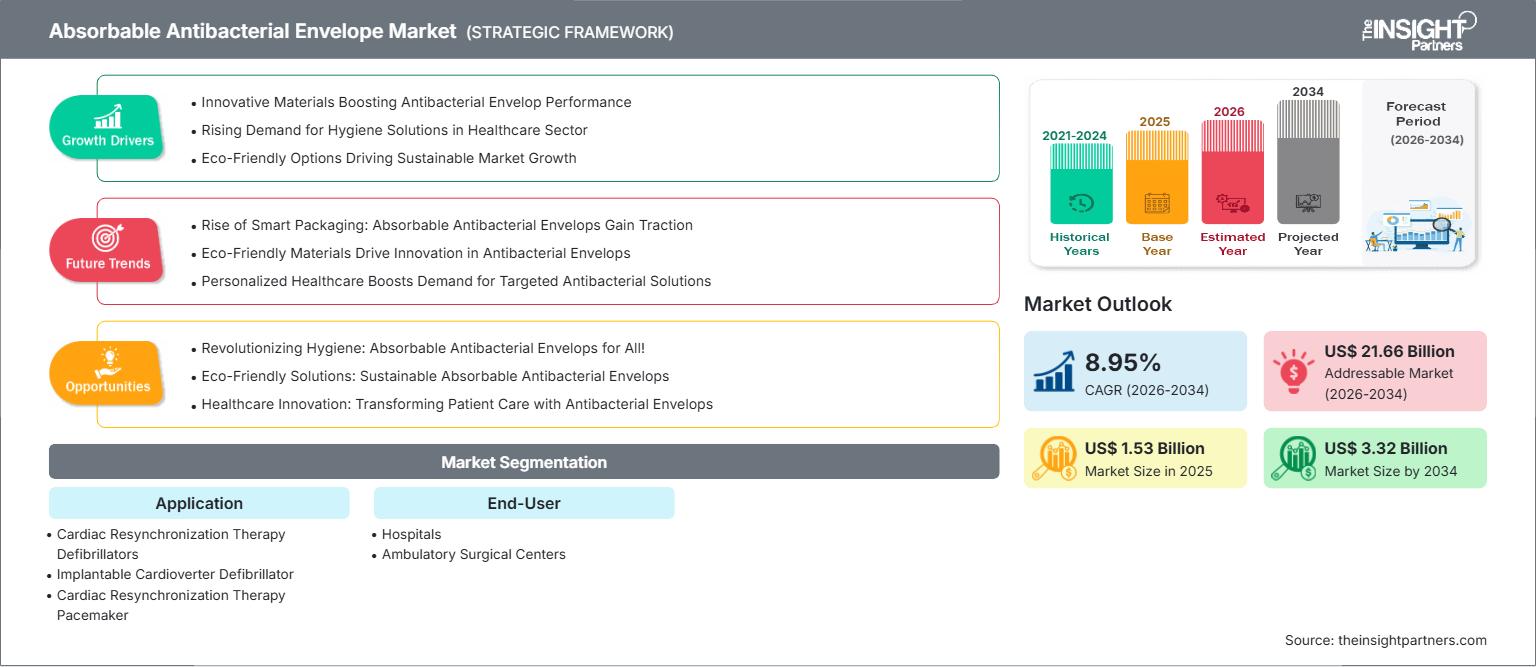
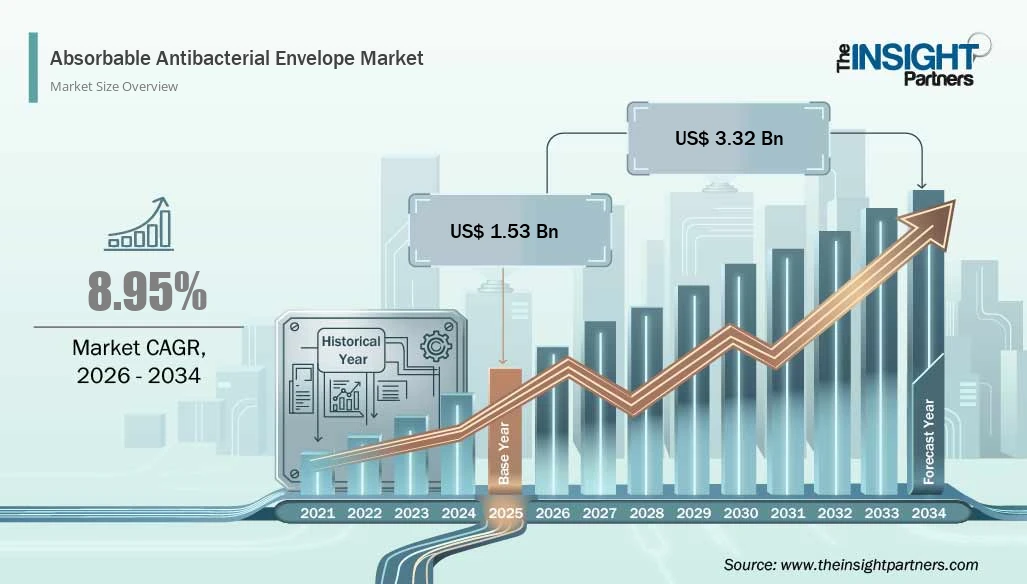
The absorbable antibacterial envelope market size was valued at US$ 1.53 Billion in 2025 and is projected to reach US$ 3.32 Billion by 2034, registering a CAGR of 8.95% during 2026–2034. Demand is centered on infection-prevention envelopes used with cardiac resynchronization therapy defibrillators, implantable cardioverter defibrillators, and cardiac resynchronization therapy pacemakers, with hospitals and ambulatory surgical centers representing the core end-user base.
Across North America, the absorbable antibacterial envelope market size is supported by high cardiac implantable electronic device procedure volume, early adoption of infection-reduction protocols, and strong electrophysiology infrastructure. The region is expected to grow at a CAGR range of 8.2–8.8% during 2026–2034, reflecting broader risk stratification of CIED patients, greater use in revision procedures, and payer focus on avoiding infection-related extraction costs.
Absorbable Antibacterial Envelope Market Assessment and Insights
- North America held 46–49% of the absorbable antibacterial envelope market share in 2025 and is growing at a CAGR between 2026–2034 of 8.2–8.8%, supported by CIED replacement volume, specialist electrophysiology centers, and infection-prevention reimbursement logic.
- US represented 84–88% of North America in 2025 and is growing at a CAGR between 2026–2034 of 8.3–8.9%, driven by high ICD and CRT penetration.
- Europe accounted for 24–27% share in 2025 and is growing at a CAGR between 2026–2034 of 7.5–8.1%, with Germany, the UK, France, and Italy leading adoption.
- Asia Pacific held 17–20% share in 2025 and is growing at a CAGR between 2026–2034 of 9.8–10.6%, led by China, Japan, South Korea, India, and Australia.
- Largest Segment Implantable Cardioverter Defibrillator held 43–47% market share in 2025, growing at a CAGR range of 8.5–9.1% during 2026–2034 due to replacement intensity.
- High Growth Segment Ambulatory Surgical Centers held 14–17% market share in 2025, growing at a CAGR range of 10.0–10.8% during 2026–2034 as selected CIED procedures migrate outpatient.
- Key companies analyzed in detail: Medtronic plc, Elutia Inc., Boston Scientific Corporation, Abbott Laboratories, Johnson & Johnson Services, Inc., B. Braun Melsungen AG, Smith & Nephew plc, Zimmer Biomet Holdings, Inc., Cook Medical LLC, BIOTRONIK SE & Co. KG.
Source: The Insight Partners' analysis based on proprietary research, government publications, company annual reports, investor presentations, industry databases, and expert interviews.
The absorbable antibacterial envelope market trends has evolved from mechanical pocket stabilization toward localized antimicrobial delivery and bioabsorbable carrier design. Manufacturers now compete on drug-elution duration, envelope handling, device compatibility, absorption behavior, and tissue integration after implantation. Production dynamics are shaped by polymer processing, biologic matrix sourcing, antibiotic loading validation, sterile barrier packaging, and consistency testing. In absorbable antibacterial envelope market operations, quality assurance is especially important because products combine implantable materials with infection-risk reduction claims.
Forward momentum will come from emerging CIED implantation capacity in Asia Pacific, stronger electrophysiology programs in the Middle East, and wider hospital use of device infection risk scores. Regulatory pathways are expected to emphasize combination-product evidence, post-market surveillance, and antimicrobial stewardship. Investment will likely focus on biologic envelopes, expanded indications, real-world clinical registries, and procurement pathways that link envelope adoption to avoided hospitalization, extraction, and reimplantation expense.
Absorbable Antibacterial Envelope Market Report Scope
| Report Attribute | Details |
|---|---|
| Market size in 2025 | US$ 1.53 Billion |
| Market Size by 2034 | US$ 3.32 Billion |
| Global CAGR (2026 - 2034) | 8.95% |
| Historical Data | 2021-2024 |
| Forecast period | 2026-2034 |
Absorbable Antibacterial Envelope Market Analysis
Procedure-side demand is tied to aging demographics, heart failure prevalence, arrhythmia diagnosis, and greater use of CRT and ICD therapy in eligible patients. absorbable antibacterial envelope market growth is reinforced by the high cost of CIED infections, which can require device extraction, prolonged antibiotics, and later reimplantation. The Value Chain consists of antibiotic providers, manufacturers of bioabsorbable polymers or biological matrix, sterile manufacturing organizations, electrophysiology equipment providers, hospitals’ value analysis panels, and specialty distributors. The supply situation is advantageous to those organizations that have tested antimicrobial delivery systems, constant envelope sizes, and sterile distribution systems since shortages may disrupt planned generator replacements.
Competitiveness revolves around clinical evidence and channel control. Absorbable Antibacterial Envelope Market report suggests that Medtronic plc enjoys a strong positioning via TYRX, and Elutia Inc. and Boston Scientific Corporation have enhanced the segment through biologic envelope capabilities. Positioning of the company will include neighboring cardiac rhythm franchises. Procedural ecosystems are impacted by CIED product lines for Abbott Laboratories and BIOTRONIK SE & Co. KG, and Johnson & Johnson Services, Inc., B. Braun Melsungen AG, Smith & Nephew plc, Zimmer Biomet Holdings, Inc., and Cook Medical LLC have wider experience in biomaterials, infection control, surgical devices, and implantable medical devices that can be utilized in the future platform development.
● REPORT CUSTOMIZATION
Tailor This Report To Align With Your Specific Business Requirements
This report can be customized to align precisely with your business objectives, scope, and target markets. Customization options include tailored segmentation, geography, competitive analysis, and strategic insights to support informed decision-making.
Customize This Report →WHAT YOU CAN ADJUST
- ● Segmentations
- ● Geography
- ● Competitive Analysis
- ● Language Preferences
Absorbable Antibacterial Envelope Market: Strategic Insights
Regional Insights
North America Absorbable antibacterial envelope market
North America held 46–49% share in 2025 and is projected to grow at a CAGR range of 8.2–8.8% during 2026–2034. The region benefits from frequent ICD and CRT replacement cycles, extensive electrophysiology infrastructure, and established pathways for evaluating technologies that reduce infection-related readmission, extraction, and length-of-stay risk.
The absorbable antibacterial envelope market share in North America is also supported by product availability, cardiac rhythm management sales coverage, and strong hospital value analysis processes. Medtronic plc, Boston Scientific Corporation, Elutia Inc., Abbott Laboratories, and BIOTRONIK SE & Co. KG are commercially relevant because envelope use is closely linked to CIED implantation workflows and physician education.
U.S. Absorbable antibacterial envelope market
The U.S. represented 84–88% of North America in 2025 and is expected to grow at a CAGR range of 8.3–8.9% during 2026–2034. Demand is strongest in generator replacement, system revision, upgrade, and high-risk patient procedures, where diabetes, renal impairment, prior infection, or anticoagulation can elevate pocket complication concern.
Company presence is highly concentrated in cardiac rhythm management, with Medtronic plc, Boston Scientific Corporation, Abbott Laboratories, and BIOTRONIK SE & Co. KG shaping procedure ecosystems. Elutia Inc. contributed biologic envelope technology, while hospital systems increasingly assess envelope adoption through infection-control committees, electrophysiology leadership, pharmacy oversight, and total cost-of-care models.
Europe Absorbable antibacterial envelope market
Europe accounted for 24–27% share in 2025 and is forecast to grow at a CAGR range of 7.5–8.1% during 2026–2034. Germany leads regional adoption because of high CIED procedure capacity, structured reimbursement, and strong specialist cardiology networks. The UK emphasizes infection prevention within backlog recovery and productivity improvement programs.
Germany’s demand is reinforced by electrophysiology centers that evaluate device infection risk in replacement and revision cases. France and Italy show rising adoption where tertiary hospitals manage complex CRT and ICD populations, while Spain’s procurement remains more tender-sensitive. European growth depends on institutional evidence review, antimicrobial stewardship alignment, and budget justification against extraction-related costs.
APAC Absorbable antibacterial envelope market
APAC held 17–20% share in 2025 and is expected to grow at a CAGR range of 9.8–10.6% during 2026–2034. China is the leading country, supported by expanding tertiary cardiac infrastructure, broader arrhythmia diagnosis, and domestic policy focus on advanced cardiovascular care. Japan and South Korea sustain premium adoption.
India and Australia add complementary demand patterns. India is expanding CIED access through private hospitals and insurance growth, while Australia emphasizes quality-based procedural standards. Regional policy momentum around hospital infrastructure, local device registration, and specialty cardiac capacity is improving envelope adoption, although pricing and physician training remain critical constraints.
Middle East & Africa Absorbable antibacterial envelope market
Middle East & Africa is projected to grow at a CAGR range of 8.0–8.6% during 2026–2034, led by Saudi Arabia. Specialty cardiac investments, tertiary hospital expansion, and medical tourism strategies in Saudi Arabia and the UAE are strengthening demand for advanced CIED infection-prevention products in high-risk procedures.
South Africa remains the most developed African market due to private cardiac care networks and distributor access. Rest of MEA adoption is uneven because of reimbursement limits, imported-device dependency, and lower electrophysiology density. Gulf healthcare investment, linked partly to energy-funded modernization programs, supports premium cardiac services and selective envelope uptake.
Segmentation Analysis
Application
Application is expected to grow at a CAGR range of 8.6–9.2% during 2026–2034. The absorbable antibacterial envelope market forecast under this segment is defined by CIED type, infection-risk profile, procedural complexity, and replacement frequency. Envelope use is most compelling when high device value, longer implant life, and patient risk factors make infection prevention economically and clinically important.
- Cardiovascular applications rely on high-strength, biocompatible sutures for vascular anastomosis, valve procedures, graft fixation, and long-term tissue support in complex surgical environments.
- Orthopedic use is tied to tendon repair, sports medicine, trauma fixation, and reconstructive procedures where suture strength and anchor compatibility influence procedural reliability.
- Gynecology demand reflects cesarean delivery, hysterectomy, pelvic repair, and minimally invasive procedures requiring absorbable materials with predictable handling and absorption.
- Opthalmolog applications require fine sutures, precision needles, and minimal tissue reaction, making specialty manufacturing quality central to surgeon trust and clinical outcomes.
- General surgery represents the broadest use base, covering abdominal, gastrointestinal, hernia, trauma, and skin closure procedures across hospitals and ambulatory surgical settings.
End-User
End-User is expected to grow at a CAGR range of 8.8–9.4% during 2026–2034. Hospitals remain the principal users because complex CIED implantation, infected system extraction, high-risk replacement, and multidisciplinary cardiac care are concentrated in advanced facilities. Ambulatory surgical centers are gaining relevance where selected generator replacements and lower-risk electrophysiology procedures can be performed efficiently.
- Hospitals generate the highest revenue contribution because they manage complex CRT-D, ICD, and CRT-P cases, high-risk patients, inpatient complications, and specialist electrophysiology teams.
- Ambulatory Surgical Centers are strategically important as procedural migration advances, especially for predictable generator replacements requiring standardized infection-prevention protocols and efficient supply utilization.
Opportunity Snapshot
| Segment Name | Revenue Contribution | Trend Tag | Adoption Stage |
| Hospitals | High | EP Suites | Mature |
| Ambulatory Surgical Centers | Medium | Replacement Care | Scaling |
Absorbable Antibacterial Envelope Market Growth Drivers and Impact Analysis
High Cost Burden of Cardiac Device Infections
CIED infections are disruptive from a clinical standpoint since they involve the need to remove the device, intravenous antibiotics, delayed reimplantation, and even hospitalization. This presents an economic rationale for preventive devices that can be utilized by selected patients. Hospital institutions will analyze envelopes not only as supplementary implants but also as devices that could minimize any avoidable cost incurred in the process. This effect is particularly relevant in replacement, upgrade, and revision surgeries due to higher infection risks related to pocket manipulation and patient co-morbidities. The provider implication is in standardizing care via protocol definition of eligible patients for envelope use.
Expansion of ICD and CRT Therapy in Aging Populations
Aging populations along with survival of chronic cardiovascular patients will continue to increase the patient pool that is suitable candidates for ICD and CRT therapy. Aging populations tend to have underlying conditions such as diabetes, renal issues, heart failure, and even immuno-suppression which makes infection control an important part of generator change procedures or upgrades. Increased prevalence will lead to increased number of patients who will require future procedures. This will result in recurring revenues that will be generated after the initial device implantation. Growth in the number of replacement procedures is an example of how this will play out in the marketplace.
Greater Hospital Focus on Preventable Complications
The approach of hospitals towards management of surgical site and medical device infections is shifting towards the use of prevention bundles, antimicrobial stewardship, and checklists for standard procedures. This product is a good fit for this trend as it delivers antimicrobial protection in a local setting while helping in securing the medical device pocket. This not only affects patient health, but also operating measures such as time of hospitalization, risk of being readmitted, and quality metrics. With this, procurement teams will be more interested in assessing the effectiveness of these envelopes among specific groups of patients. Companies that give dose information, absorption, handling, and outcome details get better chances of formulary acceptance.
Absorbable Antibacterial Envelope Market Future Trends
Risk-Scored Use of Antibacterial Envelopes
The most effective trends in the absorptive antibacterial envelop market will include application through risk assessment and not general usage. Hospitals should consider factors like patient co-morbidities, procedure, history of generator replacement, anticoagulation, and previous infections during their decision-making process when choosing envelopes. This will create greater consistency in clinical practice and help hospitals justify the expense as the envelopes will only be prescribed for patients who will derive most benefits. Manufacturers have to provide information relating to risk assessment tools, education materials, and data on the relationship between envelope application and reduced infections.
Biologic and Bioabsorbable Platform Differentiation
The future competitive edge will extend from basic antibacterial properties to envelope substrates that integrate infection prevention, tissue remodeling, pocket stability, and easy reoperations. There will be increased interest in biologic matrices if clinicians prefer vascularized tissue integration and scar formation, but synthetic absorbable substrates will still be in high demand for consistent degradation and scalable production. Next-generation devices will improve on antibiotic release timing, conformance, and cross-device compatibility. The future trend will prompt companies to conduct comparative handling trials and long-term clinical evidence, as well as device designs that allow both the initial placement and later re-operation of the generator.
Absorbable Antibacterial Envelope Market Opportunities
Protocol-Based Adoption in Generator Replacement Procedures
Absorbable antibacterial envelope market forecast suggest that there exists a great opportunity in generator replacement, revision, and upgrading operations since such operations pose higher risks of infection compared to the majority of initial implants. It would be possible for manufacturers to collaborate with the hospitals in determining the criteria for selection, integrating the choice of the envelopes before the operation and connecting the envelope use with the review of infection control procedures. The areas for investment are procedure kits, electronic medical records reminders, risk scores and cost dossiers. The opportunity is action-oriented as it does not demand universal adoption.
Expansion Through Ambulatory Electrophysiology Pathways
Ambulatory surgical centers offer an emerging opportunity as selected CIED procedures shift toward lower-cost outpatient environments. Envelope suppliers can gain share by providing compact packaging, predictable ordering, short-cycle replenishment, and training that fits lean procedural teams. The opportunity is strongest for generator replacements and suitable ICD or CRT-P cases where infection prevention remains important but inpatient resources are not required. Companies should build distributor partnerships, ASC-specific economic materials, and standardized product bundles. Winning strategies will combine ease of use, clear patient selection criteria, and operational support that reduces friction for centers adopting advanced cardiac procedures.
Recent Developments
- October 2025: Elutia Inc. announced the closing of the sale of its BioEnvelope business, including EluPro and CanGaroo bioenvelopes, to Boston Scientific Corporation for US$ 88 million in cash. The transaction shifted strategic control of the bioenvelope portfolio to Boston Scientific and enabled Elutia to focus resources on its drug-eluting biomatrix pipeline.
- September 2025: Boston Scientific Corporation entered into a definitive agreement to acquire Elutia’s EluPro and CanGaroo bioenvelopes for US$ 88 million. The assets are designed to protect patients receiving implantable medical devices and complement Boston Scientific’s cardiac rhythm management reach, strengthening commercial competition in infection-prevention envelopes.
- March 2025: Elutia Inc. announced publication of preclinical data on its antibiotic-eluting biologic envelope, reporting broad antimicrobial activity against bacterial strains associated with CIED infections and antibiotic elution over 14 days. The publication supported EluPro’s scientific positioning after its U.S. commercial launch in January 2025.
Frequently Asked Questions

- Comprehensive Market Sizing and Forecast Analysis
- Detailed Segmentation Analysis
- In-Depth Market Dynamics Assessment
- Regional and Country-Level Insights
- Competitive Landscape and Company Benchmarking
- Strategic Business Intelligence
Recent Reports
Testimonials

The Insight Partners' SCADA System Market report is comprehensive, with valuable insights on current trends and future forecasts. The team was highly professional, responsive, and supportive throughout. We are very satisfied and highly recommend their services.
RAN KEDEM Partner, Reali Technologies LTDs
I requested a report on a very specific software market and the team produced the report in a few days. The information was very relevant and well presented. I then requested some changes and additions to the report. The team was again very responsive and I got the final report in less than a week.
JEAN-HERVE JENN Chairman, Future Analytica
We worked with The Insight Partners for an important market study and forecast. They gave us clear insights into opportunities and risks, which helped shape our plans. Their research was easy to use and based on solid data. It helped us make smart, confident decisions. We highly recommend them.
PIYUSH NAGPAL Sr. Vice President, High Beam Global
The Insight Partners delivered insightful, well-structured market research with strong domain expertise. Their team was professional and responsive throughout. The user-friendly website made accessing industry reports seamless. We highly recommend them for reliable, high-quality research services
YUKIHIKO ADACHI CEO, Deep Blue, LLC.
This is the first time I have purchased a market report from The Insight Partners.While I was unsure at first, I visited their web site and felt more comfortable to take the risk and purchase a market report.I am completely satisfied with the quality of the report and customer service. I had several questions and comments with the initial report, but after a couple of dialogs over email with their analyst I believe I have a report that I can use as input to our strategic planning process.Thank you so much for taking the extra time and making this a positive experience.I will definitely recommend your service to others and you will be my first call when we need further market data.
JOHN SUZUKI President and Chief Executive Officer, Board Director, BK Technologies
I wish to appreciate your support and the professionalism you displayed in the course of attending to my request for information regarding to infectious disease IVD market in Nigeria. I appreciate your patience, your guidance, and the fact that you were willing to offer a discount, which eventually made it possible for us to close a deal. I look forward to engaging The Insight Partners in the future, all thanks to the impression you have created in me as a result of this first encounter.
DR CHIJIOKE ONYIA MANAGING DIRECTOR, PineCrest Healthcare Ltd.Reason to Buy
- Informed Decision-Making
- Understanding Market Dynamics
- Competitive Analysis
- Identifying Emerging Markets
- Customer Insights
- Market Forecasts
- Risk Mitigation
- Boosting Operational Efficiency
- Strategic Planning
- Investment Justification
- Tracking Industry Innovations
- Aligning with Regulatory Trends





 Get Free Sample for