
Accessibility Testing Market Size, Growth & Demand by 2034
Coverage: By Type (Web app, Mobile app); Application (SME, Large enterprise) , and Geography (North America, Europe, Asia Pacific, and South and Central America)
- Status : Data Released
- Report Code : TIPRE00009319
- Category : Technology, Media and Telecommunications
- No. of Pages : 150
- Available Report Formats :


- Last update date : August 07, 2026


2025 Market Size
US$ 641.26 Mn
Base year value
2034 Forecast
US$ 977.41 Mn
Projected by 2034
CAGR 2026-2034
4.79 %
Growth rate
Addressable Market
US$ 7,345.82 Mn
(2026-2034)
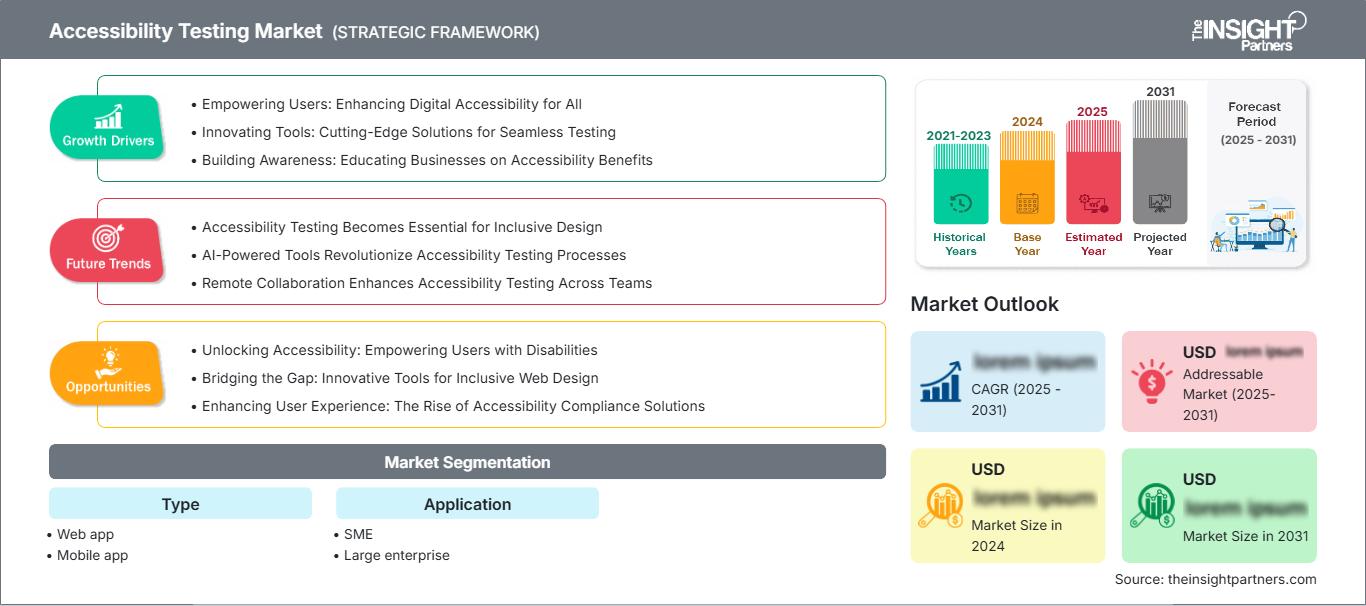
The accessibility testing market was valued at US$ 641.26 Million in 2025 and is projected to reach US$ 977.41 Million by 2034, registering a CAGR of 4.79% during 2026–2034. Market expansion is supported by increasing regulatory focus on digital inclusion, rising adoption of accessibility standards across enterprise software environments, and growing integration of accessibility validation throughout application development lifecycles. Organizations are investing in comprehensive testing frameworks to enhance usability, compliance readiness, and user engagement across digital channels.
Driven by a mature digital ecosystem, North America remains a pivotal region for accessibility solution deployment. The accessibility testing market size in the region is supported by widespread implementation of WCAG-aligned development practices, ADA compliance considerations, and increasing enterprise spending on digital experience optimization. Growth across North America is expected within a 4.3–5.3% CAGR range through the forecast period, supported by cloud-native architectures, DevOps adoption, and expanding digital service portfolios.
Accessibility Testing Market Assessment and Insights
- North America: Strong compliance culture and advanced software development ecosystems support sustained adoption. Share in 2025: 37–41% and CAGR between 2026–2034: 4.3–5.3%.
- US: The largest country-level market benefits from widespread enterprise digitization and accessibility governance initiatives. Share in 2025: 72–76% of North America and CAGR between 2026–2034: 4.4–5.4%.
- Europe: Regulatory momentum and implementation of accessibility requirements support long-term demand across the UK, Germany, France, Italy, and Spain. Accessibility testing market share in 2025: 28–32% and CAGR between 2026–2034: 4.8–5.8%.
- Asia Pacific: Rapid digital transformation and expanding online service ecosystems accelerate market penetration across China, Japan, India, South Korea, and Australia. Share in 2025: 22–26% and CAGR between 2026–2034: 5.4–6.4%.
- Largest Segment: Web App testing continues to dominate due to broad enterprise web presence, accounting for 58–62% of the accessibility testing market share in 2025 and expanding at 4.2–5.2% CAGR during 2026–2034.
- High Growth Segment: Mobile App testing benefits from increasing smartphone-centric engagement models, representing 38–42% share in 2025 and growing at 5.5–6.5% CAGR during 2026–2034.
- Key companies analyzed in detail: 360Logica Testing Services Pvt. Ltd., AccessibilityOz Pty Ltd, Applause App Quality, Inc., BarrierBreak Solutions Pvt. Ltd., Criterion 508 Solutions, Inc., Deque Systems, Inc., Digivante Ltd., Happiest Minds Technologies Limited, Intopia Pty Ltd, and Invensis Technologies Pvt. Ltd.
Source: The Insight Partners' analysis based on proprietary research, government publications, company annual reports, investor presentations, industry databases, and expert interviews.
Accessibility testing market enterprise accessibility initiatives have progressed beyond periodic compliance assessments toward continuous testing integrated within software engineering workflows. Automated scanning technologies, AI-supported validation tools, and user-centered testing methodologies are increasingly deployed simultaneously to improve coverage and reduce remediation timelines. Growth in digital commerce, online banking, healthcare portals, educational platforms, and government services has elevated accessibility verification from a regulatory requirement to an operational necessity supporting broader digital experience objectives.
Emerging opportunities are increasingly visible across developing digital economies where governments are advancing inclusive technology policies and public service digitization programs. Investment trends indicate rising demand for scalable accessibility governance solutions, integrated testing environments, and managed compliance services. Regulatory harmonization around international accessibility standards, combined with expanding digital participation expectations, is expected to sustain long-term demand while encouraging broader integration of accessibility practices within enterprise software development strategies.
Accessibility Testing Market Report Scope
| Report Attribute | Details |
|---|---|
| Market size in 2025 | US$ 641.26 Million |
| Market Size by 2034 | US$ 977.41 Million |
| Global CAGR (2026 - 2034) | 4.79% |
| Historical Data | 2021-2024 |
| Forecast period | 2026-2034 |
Accessibility Testing Market Analysis
The accessibility testing market growth trajectory is increasingly linked to the expansion of digital-first customer engagement models and stricter accessibility expectations across industries. Organizations in banking, healthcare, retail, education, telecommunications, and government sectors now rely heavily on websites, applications, and self-service digital platforms to deliver services. As digital interactions become more central to business operations, accessibility compliance is evolving into a strategic imperative rather than a reactive requirement. This shift is encouraging enterprises to conduct accessibility validation throughout software development lifecycles and establish long-term testing partnerships.
The market ecosystem includes specialist accessibility consultants, software testing providers, compliance advisory firms, platform developers, and managed service vendors. Automated accessibility assessment tools continue gaining traction due to their ability to identify recurring issues quickly across large application environments. Nonetheless, manual testing remains indispensable for evaluating real-world user interactions, assistive technology compatibility, keyboard navigation, and screen-reader performance. Consequently, organizations increasingly adopt hybrid testing approaches that combine automation efficiencies with expert human assessment.
The accessibility testing market analysis highlights an increasingly competitive environment where providers differentiate through automation capabilities, consulting expertise, accessibility remediation support, and governance solutions. Companies such as Deque Systems, Applause App Quality, AccessibilityOz, Criterion 508 Solutions, and BarrierBreak Solutions have expanded service portfolios to address growing demand for enterprise-scale accessibility programs. Market participants are also investing in developer-centric tools that embed accessibility validation earlier in the software engineering process, reducing total remediation costs and compliance risks.
Strategic investment activity is focused on AI-assisted accessibility testing, continuous monitoring platforms, cloud-based delivery models, and accessibility analytics environments. Leading vendors are forming partnerships with software development tool providers and enterprise technology ecosystems to strengthen adoption. Competitive positioning increasingly depends on the ability to deliver measurable accessibility outcomes while supporting agile development practices. Large enterprises remain the dominant source of revenue; however, cost-effective subscription models are opening new opportunities among small and medium-sized businesses seeking scalable accessibility support without extensive internal expertise.
● REPORT CUSTOMIZATION
Tailor This Report To Align With Your Specific Business Requirements
This report can be customized to align precisely with your business objectives, scope, and target markets. Customization options include tailored segmentation, geography, competitive analysis, and strategic insights to support informed decision-making.
Customize This Report →WHAT YOU CAN ADJUST
- ● Segmentations
- ● Geography
- ● Competitive Analysis
- ● Language Preferences
Accessibility Testing Market: Strategic Insights
Regional Insights
North America Accessibility Testing Market
North America represented 37–41% of global revenue in 2025, maintaining its position as the largest regional market for accessibility testing services and solutions. The region benefits from well-established digital infrastructure, high enterprise software spending, and mature regulatory awareness regarding digital accessibility requirements. Public agencies and private organizations increasingly consider accessibility a core element of digital transformation strategies rather than a stand-alone compliance function. This shift has encouraged organizations to implement accessibility validation throughout software design, development, testing, and deployment processes.
The growing prevalence of cloud-native applications, digital customer service channels, mobile commerce platforms, and online public services continues to strengthen demand for the accessibility testing market. Enterprises are increasingly adopting automated testing tools alongside expert assessments to improve scalability and compliance outcomes. Accessibility programs are also receiving greater executive attention as organizations seek to enhance customer experience and reduce legal exposure. Supported by sustained technology investment and widespread accessibility awareness, the regional market is projected to record a 4.3–5.3% CAGR during 2026–2034.
U.S. Accessibility Testing Market
The United States accounted for 72–76% of North American accessibility testing market revenue in 2025, making it the most significant national contributor. Accessibility testing demand is particularly strong among large enterprises managing complex digital ecosystems that include websites, mobile applications, customer portals, and cloud-based platforms. Accessibility requirements increasingly influence software procurement decisions, vendor evaluations, and digital modernization initiatives across both public and private sectors.
A strong presence of specialized providers, including Deque Systems, Applause App Quality, and Criterion 508 Solutions, contributes to market maturity and innovation. Organizations are integrating accessibility testing into agile and DevOps workflows to ensure issues are identified before deployment. Demand is also supported by increasing recognition of accessibility as a customer experience differentiator capable of improving usability for broader user groups. The U.S. market is anticipated to expand at a 4.4–5.4% CAGR through 2034, supported by continued investment in digital service quality and governance.
Europe Accessibility Testing Market
Europe accounted for 28–32% of global market revenue in 2025 and is projected to grow at a 4.8–5.8% CAGR throughout the accessibility testing market forecast period. Regulatory developments remain among the most influential growth catalysts, encouraging organizations to strengthen digital accessibility capabilities. Public institutions and enterprises alike are increasing investments in accessibility audits, testing services, and remediation programs to align with evolving requirements and improve digital inclusivity outcomes.
The United Kingdom remains a major regional contributor due to widespread digital service adoption and advanced awareness of accessibility obligations. Germany benefits from strong enterprise technology spending, extensive software deployment, and a highly developed industrial digitalization landscape. France, Italy, and Spain are experiencing increasing demand as organizations modernize digital infrastructure and strengthen accessibility governance frameworks. Among European countries, Germany maintains leadership owing to its substantial enterprise software ecosystem and ongoing investment in digital quality initiatives.
APAC Accessibility Testing Market
Asia Pacific represented 22–26% of global accessibility testing market revenue in 2025 and is expected to achieve the highest regional expansion rate of 5.4–6.4% CAGR through 2034. Rapid growth in online services, digital commerce, cloud adoption, and government digitization programs continues to create favorable conditions for accessibility testing adoption.
China, Japan, South Korea, India, and Australia are driving regional demand through large-scale software development activity and increasing attention to inclusive digital experiences. India is strengthening its position as a technology services hub, while Japan and Australia demonstrate strong adoption of structured accessibility practices and compliance-focused testing frameworks.
Middle East & Africa Accessibility Testing Market
The Middle East & Africa accessibility testing market is relatively small, yet continues to accelerate as governments and organizations intensify efforts to advance digital transformation. The rise of web-based services for citizens, smart city projects, and the emergence of digital commerce ecosystems have led to a growing focus on accessibility issues in application development.
Saudi Arabia and the United Arab Emirates are the most developed markets owing to extensive investments in IT infrastructure and digital transformation projects in the public sector. In addition, South Africa accounts for a significant share of demand due to organizations' digital transformation projects. The market is forecast to increase at a CAGR of 4.7–5.7% through 2034, supported by increasing awareness of accessibility requirements and broader digital inclusion objectives.
Segmentation Analysis
Type
Type is expected to grow at a rate of 4.7%-5.7% CAGR between 2026-2034. The demand for accessibility testing will continue to rise as organizations are required to test the accessibility of their varied digital landscape, which may include websites, customer portals, enterprise software, and mobile ecosystems, among others. Testing approaches will now integrate automated scans, manual tests, assistive technology testing, and monitoring.
- Web App: Web-based platforms remain the most widely tested environments due to their extensive use in e-commerce, banking, healthcare, education, and government services. Organizations prioritize regular accessibility validation to maintain compliance and improve usability across browsers and assistive technologies.
- Mobile App: Growing reliance on smartphone applications for transactions, communication, and service delivery is driving demand for accessibility assessments. Testing focuses on screen reader compatibility, navigation functionality, gesture interactions, and operating system-specific accessibility requirements.
Application
Applications are forecast to exhibit a CAGR of 4.8–5.8% between 2026–2034. The methods used to ensure accessibility are largely determined by the organization’s size and capabilities. Whereas larger companies will have their accessibility programs and infrastructure in place, smaller companies are turning to third-party testing companies and cloud solutions. There are also compliance needs across industries and increased awareness of accessibility as a performance metric.
- SME: Small and medium-sized enterprises are adopting accessibility testing to address compliance requirements, improve customer reach, and strengthen digital competitiveness. Subscription-based platforms and managed services are reducing implementation barriers and supporting broader market participation.
- Large Enterprise: Large organizations represent the leading demand source due to extensive digital portfolios, stronger regulatory exposure, and greater investment capacity. These organizations increasingly embed accessibility testing within software development lifecycles and enterprise governance frameworks.
Opportunity Snapshot
| Application | Revenue Contribution | Trend Tag | Adoption Stage |
| SME | Medium | Cloud QA | Scaling |
| Large Enterprise | High | DevOps Accessibility | Mature |
Accessibility Testing Market Growth Drivers and Impact Analysis
Expansion of Digital Accessibility Compliance Requirements
Digital accessibility has emerged as a major consideration for governments, companies, and public bodies looking to provide digital services to everyone on an equal footing. Expectations regarding compliance have been rising for websites, mobile applications, e-commerce platforms, and other online systems used by the general public. With greater visibility into compliance requirements, organizations are placing greater focus on accessibility testing, remediation, and the establishment of testing partnerships. Testing for accessibility is becoming increasingly common in procurement procedures, quality assurance programs, and digital transformation initiatives. All of this is resulting in sustained demand for vendors that can provide automated testing, audits, and accessibility governance capabilities.
Rising Dependence on Mobile and Multichannel Digital Platforms
Organizations now engage users through websites, mobile applications, customer portals, self-service interfaces, and cloud-based collaboration tools. This development has led to a marked increase in the difficulty of managing accessibility, as the digital experience needs to be functional across all types of devices and operating systems, as well as through different assistive technologies. The services offered by testing companies for accessibility help ensure that these environments are properly tested for usability barriers before product launch. Companies have started to realize the impact of inaccessible digital experiences on customer satisfaction, audience reach, and brand image.
Integration of Accessibility into Agile Development Practices
Software developers are no longer conducting isolated accessibility audits at the later stages of the release process. Rather, they have started including accessibility into their agile software development, DevOps operations, and continuous integration processes. Through this approach, organizations can not only spot problems early but also save money on fixing them and ensure efficient releases. Accessibility testing tools are now embedded in the development environment, enabling companies to track their accessibility while deploying quickly. Dashboards and governance systems also provide organizations with better insight into their accessibility performance.
Accessibility Testing Market Future Trends
AI-Powered Accessibility Validation Becomes Mainstream
The accessibility testing market trends have been increasingly influenced by artificial intelligence and machine learning technologies designed to optimize testing. Future accessibility testing platforms should be able to automatically detect problems, assign priorities for problem-solving, and offer recommendations for developers. Although human verification will remain necessary for more complex accessibility testing cases, there is no doubt that AI-based tools will reduce the workload of repetitive testing and increase the scale of testing processes. Businesses that need to accelerate software release cycles will incorporate testing tools into their development environments. Vendors investing in predictive analytics, automated reporting, and AI-supported accessibility management frameworks are likely to gain strategic advantages as enterprise demand evolves.
Enterprise Accessibility Governance Platforms Gain Momentum
Future market trends will see the emergence of central accessibility governance tools capable of handling vast numbers of applications. Organizations will need a unified view of testing results, compliance, remediations, and risks. The use of governance tools will help standardize processes across teams, business units, and websites. In the future, these solutions will be adopted by integrating them with software lifecycle management systems, cloud-based development platforms, and quality engineering tools. Given the growing involvement of executives in digital accessibility, governance-related tools are likely to become a focal point of technology investments in the enterprise space.
Accessibility Testing Market Opportunities
Expansion Through Emerging Digital Accessibility Programs
The development of accessibility testing initiatives in Asia Pacific, the Middle East, and selected developing countries offers great opportunities for companies specializing in accessibility testing. With greater government interest in providing inclusive digital services as part of their economic modernization efforts, many opportunities are emerging for testing services, consultation, and governance solutions related to accessibility. In addition, businesses in these regions are under increased pressure to deliver high-quality experiences and inclusive digital offerings. Awareness of accessibility issues will contribute to the growing demand for regional testing services tailored to specific language, device, and regulatory requirements. Those vendors that can offer a combination of automation services, consultations, and managed compliance services will be able to create a regional stronghold.
Managed Accessibility Services for Mid-Market Organizations
A considerable number of small and medium-sized enterprises still lack specialized accessibility expertise, even as the need for compliance grows. This presents an interesting opportunity for providers of managed accessibility services, including testing, remediation assistance, monitoring, reporting, and governance, delivered through a subscription-based model. This service enables organizations to be ready for compliance without spending significant resources on it. It is expected that demand will increase as digital channels become the primary means of communication between companies and their clients. The provider of scalable, affordable solutions will meet the needs of this niche market.
Frequently Asked Questions

- Comprehensive Market Sizing and Forecast Analysis
- Detailed Segmentation Analysis
- In-Depth Market Dynamics Assessment
- Regional and Country-Level Insights
- Competitive Landscape and Company Benchmarking
- Strategic Business Intelligence
Recent Reports
Testimonials

The Insight Partners provided valuable market intelligence that supported our global go-to-market strategy. Their team was professional, responsive, and attentive to our feedback, providing thoughtful analysis and helpful methodological clarifications throughout the project.
Junmo Kim Chief Financial Officer (CFO), Enertech Co., Ltd.
The Insight Partners' SCADA System Market report is comprehensive, with valuable insights on current trends and future forecasts. The team was highly professional, responsive, and supportive throughout. We are very satisfied and highly recommend their services.
RAN KEDEM Partner, Reali Technologies LTDs
I requested a report on a very specific software market and the team produced the report in a few days. The information was very relevant and well presented. I then requested some changes and additions to the report. The team was again very responsive and I got the final report in less than a week.
JEAN-HERVE JENN Chairman, Future Analytica
We worked with The Insight Partners for an important market study and forecast. They gave us clear insights into opportunities and risks, which helped shape our plans. Their research was easy to use and based on solid data. It helped us make smart, confident decisions. We highly recommend them.
PIYUSH NAGPAL Sr. Vice President, High Beam Global
The Insight Partners delivered insightful, well-structured market research with strong domain expertise. Their team was professional and responsive throughout. The user-friendly website made accessing industry reports seamless. We highly recommend them for reliable, high-quality research services
YUKIHIKO ADACHI CEO, Deep Blue, LLC.
This is the first time I have purchased a market report from The Insight Partners.While I was unsure at first, I visited their web site and felt more comfortable to take the risk and purchase a market report.I am completely satisfied with the quality of the report and customer service. I had several questions and comments with the initial report, but after a couple of dialogs over email with their analyst I believe I have a report that I can use as input to our strategic planning process.Thank you so much for taking the extra time and making this a positive experience.I will definitely recommend your service to others and you will be my first call when we need further market data.
JOHN SUZUKI President and Chief Executive Officer, Board Director, BK Technologies
I wish to appreciate your support and the professionalism you displayed in the course of attending to my request for information regarding to infectious disease IVD market in Nigeria. I appreciate your patience, your guidance, and the fact that you were willing to offer a discount, which eventually made it possible for us to close a deal. I look forward to engaging The Insight Partners in the future, all thanks to the impression you have created in me as a result of this first encounter.
DR CHIJIOKE ONYIA MANAGING DIRECTOR, PineCrest Healthcare Ltd.Reason to Buy
- Informed Decision-Making
- Understanding Market Dynamics
- Competitive Analysis
- Identifying Emerging Markets
- Customer Insights
- Market Forecasts
- Risk Mitigation
- Boosting Operational Efficiency
- Strategic Planning
- Investment Justification
- Tracking Industry Innovations
- Aligning with Regulatory Trends





 Get Free Sample for