
Activated Clotting Time Testing Market Trends, Size & Growth by 2034
Coverage: by Type (Point of Care, Clinical Laboratory Analyzer); Application (Cardiovascular and Vascular Surgery, ECMO, Cardiac Catheterization Laboratories, Critical Care Units, Hemodialysis Units); Technology (Optical Detection, Laser Based Detection, Fluorescent Based Detection); Test (Prothrombin Time, Fibrinogen,, Activated Partial Thromboplastin Time,, Activated Clotting Time, Others); End-User (Hospitals, Clinical Laboratories, Ambulatory Surgical Center, Academic and Research Institutes), and Geography (North America, Europe, Asia Pacific, and South and Central America)
- Status : Data Released
- Report Code : TIPRE00008531
- Category : Life Sciences
- No. of Pages : 150
- Available Report Formats :


- Last update date : July 16, 2026


2025 Market Size
US$ 525.11 Mn
Base year value
2034 Forecast
US$ 777.12 Mn
Projected by 2034
CAGR 2026-2034
4.45 %
Growth rate
Addressable Market
US$ 5,912.56 Mn
(2026-2034)
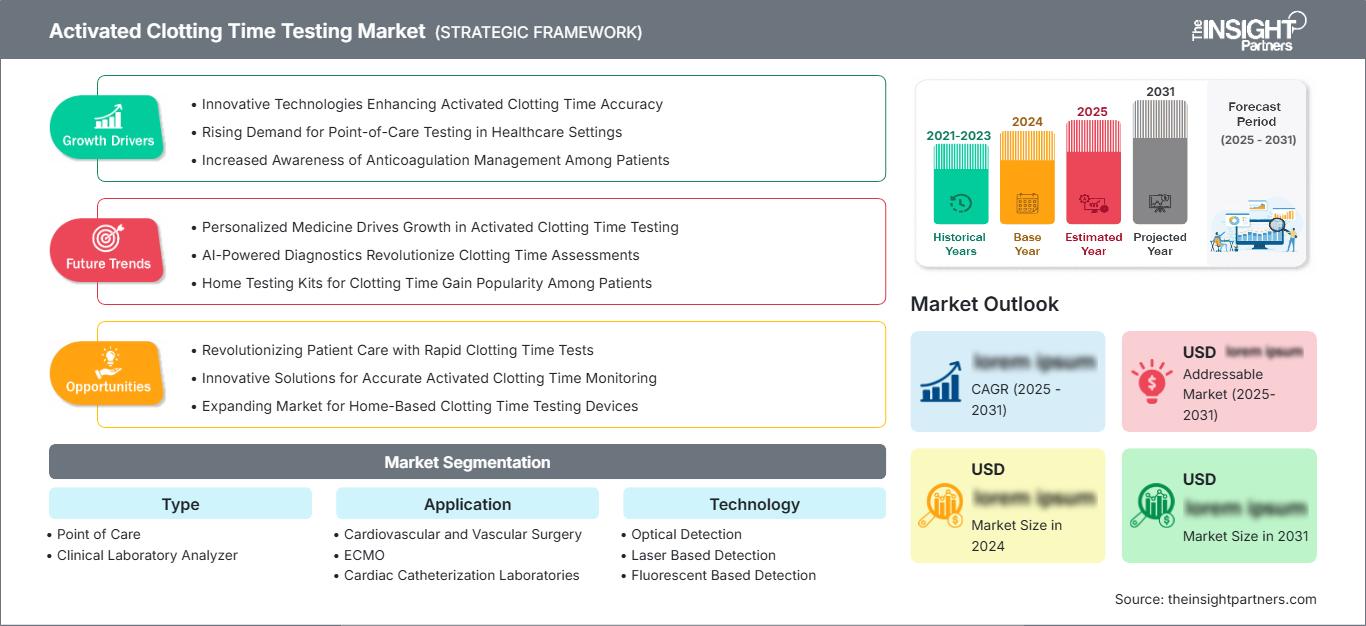
The Activated clotting time testing market was valued at US$ 525.11 Million in 2025 and is projected to reach US$ 777.12 Million by 2034, expanding at a CAGR of 4.45% during 2026–2034. There is a consistent demand for coagulation monitoring in cardiovascular surgery, extracorporeal circulation, cardiac catheterization, critical care anticoagulation, and heparin-assisted processes due to the need for instant evaluation of the patient's blood coagulability.
In North America, the size of the activated clotting time test market is backed up by large numbers of cardiac surgeries performed, effective point of care testing regulations, and high adoption of cartridge based coagulation devices. The expected CAGR of the region during 2026-2034 will range between 4.2% and 4.6%.
Activated Clotting Time Testing Market Assessment and Insights
- North America: Share in 2025 is estimated at 35–37%, with CAGR between 2026–2034 at 4.2–4.6%, supported by advanced cardiovascular centers, ECMO programs, point-of-care governance, and high procedural testing frequency.
- US: Share in 2025 is estimated at 84–88% of North America, with CAGR between 2026–2034 at 4.1–4.5%, reflecting strong cardiac catheterization and surgical infrastructure.
- Europe: Share in 2025 is estimated at 26–28%, with CAGR between 2026–2034 at 3.8–4.2%; Germany, the UK, France, Italy, and Spain lead through structured coagulation testing and cardiac surgery networks.
- Asia Pacific: Share in 2025 is estimated at 24–26%, with CAGR between 2026–2034 at 5.3–5.7%; China, Japan, India, South Korea, and Australia benefit from cardiac care expansion and laboratory automation.
- Largest Segment: Point of Care held a market share range of 62–66% in 2025, with CAGR between 2026–2034 at 4.7–5.1%, due to rapid intraoperative and bedside anticoagulation decisions.
- High Growth Segment: ECMO held a market share range of 12–15% in 2025, with CAGR between 2026–2034 at 5.8–6.2%, supported by critical care anticoagulation monitoring needs.
- Key companies analyzed in detail: F. Hoffmann-La Roche Ltd, Siemens Healthineers AG, Thermo Fisher Scientific Inc., Abbott Laboratories, Helena Laboratories Corporation, Sysmex Corporation, Nihon Kohden Corporation, Instrumentation Laboratory India Private Limited, Medtronic plc, Diagnostica Stago S.A.S.
Source: The Insight Partners' analysis based on proprietary research, government publications, company annual reports, investor presentations, industry databases, and expert interviews.
The evaluation of evolution has moved from coagulation testing using laboratory-based instrumentation to bedside and procedure room decision-making based on rapid testing. Innovation is driven by optical sensing technologies, miniaturization of the cartridge, better sample handling, middleware integration, and automated quality control. Manufacturing considerations include instrument robustness, reagent stability, lot tracking, and educational support. Health-care institutions are seeking out systems that provide both fast and documented information in anticoagulated patients.
Future growth opportunities are expected to come from new cardiac surgery centers, ICUs for ECMO treatment, and catheterization laboratories where protocols for anticoagulation monitoring have become more prevalent. The favorable trends are traceability of the devices, higher quality control, and better connectivity. Investments will be made in putting analyzers, full coagulation profile panel tests, staff training, and regional support minimizing downtime of the equipment in time-critical procedures.
Activated Clotting Time Testing Market Report Scope
| Report Attribute | Details |
|---|---|
| Market size in 2025 | US$ 525.11 Million |
| Market Size by 2034 | US$ 777.12 Million |
| Global CAGR (2026 - 2034) | 4.45% |
| Historical Data | 2021-2024 |
| Forecast period | 2026-2034 |
Activated Clotting Time Testing Market Analysis
The demand side is strengthened through cardiovascular procedures, hemodialysis, ECMO, vascular surgery, and intensive care anticoagulation. It helps to drive the market for activated clotting time testing since the test results are often employed when there is a need to adjust the levels of heparin rapidly. The ecosystem consists of device manufacturers, suppliers of coagulation reagents, cardiology operating rooms, catheterization labs, critical care departments, perfusionists, nephrology departments, distributors, and procurement organizations in hospitals.
The supply side is driven by the speed of testing, sample size, number of cartridges, uptime of devices, and interoperability with the hospital information systems. Point-of-care instruments lead in areas where there is an urgent need for assessment of the effectiveness of anticoagulation, while in other cases the importance of central laboratory analyzers is higher.
Activated Clotting Time Testing Market report indicates a landscape that is dominated by the presence of diagnostic platforms on a global level and hemostasis providers. The companies such as Abbott Laboratories, F. Hoffmann-La Roche Ltd., Siemens Healthineers AG, Sysmex Corporation, and Diagnostica Stago S.A.S. play a role in setting the standards for coagulation testing, whereas Helena Laboratories Corporation and Instrumentation Laboratory India Private Limited provide support for hemostasis.
Positioning Strategy relates more to procedure relevancy and installation base. Thermo Fisher Scientific Inc. supports laboratories with facility and reagents, Medtronic plc supports themselves with cardiovascular and extracorporeal care ecosystems, and Nihon Kohden Corporation supports through critical care monitoring. It would be advisable to invest in point-of-care testing connectivity, coagulation menu, cartridge systems, and hospital quality management systems.
● REPORT CUSTOMIZATION
Tailor This Report To Align With Your Specific Business Requirements
This report can be customized to align precisely with your business objectives, scope, and target markets. Customization options include tailored segmentation, geography, competitive analysis, and strategic insights to support informed decision-making.
Customize This Report →WHAT YOU CAN ADJUST
- ● Segmentations
- ● Geography
- ● Competitive Analysis
- ● Language Preferences
Activated Clotting Time Testing Market: Strategic Insights
Regional Insights
North America Activated clotting time testing market
North America accounted for an estimated 35–37% share in 2025 and is projected to grow at a 4.2–4.6% CAGR during 2026–2034. The area has been able to take advantage of cardiac surgical expertise programs, density of catheterization laboratories, ECMO, and robust governance of point-of-care testing. Activated clotting time testing continues to be important where healthcare providers perform procedural heparinization and make rapid reversal decisions.
Activated clotting time testing market share in North America is also driven by accreditation-based quality systems, operator training, and hospitals' preference for the use of validated instruments. The United States makes up the major part of the demand due to procedural intensity, whereas Canada makes its contribution through tertiary cardiac institutions and procurement of public hospitals.
U.S. Activated clotting time testing market
The U.S. represented 84–88% of North America in 2025 and is expected to expand at a 4.1–4.5% CAGR through 2034. The demand will be stabilized by the sheer volume of cardiac catheterization, coronary bypass, vascular interventions, ECMO and dialysis access cases. Point-of-care testing is recommended in situations where anticoagulation has to happen within minutes.
The company is well distributed across all hospitals and procedure suites. Abbott Laboratories provides cartridge-based point-of-care testing services, while Siemens Healthineers AG, Sysmex Corporation, F. Hoffmann-La Roche Ltd and Diagnostica Stago S.A.S. offer services for laboratory and hemostasis management. The application trends point towards procedural anticoagulation management, multidisciplinary quality review, electronic documentation and protocol for high-risk patients on UFH therapy.
Europe Activated clotting time testing market
Europe held an estimated 26–28% share in 2025 and is forecast to grow at a 3.8–4.2% CAGR during 2026–2034. The UK has advantages in terms of centralized cardiac services, quality-based hospital purchasing, and effective anticoagulation management. Germany is the most prominent market, owing to high cardiac surgery capacity, coagulation laboratories, and interventional cardiology facilities.
The value addition occurs through public hospitals' infrastructure, cardiac centers of universities, and the enhancement of ECMO and catheterization facilities in France, Italy, and Spain. The European Activated clotting time testing market purchasers will be concerned about the IVDR, traceability, method comparison, and competence of the personnel. Growth will be modest as the procedures are mature, but critical care and hemostasis automation call for an upgrade.
APAC Activated clotting time testing market
APAC accounted for an estimated 24–26% share in 2025 and is projected to grow at a 5.3–5.7% CAGR during 2026–2034. China takes the lead on quantity, whereas Japan and South Korea have shown good adoption of hemostasis devices.
India and Australia contribute through the development of their cardiac hospitals, private healthcare facilities, and dialysis centers. On the industrial front, there are factors like device distribution, analyzer installation, and laboratory automation. Policies related to cardiovascular care, intensive care units, and insurance will help in improving accessibility.
Middle East & Africa Activated clotting time testing market
Middle East & Africa is expected to grow at a 3.6–4.0% CAGR during 2026–2034, led by Saudi Arabia. Tertiary heart hospitals, imported analyzers, and gradual critical care development are contributions from UAE, South Africa, and Rest of MEA.
Healthcare investment in Gulf countries through energy funding will help in building cath lab facilities, heart surgery centers, and intensive care units capable of supporting ECMO. South Africa continues to be the sub-regional center for clinical activities. Some limitations include reliance on services, lack of training for the personnel, and logistics for reagents.
Segmentation Analysis
Type
The Type segment is expected to grow at a 4.4–4.8% CAGR during 2026–2034. The activated clotting time testing market trends across type is shaped by procedural urgency, operator availability, quality-control burden, and test menu requirements. Point-of-care systems dominate procedure rooms, while clinical laboratory analyzers provide broader hemostasis assessment, confirmatory testing, and centralized quality oversight.
- Point of Care: This sub-segment dominates because ACT results must be available rapidly during cardiac surgery, catheterization, ECMO, vascular intervention, and other heparinized procedures.
- Clinical Laboratory Analyzer: This sub-segment remains important for centralized coagulation testing, quality-controlled workflows, broader assay menus, and institutions managing high volumes across multiple care departments.
Application
The Application segment is projected to grow at a 4.6–5.0% CAGR during 2026–2034, driven by procedural anticoagulation monitoring and critical care complexity. Cardiovascular and vascular surgery remains a major use area, while ECMO represents the fastest-growing application. Catheterization laboratories, critical care units, and hemodialysis units require reliable testing to balance clotting and bleeding risks.
- Cardiovascular and Vascular Surgery: This sub-segment relies on ACT monitoring to guide high-dose heparin use, cardiopulmonary bypass management, reversal timing, and bleeding-risk control during complex procedures.
- ECMO: This sub-segment is strategically important because extracorporeal circuits require continuous anticoagulation oversight, frequent testing, and rapid clinical response to clotting or bleeding complications.
- Cardiac Catheterization Laboratories: This sub-segment supports percutaneous coronary and structural heart procedures where heparin dosing decisions must be made quickly during intervention.
- Critical Care Units: This sub-segment uses ACT selectively in patients requiring anticoagulation monitoring, extracorporeal support, or bedside coagulation assessment under urgent clinical conditions.
- Hemodialysis Units: This sub-segment supports anticoagulation management during dialysis sessions, particularly when clotting risk, bleeding risk, or vascular access complications require closer monitoring.
Technology
The Technology segment is forecast to grow at a 4.3–4.7% CAGR during 2026–2034. Technology choice depends on detection precision, device footprint, assay speed, maintenance requirements, and suitability for bedside or laboratory operations. Optical detection remains widely used, while laser and fluorescent approaches support differentiated measurement platforms where signal sensitivity and automation are valued.
- Optical Detection: This sub-segment is widely used because clot formation can be monitored through light transmission or scattering changes, supporting dependable and scalable coagulation assessment.
- Laser Based Detection: This sub-segment supports advanced measurement sensitivity and automated systems where precise clot-endpoint recognition can improve workflow confidence.
- Fluorescent Based Detection: This sub-segment is selectively relevant in specialized platforms where signal amplification, assay differentiation, or research-linked coagulation assessment is required.
Test
The Test segment is expected to grow at a 4.2–4.6% CAGR during 2026–2034. Demand spans routine and specialized coagulation markers, with ACT positioned as a procedure-critical test. Prothrombin time, fibrinogen, and activated partial thromboplastin time support broader coagulation evaluation, while ACT remains central where high-dose heparin monitoring must occur at the bedside or in procedural suites.
- Prothrombin Time: This sub-segment supports routine coagulation assessment, anticoagulant therapy review, liver function-related clotting evaluation, and preoperative testing in centralized laboratories.
- Fibrinogen: This sub-segment is important in bleeding management, trauma, obstetric complications, cardiac surgery, and critical care where clot strength may be compromised.
- Activated Partial Thromboplastin Time: This sub-segment supports intrinsic pathway evaluation, heparin monitoring in selected settings, and broader assessment of bleeding or clotting disorders.
- Activated Clotting Time: This sub-segment is central to high-dose heparin monitoring during invasive cardiovascular procedures, ECMO, and extracorporeal circulation management.
Opportunity Snapshot
| Application | Revenue Contribution | Trend Tag | Adoption Stage |
| Cardiovascular and Vascular Surgery | High | Bypass Monitoring | Mature |
| ECMO | Medium | Circuit Safety | Scaling |
| Cardiac Catheterization Laboratories | High | Heparin Control | Mature |
| Critical Care Units | Medium | Bedside Testing | Scaling |
| Hemodialysis Units | Medium | Dialysis Anticoagulation | Mature |
Activated Clotting Time Testing Market Growth Drivers and Impact Analysis
Growth in Cardiac and Vascular Procedures
Increased numbers of cardiac and vascular procedures will be the principal Activated clotting time testing market driver as ACT testing can help make decisions about anticoagulant use during bypass surgery, catheter interventions, structural heart disease procedures, and vascular surgery. It is essential to get results quickly in order to guarantee the safety of the procedure and reduce the risk of clot formation or bleeding. There will be a need for repetitive purchase of devices and cartridges, as well as control samples and training of operators in operating rooms and cath labs. The supplier can benefit from frequent testing required by procedures.
Rising Use of ECMO and Complex Critical Care
The expansion of ECMO is raising the need for coagulation monitoring at the point of care because ECMO requires precise anticoagulation balance. The ACT test is not the sole available method of monitoring, but it continues to be significant in situations when clinicians require quick information about the patient’s condition during circuit management, bleeding assessment, and in the case of clot formation. The practical consequence is higher usage of devices in ICU facilities, pediatric cardiac centers, and tertiary care hospitals. Regular tests mean high consumption and more demands on services.
Need for Faster Point-of-Care Anticoagulation Decisions
The demand for point-of-care anticoagulation tests is increasing due to the possibility of the turnaround being slow at the central laboratory during risky operations. The need for immediate results would help clinicians make decisions about heparin adjustment, determination of when to perform bypass surgery, reversal, or whether an operation is safe. The implication will include increased deployment of portable devices in operating theatres, cath labs, dialysis wards, and intensive care units. The procurement department considers the speed of workflow, usability, shelf life of cartridges, and competency training required.
Activated Clotting Time Testing Market Future Trends
Connected Quality Management for Decentralized Testing
In the activated clotting time testing market trends, there will be a growing emphasis on connectivity in quality management because hospitals are going to move point-of-care testing from their central laboratories. Such devices must have middleware connectivity, bar code scanning, operator lockout, automated quality assurance, and result electronic transmission in order to minimize compliance risks. Point-of-care testing provides clinical benefit only if results are comparable among different locations. Hospitals are likely to give preference to such systems which allow laboratory directors to manage device status, lot management, competency documentation, and exception reports remotely.
Broader Coagulation Platforms Around Procedural Care
Testing systems will need to move beyond stand-alone ACT measurement to become comprehensive procedural coagulation systems. Hospitals need systems that integrate all of their testing, including ACT, PT, APTT, fibrinogen and viscoelastic testing interfaces into one quality system. This emerging trend can avoid fragmented procurement and help with clinical interpretation during events of bleeding or thrombosis. The vendors can offer their advantage by developing their platforms that can be used in the operating room, catheterization laboratory, intensive care unit, and central laboratory. The development trend will not phase out stand-alone ACT devices; rather, it will increase demand for comprehensive systems.
Activated Clotting Time Testing Market Opportunities
POC Testing Expansion in Cardiac Centers
Heart centers offer a specialized market segment due to the need for rapid, repeatable anticoagulation tests in bypass surgery, catheterization, and vascular interventions by procedure groups. The Activated clotting time testing market forecasts greater opportunities in terms of value creation as suppliers provide combined products, including analyzers, cartridges, controls, operator training, maintenance agreements, and connectivity. Suppliers may address high-throughput hospitals with workflow studies that prove less downtime and better documentation of the process. The best opportunity exists in North America, Europe, Japan, China, and India's private heart centers. Success will depend on reliability, quick service, reagent supply, and quality system integration.
ECMO Protocol Partnerships With Critical Care Teams
In this way, the ECMO-specific collaboration offers an alternative as ICUs create their own anticoagulation policy. The collaboration can be formed between the supplier and perfusionists, hematologists, laboratory medicine specialists, and critical care physicians to develop testing frequency, validation, education, and escalation strategy. This kind of collaboration offers a commercial opportunity since the ECMO patients have to be tested periodically during several days. The manufacturers which will provide education, cartridges management, and data integration will become preferable collaborators. The most attractive target segment includes tertiary hospitals with newly acquired ECMO for respiratory and cardiac failure and pediatric ECMO.
Recent Developments
- June 2025: Sysmex Corporation received U.S. FDA clearance for the CN-6000 Automated Blood Coagulation Analyzer, including reagent products for PT, APTT, fibrinogen, antithrombin, and D-dimer testing. The company stated the analyzer provides high throughput and a space-saving footprint for automated hemostasis laboratories.
- March 2025: Instrumentation Laboratory Company, a Werfen company commercialized the ACL TOP Family 70 Series Hemostasis Testing Systems in North America after U.S. FDA 510(k) clearance and Health Canada licensure. The systems feature centralized quality management, automated performance verification, preanalytical checks, and scalable configurations for laboratory networks.
- July 2025: F. Hoffmann-La Roche Ltd presented an ISTH 2025 method-comparison study of Roche APTT reagents on the cobas t instrument against Siemens, Werfen, and Stago reagents. Roche reported good performance characteristics and comparable correlation, supporting suitability for consistent APTT results across laboratory settings.
Frequently Asked Questions

- Comprehensive Market Sizing and Forecast Analysis
- Detailed Segmentation Analysis
- In-Depth Market Dynamics Assessment
- Regional and Country-Level Insights
- Competitive Landscape and Company Benchmarking
- Strategic Business Intelligence
Recent Reports
Testimonials

The Insight Partners' SCADA System Market report is comprehensive, with valuable insights on current trends and future forecasts. The team was highly professional, responsive, and supportive throughout. We are very satisfied and highly recommend their services.
RAN KEDEM Partner, Reali Technologies LTDs
I requested a report on a very specific software market and the team produced the report in a few days. The information was very relevant and well presented. I then requested some changes and additions to the report. The team was again very responsive and I got the final report in less than a week.
JEAN-HERVE JENN Chairman, Future Analytica
We worked with The Insight Partners for an important market study and forecast. They gave us clear insights into opportunities and risks, which helped shape our plans. Their research was easy to use and based on solid data. It helped us make smart, confident decisions. We highly recommend them.
PIYUSH NAGPAL Sr. Vice President, High Beam Global
The Insight Partners delivered insightful, well-structured market research with strong domain expertise. Their team was professional and responsive throughout. The user-friendly website made accessing industry reports seamless. We highly recommend them for reliable, high-quality research services
YUKIHIKO ADACHI CEO, Deep Blue, LLC.
This is the first time I have purchased a market report from The Insight Partners.While I was unsure at first, I visited their web site and felt more comfortable to take the risk and purchase a market report.I am completely satisfied with the quality of the report and customer service. I had several questions and comments with the initial report, but after a couple of dialogs over email with their analyst I believe I have a report that I can use as input to our strategic planning process.Thank you so much for taking the extra time and making this a positive experience.I will definitely recommend your service to others and you will be my first call when we need further market data.
JOHN SUZUKI President and Chief Executive Officer, Board Director, BK Technologies
I wish to appreciate your support and the professionalism you displayed in the course of attending to my request for information regarding to infectious disease IVD market in Nigeria. I appreciate your patience, your guidance, and the fact that you were willing to offer a discount, which eventually made it possible for us to close a deal. I look forward to engaging The Insight Partners in the future, all thanks to the impression you have created in me as a result of this first encounter.
DR CHIJIOKE ONYIA MANAGING DIRECTOR, PineCrest Healthcare Ltd.Reason to Buy
- Informed Decision-Making
- Understanding Market Dynamics
- Competitive Analysis
- Identifying Emerging Markets
- Customer Insights
- Market Forecasts
- Risk Mitigation
- Boosting Operational Efficiency
- Strategic Planning
- Investment Justification
- Tracking Industry Innovations
- Aligning with Regulatory Trends





 Get Free Sample for