
Active B12 Test Market Growth, Trends & Demand by 2034
Coverage: By Diagnosis ( ELISA Assay, Enzyme Immunoassay, Others ); Indication ( Folate Deficiency Anemia, Pernicious Anemia, Macrocytic Anemia, Others ); End User ( Hospitals, Medical Laboratories, Clinical Research Organization, Others ), and Geography (North America, Europe, Asia Pacific, and South and Central America)
- Status : Data Released
- Report Code : TIPRE00017671
- Category : Life Sciences
- No. of Pages : 150
- Available Report Formats :


- Last update date : July 22, 2026


2025 Market Size
US$ 182.25 Mn
Base year value
2034 Forecast
US$ 251.5 Mn
Projected by 2034
CAGR 2026-2034
3.64 %
Growth rate
Addressable Market
US$ 1,969.68 Mn
(2026-2034)
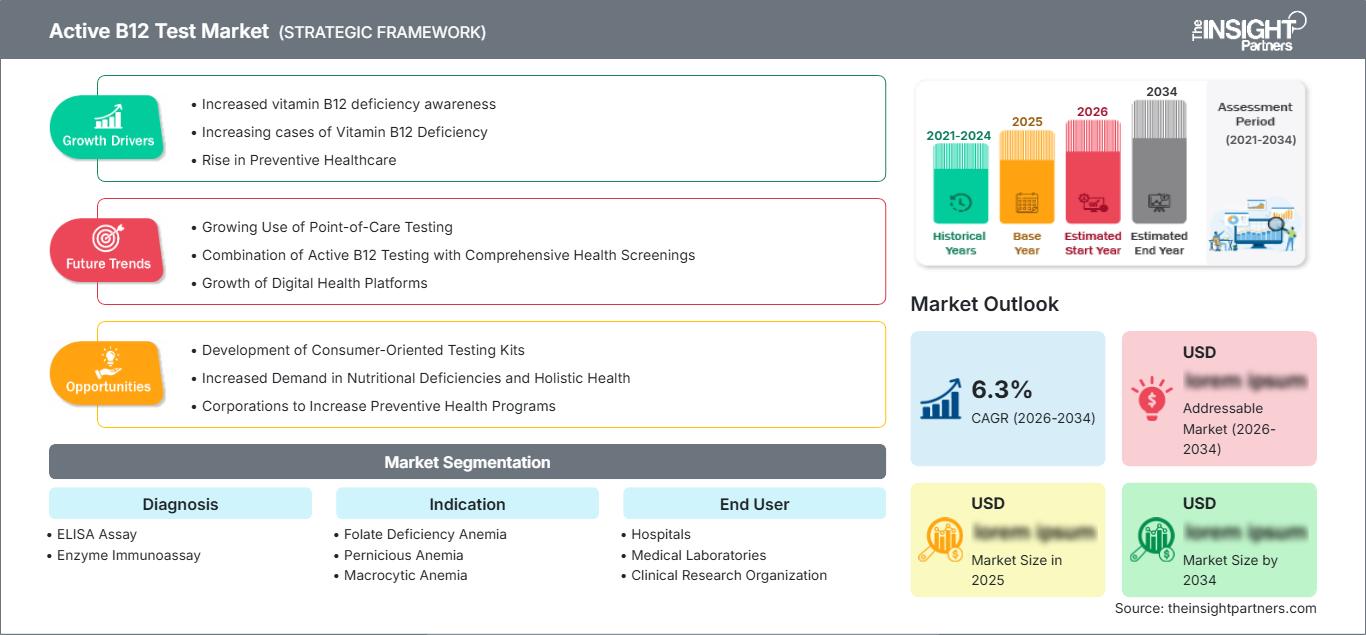
The active b12 test market held a valuation of US$ 182.25 Million in 2025 and is anticipated to grow and touch US$ 251.5 Million by 2034 at a CAGR of 3.64%. This market will be driven by increased use of holotranscobalamin tests to diagnose early vitamin B12 deficiency that is biologically available, particularly for anemia diagnosis, malabsorption evaluation, pregnancy, and neurological symptoms.
In North America, the active b12 test market size is anticipated to register a compound annual growth rate of 3.4 – 4.0% during the forecast period. This is due to highly automated labs and the preference for clinicians for functional B12 level testing. Factors influencing regional demand include aged populations, more tests conducted on patients who take metformin and proton pump inhibitors, and the use of immunoassays.
Active B12 Test Market Assessment and Insights
- North America held 37–40% active b12 test market share in 2025 and is projected to grow at a CAGR between 3.4–4.0% during 2026–2034, driven by automated immunoassay infrastructure, anemia screening, and specialist laboratory adoption.
- US represented 80–84% of North America share in 2025 and is expected to grow at a CAGR between 3.3–3.9% during 2026–2034, supported by reference laboratory scale.
- Europe accounted for 29–32% share in 2025 and is forecast to grow at a CAGR between 3.0–3.6% during 2026–2034, led by the UK, Germany, France, Italy, and Spain.
- Asia Pacific captured 21–24% share in 2025 and is likely to grow at a CAGR between 4.2–4.9% during 2026–2034, with China, Japan, India, South Korea, and Australia leading regional uptake.
- Largest Segment Enzyme Immunoassay recorded 56–60% market share in 2025 and is expected to grow at a CAGR between 3.5–4.1% during 2026–2034 due to platform automation.
- High Growth Segment Clinical Research Organization held 8–11% market share in 2025 and is projected to grow at a CAGR between 4.5–5.3% during 2026–2034 as nutritional biomarker studies increase.
- Key companies analyzed in detail: Axis-Shield Diagnostics Limited, Abbott Laboratories, Siemens Healthineers AG, DiaSorin S.p.A., F. Hoffmann-La Roche Ltd, LifeSpan BioSciences, Inc., Demeditec Diagnostics GmbH, New Stetic S.A., Biohit Oyj, Tecan Group Ltd.
Source: The Insight Partners' analysis based on proprietary research, government publications, company annual reports, investor presentations, industry databases, and expert interviews.
Testing practice has evolved from general total B12 testing to active B12 tests that measure holotranscobalamin, which is the part of B12 that can be taken up by cells. This has created a shift in production towards calibrated immunoassays, coated plates, reagent kits, and traceable controls. Kit manufacturers are designing according to the needs of clinical chemistry while laboratories focus on reproducibility, stability of samples, and faster interpretation of results in different pathways of anemia, pregnancy, and malabsorption.
Future growth will depend on guideline compliance, reimbursement control, and availability through new diagnostic networks. Asia Pacific and selected Middle Eastern platforms have begun building central laboratories while Europe has focused on refining the vitamin deficiency pathway with new clinical guidelines. IVDR and ISO 15189 requirements will make it favorable for suppliers having validated performance, documentation, and reliable distribution of specialty immunoassay reagents.
Active B12 Test Market Report Scope
| Report Attribute | Details |
|---|---|
| Market size in 2025 | US$ 182.25 Million |
| Market Size by 2034 | US$ 251.5 Million |
| Global CAGR (2026 - 2034) | 3.64% |
| Historical Data | 2021-2024 |
| Forecast period | 2026-2034 |
Active B12 Test Market Analysis
The active b12 test market is driven by awareness of the limitations of total serum B12 in identifying early or functional deficiency among certain patient groups. The demand will move through an ecosystem consisting of antibody manufacturers, assay developers, analyzer companies, distributors, hospitals, reference labs, and clinical research organizations. Supply will tend to be advantageous for companies able to ensure consistency across batches of the reagents used, calibrator traceability, and suitability for either manual or automated immunoassays.
Clinical demand is driven by anemia prevalence and risk-based screening of anemia. According to WHO, there is an estimated 30%, 37%, and 40% prevalence of anemia among women age 15-49 years, pregnant women, and children age 6-59 months, respectively, worldwide. In addition, in 2024, NICE released its guideline in which it included total or active B12 testing as a first-line testing option.
Active b12 test market analysis suggests a highly specific competitive environment, which is characterized by competition among Abbott Laboratories, Axis-Shield Diagnostics Limited, Siemens Healthineers AG, F. Hoffmann-La Roche Ltd, DiaSorin S.p.A., Biohit Oyj and Tecan Group Ltd for automated assays, ELISA systems, and laboratory reagents market. The niche supply capability comes from LifeSpan BioSciences, Inc., Demeditec Diagnostics GmbH, and New Stetic S.A., due to their capabilities in immunoassay, specialized kits, and regional distribution.
Investments are made in assay integration and development of evidence in contrast to investments in consumer diagnostics. Siemens Healthineers AG focuses on active B12 assays in already existing immunoassay platform, Roche develops the spectrum of Elecsys immunoassay tests, and Abbott relies on Axis-Shield technology due to its history. Competitive advantage is provided by the ability to prove differentiation from total B12 in indeterminate cases.
● REPORT CUSTOMIZATION
Tailor This Report To Align With Your Specific Business Requirements
This report can be customized to align precisely with your business objectives, scope, and target markets. Customization options include tailored segmentation, geography, competitive analysis, and strategic insights to support informed decision-making.
Customize This Report →WHAT YOU CAN ADJUST
- ● Segmentations
- ● Geography
- ● Competitive Analysis
- ● Language Preferences
Active B12 Test Market: Strategic Insights
Regional Insights
North America Active b12 test Market
North America is expected to dominate the market with 37–40% share in 2025, growing at a CAGR between 3.4–4.0% for 2026-2034. The major factors driving the growth of the active b12 test market include automation, aging population, and extensive reference laboratory network. The key drivers behind the demand include anemia, pregnancy, neurological symptoms, and malabsorption conditions.
The region is favored with an extensive installed base of Abbott Laboratories, Siemens Healthineers AG, and F. Hoffmann-La Roche Ltd devices, thereby offering flexibility for laboratories to perform specialized tests without redesigning their workflow process. Medication-induced deficiency is another factor that drives the demand for active b12 test in North America. Procurement includes considerations such as reproducibility, turnaround time, quality control, and compatibility of laboratory instruments.
U.S. Active b12 test Market
North American contribution was accounted for 80-84% of the US market in 2025 and will register a CAGR from 3.3-3.9% through 2026-2034. Large commercial laboratories and integrated delivery networks are key to adoption, since large numbers of anemia panels, pregnancy screening, bariatric follow-ups, and GI malabsorption screens take place there.
Corporate penetration is notable on all fronts, including the instrumentation platform, reagent supply, and laboratory quality control systems. The workflow is supported by Abbott Laboratories and Siemens Healthineers AG for active B12 and related immunoassays, and F. Hoffmann-La Roche Ltd drives wider adoption in clinical chemistry. Clinical application trends include greater frequency where total B12 measurements are marginal, clinical symptoms remain present, or methylmalonic acid test is used only to clarify diagnosis.
Europe Active b12 test Market
Europe was responsible for 29-32% share in 2025 and is expected to grow at a CAGR of 3.0-3.6% in 2026-2034. The significance of the UK lies in the NICE guidelines that have outlined diagnostic pathway in case of deficiency and recommend the use of active B12 as a preliminary test.
The market leader is Germany owing to the presence of sophisticated clinical chemistry labs, well-established reimbursement system, and availability of automated immunoassays. Hospital groups value assay documentation, certified reagents, and the need for compliance with accreditation standards. In addition, there is continuous demand in German labs for nutritional and hematology biomarkers used in the study of elderly and gastrointestinal patients.
France, Italy, and Spain contribute stable demand through hospital-based anemia workups, maternal care, and chronic disease monitoring. IVDR implementation is influencing procurement by raising expectations for clinical evidence, performance traceability, and post-market documentation. Suppliers with complete technical files, customer training, and regional service networks are better positioned for steady adoption.
APAC Active b12 test Market
In 2025, APAC held 21–24% market share and is projected to grow at a CAGR of 4.2–4.9% for 2026–2034. China leads owing to hospital modernization, private lab growth, and rising demand for nutritional tests. Japan and South Korea have experienced maturing analyzer adoption, whereas India has grown laboratory networks.
Australia is driven by quality concerns, high accreditation consciousness, and reference testing. Government drivers consist of investments in universal access, motherhood care, and diagnostics of chronic diseases. The industrial base in China, Japan, and South Korea ensures reagents supply, while India’s consolidation of diagnostics drives menu efficiency.
Middle East & Africa Active b12 test Market
The Middle East & Africa is expected to grow at a CAGR between 3.2–3.8% during 2026–2034. Saudi Arabia is the leading country due to hospital infrastructure investment, medical city expansion, and higher demand for hematology and nutrition biomarkers. The UAE is expanding private laboratory networks serving preventive and specialty care.
South Africa still stands out as the most developed market in the sub-Saharan region, having tertiary level laboratories and private pathology organizations. Demand from other MEA countries is irregular but becoming better due to the improvement in their hospitals’ facilities. The energy sector still pays for health infrastructures in Gulf countries, while procurement is becoming platform-based.
Segmentation Analysis
Diagnosis
Diagnosis is expected to grow at a CAGR between 3.3–4.0% during 2026–2034. The active b12 test market scope across diagnosis is shaped by laboratory preference for methods that balance cost, workflow speed, sensitivity, and standardization. ELISA remains relevant in specialized and batch-testing settings, while enzyme immunoassay platforms gain traction where laboratories need automation, lower manual handling, and easier integration with routine chemistry operations.
- ELISA Assay retains importance in specialized laboratories, research-linked facilities, and regional diagnostic centers where batch processing, kit affordability, and flexible sample volumes support cost-controlled testing.
- Enzyme Immunoassay leads routine adoption because automated platforms reduce hands-on time, improve throughput, support standardized calibration, and fit established clinical chemistry laboratory workflows.
Indication
Indication is projected to grow at a CAGR between 3.2–3.8% during 2026–2034. Active B12 testing is used when clinicians need better functional insight into deficiency-related anemia and neurologic symptoms. Demand is influenced by overlap between folate deficiency, pernicious anemia, and macrocytic anemia, where interpretation of red-cell indices and serum biomarkers can be clinically complex.
- Folate Deficiency Anemia requires careful differentiation because folate and vitamin B12 deficiencies can present with similar hematologic patterns, making active B12 useful when combined with folate and blood indices.
- Pernicious Anemia remains a strategically important indication because autoimmune gastritis can impair B12 absorption, requiring accurate diagnosis, ongoing monitoring, and linkage to intrinsic factor antibody assessment.
- Macrocytic Anemia drives consistent testing demand because enlarged red blood cells prompt evaluation of B12, folate, liver disease, alcohol use, medication effects, and marrow-related causes.
End-User
End User is expected to grow at a CAGR between 3.6–4.3% during 2026–2034. Hospitals generate clinically complex demand, while medical laboratories provide scalable testing efficiency across outpatient and referral samples. Clinical research organizations are gaining relevance as nutrition, aging, pregnancy, and metabolic studies increasingly include functional biomarkers to improve patient stratification and trial design.
- Hospitals use active B12 testing for anemia, pregnancy, neurology, gastroenterology, bariatric surgery follow-up, and complex inpatient evaluations requiring integrated clinical interpretation.
- Medical Laboratories are central to routine access because they aggregate outpatient demand, support reflex testing, maintain quality systems, and operate high-throughput immunoassay analyzers.
- Clinical Research Organization demand is emerging through biomarker-driven nutrition studies, anemia trials, elderly cohort research, and investigations linking B12 status with neurologic or metabolic outcomes.
Opportunity Snapshot
| Segment Name | Revenue Contribution | Trend Tag | Adoption Stage |
| Hospitals | High | Complex Anemia | Mature |
| Medical Laboratories | High | Reflex Testing | Scaling |
| Clinical Research Organization | Medium | Biomarker Trials | Emerging |
Active B12 Test Market Growth Drivers and Impact Analysis
Rising need for functional vitamin deficiency assessment
There is a growing need for tests that are capable of separating biologically active B12 from total circulating B12, especially when the clinical presentation does not agree with test results. This can be achieved through Holotranscobalamin tests, which target the fraction of B12 that is available for cellular uptake. The market effect will be evident in increased use of such tests in anemia clinic diagnosis, obstetrics test pathways, gastrointestinal cases, and neurological referrals. Laboratories will benefit from differentiated testing, while suppliers will receive repeat business through the sale of specialty reagents for immunoassays.
Growth in aging and medication-exposed patient populations
Malabsorption, autoimmune gastritis, dietary deficiency, and polypharmacy among older individuals will result in an increased requirement for the detection of B12 deficiencies. Chronic intake of metformin and proton pump inhibitors can also lead to decreased B12 levels, thus constituting a large population for monitoring among diabetics and gastroenterologists. Such a driver allows extending B12 testing not only in hematology but also in primary care, endocrinology, post-bariatric surgeries, and geriatrics. Market implications will be consistent demand as opposed to periodic peaks. Suppliers of automatic assays and compatible reagents will have an advantage as health organizations implement risk-driven approaches to testing.
Laboratory automation and accredited testing workflows
Active testing for vitamin B12 can be facilitated with automated immunoassay systems. When compared to conventional batch assays, automated systems can enhance workflow, decrease operator variability, enable calibration traceability, and make reporting through laboratory information systems easier. This is important to accredited laboratories, which have to demonstrate quality control, reference ranges, reagent performance, and turnaround times. The commercial significance of the innovation is most evident for medical laboratories and hospital organizations that are trying to consolidate their anemia profiles. Manufacturers who offer controls, calibrators, technical support, and documentation will benefit from increased utilization of their installed base.
Active B12 Test Market Future Trends
Reflex algorithms for anemia and borderline B12 results
The active b12 test market trends are moving toward structured testing algorithms that combine total B12, active B12, folate, methylmalonic acid, intrinsic factor antibodies, and blood indices. Future laboratory protocols will likely reduce standalone ordering and instead apply active B12 where total B12 is borderline or clinical suspicion remains high. This approach can improve diagnostic efficiency, reduce unnecessary confirmatory testing, and support consistent interpretation across departments. Hospitals and reference laboratories will increasingly use middleware rules to guide reflex sequencing. Suppliers that support algorithm validation and reporting templates will gain relevance in evidence-based anemia pathways.
Expansion of active B12 testing in maternal care
Pregnancy testing pathways are expected to create a distinct growth channel because total B12 may fall during pregnancy without always reflecting cellular deficiency. Active B12 is gaining attention as a more stable marker in selected maternal assessments, especially when anemia, dietary restriction, or malabsorption risk is present. Future adoption will depend on local guidance, obstetric laboratory protocols, and clinician education. The trend favors assays with fast turnaround, low sample volume, and clear interpretive ranges. Wider maternal use could increase testing consistency while reducing uncertainty in cases where folate supplementation, iron deficiency, and B12 status overlap clinically.
Active B12 Test Market Opportunities
Bundled anemia testing panels for laboratory networks
Suppliers can expand by positioning active B12 within bundled anemia panels that include folate, ferritin, total B12, intrinsic factor antibodies, and confirmatory markers. active b12 test market Forecasts indicate that laboratory buyers will prioritize workflow economics, interpretive consistency, and reagent menu breadth over isolated assay pricing. Vendors with established analyzer footprints can design contracting models that improve reagent pull-through and simplify procurement. The opportunity is strongest in reference laboratories and hospital networks standardizing anemia pathways across multiple sites. Bundles should include training, controls, calibration documentation, and decision-support materials to improve adoption among clinicians and laboratory directors.
Emerging-market access through scalable immunoassay formats
Emerging diagnostic systems offer an opportunity for suppliers that can provide affordable, scalable, and technically supported assays. Entry strategies should differentiate between tertiary hospitals needing automated platforms and smaller laboratories requiring ELISA-based testing. Local distributor training, temperature-stable logistics, and clear quality-control procedures will be critical in Asia Pacific, the Middle East, Africa, and Latin America. Vendors can also partner with private diagnostic chains to introduce active B12 as part of preventive health, maternal care, and anemia packages. Success will depend on demonstrating clinical value without overburdening laboratories with complex interpretation or high per-test costs.
Recent Developments
- June 2026: DiaSorin S.p.A. announced FDA 510(k) clearance and CLIA waiver for its LIAISON NES Group A Streptococcus assay, strengthening its point-of-care molecular diagnostics strategy. Although outside active B12 testing, the launch shows continuing investment in accessible automated diagnostic platforms, which supports broader laboratory relationships and cross-portfolio commercial reach.
- March 2026: F. Hoffmann-La Roche Ltd received U.S. FDA 510(k) clearance for the cobas c 703 and cobas ISE neo analytical units, extending its next-generation laboratory automation portfolio. The clearance supports higher-throughput clinical chemistry operations and reinforces Roche’s position with laboratories seeking scalable platforms for routine and specialty diagnostic menus.
- November 2025: Abbott Laboratories announced an agreement to acquire Exact Sciences, a major cancer screening and precision oncology diagnostics company. The transaction expanded Abbott’s diagnostics strategy beyond core immunoassay and point-of-care segments, highlighting the company’s focus on high-value testing categories, laboratory relationships, and recurring diagnostic revenue streams.
Frequently Asked Questions

- Comprehensive Market Sizing and Forecast Analysis
- Detailed Segmentation Analysis
- In-Depth Market Dynamics Assessment
- Regional and Country-Level Insights
- Competitive Landscape and Company Benchmarking
- Strategic Business Intelligence
Recent Reports
Testimonials

The Insight Partners' SCADA System Market report is comprehensive, with valuable insights on current trends and future forecasts. The team was highly professional, responsive, and supportive throughout. We are very satisfied and highly recommend their services.
RAN KEDEM Partner, Reali Technologies LTDs
I requested a report on a very specific software market and the team produced the report in a few days. The information was very relevant and well presented. I then requested some changes and additions to the report. The team was again very responsive and I got the final report in less than a week.
JEAN-HERVE JENN Chairman, Future Analytica
We worked with The Insight Partners for an important market study and forecast. They gave us clear insights into opportunities and risks, which helped shape our plans. Their research was easy to use and based on solid data. It helped us make smart, confident decisions. We highly recommend them.
PIYUSH NAGPAL Sr. Vice President, High Beam Global
The Insight Partners delivered insightful, well-structured market research with strong domain expertise. Their team was professional and responsive throughout. The user-friendly website made accessing industry reports seamless. We highly recommend them for reliable, high-quality research services
YUKIHIKO ADACHI CEO, Deep Blue, LLC.
This is the first time I have purchased a market report from The Insight Partners.While I was unsure at first, I visited their web site and felt more comfortable to take the risk and purchase a market report.I am completely satisfied with the quality of the report and customer service. I had several questions and comments with the initial report, but after a couple of dialogs over email with their analyst I believe I have a report that I can use as input to our strategic planning process.Thank you so much for taking the extra time and making this a positive experience.I will definitely recommend your service to others and you will be my first call when we need further market data.
JOHN SUZUKI President and Chief Executive Officer, Board Director, BK Technologies
I wish to appreciate your support and the professionalism you displayed in the course of attending to my request for information regarding to infectious disease IVD market in Nigeria. I appreciate your patience, your guidance, and the fact that you were willing to offer a discount, which eventually made it possible for us to close a deal. I look forward to engaging The Insight Partners in the future, all thanks to the impression you have created in me as a result of this first encounter.
DR CHIJIOKE ONYIA MANAGING DIRECTOR, PineCrest Healthcare Ltd.Reason to Buy
- Informed Decision-Making
- Understanding Market Dynamics
- Competitive Analysis
- Identifying Emerging Markets
- Customer Insights
- Market Forecasts
- Risk Mitigation
- Boosting Operational Efficiency
- Strategic Planning
- Investment Justification
- Tracking Industry Innovations
- Aligning with Regulatory Trends





 Get Free Sample for