
Active Implantable Medical Devices Market Strategies, Growth Opportunities, and Forecast by 2031
Coverage: By Product [Implantable Cardioverter Defibrillators (Transvenous Implantable Cardioverter Defibrillators and Subcutaneous Implantable Cardioverter Defibrillators), Implantable Cardiac Pacemakers, Neurostimulators, Implantable Hearing Devices, Ventricular Assist Devices, and Implantable Heart Monitors/ Insertable Loop Recorders] and End User (Hospitals, Ambulatory Surgical Centers, and Specialty Clinics), and Geography (North America, Europe, Asia Pacific, and South and Central America)
- Status : Data Released
- Report Code : TIPMD00002232
- Category : Life Sciences
- No. of Pages : 154
- Available Report Formats :


- Last update date : July 22, 2026


2024 Market Size
US$ 26.16 Bn
Base year value
2031 Forecast
US$ 44.26 Bn
Projected by 2031
CAGR 2025-2031
7.8 %
Growth rate
Addressable Market
US$ 250.09 Bn
(2025-2031)
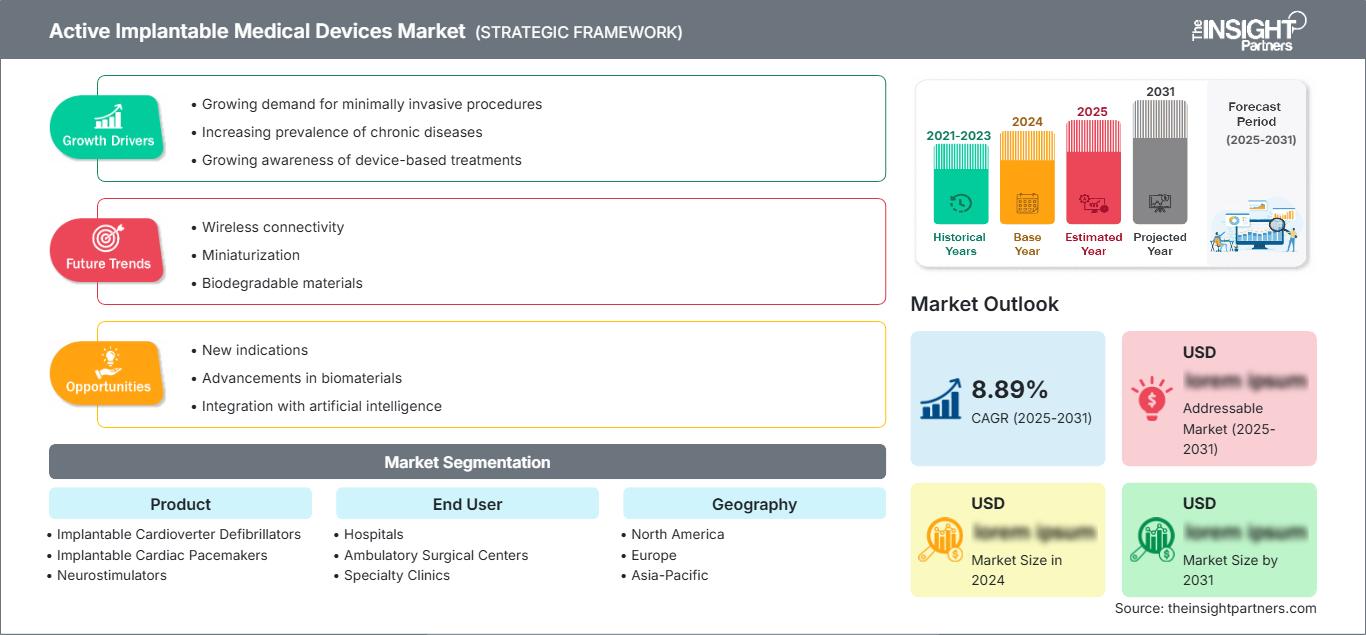
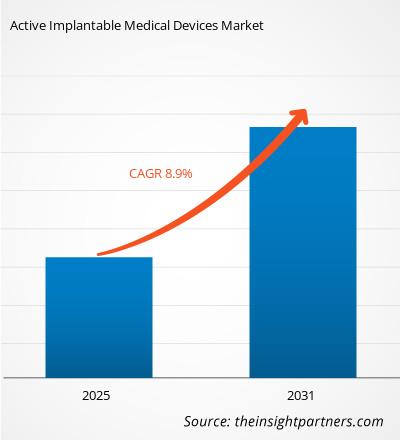
The Active Implantable Medical Devices Market Size was valued at US$ 26.16 Billion in 2025 and is anticipated to reach US$ 44.26 billion by 2034 growing at a CAGR of 7.8%. It is characterized by constant requirement of electricity-powered medical devices that diagnose, stimulate, monitor, or aid in organ functioning in the applications of cardiac rhythm management, neuromodulation, hearing restoration, and mechanical circulatory support.
The active implantable medical devices market in North America will grow at a CAGR of 7.1–8.0% driven by the development of electrophysiology facilities and widespread usage of remote monitoring services. Growth factors include coverage of insurance for implantable cardiac and hearing devices, physician specialists, and investments in hospitals into treating chronic cardiac, neurologic, and sensory diseases through the use of medical devices.
Active Implantable Medical Devices Market Assessment and Insights
- North America held 41–44% share in 2025 and is projected to grow at a CAGR between 7.1–8.0% during 2026–2034, led by cardiac rhythm management, neuromodulation access, and connected device follow-up.
- US represented 83–87% of North America share in 2025 and is expected to grow at a CAGR between 7.0–7.9% during 2026–2034, supported by high implant procedure volumes.
- Europe accounted for 27–30% share in 2025 and is forecast to grow at a CAGR between 6.4–7.3% during 2026–2034, with Germany, France, the UK, Italy, and Spain leading adoption.
- Asia Pacific captured 20–23% share in 2025 and is likely to grow at a CAGR between 8.8–10.2% during 2026–2034, supported by China, Japan, India, South Korea, and Australia.
- Largest Segment Implantable Cardioverter Defibrillators recorded 28–32% market share in 2025 and are expected to grow at a CAGR between 7.2–8.2% during 2026–2034.
- High Growth Segment Neurostimulators held 9–12% market share in 2025 and are projected to grow at a CAGR between 9.0–10.4% during 2026–2034 as therapy indications broaden.
- Key companies analyzed in detail: Medtronic plc, Abbott Laboratories, Cochlear Limited, Boston Scientific Corporation, BIOTRONIK SE & Co. KG, MED-EL Elektromedizinische Geräte GmbH, Sonova Holding AG, Demant A/S, LivaNova PLC, Nurotron Biotechnology Co., Ltd.
Source: The Insight Partners' analysis based on proprietary research, government publications, company annual reports, investor presentations, industry databases, and expert interviews.
Device innovation is transitioning from standalone implants to a connected therapeutic platform incorporating microelectronics, sophisticated leads, battery-powered devices, sensing algorithms, and cloud-based follow-up services. Manufacturing will now concentrate on biocompatibility of materials, hermetic encapsulation, firmware robustness, sterilization control, and battery longevity. Implant manufacturers are also honing their surgical equipment and programming interface in order to reduce procedure time, enhance patient selection and enable remote device management in cardiology, audiology, neurology, and heart failure treatments.
Future growth is likely to be determined by new hospital capacity creation, increasing regulatory oversight, and emphasis on long-term outcomes by payers. The Asia-Pacific and certain Middle Eastern healthcare systems are developing their tertiary care facilities and electrophysiology capabilities, and Europe continues to raise its standards for medical device clinical validation. Manufacturers with clinical data, service delivery, security preparedness, and remote monitoring solutions can expect to grow as implants become increasingly software-dependent.
Active Implantable Medical Devices Market Report Scope
| Report Attribute | Details |
|---|---|
| Market size in 2024 | US$ 26.16 Billion |
| Market Size by 2031 | US$ 44.26 billion |
| Global CAGR (2025 - 2031) | 7.8% |
| Historical Data | 2021-2023 |
| Forecast period | 2025-2031 |
Active Implantable Medical Devices Market Analysis
There are several key factors contributing to the expansion of active implantable medical devices, including the growing burden of chronic diseases, an aging population, and increasing acceptance of their use in clinical settings. The demand goes through a chain of stakeholders including components providers, battery producers, leads producers, implantable electronics producers, hospitals, physicians with specialized practice, rehabilitation centers, and monitoring technologies.
Among the conditions that still generate large target groups of patients for active implants include cardiovascular diseases, hearing loss, epilepsy, movement disorders, and heart failure. At the same time, health care facilities are increasingly adopting a longitudinal approach to disease management, and remote monitoring with follow-up actions based on collected data will help reduce unnecessary visits and provide timely intervention. This creates a demand for devices that offer not only therapeutic functionality but also diagnostic and alerts features.
The market analysis for active implantable medical devices reveals a competitive landscape dominated by multinational firms backed by clinical evidence and an advantage in terms of their installed bases. Medtronic plc, Abbott Laboratories, Boston Scientific Corporation, BIOTRONIK SE & Co. KG, and LivaNova PLC represent the main competitors in cardiac rhythm, neuromodulation, and monitoring platforms. Hearing implants' value chain is bolstered by Cochlear Limited, MED-EL Elektromedizinische Geräte GmbH, Sonova Holding AG, Demant A/S, and Nurotron Biotechnology Co., Ltd.
Investments are directed toward unique sensing, physiological pacing, rechargable technologies, MRI compatibility, and data platforms minimizing the clinicians' burden. Abbott Laboratories is focused on connected cardiac monitoring, Boston Scientific Corporation aims at expanding cardiac rhythm and neuromodulation offerings, and Cochlear Limited develops innovative implantable hearing. Strategic orientation increasingly hinges on ecosystems as well as hardware in order to improve the effectiveness of follow-up procedures and software-driven analytics.
● REPORT CUSTOMIZATION
Tailor This Report To Align With Your Specific Business Requirements
This report can be customized to align precisely with your business objectives, scope, and target markets. Customization options include tailored segmentation, geography, competitive analysis, and strategic insights to support informed decision-making.
Customize This Report →WHAT YOU CAN ADJUST
- ● Segmentations
- ● Geography
- ● Competitive Analysis
- ● Language Preferences
Active Implantable Medical Devices Market: Strategic Insights
Regional Insights
North America Active implantable medical devices market
North America held 41–44% share in 2025 and is projected to grow at a CAGR between 7.1–8.0% during 2026–2034. The active implantable medical devices market share is anchored by strong use of implantable defibrillators, pacemakers, insertable loop recorders, cochlear implants, and neurostimulation systems. Specialist centers are expanding remote follow-up to manage device alerts, battery status, arrhythmias, and therapy optimization.
The regional demand is bolstered by advanced reimbursement processes, high training standards among physicians, and clinical guidelines for the procedures related to cardiac rhythms and hearing restoration. The key market players are Medtronic plc, Abbott Laboratories, Boston Scientific Corporation, Cochlear Limited, and LivaNova PLC. There has been increasing evaluation of devices based on longevity, security, availability for MRIs, programming capabilities, and after-implantation services.
U.S. Active implantable medical devices market
The U.S. represented 83–87% of North America share in 2025 and is expected to grow at a CAGR between 7.0–7.9% during 2026–2034. High electrophysiology capacity, implantable cardiac monitor use, cochlear implant programs, and neuromodulation centers support consistent demand. Procedure growth is also influenced by older patients requiring rhythm therapy, heart failure support, and neurologic symptom control.
Corporate representation is heavy on clinical education, monitoring technology, and hospital contracting. Medtronic plc and Abbott Laboratories offer products for cardiac rhythm and monitoring categories, while Boston Scientific Corporation competes in pacing, defibrillation, and neuromodulation. Cochlear Limited and MED-EL Elektromedizinische Geräte GmbH facilitate recovery of hearing. Application developments center on physiologic pacing, increased monitoring time, reduced device size, and enhanced patient communication.
Europe Active implantable medical devices market
Europe accounted for 27-30% in 2025 and is projected to grow at a CAGR of 6.4-7.3% over 2026-2034. The UK is progressing with surgical efficiency and telemedicine-based care delivery, favoring device follow-up programs, reducing in-person monitoring efforts. Adoption is based on clinical evidence since there is need for clinical and economic value demonstrated by public health systems.
Germany is the lead country due to the presence of advanced electrophysiology departments, highly developed hearing implants, and high rates of adoption of reliable implantable devices. Hospitals in Germany prefer clinically proven technology, MRI compatibility, and longevity of devices. MDR compliance plays an increasingly important role as buyers want comprehensive technical documentation, post-market surveillance, and service accountability.
France, Italy, and Spain provide constant demand through cardiac rhythm management, cochlear implant surgery, and select neuromodulation surgeries. Tendering process affects prices, but the choice of suppliers is determined by physicians' preference. Companies that have clinical training and remote monitoring facilities, as well as broad portfolio of products, have competitive advantages over single-product suppliers.
APAC Active implantable medical devices market
In APAC, the market size reached 20-23% share in 2025 and is expected to expand at a CAGR of 8.8-10.2% during 2026-2034. China leads the region on account of hospitals' modernization, local capabilities of devices, and availability of cardiac and hearing implant surgeries. Japan and South Korea demonstrate advanced stage of adoption, while in India, it is tertiary care.
The main factors driving Australia's growth include high-quality standards and well-developed specialist and post-implant programs. Universal healthcare coverage expansion, localization of medical devices, and investments in electrophysiology and audiology sectors are among the key policy drivers for growth. Improved industrial capacity in China, Japan, South Korea, and India increases accessibility of the components.
Middle East & Africa Active implantable medical devices market
The Middle East & Africa is expected to grow at a CAGR between 6.8–7.9% during 2026–2034. Saudi Arabia is the leading country due to medical city development, cardiac center investment, and growing cochlear implant access. The UAE is expanding private specialty hospitals and attracting complex cardiac and hearing procedures.
South Africa remains the most established sub-Saharan market, supported by private hospital groups and tertiary referral centers. Rest of MEA demand is uneven but improving through public-sector upgrades. Energy-sector revenues in Gulf economies continue to fund healthcare infrastructure, while procurement is shifting toward connected devices, evidence-backed implants, and long-term service contracts.
Segmentation Analysis
Product
Product is expected to grow at a CAGR between 7.5–8.5% during 2026–2034. The active implantable medical devices market scope across product categories is shaped by disease prevalence, procedure complexity, battery technology, device miniaturization, and remote monitoring integration. Cardiac implants retain the strongest revenue base, while neurostimulators and hearing devices benefit from indication expansion, patient awareness, and improvements in programming, connectivity, and surgical delivery.
- Implantable Cardioverter Defibrillators remain a major category because they prevent sudden cardiac death in high-risk patients and increasingly integrate with physiologic pacing, remote monitoring, and advanced lead technologies.
- Implantable Cardiac Pacemakers support consistent demand in bradycardia, conduction disease, and aging populations, with adoption shifting toward smaller platforms, longer battery life, and conduction system pacing.
- Neurostimulators are gaining strategic importance across epilepsy, movement disorders, chronic pain, and emerging neurologic indications where programmable stimulation can reduce dependence on medication alone.
- Implantable Hearing Devices serve patients with severe hearing impairment, conductive loss, mixed loss, or single-sided deafness, with innovation focused on sound processing, MRI compatibility, and connectivity.
- Ventricular Assist Devices are used in advanced heart failure care, where transplant constraints and destination therapy needs support demand for durable mechanical circulatory support.
- Implantable Heart Monitors/ Insertable Loop Recorders enable long-term arrhythmia detection, especially for syncope, cryptogenic stroke evaluation, atrial fibrillation monitoring, and post-ablation follow-up.
End-User
End User is projected to grow at a CAGR between 7.0–8.1% during 2026–2034. Hospitals remain the primary demand base because active implants require surgical infrastructure, imaging, anesthesia, electrophysiology, audiology, neurology, and post-operative follow-up. Ambulatory surgical centers are gaining relevance for selected lower-complexity procedures, while specialty clinics support screening, programming, rehabilitation, and long-term therapy optimization.
- Hospitals generate the largest revenue because they manage complex cardiac, neurologic, hearing, and heart failure procedures requiring multidisciplinary teams, implant suites, and emergency backup.
- Ambulatory Surgical Centers are expanding for selected cardiac monitoring and device-related procedures where standardized workflows, lower acuity, and payer interest support outpatient migration.
- Specialty Clinics play an important role in patient selection, device programming, audiology services, neuromodulation follow-up, and remote monitoring review across chronic therapy pathways.
Opportunity Snapshot
| Segment Name | Revenue Contribution | Trend Tag | Adoption Stage |
| Hospitals | High | Complex Implants | Mature |
| Ambulatory Surgical Centers | Medium | Outpatient Implant | Scaling |
| Specialty Clinics | Medium | Device Follow-up | Scaling |
Active Implantable Medical Devices Market Growth Drivers and Impact Analysis
Rising chronic disease burden requiring device-based therapy
Arrhythmia in the heart, heart failure, profound deafness, epilepsy, motor dysfunction, and chronic pain are all increasing the clinical applications for active implants. Such diseases typically need continual treatment rather than occasional treatment, thus the relevance of implantable technologies to provide continuous treatment or stimulation. The actual market application of this is evident in the consistent number of procedures carried out, consistent replacement, and increased needs for connectivity. Both hospitals and suppliers can benefit from this since hospitals will see patients' conditions improve or be treated effectively, while suppliers will benefit financially from the implant technology.
Expansion of remote monitoring and connected care
Remote monitoring is becoming central to device-based medicine because it helps clinicians track arrhythmias, device integrity, battery status, therapy trends, and patient alerts outside routine visits. This driver improves the value proposition of active implants by connecting therapy with longitudinal disease management. The impact is particularly strong in cardiac rhythm management and insertable loop recorders, where remote transmissions can reduce data gaps and enable earlier clinical review. Providers are also using remote platforms to manage growing patient pools without proportional increases in clinic staffing. Vendors with secure data platforms, actionable alerts, workflow tools, and technical support gain competitive advantage.
Technology advances in miniaturization, batteries, and leads
Device innovation is improving patient acceptance, procedural flexibility, and long-term performance. Smaller implants can reduce surgical burden, while better batteries and rechargeable systems extend therapeutic life. Lead design improvements support physiologic pacing, better sensing, and more stable therapy delivery. These advances influence purchasing because clinicians prioritize reliability, MRI conditionality, implant simplicity, and fewer revisions. The market impact includes faster adoption of next-generation pacemakers, defibrillation leads, cochlear processors, and neuromodulation systems. Manufacturers that combine durable hardware with intuitive programming and strong clinical data can defend premium pricing. Component quality and manufacturing control remain critical because recalls can damage brand confidence.
Active Implantable Medical Devices Market Future Trends
AI-enabled monitoring and predictive device management
The active implantable medical devices market trends are moving toward intelligent monitoring platforms that convert device data into actionable clinical signals. AI-enabled systems are expected to prioritize alerts, reduce false positives, identify deterioration patterns, and support individualized therapy adjustment. This will be especially important in cardiac rhythm management, insertable monitors, neurostimulation, and hearing implants, where data volume can overwhelm clinical teams. Predictive maintenance may also help plan replacements before battery depletion or performance issues create risk. Vendors with secure analytics, interoperable dashboards, and clinically validated algorithms will be favored as hospitals demand measurable workflow improvements and patient safety benefits.
Physiologic and personalized stimulation therapies
Future development will increasingly focus on therapies that mimic or adapt to natural physiologic processes. In cardiology, conduction system pacing and advanced defibrillation leads are designed to preserve synchrony and reduce long-term complications. In neuromodulation, closed-loop stimulation may adjust therapy based on patient signals rather than fixed settings. Hearing implants will continue to personalize sound processing through data-driven fitting and remote care. This trend requires deeper integration between hardware, software, and clinical workflows. Companies that demonstrate durable outcomes and simplify programming will gain advantage as specialists shift from device implantation toward therapy optimization.
Active Implantable Medical Devices Market Opportunities
Integrated remote-care service models
Suppliers can expand by offering integrated remote monitoring, device analytics, patient onboarding, technical support, and clinic workflow services around implant platforms. active implantable medical devices market Forecasts indicate that providers will increasingly assess total therapy management rather than device price alone. Service models can reduce clinic burden, improve alert triage, and strengthen patient retention across cardiac rhythm, hearing, neuromodulation, and loop recorder programs. The strongest opportunity lies in large hospital systems managing thousands of implanted patients across multiple sites. Vendors should pair contracts with cybersecurity documentation, interoperability support, training, and measurable clinic productivity outcomes.
Emerging-market access through scalable implant programs
Emerging markets offer growth opportunities where tertiary hospitals, cardiac centers, and hearing restoration programs are expanding. Suppliers should tailor strategies by procedure complexity, offering premium systems for advanced centers and cost-sensitive configurations for earlier-stage programs. Local clinical training, distributor quality, financing models, and post-implant service capacity will be essential. Partnerships with government hospitals and private specialty groups can accelerate adoption in Asia Pacific, the Middle East, Africa, and Latin America. Success will depend on demonstrating long-term value, reliable follow-up, and procedural support rather than treating implants as isolated one-time device sales.
Recent Developments
- July 2026: Cochlear Limited introduced the Osia 3 Sound Processor after FDA clearance, adding a fully rechargeable active bone conduction sound processor with up to 30 hours of battery life, expanded fitting range, wireless fitting support, and broader streaming options. The development strengthened Cochlear’s implantable hearing platform and supported future adoption among patients with conductive, mixed, or single-sided hearing loss.
- April 2026: BIOTRONIK SE & Co. KG announced FDA approval for Acticor Sky and Rivacor Sky ICD and CRT-D systems. The devices added physiology-driven therapy options, left bundle branch area pacing support, expanded anti-tachycardia pacing features, HeartInsight monitoring, and MRI Guard workflow tools, reinforcing BIOTRONIK’s role in cardiac rhythm management and remote heart failure surveillance.
- March 2026: Medtronic plc received FDA approval for an expanded indication for the OmniaSecure defibrillation lead, allowing placement in the left bundle branch area for conduction system pacing. The lead connects to ICD or CRT-D systems and supports physiologic activation while providing defibrillation therapy, strengthening Medtronic’s position in advanced cardiac rhythm management.
Frequently Asked Questions

- Comprehensive Market Sizing and Forecast Analysis
- Detailed Segmentation Analysis
- In-Depth Market Dynamics Assessment
- Regional and Country-Level Insights
- Competitive Landscape and Company Benchmarking
- Strategic Business Intelligence
Recent Reports
Testimonials

The Insight Partners' SCADA System Market report is comprehensive, with valuable insights on current trends and future forecasts. The team was highly professional, responsive, and supportive throughout. We are very satisfied and highly recommend their services.
RAN KEDEM Partner, Reali Technologies LTDs
I requested a report on a very specific software market and the team produced the report in a few days. The information was very relevant and well presented. I then requested some changes and additions to the report. The team was again very responsive and I got the final report in less than a week.
JEAN-HERVE JENN Chairman, Future Analytica
We worked with The Insight Partners for an important market study and forecast. They gave us clear insights into opportunities and risks, which helped shape our plans. Their research was easy to use and based on solid data. It helped us make smart, confident decisions. We highly recommend them.
PIYUSH NAGPAL Sr. Vice President, High Beam Global
The Insight Partners delivered insightful, well-structured market research with strong domain expertise. Their team was professional and responsive throughout. The user-friendly website made accessing industry reports seamless. We highly recommend them for reliable, high-quality research services
YUKIHIKO ADACHI CEO, Deep Blue, LLC.
This is the first time I have purchased a market report from The Insight Partners.While I was unsure at first, I visited their web site and felt more comfortable to take the risk and purchase a market report.I am completely satisfied with the quality of the report and customer service. I had several questions and comments with the initial report, but after a couple of dialogs over email with their analyst I believe I have a report that I can use as input to our strategic planning process.Thank you so much for taking the extra time and making this a positive experience.I will definitely recommend your service to others and you will be my first call when we need further market data.
JOHN SUZUKI President and Chief Executive Officer, Board Director, BK Technologies
I wish to appreciate your support and the professionalism you displayed in the course of attending to my request for information regarding to infectious disease IVD market in Nigeria. I appreciate your patience, your guidance, and the fact that you were willing to offer a discount, which eventually made it possible for us to close a deal. I look forward to engaging The Insight Partners in the future, all thanks to the impression you have created in me as a result of this first encounter.
DR CHIJIOKE ONYIA MANAGING DIRECTOR, PineCrest Healthcare Ltd.Reason to Buy
- Informed Decision-Making
- Understanding Market Dynamics
- Competitive Analysis
- Identifying Emerging Markets
- Customer Insights
- Market Forecasts
- Risk Mitigation
- Boosting Operational Efficiency
- Strategic Planning
- Investment Justification
- Tracking Industry Innovations
- Aligning with Regulatory Trends





 Get Free Sample for