
Active Wheelchair Market Growth, Share & Trends by 2034
Coverage: By Product Type (Manual Wheelchairs, Power Wheelchairs); Indication (Alzheimer's Disease, Amyotrophic Lateral Sclerosis (ALS), Multiple Sclerosis, Diabetes, Cerebral Palsy, Muscular Dystrophy), and Geography (North America, Europe, Asia Pacific, and South and Central America)
- Status : Data Released
- Report Code : TIPRE00015769
- Category : Life Sciences
- No. of Pages : 150
- Available Report Formats :


- Last update date : July 30, 2026


2025 Market Size
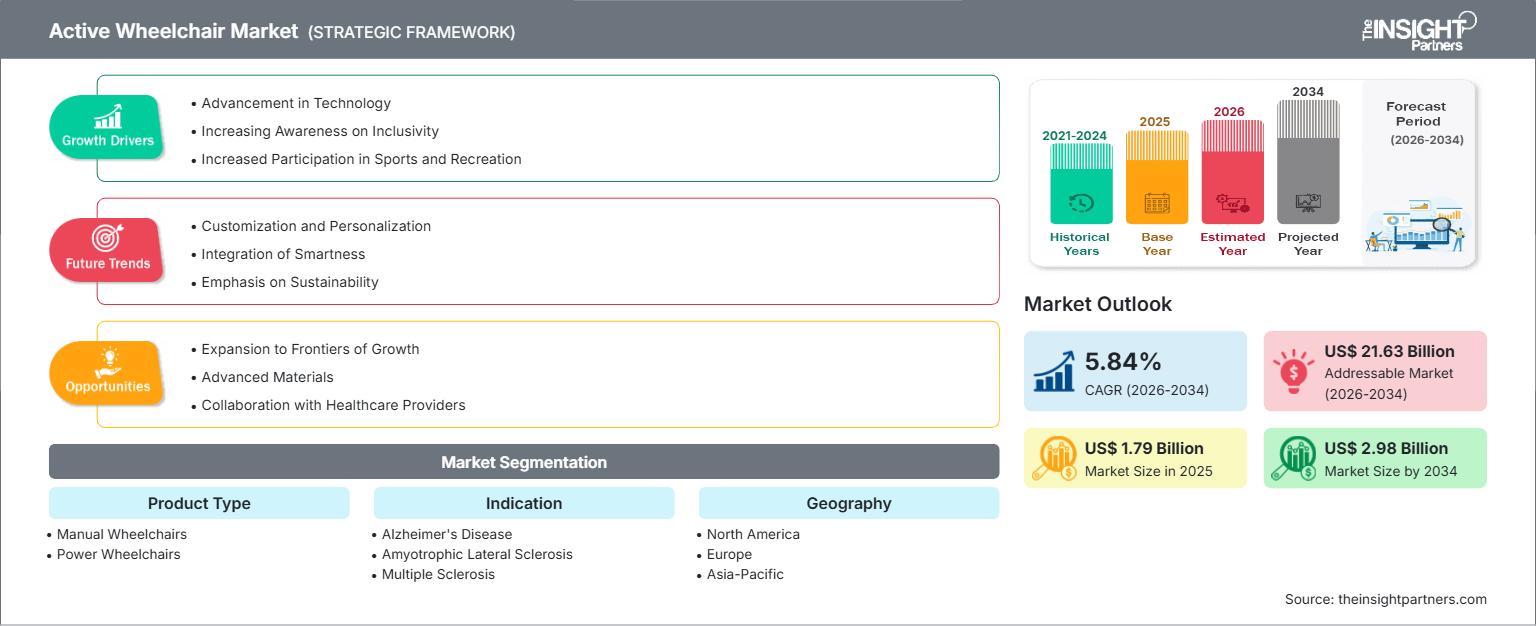
US$ 1.79 Bn
Base year value
2034 Forecast
US$ 2.98 Bn
Projected by 2034
CAGR 2026-2034
5.84 %
Growth rate
Addressable Market
US$ 21.63 Bn
(2026-2034)
The active wheelchair market was valued at US$ 1.79 Billion in 2025 and is projected to reach US$ 2.98 Billion by 2034, registering a CAGR of 5.84% during 2026–2034. Growth reflects rising demand for mobility systems designed for active daily use, sports participation, neurorehabilitation, and independent living. Manufacturers are prioritizing lightweight frames, power-assist integration, customized seating, and improved maneuverability to address diverse clinical and lifestyle needs.
Across North America, active wheelchair market size is supported by structured reimbursement pathways, higher adoption of complex rehabilitation technology, and strong clinical involvement in device selection. The region is estimated to grow at a CAGR range of 5.7–6.2% during 2026–2034. Demand is shaped by aging demographics, spinal cord injury rehabilitation programs, and greater awareness of mobility devices that support community participation rather than basic indoor movement alone.
Active Wheelchair Market Assessment and Insights
- North America accounted for 34–36% share in 2025 and is expected to grow at a CAGR of 5.7–6.2% between 2026–2034, supported by complex rehabilitation technology access, payer coverage, and specialized mobility clinics.
- US represented 84–87% of North America in 2025 and is projected to expand at a CAGR of 5.6–6.1% between 2026–2034, led by customized wheelchair prescription and service networks.
- Europe held 27–29% share in 2025 and is set to grow at a CAGR of 5.1–5.6% between 2026–2034, with Germany, the UK, France, Italy, and Spain leading structured mobility procurement.
- Asia Pacific captured 23–25% share in 2025 and is projected to grow at a CAGR of 6.5–7.1% between 2026–2034, with China, Japan, India, South Korea, and Australia driving adoption.
- Largest Segment Manual Wheelchairs held 60–64% market share in 2025 and is expected to grow at a CAGR of 5.2–5.7% during 2026–2034 due to lightweight customization.
- High Growth Segment Power Wheelchairs represented 36–40% share in 2025 and is forecast to grow at a CAGR of 6.6–7.2% during 2026–2034 as power-assist demand expands.
- Key companies analyzed in detail: Sunrise Medical, Mountain Trike Company Ltd, Numotion, Invictus Active Ltd, Karman Healthcare, Inc., PER4MAX Medical LLC, MEYRA GmbH, SpinLife, Sportaid, and Permobil AB.
Source: The Insight Partners' analysis based on proprietary research, government publications, company annual reports, investor presentations, industry databases, and expert interviews.
Technology-led product refinement has shifted the market from standard mobility supply toward performance-oriented prescription. Carbon, titanium, and high-strength aluminum frames have improved durability while lowering transport weight. Production dynamics are also changing as modular platforms allow manufacturers to offer multiple frame angles, wheel positions, seat widths, cushions, and control systems without rebuilding every chair from scratch. The active wheelchair market is increasingly influenced by clinician input, user lifestyle goals, and post-sale service availability.
In the future, new geographies will arise from urban rehab centers, disability inclusion strategies, and local supply chain relationships. Public procurement processes are increasingly understanding mobility as a component of long-term independence as opposed to immediate equipment access. Resources are being invested in digital customization, quicker fitting cycles, and hybridization with manual power. Tailwinds coming from accessibility laws, transportation regulations, and coverage of assistive devices in developing countries are expected to support this trend.
Active Wheelchair Market Report Scope
| Report Attribute | Details |
|---|---|
| Market size in 2025 | US$ 1.79 Billion |
| Market Size by 2034 | US$ 2.98 Billion |
| Global CAGR (2026 - 2034) | 5.84% |
| Historical Data | 2021-2024 |
| Forecast period | 2026-2034 |
Active Wheelchair Market Analysis
Demand is anchored in long-term mobility impairment, neurological disease progression, and the growing preference for devices that support employment, education, sports, and independent living. The active wheelchair market growth is further supported by WHO estimates indicating a large global population requiring assistive products and appropriate wheelchair services. Value creation depends on frame design, seating accuracy, propulsion efficiency, battery reliability, and service response.
Supply dynamics are becoming more specialized as manufacturers combine mass-customized production with regional dealer networks. The ecosystem includes rehabilitation physicians, occupational therapists, physiotherapists, assistive technology professionals, payers, distributors, and service technicians. Procurement decisions increasingly evaluate lifetime usability, repairability, and clinical outcomes rather than upfront unit cost alone.
The competitive landscape is moderately consolidated among global complex rehabilitation providers and specialist active mobility brands. The active wheelchair market analysis shows Sunrise Medical, Permobil AB, MEYRA GmbH, Karman Healthcare, Inc., and PER4MAX Medical LLC using product breadth, dealer reach, and clinical education to defend their position. Mountain Trike Company Ltd and Invictus Active Ltd address outdoor and lifestyle mobility niches.
Investment trends favor power-assist modules, ultralight manual frames, digital ordering platforms, and integrated seating. Numotion, SpinLife, and Sportaid strengthen market access through retail, online, and service-led distribution models. Strategic positioning depends on customization speed, reimbursement documentation support, parts availability, and the ability to serve users with progressive conditions requiring periodic adjustments.
● REPORT CUSTOMIZATION
Tailor This Report To Align With Your Specific Business Requirements
This report can be customized to align precisely with your business objectives, scope, and target markets. Customization options include tailored segmentation, geography, competitive analysis, and strategic insights to support informed decision-making.
Customize This Report →WHAT YOU CAN ADJUST
- ● Segmentations
- ● Geography
- ● Competitive Analysis
- ● Language Preferences
Active Wheelchair Market: Strategic Insights
Regional Insights
North America Active wheelchair Market
North America held 34–36% share in 2025 and is projected to grow at a CAGR of 5.7–6.2% during 2026–2034. Demand is supported by complex rehabilitation technology networks, higher clinical engagement in wheelchair prescription, and stronger documentation practices for customized mobility devices. The region benefits from specialized seating clinics, dealer service infrastructure, and broad availability of manual, power, and power-assist solutions.
The active wheelchair market share in North America is strengthened by sports participation, veteran rehabilitation programs, and a policy focus on accessible transport. U.S. and Canadian providers increasingly evaluate shoulder preservation, propulsion biomechanics, and pressure management during product selection. Manufacturers also benefit from users replacing standard chairs with lighter, better-fitted models that improve daily independence.
U.S. Active wheelchair Market
The U.S. represented 84–87% of North America in 2025 and is expected to grow at a CAGR of 5.6–6.1% during 2026–2034. It will be affected by increased payments, a strong network of providers of complicated rehab technology, and clinicians specialized in mobility.
Custom-made wheelchairs and power-assist chairs have gained wide popularity among physically active people seeking less fatigue in the community.
The list of companies working in this market is diverse and includes Sunrise Medical, Permobil AB, Numotion, Karman Healthcare, Inc., SpinLife, Sportaid, and PER4MAX Medical LLC. Areas of application of such products are spinal cord injury, cerebral palsy, multiple sclerosis, and muscular dystrophy. The demand will increase if there is a need for mobility aids suitable for vehicles.
Europe Active wheelchair Market
Europe held 27–29% share in 2025 and is forecast to expand at a CAGR of 5.1–5.6% during 2026–2034. The market leader is Germany due to the well-defined rehabilitation paths, product standards and technical supplier competence. The UK benefits from the wheelchair services, suppliers and increasing need for outdoor mobility in the country.
In Germany, the market dynamics comprise prescription-driven fitting, the existence of a proactive users group and increased demand for better quality manual frames by MEYRA GmbH and Permobil AB. In the UK, there is a very high demand for lifestyle-oriented mobility products, such as off-road mobility products and power assist products of Invictus Active Ltd and Mountain Trike Company Ltd.
France, Italy and Spain have increasing market dynamics because of hospital-based rehabilitation, aging population and incorporation of disabled persons in the society. In France, market demand is oriented towards clinical suitability and reimbursement process, whereas in Italy and Spain, there is increased demand for lightweight chairs for urban mobility needs.
APAC Active wheelchair Market
APAC accounted for 23–25% share in 2025 and is projected to grow at a CAGR of 6.5–7.1% during 2026–2034. While China is the biggest market, other key players in this market include Japan, South Korea, Australia, and India, which are driven by the aging population, rehabilitation investments, and improvement in access to assistive technologies.
Industrial factors include the production of wheelchairs, e-commerce logistics, and growth of private healthcare systems. The growing policy interest in disabilities and long-term care adds to this development, yet affordability issues persist. Japan and Australia have more penetration of expensive powered wheelchairs, whereas India and Southeast Asia have room for growth in cheaper manual wheelchairs.
Middle East & Africa Active wheelchair Market
The Middle East & Africa is projected to grow at a CAGR of 4.8–5.3% during 2026–2034. Saudi Arabia leads regional demand, supported by healthcare infrastructure investment, rehabilitation hospitals, and disability inclusion initiatives. The UAE follows with premium mobility adoption, specialist clinics, and higher purchasing power among urban users.
South Africa anchors demand in the African subregion through rehabilitation networks and private distribution. The rest of MEA remains cost-sensitive, with access concentrated around hospitals, charities, and government tenders. Energy-linked public spending and infrastructure modernization in Gulf countries may support accessible public spaces, improving long-term demand for active mobility products.
Segmentation Analysis
Product Type
The Product Type segment is expected to grow at a CAGR of 5.7–6.2% during 2026–2034. active wheelchair market scope across product types is widening as users seek solutions that balance propulsion efficiency, terrain adaptability, seating support, and transport convenience. Manual models dominate because of affordability and customization, while powered products are gaining importance for users with fatigue, upper-limb limitations, or progressive neurological conditions.
- Manual Wheelchairs maintain the leading position due to lighter frames, rigid and folding designs, adjustability, and lower ownership costs. They remain strategically important for active users requiring precise fit and efficient propulsion.
- Power Wheelchairs are gaining demand among users with reduced strength, neurological progression, or longer mobility ranges. Their strategic role is increasing as control systems, seating functions, and compact power bases improve.
Indication
The Indication segment is projected to grow at a CAGR of 5.5–6.0% during 2026–2034. Demand varies by disease progression, functional limitation, fatigue profile, and need for caregiver support. Neurological and musculoskeletal conditions create recurring demand for seating reassessment, pressure management, and mobility upgrades, making clinical evaluation central to device selection and long-term user outcomes.
- Alzheimer's Disease creates demand where cognitive decline combines with mobility loss, requiring stable seating, caregiver-friendly handling, and safe indoor maneuverability to reduce falls and improve daily assistance.
- Amyotrophic Lateral Sclerosis requires adaptable mobility solutions as strength and respiratory function decline. Power models, positioning features, and supportive seating become strategically important during progressive functional transition.
- Multiple Sclerosis drives demand for fatigue-reducing devices, compact powered options, and lightweight manual chairs that can adapt to fluctuating mobility levels and changing daily activity patterns.
- Diabetes supports demand through lower-limb complications, amputations, neuropathy, and wound prevention needs. Appropriate seating and pressure management remain essential for reducing secondary health risks.
- Cerebral Palsy requires customized seating, postural support, and pediatric-to-adult transition planning. Demand is shaped by long-term growth adjustments, family support needs, and rehabilitation-led product selection.
- Muscular Dystrophy creates sustained demand for progressive mobility support, including power wheelchairs, tilt functions, and seating systems that accommodate declining strength and respiratory considerations.
Opportunity Snapshot
| Segment Name | Revenue Contribution | Trend Tag | Adoption Stage |
|---|---|---|---|
| Alzheimer's Disease | Medium | Caregiver Safety | Scaling |
| Amyotrophic Lateral Sclerosis | Medium | Progressive Support | Scaling |
| Multiple Sclerosis | High | Fatigue Relief | Scaling |
| Diabetes | Medium | Pressure Care | Scaling |
| Cerebral Palsy | High | Postural Fit | Mature |
| Muscular Dystrophy | Medium | Power Positioning | Scaling |
Active Wheelchair Market Growth Drivers and Impact Analysis
Rising Need for Clinically Appropriate Mobility Devices
An estimated 80 million people globally may require wheelchairs, while more than 2.5 billion people need at least one assistive product. This creates a large structural demand base for mobility technologies that improve participation, health, and independence. The active wheelchair market benefits as healthcare systems shift from providing basic chairs toward fitting appropriate devices matched to posture, function, environment, and daily activity. Poorly fitted devices increase risks such as pressure injury, shoulder strain, and reduced community access, which raises long-term care costs. Consequently, payers and clinicians are placing greater emphasis on assessment, fitting, training, and follow-up. This driver supports recurring demand for higher-quality manual chairs, power systems, seating upgrades, and service contracts across developed and emerging markets.
Growth in Neurological and Chronic Disease Burden
The neurological conditions and diseases, coupled with chronic ailments, are adding to the pool of users in the active mobility equipment space. The list includes multiple sclerosis, amyotrophic lateral sclerosis, cerebral palsy, muscular dystrophy, diabetes-induced amputations, and aging-related mental impairment, among others. These conditions exhibit varying mobility challenges but require similar solutions in terms of safety, durability, and adaptability of the equipment. The result of the changing landscape is evident from the increased uptake of adjustable seating systems, pressure-relieving cushions, smaller powered bases, and manually operated chairs that have been engineered to minimize strain on the patient’s body.
Expansion of Accessibility and Independent Living Policies
Attention to accessibility requirements on the regulatory front is increasing expectations about mobility independence for transportation, infrastructure, places of work and healthcare institutions. Air transport regulation changes in the U.S. for passengers requiring wheelchairs show the significance of proper handling, respectful assistance, and accountability in cases of damaged and/or delayed mobility aids. The same emphasis of regulatory policy in Europe, Japan, Australia, and selected Gulf countries makes users look for mobility devices that will help them participate in public life. This is an important factor influencing the development of wheelchair designs, which should become lighter, easier to transport and durable in diverse conditions.
Active Wheelchair Market Future Trends
Hybrid Power-Assist Integration
Hybrid mobility systems will shape active wheelchair market trends as users seek manual control with optional powered support. Power-assist wheels, front-mounted drive units, and compact add-ons reduce shoulder strain while preserving active propulsion where possible. This development is anticipated to have more followers among those suffering from multiple sclerosis, spinal cord injuries, muscular dystrophy, and fatigue-induced mobility problems. The manufacturers can be expected to focus on developing light batteries, easy controls, airliner-friendly models, and fast docking systems. It should be noted that dealers and practitioners will need guidelines for assessing the situation where power assistance provides functional benefit but does not replace the independence of the individual.
Digital Configuration and Service-Led Fitting
Digital configuration platforms are expected to reduce order errors, shorten lead times, and improve transparency for customized devices. Future success will increasingly rely not just on catalog size but on the accuracy of translation of clinical data into manufacturable specs. Visual configurator tools, e-documentation, and parts procurement will allow for improved cooperation between clinicians, end-users, vendors, and repair personnel. The development of such an approach becomes particularly important in view of the growing complexity of adjustable components, seating interfaces, and powered options of active chairs. Those manufacturers who manage to integrate digital fitting with post-sale services will be able to facilitate periodic re-assessment and faster repair.
Active Wheelchair Market Opportunities
Emerging Market Rehabilitation Partnerships
The active wheelchair market Forecasts indicate a meaningful opportunity where rehabilitation capacity is expanding but access to active mobility products remains limited. The ability to design scalable programs may be achieved through collaboration with hospitals, non-governmental organizations, disability organizations, and local distributors to implement assessment-based supply systems. The approach that should be adopted is the provision of modular manual wheelchairs, technician training, provision of spare parts, and different types of products that cater to all income classes. India, Southeast Asia, some Latin American countries, and parts of the Middle East may offer an opportunity as the awareness of assistive technology becomes more widespread.
Specialized Mobility for Outdoor and Sports Use
Outdoor, sport, and recreational mobility provides a targeted investment opportunity, as consumers are becoming more health-conscious and seek an active lifestyle outside the confines of the indoors. The rising demand for off-road wheelchairs, all-terrain accessories, sports wheelchairs, and robust components will benefit from trails, parks, colleges, and adaptive sports activities. There is differentiation possible through terrain tests, lightweight construction, suspension characteristics, and working with adaptive sports organizations. The opportunity will also generate income from accessories such as wheels, tires, seating cushions, gloves, and maintenance. Specialist companies will be able to effectively compete with the big players, since they have clearly identified use cases and established credibility with active user groups.
Recent Developments
- October 2025: Sunrise Medical received six awards at the 2025 Mobility Management Product Awards, recognizing products including Empulse M90, Empulse F35, Switch-It CTRL+5 with Voice Activation, QUICKIE QS5 X, and LECKEY MyWay Pedal. The recognition reinforced the company’s active mobility portfolio across power-assist systems, ultralight manual wheelchairs, electronics, and gait-related solutions.
- October 2025: Invictus Active Ltd showcased wheelchair power attachments and off-road wheelchairs at the UK Wheelchair Roadshow in Birmingham, enabling users, healthcare professionals, and mobility specialists to test more than 20 products in real-world terrain. The event highlighted growing demand for outdoor mobility, product trials, and specialist advice in active wheelchair selection.
- October 2024: Permobil AB launched the TiLite X folding-frame and TiLite Z rigid ultralight manual wheelchairs, expanding the TiLite portfolio with highly configurable aluminum models. The company emphasized rapid assembly, extensive customization, and digital ordering through Permobil Store, strengthening its position in active manual mobility and clinician-supported product configuration.
Frequently Asked Questions

- Comprehensive Market Sizing and Forecast Analysis
- Detailed Segmentation Analysis
- In-Depth Market Dynamics Assessment
- Regional and Country-Level Insights
- Competitive Landscape and Company Benchmarking
- Strategic Business Intelligence
Recent Reports
Testimonials

The Insight Partners' SCADA System Market report is comprehensive, with valuable insights on current trends and future forecasts. The team was highly professional, responsive, and supportive throughout. We are very satisfied and highly recommend their services.
RAN KEDEM Partner, Reali Technologies LTDs
I requested a report on a very specific software market and the team produced the report in a few days. The information was very relevant and well presented. I then requested some changes and additions to the report. The team was again very responsive and I got the final report in less than a week.
JEAN-HERVE JENN Chairman, Future Analytica
We worked with The Insight Partners for an important market study and forecast. They gave us clear insights into opportunities and risks, which helped shape our plans. Their research was easy to use and based on solid data. It helped us make smart, confident decisions. We highly recommend them.
PIYUSH NAGPAL Sr. Vice President, High Beam Global
The Insight Partners delivered insightful, well-structured market research with strong domain expertise. Their team was professional and responsive throughout. The user-friendly website made accessing industry reports seamless. We highly recommend them for reliable, high-quality research services
YUKIHIKO ADACHI CEO, Deep Blue, LLC.
This is the first time I have purchased a market report from The Insight Partners.While I was unsure at first, I visited their web site and felt more comfortable to take the risk and purchase a market report.I am completely satisfied with the quality of the report and customer service. I had several questions and comments with the initial report, but after a couple of dialogs over email with their analyst I believe I have a report that I can use as input to our strategic planning process.Thank you so much for taking the extra time and making this a positive experience.I will definitely recommend your service to others and you will be my first call when we need further market data.
JOHN SUZUKI President and Chief Executive Officer, Board Director, BK Technologies
I wish to appreciate your support and the professionalism you displayed in the course of attending to my request for information regarding to infectious disease IVD market in Nigeria. I appreciate your patience, your guidance, and the fact that you were willing to offer a discount, which eventually made it possible for us to close a deal. I look forward to engaging The Insight Partners in the future, all thanks to the impression you have created in me as a result of this first encounter.
DR CHIJIOKE ONYIA MANAGING DIRECTOR, PineCrest Healthcare Ltd.Reason to Buy
- Informed Decision-Making
- Understanding Market Dynamics
- Competitive Analysis
- Identifying Emerging Markets
- Customer Insights
- Market Forecasts
- Risk Mitigation
- Boosting Operational Efficiency
- Strategic Planning
- Investment Justification
- Tracking Industry Innovations
- Aligning with Regulatory Trends





 Get Free Sample for