
Additive Masterbatch Market Size, Trends & Demand by 2034
Additive Masterbatch Market Size and Forecasts (2021 - 2034), Global and Regional Share, Trends, and Growth Opportunity Analysis Report Coverage : by Additive Type (Antioxidants, UV Stabilizers, Flame Retardants, Coloring Agents, Processing Aids, Anti-static Agents, Anti-blocking Agents); Polymer Type (Polyethylene, Polypropylene, Polyvinyl Chloride, Polyethylene Terephthalate, Polystyrene); End-Use Industry (Packaging, Automotive, Consumer Goods, Textiles, Construction, Agriculture, Electronics); and Geography (North America, Europe, Asia Pacific, and South and Central America)
- Status : Data Released
- Report Code : TIPRE00040564
- Category : Chemicals and Materials
- No. of Pages : 150
- Available Report Formats :


- Last update date : July 14, 2026


2025 Market Size
US$ 2.26 Bn
Base year value
2034 Forecast
US$ 3.68 Bn
Projected by 2034
CAGR 2026-2034
5.56 %
Growth rate
Addressable Market
US$ 26.92 Bn
(2026-2034)
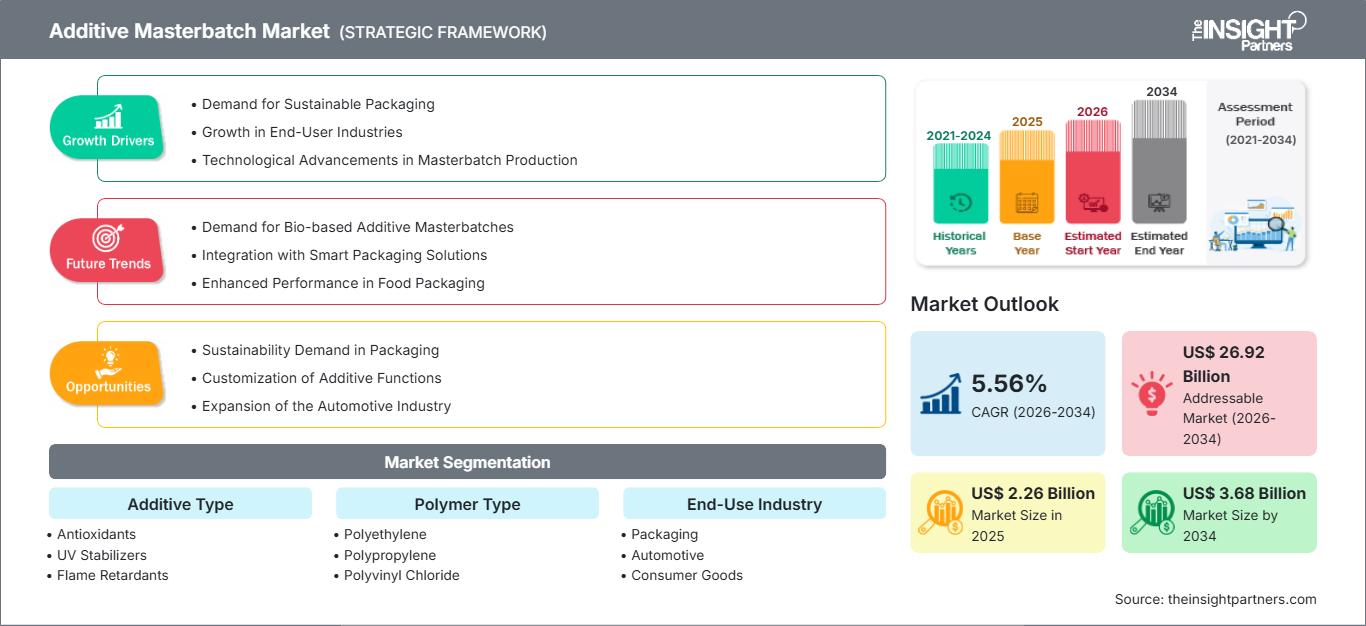
The additive masterbatch market size was valued at US$ 2.26 billion in 2025 and is projected to reach US$ 3.68 billion by 2034, registering a CAGR of 5.56% during 2026–2034. Market expansion is supported by rising consumption of high-performance polymer compounds across packaging, automotive, consumer goods, construction, and agricultural applications. Additive masterbatches are being developed with multi-functional properties that make them efficient in processing, provide increased strength, increase their fire-retardant qualities, offer protection against UV rays, and enhance the aesthetic qualities of the products while adhering to ever stricter sustainability and compliance norms.
In North America, strong demand from the converters of packaging products, producers of automotive components, and industrial processors is helping the region consolidate its dominance in the additive masterbatch market size. Growing investments in sustainable plastics, lightweight automotive parts, and specialty polymers are driving the region’s CAGR of 5.2%–5.8% through 2034.
Additive Masterbatch Market Assessment and Insights
- North America accounted for 34%–38% of the additive masterbatch market share in 2025 and is projected to expand at a CAGR of 5.2%–5.8% during 2026–2034. Strong packaging production, advanced polymer processing capabilities, and continuous innovation in specialty additives support regional market leadership.
- US represented 76%–80% of the North American market in 2025 and is anticipated to register a CAGR of 5.3%–5.9% through 2034, supported by strong domestic plastics manufacturing, packaging innovation, and automotive lightweighting initiatives.
- Europe captured 26%–30% market share in 2025 and is forecast to grow at a CAGR of 5.0%–5.6% during 2026–2034. Germany, France, Italy, and the UK remain leading markets owing to strong automotive, packaging, and construction industries alongside sustainability-driven regulations.
- Asia Pacific held 28%–32% market share in 2025 and is expected to record the fastest regional expansion with a CAGR of 6.0%–6.6% between 2026–2034. China, India, Japan, and South Korea continue to strengthen manufacturing capacity and plastics processing investments.
- Largest Segment: Packaging accounted for 36%–40% market share in 2025 and is anticipated to grow at a CAGR of 5.5%–6.0%, supported by rising demand for durable, lightweight, and functional flexible and rigid plastic packaging.
- High Growth Segment: UV Stabilizers are projected to witness the highest growth, holding 15%–19% market share in 2025 while expanding at a CAGR of 6.6%–7.2%, driven by increasing outdoor applications, agricultural films, and infrastructure products.
- Key companies analyzed in detail: Ampacet Corporation, Clariant AG, SABIC, LyondellBasell Industries N.V., Avient Corporation, Mitsui Chemicals, Inc., Dow Inc., Plastiblends India Limited, TechnoCompound GmbH, BASF SE, EPL Limited, J.M. Huber Corporation, Kraton Corporation, Vibrantz Technologies Inc.
Source: The Insight Partners' analysis based on proprietary research, government publications, company annual reports, investor presentations, industry databases, and expert interviews.
The development of the additive masterbatch market has witnessed the growth from manufacturing polymer modifiers of one function to developing high-tech multi-functional systems, which can enhance mechanical properties, increase processability, extend the lifetime of products, and boost sustainability. Numerous innovations in the fields of polymer technology, compounding equipment, and dosing systems have made it possible for manufacturers to produce specialized masterbatches that are suited for applications in automotive industry, flexible packaging, consumer goods, agriculture, and construction industries. The use of recycled materials has driven demand for additive systems that can enhance performance.
In the future, manufacturers are projected to focus more on bio-based additives, PFAS-free formulations, and recyclable masterbatch technologies in order to comply with the sustainability objectives. Capacity increase in the Asia-Pacific region, collaboration of polymer manufacturers and additive companies, and investments in circular plastic solutions are predicted to provide long-term opportunities. The regulatory focus on material safety, product longevity, and recyclability will stimulate innovation in the additive masterbatch industry.
Additive Masterbatch Market Report Scope
| Report Attribute | Details |
|---|---|
| Market size in 2025 | US$ 2.26 Billion |
| Market Size by 2034 | US$ 3.68 Billion |
| Global CAGR (2026 - 2034) | 5.56% |
| Historical Data | 2021-2024 |
| Forecast period | 2026-2034 |
Additive Masterbatch Market Analysis
The increasing need for engineered plastic products in packaging, transportation, electronics, medical, and infrastructure applications is expected to continue driving the demand for additive masterbatch. The need for masterbatch products which increase UV resistance, flame-retardancy, processing capability, anti-static properties, and oxidative stability of the products without affecting the processability of the polymers is increasingly becoming common among manufacturers. Moreover, the increasing use of recycled plastics is expected to drive the demand for additive masterbatch products due to their ability to offset the impact of reduced properties of the recycled plastic products. Companies in the resin, compounder, additives, converter, and OEM markets are forming collaborations within the value chain in order to provide application-specific products which adhere to environmental regulations and customer expectations.
Availability of raw materials, advancement in the specialty chemicals sector, and the use of innovative compounding technology will continue to determine competitiveness in the additive masterbatch market. Suppliers are investing in precision extrusion technology, automated dosing technology, and digital quality control software in order to ensure even distribution of additives across different polymer bases.
Intensifying competitive pressure is seen in efforts by the top players in the sector in innovation, sustainability, regional manufacturing growth, and M&A. The competitive profile mentioned in the Additive Masterbatch Market report shows that Ampacet Corporation, Clariant AG, BASF SE, Avient Corporation, LyondellBasell Industries N.V., SABIC, Mitsui Chemicals, Inc., and Dow Inc. are expanding their range of products in recyclable plastic, low carbon, PFAS free, and polymer additive solutions. Regional specialist companies like Plastiblends India Limited and TechnoCompound GmbH are also growing their range of custom made products in the area of auto and industrial applications.
Investments are increasingly geared towards developing sustainable polymer additives, recycled resins and formulations that improve both the performance and the processing of the products. Collaborations between the polymers producer, compounder, packaging manufacturers and automotive suppliers are making it possible to commercialize next generation additive systems with better regulatory compliance and lifecycle performance. It is likely that digital manufacturing, AI assisted formulation design and laboratory automation will shorten the development process and enable quick customization for the new generation of high value added applications.
● REPORT CUSTOMIZATION
Tailor This Report To Align With Your Specific Business Requirements
This report can be customized to align precisely with your business objectives, scope, and target markets. Customization options include tailored segmentation, geography, competitive analysis, and strategic insights to support informed decision-making.
Customize This Report →WHAT YOU CAN ADJUST
- ● Segmentations
- ● Geography
- ● Competitive Analysis
- ● Language Preferences
Additive Masterbatch Market: Strategic Insights
Regional Insights
North America Additive Masterbatch Market
North America accounted for 34%–38% of the global market in 2025 and is projected to register a CAGR of 5.2%–5.8% during 2026–2034. The region benefits from a mature plastics processing industry, high adoption of specialty polymer compounds, and significant investments in sustainable packaging materials. Rising demand from food packaging, healthcare products, construction materials, and automotive applications continues to support long-term market expansion. The additive masterbatch market share in North America also remains supported by advanced research capabilities and strong collaboration between resin manufacturers and compounders.
Regulatory initiatives promoting recyclable plastics, extended producer responsibility programs, and lightweight material adoption are encouraging manufacturers to develop multifunctional additive masterbatches compatible with recycled polymers. Growing investments in high-performance packaging films, electric vehicle components, and industrial polymer applications are further stimulating demand. Continuous product innovation, combined with expanding domestic production capacity and technological advancements in polymer compounding, is expected to sustain regional competitiveness throughout the forecast period.
U.S. Additive Masterbatch Market
The United States represented 76%–80% of the North American market in 2025 and is anticipated to expand at a CAGR of 5.3%–5.9% during 2026–2034. Strong demand from packaging, automotive, healthcare, agriculture, and consumer goods industries continues to support specialty additive consumption. Domestic manufacturers increasingly utilize multifunctional masterbatches to improve product durability, UV resistance, flame retardancy, and processing efficiency while meeting evolving sustainability objectives.
The presence of leading companies including Ampacet Corporation, Avient Corporation, Dow Inc., LyondellBasell Industries N.V., BASF SE, and J.M. Huber Corporation strengthens regional innovation through continuous product development and investment in advanced compounding technologies. Rising adoption of recycled plastics, growth in e-commerce packaging, and increased production of lightweight automotive components are expected to create sustained opportunities for specialty additive suppliers over the coming decade.
Europe Additive Masterbatch Market
Europe accounted for 26%–30% of the global market in 2025 and is forecast to grow at a CAGR of 5.0%–5.6% between 2026–2034. Germany remains the leading regional market owing to its strong automotive manufacturing base, advanced plastics processing industry, and extensive production of engineered polymer components. Continuous investments in circular economy initiatives and recycled plastic technologies further support demand for high-performance additive masterbatches.
The United Kingdom is experiencing growing adoption of specialty additives within packaging and consumer goods manufacturing, supported by sustainability targets and increased utilization of recycled polymers. France, Italy, and Spain continue expanding consumption across food packaging, industrial manufacturing, agricultural films, and construction applications. Increasing regulatory emphasis on material recyclability, reduced carbon emissions, and extended product life is encouraging manufacturers to invest in innovative additive technologies compatible with next-generation polymer formulations.
APAC Additive Masterbatch Market
Asia Pacific captured 28%–32% of the global market in 2025 and is expected to register the fastest regional expansion with a CAGR of 6.0%–6.6% during 2026–2034. China remains the largest regional producer and consumer, while India continues recording rapid industrial expansion across packaging, automotive, consumer goods, and infrastructure sectors.
Japan and South Korea emphasize advanced engineering plastics and high-value manufacturing, whereas Australia maintains stable demand from construction and agricultural applications. Continued investments in plastics processing capacity, export-oriented manufacturing, and sustainable packaging policies are expected to reinforce long-term regional growth.
Middle East & Africa Additive Masterbatch Market
The Middle East & Africa market is projected to expand at a CAGR of 5.4%–6.0% during 2026–2034. Saudi Arabia leads regional demand owing to its integrated petrochemical industry and expanding polymer manufacturing capacity. The UAE continues investing in high-value packaging and industrial plastics production, while South Africa remains an important for consumer packaging and construction materials.
Increasing investments in downstream petrochemical industries, infrastructure development, and agricultural modernization continue supporting demand across the Rest of Middle East & Africa. Growing production of flexible packaging, irrigation systems, and industrial plastic products is expected to create additional opportunities for additive masterbatch manufacturers.
Segmentation Analysis
Additive Type
The additive type segment is projected to expand at a CAGR of 5.8%–6.3% during 2026–2034. The additive masterbatch market forecast continues to broaden as manufacturers increasingly incorporate multifunctional additives that enhance durability, processability, weather resistance, flame retardancy, and product appearance while supporting recycled polymer utilization and compliance with evolving environmental regulations.
- Antioxidants – Widely utilized to improve thermal and oxidative stability during polymer processing and product service life. Strong demand exists across packaging, automotive components, industrial products, and consumer goods requiring long-term material durability.
- UV Stabilizers – Increasing adoption in agricultural films, outdoor furniture, pipes, construction products, and automotive exterior components supports growing demand for protection against ultraviolet degradation and extended product lifespan.
- Flame Retardants – Essential for electrical, electronics, transportation, and construction applications where compliance with fire safety regulations remains a primary purchasing criterion.
- Coloring Agents – Used extensively to achieve consistent color quality, branding requirements, and enhanced product aesthetics across packaging, consumer products, household goods, and industrial plastic applications.
- Processing Aids – Improve extrusion efficiency, reduce die build-up, enhance melt flow characteristics, and increase production consistency across high-volume polymer processing operations.
- Anti-static Agents – Increasingly incorporated into electronic packaging, industrial containers, consumer electronics, and medical packaging to minimize electrostatic discharge and dust accumulation.
- Anti-blocking Agents – Improve handling characteristics of plastic films by reducing surface adhesion, making them particularly valuable for flexible packaging and agricultural film applications.
Polymer Type
The polymer type segment is expected to register a CAGR of 5.3%–5.8% during 2026–2034. Demand is primarily influenced by increasing production of commodity and engineering plastics across packaging, automotive, healthcare, consumer products, and industrial manufacturing. Manufacturers continue developing polymer-specific masterbatch formulations to maximize additive performance while ensuring compatibility with different resin systems.
- Polyethylene – Represents the largest polymer category due to extensive utilization in flexible packaging, films, bottles, pipes, and agricultural applications requiring UV, antioxidant, and processing additive solutions.
- Polypropylene – Widely adopted across automotive interiors, household products, medical devices, and rigid packaging because of its excellent balance between mechanical performance and processing efficiency.
- Polyvinyl Chloride – Continues generating steady demand from construction materials, cables, pipes, window profiles, and flooring products requiring specialized stabilizers and processing additives.
- Polyethylene Terephthalate – Increasingly utilized in beverage packaging, food containers, textile fibers, and recycled PET applications where additive technologies improve processability and product quality.
- Polystyrene – Maintains stable consumption across disposable packaging, insulation materials, and consumer products requiring improved processing characteristics and enhanced surface quality.
End-Use Industry
The end-use industry segment is anticipated to grow at a CAGR of 5.7%–6.2% during 2026–2034. Increasing demand for lightweight, durable, recyclable, and high-performance plastic products across multiple industrial sectors continues driving consumption of specialized additive masterbatches. Packaging remains the largest revenue contributor, while automotive, electronics, and construction applications continue adopting advanced formulations for improved material performance.
- Packaging – Represents the largest end-use segment owing to widespread adoption in flexible packaging, rigid containers, food packaging, pharmaceutical packaging, and industrial films requiring enhanced functionality and longer shelf life.
- Automotive – Increasing lightweight vehicle production and electric vehicle manufacturing continue driving demand for UV-resistant, flame-retardant, and processing-enhancing additive masterbatches.
- Consumer Goods – Household appliances, furniture, personal care packaging, and recreational products increasingly incorporate specialty additives to improve appearance, durability, and processing efficiency.
- Textiles – Growing use of functional fibers and technical textiles supports demand for additive masterbatches that improve UV stability, antistatic performance, and processing consistency.
- Construction – Pipes, cables, roofing membranes, insulation materials, and structural polymer products increasingly require advanced additive technologies for weather resistance and extended service life.
- Agriculture – Agricultural films, irrigation systems, greenhouse covers, and storage products continue generating demand for UV stabilizers, antioxidants, and anti-blocking additives capable of withstanding harsh environmental conditions.
- Electronics – Electronic housings, cable insulation, connectors, and protective packaging increasingly utilize flame-retardant and antistatic masterbatches to improve product reliability and regulatory compliance.
Opportunity Snapshot
| End Use Industry | Revenue Contribution | Trend Tag | Adoption Stage |
| Packaging | High | Recyclable Films | Mature |
| Automotive | High | Lightweight Parts | Scaling |
| Consumer Goods | Medium | Premium Packaging | Mature |
| Textiles | Medium | Technical Fibers | Scaling |
| Construction | High | Durable Pipes | Mature |
| Agriculture | Medium | Greenhouse Films | Scaling |
| Electronics | Medium | ESD Protection | Emerging |
Additive Masterbatch Market Growth Drivers and Impact Analysis
Growing demand for functional and sustainable packaging materials
The packaging industry continues to represent the largest consumer of additive masterbatches as manufacturers increasingly seek materials that improve product protection, shelf life, processing efficiency, and recyclability. Demand for UV stabilizers, antioxidants, anti-blocking agents, and processing aids has increased significantly due to the rapid expansion of food packaging, pharmaceutical packaging, e-commerce logistics, and industrial packaging applications. Regulatory initiatives encouraging recyclable packaging and reduced plastic waste are further accelerating the adoption of advanced additive formulations compatible with mechanically and chemically recycled polymers. Packaging converters are also investing in mono-material structures that require specialized masterbatch technologies to maintain performance while supporting circular economy objectives. These developments continue to strengthen long-term Additive Masterbatch market demand across both developed and emerging economies.
Expansion of lightweight automotive and transportation applications
The automotive industry has been adopting the use of engineered plastics in a bid to reduce weight, achieve better fuel economy, and improve the range of electric vehicles. The move has seen an upsurge in the consumption of additive master batches that help in providing protection from UV radiation, flame retardation, heat stability, scratching resistance, and processability of the plastic. Automotive interior trims, under-the-hood applications, batteries, cables, and exteriors have adopted the application of special additives, which help in meeting various safety and durability criteria. Increase in electric vehicle production in North America, Europe, China, and India has seen compounders formulate specific compounds for enhancing the performance of polymers and achieving sustainability targets.
Increasing utilization of recycled polymers across manufacturing industries
The global sustainability initiatives have prompted the manufacturers to boost the amount of recycled plastics used while maintaining product quality and process efficiency. There is degradation in the mechanical performance, color stability, and heat stability of the recycled polymers; hence, there is a growing need for modern additives which enhance the performance of the materials. Processing aids, antioxidants, ultraviolet (UV) stabilizers, and compatibilizer technology allow converters to enhance the quality of the recycled plastics which are utilized in packaging, automotive parts, building products, and consumer goods. With the adoption of stringent recycling targets and the shift towards the circular economy by the governments and manufacturers respectively, the growth in innovation in the additive technologies has been increasing.
Additive Masterbatch Market Future Trends
Development of bio-based and recyclable additive technologies
There is an increased focus on the use of sustainable raw materials, biodegradable additives, and recycled formulas that have low impact on the environment without compromising product performance. The additive masterbatch market trends is observing an increase toward increased collaboration between resin suppliers, chemicals, and packaging makers in the creation of additives for plastics which have a circular system. There is development of new formulations that have the ability to make products easily recyclable and minimize volatile organic compounds emission. Such innovations will play a role in promoting eco-friendly polymer solutions during the forecast period.
Digital formulation and smart manufacturing technologies
The advent of artificial intelligence, digital simulation, automation of laboratories, and process analytics has revolutionized masterbatch additives manufacturing. Predictive modeling is now extensively used by manufacturers for better concentration of additives, faster product development, and more consistent formulations. Automated compounding technology and quality control systems help increase efficiency in production processes and reduce wastage of materials. Customers are asking for customized masterbatch products for their applications and with faster lead times. It is anticipated that digital manufacturing technology will be a key competitive advantage.
Additive Masterbatch Market Opportunities
Expansion opportunities in emerging polymer processing markets
The rapid pace of industrialization seen in Asia Pacific, the Middle East, Latin America, and some African regions has created new business prospects for additive makers. Additive masterbatch market forecast suggest that there will be increasing investments in packaging, automotive, building materials, and consumer goods manufacture in these fast-growing economies. Polymer processing capabilities keep growing owing to the fact that foreign companies open local factories to meet local demands. All this creates a favorable situation for providers who can offer special additives tailored to local conditions.
Innovation in specialty masterbatches for high-performance applications
Demand for advanced polymers used in electric vehicles, medical devices, renewable energy systems, electronics, and industrial automation continues to create new growth opportunities for specialty additive suppliers. High-performance masterbatches offering enhanced flame resistance, antimicrobial protection, thermal management, conductivity, and weatherability are gaining importance across these applications. Manufacturers investing in research and development, strategic partnerships, and customized formulation capabilities are expected to capture premium market segments. Continuous innovation supporting lightweight materials, recycled plastics, and sustainable product design will further expand commercial opportunities while strengthening long-term industry competitiveness.
Recent Developments
- April 21, 2026: BASF SE announced the expansion of production capacities for its standard and NOR hindered amine light stabilizers (HALS) to meet rising global demand for high-performance plastic additives. The investment strengthens supply reliability for UV stabilization technologies used in packaging, automotive, agricultural films, and construction applications, while supporting the industry's transition toward more durable and sustainable polymer solutions.
- April 8, 2026: Clariant AG showcased a portfolio of sustainable plastics additive innovations at CHINAPLAS 2026, highlighting PFAS-free polymer processing aids, halogen-free flame retardants, bio-based waxes, multifunctional stabilizers, and additive technologies designed to improve recyclability and regulatory compliance. The solutions reinforce the company's strategy to support circular plastics value chains and low-carbon polymer processing across packaging, automotive, electronics, and consumer goods applications.
Frequently Asked Questions

- Comprehensive Market Sizing and Forecast Analysis
- Detailed Segmentation Analysis
- In-Depth Market Dynamics Assessment
- Regional and Country-Level Insights
- Competitive Landscape and Company Benchmarking
- Strategic Business Intelligence
Recent Reports
Testimonials

The Insight Partners' SCADA System Market report is comprehensive, with valuable insights on current trends and future forecasts. The team was highly professional, responsive, and supportive throughout. We are very satisfied and highly recommend their services.
RAN KEDEM Partner, Reali Technologies LTDs
I requested a report on a very specific software market and the team produced the report in a few days. The information was very relevant and well presented. I then requested some changes and additions to the report. The team was again very responsive and I got the final report in less than a week.
JEAN-HERVE JENN Chairman, Future Analytica
We worked with The Insight Partners for an important market study and forecast. They gave us clear insights into opportunities and risks, which helped shape our plans. Their research was easy to use and based on solid data. It helped us make smart, confident decisions. We highly recommend them.
PIYUSH NAGPAL Sr. Vice President, High Beam Global
The Insight Partners delivered insightful, well-structured market research with strong domain expertise. Their team was professional and responsive throughout. The user-friendly website made accessing industry reports seamless. We highly recommend them for reliable, high-quality research services
YUKIHIKO ADACHI CEO, Deep Blue, LLC.
This is the first time I have purchased a market report from The Insight Partners.While I was unsure at first, I visited their web site and felt more comfortable to take the risk and purchase a market report.I am completely satisfied with the quality of the report and customer service. I had several questions and comments with the initial report, but after a couple of dialogs over email with their analyst I believe I have a report that I can use as input to our strategic planning process.Thank you so much for taking the extra time and making this a positive experience.I will definitely recommend your service to others and you will be my first call when we need further market data.
JOHN SUZUKI President and Chief Executive Officer, Board Director, BK Technologies
I wish to appreciate your support and the professionalism you displayed in the course of attending to my request for information regarding to infectious disease IVD market in Nigeria. I appreciate your patience, your guidance, and the fact that you were willing to offer a discount, which eventually made it possible for us to close a deal. I look forward to engaging The Insight Partners in the future, all thanks to the impression you have created in me as a result of this first encounter.
DR CHIJIOKE ONYIA MANAGING DIRECTOR, PineCrest Healthcare Ltd.Reason to Buy
- Informed Decision-Making
- Understanding Market Dynamics
- Competitive Analysis
- Identifying Emerging Markets
- Customer Insights
- Market Forecasts
- Risk Mitigation
- Boosting Operational Efficiency
- Strategic Planning
- Investment Justification
- Tracking Industry Innovations
- Aligning with Regulatory Trends





 Get Free Sample for