
Advanced Suspension Control System Market Size, Growth & Demand by 2034
Coverage: By Technology (Semi-Active Suspension System, Active Suspension System); Vehicle Type (Passenger Cars, Commercial Vehicles) , and Geography (North America, Europe, Asia Pacific, and South and Central America)
- Status : Data Released
- Report Code : TIPRE00017106
- Category : Automotive and Transportation
- No. of Pages : 150
- Available Report Formats :


- Last update date : August 06, 2026


2025 Market Size
US$ 19.26 Bn
Base year value
2034 Forecast
US$ 37.14 Bn
Projected by 2034
CAGR 2026-2034
7.57 %
Growth rate
Addressable Market
US$ 254.12 Bn
(2026-2034)
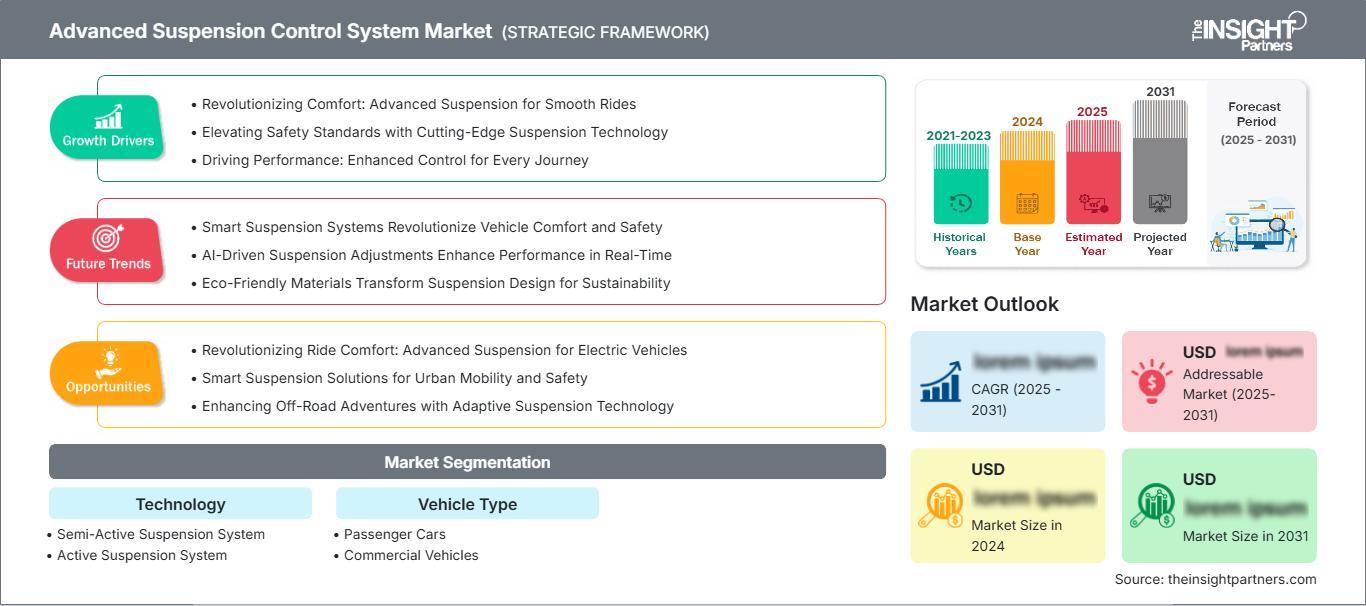
The Advanced suspension control system market was valued at US$ 19.26 billion in 2025 and is projected to reach US$ 37.14 billion by 2034, expanding at a CAGR of 7.57% during 2026–2034. The market continues to benefit from vehicle electrification, premium vehicle penetration, and increasing integration of electronics within chassis management architectures. Automotive manufacturers are investing in ride comfort, vehicle stability, and safety enhancement technologies, creating favorable conditions for broader deployment of advanced suspension control solutions across passenger and commercial vehicle platforms.
Across North America, adoption remains supported by demand for premium utility vehicles, high consumer preference for safety technologies, and increasing integration of software-defined vehicle architectures. The advanced suspension control system market size in the region is supported by growing deployment of active chassis systems, particularly in luxury passenger cars and electric vehicles. Regional growth is anticipated to remain within a 6.8%–7.6% CAGR range, supported by technology innovation, semiconductor advancements, and investments in intelligent vehicle control systems.
Advanced Suspension Control System Market Assessment and Insights
- North America: Strong penetration of premium vehicles and advanced driver assistance technologies supports adoption. Share in 2025 is estimated at 32%–36%, while the market is projected to grow at a 6.8%–7.6% CAGR during 2026–2034.
- US: The country remains the largest revenue contributor within North America, accounting for 76%–80% of regional revenue in 2025 and expanding at a 6.9%–7.7% CAGR during 2026–2034.
- Europe: Established automotive manufacturing clusters and premium vehicle production support demand. Regional share in 2025 is estimated at 28%–32%, growing at a 7.0%–7.8% CAGR during 2026–2034, led by Germany, the UK, and France.
- Asia Pacific: Expanding electric vehicle production, rising vehicle safety standards, and increasing premiumization support growth. Share in 2025 is estimated at 30%–34%, with a 8.2%–9.0% CAGR during 2026–2034, led by China, Japan, South Korea, and India.
- Largest Segment: Passenger Cars represent the leading segment, accounting for 68%–72% market share in 2025 and expected to expand at a 7.2%–8.0% CAGR during 2026–2034.
- High Growth Segment: Active Suspension System technology is expected to witness the fastest adoption, holding 38%–42% market share in 2025 and growing at a 8.5%–9.3% CAGR during 2026–2034.
- Key companies analyzed in detail: BWI Group, Continental AG, Hitachi Astemo Ltd., Infineon Technologies AG, Marelli Europe S.p.A., Parker-Hannifin Corporation, Quanser Inc., Tenneco Inc., HL Mando Corporation, ZF Friedrichshafen AG.
Source: The Insight Partners' analysis based on proprietary research, government publications, company annual reports, investor presentations, industry databases, and expert interviews.
Vehicle dynamics technologies have evolved from conventional mechanical systems toward electronically managed chassis platforms capable of continuously adapting suspension behavior in real time. Sensor integration, high-speed controllers, and predictive vehicle control algorithms are transforming suspension architectures across multiple vehicle categories. Automotive manufacturers increasingly deploy semi-active and active systems to improve handling, ride quality, and safety performance while supporting electric vehicle packaging requirements. Advances in semiconductors and software-driven vehicle platforms continue to improve response times, reliability, and scalability across production programs.
Looking ahead, deployment opportunities are expanding beyond traditional luxury segments into mid-range passenger vehicles and selected commercial vehicle applications. Regulatory emphasis on vehicle safety, growing investment in autonomous driving technologies, and rising consumer expectations regarding comfort continue to strengthen long-term prospects. Emerging automotive manufacturing hubs across Asia Pacific and selected Middle Eastern markets are expected to attract additional investment, while collaboration among component suppliers, software developers, and vehicle manufacturers is likely to accelerate commercialization of next-generation intelligent suspension solutions.
Advanced Suspension Control System Market Report Scope
| Report Attribute | Details |
|---|---|
| Market size in 2025 | US$ 19.26 Billion |
| Market Size by 2034 | US$ 37.14 Billion |
| Global CAGR (2026 - 2034) | 7.57% |
| Historical Data | 2021-2024 |
| Forecast period | 2026-2034 |
Advanced Suspension Control System Market Analysis
The advanced suspension control system market growth trajectory is increasingly influenced by the intersection of electrification, automation, and vehicle safety innovation. Electric vehicles require optimized weight distribution and enhanced ride stability due to battery placement and higher vehicle mass. Consequently, OEMs are integrating adaptive damping systems, electronically controlled actuators, and predictive road-sensing technologies into next-generation vehicle platforms. Rising consumer demand for premium ride comfort further supports adoption, particularly within sport utility vehicles and executive passenger car segments.
Supply chain ecosystems supporting these systems have become increasingly sophisticated. Component manufacturers are strengthening partnerships with sensor suppliers, semiconductor providers, software developers, and original equipment manufacturers. Real-time processing capabilities and advanced control modules now play a critical role in system differentiation. As semiconductor availability improves and production scalability increases, manufacturers are expected to reduce costs and support wider deployment across additional vehicle classes.
The competitive landscape within the advanced suspension control system market analysis remains characterized by technological differentiation, software innovation, and long-term vehicle platform partnerships. Companies including ZF Friedrichshafen AG, Continental AG, Hitachi Astemo Ltd., and HL Mando Corporation continue to invest in intelligent chassis solutions capable of integrating with advanced driver assistance systems. Product development increasingly focuses on predictive vehicle control functions that leverage data from cameras, sensors, and onboard computing systems.
Strategic investments are also targeting electrified mobility and software-defined vehicle architectures. Infineon Technologies AG is strengthening semiconductor capabilities that support intelligent vehicle control applications, while Parker-Hannifin Corporation and Tenneco Inc. continue developing advanced damping and motion-control solutions. BWI Group and Marelli Europe S.p.A. remain active across adaptive suspension technologies, while Quanser Inc. contributes to research and development ecosystems through control system innovation and advanced engineering testing platforms.
● REPORT CUSTOMIZATION
Tailor This Report To Align With Your Specific Business Requirements
This report can be customized to align precisely with your business objectives, scope, and target markets. Customization options include tailored segmentation, geography, competitive analysis, and strategic insights to support informed decision-making.
Customize This Report →WHAT YOU CAN ADJUST
- ● Segmentations
- ● Geography
- ● Competitive Analysis
- ● Language Preferences
Advanced Suspension Control System Market: Strategic Insights
Regional Insights
North America Advanced Suspension Control System Market
North America remains among the most technologically advanced automotive markets and is expected to account for 32%–36% of the advanced suspension control system market share in 2025. The region benefits from strong consumer demand for premium vehicles, pickup trucks, and sport utility vehicles equipped with advanced ride and handling systems. Increasing adoption of electrified vehicle platforms has further accelerated integration of adaptive suspension technologies. Growth is anticipated at a 6.8%–7.6% CAGR between 2026 and 2034, supported by ongoing investment in software-defined vehicle architectures and connected mobility ecosystems.
Automotive manufacturers continue prioritizing ride comfort and vehicle safety as key differentiators. Advanced driver assistance systems require enhanced vehicle stability, creating additional demand for electronically controlled chassis solutions. Supply chain investments in semiconductors, sensors, and intelligent control units are strengthening regional capabilities. Premium vehicle brands and electric vehicle manufacturers remain major adopters of active and semi-active suspension systems, supporting long-term technology deployment across both established and emerging vehicle segments.
U.S. Advanced Suspension Control System Market
The United States represents the largest contributor within North America, accounting for 76%–80% of regional revenue in 2025. Demand remains concentrated in premium passenger vehicles, electric sport utility vehicles, luxury pickups, and performance-oriented automotive segments. The market is expected to expand at a 6.9%–7.7% CAGR during 2026–2034, supported by continued investment in intelligent vehicle systems and advanced mobility technologies. Leading automotive technology suppliers maintain extensive engineering and manufacturing operations throughout the country.
Vehicle manufacturers increasingly deploy suspension control technologies as part of broader safety and comfort packages. Integration with autonomous driving functions, predictive vehicle control systems, and connected vehicle platforms is becoming more common. Consumer willingness to adopt advanced vehicle technologies continues to support demand. Additionally, strong research and development activity across automotive software, semiconductors, and motion-control technologies contributes to continued product innovation and commercial deployment.
Europe Advanced Suspension Control System Market
Europe is estimated to account for 28%–32% of global revenue in 2025 and is projected to advance at a 7.0%–7.8% CAGR through 2034. Germany remains the regional leader due to its concentration of premium automotive manufacturers and advanced engineering capabilities. The country continues to drive innovation in adaptive chassis systems, vehicle dynamics control, and software-integrated suspension technologies. Strong export-oriented automotive production supports sustained technology adoption across multiple vehicle categories.
The United Kingdom and France are increasingly focused on electrified mobility, enhancing opportunities for advanced suspension deployment. Italy and Spain maintain important positions through automotive manufacturing, engineering expertise, and component production capabilities. Regulatory emphasis on vehicle safety, emissions compliance, and driving performance supports ongoing investment across the region. Collaboration between OEMs and technology suppliers continues to accelerate development of intelligent suspension solutions suitable for future automated and connected vehicle platforms.
APAC Advanced Suspension Control System Market
Asia Pacific is projected to account for 30%–34% of global revenue in 2025 and is expected to register the fastest growth at a 8.2%–9.0% CAGR through 2034. China remains the leading Advanced suspension control system market due to its electric vehicle production scale and extensive domestic automotive manufacturing ecosystem. Japan and South Korea continue contributing through innovation in vehicle electronics and advanced mobility technologies.
India and Australia are witnessing growing demand for technology-enabled vehicles as consumer expectations and safety standards continue to rise. Increasing investment in local vehicle production, advanced manufacturing capabilities, and electrification initiatives supports strong long-term adoption prospects for intelligent suspension systems throughout the region.
Middle East & Africa Advanced Suspension Control System Market
The Middle East & Africa market remains comparatively smaller but is expected to exhibit steady development during the Advanced suspension control system market forecast period. Growth is supported by rising vehicle imports, infrastructure development, and increasing consumer demand for premium automotive technologies. Saudi Arabia and the United Arab Emirates lead regional adoption due to higher premium vehicle ownership and expanding mobility investments.
South Africa remains an important automotive production hub, supporting regional technology deployment. Infrastructure modernization programs and gradual expansion of advanced vehicle offerings are expected to enhance demand. The market is projected to advance at a 6.2%–7.0% CAGR between 2026 and 2034, supported by long-term economic diversification initiatives and evolving transportation ecosystems.
Segmentation Analysis
Technology
The Technology segment is expected to expand at a 7.8%–8.6% CAGR during 2026–2034. The advanced suspension control system market scope continues to widen as vehicle manufacturers increasingly integrate electronic control units, sensors, predictive analytics, and intelligent damping systems into vehicle architectures. Demand is driven by improving ride comfort requirements, enhanced vehicle stability expectations, and growing adoption of software-controlled vehicle platforms. Electrification trends are also encouraging manufacturers to deploy more responsive suspension technologies capable of optimizing vehicle dynamics under varying operating conditions.
- Semi-Active Suspension System: This sub-segment remains widely adopted due to its favorable balance between performance improvement and cost efficiency. Automotive manufacturers increasingly deploy electronically controlled dampers in premium and upper-midrange vehicles to enhance comfort and handling characteristics.
- Active Suspension System: Active systems are becoming strategically important as OEMs pursue premium differentiation and intelligent chassis integration. Their ability to continuously adjust suspension behavior in real time supports advanced vehicle dynamics, autonomous driving readiness, and superior ride quality.
Vehicle Type
The Vehicle Type segment is projected to grow at a 7.2%–8.0% CAGR during 2026–2034. Adoption patterns continue to be influenced by vehicle production volumes, consumer demand for safety technologies, and increasing integration of advanced control systems. Manufacturers are expanding availability across several vehicle classes as production costs gradually decline. Growth is supported by technological advancements, electrification programs, and rising demand for comfort-oriented vehicle features in both developed and emerging automotive Advanced suspension control system market.
- Passenger Cars: Passenger cars account for the largest revenue contribution due to high production volumes and increasing integration of adaptive suspension technologies. Demand is particularly strong within luxury, premium, electric, and performance-oriented vehicle categories.
- Commercial Vehicles: Commercial vehicle adoption is driven by fleet requirements related to load stability, driver comfort, vehicle durability, and operational efficiency. Increasing use of advanced control technologies in premium buses, logistics vehicles, and specialty transportation platforms supports demand.
Opportunity Snapshot
| Vehicle Type | Revenue Contribution | Trend Tag | Adoption Stage |
|---|---|---|---|
| Passenger Cars | High | EV Premium | Mature |
| Commercial Vehicles | Medium | Fleet Comfort | Scaling |
Advanced Suspension Control System Market Growth Drivers and Impact Analysis
Electrification Increasing Demand for Intelligent Chassis Control
Electric vehicle deployment is reshaping vehicle architecture requirements and creating substantial demand for advanced suspension technologies. Battery packs increase vehicle weight and alter center-of-gravity characteristics, requiring more sophisticated ride and handling management. Adaptive damping and electronic suspension have become a norm in the manufacturing of vehicles in order to keep the vehicle stable and safe. With the increasing production of electric vehicles all around the world, manufacturers are also developing electronic suspension systems that can be used with the future vehicle architectures. The shift towards electric vehicles has also brought up chances for the development of control systems that would be able to coordinate with suspension, braking, steering, and powertrain system of the vehicle.
Rising Consumer Preference for Premium Ride Comfort
Consumer expectations regarding ride quality have evolved considerably, particularly within premium passenger vehicle segments. Buyers increasingly evaluate vehicles not only on performance and safety but also on comfort, vibration reduction, and overall driving experience. Suspensions which are extremely modern make sure that there is constant adjustability which improves the comfort level of the passengers even when on different roads. In view of the reality that more and more sport utility vehicles and luxury cars are manufactured, the automotive industry is adopting more chassis technology in their product lines. Comfort features enable the companies to keep their customers and develop their brand image, apart from ensuring that they have a good car that is expensive.
Integration of Suspension Systems with Vehicle Safety Platforms
Safety technologies in automobiles increasingly rely on vehicle dynamics management. Suspension systems have started to work together with brake systems, electronic stability control systems, advanced driver assistance systems, and vehicle control architecture. These integrations improve handling during emergency maneuvers, reduce rollover risk, and enhance vehicle responsiveness. With more governments setting stringent safety guidelines and manufacturers looking to gain higher safety scores, the use of electronic control suspension systems has grown. The development of driverless vehicles will further spur the need for accurate chassis management. Intelligent suspension systems directly help in improving the stability of vehicles and ensuring passenger safety and thus form an essential part of the future mobility eco-systems.
Advanced Suspension Control System Market Future Trends
Expansion of Predictive Suspension Technologies
The advanced suspension control system market trends increasingly point toward predictive suspension technologies that use cameras, radar, sensors, and onboard computing platforms to anticipate road conditions before vehicle contact occurs. These future systems will have capabilities to analyze data collected from various sub-systems of the vehicle and optimize the performance of the ride in real time. Advances in terms of processing power, artificial intelligence and connectivity will allow for wider commercialization in the coming years. There is a strong emphasis on providing better rides with improved stability and passenger comfort while minimizing the use of energy.
Software-Defined Vehicle Architectures Transforming Chassis Systems
This paradigm shift towards software-defined cars within the automotive industry would revolutionize suspension design methods. Future platforms would include computing structures in which numerous vehicle operations can be coordinated via software updates and electronic control systems. The suspensions would form an integral part of future intelligent vehicle systems which would ensure continuous development through over-the-air updates and tuning algorithms. It is assumed that manufacturers will strive to develop modular and scalable suspensions that will be capable of adapting to changing software environments. This will probably speed up innovation cycles and open up new opportunities for providers of intelligent control systems and software.
Advanced Suspension Control System Market Opportunities
Expansion Across Mid-Range Electric Vehicle Platforms
With the change from deployment only in premium automobiles to mass-market applications, there lies a great opportunity for suppliers and OEMs in the development and marketing of such systems. With falling prices and the standardization of the architecture of vehicles, advanced suspension systems are anticipated to penetrate mid-level electric vehicle market segments at a greater speed than before. The availability of scalable suspension platforms provides opportunities for suppliers to address larger production volumes. Advanced Suspension Control System Forecasts indicate that electrification programs across Asia Pacific, Europe, and North America will encourage greater deployment of adaptive chassis technologies. Firms that effectively combine these three factors will be successful in getting long-term supply contracts and market penetration during the forecast period.
Commercial Vehicle Digitalization and Fleet Optimization
Commercial transport companies have become more focused on efficiency, comfort for their drivers, vehicle durability, and minimizing costs throughout the entire life cycle of the vehicle. This trend opens up great potential for new suspension systems that can enhance load distribution and increase stability. Logistics, public transport, and special transportation companies are looking into smart systems that will enable them to increase their performance and reduce the need for maintenance. Integration of such systems with telematics and predictive maintenance is only going to strengthen the case further. In today’s interconnected transport systems, suspension control systems will be able to help fleet operators meet their performance targets. Companies that offer integrated hardware and software solutions are likely to profit from such growth.
Frequently Asked Questions

- Comprehensive Market Sizing and Forecast Analysis
- Detailed Segmentation Analysis
- In-Depth Market Dynamics Assessment
- Regional and Country-Level Insights
- Competitive Landscape and Company Benchmarking
- Strategic Business Intelligence
Recent Reports
Testimonials

The Insight Partners' SCADA System Market report is comprehensive, with valuable insights on current trends and future forecasts. The team was highly professional, responsive, and supportive throughout. We are very satisfied and highly recommend their services.
RAN KEDEM Partner, Reali Technologies LTDs
I requested a report on a very specific software market and the team produced the report in a few days. The information was very relevant and well presented. I then requested some changes and additions to the report. The team was again very responsive and I got the final report in less than a week.
JEAN-HERVE JENN Chairman, Future Analytica
We worked with The Insight Partners for an important market study and forecast. They gave us clear insights into opportunities and risks, which helped shape our plans. Their research was easy to use and based on solid data. It helped us make smart, confident decisions. We highly recommend them.
PIYUSH NAGPAL Sr. Vice President, High Beam Global
The Insight Partners delivered insightful, well-structured market research with strong domain expertise. Their team was professional and responsive throughout. The user-friendly website made accessing industry reports seamless. We highly recommend them for reliable, high-quality research services
YUKIHIKO ADACHI CEO, Deep Blue, LLC.
This is the first time I have purchased a market report from The Insight Partners.While I was unsure at first, I visited their web site and felt more comfortable to take the risk and purchase a market report.I am completely satisfied with the quality of the report and customer service. I had several questions and comments with the initial report, but after a couple of dialogs over email with their analyst I believe I have a report that I can use as input to our strategic planning process.Thank you so much for taking the extra time and making this a positive experience.I will definitely recommend your service to others and you will be my first call when we need further market data.
JOHN SUZUKI President and Chief Executive Officer, Board Director, BK Technologies
I wish to appreciate your support and the professionalism you displayed in the course of attending to my request for information regarding to infectious disease IVD market in Nigeria. I appreciate your patience, your guidance, and the fact that you were willing to offer a discount, which eventually made it possible for us to close a deal. I look forward to engaging The Insight Partners in the future, all thanks to the impression you have created in me as a result of this first encounter.
DR CHIJIOKE ONYIA MANAGING DIRECTOR, PineCrest Healthcare Ltd.Reason to Buy
- Informed Decision-Making
- Understanding Market Dynamics
- Competitive Analysis
- Identifying Emerging Markets
- Customer Insights
- Market Forecasts
- Risk Mitigation
- Boosting Operational Efficiency
- Strategic Planning
- Investment Justification
- Tracking Industry Innovations
- Aligning with Regulatory Trends





 Get Free Sample for