
Advanced Suspension System Market Growth, Demand & Size by 2034
Coverage: By Type (CES (Continuously Controlled Electronic Suspension), CVSA (Continuously Variable Semi Active)); Vehicle Type (Passenger Cars, Light Commercial Vehicle) , and Geography (North America, Europe, Asia Pacific, and South and Central America)
- Status : Data Released
- Report Code : TIPRE00010255
- Category : Automotive and Transportation
- No. of Pages : 150
- Available Report Formats :


- Last update date : August 04, 2026


2025 Market Size
US$ 33.39 Bn
Base year value
2034 Forecast
US$ 53.80 Bn
Projected by 2034
CAGR 2026-2034
5.44 %
Growth rate
Addressable Market
US$ 395.31 Bn
(2026-2034)
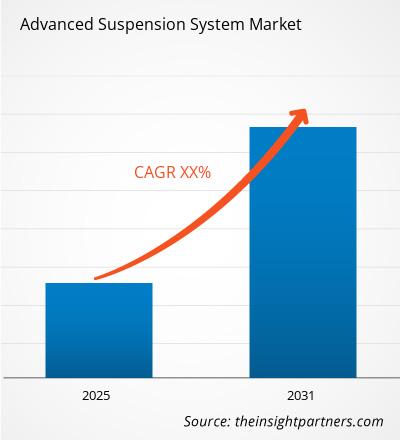
The Advanced suspension system market was valued at US$ 33.39 Billion in 2025 and is projected to reach US$ 53.80 Billion by 2034, expanding at a CAGR of 5.44% during 2026–2034. Market expansion is supported by increasing integration of electronically controlled damping systems, higher penetration of premium vehicles, and growing adoption of intelligent chassis technologies designed to improve ride comfort, safety, and vehicle handling across modern automotive platforms.
Across North America, demand remains supported by strong production of SUVs, pickup trucks, and premium passenger vehicles. The advanced suspension system market size in the region benefits from rapid deployment of adaptive suspension technologies in electric vehicles and growing investment in software-defined vehicle architectures. Regional demand is expected to advance at a CAGR range of 4.8–5.3% during the forecast period, supported by continuing innovation in ride-control systems.
Advanced Suspension System Market Assessment and Insights
- North America: Held approximately 32–34% share in 2025, supported by luxury vehicle demand, increasing SUV penetration, and strong adoption of electronically controlled suspension technologies. The region is expected to register a CAGR of 4.8–5.3% during 2026–2034.
- US: Accounted for 76–79% of North American demand in 2025, driven by premium vehicle production, growing EV deployment, and high consumer preference for ride comfort technologies. The market is anticipated to grow at 4.9–5.4% CAGR during 2026–2034.
- Europe: Represented 27–29% share in 2025, led primarily by Germany, the UK, and France. Strong automotive engineering capabilities and stringent vehicle safety standards are expected to support a CAGR of 4.7–5.2% during 2026–2034.
- Asia Pacific: Accounted for approximately 33–35% share in 2025, supported by large-scale vehicle production in China, Japan, South Korea, and India. Regional growth is forecast at 6.1–6.6% CAGR during 2026–2034.
- Largest Segment: Passenger Cars maintained approximately 72–75% market share in 2025, driven by premiumization trends and increasing adoption of comfort-oriented chassis systems. Expected CAGR is 5.2–5.7% during 2026–2034.
- High Growth Segment: CVSA accounted for approximately 42–45% market share in 2025 and is projected to expand at a CAGR of 6.0–6.5% during 2026–2034, supported by rising demand for real-time damping technologies.
- Key companies analyzed in detail: Continental AG, KYB Corporation, Marelli Holdings Co., Ltd., HL Mando Corporation, ZF Friedrichshafen AG, Tenneco Inc., Hitachi Astemo, Ltd., thyssenkrupp AG, BWI Group, Schaeffler AG.
Source: The Insight Partners' analysis based on proprietary research, government publications, company annual reports, investor presentations, industry databases, and expert interviews.
Continuous developments in automotive electronics and sensor technologies have accelerated the transition from passive suspension architectures toward software-controlled ride management systems. Modern suspension platforms increasingly integrate sensors, actuators, control units, and predictive software capable of adjusting damping characteristics in real time. Automotive manufacturers are integrating these systems to improve handling precision, passenger comfort, and operational safety while supporting the requirements of electric and connected vehicles.
Over the coming years, Advanced suspension system market expansion is expected to be influenced by growth in vehicle manufacturing across Asia, investments in electric mobility ecosystems, and increased adoption of autonomous driving functions. Regulatory focus on vehicle safety and passenger experience is encouraging automakers to incorporate intelligent chassis systems within both premium and upper mid-range platforms. These developments are likely to create attractive opportunities for technology providers and component manufacturers throughout the value chain.
Advanced Suspension System Market Report Scope
| Report Attribute | Details |
|---|---|
| Market size in 2025 | US$ 33.39 Billion |
| Market Size by 2034 | US$ 53.80 Billion |
| Global CAGR (2026 - 2034) | 5.44% |
| Historical Data | 2021-2024 |
| Forecast period | 2026-2034 |
Advanced Suspension System Market Analysis
The advanced suspension system market growth outlook remains closely tied to evolving consumer expectations related to ride quality, driving dynamics, and safety performance. Electrification is creating substantial demand for adaptive suspension solutions as battery-electric vehicles require advanced weight distribution management and enhanced chassis stability. Automakers increasingly deploy electronically controlled systems to improve cornering behavior, braking stability, and overall driving comfort. Simultaneously, advancements in sensors and control algorithms have improved the affordability and scalability of intelligent suspension technologies.
Beyond vehicle manufacturers, the broader ecosystem includes semiconductor suppliers, software developers, actuator manufacturers, and suspension component producers. Improvements in actuator performance, communication systems, and electronic control architecture are strengthening system capabilities while lowering integration complexity. As suspension functionality becomes increasingly software driven, suppliers are investing in modular architectures that can support multiple vehicle platforms and reduce development costs for original equipment manufacturers.
The advanced suspension system market analysis indicates a competitive environment characterized by strong emphasis on innovation, strategic partnerships, and platform integration capabilities. Companies such as Continental AG, ZF Friedrichshafen AG, HL Mando Corporation, and Hitachi Astemo, Ltd. continue investing in advanced motion-control technologies designed to support next-generation mobility requirements. Their product development strategies focus on enhancing vehicle responsiveness, predictive control capabilities, and compatibility with electric vehicle architectures.
Meanwhile, KYB Corporation, Tenneco Inc., Schaeffler AG, and thyssenkrupp AG continue strengthening their positions through expanded product portfolios and engineering investments. Marelli Holdings Co., Ltd. and BWI Group are actively pursuing opportunities related to intelligent damping systems and electromechanical suspension solutions. Competitive differentiation increasingly depends on software expertise, integration capabilities, and the ability to deliver scalable technologies that meet evolving vehicle performance requirements across global automotive markets.
● REPORT CUSTOMIZATION
Tailor This Report To Align With Your Specific Business Requirements
This report can be customized to align precisely with your business objectives, scope, and target markets. Customization options include tailored segmentation, geography, competitive analysis, and strategic insights to support informed decision-making.
Customize This Report →WHAT YOU CAN ADJUST
- ● Segmentations
- ● Geography
- ● Competitive Analysis
- ● Language Preferences
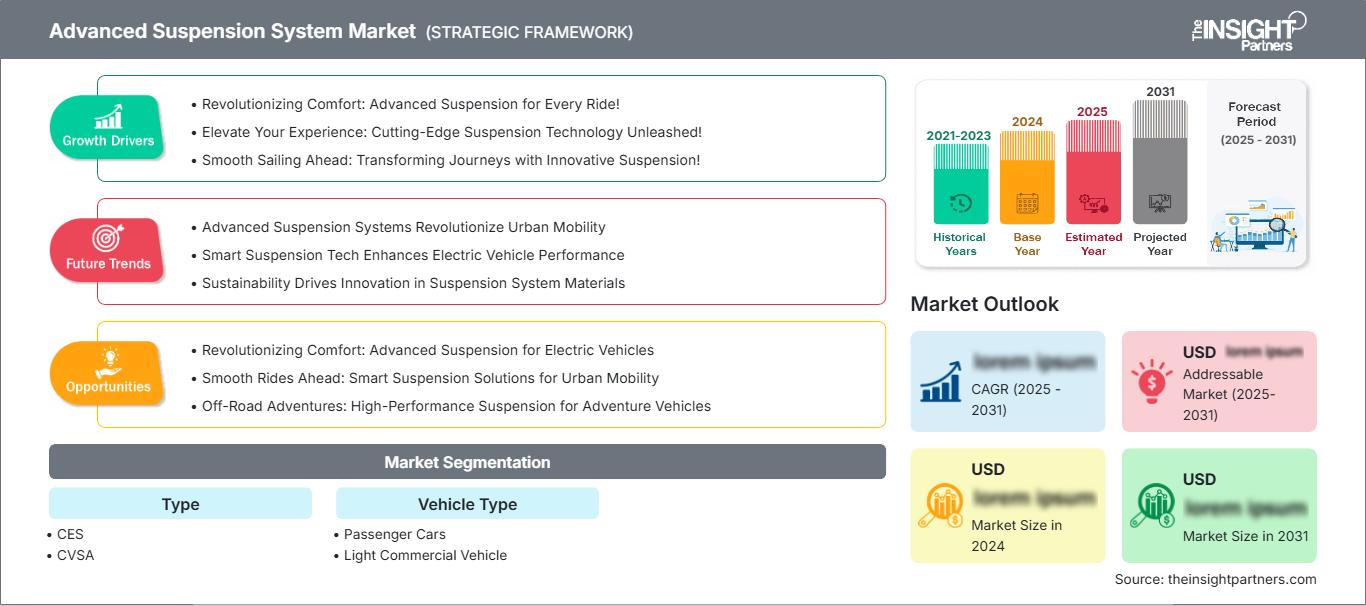
Advanced Suspension System Market: Strategic Insights
Regional Insights
North America Advanced Suspension System Market
North America accounted for an estimated 32–34% advanced suspension system market share in 2025. Demand is supported by substantial production of premium vehicles, luxury SUVs, and pickup trucks equipped with adaptive ride-control technologies. Vehicle manufacturers continue incorporating electronically controlled suspension systems to address increasing consumer expectations regarding comfort, handling precision, and safety performance. The accelerating shift toward electrification is also creating new opportunities for active and semi-active suspension solutions that improve weight management and vehicle stability. The regional market is expected to expand at a CAGR of 4.8–5.3% between 2026 and 2034.
The United States and Mexico remain important manufacturing centers for automotive production, enabling efficient integration of advanced chassis technologies within domestic and export-oriented vehicle programs. Increasing investment in intelligent mobility platforms, software-defined vehicles, and advanced driver assistance systems further supports technology adoption. As premium features continue moving into broader vehicle segments, demand for adaptive suspension systems is expected to remain resilient across North America throughout the forecast period.
U.S. Advanced Suspension System Market
The United States represents approximately 76–79% of total North American demand and is forecast to register a CAGR of 4.9–5.4% through 2034. Strong penetration of premium vehicles, luxury SUVs, and performance-oriented models continues supporting deployment of electronically controlled suspension technologies. Consumer demand increasingly favors vehicles delivering superior ride quality, reduced vibration, improved handling, and enhanced safety. The rapid expansion of battery-electric vehicle production further strengthens requirements for advanced chassis management systems capable of optimizing vehicle dynamics.
Several leading automotive manufacturers and tier-one suppliers maintain major engineering and development operations throughout the country, supporting continuous innovation in ride-control technologies. Demand remains particularly strong across premium passenger vehicles, electric crossovers, and high-performance automotive segments where handling characteristics directly influence purchasing decisions. The country's mature automotive ecosystem and strong research capabilities continue to reinforce its leading position within the regional Advanced suspension system market.
Europe Advanced Suspension System Market
Europe accounted for approximately 27–29% of global demand in 2025 and is anticipated to grow at a CAGR of 4.7–5.2% during the forecast period. Germany remains the dominant regional market due to its concentration of premium automotive manufacturers and advanced engineering expertise. The country continues investing in vehicle electrification, intelligent mobility, and high-performance chassis technologies that support broad adoption of active suspension systems. Strong emphasis on vehicle safety, efficiency, and comfort further reinforces deployment across passenger vehicle categories.
The United Kingdom maintains an important position through luxury vehicle manufacturing, motorsport-related engineering capabilities, and innovation in premium mobility solutions. France, Italy, and Spain collectively contribute through established automotive production networks, increasing electrification initiatives, and growing integration of advanced vehicle technologies. European regulatory frameworks emphasizing safety performance and reduced emissions continue encouraging manufacturers to adopt sophisticated suspension systems that improve vehicle dynamics while supporting broader electrification objectives.
APAC Advanced Suspension System Market
Asia Pacific held approximately 33–35% share of global revenue in 2025 and represents the largest regional market. China leads regional demand through extensive automotive manufacturing capacity and strong electric vehicle production, while Japan and South Korea contribute through advanced engineering and technology development. India continues emerging as a significant growth market. Regional CAGR is projected at 6.1–6.6% through 2034.
Government support for electric mobility, increasing vehicle ownership rates, and rising demand for premium passenger vehicles continue supporting market expansion. Localized manufacturing strategies and ongoing investments in intelligent automotive technologies further strengthen adoption of advanced suspension systems throughout the region.
Middle East & Africa Advanced Suspension System Market
The Middle East & Africa market remains comparatively smaller but is projected to expand at a CAGR of 4.2–4.7% through 2034. Saudi Arabia and the United Arab Emirates lead demand due to strong premium vehicle sales, expanding transportation infrastructure, and increasing investments in mobility modernization initiatives.
South Africa continues serving as a key automotive manufacturing center within the region. Growing interest in vehicle comfort technologies, fleet modernization efforts, and broader infrastructure development are expected to support progressive adoption of advanced suspension technologies across multiple vehicle categories.
Segmentation Analysis
Type
Type is projected to grow at a CAGR of 5.5–6.0% during 2026–2034. The advanced suspension system market scope continues expanding as vehicle manufacturers transition toward electronically controlled ride-management architectures capable of improving handling, safety, and passenger comfort. The adoption of such technologies is also being driven by the increasing adoption of chassis-control software, sensor-monitoring technology, and intelligent vehicle dynamics system. Growing electrification and the need for advanced driver assistance systems have made technologically superior suspension systems increasingly important.
- CES – Electronically controlled suspension solutions maintain strong adoption across premium and upper mid-range passenger vehicles due to their ability to optimize ride comfort while balancing cost, performance, and system complexity.
- CVSA – Continuously variable semi-active systems are increasingly deployed in electric vehicles and luxury platforms, supporting real-time damping adjustments, improved responsiveness, and enhanced vehicle stability under varying driving conditions.
Vehicle Type
Vehicle Type is expected to record a CAGR of 5.1–5.6% during 2026–2034. Auto makers are increasingly incorporating advanced suspension technologies into many different types of vehicles to ensure comfort and safety as well as to improve driving performance. Factors influencing demand include growing premiumization, vehicle electrification, and the desire for better ride quality from consumers. Whereas passenger cars have been more profitable, commercial use of smart suspension technologies has been gaining ground.
- Passenger Cars – The segment remains the largest contributor owing to widespread deployment of adaptive suspension systems in premium sedans, SUVs, crossovers, and electric vehicles focused on passenger comfort and dynamic performance.
- Light Commercial Vehicle – Adoption continues increasing as fleet operators seek improved vehicle control, reduced cargo movement, greater operational stability, and enhanced durability across urban and regional transportation applications.
Opportunity Snapshot
| Vehicle Type | Revenue Contribution | Trend Tag | Adoption Stage |
|---|---|---|---|
| Passenger Cars | High | Premium EVs | Mature |
| Light Commercial Vehicle | Medium | Fleet Stability | Scaling |
Advanced Suspension System Market Growth Drivers and Impact Analysis
Rapid Expansion of Electric Vehicle Production Worldwide
Electric vehicle deployment is transforming vehicle engineering priorities, creating sustained demand for advanced chassis and ride-control technologies. Battery packs alter vehicle weight distribution and increase overall vehicle mass, requiring suspension systems capable of maintaining handling balance, ride comfort, and operational stability. The use of high-performance suspension systems offers dynamic adjustment features that will enhance performance of the car while minimizing vibrations and body roll. As global auto producers increasingly offer a variety of EV models in their passenger and commercial vehicles, the need for electronically-controlled and semi-active suspension systems becomes more prominent. Transition to EV-specific architectures provides additional space for suppliers to develop suspension systems specially tailored for EVs. This development trend will favor sustained investments in the automotive components industry.
Increasing Integration of Vehicle Safety and Driver Assistance Technologies
Advanced driver assistance systems rely on vehicle stability, predictable steering behavior, and effective road contact to achieve optimal performance. Modern suspension technologies contribute directly to these outcomes by improving wheel control, braking efficiency, and handling characteristics across a wide range of operating conditions. Automotive manufacturers increasingly integrate ride-control systems with sensors, cameras, electronic control units, and vehicle dynamics software. Such convergence improves the safety performance as well as makes it easier for automated driving technologies to operate smoothly. With regulatory agencies becoming increasingly focused on vehicle safety and collision prevention, the suspension technology is changing from being simply mechanical to becoming a crucially important technology for control purposes. Thus, the adoption of such advanced solutions becomes more rapid.
Growth of Premium and Comfort-Oriented Vehicle Demand
Consumer preferences continue shifting toward vehicles that provide superior comfort, reduced noise and vibration, and enhanced driving refinement. Premium suspension technologies have consequently evolved into important differentiators for vehicle manufacturers seeking to strengthen product positioning and customer satisfaction. Adaptive damping systems, active ride control systems, and intelligent chassis systems provide noticeable benefits in terms of passenger comfort as well as more control at increased speeds. Requirements go beyond that of luxury cars as highly developed comfort systems are increasingly finding their way into other automotive segments. Automotive makers are using such systems to create unique driving performance and add more value to vehicles. Global growth in sales of premium cars will drive ongoing need for high-performance suspension systems.
Advanced Suspension System Market Future Trends
Predictive Suspension Systems Powered by Real-Time Data
The advanced suspension system market trends indicate a movement toward predictive ride-control technologies capable of analyzing road conditions before the vehicle encounters them. In future, it is anticipated that such systems will be developed to include cameras, sensors, navigational data, intelligent algorithms, and cloud connectivity to anticipate any surface imperfections and make real-time changes to the suspension system. This technology could increase the comfort of passengers, prevent wear and tear of components, and improve safety performance of the vehicle. With the growing availability of processing power and increasing acceptance of software defined vehicles, there will definitely be an increase in the number of vehicles equipped with predictive suspension technologies.
Transition Toward Electromechanical Suspension Architectures
Future vehicle platforms are expected to incorporate greater use of electromechanical suspension technologies that offer faster response times, reduced maintenance requirements, and improved energy efficiency compared with conventional hydraulic solutions. These systems make it possible to achieve accurate control at a wheel level, and they provide enhanced vehicle dynamics capabilities while operating under different circumstances. Moreover, electromechanical systems complement other initiatives of automotive electrification by lowering the dependence on mechanical subsystems. With the fall in costs and scaling up of production processes, full-scale commercial implementation of active suspension systems can be expected. It opens the door for vendors dealing with software and motion-control solutions, actuators, etc.
Advanced Suspension System Market Opportunities
Localization Strategies in Emerging Automotive Manufacturing Centers
Growing automotive investments in India, Southeast Asia, Eastern Europe, and selected Middle Eastern economies are creating attractive expansion pathways for suspension technology suppliers. Vehicle manufacturers increasingly seek localized sourcing networks to improve supply chain resilience, control costs, and reduce procurement lead times. Advanced suspension system market Forecasts indicate that future vehicle production growth will be concentrated in regions receiving significant investments in electric mobility and advanced manufacturing infrastructure. Suppliers who set up engineering centers, testing facilities, and manufacturing capacity within regional locations are better equipped to forge stronger ties with global and local automobile manufacturers. Localization also allows for customizing suspension technology according to regional driving needs, regulations, and consumer preferences. Such an approach is well-positioned to create future revenue streams in a diversified global production system.
Software-Enabled Performance and Lifecycle Service Models
With the increased adoption of intelligent suspension technology within the software architecture of vehicles, there will be greater possibilities for suppliers to build ongoing revenues from software sales, in addition to hardware sales. The future generation of vehicles is likely to incorporate features like over-the-air updates, predictive maintenance capability, and software packages for performance optimization. Comfort, economy, towability, or sport calibration programs could be delivered digitally for the full life of the car. This move opens up possibilities of leveraging software assets, along with enhanced customer experience and added value for the product. Companies that focus on developing capabilities in data analysis, remote diagnostics, and a connected car ecosystem can build unique services that could prove to be profitable and relevant beyond initial sales stage.
Frequently Asked Questions

- Comprehensive Market Sizing and Forecast Analysis
- Detailed Segmentation Analysis
- In-Depth Market Dynamics Assessment
- Regional and Country-Level Insights
- Competitive Landscape and Company Benchmarking
- Strategic Business Intelligence
Recent Reports
Testimonials

The Insight Partners provided valuable market intelligence that supported our global go-to-market strategy. Their team was professional, responsive, and attentive to our feedback, providing thoughtful analysis and helpful methodological clarifications throughout the project.
Junmo Kim Chief Financial Officer (CFO), Enertech Co., Ltd.
The Insight Partners' SCADA System Market report is comprehensive, with valuable insights on current trends and future forecasts. The team was highly professional, responsive, and supportive throughout. We are very satisfied and highly recommend their services.
RAN KEDEM Partner, Reali Technologies LTDs
I requested a report on a very specific software market and the team produced the report in a few days. The information was very relevant and well presented. I then requested some changes and additions to the report. The team was again very responsive and I got the final report in less than a week.
JEAN-HERVE JENN Chairman, Future Analytica
We worked with The Insight Partners for an important market study and forecast. They gave us clear insights into opportunities and risks, which helped shape our plans. Their research was easy to use and based on solid data. It helped us make smart, confident decisions. We highly recommend them.
PIYUSH NAGPAL Sr. Vice President, High Beam Global
The Insight Partners delivered insightful, well-structured market research with strong domain expertise. Their team was professional and responsive throughout. The user-friendly website made accessing industry reports seamless. We highly recommend them for reliable, high-quality research services
YUKIHIKO ADACHI CEO, Deep Blue, LLC.
This is the first time I have purchased a market report from The Insight Partners.While I was unsure at first, I visited their web site and felt more comfortable to take the risk and purchase a market report.I am completely satisfied with the quality of the report and customer service. I had several questions and comments with the initial report, but after a couple of dialogs over email with their analyst I believe I have a report that I can use as input to our strategic planning process.Thank you so much for taking the extra time and making this a positive experience.I will definitely recommend your service to others and you will be my first call when we need further market data.
JOHN SUZUKI President and Chief Executive Officer, Board Director, BK Technologies
I wish to appreciate your support and the professionalism you displayed in the course of attending to my request for information regarding to infectious disease IVD market in Nigeria. I appreciate your patience, your guidance, and the fact that you were willing to offer a discount, which eventually made it possible for us to close a deal. I look forward to engaging The Insight Partners in the future, all thanks to the impression you have created in me as a result of this first encounter.
DR CHIJIOKE ONYIA MANAGING DIRECTOR, PineCrest Healthcare Ltd.Reason to Buy
- Informed Decision-Making
- Understanding Market Dynamics
- Competitive Analysis
- Identifying Emerging Markets
- Customer Insights
- Market Forecasts
- Risk Mitigation
- Boosting Operational Efficiency
- Strategic Planning
- Investment Justification
- Tracking Industry Innovations
- Aligning with Regulatory Trends





 Get Free Sample for