
AI in Gaming Market Share, Size & Demand by 2034
AI in Gaming Market Size and Forecast (2021 - 2034), Global and Regional Share, Trend, and Growth Opportunity Analysis Report Report Coverage : by Component (Hardware, Software and Services), Technology (Machine learning/Deep learning, Generative AI, Natural Language Learning ), Application (Non-Player Character (NPC) Behavior / Character AI, Game Development & Design, Game Testing & Quality Assurance (QA) Automation:, Gameplay Optimization / Player Experience, Cheat Detection & Fraud Prevention), Platform(Mobile games, PC & Console Games, Cloud / VR & AR Games) Game Genre (Action & Adventure, Role-Playing Games , Strategy Games, Simulation, Puzzle and Casual Games)and Geography
- Status : Data Released
- Report Code : TIPRE00042037
- Category : Technology, Media and Telecommunications
- No. of Pages : 150
- Available Report Formats :


- Last update date : August 11, 2026


2025 Market Size
US$ 6.22 Bn
Base year value
2034 Forecast
US$ 70.66 Bn
Projected by 2034
CAGR 2026-2034
31.00 %
Growth rate
Addressable Market
US$ 272.35 Bn
(2026-2034)
The AI in gaming market size stood at US$ 6.22 Billion in 2025 and is predicted to grow to a value of US$ 70.66 Billion by 2034, registering a CAGR of 31.00% between 2026–2034. The market growth is due to innovations in areas like generative AI, machine learning, real-time analytics, and AI-driven content creation technologies. Usage of AI in development, engagement, content production, and monetization is increasing fast in major game publishing firms and independent studios.
In North America, the consistent effort towards cloud gaming infrastructure, graphic processing capability, and AI research ecosystem is driving growth. The market size in North America will benefit from the adoption of live service gaming model and high penetration of technology vendors in the region. The market is expected to grow at a CAGR range of 28–31% until 2034.
AI in Gaming Market Assessment and Insights
- North America: Accounted for 36–39% share in 2025 and is anticipated to grow at a CAGR of 28–31% during 2026–2034, supported by high gaming expenditure, AI innovation ecosystems, and strong publisher investment.
- US: Represented 78–82% of North American revenue in 2025 and is expected to record a CAGR of 29–32% during 2026–2034, driven by AI-enabled game production and cloud-based gaming services.
- Europe: Held 24–27% share in 2025 and is projected to expand at a CAGR of 27–30% during 2026–2034. Germany, the UK, and France remain leading contributors.
- Asia Pacific: Captured 28–31% share in 2025 and is forecast to grow at a CAGR of 33–36% during 2026–2034, led by China, Japan, South Korea, and India.
- Largest Segment: Software accounted for 48–52% market share in 2025 and is expected to grow at a CAGR of 30–33% during 2026–2034 due to increasing deployment of AI engines and development platforms.
- High Growth Segment: Generative AI represented 22–26% market share in 2025 and is projected to advance at a CAGR of 35–38% during 2026–2034 as studios automate content creation processes.
- Key companies analyzed in detail: NVIDIA Corporation, Microsoft Corporation, Sony Interactive Entertainment LLC, Ubisoft Entertainment SA, Tencent Holdings Limited, NetEase, Inc., Google LLC, Electronic Arts Inc., Unity Technologies, Inc., Activision Blizzard, Inc.
Source: The Insight Partners' analysis based on proprietary research, government publications, company annual reports, investor presentations, industry databases, and expert interviews.
The fast development of neural networks, real-time rendering, procedural generation, and intelligent automation has revolutionized the game development process. Game publishers have been increasingly adopting AI technologies to design adaptive games, conduct automated testing, enhance player engagement, and improve monetization tactics. The availability of generative AI software has cut down the game development process time, allowing better content production on different gaming platforms.
In the future, increased funding in new gaming markets, improvements of cloud computing infrastructure, and digital economy initiatives will contribute to further penetration of AI in the market. The effective funding of computing platforms that use AI together with growing interest in virtual reality is creating the conditions for continued growth of the industry.
AI in Gaming Market Report Scope
| Report Attribute | Details |
|---|---|
| Market size in 2025 | US$ 6.22 Billion |
| Market Size by 2034 | US$ 70.66 Billion |
| Global CAGR (2026 - 2034) | 31.00% |
| Historical Data | 2021-2024 |
| Forecast period | 2026-2034 |
AI in Gaming Market Analysis
Factors influencing the evolution of the growth trajectory of AI in gaming include a growing demand for personalized services, intelligent NPCs, and automation of the development process. Gaming companies have begun to implement the use of AI at every stage of the value chain including content creation, game concept development, player engagement, and anti-fraud solutions. Cloud development environments further allow the scaling of the more complex AI models.
Machine learning technology is used for behavioral analysis, matchmaking, player segmentation, and revenue management among other applications. Improvements in graphics processing units, dedicated AI hardware accelerators, and cloud computing infrastructure contribute to creating a stronger ecosystem.
The competitive environment is still very vibrant. In terms of the AI in Gaming Market Analysis, it shows that there is ongoing investment from NVIDIA Corporation in AI-based gaming platforms, from Microsoft Corporation in gaming assistants and from Unity Technologies, Inc. in AI-based development tools. Sony Interactive Entertainment LLC and Electronic Arts Inc. are continuing to invest in AI for their content development and engagement initiatives.
The strategic partnership of the gaming companies with cloud service providers is also contributing to the advancement of the technology in the industry. The ongoing investment from Tencent Holdings Limited, NetEase, Inc., Activision Blizzard, Inc., Ubisoft Entertainment SA and Google LLC in data-based gaming ecosystems is also evident.
● REPORT CUSTOMIZATION
Tailor This Report To Align With Your Specific Business Requirements
This report can be customized to align precisely with your business objectives, scope, and target markets. Customization options include tailored segmentation, geography, competitive analysis, and strategic insights to support informed decision-making.
Customize This Report →WHAT YOU CAN ADJUST
- ● Segmentations
- ● Geography
- ● Competitive Analysis
- ● Language Preferences
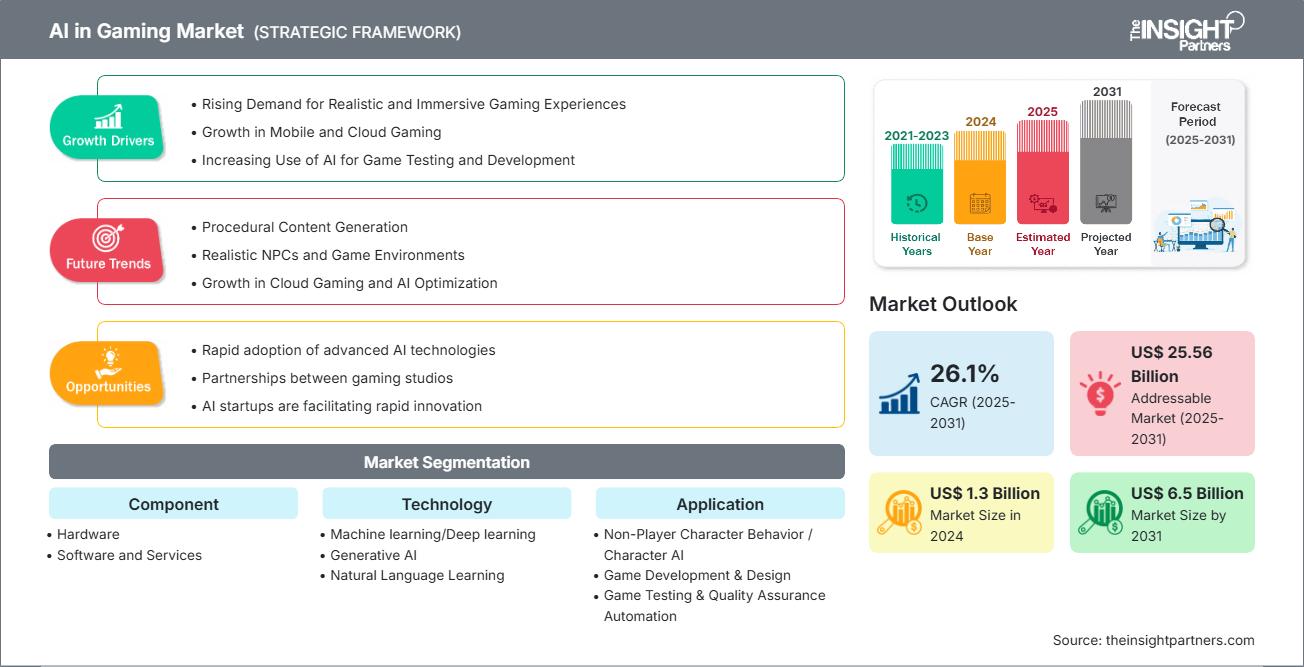
AI in Gaming Market: Strategic Insights
Regional Insights
North America AI in gaming Market
North America accounted for approximately 36–39% of global revenue in 2025 and is expected to register a CAGR of 28–31% through 2034. Strong digital infrastructure, advanced semiconductor capabilities, and high consumer spending on premium gaming experiences continue to support regional expansion. The AI in gaming market share remains highest in this region due to concentration of major platform providers and AI innovators.
The regional ecosystem benefits from extensive cloud adoption and rising integration of generative AI into development workflows. Investments in AI computing infrastructure, coupled with increasing deployment of live-service business models, support continued implementation of intelligent game design, automated testing, and personalized player engagement solutions.
U.S. AI in gaming Market
The United States represented approximately 78–82% of North American revenue in 2025 and is projected to grow at a CAGR of 29–32% through 2034. Strong presence of Microsoft Corporation, NVIDIA Corporation, Google LLC, Unity Technologies, Inc., and Electronic Arts Inc. contributes to innovation and commercialization of AI-enabled gaming technologies.
Widespread adoption of cloud gaming, esports, subscription-based services, and player analytics platforms continues to fuel demand. Publishers increasingly deploy AI across gameplay optimization, NPC intelligence, recommendation systems, and automated content generation, reinforcing the country's leadership position within the regional market.
Europe AI in gaming Market
Europe accounted for around 24-27% of world-wide revenue during 2025 and will grow with a CAGR of 27-30% until 2034. The United Kingdom continues to be one of the significant hubs for development studios and AI initiatives. Germany profits from the well-developed game industry along with the growth in investments into digital innovations.
France, Italy, and Spain continue observing increased implementation of AI-based tools for development and engagement. Ubisoft Entertainment SA still continues its contribution to innovation activities in the region. The growing emphasis on digital competitiveness and responsible deployment of AI ensures further expansion of the region’s gaming market.
APAC AI in gaming Market
Asia Pacific accounted for 28–31% of global revenue in 2025 and is forecast to record a CAGR of 33–36% through 2034. China remains the largest regional market, supported by Tencent Holdings Limited and NetEase, Inc., while Japan and South Korea maintain strong technology adoption rates.
India and Australia continue attracting investment in mobile gaming and cloud-based entertainment. Expanding digital populations, smartphone penetration, and AI innovation programs are expected to support regional growth throughout the forecast period.
Middle East & Africa AI in gaming Market
The Middle East & Africa market is anticipated to expand at a CAGR of 25–28% through 2034. Saudi Arabia and the UAE are increasing investment in gaming, esports, and digital infrastructure strategies aligned with broader economic diversification efforts.
South Africa represents a developing hub for digital entertainment adoption. Improved connectivity, cloud infrastructure deployment, and government-backed technology initiatives are expected to strengthen the role of AI-enabled gaming solutions across the region.
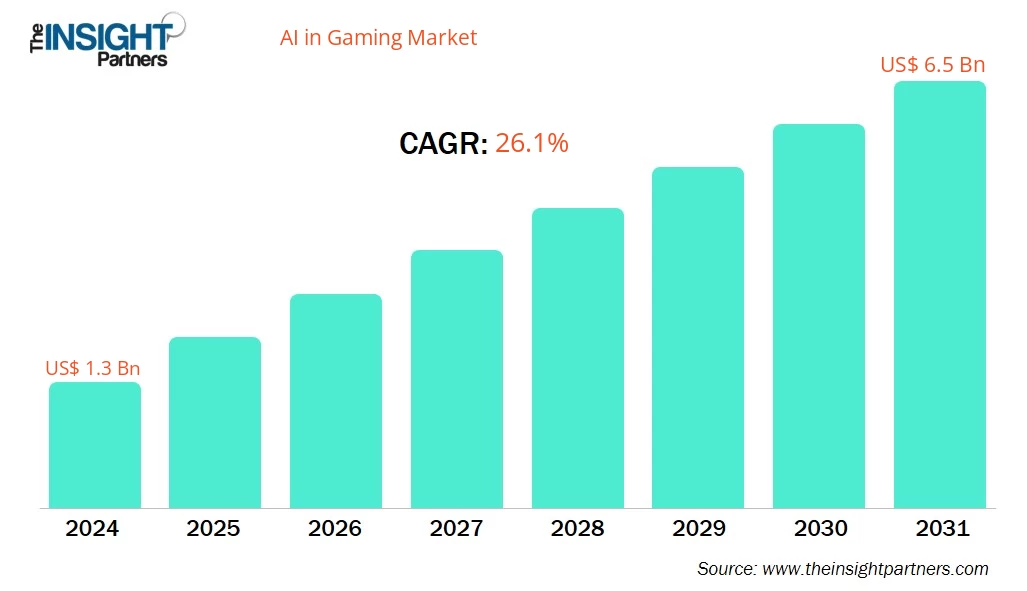
Segmentation Analysis
Component
The Software category leads revenue generation owing to widespread deployment of AI engines, development platforms, analytics systems, and content generation tools. The segment is projected to expand at a CAGR of 30–33%. The AI in gaming market scope continues widening as software solutions become central to gameplay optimization, testing automation, and adaptive content delivery.
- Hardware: Advanced GPUs and AI accelerators support real-time inference, rendering enhancement, and sophisticated gameplay experiences across gaming platforms.
- Software: Core enabler of intelligent gameplay, procedural generation, analytics, and content development workflows across publishers and developers.
- Services: Includes implementation, integration, consulting, maintenance, and optimization services supporting enterprise-scale AI deployment.
Technology
Technology innovation remains the foundation of market development. This segment is forecast to grow at a CAGR of 32–35% through 2034 as developers implement increasingly sophisticated AI architectures to improve immersion and operational efficiency.
- Machine learning/Deep learning: Supports predictive analytics, gameplay balancing, recommendation engines, and adaptive behavioral systems.
- Generative AI: Enables automated asset generation, narrative creation, dialogue development, and accelerated production workflows.
- Natural Language Learning: Facilitates conversational interaction, voice engagement, and intelligent communication between players and virtual characters.
Application
Application expansion continues driving revenue growth and is expected to register a CAGR of 33–36% during the forecast period. Demand is increasing as publishers seek measurable improvements in productivity, engagement, and player retention.
- Non-Player Character Behavior / Character AI: Enhances realism through adaptive decision-making, contextual responses, and evolving interactions.
- Game Development & Design: Accelerates content creation and creative iteration while reducing development costs.
- Game Testing & Quality Assurance Automation: Improves efficiency through automated bug detection and performance validation.
- Gameplay Optimization / Player Experience: Uses analytics and personalization models to increase engagement and satisfaction.
- Cheat Detection & Fraud Prevention: Strengthens security through anomaly detection and behavioral monitoring capabilities.
Platform
Platform diversification is expected to support a CAGR of 31–34% through 2034 as AI capabilities become embedded across gaming ecosystems.
- Mobile games: Benefit from broad consumer reach, behavioral analytics, and personalized engagement mechanisms.
- PC & Console Games: Maintain strong demand for advanced AI-driven rendering, immersion, and gameplay experiences.
- Cloud / VR & AR Games: Represent an increasingly important area for real-time intelligence and immersive interactions.
Opportunity Snapshot
| Application | Revenue Contribution | Trend Tag | Adoption Stage |
|---|---|---|---|
| Non-Player Character Behavior / Character AI | High | Smart NPCs | Scaling |
| Game Development & Design | High | Asset Gen | Scaling |
| Game Testing & Quality Assurance Automation | Medium | Auto QA | Scaling |
| Gameplay Optimization / Player Experience | High | Live Personalization | Mature |
| Cheat Detection & Fraud Prevention | Medium | Behavior Security | Scaling |
AI in Gaming Market Growth Drivers and Impact Analysis
Expansion of Generative Content Creation
Generative AI is increasingly reducing content production timelines across asset design, animation, narrative development, and dialogue generation. Studios can create larger volumes of interactive content with fewer resource constraints, improving efficiency while supporting complex gaming environments. This capability is particularly valuable for live-service titles that require continuous content updates. As computational costs decline and model performance improves, broader adoption across independent and large publishers is expected to accelerate commercial deployment.
Demand for Personalized Gameplay Experiences
Player expectations continue shifting toward individualized experiences. AI-driven analytics enable developers to customize challenges, recommendations, reward systems, and engagement strategies. Sophisticated behavioral modeling enhances retention and monetization outcomes while improving overall satisfaction. Growing competition within the gaming industry makes personalization a critical differentiator, encouraging vendors to invest in advanced machine learning capabilities that support real-time adaptation.
Growth of Cloud Gaming Infrastructure
Cloud-based gaming ecosystems provide scalable environments capable of supporting AI-intensive processing requirements. Improved connectivity, data availability, and distributed computing resources allow publishers to deploy advanced intelligence capabilities without dependency on local hardware. As gaming increasingly transitions toward service-oriented delivery models, cloud infrastructure will play a central role in enabling AI-powered innovation and broader accessibility.
AI in Gaming Market Future Trends
Rise of Autonomous AI Characters
The AI in gaming market trends increasingly point toward autonomous virtual characters capable of perception, reasoning, memory retention, and contextual decision-making. Future gaming environments are expected to feature dynamic interactions where characters adapt continuously to player behavior. This evolution could significantly influence narrative structures, engagement models, and long-term user retention while creating opportunities for entirely new gameplay formats and persistent digital worlds.
Integration of Multimodal Intelligence
Future development efforts are expected to combine voice, text, visual recognition, and behavioral interpretation within unified AI frameworks. These capabilities will allow games to understand player intent more accurately and respond in increasingly natural ways. Multimodal intelligence may ultimately become a foundational element of immersive gaming experiences spanning mobile, console, cloud, VR, and AR environments.
AI in Gaming Market Opportunities
Commercial Expansion Across Emerging Markets
The growing accessibility of smartphones, cloud services, and digital payment systems creates significant potential across developing gaming economies. AI in gaming market Forecasts indicate that publishers investing early in localized content, adaptive engagement systems, and scalable cloud-based architectures may gain competitive advantages. These markets provide opportunities for expanding user acquisition while optimizing development investments through AI-driven personalization capabilities.
AI-Native Development Platforms
Development environments built specifically around AI workflows represent a substantial investment opportunity. Integrated capabilities for content generation, automated testing, design assistance, and live operational analytics can reshape production economics. Vendors offering comprehensive platforms that simplify adoption for developers are likely to benefit from increasing demand as AI becomes embedded throughout the game development lifecycle.
Frequently Asked Questions

- Comprehensive Market Sizing and Forecast Analysis
- Detailed Segmentation Analysis
- In-Depth Market Dynamics Assessment
- Regional and Country-Level Insights
- Competitive Landscape and Company Benchmarking
- Strategic Business Intelligence
Recent Reports
Testimonials

The Insight Partners' SCADA System Market report is comprehensive, with valuable insights on current trends and future forecasts. The team was highly professional, responsive, and supportive throughout. We are very satisfied and highly recommend their services.
RAN KEDEM Partner, Reali Technologies LTDs
I requested a report on a very specific software market and the team produced the report in a few days. The information was very relevant and well presented. I then requested some changes and additions to the report. The team was again very responsive and I got the final report in less than a week.
JEAN-HERVE JENN Chairman, Future Analytica
We worked with The Insight Partners for an important market study and forecast. They gave us clear insights into opportunities and risks, which helped shape our plans. Their research was easy to use and based on solid data. It helped us make smart, confident decisions. We highly recommend them.
PIYUSH NAGPAL Sr. Vice President, High Beam Global
The Insight Partners delivered insightful, well-structured market research with strong domain expertise. Their team was professional and responsive throughout. The user-friendly website made accessing industry reports seamless. We highly recommend them for reliable, high-quality research services
YUKIHIKO ADACHI CEO, Deep Blue, LLC.
This is the first time I have purchased a market report from The Insight Partners.While I was unsure at first, I visited their web site and felt more comfortable to take the risk and purchase a market report.I am completely satisfied with the quality of the report and customer service. I had several questions and comments with the initial report, but after a couple of dialogs over email with their analyst I believe I have a report that I can use as input to our strategic planning process.Thank you so much for taking the extra time and making this a positive experience.I will definitely recommend your service to others and you will be my first call when we need further market data.
JOHN SUZUKI President and Chief Executive Officer, Board Director, BK Technologies
I wish to appreciate your support and the professionalism you displayed in the course of attending to my request for information regarding to infectious disease IVD market in Nigeria. I appreciate your patience, your guidance, and the fact that you were willing to offer a discount, which eventually made it possible for us to close a deal. I look forward to engaging The Insight Partners in the future, all thanks to the impression you have created in me as a result of this first encounter.
DR CHIJIOKE ONYIA MANAGING DIRECTOR, PineCrest Healthcare Ltd.Reason to Buy
- Informed Decision-Making
- Understanding Market Dynamics
- Competitive Analysis
- Identifying Emerging Markets
- Customer Insights
- Market Forecasts
- Risk Mitigation
- Boosting Operational Efficiency
- Strategic Planning
- Investment Justification
- Tracking Industry Innovations
- Aligning with Regulatory Trends





 Get Free Sample for