
Air Brake System Market Trends, Demand & Growth by 2034
Coverage: by Brake Type (Disc Brake, and Drum Brake), Component (Compressor, Tank, Air Dryer, Gauges, Valves, and Others), and End-users (Heavy-Duty Vehicles, Semi-Trailer & Trailers, Commercial Vehicles, and Others), and Geography (North America, Europe, Asia Pacific, and South and Central America)
- Status : Data Released
- Report Code : TIPMC00002731
- Category : Automotive and Transportation
- No. of Pages : 150
- Available Report Formats :


- Last update date : August 12, 2026


2025 Market Size
US$ 5.22 Bn
Base year value
2034 Forecast
US$ 8.49 Bn
Projected by 2034
CAGR 2026-2034
5.55 %
Growth rate
Addressable Market
US$ 62.15 Bn
(2026-2034)
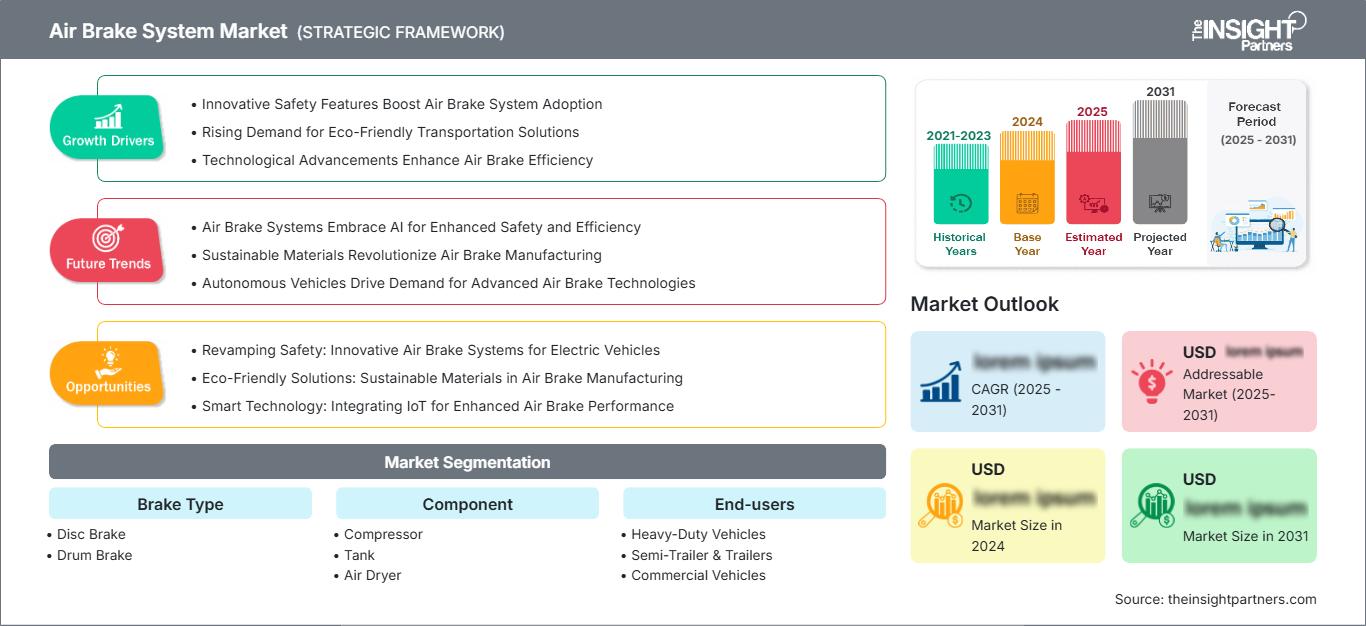
The air brake system market was valued at US$ 5.22 Billion in 2025 and is projected to reach US$ 8.49 Billion by 2034, expanding at a CAGR of 5.55% during 2026–2034. Growth is supported by increasing production of heavy commercial vehicles, stricter braking safety regulations, and broader deployment of pneumatic braking technologies in trucks, buses, trailers, and off-highway transportation equipment. Continuous advancements in brake efficiency, electronic integration, and fleet safety systems are strengthening long-term market prospects.
Across North America, demand remains supported by freight transportation activity, replacement cycles for aging truck fleets, and adoption of air disc brake technologies. The air brake system market size in the region continues to benefit from regulatory emphasis on vehicle safety and maintenance compliance. Regional growth is expected to remain within a mid-single-digit CAGR range through 2034, backed by investments in logistics networks and commercial vehicle modernization programs.
Air Brake System Market Assessment and Insights
- North America: Share in 2025: 30–34%; CAGR between 2026–2034: 4.8–5.4%. Mature fleet infrastructure, strong aftermarket demand, and safety regulations support steady expansion.
- US: Share in 2025: 72–76% of North America; CAGR between 2026–2034: 4.9–5.5%. Heavy truck production and logistics fleet upgrades remain key demand contributors.
- Europe: Share in 2025: 26–30%; CAGR between 2026–2034: 4.6–5.2%. Germany, the UK, and France lead adoption through advanced commercial vehicle manufacturing and safety compliance requirements.
- Asia Pacific: Share in 2025: 32–36%; CAGR between 2026–2034: 6.4–7.0%. China, Japan, India, and South Korea drive growth through fleet expansion and infrastructure development.
- Largest Segment: Commercial Vehicles with market share of 42–46% in 2025 and CAGR of 5.3–5.9% during 2026–2034 owing to broad deployment across logistics and transportation fleets.
- High Growth Segment: Disc Brake with market share of 34–38% in 2025 and CAGR of 6.4–7.0% during 2026–2034 due to higher braking efficiency and lower maintenance requirements.
- Key companies analyzed in detail: Wabtec Corporation, Haldex AB, Meritor, Inc., WABCO, Knorr-Bremse AG, Federal-Mogul Corporation, Nabtesco Corporation, SORL Auto Parts, Inc., TSE Brakes, Inc., ZF Friedrichshafen AG.
Source: The Insight Partners' analysis based on proprietary research, government publications, company annual reports, investor presentations, industry databases, and expert interviews.
Markets are evolving from pneumatic braking systems into those that are integrated and provide electronic controls, diagnostics, and better response of the brakes. The emphasis is being placed on making braking systems more reliable, maintenance efficient, and more compatible with fleet management. The rising number of trucks, buses, and trailers produced around the world will drive this market.
The future growth in the market will come from logistics in Asia, investments in the infrastructure of developing countries, and regulations that affect commercial vehicle safety. Operators will emphasize lifecycle costs, thus providing an opening for air disc brakes, intelligent valves, and predictive maintenance technologies.
Air Brake System Market Report Scope
| Report Attribute | Details |
|---|---|
| Market size in 2025 | US$ 5.22 Billion |
| Market Size by 2034 | US$ 8.49 Billion |
| Global CAGR (2026 - 2034) | 5.55% |
| Historical Data | 2021-2024 |
| Forecast period | 2026-2034 |
Air Brake System Market Analysis
The air brake system market growth trajectory is supported by expanding freight movement, rising commercial vehicle utilization, and stricter transportation safety requirements. Air brake systems continue to be the dominant brake system type in heavy-duty vehicles due to their consistent ability to stop under high-load conditions. Moreover, supply is further stimulated by rising vehicle parc in developing countries where logistics upgrades are taking place, driving rapid growth in fleets.
The supply chains from compressors to tanks, dryers, valves, and brakes are becoming more technically advanced. Suppliers of components are focusing on increased durability, anti-corrosion capabilities, and compatibility with electronic brakes. Thus, OEs increasingly incorporate advanced air brake systems in new and replacement programs.
The air brake system market analysis highlights a competitive landscape characterized by global technology specialists, braking component manufacturers, and integrated vehicle system suppliers. Knorr-Bremse AG, ZF Friedrichshafen AG, WABCO, and Haldex AB are some of the companies that are making continuous innovations in the technology of intelligent brakes that enhance safety and operational efficiency.
The trend is seen to be moving towards investment in air disc brakes, digital diagnostics, and connectivity features. The efforts being made by Wabtec Corporation, Meritor, Inc., and Nabtesco Corporation involve innovation of products and geographical expansion.
● REPORT CUSTOMIZATION
Tailor This Report To Align With Your Specific Business Requirements
This report can be customized to align precisely with your business objectives, scope, and target markets. Customization options include tailored segmentation, geography, competitive analysis, and strategic insights to support informed decision-making.
Customize This Report →WHAT YOU CAN ADJUST
- ● Segmentations
- ● Geography
- ● Competitive Analysis
- ● Language Preferences
Air Brake System Market: Strategic Insights
Regional Insights
North America air brake system market
North America accounted for 30–34% of the global market in 2025 and is projected to expand at a 4.8–5.4% CAGR through 2034. The region benefits from established freight transportation networks, strong commercial vehicle production, and stringent braking performance standards. Fleet operators continue to invest in replacement components, air dryers, compressors, and brake modernization programs to improve safety and uptime.
The air brake system market share in North America remains supported by rising trailer registrations and increasing demand for air disc brake technologies in long-haul trucking applications. Regulatory enforcement regarding vehicle inspection and maintenance standards encourages ongoing replacement demand. Growth is additionally supported by e-commerce logistics requirements and infrastructure spending across transportation corridors.
U.S. air brake system market
The United States represents approximately 72–76% of the North American market and is expected to register a 4.9–5.5% CAGR through 2034. High heavy-truck production volumes, extensive freight activity, and advanced fleet management practices contribute significantly to regional demand. Replacement demand remains an important revenue source.
Major technology providers maintain strong manufacturing, engineering, and distribution operations across the country. Air disc brakes, intelligent pneumatic systems, and predictive maintenance solutions are gaining adoption among large fleet operators. Investments in logistics, construction, and trucking industries continue to support stable demand across primary component categories.
Europe air brake system market
Europe accounted for 26–30% of the global market in 2025 and is anticipated to expand at a 4.6–5.2% CAGR. Germany remains the leading country due to its commercial vehicle manufacturing ecosystem and concentration of braking technology suppliers. Regulatory emphasis on road safety and emissions efficiency supports advanced braking system adoption.
The UK market benefits from fleet renewal programs and growing adoption of air disc brakes in commercial transport applications. Germany continues to lead innovation through strong engineering capabilities and established OEM partnerships. France, Italy, and Spain collectively contribute significant demand through logistics, construction, and public transportation vehicle fleets, supporting consistent regional expansion.
APAC air brake system market
Asia Pacific represented 32–36% of the global market in 2025 and is forecast to grow at a 6.4–7.0% CAGR, the strongest among major regions. China remains the dominant market due to its extensive commercial vehicle manufacturing base, growing freight transportation activity, and continued investment in logistics infrastructure.
India, Japan, South Korea, and Australia continue investing in transportation infrastructure, fleet modernization programs, and vehicle safety initiatives, supporting demand for advanced braking technologies. Rapid industrialization, expanding e-commerce logistics networks, and increasing commercial vehicle sales are creating substantial opportunities for pneumatic braking systems across both OEM and aftermarket channels. Additionally, regulatory emphasis on vehicle safety and operational reliability is encouraging broader adoption of high-performance braking solutions throughout the region.
Middle East & Africa air brake system market
The Middle East and Africa market is projected to expand at a 5.2–5.8% CAGR through 2034. Countries like Saudi Arabia and the UAE are enjoying the advantages of large-scale infrastructure development projects, logistics investments, and vehicle fleet growth owing to economic diversification programs. These trends will be responsible for the growth in the demand for high-quality and effective braking systems.
The country, like South Africa, still holds a leading position in terms of transportation and logistics in the region. Other countries will slowly but steadily adopt high-technology braking systems in order to enhance vehicle safety and efficiency. The growth will be further fuelled due to the growth in construction, mining, transportation, freight networks, and logistics infrastructure development programs. The increase in commercial transportation activities will result in an increase in the demand for pneumatic braking systems.
Segmentation Analysis
Brake Type
Brake Type is expected to grow at a 5.7–6.3% CAGR during 2026–2034. The segment benefits from increasing safety requirements and growing deployment of advanced braking technologies in commercial transportation. The air brake system market scope continues to expand through improved durability, lower maintenance requirements, and stronger operational performance.
- Disc Brake: Increasing adoption in heavy vehicles due to faster heat dissipation, improved braking consistency, and compatibility with advanced vehicle safety systems.
- Drum Brake: Maintains a significant installed base because of cost effectiveness, durability, and widespread use in trailers and commercial transport fleets.
Component
Component is projected to expand at a 5.4–6.0% CAGR through 2034. Demand is driven by ongoing replacement requirements, preventive maintenance activities, and integration of higher-performance pneumatic subsystems within commercial vehicle platforms.
- Compressor: Critical for supplying compressed air and sustaining system performance across trucks, buses, and trailers operating under varying load conditions.
- Tank: Essential storage element that ensures stable air availability and supports reliable braking response during demanding operational cycles.
- Air Dryer: Increasingly important for moisture control, component protection, and long-term reliability in harsh operating environments.
- Gauges: Support monitoring and compliance requirements by providing operators with visibility into system pressure conditions.
- Valves: Enable efficient pressure regulation and braking responsiveness, making them strategically important across pneumatic control architectures.
End-Users
End-users are anticipated to record a 5.6–6.2% CAGR during 2026–2034. Commercial transportation growth, fleet modernization programs, and regulatory safety requirements continue to support sustained demand across primary vehicle categories.
- Heavy-Duty Vehicles: Significant demand originates from freight transportation, mining, and construction applications that require dependable braking performance.
- Semi-Trailer & Trailers: Adoption remains linked to logistics expansion and regulatory requirements related to safe load transportation.
- Commercial Vehicles: Largest revenue contributor due to broad deployment across trucking, passenger transportation, municipal fleets, and logistics operations.
Opportunity Snapshot
| End-Users | Revenue Contribution | Trend Tag | Adoption Stage |
| Heavy-Duty Vehicles | High | Fleet Safety | Mature |
| Semi-Trailer & Trailers | Medium | Logistics Upgrade | Scaling |
| Commercial Vehicles | High | Air Disc | Mature |
Air Brake System Market Growth Drivers and Impact Analysis
Expansion of Global Freight Transportation Networks
Growing cargo volume will raise the use rate of trucks, trailers, and transportation vehicles. With the requirement for safety and reliability of vehicles, the pneumatic braking system is necessary in heavy-load transportation. Growing cross-border activities, expansion of warehouses and e-commerce activities will drive the demand from OEMs and aftermarket players. The braking system becomes important to the fleet owners as it has an impact on the profit margin. It will drive the demand from manufacturing companies that are enhancing the performance of braking systems.
Regulatory Focus on Commercial Vehicle Safety
The tightening of the laws relating to vehicular inspection requirements, brake performance standards, and road safety is on the increase. Such laws serve to drive the adoption of more reliable fleets and the replacement of older braking equipment. The air brakes have continued to be popular owing to their reliable performance in high-load cases and their usefulness in meeting compliance needs. Increased levels of law enforcement also serve to drive the need for maintenance and replacement of the parts.
Transition Toward Advanced Air Disc Brake Systems
The rate of installation of air disc brakes is growing due to the desire by fleet managers for shorter braking distances, better heat management, and low maintenance. The systems offer superior braking efficiency and can easily be incorporated into electronic safety systems as compared to other brake types available in the market. Continued innovation among manufacturers in terms of lighter and more robust products is enhancing the economic feasibility of the vehicle operation. The concept of life cycle costing is influencing decision-making with respect to brake purchase decisions.
Air Brake System Market Future Trends
Integration of Smart Diagnostics and Predictive Maintenance
The air brake system market trends increasingly point toward connected braking solutions capable of monitoring performance conditions in real time. The combination of sensors, telematics, and predictive analytics is helping fleet operators get better visibility into the condition of their brakes. This technology will allow them to do better planning of the maintenance and minimize the risk of unexpected breakdowns and will increase the overall efficiency of the fleet.
Modern operators are implementing new maintenance practices that are safer and help reduce operating costs and increase the life span of components. The future development will be aimed at the creation of intelligent platforms for monitoring the wear out, pressure changes, and possible breakdowns of components before any problems occur during operation. With the development of connectivity of vehicles, smart brake systems will play an increasing role in the prevention and maintenance of the fleets.
Growing Adoption of Electrically Assisted Pneumatic Systems
Commercial vehicles of the future will be equipped with the fusion of existing pneumatic braking systems along with advanced digital braking technology that will increase the efficiency of braking systems as well as their performance and safety level of commercial vehicles.
Manufacturers are increasingly focusing on development of such advanced control units, electronic brake management systems, and comprehensive safety systems that will increase the efficiency of the brake systems as well as meet future transportation needs.
This will facilitate manufacturers to cope with stringent regulations, compatibility with autonomous and semi-autonomous driving capabilities, and increased fleet reliability. Increased digitization in commercial vehicles will lead to stiff competition among suppliers in future due to the need for integrated braking solutions.
Air Brake System Market Opportunities
Expansion Across Emerging Commercial Vehicle Markets
Emerging economies continue investing in transportation infrastructure, industrial development, and logistics modernization. These trends create significant opportunities for braking system manufacturers seeking new revenue streams. Countries expanding freight corridors and commercial vehicle production capacity represent attractive destinations for manufacturing investments and distribution partnerships. Air brake system market Forecasts indicate that suppliers capable of localizing production, strengthening aftermarket networks, and supporting regulatory compliance requirements may achieve stronger long-term growth positions in these regions.
Aftermarket Service and Fleet Lifecycle Solutions
The number of vehicles in the global installed base is a source of various business opportunities, such as maintenance, replacement parts, and upgrades. Vehicle operators have started giving greater emphasis on vehicle availability and reliability; therefore, after-market maintenance service is becoming a critical area for companies. Companies that have the ability to provide aftermarket services like diagnostics, training, spare parts, and other value-added services will be able to create a stable, recurring revenue stream and foster customer relations.
Due to the increasing aging of fleets in many countries, there is an opportunity to provide replacement parts and maintenance services. Moreover, due to increasing use of technology in vehicles, the opportunity for predictive maintenance and diagnostics services is also increasing. These trends are motivating the suppliers to increase their aftermarket capability and offer value-added services to improve the performance of the fleet and decrease downtime.
Frequently Asked Questions

- Comprehensive Market Sizing and Forecast Analysis
- Detailed Segmentation Analysis
- In-Depth Market Dynamics Assessment
- Regional and Country-Level Insights
- Competitive Landscape and Company Benchmarking
- Strategic Business Intelligence
Recent Reports
Testimonials

The Insight Partners' SCADA System Market report is comprehensive, with valuable insights on current trends and future forecasts. The team was highly professional, responsive, and supportive throughout. We are very satisfied and highly recommend their services.
RAN KEDEM Partner, Reali Technologies LTDs
I requested a report on a very specific software market and the team produced the report in a few days. The information was very relevant and well presented. I then requested some changes and additions to the report. The team was again very responsive and I got the final report in less than a week.
JEAN-HERVE JENN Chairman, Future Analytica
We worked with The Insight Partners for an important market study and forecast. They gave us clear insights into opportunities and risks, which helped shape our plans. Their research was easy to use and based on solid data. It helped us make smart, confident decisions. We highly recommend them.
PIYUSH NAGPAL Sr. Vice President, High Beam Global
The Insight Partners delivered insightful, well-structured market research with strong domain expertise. Their team was professional and responsive throughout. The user-friendly website made accessing industry reports seamless. We highly recommend them for reliable, high-quality research services
YUKIHIKO ADACHI CEO, Deep Blue, LLC.
This is the first time I have purchased a market report from The Insight Partners.While I was unsure at first, I visited their web site and felt more comfortable to take the risk and purchase a market report.I am completely satisfied with the quality of the report and customer service. I had several questions and comments with the initial report, but after a couple of dialogs over email with their analyst I believe I have a report that I can use as input to our strategic planning process.Thank you so much for taking the extra time and making this a positive experience.I will definitely recommend your service to others and you will be my first call when we need further market data.
JOHN SUZUKI President and Chief Executive Officer, Board Director, BK Technologies
I wish to appreciate your support and the professionalism you displayed in the course of attending to my request for information regarding to infectious disease IVD market in Nigeria. I appreciate your patience, your guidance, and the fact that you were willing to offer a discount, which eventually made it possible for us to close a deal. I look forward to engaging The Insight Partners in the future, all thanks to the impression you have created in me as a result of this first encounter.
DR CHIJIOKE ONYIA MANAGING DIRECTOR, PineCrest Healthcare Ltd.Reason to Buy
- Informed Decision-Making
- Understanding Market Dynamics
- Competitive Analysis
- Identifying Emerging Markets
- Customer Insights
- Market Forecasts
- Risk Mitigation
- Boosting Operational Efficiency
- Strategic Planning
- Investment Justification
- Tracking Industry Innovations
- Aligning with Regulatory Trends





 Get Free Sample for