
Aircraft De-icing Market Growth, Size & Forecast by 2034
Coverage: By Fluid Type (Type-I, Type-II, Type-III, Type-IV); Product (Sweepers, De-Icing Trucks, De-icing Chemicals, Fluids); Application (Commercial Aircrafts, Military Aircrafts), and Geography (North America, Europe, Asia Pacific, and South and Central America)
- Status : Data Released
- Report Code : TIPRE00017677
- Category : Aerospace and Defense
- No. of Pages : 150
- Available Report Formats :


- Last update date : November 25, 2026


2025 Market Size
US$ 2.00 Bn
Base year value
2034 Forecast
US$ 3.25 Bn
Projected by 2034
CAGR 2026-2034
5.53 %
Growth rate
Addressable Market
US$ 23.79 Bn
(2026-2034)
The aircraft de-icing market was valued at US$ 2.00 Billion in 2025 and is projected to reach US$ 3.25 Billion by 2034, registering a CAGR of 5.53% during 2026–2034. The market covers aircraft ground de-icing and anti-icing requirements across fluid technologies, specialized ground equipment, and commercial and military aviation applications. Demand is shaped by winter-weather exposure, aircraft turnaround requirements, airport operating procedures, fluid performance standards, and continued modernization of ground support fleets.
North America is expected to maintain a substantial position in the Aircraft De-Icing Market share through 2034, supported by extensive airport infrastructure, established winter-operations procedures, and recurring fleet requirements at airports exposed to snow and freezing precipitation. The region is modeled to expand at a CAGR of ~5% through 2034, with the replacement of aging ground support equipment and continued investment in operational efficiency supporting demand for advanced de-icing systems and fluid-management technologies.
Aircraft De-icing Market Assessment and Insights
Regional Outlook
- North America: ~34% of the global market in 2025 | ~5% CAGR through 2034. Market position: North America represents the largest regional market, supported by extensive cold-weather airport operations, established commercial aviation infrastructure, military airfield requirements, and recurring investment in specialized de-icing vehicles and fluid-handling systems.
- US: ~78% of North American market revenue in 2025 | ~5% CAGR through 2034. Market position: The US is the leading country in North America, supported by a large airport network, significant airline activity across snow-prone states, military aviation demand, and established procurement channels for specialized de-icing equipment and fluids.
- Europe: ~29% of the global market in 2025 | ~4% CAGR through 2034. Market position: Europe has a mature de-icing ecosystem, with Germany representing the leading country in Europe. The UK, France, Italy, and Spain contribute through airport modernization, airline activity, and geographically varied winter-weather requirements.
- Asia Pacific: ~23% of the global market in 2025 | ~7% CAGR through 2034. Market position: Asia Pacific is the fastest-growing region, driven by expanding airport capacity, increasing winter-operation requirements in northern markets, fleet expansion, and modernization of ground support equipment. China is the leading country in Asia Pacific.
Segment Outlook
- Product: ~43% Share in 2025 | ~6% CAGR through 2034. Market position: Product represents the largest main segment because de-icing trucks, sweepers, chemicals, and fluids constitute the operational equipment and consumables required to execute aircraft de-icing programs across airports and aviation operators.
- Application: ~36% Share in 2025 | ~6% CAGR through 2034. Market position: Application represents the higher-growth main segment as commercial aviation recovery, airport expansion, and increasingly structured winter operations broaden demand for scalable de-icing capabilities across international and regional airport networks.
Competitive Coverage
RTX Corporation, Vestergaard Company, Textron Ground Support Equipment Inc., Airport Equipment Co., Cox & Company, BASF Corporation, Global Ground Support LLC, Weihai Guangtai Airport Equipment Co., Ltd., Clariant AG, Kilfrost Limited
Methodology
The Insight Partners follows Data Collection & Secondary Research, Primary Research, Data Analysis, and Data Triangulation & Final Review to validate market estimates and insights.
Source: The Insight Partners' analysis based on proprietary research, government publications, company annual reports, investor presentations, industry databases, and expert interviews.
The Aircraft De-Icing Market forecast reflects the evolution from relatively labor-intensive spraying and manual fluid-management practices toward integrated ground support operations combining specialized vehicles, controlled fluid application, improved operator visibility, and increasingly automated monitoring. De-icing trucks have become more important due to their ability to incorporate fluid storage, heating, pumping, spraying, and raised access in a single mobile platform. The development in fluid technology has seen more performance-related fluids being developed, such as Type I, Type II, Type III, and Type IV, depending on the weather conditions, aircraft needs, and holdovers.
Future developments will see more focus on equipment electrification, fluid efficiency, spray control, and fluid recovery. Airports situated in colder regions of the Asia Pacific will increase the need for specialized winter operation services, while those in Europe and North America will be focused on fleet replacement and cost management. Biodegradable fluids, glycol recovery, spraying control, and fluid-saving equipment will be promoted by regulations and environmental factors.
Aircraft De-icing Market Report Scope
| Report Attribute | Details |
|---|---|
| Market size in 2025 | US$ 2.00 Billion |
| Market Size by 2034 | US$ 3.25 Billion |
| Global CAGR (2026 - 2034) | 5.53% |
| Historical Data | 2021-2024 |
| Forecast period | 2026-2034 |
Aircraft De-icing Market Analysis
Key Aircraft De-Icing Market trends show that demand is closely connected to airport throughput, winter precipitation, aircraft turnaround targets, and the operational consequences of frozen contamination. The ecosystem includes fluid manufacturers, equipment manufacturers, airport authorities, airlines, ground handlers, maintenance providers, and military operators. De-icing trucks provide the principal mobile interface between fluids and aircraft surfaces, while sweepers and associated equipment support the removal of snow and contamination. Fluid suppliers compete around freezing-point performance, application characteristics, holdover performance, residue control, and environmental properties.
Supply dynamics in the Aircraft De-Icing Market are influenced by the availability of glycols, specialized additives, stainless-steel tanks, pumps, heating systems, spray nozzles, chassis platforms, and electronic controls. Metering, touchscreens, automation, and fluid management capabilities are being combined by equipment suppliers to improve repeatability. The value chain has shifted its focus from cost of acquisition to the operating cost, as fluid usage, heating energy, manpower needs, maintenance, downtime, and fleet utilization have a significant influence on the economics of winter operation at airports.
The competition involves de-icing equipment specialists and diversified firms in aviation, chemicals, and ground support operations. Vestergaard Company specializes in dedicated aircraft de-icing trucks and has developed its range of electric de-icing equipment. Textron Ground Support Equipment Inc. provides both de-icers and other related ground equipment. Global Ground Support LLC provides de-icing platforms for commercial as well as military air carriers. BASF Corporation, Clariant AG, and Kilfrost Limited are part of the competitive set through their aviation fluid solutions.
Investment priorities in the Aircraft De-Icing Market increasingly favor equipment modernization, lower fluid consumption, higher equipment utilization, and reduced local emissions. Strategic positioning therefore, depends on combining reliable de-icing performance with fleet compatibility, operator ergonomics, digital monitoring, service support, and environmental considerations. Companies with established airport relationships can benefit from replacement cycles, while newer technologies create opportunities to enter through electrification, automation, fluid optimization, and specialized solutions for large-aircraft operations.
● REPORT CUSTOMIZATION
Tailor This Report To Align With Your Specific Business Requirements
This report can be customized to align precisely with your business objectives, scope, and target markets. Customization options include tailored segmentation, geography, competitive analysis, and strategic insights to support informed decision-making.
Customize This Report →WHAT YOU CAN ADJUST
- ● Segmentations
- ● Geography
- ● Competitive Analysis
- ● Language Preferences
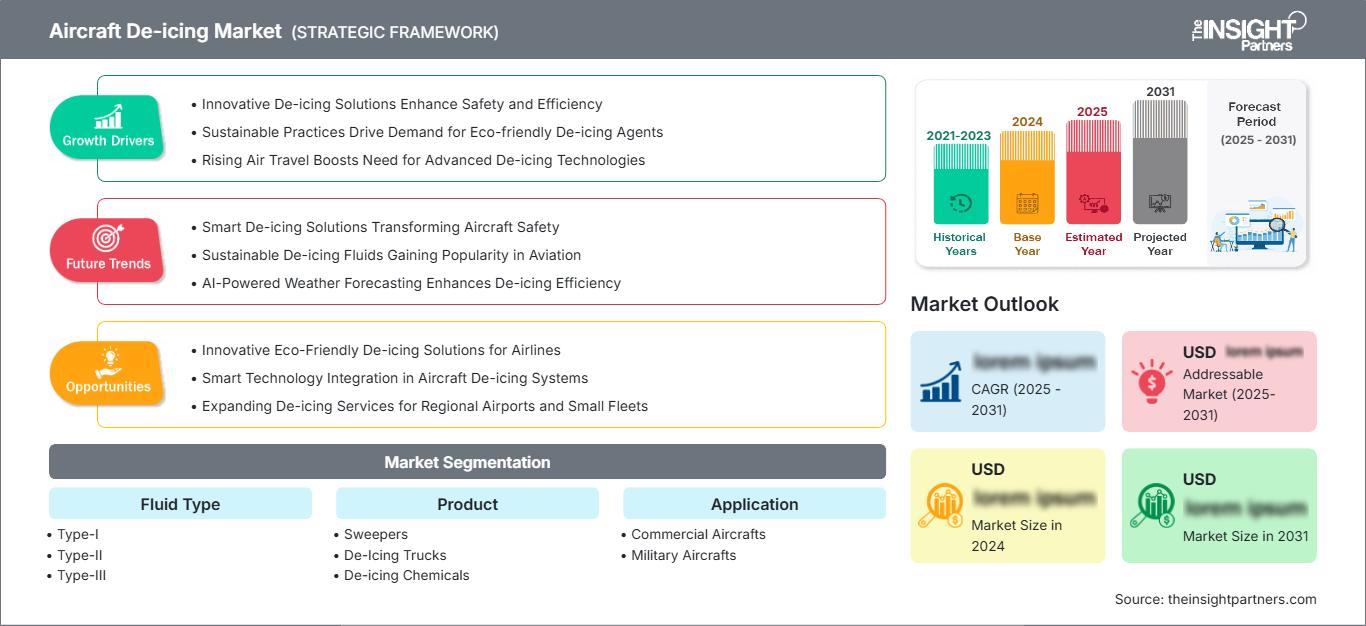
Aircraft De-icing Market: Strategic Insights
Regional Insights
North America Aircraft De-Icing Market
North America accounted for ~34% of the global aircraft de-icing market in 2025 and is modeled to expand at a CAGR of ~5% through 2034. North America enjoys the benefit of well-developed airport infrastructure in Canada and the northern and central United States, regions that experience snow, ice, and frost that pose challenges in handling flights at such airports. Large airports require well-coordinated fleets that are able to handle many aircraft within a limited time frame, which poses the challenge of frequent replacements of specialized equipment and fluids.
North America’s market is dominated by the US, owing to the presence of a well-developed commercial aviation fleet along with the military aviation sector. Airport management is increasingly focusing on fluid conservation, equipment uptime, visibility to operators, and quick turnaround treatment of flights. The second largest contribution comes from Canada owing to cold weather airport operations, despite its relatively small aviation sector. Fleet replacement and environmental management of glycol-based fluids are expected to be key purchasing considerations in the region.
U.S. Aircraft De-Icing Market
The US represented ~78% of the North American aircraft de-icing market revenue in 2025 and is projected to expand at a CAGR of ~5% through 2034. The demand is segmented into major airports in snowfall regions, regional airports, cargo airports, and military airports. The commercial airlines and ground support firms need a de-icing system that allows quick application, accurate flow control, and consistent operations in concentrated winter conditions.
The competitors are Textron Ground Support Equipment Inc., Global Ground Support LLC, Vestergaard Company, and others who provide specialized products. Increasingly, the demand is being driven by the automation of equipment, single-man operation of the equipment, flow metering systems, large tank capacities, and accessibility to aircraft parts. The military operators are having additional requirements of durability and the ability to support large aircraft. Thus, fleet replacement is also an important channel.
Europe Aircraft De-Icing Market
Europe represented ~29% of the global aircraft de-icing market in 2025 and is modeled to grow at a CAGR of ~4% through 2034. Germany is the leading country in Europe, supported by large aviation hubs and substantial winter-weather exposure. The UK contributes through major international airports and regional operations, while France combines high passenger traffic with winter operations at airports exposed to freezing conditions and mountain weather.
The basis for Germany's need for these services lies in its airport infrastructure and seasonal needs during winter conditions. On the other hand, France and Italy have needs due to their extensive aviation infrastructure and airports located in cold and continental regions. Spain is less exposed to cold winter weather but has its own need for such services based on its airport capacity, fleet operations, and requirements in cold and high-altitude environments. European operators increasingly look at fluid efficiency, equipment use, emissions, and environmental management, along with safety and turnaround performance.
In the European market, there is competition from companies like Vestergaard Company, Clariant AG, and Kilfrost Limited, as well as other suppliers of ground support equipment for airports and aviation fluids. Since the infrastructure of Europe is well developed, modernization and replacement could actually be a bigger source of demand than new infrastructure installation. As such, electric de-icing equipment, advanced fluid management, recovery solutions, and low-emission equipment will all be important factors in the development of long-term fleets.
APAC Aircraft De-Icing Market
Asia Pacific represented ~23% of the global aircraft de-icing market in 2025 and is expected to expand at a CAGR of ~7% through 2034, making it the fastest-growing region. China is the leading country in Asia Pacific, supported by expanding aviation infrastructure and growing requirements for specialized airport ground support. Japan and South Korea have established winter operations, while India and Australia contribute through expanding aviation activity and airport modernization.
China's airport investment and equipment localization support regional growth, while Japan and South Korea require sophisticated winter-operation capabilities at snow-exposed airports. India's growth is more closely connected to expanding airport capacity and aviation activity, while Australia's demand is concentrated geographically. Increasing adoption of modern ground equipment, fleet standardization, automation, and environmental controls should strengthen the regional market as airports expand operational capabilities.
Middle East & Africa Aircraft De-Icing Market
The Middle East & Africa is expected to record a CAGR of ~6% through 2034. Saudi Arabia and the UAE are considered two of the key infrastructure hubs for aviation in the Middle East region, even though their need for conventional snow-based de-icing is relatively less compared to colder regions. Their importance is based on large airport infrastructure, international connectivity, an increase in aircraft fleet, and enhanced capabilities of ground support equipment.
On the other hand, South Africa is important because of its aviation infrastructure, while the Rest of the MEA region has only a few airports, which face seasonal frost, freezing conditions, or special military needs. The investment made by the region into its airport infrastructure can give chances for platforms and fluid management systems. For the operators with lesser need for de-icing, multipurpose equipment can be useful.
Segmentation Analysis
Fluid Type
The aircraft de-icing market scope across fluid type is divided into Type-I, Type-II, Type-III, and Type-IV fluids. The fluid type segment is modeled to expand at a CAGR of ~5% during 2026–2034. Demand is influenced by weather severity, aircraft characteristics, application procedures, holdover requirements, and the balance between rapid ice removal and longer anti-icing protection. Suppliers increasingly emphasize lower residue, improved application behavior, environmental performance, and compatibility with modern spraying equipment.
- Type-I: Type-I fluids primarily support rapid removal of frost, snow, and ice from aircraft surfaces. Their relatively straightforward application makes them important in conventional de-icing procedures, particularly when immediate aircraft departure follows treatment.
- Type-II: Type-II fluids combine de-icing and anti-icing functions and are relevant where operators require additional protection following initial contamination removal. Their use is influenced by aircraft type, weather conditions, and operational procedures.
- Type-III: Type-III fluids occupy a specialized position for aircraft requiring particular anti-icing characteristics. Their adoption depends on aircraft operating requirements, approved fluid specifications, and the weather conditions encountered during winter operations.
- Type-IV: Type-IV fluids are strategically important for anti-icing operations requiring extended protection under suitable conditions. Demand is supported by airports seeking predictable treatment procedures and improved protection during continuing precipitation.
Product
The Aircraft De-Icing Market product segment includes Sweepers, De-Icing Trucks, De-icing Chemicals, and Fluids and is modeled to grow at a CAGR of ~6% during 2026–2034. It represents the largest segment because aircraft winter operations require an integrated combination of mobile equipment and consumable fluids. Fleet modernization, large-aircraft servicing, operator productivity, fluid metering, and environmental management are shaping purchasing decisions.
- Sweepers: Sweepers support the physical removal of snow and contamination before or alongside fluid application. Their strategic role is strongest at airports where rapid surface preparation improves the effectiveness and efficiency of subsequent de-icing activities.
- De-Icing Trucks: De-icing trucks provide integrated storage, heating, pumping, elevated access, and spraying capabilities. Demand is strongly connected to airport fleet renewal, aircraft size, winter-weather intensity, turnaround requirements, and the need to reduce repositioning and labor.
- De-icing Chemicals: De-icing chemicals are essential consumables for removing frozen contamination and supporting airport winter operations. Product development increasingly focuses on performance, corrosion considerations, environmental characteristics, supply reliability, and compatibility with application equipment.
- Fluids: Aircraft de-icing fluids are selected according to fluid type, weather conditions, aircraft requirements, and operating procedures. Suppliers compete through formulation performance, application characteristics, storage behavior, environmental considerations, and compatibility with approved operating practices.
Application
The Aircraft De-Icing Market application segment covers Commercial Aircrafts and Military Aircrafts and is modeled to expand at a CAGR of ~6% during 2026–2034. Commercial operations provide a broad, recurring demand base because airport operators and ground handlers must protect aircraft turnaround schedules during winter events. Military requirements add demand for robust systems capable of supporting specialized aircraft and airfield conditions.
- Commercial Aircrafts: Commercial aircraft operations generate recurring de-icing demand at airports exposed to winter precipitation. Fleet scale, passenger schedules, cargo activity, turnaround requirements, and airport operating procedures influence equipment capacity and fluid consumption.
- Military Aircrafts: Military aircraft require dependable de-icing capabilities across air bases and operational environments. Procurement emphasizes ruggedness, mobility, rapid deployment, maintainability, and compatibility with different aircraft configurations and mission requirements.
Opportunity Snapshot
| Application | Revenue Contribution | Trend Tag | Adoption Stage |
|---|---|---|---|
| Commercial Aircrafts | High | Fleet Renewal | Mature |
| Military Aircrafts | Medium | Defense Readiness | Scaling |
Aircraft De-icing Market Growth Drivers and Impact Analysis
Expansion of Airport Capacity and Aircraft Turnaround Requirements
An increased airport throughput makes it essential to make the process of aircraft de-icing rapid and repetitive in adverse weather conditions. An airport should not look at de-icing as a separate task when delays can be transferred from one aircraft to another due to tight schedules. Increased number of aircraft, utilization, cargo operations, and concentration of departures will make equipment more valuable, which treats aircrafts and reduces repositioning, filling and heating time. It means that it is necessary to invest in high-throughput trucks and in automation, including fluid metering, better reach of booms and an operator assistance system. This effect is relevant for both equipment and consumables since increased activity will require approved fluids.
Modernization of De-Icing Fleets and Ground Support Infrastructure
Fleet aging generates replacement need irrespective of whether there is any change in total aircraft volume. Aging aircraft could involve higher maintenance needs, be less accurate in their fluid spraying, and also entail more manpower needs compared to their younger counterparts. De-icing systems are being considered by airport management companies within a wider scope of overall modernization programs for airport support equipment, hence leading to the purchase of equipment that includes advanced features such as digital controls, metering capacity, heating, ergonomics for the operator and tanks that are adjustable. Fleet replacement also provides consistent performance at various airports through equipment uniformity. This provides an advantage to manufacturers in differentiating their products based on lifecycle cost, serviceability, spare parts, and integration with airport operation systems.
Environmental Management and Pressure to Reduce Fluid Consumption
Environmental considerations are becoming increasingly significant in procurement decisions for de-icing aircraft because large-scale winter operations can use huge volumes of glycol solutions. The airports need to be concerned about issues such as collection, treatment, drainage, storage, and disposal of the solution while ensuring the safety and efficiency of their aircrafts. This trend would drive the development of technologies that use the fluid in a more precise manner, reclaim the used glycol solution, minimize spraying of the fluid, and enhance the performance of the heating and mixing equipment. Equipment manufacturers have the ability to meet these demands by means of flow metering, nozzle control, glycol reclamation equipment, forced air technology, and operator assistance.
Aircraft De-icing Market Future Trends
Electrification of Aircraft De-Icing Equipment
Electrification is expected to become increasingly relevant for aircraft de-icing equipment as airports pursue lower local emissions, lower noise, and more efficient ground operations. Battery-electric platforms can power vehicle movement, pumps, controls, and other functions without relying continuously on conventional propulsion. The transition is technically more complex for de-icing than for many other ground-support applications because fluid heating requires substantial energy, particularly during severe winter conditions. This favors hybrid architectures, external pre-heated fluid infrastructure, improved thermal efficiency, and high-capacity battery systems. Over time, airport fleet planning is likely to consider charging infrastructure, duty-cycle requirements, energy availability, and heating configuration alongside vehicle specifications. Suppliers capable of integrating electrification without reducing treatment capacity can address the operational requirements of airports seeking lower-emission ground fleets.
Automation and Data-Assisted Fluid Application
Automation is likely to reshape aircraft de-icing through greater use of sensors, machine vision, positioning systems, digital fluid measurement, and operator-assistance technologies. Automated or semi-automated spray paths can help maintain consistent nozzle distance and coverage while reducing unnecessary fluid application. Digital records can also improve accountability by documenting fluid volumes, treatment times, operating conditions, and equipment performance. Such capabilities become particularly valuable at large airports where multiple de-icing teams operate simultaneously and standardized procedures are essential. Future systems may increasingly integrate aircraft geometry, weather information, fluid characteristics, and operational status into decision-support tools. The commercial opportunity extends beyond vehicle sales because software, monitoring, data services, and predictive maintenance can create recurring value throughout the equipment lifecycle.
Aircraft De-icing Market Opportunities
Integrated Fluid Recovery and Resource-Efficiency Solutions
The combination of aircraft de-icing equipment with fluid recovery and resource-management technologies offers an opportunity for suppliers to address airport operating costs and environmental requirements simultaneously. Airports with high winter throughput can benefit from systems that monitor application volumes, minimize overspray, collect spent glycol, and support treatment or recycling processes. Equipment manufacturers can partner with chemical suppliers and airport environmental-service providers to create integrated solutions rather than selling individual vehicles or fluid products. Such systems can be particularly relevant to mature airports where existing de-icing infrastructure limits the scope for entirely new facilities. Commercial differentiation can come from measurable reductions in fluid consumption, lower waste-handling requirements, improved data visibility, and compatibility with existing fleets. These factors can support longer-term service and retrofit opportunities.
Specialized Equipment for Emerging Winter-Operation Airports
Emerging aviation markets create opportunities for modular de-icing solutions that can be deployed without the extensive infrastructure associated with mature winter airports. Airport expansion in parts of Asia Pacific is increasing the potential customer base for equipment capable of handling seasonal snow, frost, and freezing precipitation. Operators with limited historical winter activity may prefer flexible platforms that can support multiple aircraft sizes and variable treatment volumes rather than maintaining large dedicated fleets. Suppliers can address this requirement through compact de-icers, configurable tanks, rapid-delivery equipment, mobile fluid-storage systems, and operator-training packages. Local manufacturing and service partnerships can further reduce procurement lead times and improve lifecycle support. This opportunity is particularly relevant where airport development is occurring faster than specialized winter ground-support capabilities.
Frequently Asked Questions

- Comprehensive Market Sizing and Forecast Analysis
- Detailed Segmentation Analysis
- In-Depth Market Dynamics Assessment
- Regional and Country-Level Insights
- Competitive Landscape and Company Benchmarking
- Strategic Business Intelligence
Recent Reports
Testimonials

The Insight Partners provided valuable market intelligence that supported our global go-to-market strategy. Their team was professional, responsive, and attentive to our feedback, providing thoughtful analysis and helpful methodological clarifications throughout the project.
Junmo Kim Chief Financial Officer (CFO), Enertech Co., Ltd.
The Insight Partners' SCADA System Market report is comprehensive, with valuable insights on current trends and future forecasts. The team was highly professional, responsive, and supportive throughout. We are very satisfied and highly recommend their services.
RAN KEDEM Partner, Reali Technologies LTDs
I requested a report on a very specific software market and the team produced the report in a few days. The information was very relevant and well presented. I then requested some changes and additions to the report. The team was again very responsive and I got the final report in less than a week.
JEAN-HERVE JENN Chairman, Future Analytica
We worked with The Insight Partners for an important market study and forecast. They gave us clear insights into opportunities and risks, which helped shape our plans. Their research was easy to use and based on solid data. It helped us make smart, confident decisions. We highly recommend them.
PIYUSH NAGPAL Sr. Vice President, High Beam Global
The Insight Partners delivered insightful, well-structured market research with strong domain expertise. Their team was professional and responsive throughout. The user-friendly website made accessing industry reports seamless. We highly recommend them for reliable, high-quality research services
YUKIHIKO ADACHI CEO, Deep Blue, LLC.
This is the first time I have purchased a market report from The Insight Partners.While I was unsure at first, I visited their web site and felt more comfortable to take the risk and purchase a market report.I am completely satisfied with the quality of the report and customer service. I had several questions and comments with the initial report, but after a couple of dialogs over email with their analyst I believe I have a report that I can use as input to our strategic planning process.Thank you so much for taking the extra time and making this a positive experience.I will definitely recommend your service to others and you will be my first call when we need further market data.
JOHN SUZUKI President and Chief Executive Officer, Board Director, BK Technologies
I wish to appreciate your support and the professionalism you displayed in the course of attending to my request for information regarding to infectious disease IVD market in Nigeria. I appreciate your patience, your guidance, and the fact that you were willing to offer a discount, which eventually made it possible for us to close a deal. I look forward to engaging The Insight Partners in the future, all thanks to the impression you have created in me as a result of this first encounter.
DR CHIJIOKE ONYIA MANAGING DIRECTOR, PineCrest Healthcare Ltd.Reason to Buy
- Informed Decision-Making
- Understanding Market Dynamics
- Competitive Analysis
- Identifying Emerging Markets
- Customer Insights
- Market Forecasts
- Risk Mitigation
- Boosting Operational Efficiency
- Strategic Planning
- Investment Justification
- Tracking Industry Innovations
- Aligning with Regulatory Trends





 Get Free Sample for